A Bay Area developer wants to build 4,400 sorely needed homes. Here’s why it won’t happen
Reporting from Brisbane, Calif. — Just beyond San Francisco’s city limits lies 640 acres of land that could help solve some of California’s biggest problems.
A developer wants to build 4,400 new homes there — one of the largest projects recently proposed in one of the country’s most unaffordable regions. The development would overlook a railway that drops riders into the heart of San Francisco in 15 minutes, reducing the need for cars and cutting the greenhouse gas emissions that come from them.
State and regional leaders have endorsed the project. But its fate rests with Brisbane, a city of 4,700 people that annexed the property 55 years ago. And no one, not even the developer, thinks Brisbane’s residents will approve all 4,400 homes.
“Unfortunately, we believe that their ceiling is going to be below that,” said Jonathan Scharfman, the general manager for the developer, Universal Paragon Corp.
The project, Brisbane Baylands, reveals how few incentives local governments have to accept large developments — even as the state is pushing to lower housing costs and funnel growth toward existing cities and nearby mass transit to combat climate change. Brisbane residents are wary of a project that could triple the city’s population. Under California’s tax system, Brisbane also earns more money if it rejects the current plan in favor of potential alternatives with more hotel rooms and space for businesses — but no homes.
The Bay Area’s dire need for housing makes the debate over the Baylands project “particularly painful,” said Ben Metcalf, director of the state Department of Housing and Community Development.
“It is frustrating that as a state and as a constellation of local jurisdictions we are constantly making decisions that aren’t the best for alleviating poverty, housing affordability, furthering our state’s economy or meeting our climate change goals,” Metcalf said.
For their part, some Brisbane residents feel besieged by pressure from housing activists, business groups, state lawmakers, San Francisco politicians, newspaper editorials and others beyond the city’s boundaries. An old rail yard and garbage dump contaminated the land, and opponents contend they want to protect anyone who might decide to live there even after regulators approve a cleanup. More than that, Brisbane residents say, outsiders don’t understand how much the Baylands project would upend their community.
“We’re a small town,” City Councilman W. Clarke Conway said at a meeting on the project last fall, “and we’re a small town by choice.”

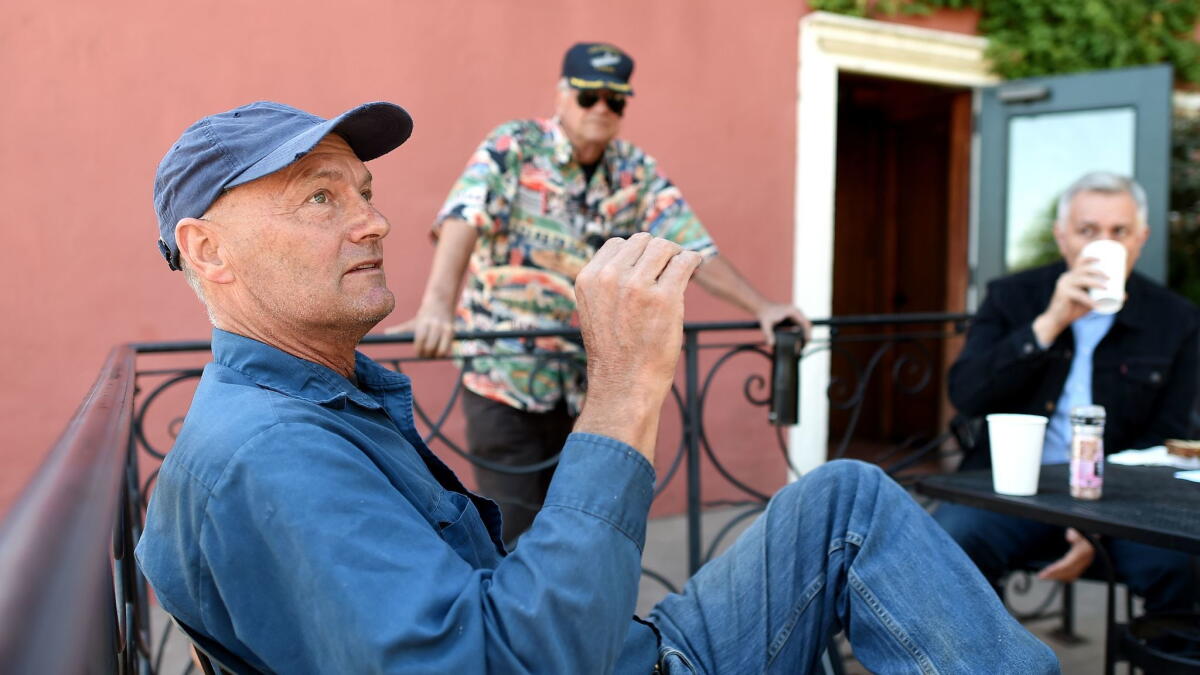
Bill Dettmer, left, speaks with a group of men who regularly meet and discuss local politics and civic issues at Madhouse Coffee in Brisbane, Calif. Dettmer thinks a developer should be allowed to build housing on an old rail yard in the city.
(Josh Edelson / For The Times)
Brisbane’s main drag is Visitacion Avenue. It slopes upward for five blocks, starting at a city park and continuing through mom-and-pop shops, cafes and restaurants. The rest of Brisbane comprises office parks, a strip mall and mostly single-family homes built throughout the town’s hills.
“This is the land that time forgot,” said Greg Lee, 55, an electrical engineer who has lived in the city for more than two decades.
San Bruno Mountain, which rises a quarter-mile into the sky, is Brisbane’s landmark, and residents have fought to preserve it. In the 1960s, they blocked a developer from leveling the mountaintop and building enough new homes for 70,000 people. In 1980, after years of battling another massive project on the mountain, residents received a last-minute reprieve from the federal government, which declared San Bruno a critical habitat for the endangered callippe silverspot butterfly.
Anti-development fervor has continued. About a decade ago, a city councilman suggested sidestepping a state housing law that requires cities to plan for growth by zoning for homes where nothing would ever get built — the bottom of Brisbane’s lagoon.
Residents’ efforts to protect Brisbane’s small-town feel make large changes hard to accept, said Paul Bouscal, 58, a San Francisco water department employee who has lived in the area since 1982.
The Baylands, he said, plays on fears of Brisbane getting big.
“For our town to grow like that, it would be too much, too fast,” Bouscal said.
It might be easier for residents and elected officials to welcome growth if the city received more tax dollars for doing so. But the opposite is true.
Because of tax limits established in 1978 by Proposition 13, local governments generally receive more revenue from sales and hotel room taxes than property taxes. Proposition 13 limited property tax rates to 1% of a home’s taxable value and restricted how quickly that taxable value could increase after a purchase.
Last year, Brisbane hired a consultant who found that the city would net $1 million a year in tax revenue by approving the Baylands. But if the city instead approved a project with lots more commercial space, a larger hotel and no housing, Brisbane would gain $9 million annually — an amount equivalent to more than half the city’s current day-to-day operating budget.
Developers are always going to face opposition because of residents’ concerns about their communities changing, said Mark Stivers, a longtime state housing policy staffer. But the tax system is another big reason the state has a housing shortage, he said.
“I’d like to think if just the fiscal incentives were reversed, if a city could make as much money off housing as they could retail, we’d be having a very different conversation in California,” Stivers said.

Jonathan Scharfman, general manager of Universal Paragon Corp., describes the area where his company hopes to build a 4,400-unit housing development.
(Josh Edelson / For The Times)
Debate over the Baylands has divided the town and dominated Brisbane politics for at least a decade. More than half of Brisbane residents said in a 2015 city-sponsored poll that they were OK with some housing on the Baylands site. But just 3% backed a project of more than 4,000 homes such as the developer is proposing.
Bill Dettmer, 63, spent a recent morning at Madhouse Coffee, one of the city’s main gathering spots, trying to convince skeptical neighbors that the city should support the housing. Dettmer moved to Brisbane 50 years ago and does maintenance work in the city.
“I see a lot of stuff,” Dettmer said. “I see beds in garages. You have to increase the [housing] supply. If you really want to help out people, let them live in dignity. It just seems like a no-brainer.”
Many local opponents cite the land’s history — not hostility to growth — for why they’re against the project. San Francisco used to dump its garbage on the site, and a railroad company repaired its trains there. Longtime residents remember watching tires burn.
Scharfman, the developer’s general manager, said Universal Paragon Corp. will clean up the land and won’t begin building until all environmental agencies responsible say it’s safe. He likened the process to how an old rail yard at San Francisco’s Mission Bay was cleaned up and now has thousands of homes.
Still, some Brisbane residents say they don’t trust regulators will get it right, because what’s known about the toxicity of chemicals can change over time. Even though they won’t live in the Baylands, opponents believe they have a responsibility to shield those who might.
“Why do we have a seat belt law? Why do we have a helmet law? They’re anti-stupidity laws to protect the general population,” said Michele Salmon, 63, who was born and raised in Brisbane.
Salmon said she understood housing problems were real and lamented the lack of space to accommodate a growing population.
“I do feel sorry that the younger generation is not going to get to live the life that we did,” she said. “But it’s a different time.”
State and regional officials have few tools to push Brisbane. Every eight years, the state tells every city and county to plan for the construction of a certain number of new homes to accommodate planned population growth. Between 2007 and 2014, Brisbane’s goal was 401 houses. Developers built a little more than a third of that target, but the city faces no consequences for the lack of home building.
Similarly, regional agencies such as the Assn. of Bay Area Governments have to plan for urban growth as part of the the state’s climate change efforts. California won’t meet its greenhouse gas reduction targets, regulators have said, without a significant reduction in driving fueled by more people walking, biking and using mass transit. The Baylands project and its 4,400 homes next to a Caltrain station are written into the region’s climate change proposal, but that means nothing for the project’s actual approval.
“This is a plan, an expectation of how we could grow,” said Leah Zippert, an Assn. of Bay Area Governments spokeswoman. “It is not a mandate to build. It’s not a mandate to do anything.”
The Brisbane City Council plans to make a key decision on the Baylands this summer, including whether it supports any housing on the site. But the council expects to put that proposal on the ballot next year. Brisbane’s residents will be the ones with the last word.
ALSO
California won’t meet its climate change goals without a lot more housing density in its cities