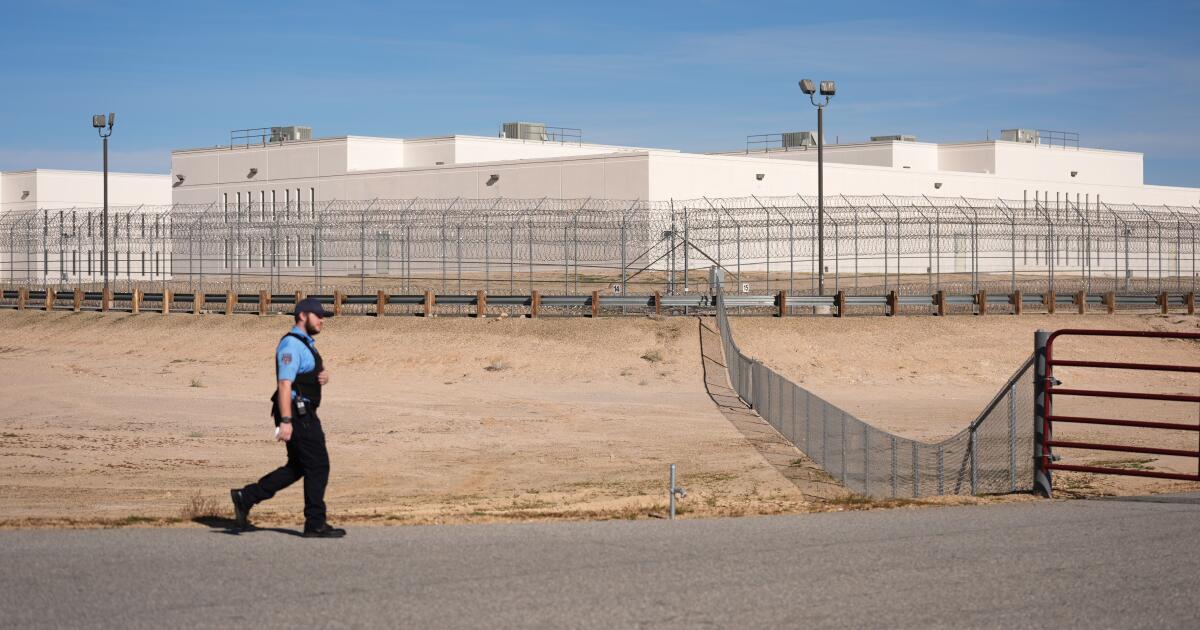
detention facility

DHS buys two California immigrant detention centers for $1.5 billion

The Department of Homeland Security bought two of the largest immigrant detention facilities in California for $1.5 billion, according to the private prison company that sold them.

The purchase comes as the department — flush with cash after Trump’s One Big Beautiful Bill Act infused the agency with $170 billion — has moved to scale up its capacity to detain immigrants without relying as heavily on private prison corporations.

In announcement Monday, the Tennessee-based CoreCivic said the sale of the 2,560-bed California City Detention Facility and the 1,994-bed Otay Mesa Detention Center in San Diego closed on July 2.

The company said it expects net proceeds of about $1.1 billion after income taxes and transaction expenses.

Ryan Gustin, public affairs director for CoreCivic, said such sales are not uncommon and that “the process was marked with rigor and integrity.” He added that the valuations were established through the federal government’s required appraisal process, using independent appraisers, who determined objective fair market value.

The sale doesn’t immediately change anything at the facilities — CoreCivic expects to continue managing them under existing contracts with U.S. Immigration and Customs Enforcement, according to the company and a filing with the Securities and Exchange Commission.

But the terms of those contracts could be modified given the change in ownership, the filing states. The California City facility contract expires in August 2027 and the Otay Mesa facility contract expires in December 2029, with the option to extend for another five years.

“We are pleased with the sales of these two mission-critical facilities for the Company’s government partner, which demonstrates the value of the Company’s underlying real estate portfolio, while reflecting our role as a long-term, flexible solutions provider to government,” CoreCivic CEO Patrick Swindle said in the announcement.

The Department of Homeland Security did not immediately respond to a request for comment.

During a quarterly earnings call in May, George Zoley, CEO of the GEO Group, another major private prison corporation, said that the company had been in discussions with ICE “regarding the potential sale of multiple facilities.”

Critics of the purchases of detention facilities say the Trump administration is simply looking to avoid state and local oversight by bringing them under federal ownership. That issue was raised during the GEO Group earnings call when a participant later asked why the federal government wants to own the facilities instead of contracting with third parties.

If the facilities are federally owned, Zoley replied, there are “more protections from unwarranted litigation that infringes upon the activities of the ICE processing centers.”

Zoley said federal ownership would bolster the legal defense of the facilities and the argument that “states can only have very limited involvement.”

“There’s been litigation regarding overseeing medical services, food services, general cleanliness, etc.,” Zoley continued. “It’s really unprecedented and I believe it’s fundamentally unconstitutional. As some blue states are considering more active involvement in oversight of facilities, I think the logical solution to much of that is federal ownership of the facilities.”

California tried to kick private detention operators out of the state, but the 2020 law was overturned in the Ninth Circuit Court of Appeals. Since then, state leaders have established oversight mechanisms through laws that allow for monitoring and investigation of detention centers by the California Department of Justice and local health authorities.

Asked to comment about the sale, Sen. Alex Padilla (D-Calif.) said his congressional oversight visits to facilities operated by CoreCivic have shown that immigrants who pose no public safety threat are being held in “unacceptable conditions.”

“Whether these facilities are operated by a private contractor or owned by the federal government, my expectations remain the same,” he said. “I will continue demanding transparency, accountability, and humane conditions that respect the dignity and rights of every person in immigration detention.”

Eight ICE detention facilities now operate in California, with a combined capacity to hold nearly 9,000 people.

The California City and Otay Mesa facilities have both been the subject of lawsuits by detainees alleging detainee mistreatment. CoreCivic calls such allegations unfounded and says it complies with all regulations concerning the treatment of detainees.

In its announcement on Monday, CoreCivic said the company is in discussions with ICE about potentially selling additional detention facilities, though it said those talks are in various stages and it’s unclear whether the sales will go through.

Source link

ICE puts new restrictions on members of Congress inspecting detention centers

A new Immigration and Customs Enforcement policy requires members of Congress to seek advanced approval in order to speak with detainees during oversight inspections at detention facilities.

It’s the latest twist in a months-long effort by ICE to restrict such visits by lawmakers, which have skyrocketed amid the Trump administration’s mass deportation campaign.

California Reps. Mike Levin (D-San Juan Capistrano) and Sara Jacobs (D-San Diego) learned about the new policy when they made a surprise visit on Monday to the Otay Mesa Detention Center in San Diego.

ICE allowed them to enter, Levin said, but when the members asked to speak with detainees, local personnel handed them a memo outlining the new policy — dated the same day and signed by acting ICE Director Todd Lyons.

In it, Lyons calls the visits disruptive and resource-intensive because they pull staff away from law enforcement duties. Lawmakers sometimes request to speak with a particular kind of detainee — for example, people held longer than 90 days — and Lyons said meeting such requests takes up too much time.

“This is an unsustainable burden for ICE employees and a hindrance to ICE operations given the exceptional growth in congressional visits,” he wrote.

Moving forward, members must identify detainees by name at least two business days in advance of a visit and provide a signed consent form from each detainee.

The Department of Homeland Security and ICE did not immediately respond to a request for comment.

Levin said the new policy effectively defeats the purpose of unannounced oversight visits.

“I think it’s a deliberate effort to make sure we don’t hear from people in ICE custody,” he said.

Democratic House members sued the Trump administration last July after they were repeatedly denied access to immigrant detention facilities in California and across the country.

Under federal law, funds appropriated by Congress cannot be used to prevent a member of Congress from entering or inspecting a detention facility operated by or for Homeland Security.

Monday’s unannounced visit was Levin’s first to the Otay Mesa facility since a federal judge in February blocked a previous Trump administration policy requiring members of Congress to give seven days notice before visiting ICE detention centers.

The administration appealed, and on Friday an appellate court in Washington denied the administration’s request to restore the seven-day policy while the case proceeds, saying the government hadn’t provided enough evidence that the visits are harmful.

That win for the lawmakers could be short-lived — the panel of judges who denied the administration’s request also wrote in their order that the members of Congress “have no standing to maintain this lawsuit, so the government is very likely to succeed on the merits of its appeal.”

In the memo on ICE’s new policy, Lyons noted that in the 10 fiscal years before 2025, ICE facilitated roughly 45 congressional visits to detention centers each year.

After Trump took office, the agency facilitated more than 150 visits in fiscal year 2025. As of May 11, ICE had facilitated about 200 congressional visits since the start of this fiscal year.

Levin said the increased visits by himself and other members have become necessary because Homeland Security has slashed the vast majority of staff at the Office for Civil Rights and Civil Liberties, as well as the Office of the Immigrant Detention Ombudsman.

“The volume Lyons is citing is a direct consequence of his own department dismantling all the alternatives,” Levin said. “They gutted the internal oversight and then complained that the external oversight is too active, then issued a memo to restrict it. All of that only makes sense if the goal is no oversight.”

During previous visits, Levin said he would ask for detainees who met specific criteria, such as those held in a unit of the detention center that was the source of complaints to his office. Those detainees would write their names on a sheet of paper if they were interested in speaking with him.

Barred from speaking with detainees, Levin inspected what he could at Otay Mesa on Monday. Levin said he drank the facility’s water (it tasted like regular tap water) and tried the food — chili, salad, corn, chips and cake that won’t “win any culinary awards, but it was fine.”

At one point, Levin said he saw a detainee using a tablet and asked how it works. An employee interjected and reminded him of the new policy, he said.

Observation is a necessary part of any inspection, Levin said, but you don’t really know what’s going on without talking to people in a way that’s unplanned.

The facility held 1,008 ICE detainees — 864 men and 144 women, as well as others in U.S. Marshals Service custody, Levin said. Nearly a third of the detainees were from Mexico, with smaller numbers from Guatemala, China and other countries. On average, they had been detained 130 days.

Levin said he sent the ICE memo to Rep. Joe Neguse (D-Colo.), who is the main plaintiff in the lawsuit over the oversight visits, and lawyers in the case are now reviewing its legality.

Eighteen people have died so far this year in immigrant detention facilities, leaving 2026 on track to be the agency’s deadliest year in more than two decades. Last year, 32 people died in detention facilities.

Since Trump returned to the White House, reports from detention centers have highlighted issues of overcrowding, insufficient medical care and widespread use of force.

Source link