detention center

House Democrats ask new ICE director to roll back policy on visits

Dozens of House Democrats are asking the new director of Immigration and Customs Enforcement to roll back a policy that they say hinders their ability to speak with detainees during oversight visits.

The new policy requires that lawmakers identify detainees by name at least two business days before a visit and provide a signed consent form from each detainee. It’s the latest point of conflict in an ongoing battle over when and how lawmakers can inspect immigration facilities.

In a letter Thursday to acting ICE Director David Venturella, Rep. Mike Levin (D-San Juan Capistrano) and 77 other members of Congress, including two dozen from California, argued that they need to conduct constant oversight of immigration facilities because of historic levels of reports regarding the mistreatment of detainees, deaths in custody and substandard facility conditions.

“This Administration has enabled a revolving door of arbitrary policies, directives, and guidance on member access to facilities or on communication with detainees designed to hinder any productive oversight,” they wrote.

The letter was written in response to the new policy, which was outlined in a memo last month.

In the letter, Levin and the other members wrote that detainees have a hard time accessing the visitation form because it is at times unavailable at a detention center’s law library. They said it limits their ability to speak broadly with detainees, particularly those from vulnerable populations, such as the elderly.

Detainees previously used a sign-up sheet to meet with members of Congress or just started talking to detainees they encountered during facility tours.

In the memo outlining ICE’s new policy, then-acting director Todd Lyons said the increased visits by members of Congress have become a burden and a time suck. Homeland Security didn’t immediately reply to a request for comment, but previously said that the policy doesn’t prevent lawmakers from speaking with detainees.

Levin said the increase in visits was necessary because the agency slashed staffing of its oversight offices. The letter notes that for next fiscal year, the president requested additional cuts to the Homeland Security Office of Inspector General.

“These actions, coupled with the constant changes to policies surrounding member access to facilities, reveal a clear attack on the levers that ensure government transparency at every level,” the members wrote.

Democratic House members sued the Trump administration last July after they were repeatedly denied access to immigrant detention facilities in California and across the country.

Homeland Security officials previously implemented a policy requiring lawmakers to give seven days’ notice before a visit, but that policy was temporarily blocked in federal court.

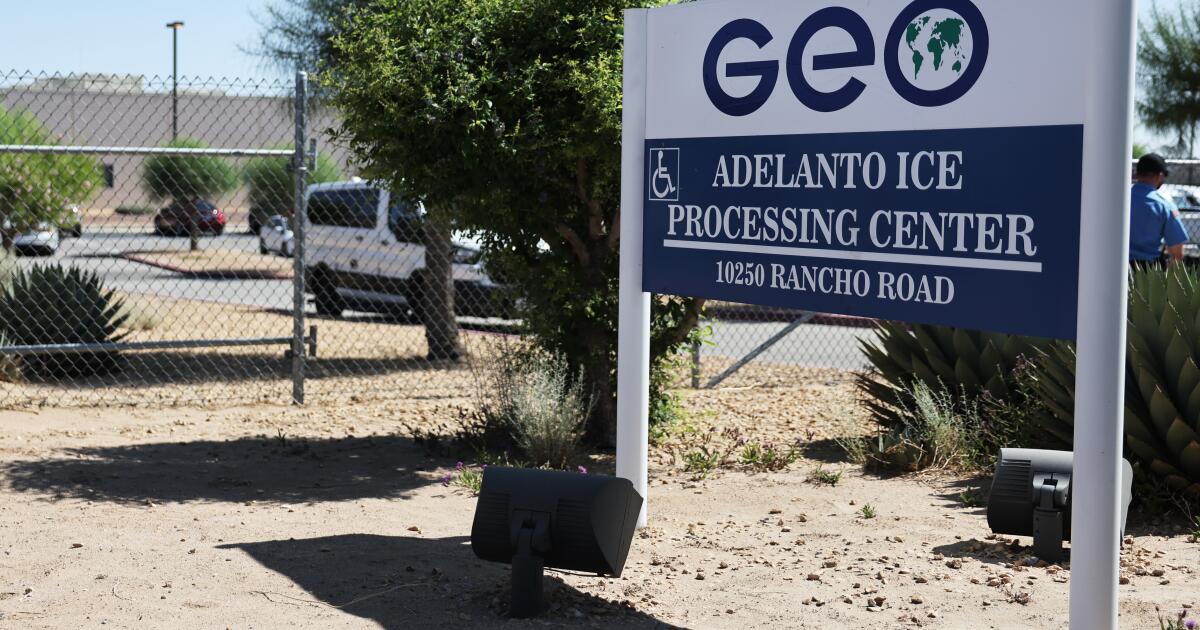
This week, lawyers said a Belizean man who helped organize hunger strikes at the Adelanto ICE Processing Center was moved to facilities out of state and scheduled to be deported after he spoke to three members of Congress about conditions at the detention center in San Bernardino County.

Source link

6 protesters arrested after clash with ICE officers outside a New Jersey detention center

Protesters clashed with armed federal immigration officers in front of a New Jersey detention center where advocates have demonstrated for days while asserting that people detained there are staging a hunger strike over poor living conditions.

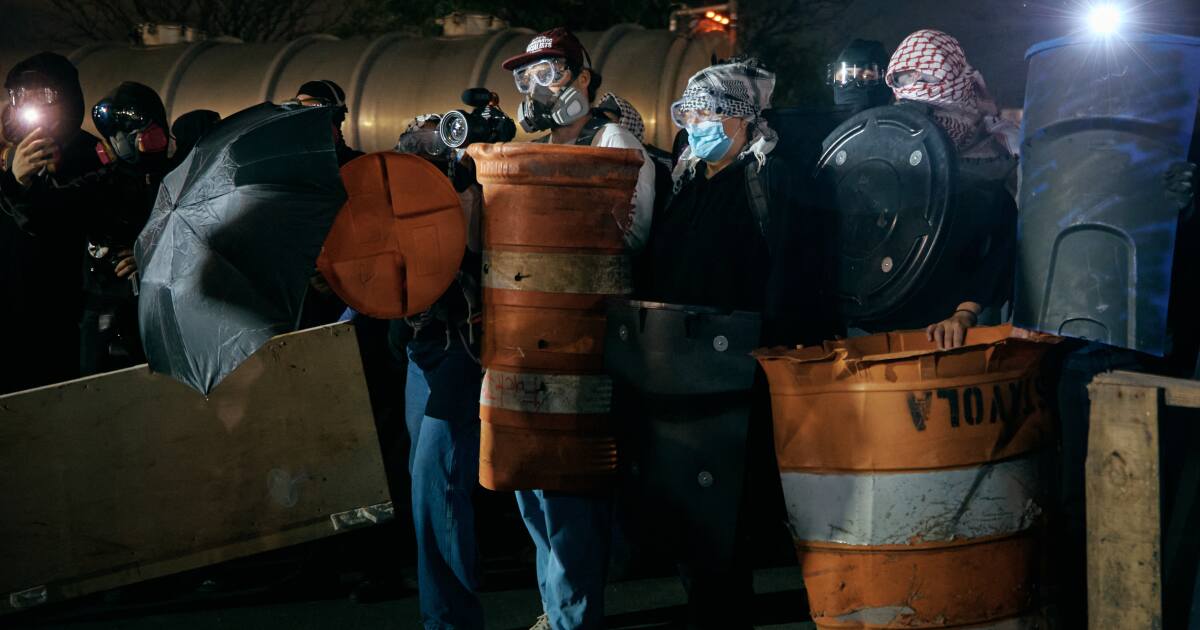
Groups of demonstrators, many wearing gas masks and other face coverings, linked arms in a human chain in front of Delaney Hall in Newark on Wednesday night, videos and photos posted on social media show.

Some used trash cans, old mattresses, umbrellas and other materials as makeshift shields and barricades as they confronted U.S. Immigration and Customs Enforcement officers. Others attempted to block people and vehicles from entering and exiting the building or threw orange traffic cones and other objects in the direction of the ICE officers lined at the entry gate.

The group chanted, “You will hang!” and, “Every cop, every fed, shoot yourself in the head,” and other taunts at the officers, many of whom wore helmets and tactical vests.

The ICE officers used pepper spray to try to disperse the protesters, according to videos posted to social media. Some used their batons to beat and push back protesters as the officers attempted to clear the roadway for vehicles.

At least one truck driver got out of his vehicle to vent his frustration when some protesters tried to block vehicles driving on the road in front of the detention center. People detained inside could at times be seen waving to protesters from Delaney Hall’s windows.

The U.S. Department of Homeland Security, which oversees ICE, said about six demonstrators were arrested for assaulting law enforcement officers.

“Assaulting and obstructing ICE law enforcement is a crime and felony,” the agency said in a statement. “Anyone who assaults law enforcement will be prosecuted to the fullest extent of the law.”

On Thursday, demonstrators again returned to Delaney Hall.

New Jersey Gov. Mikie Sherrill also said state health department officials were “denied full access” to the facility for a health inspection. The Democrat said the officials were only allowed to inspect a limited part of the facility as she called on ICE to “de-escalate” the situation.

“As I’ve said repeatedly, refusing to provide full access raises serious questions about what ICE is trying to hide from public view,” Sherrill said in a statement that also repeated her calls to shut down the facility outright.

Earlier Wednesday, Democratic members of Congress from New York City toured the facility as part of an oversight visit. A private prison company runs the detention center, which sits along an industrial stretch of Newark Bay.

Reps. Jerry Nadler, Daniel Goldman and Adriano Espaillat, who all represent Manhattan, described dire conditions where people held in the facility are fed small portions of often spoiled food and their varied medical needs are ignored.

Homeland Security spokespersons have denied any hunger strike, abuse or poor conditions inside the center and dismissed criticism from opponents as political posturing.

Source link

ICE puts new restrictions on members of Congress inspecting detention centers

A new Immigration and Customs Enforcement policy requires members of Congress to seek advanced approval in order to speak with detainees during oversight inspections at detention facilities.

It’s the latest twist in a months-long effort by ICE to restrict such visits by lawmakers, which have skyrocketed amid the Trump administration’s mass deportation campaign.

California Reps. Mike Levin (D-San Juan Capistrano) and Sara Jacobs (D-San Diego) learned about the new policy when they made a surprise visit on Monday to the Otay Mesa Detention Center in San Diego.

ICE allowed them to enter, Levin said, but when the members asked to speak with detainees, local personnel handed them a memo outlining the new policy — dated the same day and signed by acting ICE Director Todd Lyons.

In it, Lyons calls the visits disruptive and resource-intensive because they pull staff away from law enforcement duties. Lawmakers sometimes request to speak with a particular kind of detainee — for example, people held longer than 90 days — and Lyons said meeting such requests takes up too much time.

“This is an unsustainable burden for ICE employees and a hindrance to ICE operations given the exceptional growth in congressional visits,” he wrote.

Moving forward, members must identify detainees by name at least two business days in advance of a visit and provide a signed consent form from each detainee.

The Department of Homeland Security and ICE did not immediately respond to a request for comment.

Levin said the new policy effectively defeats the purpose of unannounced oversight visits.

“I think it’s a deliberate effort to make sure we don’t hear from people in ICE custody,” he said.

Democratic House members sued the Trump administration last July after they were repeatedly denied access to immigrant detention facilities in California and across the country.

Under federal law, funds appropriated by Congress cannot be used to prevent a member of Congress from entering or inspecting a detention facility operated by or for Homeland Security.

Monday’s unannounced visit was Levin’s first to the Otay Mesa facility since a federal judge in February blocked a previous Trump administration policy requiring members of Congress to give seven days notice before visiting ICE detention centers.

The administration appealed, and on Friday an appellate court in Washington denied the administration’s request to restore the seven-day policy while the case proceeds, saying the government hadn’t provided enough evidence that the visits are harmful.

That win for the lawmakers could be short-lived — the panel of judges who denied the administration’s request also wrote in their order that the members of Congress “have no standing to maintain this lawsuit, so the government is very likely to succeed on the merits of its appeal.”

In the memo on ICE’s new policy, Lyons noted that in the 10 fiscal years before 2025, ICE facilitated roughly 45 congressional visits to detention centers each year.

After Trump took office, the agency facilitated more than 150 visits in fiscal year 2025. As of May 11, ICE had facilitated about 200 congressional visits since the start of this fiscal year.

Levin said the increased visits by himself and other members have become necessary because Homeland Security has slashed the vast majority of staff at the Office for Civil Rights and Civil Liberties, as well as the Office of the Immigrant Detention Ombudsman.

“The volume Lyons is citing is a direct consequence of his own department dismantling all the alternatives,” Levin said. “They gutted the internal oversight and then complained that the external oversight is too active, then issued a memo to restrict it. All of that only makes sense if the goal is no oversight.”

During previous visits, Levin said he would ask for detainees who met specific criteria, such as those held in a unit of the detention center that was the source of complaints to his office. Those detainees would write their names on a sheet of paper if they were interested in speaking with him.

Barred from speaking with detainees, Levin inspected what he could at Otay Mesa on Monday. Levin said he drank the facility’s water (it tasted like regular tap water) and tried the food — chili, salad, corn, chips and cake that won’t “win any culinary awards, but it was fine.”

At one point, Levin said he saw a detainee using a tablet and asked how it works. An employee interjected and reminded him of the new policy, he said.

Observation is a necessary part of any inspection, Levin said, but you don’t really know what’s going on without talking to people in a way that’s unplanned.

The facility held 1,008 ICE detainees — 864 men and 144 women, as well as others in U.S. Marshals Service custody, Levin said. Nearly a third of the detainees were from Mexico, with smaller numbers from Guatemala, China and other countries. On average, they had been detained 130 days.

Levin said he sent the ICE memo to Rep. Joe Neguse (D-Colo.), who is the main plaintiff in the lawsuit over the oversight visits, and lawyers in the case are now reviewing its legality.

Eighteen people have died so far this year in immigrant detention facilities, leaving 2026 on track to be the agency’s deadliest year in more than two decades. Last year, 32 people died in detention facilities.

Since Trump returned to the White House, reports from detention centers have highlighted issues of overcrowding, insufficient medical care and widespread use of force.

Source link

Lawyer says guards beat and pepper-sprayed detainees at Florida’s ‘Alligator Alcatraz’

Guards severely beat and pepper-sprayed detainees at a state-run immigration detention center known as “Alligator Alcatraz” in the Florida Everglades this month, according to a lawyer for two detainees.

The guards targeted Katherine Blankenship’s clients and other detainees at the facility after they complained about not having phone access on April 2, Blankenship said in a court declaration.

The phones, which weren’t functioning, are the primary way for detainees to communicate with family and their attorneys while in the detention center. The guards began taunting the detainees, who were in a cell, then became “more aggressive and were yelling and threatening to enter the cage,” Blankenship wrote.

When one detainee approached a guard, he was punched in the face. The guards then started beating other detainees in the cell. One of Blankenship’s clients was punched in the right eye, thrown to the floor and beaten by several guards. He was kicked in the head and his shoulder and arm were injured. A guard put his knee on the detainee’s neck while restraining him, according to the attorney’s declaration, which included a photo made during a video call almost a week later showing the detainee with a bruised eye.

“The officers beat several people during this incident and broke another detained individual’s wrist,” Blankenship wrote. The detainee whose wrist was broken is not one of her clients.

Phone service was restored the next day without any explanation for why it was cut off.

The Florida Department of Emergency Management didn’t respond to questions emailed Wednesday about the incident.

Blankenship’s declaration was included in a court filing accusing state and federal officials of failing to comply with a federal judge’s preliminary injunction last month ordering detention center officials to provide access to timely, free, confidential, unmonitored and unrecorded outgoing legal calls. U.S. District Judge Sheri Polster Chappell in Fort Myers, Florida also said facility officials must provide at least one operable telephone for every 25 people held in the facility.

The judge’s order came in a response to a lawsuit that claimed detainees’ First Amendment rights were being violated.

State officials have denied restricting detainees’ access to their attorneys and cited security and staffing reasons for any challenges. Federal officials who also are defendants denied that detainees’ First Amendment rights were violated. State officials last week filed a notice that they plan to appeal the judge’s order.

The Everglades facility was built last summer at a remote airstrip by Republican Gov. Ron DeSantis’ administration to support President Trump’s immigration policies. Florida also has built a second immigration detention center in north Florida.

During a visit last week to the detention center, U.S. Rep. Debbie Wasserman Schultz, a Florida Democrat, said she wasn’t given the chance to talk to detainees. She described conditions at the detention center as “inhumane.”

“The way the detainees are housed is cruel and unnecessary,” she said.

Schneider writes for the Associated Press. AP journalist Gisela Salomon in Miami contributed to this report.

Source link