Hope and despair simmer among California Republicans as election day approaches
MISSION VIEJO — Twenty years after the GOP last won a state-level election in California, few Republican voters believe this will be the year.
But they can hope.
“I’m praying, praying, praying that people will come out of the woodwork and show up and just vote for Steve,” said Annette Owens, a 65-year-old Orange County resident and longtime special education teacher.
Steve Hilton, a former Fox News host originally from the United Kingdom, faces Xavier Becerra, a longtime Democratic politician who is heavily favored to win the Nov. 3 election to replace term-limited Gov. Gavin Newsom.
The 2026 elections are looking particularly grim for California Republicans, whose statewide influence over the past two decades has atrophied to super-minority levels. Redistricting from Proposition 50 removed some key GOP seats in Congress. And nationally, the party is struggling with high prices, fallout from the war in Iran and polls showing President Trump’s popularity at all-time lows.
While she is “doubtful” Hilton or any other Republicans running statewide will beat their Democratic opponents, Owens says “if anyone’s going to do it,” it’s Hilton.
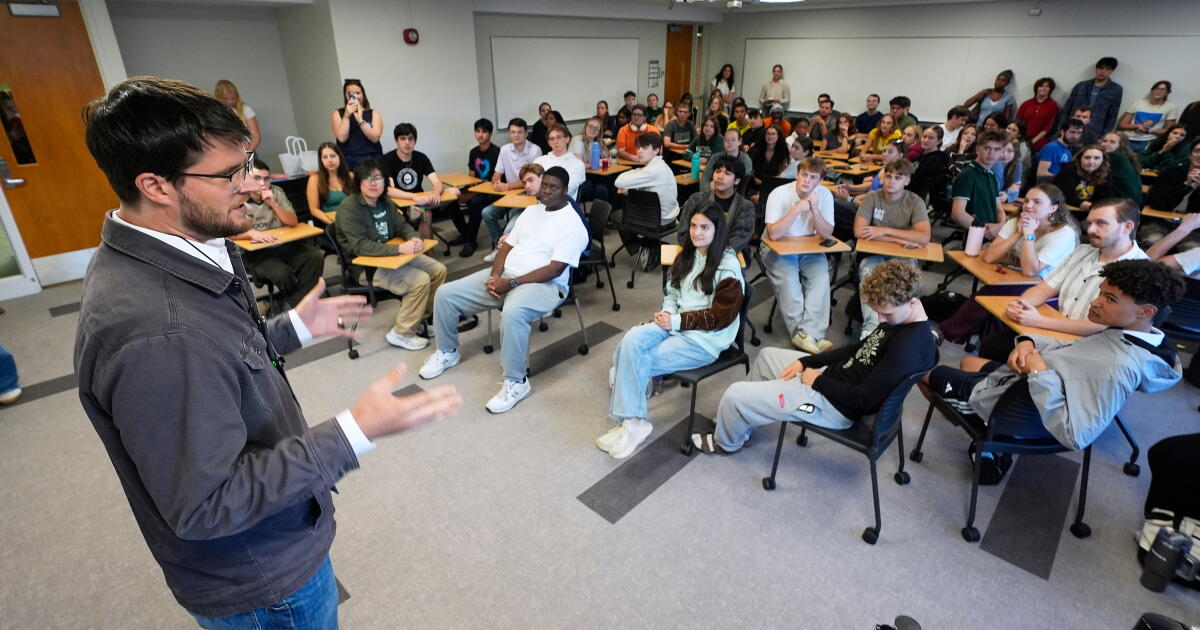
The candidate had just spent nearly 40 minutes addressing several dozen Orange County moms in Mission Viejo, a hilly and affluent enclave speckled with golf courses and Spanish colonial architecture.

Republican gubernatorial candidate Steve Hilton visits patrons at Victorio’s Ristorante in North Hollywood, which hosted a watch party for the CNN debate between him and Xavier Becerra.
(Jason Armond / Los Angeles Times)
Sipping mimosas in a glass-walled event space overlooking the city’s verdant public course, women — and a couple of tagalong husbands — listened as Hilton and local Republicans argued for a change after 16 years of Democrats controlling California government.
“We can make this a place where people follow their dreams and build their lives, and that’s the ultimate test: That people are moving back to California after my first four years in government,” Hilton said.
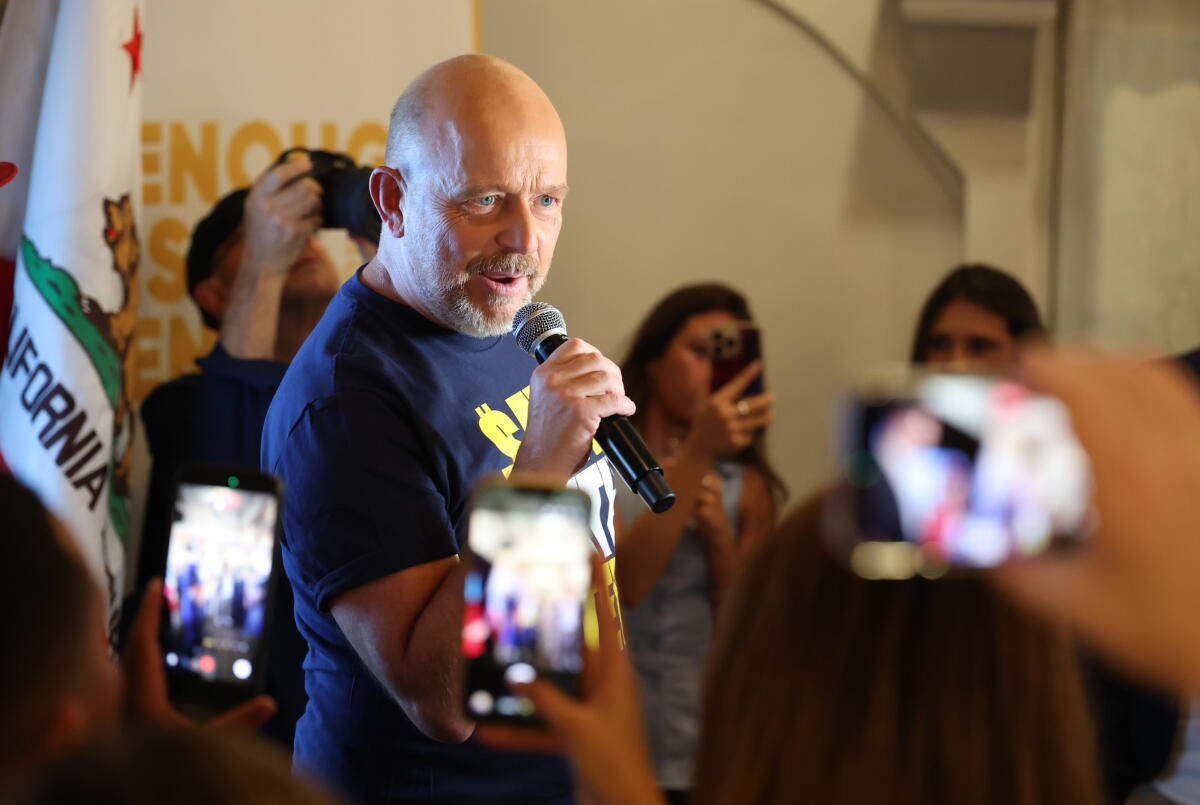
Rachel Darvish drove from her home in Pacific Palisades to support the gubernatorial candidate. In the aftermath of the January 2025 fires, Darvish was captured on viral video angrily confronting Newsom as he toured the wreckage. She joined the Republican Party after the fires.
“I considered myself an independent up until the day I realized we had no choice,” Darvish, wearing a Hilton campaign T-shirt, said. “I think this is really the first election that the R or the D really does matter, and there is an obvious difference.”
Hilton and other Republicans acknowledge the math. Democrats outnumber GOP voters nearly 2-to-1 in California, and no-party-preference voters largely side with Democrats in statewide contests.
Hilton, who is endorsed by Trump, often declares to supporters that the race against Becerra, a President Biden-era U.S. Health and Human Services secretary and former state attorney general, “is going to be really difficult to win, but not impossible.”
As he calculates his chances of victory, the former Fox News host considers three sets of facts. The “establishment polls,” as he calls them, conducted by widely trusted pollsters, including the Berkeley Institute of Governmental Studies and the Public Policy Institute of California, have shown him more than 20 percentage points behind. His internal polls also have him losing, albeit by smaller margins.
Then there are the people who come to his events.

California Democratic gubernatorial candidate Xavier Becerra speaks at a rally Thursday in Bakersfield.
(Jae C. Hong / Associated Press)
“Every single day I get all these people saying, ‘I’m a lifelong Democrat, but I’m voting for you because we got to have some balance, we got to have a change,’” he said in an interview on the golf course patio following his event. “A lot of them say, ‘But I’m not telling anyone.’”
Midterm elections are historically more difficult for the incumbent president’s party. While never popular in California, Trump’s approval rating recently fell to a record low of 27% in a Berkeley IGS poll.
Fierce headwinds for GOP in California
Political operatives expect anti-Trump sentiment to intensify the headwinds Republicans face in California. More than half of likely Democratic voters, and 37% overall, said a top motivator in this election is pushing back against the administration‘s policies.
“I’m not really anticipating Republicans winning for anything statewide,” said Jon Fleischman, a conservative writer and former executive director of the California GOP. “If somebody’s anticipating that, then they don’t know how to do math.”
He doesn’t expect Republican turnout to drop, but “Democrat turnout could be enhanced over what it normally is. Maybe it’s a distinction without a difference.”
Some Republicans are frustrated by the Democratic-only choices in the high-profile race for Los Angeles mayor, as well as the down-ballot contest for state insurance commissioner.
Darvish, who supported conservative Spencer Pratt for L.A. mayor in the primary, described the runoff between incumbent Karen Bass and City Councilmember Nithya Raman as a choice between “Satan and Lucifer.”
“I’m going to have to vote for Karen Bass,” she said. “It’s really hard for me to say that,” but she does not want Raman or any candidates backed by the Democratic Socialists of America to win.
Some Republicans say they won’t vote for insurance commissioner, the only statewide race between two Democrats: Jane Kim, a former San Francisco supervisor, and state Sen. Ben Allen.
Fleischman described the DSA-endorsed Kim as “nuts” and Allen, who represents Manhattan Beach, El Segundo, Beverly Hills and other cities, as “an extreme liberal” who “has enthusiastically supported virtually every Gavin Newsom policy I dislike.”
While Trump and Republicans will likely suffer midterm losses, many Democrats are “massively unpopular as well,” said Republican strategist Rob Stutzman. “All politicians are underwater right now. Voters are in a pretty bad mood.”
Hilton concedes it would be easier to run a midterm race with a sitting Democratic president, but believes the Trump endorsement is not as toxic to his campaign as it might seem.

Republican gubernatorial candidate Steve Hilton enjoys a light moment with a woman who was happy to get gas for $3 a gallon at a gas station in Los Angeles on Oct. 8.
(Genaro Molina / Los Angeles Times)
“It doesn’t come up in really any of the meetings,” he said. “People really are asking about gas prices.”
Republican candidates and party officials are making the case that California’s longstanding homelessness and cost-of-living woes have little to do with the president.
“I can’t think of anything less relevant” than Trump, said Roxanne Hoge, chair of the Los Angeles Republican Party. “We are drowning in high taxes and high costs. Anyone trying to make this election about who the president is — and who will only be president for two more years — has a screw loose and also doesn’t have much of anything to offer.”
Hilton doesn’t engage in voter fraud allegations
Federal authorities this week charged 28 people in California with illegally registering and casting ballots as part of a broader fight to exert more control over elections, which are run by states.
Having just won an election primary in June, Hilton walks a line when discussing claims of electoral fraud. He takes issue with rules like ballot harvesting and a seven-day, post-election deadline for mail ballots to arrive, but he does not believe there is systemic fraud or cheating.
“We mustn’t let ourselves believe that every time we lose an election, it’s because they cheated,” he said when a supporter made the accusation during a Modesto town hall in August. “We lose the elections [because] we don’t win enough votes, right?”

Viewers attend a watch party at Victorio’s Ristorante in North Hollywood during the debate between gubernatorial candidates Democrat Xavier Becerra, left, and Republican Steve Hilton earlier this month.
(Jason Armond / Los Angeles Times)
That’s why he is trying to reach independent voters and Democrats who “can’t stand President Trump” but “are desperate for something to change in California,” he explained as applause rippled through the heavily Republican crowd.
Hilton is counting on voters like Summer Behan, a former Democrat, to not only vote for him but persuade other disenchanted voters.
“My car got broken into 14 times in a year and a half,” Behan told Hilton during the Modesto event. “Our homeowners insurance went from $180 to $860, so we had to sell our house.”
She drives more than two hours to her nonprofit job in San Francisco.
“It’s sort of an exhausting way to live,” Behan said after the town hall. Families from her children’s schools have moved to other states, but she wants to stay. “California is beautiful, and it’s just got so much to offer people, so I want to try and stick it out and see what it looks like with different leadership.”