S. Korea gov’t to enact special law this year to designate special zone for AI investment projects

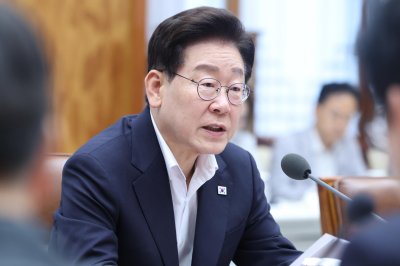
South Korean President Lee Jae Myung speaks during a government meeting to assess progress on three megaprojects at Cheong Wa Dae in Seoul on Monday. Pool photo by Yonhap
The government plans to enact a special law this year to designate special zones for investment projects related to artificial intelligence (AI), the presidential chief of staff said Monday, as Seoul seeks to accelerate their implementation.
Presidential chief of staff Kang Hoon-sik unveiled the plan at a press briefing following a meeting presided over by President Lee Jae Myung to assess progress on the projects.
The Lee administration announced the “three megaprojects” in late June that outlined plans for large-scale investments in a semiconductor production cluster, physical AI and AI data centers in regional areas.
Under the chip cluster project alone, the two leading chipmakers — Samsung Electronics Co. and SK hynix Inc. — have pledged to invest a combined 800 trillion won (US$564.9 billion), marking the single-largest investment plan to date in the southwestern city of Gwangju and the surrounding Honam area. The initiative also includes large-scale investments in Chungcheong Province and the southeastern Yeongnam region.
Through the envisioned special law on megaproject zones, the government will help streamline licensing and approval procedures, as well as environmental impact assessments, the chief of staff said.
The special law will also allow the government to swiftly establish infrastructure for electricity and water supplies, as well as living conditions for workers, including transportation, housing and education, Kang said.
At the start of the meeting, Lee urged the government to make every effort, including through deregulation, to implement the investment initiative as soon as possible.
Lee said all necessary administrative steps should be pursued simultaneously to shorten the time needed to implement the initiative while stressing that regulations should also be improved to ensure the implementation can be carried out as quickly as possible.
“We are in a situation where we must go beyond being speedy and move with the speed of lightning,” the president said.
He also instructed officials to transfer the functions of a military airport in Gwangju to other temporary facilities by 2028 to facilitate the speedy transformation of the regional airport into a semiconductor production hub.
The government earlier designated the military airport as the site for the envisioned chip cluster.
The ultimate goal of the investment initiative should be to distribute the pillars of growth across the country and make regional areas new centers of future industries, the president insisted.
“I hope that benefits from achievements garnered through the capabilities of the entire community will not be limited to certain companies or regions,” Lee said.
He said the following year should be a “golden time” that will open up a totally new world for South Korea depending on “how we prepare,” urging officials to make every effort.
Kang said that the government plans to complete the transfer of the Gwangju military airport’s functions to temporary facilities by 2028.
The government will also kick off the implementation of the investment projects in the Chungcheong and Yeongnam regions this year, worth 246 trillion won and 107 trillion won, respectively, he said.
Copyright (c) Yonhap News Agency prohibits its content from being redistributed or reprinted without consent, and forbids the content from being learned and used by artificial intelligence systems.