New York City Mayor Zohran Mamdani says he is disbanding the NYPD’s Strategic Response Group or SRG, which has been accused of using excessive force at demonstrations including the Columbia University protests over Gaza and Black Lives Matter.
The award to Machina is the latest example of the Pentagon’s push to use containerized 3D printing and other advanced fabricating systems closer to the front lines to shorten supply chains that could get severely degraded in a major conflict. Decentralizing production of drones also allows units to be more flexible and tailor their own production to their specific needs at any given moment. For instance, a unit can produce variations of multiple designs that are best suited to an upcoming mission instead of having to use whatever they are shipped.
(Machina)
This 18-month contract from the Defense Department’s Organic Industrial Base Modernization Challenge calls for Machina to prove it can build LUCAS drones at deployed locations with its RoboCraftsman system, Ed Mehr, founder and CEO of Machina, told TWZ Friday afternoon. A decision on producing them at scale in many other locales will come later.
A LUCAS drone six-foot half-scale test model created by Machina’s RoboCraftsman system during a flight test at Edwards Air Force Base. (Machina)
Creating containerized production of drones and components using 3D printing and other advanced manufacturing techniques at the forward edge is a burgeoning industry. The Machina system is one of a rapidly growing number of capabilities built around this concept, although many focus on smaller drones.
RoboCraftsman was built to manufacture where it’s needed. It folds & ships in 2 ISO 668 containers.
Building Drones Near The Point Of Need
Initially, the plan calls for Machina to set up so-called “Edge Factories” at two locations in the continental United States, said Mehr. However, the ultimate goal is to be able to deploy them to forward locations in countries like Kuwait.
The Edge Factories consist of the company’s containerized RoboCraftsman manufacturing cells, Mehr told us. A 20-foot by 36-foot system that weighs 120,000 pounds fully installed, it is essentially two robotic arms that form the airframe out of metal using reductive manufacturing based on a variety of requirements. Payload weight, range and other factors are punched into a software system designed by the nTop company and the robotic arms then cut the metal into the desired form factor based on the required specifications.
Machina uses metal instead of composites that many drones are made out of because “not only it is cheaper, it is more widely available and now can be processed with an automated process like ours versus composites, which are all done by hand layup,” Mehr explained.
The following Machina video shows how the RoboCraftsman system, guided by the inputs, forms the metal to craft the airframe.
Metal Drone Skins, Robotic Forming & the Future of Defense Manufacturing | Machina is the Factory
This avoids having to use equipment like dies and rolls, dramatically speeding the process and allowing production at scale, Mehr stated.
“Basically, the agentic AI agents can explore and generate whole different versions of an airframe with different parameters,” Mehr proffered. “Because now it’s parameterized, you can just change the parameters and you get another airframe, and then evaluate if that airframe is good for the requirement they want.”
This way, the RoboCraftsman system “can easily generate 20, 30, 40, 50 different designs just in software, and then put it through simulations to figure out which one actually meets the requirement for that,” the Machina CEO added.
“The concept is that we’re going to bring this capability closer to the point of need, so that you can build a different requirement for let’s say PACOM versus U.S. CENTCOM versus in Ukraine,” Mehr said. “They can easily switch and build a drone that they need.”
Low-cost Uncrewed Combat Attack System (LUCAS) drones in the U.S. Central Command region. (CENTCOM) (U.S. Central Command Public Affairs)
Under this contract, each Edge Factory will consist of one or two RoboCraftsman cells and each cell can make a LUCAS airframe in two to five days, depending on the size, Mehr said. A scaled deployment of 10 or more cells would take place under a new contract, he added.
The systems can make “anywhere from a one-off all the way to the thousands, sometimes tens of thousands,” Mehr said. It all depends on the number of RoboCraftsman systems that are ordered.
At the moment, Mehr envisions that each 12-foot airframe will cost “somewhere around $15,000 to $40,000,” depending on the complexity. This range is a relatively common price point for Russian Shahed-136 variants and U.S. knockoffs under the LUCAS program.
The company has already produced a six-foot, half-scale airframe that was recently tested at Edwards Air Force Base, said Mehr. However, that initial test proved problematic.
“The first design had some challenges with crosswind mitigation,” Mehr told us. “Since then, we have moved the location of the engine slightly to enable better crosswind mitigation, and now we’re running again. And the beauty is for us to go from one design to the next is just like a couple of months, a maximum of three months. Like we can just then try it again.”
A six-foot, half-scale LUCAS drone, made by a Machina RoboCraftsman system, being tested at Edwards Air Force Base, California. (Machina)
Mehr said that Machina is not working with SpektreWorks, which designed and made the LUCAS drones previously supplied to the U.S. military and already used in combat. SpektreWorks declined to comment.
The Edge Factory contract is one of several Machina has been awarded to use these systems to help build and repair military hardware.
That plan called for the creation of a 200,000-square-foot facility “designed to house up to 50 RoboCraftsman cells and support high-rate production of mission-critical metal structures for defense programs including JASSM,” according to a media release at the time. “By integrating forming, machining, welding, and assembly under one roof, Machina Factory 3 compresses production timelines from months to days.”
“Lockheed Martin Ventures invested in Machina Labs for its powerful combination of speed, flexibility, and scalability, and our teams have worked closely to transition key capabilities to production,” said Chris Moran, vice president and general manager, Lockheed Martin Ventures. “Machina’s work advances capacity, reduces risk, and helps ensure we can deliver mission-critical capabilities at scale. We congratulate Machina on this milestone as a supplier, which further strengthens an innovative and resilient American Defense Industrial Base.”
U.S. Air Force Staff Sgt. Seth Blackwood, 363rd Training Squadron Aircraft Armament instructor, directs the installation of an AGM-158 JASSM onto a B-52 during a Combat Capability Demonstration April 16, 2024, at Sheppard Air Force Base, Texas. (U.S. Air Force photo by Rachel Ross) Rachel Ross
Earlier this year, a Machina RoboCraftsman platform helped repair a C-17 Globemaster III cargo jet that was damaged during a tornado, Mehr told us.
The system “fabricated a first-of-its-kind replacement part for the damaged C-17 without the need for dedicated tooling,” the company noted. “Machina deployed a RoboCraftsman at the RSO [Rapid Sustainment Office], where production for a left nose panel began in March 2026 and was completed in May 2026. The aircraft returned to flight on July 30, 2026 at Wright-Patterson Air Force Base, Ohio.”
Damage to a C-17 Globemaster III cargo jet caused by a tornado that was eventually repaired with a Machina RoboCraftsman system. (Machina)
We asked the Pentagon for information about why they selected Machina and their metrics for success, but we have not heard back yet.
Pentagon Pushing For Deployable Manufacturing
The U.S. military has been pushing for several years for the employment of mobile additive and other forms of advanced manufacturing “to produce unmanned aircraft components in remote or austere environments and reduce dependence on traditional supply chains,” the Air Force’s innovation arm, AFWERX, noted last month.
The idea is to place these systems in a wide array of locations, produce the quantity needed and tailor the airframe for the mission.
In one such case, the Air National Guard and Air Force Special Operations Command partnered with the San Diego-based Firestorm company in 2023 “to create an expeditionary assembly unit capable of mass-producing unmanned aerial systems,” according to the Pentagon.
The result was called an Expeditionary Manufacturing Cell or xCell.
“It’s basically an expeditionary 3D printer,” Master Sgt. Richard Stone, 194th Air Support Operations Group innovation officer, explained at the time. “The basis of the technology is … it’s about the size of a [shipping container] and it can print out, for this specific use case, drones.”
“Inside this [shipping container], it’ll print out all the components,” said Stone “But then you have what’s called RPA, which is robotic process [automation.]”
The xCell “prints the individual pieces and then uses RPA to assemble the major components of the drone,” the Pentagon added.
A render of Expeditionary Manufacturing Cell or xCell which is capable of mass-producing unmanned aerial systems. Theoretically, xCell can be hidden in plain sight while running on local resources to 3D-print items on the battle field. (Courtesy photo from Firestorm) 194th Wing
“The user can take these components and, almost like Legos, put them together,” said Stone. “So if you want a longer drone with a specific payload, you can take those components and put them together and the computer will tell you, ‘This is where the wings go and this is where the center of gravity should be.”
The company went on to produce Tempest drones that were flying with 3rd Littoral Combat Team, 3rd Marine Littoral Regiment, during Exercise Balikatan 2026 at Cagayan North International Airport in the Philippines, AFWERX noted.
A Firestorm Tempest Drone with 3rd Littoral Combat Team, 3rd Marine Littoral Regiment, 3rd Marine Division, is staged for preflight checks during Exercise Balikatan 2026 at Cagayan North International Airport, Lal-Lo, Philippines, April 23, 2026. (U.S. Marine Corps photo by Cpl. Ernesto Lagunes) Cpl. Ernesto Lagunes
The ForgeX system “represents being able to take the fight further forward, print drones on demand, print them out towards the front of the lines, cut down the logistics trail, and absolutely revolutionize the battlefield,” said Anders.
The goal is to be “able to kick these planes out the door on short timelines to go out and get the missions done, work within the local area to make sure that the mission can be accomplished by any means necessary,” he added.
Anders said the ForgeX printers fabricate three types of drones, the Vandal, Onyx and Raker. He added that the system can produce up to 880 a year.
AEVEX’s ForgeX containerized 3D printed drone mini factory
Growing U.S. Reliance On LUCAS
The U.S. military first announced it had begun fielding LUCAS, which was reverse-engineered from the Iranian-designed Shahed-136, in December 2025. This came just months after TWZ laid out a detailed case for why the U.S. military should start acquiring Shahed-136 clones in large volumes. LUCAS made its official combat debut in the opening phases of major combat operations against Iran earlier this year. The pusher-propeller, combustion-engine-powered kamikaze drones were first launched from the ground, a U.S. official told us at the time. They can also be fired from ships. In March, CENTCOM commander Adm. Brad Cooper told us the LUCAS drones were “indispensable.”
The following video shows Cooper answering our question about the LUCAS drones.
“So we see that playing a key role in order to be able to achieve that effect at mass, … [and] in an affordable manner, while also being able potentially to preserve something that’s more exquisite for something that requires an exquisite munition.”
“So as we start modeling out what it looks like to be able to penetrate a portion of the anti-access/area denial network in support of the joint task force in the PACOM [U.S. Pacific Command] area of operations, we started looking at, well, how do I bend – how do I achieve mass at a cost curve?” the 7th Infantry and MDC-PAC commander explained. “What effect am I really trying to achieve on a system in order to provide that window of opportunity for that joint force commander?”
A map showing Chinese military outposts in the Spratly Islands at the southern end of the South China Sea. This gives a good sense of the anti-access/area denial bubbles that China has already established and continues to expand upon. (DOD)
“So maybe I don’t necessarily need to sink a ship, but if I take out certain systems on that vessel, well then it creates this temporal window opportunity,” he continued. “Then that joint force commander can surge in that carrier strike group or bomber task force.”
While the exact details of the LUCAS program requirements have been hard to pin down, it’s likely that multiple drone types from multiple manufacturers could become part of the program as time goes on. Ed Mehr gave us an idea of what that could look like:
“Shahed clearly inspired LUCAS, which stands for Low-Cost Uncrewed Combat Attack System. But we shouldn’t confuse the inspiration with the destination. The future isn’t about mass-producing replicas of one drone. Different theaters and missions demand different performance, and therefore different designs. That could mean a LUCAS-style drone or a wide variety of Group 2 and Group 3 unmanned aircraft. The real breakthrough is making that diversity affordable. We’re developing flexible manufacturing technologies that can produce many different designs cost-effectively using one of the cheapest and most proven aerospace materials: sheet metal. It’s what aircraft have been built from for generations. We’re bringing it into an era where manufacturing can adapt as quickly as the mission.”
We won’t know how the Machina contract ultimately pans out until sometime in mid-2028. Regardless, given the importance of both the LUCAS drones and deployable, additive and advanced manufacturing are becoming, this is likely a first step in what could be a whole new logistics concept that could underpin a significant portion of the growing LUCAS program.
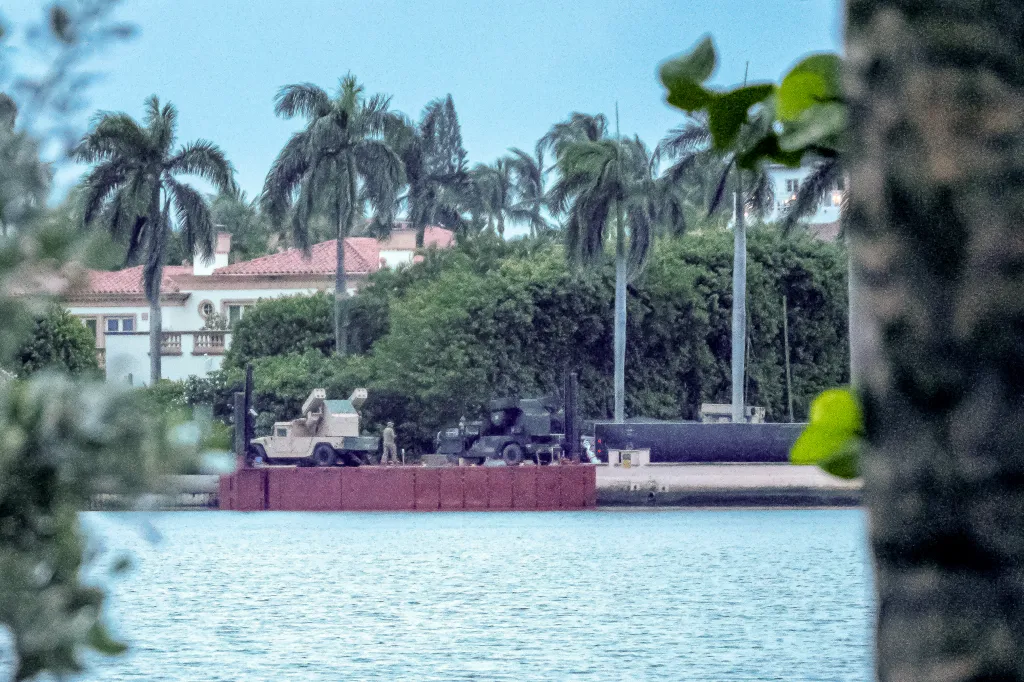
U.S. Army Humvee-based AN/TWQ-1Avenger short-range air defense systems (SHORADS) have been set up near President Donald Trump’s Mar-a-Lago estate in Palm Beach, Florida, as well as at Donald J. Trump International Airport, about three miles to the west. The Avengers were deployed about two weeks ago amid heightened concerns about the president’s safety.
Iran threatened Trump’s life long before he ordered the joint attack with Israel on the Islamic Republic in February. Airstrikes wiped out much of Iran’s senior leadership structure at the onset of Operation Epic Fury. Now the American leader is mulling over plans to renew attacks on Iran as early as next week. In addition, Trump has been the target of assassination attempts and threats not connected to Iran. There may also be elevated security concerns surrounding the midterm elections.
Officials would not provide any specific reasons for the presence of the SAM systems when we asked.
“At the request of the U.S. Secret Service (USSS) and under NORAD [North American Aerospace Defense Command] and USNORTHCOM [U.S. Northern Command] authorities, NORAD and USNORTHCOM recently deployed ground-based air defense [GBAD] assets and Counter-Unmanned Aircraft System capabilities in and around Mar-a-Lago, Florida,” the commands told us in a statement. “These assets add a complementary layer of technology to enhance protection. Due to operational security, we are unable to provide additional details. For further detail, we refer you to the USSS.”
“The U.S. Secret Service is operating in a heightened threat environment, and we continuously adapt our protective operations to incorporate cutting-edge tools, technology, and methods to safeguard our protectees,” the Secret Service told us. “At the request of the U.S. Secret Service, NORAD and U.S. Northern Command are providing Counter-Unmanned Aircraft System capabilities in support of our protective operations.”
NORAD/NORTHCOM declined to say what kinds of ground-based air defense assets are involved or where they are set up. However, Getty Images photographs show two Avenger systems set up on a floating platform in Lake Worth Lagoon on the Mar-a-Lago shoreline and one on the beach.
Avenger air defense systems seen at Mar-A-Lago in Palm Beach, Florida, on October 16, 2026, ahead of President Donald Trump’s first landing at the newly renamed President Donald J. Trump International Airport. (Photo by Christopher Beckett/NurPhoto) Christopher Beckett
There are also at least two Avengers at nearby Trump International Airport.
A military service member stands atop an AN/TWQ-1 Avenger air defense systems on the tarmac near a C-17 Globemaster transport aircraft at President Donald J. Trump International Airport (DJT) in West Palm Beach, Florida, on October 15, 2026. (Photo by Christopher Beckett/NurPhoto) Christopher Beckett
The command did confirm to us that it sent its Counter-Unmanned Aircraft System Fly-Away Kits to support these operations. These are rapidly deployable systems to react to drone threats or ongoing incursions consisting of passive and active sensor systems, such as electro-optical and infrared cameras, Ku-band radar, and electronic support measures, to help spot, classify and track drones. Electronic warfare systems can also be deployed as part of these fly-away kits.
A NORTHCOM/NORAD counter-drone Fly-Away kit. (U.S. Military)
The Avenger is a turreted system with two launchers, each capable of holding four Stinger heat-seeking surface-to-air missiles. The Stinger missiles they fire have been upgraded to deal with drones. Avengers are meant for point defense of forces on-the-go but have also played a major homeland defense role since 9/11. One is even hard-mounted on a rooftop near the White House for air defense purposes.
The deployment of these systems illustrates just how seriously the U.S. Secret Service is taking the threat of drones. Drone technology, including first-person view types and those equipped with fiber optics, is rapidly proliferating around the world and Iran has been both a user and distributor of these weapons. The Islamic Republic has uses long-range kamikaze drones, which could be a particular threat, especially considering Trump’s estate’s close proximity to the sea, which offers a most likely launch option. It’s also worth noting that traditional aircraft are also a threat and the Stingers are capable of dealing with them too.
An Army Avenger air defense system stands ready during a NORAD Temporary Flight Restriction enforcement mission in Bedminster, New Jersey, Aug. 9, 2026. (U.S. Air Force photo by Lt. Col. Andrew Scott) Lt. Col. Andrew Scott
The Temporary Flight Restriction (TFR) imposed over Mar-a-Lago. (FAA)
“More than 160 planes and drones have breached the airspace over Palm Beach since the restrictions took effect in October 2025, according to an Aug. 11 FAA filing in federal court” that was first reported that month by the Palm Beach Daily News.
The most recent publicly announced incursion took place Oct. 24.
“A NORAD F-16 fighter aircraft intercepted a general aviation aircraft over Palm Beach, Florida, at approximately 12:20 p.m. EST today after the aircraft entered a NORAD-enforced FAA Temporary Flight Restriction (TFR) area over Mar-a-Lago,” the command stated in a media release at the time. “After the fighter jet executed a standard headbutt maneuver to gain the pilot’s attention, the civilian aircraft established communication and safely exited the restricted airspace in full compliance with flight instructions.”
These combat air patrols (CAPs) are standard for presidential visits. Even when Trump is at Mar-a-Lago for days, there are usually CAPs flying overhead, which are extremely resource-intensive, as we explained in a previous story about one that took place during Trump’s first term.
The deployments of Avengers to Florida mark at least the second time since August that these systems have been used to protect Trump. Avengers were seen on Aug. 9, when Trump was attending the final round of the LIV Golf Bedminster tournament at his New Jersey golf course.
In that situation, NORAD told us that when deployed to assist the Secret Service in protecting POTUS, the Avenger systems are operated by the 263rd Army Air and Missile Defense Command. The command today declined to say if that is the case with the current deployments.
On Aug. 1, the White House shared a video of Trump talking with soldiers at Bedminster. In the background was an Avenger.
Trump, as we noted earlier in this story, has already been the subject of several assassination attempts and threats.
The most notable came on July 13, 2024, at a campaign event in Butler, Pennsylvania, when a man fired a shot at Trump, then the Republican presidential nominee. Thomas Matthew Crooks, 20, of Bethel Park, Pennsylvania, was killed, and a bloodied Trump was whisked away.
U.S. Secret Service agents remove Republican presidential candidate former president Donald Trump from the stage with blood on his face during a campaign rally at Butler Farm Show Inc. in Butler, PA on Saturday, July 13, 2024. (Photo by Jabin Botsford/The Washington Post via Getty Images) The Washington Post
An image highly suggestive of a drone targeting the then-former President Trump on a golf course in a “vengeance” strike in retaliation for the death of Iranian General Qassem Soleimani was posted on Twitter by an account for Iran’s then-Supreme Leader, Ayatollah Ali Khamenei. The U.S. military killed Soleimani in a drone strike in Iraq in January 2020, which had already prompted public threats from Iranian officials, including against Trump specifically.
Twitter suspended the @khamenei_site account around 15 hours after the post when the image first appeared on Jan. 21, 2020.
An X account tied to Iran’s former supreme leader posted this image of a drone looming over Donald Trump as he played golf. (X)
There has been extreme concern for Trump’s safety following the launch of that operation, with an Iranian revenge hit on the president being more plausible now than ever. This has triggered major changes in safety protocols, some of which have made headline news.
Alarms were raised earlier this month after U.S. intelligence found Iran has “‘substantially increased’ its efforts to target American diplomats and officials in the Middle East and beyond, with lethal plots reaching ‘advanced stages,’” Axios reported, citing an Oct. 23 memo to Secretary of State Marco Rubio the outlet obtained.
The Avengers are the most visible indication of increased efforts to protect Trump amongst threats that are unlikely to recede anytime soon.
A deadly train crash fuelled anger in Spain as far-right demonstrators clashed with police during an anti-government protest in Madrid. Hundreds demanded the transport minister’s resignation amid questions over the authorities’ handling of the disaster, which killed 68 people.