Trump Believes Venezuela’s Stability Depends on Chavismo. He’s Wrong
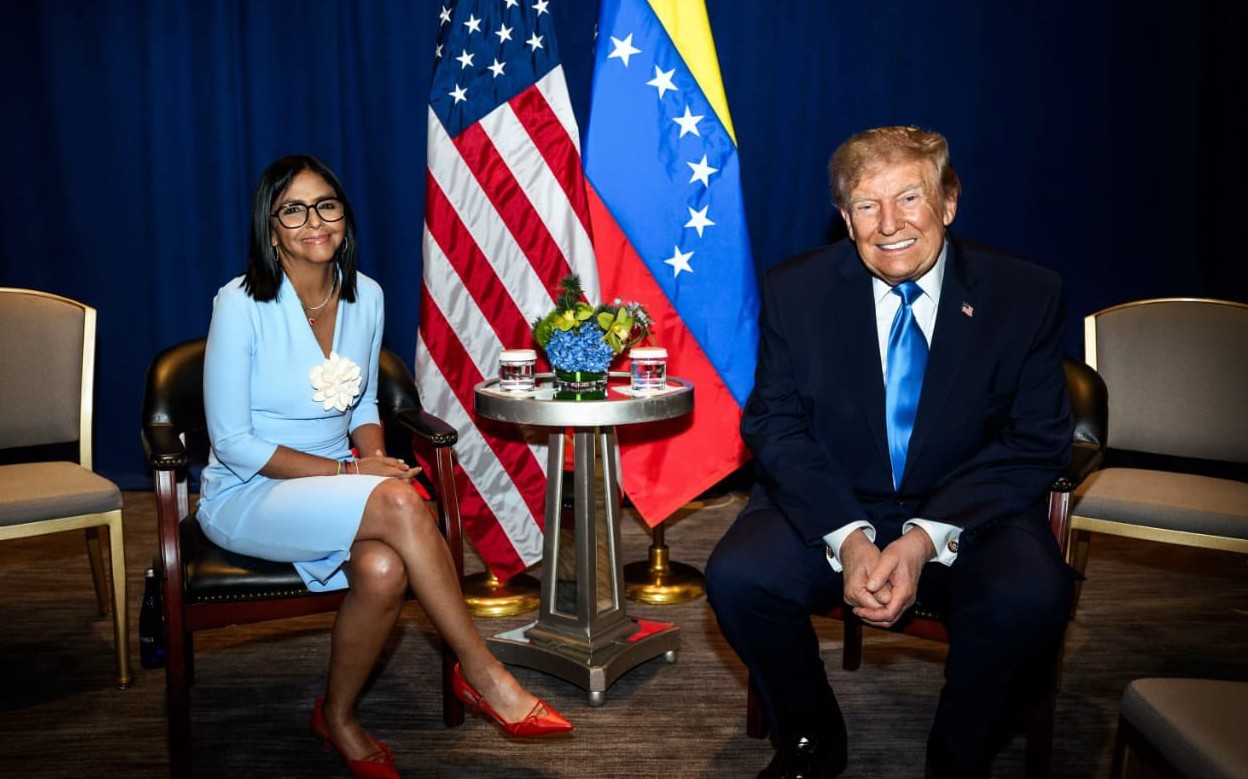
On the same day Delcy Rodríguez was in New York meeting Donald Trump and representing Venezuela at the United Nations, María Corina Machado was trying, unsuccessfully, to get closer to her own country.
It was her third attempt in barely 24 hours. First came a planned maritime departure from Panama, which was canceled after the company operating the vessel reported mechanical problems. Then came an attempted flight to Aruba, from where Machado intended to continue by sea. Finally, there was another flight plan, this time for Curaçao. That trip did not happen either. Her team now says she has attempted to return to Venezuela seven times since she left in December 2025 to get her Nobel Prize in Oslo.
The exact responsibility for the latest failures remains unclear. But what happened during previous attempts is better documented. Axios reported in July that the Trump administration’s position was that third countries should not help Machado enter Venezuela. When Deputy Secretary of State Chris Landau appeared to tell the Dutch government otherwise, officials in Washington corrected the message. Curaçao withdrew permission for Machado’s plane to land while she was already in the air. According to the same account, Secretary of State Marco Rubio subsequently reiterated the policy to Machado personally.
This sits awkwardly beside Washington’s public position. Rubio said this month that Machado, as a Venezuelan citizen, has every right to return “whenever she wants.” A State Department official told Congress in July that the US would not obstruct her return. Trump himself has denied telling her to stay away.
After World War II, keeping Emperor Hirohito in power did not mean preserving his capacity to decide who could participate in Japanese politics.
All of those statements may be technically true. The US does not issue Venezuelan visas and cannot legally forbid a Venezuelan citizen from entering Venezuela. But Machado cannot teleport into Caracas. Getting home requires aircraft, airports, territorial waters, neighboring governments and, increasingly, governments that want to know Washington’s position before helping her. There is a meaningful difference between saying that the US will not prohibit her return and telling American partners that facilitating it is not US policy.
This would already be an odd arrangement for any opposition leader. It is stranger still in Machado’s case. She is hardly a geopolitical threat to Washington. She has gone out of her way to present a democratic Venezuela as a close strategic partner of the US. In December, she said explicitly that America would be Venezuela’s “main ally.” She has spoken about opening the country to Western investment, rebuilding the energy sector with foreign capital and transforming Venezuela from a security liability into a partner for the US. After Maduro’s removal, she publicly thanked Trump and Rubio and described the outcome as a potential “win-win” for both countries.
Yet Reuters reported last week that US officials remain wary of her return because they fear her presence could disrupt the transition Washington is supporting around Rodríguez. Machado’s movement is not part of the current US-backed negotiating mechanism, while Delcy’s government has become Washington’s main Venezuelan interlocutor.
That raises a question that goes beyond Machado.
The postwar parallel
The Trump administration has repeatedly defended its approach as a matter of sequencing. Venezuela needs stability first, then economic recovery and reconciliation, and “ultimately democratic transition.” The White House argues that rebuilding the economy is a precondition for elections rather than a substitute for them.
There is a serious argument behind that position. Venezuela inherited a devastated public administration, a crippled oil industry, enormous external debt and institutions hollowed out by years of authoritarian rule. Abruptly dismantling the bureaucracy, military hierarchy or State-owned companies could reproduce some of the worst mistakes made in other post-authoritarian or post-conflict transitions. A functioning State matters.
But preserving the State is not the historical equivalent of preserving the regime.
After World War II, the United States repeatedly confronted versions of this distinction. In Japan, the occupation retained Emperor Hirohito partly because American planners believed institutional continuity could make the transition less destabilizing. But keeping the emperor did not mean preserving the emperor’s capacity to decide who could participate in Japanese politics. On October 4, 1945, General Douglas MacArthur ordered the Japanese government to remove restrictions on political and civil liberties and release political prisoners. Among those released were prominent Japanese Communists who had been imprisoned by the old order. American officials later acknowledged that the resulting political opening was so broad that some Japanese mistakenly concluded that the occupation itself favored the Communist Party.
When it comes to the geopolitical role of the US, the Trump administration depicts itself as the decisive actor reshaping Venezuela. When questions turn to the lack of institutional reforms, Venezuela’s sovereignty becomes a much more convenient explanation for the limits of American responsibility.
Something similar happened in Italy. The Allies initially worked through King Vittorio Emanuele III and Marshal Pietro Badoglio because they needed an Italian government capable of administering the country during the war. At the same time, political exiles were allowed to come home and anti-Fascist parties returned to public life. The contrast is particularly striking in the case of Palmiro Togliatti, the leader of the Italian Communist Party and a former senior official of the Communist International. When Togliatti sought to return from Moscow in 1944, the US State Department explicitly said it had “no objection.” He returned and soon participated in the new political order.
Neither Japan nor Italy offer a blueprint for Venezuela. The historical circumstances were radically different, and American occupation policy was hardly politically neutral. But the underlying distinction is useful. Administrative continuity did not require preserving the old regime’s monopoly over politics. The State could survive while the political system opened around it.
That is precisely where Washington’s current Venezuelan policy becomes harder to understand.
The art of deflecting
Keeping experienced civil servants at their desks is State continuity. Avoiding a wholesale purge of the armed forces may be State continuity. Keeping PDVSA pumping oil while new rules are negotiated is State continuity. None of those choices inherently require preventing opposition politicians from returning, organizing, or campaigning.
And Venezuela’s political opening remains incomplete. A UN Fact-Finding mission reported this month that, despite prisoner releases and some liberalization, the structures responsible for years of repression remain largely intact. Officials linked to previous abuses remain in important positions, restrictive laws survive and arbitrary detention and mistreatment have not disappeared.
This makes the widening gap between economic opening and political opening particularly important. Washington is moving rapidly on the former. Rodríguez traveled to New York accompanied by officials discussing oil, mining, debt restructuring and access to international financial institutions. American companies are negotiating their return to Venezuela’s energy sector. Trump has made the oil agreement one of the centerpieces of his foreign-policy narrative.
At the United Nations this week, Trump went further. After celebrating Maduro’s capture, the release of prisoners and Washington’s relationship with Venezuela’s current leaders, he described the new oil arrangement in unmistakably triumphalist terms. “It was a war,” he said, before invoking the old expression: “to the victor belong the spoils.” He then presented Venezuela as proof that the US would once again impose its power against threats in the Western Hemisphere.
If Machado returns, travels freely, organizes her movement, holds rallies and begins preparing for an eventual presidential campaign, Delcy’s continued presence can still be understood as part of an administrative transition.
The rhetoric creates an uncomfortable asymmetry. When discussing oil, geopolitical alignment or American power, the administration depicts itself as the decisive actor reshaping Venezuela. When questions turn to the remaining coercive apparatus, restrictions on political competition or the continued exclusion of important opposition actors, Venezuela’s sovereignty becomes a much more convenient explanation for the limits of American responsibility.
Washington cannot have unlimited responsibility for everything that happens inside Venezuela. Delcy Rodríguez still controls a government, a bureaucracy and a security apparatus of its own. But the US plainly possesses enormous leverage over the political and economic environment in which that government operates. The history of Machado’s attempts to return suggests that this influence may extend even to whether neighboring governments are prepared to help a Venezuelan opposition leader reach her country.
That is why Machado’s return matters beyond Machado herself.
If she returns, travels freely, organizes her movement, holds rallies and begins preparing for an eventual presidential campaign, Delcy’s continued presence can still be understood as part of an administrative transition: an imperfect bridge between the regime that existed under Maduro and a genuinely competitive political order.
If her return continues to be regarded as destabilizing, however, the logic starts to invert. Political competition itself becomes a threat to stability. The government is no longer merely being preserved so that the State can function while politics reopens; political reopening is being limited because it might endanger the government being preserved.
Venezuela does not need another collapse of the State. But avoiding State collapse and protecting the political equilibrium inherited from chavismo are two different objectives.
The distinction between them may ultimately define this transition.