Denuclearization

Lee says will seek ‘phased’ denuclearization of Korea, calls for help from Mongolia as trusted partner

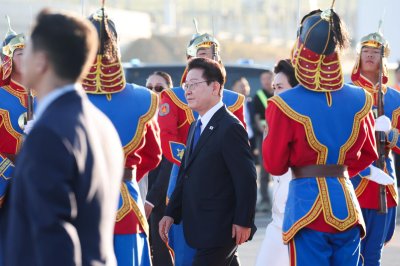
South Korean President Lee Jae Myung (C) arrives in Ulaanbaatar on a three-day state visit to Mongolia on Thursday. Photo by Yonhap

South Korea seeks phased denuclearization of the Korean Peninsula as it also seeks to normalize ties with North Korea, President Lee Jae Myung has said ahead of his state visit to Mongolia, which he called a “trusted partner” in such efforts.

In an interview with Mongolia’s state-run Montsame news agency released Thursday, the South Korean president highlighted Mongolia’s potential role in bridging the divided Koreas.

“I hope that Mongolia … will contribute even more to peace and stability, not only on the Korean Peninsula but across Northeast Asia as a whole.” the president said. “I believe that the power to create peace comes not from military force, but from mutual trust and dialogue.”

“Mongolia has maintained balanced relations not only with China and Russia, but with other key countries of the region … I believe this diplomatic capacity of Mongolia is more important now than at any time before,” he added.

Mongolia has traditionally maintained a close relationship with North Korea, having established diplomatic ties with Pyongyang only after the then Soviet Union. Lee arrived here earlier in the day, becoming the first South Korean president in 15 years to pay a state visit to Mongolia.

“Our government seeks to end the era of hostility and confrontation between South and North Korea, and to build a new era of peaceful coexistence and shared growth on the Korean Peninsula,” Lee said in the interview.

“To realize this vision, we plan to comprehensively pursue the expansion and normalization of inter-Korean relations, along with a phased approach to denuclearization.”

Lee emphasized the “significant role” Mongolia can play based on “the trust it has accumulated in the region.”

He also expressed his hope to elevate South Korea-Mongolia relations to a forward-looking “strategic partnership” that will usher in a “new golden era” of bilateral cooperation.

The South Korean president was scheduled to hold a summit with his Mongolian counterpart, Ukhnaa Khurelsukh, later in the day, followed by a joint business forum aimed at exploring opportunities for bilateral cooperation.

“Through this visit, I hope to elevate Mongolia-Korea relations to a future-oriented ‘strategic partnership,’ and I hope this will be a step toward opening a ‘New Golden Era’ of Mongolia-Korea relations together,” Lee was quoted as saying.

“I believe the Golden Era of Mongolia-Korea relations that our two countries will build together will open a new chapter filled with pride for the peoples of both nations,” he added.

Lee cited trade, supply chains, healthcare and food security as challenges the two countries need to tackle together, expressing hope that his ongoing visit could produce tangible results on those pressing issues.

The South Korean president, in particular, described critical minerals as “strategic assets” that underpin industry, technology and national security, adding that “building safe and reliable supply chains has become a vital challenge for every country.”

“From this perspective, Mongolia, with its abundant mineral wealth and development potential, and Korea, with its strengths in mining exploration, technological development and industrial innovation, can become vital supply chain partners for each other,” he said.

Seoul also aims to boost the number of visitors between the two countries to 500,000 per year by 2030, when the countries will mark the 40th anniversary of establishing their diplomatic ties, the president noted.

Copyright (c) Yonhap News Agency prohibits its content from being redistributed or reprinted without consent, and forbids the content from being learned and used by artificial intelligence systems.
Source link

Unification minister calls for moving away from ‘denuclearization first’ policy for N. Korea

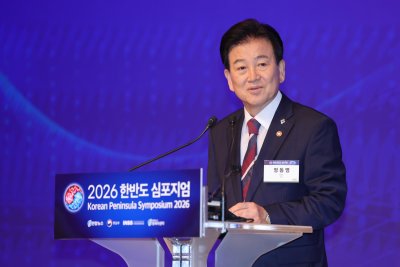
Unification Minister Chung Dong-young delivers a keynote speech during the Korean Peninsula Symposium 2026 in Seoul on Friday. Photo by Yonhap

Unification Minister Chung Dong-young called Friday for shifting away from an approach that sticks to denuclearization as the sole solution to the North Korean nuclear issue, saying such a precondition has been one of the reasons for stalled diplomacy with Pyongyang.

Chung made the remarks in a keynote speech at a forum, co-hosted by Yonhap News Agency, pointing out that the lack of progress in nuclear diplomacy has only helped the North bolster its nuclear and weapons capabilities for the past three decades.

“As the past 30 years have shown, whenever peace talks were halted by the denuclearization hurdle, North Korea used that time to further advance its nuclear capabilities,” Chung said at the Korean Peninsula Symposium.

“We must move away from the old notion that a peace regime can only be discussed after the North Korean nuclear issue is resolved … We need to pursue a phased and pragmatic solution. It is time for a paradigm shift,” he said.

Recalling major breakthroughs in nuclear diplomacy with Pyongyang in the past, Chung stressed the path toward peace opened up when relevant countries, including South Korea and the United States, sought to actively engage Pyongyang for dialogue.

Chung went on to highlight the need for a phased approach — halting and scaling down the North’s nuclear program before denuclearizing — as a solution to the nuclear issue.

“A step-by-step process toward peaceful coexistence and denuclearization should proceed in three stages — freeze, reduction and denuclearization,” he said. “China, too, has expressed support for this pragmatic approach.”

Chung said this phased approach must begin with dialogue between the U.S. and North Korea.

“As agreed in the 2018 Singapore summit between North Korea and the U.S., both sides should immediately resume talks to end mutual hostility and establish a new relationship,” he said.

“The resumption of U.S.-North Korea dialogue will serve as a powerful catalyst for opening four-party talks among the U.S., China and the two Koreas, who are the key stakeholders in achieving lasting peace on the Korean Peninsula,” Chung added.

Copyright (c) Yonhap News Agency prohibits its content from being redistributed or reprinted without consent, and forbids the content from being learned and used by artificial intelligence systems.
Source link

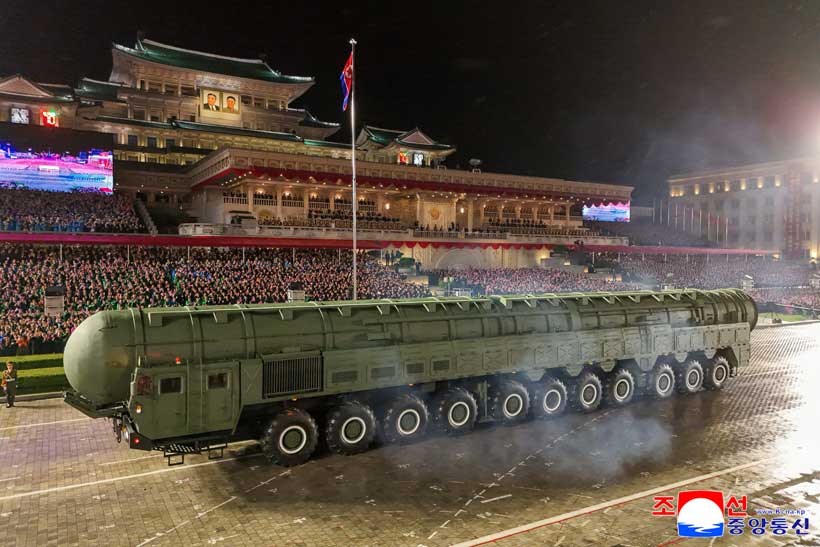
North Korea Says Denuclearization Debate Is Over

To provide the best experiences, we use technologies like cookies to store and/or access device information. Consenting to these technologies will allow us to process data such as browsing behavior or unique IDs on this site. Not consenting or withdrawing consent, may adversely affect certain features and functions.

The technical storage or access is strictly necessary for the legitimate purpose of enabling the use of a specific service explicitly requested by the subscriber or user, or for the sole purpose of carrying out the transmission of a communication over an electronic communications network.

The technical storage or access is necessary for the legitimate purpose of storing preferences that are not requested by the subscriber or user.

The technical storage or access that is used exclusively for statistical purposes.
The technical storage or access that is used exclusively for anonymous statistical purposes. Without a subpoena, voluntary compliance on the part of your Internet Service Provider, or additional records from a third party, information stored or retrieved for this purpose alone cannot usually be used to identify you.

The technical storage or access is required to create user profiles to send advertising, or to track the user on a website or across several websites for similar marketing purposes.

Source link