Denounce

Marches for International Women’s Day denounce war, abuse and oppression | Women’s Rights News

Marches on 115th anniversary of IWD place focus on issues like US-Israeli war on Iran and Donald Trump’s links with sex offender Jeffrey Epstein.

Thousands of demonstrators have taken to the streets around the world to mark International Women’s Day, taking a stand on a number of issues including the US-Israeli war on Iran and gender-based violence.

In Spain, where the government drew the ire of the United States for refusing to allow it to use Spain’s military bases for strikes against Iran, thousands of women took to the streets of major cities to call for an end to the war.

Recommended Stories

list of 3 itemsend of list

“It is within our power to stop the war, to stop the barbarity, and to win rights,” said Yolanda Diaz, Spain’s second deputy prime minister. “We proclaim ourselves in defence of peace, in defence of the Iranian people, in defence of Iranian women.”

On the first day of the joint US-Israeli war on Iran, strikes on a primary school in the city of Minab killed 165 girls, most between the ages of seven and 12, during class hours – the deadliest single attack on civilians so far.

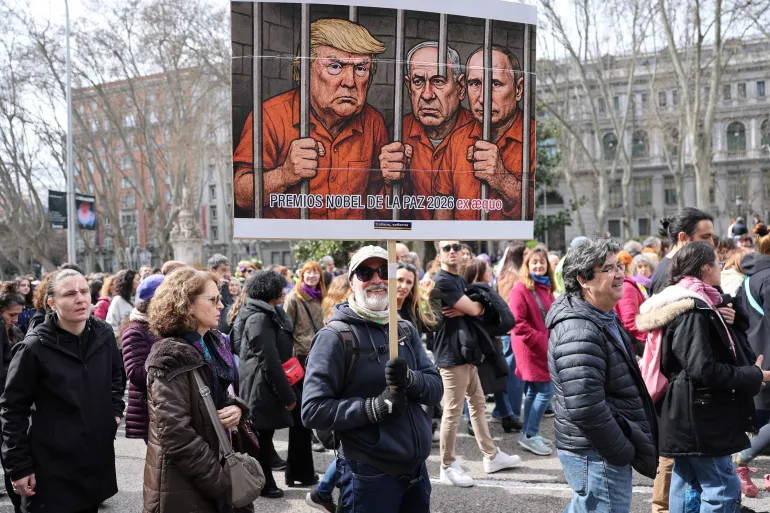
A man holds a banner mocking US President Donald Trump, Israeli Prime Minister Benjamin Netanyahu and Russia's President Vladimir Putin
A banner mocks US President Donald Trump, Israeli Prime Minister Benjamin Netanyahu and Russian President Vladimir Putin at an International Women’s Day rally in Madrid, Spain on March 8, 2026 [Thomas Coex/AFP]

In France, where more than 150 demonstrations were held, 73-year-old rape survivor Gisele Pelicot led a march calling for an end to sexual violence, telling a crowd in Paris, “We won’t give up”.

Pelicot became a global symbol in the fight against sexual violence after she waived her right to anonymity during the 2024 trial of her ex-husband and dozens of strangers who raped her while she was unconscious.

Across the Atlantic, activists gathered at Zorro Ranch in the US town of Albuquerque, New Mexico, where the late convicted sex offender Jeffrey Epstein is alleged to have sexually abused and trafficked underage girls and young women.

“The years-long cover-up and protection of Jeffrey Epstein’s allies and co-conspirators exposed a culture of impunity that tells survivors their pain is negotiable when powerful men are involved,” said Rachel O’Leary Carmona, executive director of Women’s March.

In New York, protesters gathered outside Trump Tower for a “Believe Survivors” demonstration after this week’s publication of FBI documents by the US Justice Department describing interviews with a woman who alleged President Donald Trump sexually assaulted her when she was a minor.

People protest outside Trump Tower
People protest outside Trump Tower during a ‘Believe Survivors’ demonstration against US President Donald Trump and the late convicted sex offender Jeffrey Epstein on International Women’s Day in New York City, on March 8, 2026 [Angelina Katsanis/Reuters]

In Puyo, an Amazonian town in Ecuador, members of various Indigenous groups gathered to raise their voices about the degradation of the environment, and oil and gas expansion. “We want to live in a healthy environment and in harmony with the forest, so we are asking for respect and that public policies for nature are put in place,” said Ruth Penafiel, 59, from the Kichwa community in the northern Amazon.

In Brazil, Sunday’s marches channeled outrage over the alleged gang rape of a 17-year-old girl in Rio de Janeiro’s Copacabana neighbourhood in January. The case gained national attention this week when four suspects handed themselves over to authorities.

International Women's Day
A woman with tape reading ‘living is my right’ over her mouth takes part in a march marking International Women’s Day on Copacabana beach in Rio de Janeiro, on March 8, 2026 [Silvia Izquierdo/AP]

In Pakistan’s capital, Islamabad, police briefly detained several women’s rights activists attempting to hold a rally in defiance of a government ban on public gatherings imposed amid a surge in militant violence in the country. Aurat March, a network of women’s rights activists, condemned the crackdown, saying participants had been peacefully exercising their right to protest.

Women’s rights activists shouted slogans during a protest in Istanbul, Turkiye. In China and Russia, vendors sold flowers wrapped in pink. And in Phnom Penh, Cambodia, local workers lifted fists and umbrellas as they celebrated.

International Women’s Day, officially recognised by the United Nations in 1977, marks its 115th anniversary this year.
Source link

Venezuela: Rice Producers Denounce Agribusiness Pressure, Demand Gov’t Support for Fair Prices

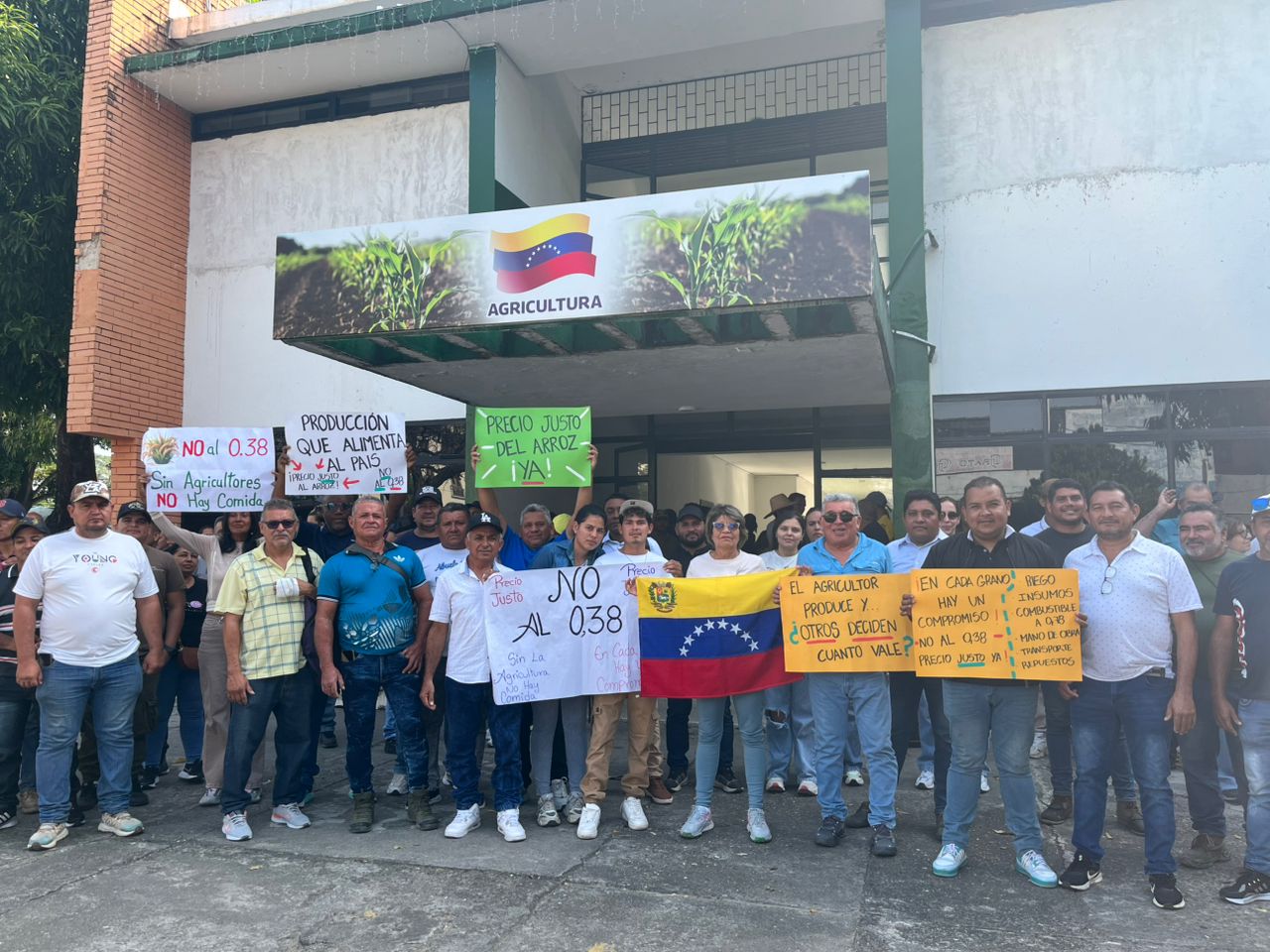
Demonstration outside the agriculture ministry’s office in Acarigua, Portuguesa state. (Archive)

Caracas, February 25, 2026 (venezuelanalysis.com) – Venezuelan rice producers have staged demonstrations in recent days, demanding responses from authorities to secure fair prices for their harvests.

Campesino organizations from Barinas, Cojedes, Guárico, and Portuguesa states have held meetings with their respective governors and local representatives of the Agriculture Ministry to denounce pressure from agribusiness conglomerates imposing lower prices for their crops.

Victor Martínez, a rice producer and representative from a rural association in Portuguesa state, told Venezuelanalysis that there is an urgent need to establish appropriate crop prices with harvesting set to begin in the coming days.

“We are calling on the Venezuelan government, from Acting President Delcy Rodríguez to Agriculture Minister Julio León Heredia, to intervene and help set fair prices for rice that take into account our production costs,” he explained. “We cannot have the agroindustrial conglomerates imposing prices unilaterally.”

According to Martínez, rural producers sold rice crops at $0.50-0.55 per kilogram last year, and presently the Iancarina group, the biggest agribusiness firm in Portuguesa state, is offering $0.32-0.38 per kilo. Iancarina holds significant market shares nationwide in corn flour and rice distribution with its “Mary” brand and has ties to the US-based transnational commodities marketer GSI Food.

“These prices would mean the extinction of rice production, jeopardizing thousands of jobs in the countryside,” Martínez continued. “We urge authorities to establish dialogue mechanisms that take our production costs into account.”

The rice growers additionally denounced that corporations have recently imported rice to drive down crop prices and that Venezuelan producers cannot compete with international prices due to “exorbitant production costs.” AgroPatria, a state-owned company that supplied agricultural inputs to campesinos, was turned over to private group AgroLlano in 2020.

Martínez stated that $0.70 per kilo of rice is the price Portuguesa producers have set as a target in negotiations.

“There are too many hurdles to produce right now, from very expensive inputs to a lack of access to credit,” he went on to add. “The same agroindustry corporations offer financing but with draconian conditions and our profit margins vanish.”

According to Martínez, current financing agreements see companies supply inputs and then collect as much as 60 percent of the crop as payment. 

“Agribusiness oligopolies say that they are better off just importing rice, which carries no risk for them. But no country can survive without agriculture.” He concluded with a call for halting imports and extending state support to campesino producers.

In recent days, rural collectives in different states have shared their production costs and come up with different proposals for Venezuelan authorities. They are likewise weighing the possibility of staging a rally in Caracas to demand the intervention of the Agriculture Ministry. Venezuelan government officials have yet to comment on the controversy.

In recent years, with the economy heavily constrained by US sanctions, the Nicolás Maduro government moved to liberalize agricultural policies, transferring former state competencies to the private sector, including provisioning of seed and fertilizer inputs and access to tractors. Fuel subsidies have likewise been phased out, with small-scale producers denouncing it as a major factor driving up production costs.

Campesino collectives have repeatedly drawn attention to a growing agribusiness influence both in the supply of inputs and the commercialization of harvests. Food conglomerates have used their control of silos and retail channels as well as imports during harvest season, to drive up profit margins by imposing lower prices on producers.

Apart from rice, farmers have condemned similar coercive practices with sugar and coffee. Standoffs have traditionally led to mediation from state authorities and a temporary agreement on prices. However, campesinos have repeatedly alerted that agribusiness firms stop honoring established prices or delay payments to take advantage of the Venezuelan currency devaluation.

Edited by Lucas Koerner in Fusagasugá, Colombia.

Source link