democrats

Louisiana congressional primaries are suspended as a result of Supreme Court ruling

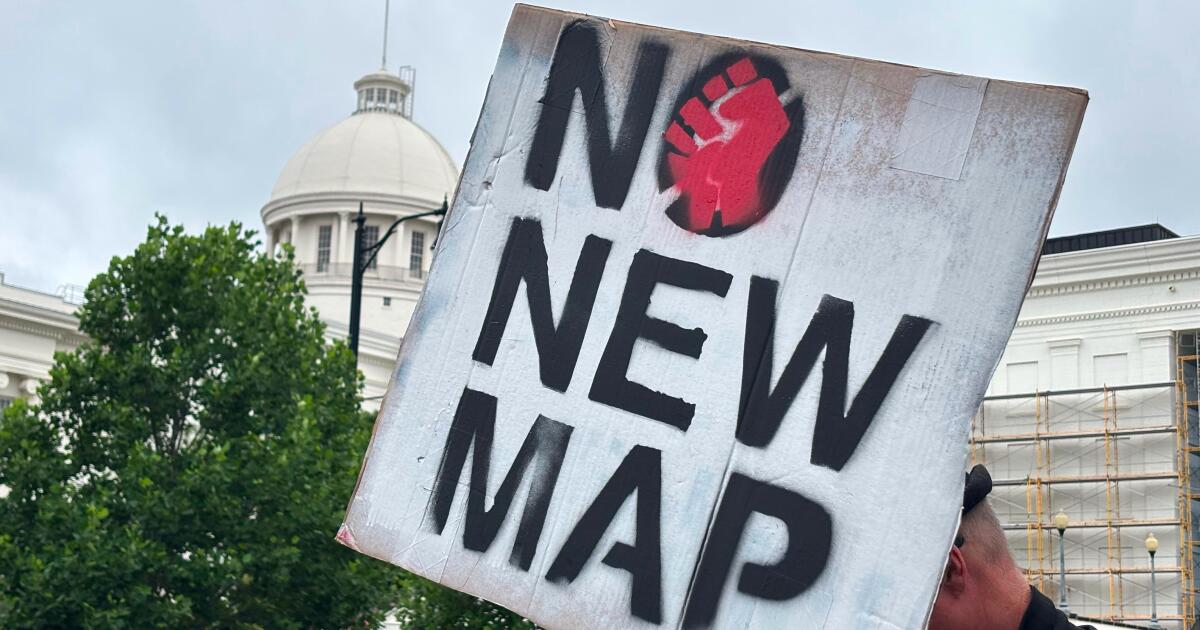
Louisiana’s congressional primaries won’t be going forward as scheduled in May, as a result of a U.S. Supreme Court ruling that struck down a majority-Black congressional district, the state’s top elected officials said Thursday.

Gov. Jeff Landry and Atty. Gen. Liz Murrill, both Republicans, said in a joint statement that Wednesday’s high court ruling effectively prohibits the state from carrying out the primaries under the current districts. Early voting had been scheduled to begin Saturday in advance of the May 16 primary.

“The State is currently enjoined from carrying out congressional elections under the current map,” Landry and Murrill said in the statement posted to social media. “We are working together with the Legislature and the Secretary of State’s office to develop a path forward.”

That path is likely to lead to a new U.S. House map benefiting Republican candidates in Louisiana.

President Trump, in a series of social media posts Thursday, praised Landry for moving quickly to revise the state’s congressional districts and urged Republican Tennessee Gov. Bill Lee to do likewise in light of the Supreme Court’s decision.

While civil rights activists denounced the potential for diminished minority representation in Congress, top Republicans cited the Supreme Court’s decision as justification to spur an already intense national redistricting battle among states before the November elections.

“I think all states who have unconstitutional maps should look at that very carefully, and I think they should do it before the midterm,” House Speaker Mike Johnson told reporters in Washington.

Questions persist about election postponement

Louisiana’s election suspension was denounced by some Democrats and questioned by some legal experts.

“This is going to cause mass confusion among voters — Democrats, Republicans, white, Black, everybody,” said Louisiana state Sen. Royce Duplessis, a Democrat who represents the New Orleans area. “What they’re effectively doing is changing the rules of the game in the middle of the game. It’s rigging the system.”

Although Louisiana officials may legally be able to move the primary, it’s not accurate to assert that it was blocked by the Supreme Court’s decision, said Ruth Greenwood, director of the Election Law Clinic at Harvard Law School.

State Rep. Kyle Green, a former assistant state attorney general who is chair of the House Democratic caucus, also cast doubt on the legal justification for postponing the congressional primary.

“The Court’s decision does not halt the election process on its own,” Green said. “And any attempt to suspend or disrupt an ongoing election at this stage would raise serious constitutional concerns.”

Delaying an election is unusual but not unprecedented.

During the onset of the COVID-19 pandemic in 2020, several states pushed back elections because of health concerns. Democratic Gov. John Bel Edwards, who led Louisiana at the time, postponed Louisiana’s April 4 presidential primary three weeks before it was supposed to occur — then delayed it again until July 11.

Louisiana could join a national redistricting wave

Louisiana currently is represented in the U.S. House by four Republicans and two Democrats. A revised map could give Republicans a chance to pick up at least one more seat in the November midterms — adding to Republican gains elsewhere from redistricting.

Voting districts typically are redrawn once a decade, after each census. But Trump last year urged Texas Republicans to redraw House districts to give the GOP an edge in the midterms. California Democrats reciprocated, and redistricting efforts soon cascaded across states.

On Wednesday, Florida became the latest state to redraw its U.S. House districts, adopting a new map backed by Republican Gov. Ron DeSantis that could give the GOP a chance at winning several additional seats.

The Florida vote occurred just hours after the U.S. Supreme Court’s conservative majority issued a ruling that significantly weakened minority protections under the federal Voting Rights Act. The court said Louisiana officials had relied too heavily on race when drawing a congressional district that is represented by Democrat Cleo Fields.

Trump wants Tennessee to also take up redistricting in response to the court’s ruling. The president posted on social media that he had spoken with Lee, who he said would work hard for a new map that could help Republicans gain an additional seat. Democrats currently hold only one of the state’s nine House seats — a district centered in Memphis, which is majority-Black.

Tennessee House Speaker Cameron Sexton, a Republican, said he is in conversations with the White House and others while reviewing the court’s decision.

Louisiana has a history of redistricting challenges

After the 2020 census, Louisiana officials had drawn House voting district boundaries that maintained one Black-majority district and five mostly white districts, in a state with a population that is about one-third Black.

A federal judge later struck down the map for violating the Voting Rights Act. And the following year the Supreme Court found that Alabama had to create its own second majority-Black congressional district.

In response, Louisiana’s Legislature and governor adopted a new House map in 2024 that created a second Black-majority district. But that map also was subsequently challenged in court, leading to the most recent Supreme Court ruling.

After the ruling, Landry called U.S. House candidates on Wednesday and told them that primaries would probably be stalled, according to Misti Cordell, a Republican running in a crowded race to fill U.S. Rep. Julia Letlow’s vacated seat.

“It’s an inconvenience for a candidate for sure, but you know they want to do it right versus having to go through all this again,” Cordell said. She added that she appreciated the heads-up before she and other candidates began “spending their war chest” during the final weeks leading up to election day.

Republican state lawmakers are reviewing which pending bills could be used to alter primaries and reconfigure congressional maps, said Louisiana state Rep. Beau Beaullieu, chair of the House committee overseeing redistricting efforts.

Cline, Brook and Lieb write for the Associated Press. Brook reported from New Orleans and Lieb reported from Jefferson City, Mo. AP reporter Travis Loller contributed to this report from Nashville.

Source link

Hegseth’s Day 2 clash with Democrats in Congress over Iran war

Defense Secretary Pete Hegseth clashed with Democratic lawmakers in Congress for a second day Thursday, rejecting senators’ accusations that the Iran war was launched without evidence of an imminent threat and waged with no coherent strategy.

The three-hour hearing of the Senate Armed Services Committee mostly traced the well-worn positions of Republicans and Democrats on the conflict, Hegseth’s leadership and the ways in which President Trump has used the American military.

In his opening statements, Hegseth called Democratic lawmakers “reckless naysayers” and “defeatists from the cheap seats” who have failed to recognize the many successes of the U.S. military against the Islamic Republic.

Hegseth said Trump has had the courage “unlike other presidents to ensure that Iran never gets a nuclear weapon and that their nuclear blackmail never succeeds. We have the best negotiator in the world driving a great deal.”

Democrats peppered Hegseth with questions about his efforts to remake military culture, U.S. support for Ukraine and whether Trump would seek congressional approval for the war. The Defense secretary said the ceasefire postpones the deadline for securing such approval.

Hegseth seemed to emerge with solid Republican support, though a few GOP senators asked about the dismissal of a top Army general and sought assurances that the Pentagon is doing everything possible to prevent civilian deaths.

The hearing was convened to discuss the Trump administration’s 2027 military budget proposal, which would boost defense spending to a historic $1.5 trillion. Hegseth and the chairman of the Joint Chiefs of Staff, Gen. Dan Caine, emphasized the need for more drones, missile defense systems and warships.

Top Democrat argues that war has left U.S. in worse position

Sen. Jack Reed, the committee’s ranking Democrat, argued that the war has left the U.S. in a worse strategic position, with 13 American troops killed, more than 400 injured and equipment destroyed.

The Strait of Hormuz remains closed, sending fuel prices skyrocketing, Reed said. Iran still has enriched uranium and retains enough combat effectiveness to keep the conflict locked in an impasse, while Iran’s hard-line government is still in charge.

“I am concerned that you have been telling the president what he wants to hear instead of what he needs to hear,” Reed said. “Bold assurances of success are a disservice to both the commander in chief and the troops who risked their lives based on them.”

Reed also lambasted Hegseth for his firing of top military leaders and suggested the Defense secretary had failed to recognize the accomplishments of women and people of color in the military. Reed noted that 60% of about two dozen officers fired by Hegseth have been female or Black.

Hegseth said that any firing is based on performance and that previous Pentagon leaders “were focused on social engineering, race and gender in ways that we think were unhealthy for the department.”

Republican chairman offers warmer welcome

Hegseth received a warmer welcome from Sen. Roger Wicker, the Republican chairman of the committee, and other GOP lawmakers. Wicker kicked off the hearing by noting that the U.S. is in the most dangerous security environment since World War II.

Through the war against Iran, Trump “has worked to remove the regime’s conventional military capabilities and force it back to the table for a permanent solution,” Wicker said.

He also commended the budget proposal for 2027, saying it “is chock-full of important programs and initiatives that are absolutely necessary to secure American interest in the 21st century.”

Sen. Deb Fischer, a Republican from Nebraska, praised Hegseth’s statement on the need for nuclear deterrence as well as the development of Trump’s Golden Dome missile defense program.

“For years, this committee has known that we must improve our ability to defend our homeland against a wider variety of threats,” Fischer said.

Sen. Tom Cotton, an Arkansas Republican, asked Hegseth whether he ever lied to Trump, pushing back against Reed’s claim that Hegseth tells the president what he wants to hear.

“I only tell the truth to the president,” Hegseth said.

Questions about civilian deaths

Senators also focused on civilian deaths in the Iran war and the Pentagon decision to hollow out a congressionally mandated office set up specifically to reduce civilian casualties.

The Associated Press has reported that growing evidence points to U.S. culpability for a deadly strike on an Iranian elementary school adjacent to a Revolutionary Guard base that killed more than 165 people, including children.

Democratic Sen. Kirsten Gillibrand of New York asked Hegseth, “What is your response to targeting that has resulted in the destruction of schools, hospitals, civilian places? Why did you cut by 90% the division that’s supposed to help you not target civilians?”

Hegseth responded that the Pentagon has an “ironclad commitment” to do more than other countries to prevent civilian deaths.

A day earlier, he battled with Democrats during a nearly six-hour House Armed Services Committee hearing, where he faced sharp questioning over the war’s costs in dollars, lives and diminishing stockpiles of crucial weapons.

Hegseth said Wednesday that the strike on the Iranian school remains under investigation.

War powers resolutions fail to pass

Democrats have called the conflict a costly war of choice that lacks congressional approval or oversight. But they have failed to pass multiple war powers resolutions that would have required Trump to halt the conflict until Congress authorizes further action.

Under the War Powers Act of 1973, Congress must declare war or authorize use of force within 60 days — a deadline that arrives Friday. The law provides for a potential 30-day extension, but the Republican administration has not indicated publicly whether Trump will seek it.

Sen. Tim Kaine, a Democrat from Virginia, asked Hegseth whether Trump will seek congressional authorization or ask for the 30-day extension. The Defense secretary said the clock pauses during a ceasefire. Kaine disagreed based on his reading of the law.

The Trump administration is in “active conversations” with lawmakers on addressing the 60-day timeline, according to a White House official, who spoke on condition of anonymity to discuss private deliberations.

Finley, Groves and Kinnard write for the Associated Press. Kinnard reported from Columbia, S.C. AP writer Seung Min Kim contributed to this report.

Source link

‘Earthquake’: Supreme Court limits Voting Rights Act in setback for Black Democrats, boost for GOP

The Supreme Court’s conservative majority on Wednesday sharply limited a part of the Voting Rights Act that has forced states to draw voting districts to help elect Black or Latino representatives to Congress as well as state and local boards.

In a 6-3 decision in Louisiana vs. Callais, the court ruled that creating these majority-minority districts may amount to racial discrimination that violates the 14th Amendment.

When weighing what the Voting Rights Act requires, “we start with the general rule that the Constitution almost never permits the federal government or a state to discriminate on the basis of race,” Justice Samuel A. Alito Jr. wrote for the court.

Alito said states may draw election districts for partisan advantage but may not use race as a basis for redistricting.

The ruling in a Louisiana case appears to clear the way for Republican-led states across the South to redraw their election maps and eliminate voting districts that favor Black or Latino candidates for Congress, state legislatures and county boards.

UCLA law professor Rick Hasen said, “It is hard to overstate what an earthquake this will be for American politics,” adding that the decision makes the Voting Rights Act a “much weaker, and potentially toothless law.”

Hasen said it’s unclear how the decision will affect the November election because in many states early voting has already started and primaries have already taken place.

But the ruling’s long-term consequences for minority representation in Congress, state legislatures and local government are almost “certainly” going to be felt in 2028, Hasen said.

Republican leaders in states across the South have already signaled they intend to move quickly to redraw congressional maps in the wake of the ruling.

Alabama Atty. Gen. Steve Marshall said the state will “act as quickly as possible” to ensure its congressional maps “reflect the will of the people, not a racial quota system the Constitution forbids.” Marshall called the decision a recognition of how much the South has changed since the civil rights era.

“The court rightly acknowledged that the South has made extraordinary progress, and that laws designed for a different era do not reflect the present reality,” he said in a statement.

Florida was already in motion before the ruling came down. But Gov. Ron DeSantis celebrated the decision and said it was all the more reason for state lawmakers to redraw its congressional maps, in a manner that could give Republicans up to four more seats in Congress.

The proposed congressional maps, drawn by DeSantis’ office, were first unveiled to Fox News on Monday. On Wednesday, both chambers approved the maps, and readied them for DeSantis’ final approval.

In Mississippi, Gov. Tate Reeves had already called lawmakers into a special session at the end of May in anticipation of a court ruling on the Voting Rights Act. In a post on X, Reeves underscored the ideological underpinnings to the ruling’s potential implications.

“First Dobbs. Now Callais. Just Mississippi and Louisiana down here saving our country!” Reeves wrote.

Sen. Raphael Warnock of Georgia speaks outside the Capitol.

Sen. Raphael Warnock (D-Ga.) speaks at a news conference outside the U.S. Capitol after the Supreme Court ruling.

(Tom Williams / CQ-Roll Call / Getty Images)

At issue was how to ensure equal representation for Black and Latino citizens.

About one-third of Louisiana’s voters are Black, but the state seeks an election map that will elect white Republicans to five of its six seats in the House of Representatives.

Lower courts said that map violated the Voting Rights Act because it denied fair representation to Black residents.

The state had one Black-majority district, in New Orleans.

Two years ago, judges upheld the creation of a second Black-majority district that stretched from Shreveport to Baton Rouge on the grounds that it was required under the law.

The state’s Republican leaders appealed and argued that race was the motivating factor in drawing the second district.

Alito and the conservatives agreed and called that district an “unconstitutional racial gerrymander.”

The three liberals dissented. The consequences of the ruling “are likely to be far-reaching and grave,” said Justice Elena Kagan, adding that it will allow “racial vote dilution in its most classic form.”

She said the decision means “a state can, without legal consequence, systematically dilute minority citizens’ voting power. Of course, the majority does not announce today’s holding that way. Its opinion is understated, even antiseptic.”

But she said states across the South may draw electoral districts that deprive Black voters of equal representation. Justices Sonia Sotomayor and Ketanji Brown Jackson agreed.

The decision was the latest example of a partisan political dispute in which the court’s six Republican appointees vote in favor of the Republican state plan, while the three Democratic appointees dissent.

The ruling is likely to have its greatest impact in the Southern states, where white Republicans are in control and Black Democrats are in the minority.

The court’s divide over redistricting is similar to the long dispute over affirmative action.

For decades, university officials said they needed to consider the race of applicants to achieve diversity and equal representation.

But in 2023, the court by a 6-3 vote struck down college affirmative action policies at Harvard and the University of North Carolina and ruled race may not be used to judge applicants.

The historic Voting Rights Act of 1965 succeeded in clearing the way for Black citizens to register and vote across the South, but it took longer for Black candidates to win elections.

The dispute was highlighted in a 1980 case from Mobile, Ala. Its three commissioners were elected to six-year terms, and each of them ran countywide.

Even though one-third of the county’s voters were Black, white candidates always won.

The Supreme Court upheld this arrangement as legal and constitutional. In dissent, Justice Thurgood Marshall said Black residents were left with the right to cast meaningless ballots.

In response, Congress amended the Voting Rights Act in 1982 to say states must give minorities an opportunity to elect representatives of their choice.

Four years later, the Supreme Court interpreted that to mean that states had a duty to draw voting districts that would elect a Black or Latino candidate if these minorities had a sufficiently large number of voters in a particular area.

In recent years, the court’s conservatives, led by Justice Clarence Thomas, have chafed at the rule on the grounds it sometimes required states to use race as a factor for drawing election districts.

Alito’s opinion adopted that view and said states are not required or permitted to use race as a basis for drawing districts.

Hours after the ruling came out, President Trump met with reporters in the Oval Office and said he had not yet seen the decision. He was visibly excited, however, when a reporter explained the decision favored Republicans.

“I love it!” he said. “This is very good.”

Former President Obama said in a statement that the court’s decision “effectively guts a key pillar of the Voting Rights Act, freeing state legislatures to gerrymander legislative districts to systematically dilute and weaken the voting power of racial minorities — so long as they do it under the guise of ‘partisanship’ rather than explicit racial bias.”

The Mexican American Legal Defense and Educational Fund, in Los Angeles, also denounced the decision.

“The Supreme Court’s decision blesses racially discriminatory gerrymandering, and dismantles the legal protections for minority voters,” said Nina Perales, the group’s vice president for litigation. It “openly invites states to dilute minority voting strength, and undermines our democracy.”

Source link

Florida Legislature approves new congressional map intended to boost Republicans in midterms

The Florida Legislature approved a new congressional map intended to maximize Republicans’ advantage in the state as part of the national redistricting battle that President Trump launched ahead of this year’s midterms.

The vote came just two days after Gov. Ron DeSantis unveiled his proposal and the same day that the U.S. Supreme Court rolled back a key provision of the Voting Rights Act. The decision could make it harder for Democrats to challenge Republican efforts to redraw congressional districts in ways that limit the influence of nonwhite voters.

DeSantis’ map could increase Republicans’ advantage in Florida’s House delegation to 24 to 4, up from the current split of 20 to 8. The potential four-seat gain is the same as what Virginia Democrats expect from a recent redistricting referendum, which is being challenged in state court there.

Florida’s new districts are certain to face lawsuits as well, especially because the state constitution prohibits redistricting for explicitly partisan purposes. DeSantis and his aides believe those provisions will not be a legal barrier because they have been weakened previously by the Florida Supreme Court and again by Wednesday’s U.S. Supreme Court ruling.

Florida Republicans, comfortable in their supermajority in both legislative chambers, said little about the new districts during the whirlwind special session. The measure’s sponsor, Rep. Jenna Persons-Mulicka (R-Fort Myers), limited her remarks to careful answers about an “evolving legal landscape” as Democrats’ asked her about the redistricting effort.

“I believe that there is a likelihood that that map will be upheld against legal challenge,” Persons-Mulicka said.

Opposition was vocal but futile

Democrats, activists and some citizens to decried the process as a partisan power play to satisfy Trump, boost DeSantis’ future ambitions and hurt the majority of registered Florida voters who are not Republicans.

“Y’all are doing this because y’all’s daddy in the White House is injecting national political objectives into what should be a state-driven process,” Rep. Michele Rayner (D-St. Petersburg) told her Republican colleagues before an 83-28 vote in favor of the measure.

The Florida Senate later approved the plan in a 21-17 vote.

Rep. Angie Nixon, a Jacksonville Democrat, chided Republicans for yielding the redistricting process to DeSantis, whose second term expires in January.

“Last time I checked, we’re the ones who were supposed to be drawing the map,” she said, “and yet we are allowing y’all to continue to hold the water of the governor, who is a lame duck and just trying to figure out what his next job is going to be.”

Democrats diminished in metro areas

The new map reshapes districts in Democratic areas around Orlando, the Tampa-St. Petersburg area and in south Florida around Palm Beach, Fort Lauderdale and Miami. The changes could cost Reps. Jared Moskowitz and Debbie Wasserman Schultz, among others, their seats.

DeSantis and his aides said before and during the session that new map is necessary to account for population growth in suburban and exurban areas since the 2020 census and to ensure Florida has a “race-neutral” congressional plan.

The proposal presumed the outcome of the U.S. Supreme Court’s Wednesday decision, which specifically struck down a Louisiana congressional district drawn for the electorate to be majority-Black. Historically, Black voters have aligned more with Democrats, while a majority of white voters lean toward Republicans.

The changes in Florida include the effective elimination of one nearly majority Black south Florida district that was represented by Rep. Sheila Cherfilus-McCormick, a Black Democrat, until her resignation earlier this month.

Lawmakers fast-tracked the measures

From the session’s opening bell Tuesday morning, Republican leaders moved swiftly.

In one of just two committee hearings, Senate Rules Chair Kathleen Passidomo (R-Naples) said she wanted “everybody who has taken the time and effort to come to Capitol to have an opportunity to speak.” Then she declared each speaker would have 30 seconds.

“I know that doesn’t seem like a lot but it actually is, uh, if you’re concise,” she said.

Deborah Courtney drove more than two hours from from Jacksonville and noted that all citizen speakers expressed opposition.

“Why are you doing this redistricting now?” she asked senators. “I doubt that your phone have been ringing off the hook from your constituents going, hey, we need some new maps.”

Rob Woods came from the Tampa area, which under the new map could have no Democratic representation in the U.S. House. A Black man, Wood told senators he was a veteran who said he “bought in from elementary school” on notions of the U.S. as an equal-opportunity democracy.

Now, he said, “it seems as if we are back in that period of Reconstruction, moving back to Jim Crow.”

On the House floor, Persons-Mulicka sidestepped specifics about what factors went into the map. She repeatedly called it “race-neutral,” citing testimony from DeSantis aide Jason Poreda, who took sole credit for the map during the session and did not disclose the names of any architects. But asked about Poreda’s admission that he examined party affiliation and voting patterns, Persons-Mulicka balked.

“I cannot speak to the intent of the map drawer,” she said.

DeSantis unveiled the map on Fox News

Persons-Mulicka and Sen. Don Gaetz, who sponsored the map in the Senate, deflected questions about why DeSantis unveiled the plan on Fox News.

Gaetz, a Crestview Republican, confirmed he had no part in drafting the map and forwarded the governor’s proposal to other senators as soon as he received it late Monday morning.

There’s no guarantee that new maps across the country will play out the way two parties hope. For example, Texas based its revised lines largely on Trump’s performance in 2024, redistributing the president’s voters across more districts to pull them into the Republican column. But Trump’s popularity has waned since his reelection, including among Latino voters who figure prominently in the state.

Florida could face a similar conundrum. Creating more majority-Republican districts could leave margins thin enough to allow for Democratic victories, especially if there’s an anti-Trump backlash at the polls this year.

Some Republicans have expressed worry about that possibility, and a handful voted against the measure in the Florida Legislature.

The governor already took a hit because of the session. He had wanted lawmakers to adopt state regulations on artificial intelligence, ostensibly protecting minors from harmful material, while rolling back vaccine mandates for students in Florida’s public schools. House Speaker Daniel Perez, a Republican but not a DeSantis ally, spiked both ideas.

DeSantis called it “political shenanigans.”

House Minority Leader Fentrice Driskell (D-Tampa) lamented that Republicans still delivered DeSantis the big-ticket item that he wanted.

“On destroying our democracy, they’ve been aligned,” she said, “and that’s what we did here today.”

Barrow writes for the Associated Press.

Source link

Skeptical Democrats confront Hegseth about Iran war for the first time since conflict started

Making his first appearance before Congress since the Trump administration went to war in Iran, Defense Secretary Pete Hegseth faced withering questioning from skeptical Democrats Wednesday over a costly conflict being waged without congressional approval.

The war has cost $25 billion so far, according to Pentagon numbers presented to the House Armed Services Committee during the contentious hearing, ostensibly focused on the administration’s 2027 military budget proposal, which would boost defense spending to a historic $1.5 trillion.

While Republicans focused on the details of military budgeting and voiced support for the operation, Democrats pivoted to the ballooning costs of the war, the huge drawdown of critical U.S. munitions and the bombing of a school that killed children. Some lawmakers also questioned President Trump’s dealings with allies and his shifting justification for the conflict.

Hegseth dismissed the criticism as political and rebuked lawmakers who pushed him for answers.

“The biggest challenge, the biggest adversary we face at this point are the reckless, feckless and defeatist words of congressional Democrats and some Republicans,” Hegseth said.

Democrats press about reasons for war

Wednesday’s hearing stretched nearly six hours as Democrats and some Republicans questioned Hegseth over the war and his ouster of several top military leaders.

In one tense exchange, Hegseth told Rep. Adam Smith (D-Wash.) that Iran’s nuclear facilities were obliterated in a 2025 attack by the U.S., prompting Smith to question the Trump administration’s reasoning for starting the Iran war less than a year later.

“We had to start this war, you just said 60 days ago, because the nuclear weapon was an imminent threat,” said Smith, the ranking Democrat on the committee. “Now you’re saying that it was completely obliterated?”

Hegseth responded by saying that Iran “had not given up their nuclear ambitions” and still had thousands of missiles.

Smith said the war “left us at exactly the same place we were before.”

Democrats accused Hegseth of misleading Americans about the reasons for the conflict and said rising gas prices are now threatening the pocketbooks of millions of people in the U.S.

“Secretary Hegseth, you have been lying to the American public about this war from day one and so has the president,” said Rep. John Garamendi of Walnut Grove, who called the war “a geopolitical calamity,” a “strategic blunder” and a ”self-inflicted wound to America.”

Hegseth blasted Garamendi’s remarks.

“Who are you cheering for here?” he asked the lawmaker. ”Your hatred for President Trump blinds you” to the success of the war.

Hegseth defends firings of officers

The Defense secretary faced intense questions from Rep. Chrissy Houlahan (D-Pa.) about his decision to oust the Army’s top uniformed officer, Gen. Randy George, one of several top military officers to be dismissed since Trump’s reelection.

Houlahan said George was deeply respected by both members of the military and Congress and asked why Hegseth fired him. Hegseth’s response that “new leadership” was needed failed to satisfy Houlahan.

“You have no way of explaining why you fired one of the most decorated and remarkable men —” Houlahan began before Hegseth interrupted her. “We needed new leadership,” he repeated.

The Pentagon announced this month that Navy Secretary John Phelan was stepping down. Hegseth previously removed Adm. Lisa Franchetti, the Navy’s top uniformed officer, and Gen. Jim Slife, the Air Force’s No. 2 leader, while Trump fired Gen. Charles “CQ” Brown Jr. as chairman of the Joint Chiefs of Staff.

Republican Rep. Don Bacon of Nebraska said that while Hegseth is empowered to make personnel changes, he shares what he called “bipartisan concern” about the firings.

“We had a huge bipartisan majority here that had confidence in the Army chief of staff and the secretary of the navy,” Bacon said. “And I would just point out it may be constitutionally right … but it doesn’t make it right or wise.”

Hegseth has said the changes are part of building a “warrior culture” at the Pentagon.

Republican Rep. Nancy Mace of South Carolina defended Hegseth’s personnel moves, saying he is “trying to innovate and trying to change the way we do business.”

“I’m glad that you’re firing people,” Mace said. “There are people there that are getting in your way. They need to go.”

Republicans back Trump on Iran

During the extended hearing, Hegseth detailed plans to increase pay for service members and upgrade munitions while also announcing that, as of Tuesday, the Pentagon had authorized $400 million in military aid for Ukraine in its fight against Russia.

But the debate and the questions were dominated by the war in Iran.

While a fragile ceasefire is now in place, the U.S. and Israel launched the war Feb. 28 without congressional oversight. House and Senate Democrats have failed to pass multiple war power resolutions that would have required Trump to halt the conflict until Congress authorizes further action.

Republicans say they back Trump’s wartime leadership, for now, citing Iran’s nuclear program, the potential for talks to resume and the high stakes of withdrawal. Still, GOP lawmakers are eager for the conflict to end, and some are eyeing future votes that could become an important test for the president if the war drags on.

Democrats questioned Hegseth over the war’s economic impact and rising gasoline costs, noting Trump’s promise to lower consumer costs. Hegseth responded by citing the threat posed by Iran.

“What is the cost of Iran having a nuclear weapon that they wield?” he said.

Republicans expressed support for Trump’s decision to strike Iran, including Mace, who in late March had expressed concerns about the justification for the war. “The longer this war continues, the faster it will lose the support of Congress and the American people,” she wrote in a social media post.

On Wednesday, Mace noted her past concerns but said she is “impressed with where we are today.” She told Hegseth: “Everything I have seen, you have surpassed all of my expectations.”

Iran’s closing of the Strait of Hormuz, a vital shipping corridor for the world’s oil, has sent fuel prices skyrocketing and posed problems for Republicans ahead of the midterm elections. The U.S. has imposed a naval blockade of Iranian shipping and three American aircraft carriers are in the Middle East for the first time in more than 20 years.

The countries appear locked in a stalemate. Trump told Axios on Wednesday that he is rejecting Iran’s proposal to reopen the Strait of Hormuz in exchange for lifting the U.S. blockade.

Finley, Groves, Klepper and Toropin write for the Associated Press.

Source link

White House says funds to pay TSA and other Homeland Security workers will ‘soon run out’

The White House is warning Congress that funding to pay Department of Homeland Security personnel will “soon run out,” sparking new threats of airport disruptions and national security concerns as the House slow-walks legislation to end what has been the longest-ever lapse in agency funding.

In a memo late Tuesday to lawmakers, the Office of Management and Budget said money that President Trump tapped to pay Transportation Security Administration and other workers through executive actions will be exhausted by May. It called on the House to quickly approve the budget resolution senators approved in an all-night session last week that would pave the way for full funding for the department.

“DHS will soon run out of critical operating funds, placing essential personnel and operations at risk,” the memo said.

The pressure from the Trump administration could help House Speaker Mike Johnson, whose narrow Republican majority has been stalled out, tangled in internal party disputes on a range of pending issues, including the Homeland Security funding. They have left the chamber at a virtual standstill.

The House was expected to vote as soon as Wednesday on the Senate budget resolution that is designed to unlock a multistep process to eventually fund the department. But by midday, House action again screeched to a halt. The administration has warned GOP lawmakers off making changes that could prolong passage.

“Restoring funding for the Department of Homeland Security has never been more urgent, as demonstrated by recent events,” the memo said, a nod to the situation over the weekend when a man armed with guns and knives tried to storm the annual White House correspondents’ dinner that Trump, the vice president and top Cabinet officials were attending.

Homeland Security shutdown is longest ever

Homeland Security has been operating without regular funds for more than two months after Democrats refused to fund Immigration and Customs Enforcement and Border Patrol without changes to those operations after the deaths of Americans protesting Trump’s deportation agenda.

While immigration enforcement workers have largely been paid through the flush of new cash — some $170 billion — that Congress approved as part of Trump’s tax cuts bill last year, others, including TSA, have had to rely on Trump’s intervention through executive action to ensure their paychecks.

But with salaries topping $1.6 billion every two weeks, Homeland Security Secretary Markwayne Mullin said recently, those funds are drying up.

More than 1,000 TSA officers have quit since the shutdown began, according to Airlines for America, the U.S. airlines trade group that called Wednesday on Congress to fully fund the agency.

“The urgency to provide predictable and stable funding for TSA is growing stronger by the day,” the group said in a statement. “Time and time again, our nation’s aviation workers and customers have been the victim of Congress’ failure to do their jobs.”

Complicated budget strategy ahead

House and Senate Republicans have embarked on a go-it-alone strategy, attempting to approve funds for Immigration and Customs Enforcement and Border Patrol without Democrats. They want to provide $70 billion for those immigration operations for the remainder of Trump’s term to ensure no further interruptions.

It’s a cumbersome process, the same that was used last year to approve Trump’s tax cuts bill, that will play out over several weeks.

The Senate launched the process last week, and is now waiting on the House to act. Once that budget resolution is approved, both the House and Senate are expected to draft the actual funding bill, a process that can take weeks.

In the meantime, Johnson is next expected to quickly turn this week to legislation that would fund the other parts of Homeland Security, including TSA, the Coast Guard and other agencies.

That bipartisan bill has support from Democrats and already passed the Senate a month ago, when Republicans reluctantly agreed to carve out the immigration-related funds that Democrats had opposed. But it has been stalled out in the House, as Republicans in that chamber disagreed with the Senate’s approach.

Mascaro writes for the Associated Press. AP writer Rio Yamat in Las Vegas contributed to this report.

Source link

California governor debate: Candidates scrap over gas tax, homelessness

The top candidates for California governor clashed over the high costs of gas, housing and homeowner’s insurance in a testy debate Tuesday evening, a fiery exchange that may finally draw voter attention as the June 2 primary election fast approaches.

Former U.S. Health and Human Services Secretary Xavier Becerra, whose campaign blossomed after former Rep. Eric Swalwell dropped out amid sexual assault and misconduct allegations, came under persistent attack during the 90-minute debate but also went on the offensive.

Former Fox News host Steve Hilton, a Republican who leads all candidates in the most recent opinion polls, ripped Becerra for promising to declare a state of emergency to address rising homeowner’s insurance rates, saying the governor lacks that constitutional authority.

“We can’t have a governor who doesn’t understand how the government works,” Hilton said.

Becerra, who served as California attorney general before joining the Biden administration, quickly defended himself, saying he knows the law better than Hilton does.

“We don’t need a talking head from Fox News to tell us how the government works,” he said.

And that was after Becerra got in an early dig at Hilton, who has been endorsed by President Trump, by referring to Trump as “Hilton’s daddy.”

The debate was broadcast and livestreamed by CBS stations around the state. Hundreds of people watched from Pomona College’s historic Bridges Auditorium, a Renaissance Revival-style landmark with Art Deco flourishes that was once among the premier performance venues in Southern California.

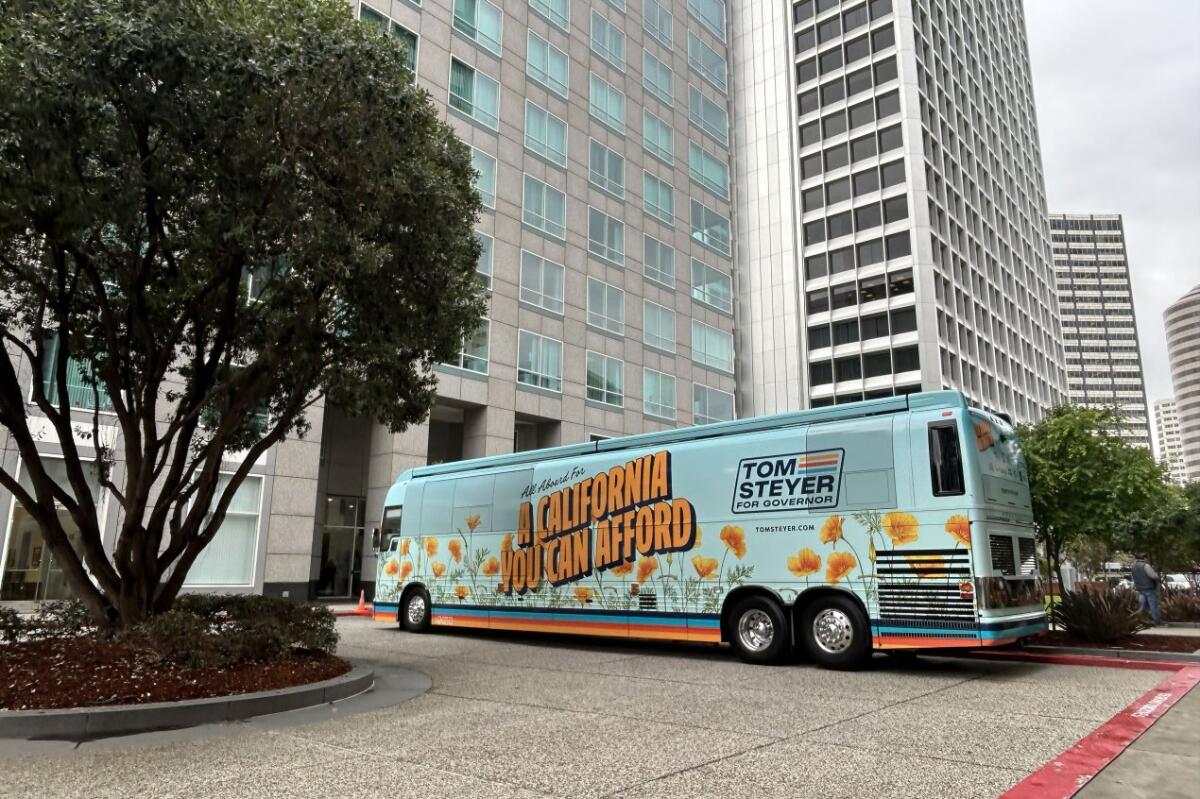
With eight major candidates from both parties participating, CBS moderators billed it as “the largest and most inclusive debate of the election.” Becerra and Hilton were joined by Republican candidate Riverside County Sheriff Chad Bianco and Democratic candidates San José Mayor Matt Mahan, former Orange County Rep. Katie Porter, billionaire Tom Steyer, state Supt. of Public Instruction Tony Thurmond and former Los Angeles Mayor Antonio Villaraigosa.

Some takeaways from the debate:

Candidates didn’t shy away from the top issues

Moderators set the theme for the first half-hour of the debate as “affordability,” a top concern among California voters, and almost immediately the candidates began sniping and talking over one another.

Almost all of them vowed to accelerate home construction in California, pivotal to reducing the state’s high cost of housing.

There was no shortage of ideas for other ways to ease the financial burdens facing Californians, but few specifics on how they would deliver on those promises given the state’s complex and arduous legislative process.

Hilton promised to cap the price of gas at $3 per gallon, and Mahan vowed to suspend the state gas tax. Bianco said Democrats have long overregulated and overtaxed Californians, and the state’s supermajority Democratic Legislature would have to get in line with him and end those things if he’s elected.

Becerra said he would reduce prescription drug prices. Thurmond said he would provide down-payment assistance grants to those trying to own their first home.

Barbs traded over climate-caused emergencies

Anchors and reporters from local CBS stations moderated the debate, including Los Angeles anchor Pat Harvey, Sacramento anchor Tony Lopez, Bay Area anchor Ryan Yamamoto and national investigative correspondent Julie Watts. They were joined by Sara Sadhwani, an assistant professor of politics at Pomona College and a member of California’s independent redistricting commission.

Moderators pointed to the surge in catastrophic wildfires across the state in recent years due to climate change, as well as the threat of earthquakes, and asked the candidates how they would respond to future emergencies.

As he did throughout most of the debate, Bianco responded by bashing California’s Democratic leadership, which he said created most of the ills facing the state.

Bianco said the root causes of fire disasters in the state are “not because of climate change” but due to “failed environmental activist policies” that prevented fire departments from clearing highly flammable brush around communities for years.

Mahan, after touting his actions as a Silicon Valley mayor during emergencies, quickly pivoted to take shots at Becerra and his role as U.S. Health and Human Services secretary during the pandemic.

He said Becerra had “never met a crisis that he couldn’t ignore” and accused Becerra of failing to deal with COVID-19, monkeypox and the surge of unaccompanied minors at the U.S.-Mexico border during the Biden administration.

Becerra responded by saying that his agency dealt with the crises by working with all 50 states and the federal government to quickly roll out vaccines and other resources.

“You’re not wearing a mask, are you, Matt? You’re not worried about catching monkeypox, right?” Becerra said.

Steyer also came under attack when he starting discussing his plans to “make polluters pay” for the effects of climate change. Porter criticized the former San Francisco hedge-fund founder for making millions off the oil and gas industry, and using those profits to fund his campaign for governor. Steyer has spent more than $143 million of his own money on his campaign, according to fundraising disclosures filed with the California secretary of state’s office.

“How about profiteers pay? You pay the lowest tax rate on this stage, and yet you made the billions that you’re using to fund your campaign off fossil fuels,” Porter said to Steyer.

Steyer responded that he is a “change agent” candidate opposed by special interests and pointed to campaign committees funded by utility and other industry groups opposing his bid. PG&E, the California Chamber of Commerce and the California Assn. of Realtors have put more than $29 million into a pair of committees to fund attack ads against the billionaire.

Republicans focus on blaming Democrats

Just weeks before the June 2 primary, the race to replace term-limited Newsom remains wide open, with many voters still undecided.

Republicans Hilton and Bianco have led numerous public opinion polls while the large field of Democrats have split the vote, leading to fears among Democrats that the party could get shut out of the general election, despite outnumbering Republicans nearly two-to-one among the state’s registered voters. In California’s open primary, the top two finishers advance to the general election, regardless of party affiliation.

The two Republicans avoided overtly attacking each other at the debate but were regularly the targets of other candidates on the stage.

Becerra, speaking about federal healthcare funding cuts approved by President Trump and congressional Republicans last year, referred to the president’s endorsement of Hilton. “The first thing we have to do is stop Steve Hilton’s daddy,” Becerra said.

Hilton responded jokingly that his father, who was the goalie for the Hungarian national ice hockey team, hadn’t weighed in on the race. And he said Becerra’s comment pointed to what is wrong with California politics — a fixation on Trump despite Democrats controlling the state for more than a decade.

“We’ve had the same people in charge for 16 years now, and it’s such a disaster and such a high cost of living for everyone, and the highest poverty rate in the country and the highest unemployment rate in the country, and the worst business plan,” Hilton said. “All these things going wrong, they can’t do anything except blame Trump. Let’s see how many times you hear that tonight.”

Bianco grew visibly frustrated several times over the debate’s format and his opponents’ answers. At different points, he compared the event to “The Twilight Zone” and called it “the hour and a half that [viewers] are never going to get back.”

Pressed on what he would do differently if elected, the Riverside sheriff also focused on criticizing Democrats and accusing them of lying.

“We have a group of of 20-ish-year-old kids and we’re just sitting here lying to them about broken Democrat policies in California for the last 20 years, and we’re going to sit here and blame a president who’s been president for a year. This is absolutely ridiculous,” he said.

Hilton has seen a bump in his polling numbers since he was endorsed by President Trump earlier this month. A CBS News/YouGov poll of more than 1,400 registered voters released Monday showed Hilton leading with 16%, followed by Steyer with 15%, Becerra with 13%, Bianco with 10%, Porter with 9%, Mahan and Villaraigosa with 4% and Thurmond with 1%. The largest group of voters — 26% — was undecided.

Nixon reported from Sacramento and Mehta reported from Claremont. Times staff writers Kevin Rector, Dakota Smith and Blanca Begert contributed to this report.

Source link

Florida redistricting and a rocky special session put DeSantis back in the Republican spotlight

Ron DeSantis was once the future of the Republican Party, a battle-tested conservative twice elected as governor of Florida. Then Donald Trump steamrolled him on his way back to the White House.

Now, more than two years after DeSantis ended his presidential campaign and endorsed Trump, the governor has called a special legislative session on redistricting and other issues that will put him back in the national spotlight and maybe remind Republicans that he could lead the party one day.

But there are also plenty of risks involved for the 47-year-old governor, and they became immediately apparent after lawmakers convened Tuesday.

DeSantis is pushing state lawmakers to redraw Florida’s congressional map as part of a coast-to-coast redistricting battle ahead of November’s midterm elections. His proposal, released the day before the session began, would make it easier for Republicans to win up to four more seats, equivalent to Democrats’ potential gains from last week’s referendum in Virginia.

The governor also wanted lawmakers to adopt new regulations for artificial intelligence and loosen vaccine requirements. However, his proposals quickly hit a roadblock when House Speaker Daniel Perez, a Republican but not a DeSantis acolyte, told members that he would not advance any legislation on those issues.

Perez said the governor’s maps are on a fast track, with a House vote expected Wednesday, but some Republicans are worried that a gerrymandered map will backfire and make it easier for Democrats to pick up seats, something that would be a black eye for DeSantis.

He already faces tough prospects on the national stage, even with Trump constitutionally barred from running for a third term in 2028. DeSantis has had a relatively low profile during Trump’s second presidency and would likely have Vice President JD Vance and Secretary of State Marco Rubio, another Floridian, to contend with in a Republican primary.

“The window for Ron looks reasonably narrow at this point,” said Whit Ayres, who served as DeSantis’ pollster in his first campaign for governor in 2018.

DeSantis’ office did not immediately respond to a request for comment on Tuesday. But the governor has at least embraced the national redistricting fight. When House Minority Leader Hakeem Jeffries (D-N.Y.) last week dared Florida Republicans to go ahead with their special session, the governor punched back with the kind of aggressiveness he showed in the early days of his failed White House bid.

“I will pay for you to come down to Florida and campaign,” DeSantis said of Jeffries. “I’ll put you up in the Florida governor’s mansion. We’ll take you fishing.”

DeSantis wants four more Republican seats

DeSantis unveiled his proposed congressional map to Fox News on Monday even before it had been widely circulated among lawmakers. He argued that the 2020 census shortchanged the state’s population, making it necessary to redraw the lines.

The governor’s map, if approved, would reshape districts in Democratic areas around Orlando, Tampa Bay, Miami and Fort Lauderdale. The changes could cost Democratic Reps. Jared Moskowitz and Debbie Wasserman Schultz, among others, their seats.

The current maps yielded a 20 to 8 Republican tilt in 2024. DeSantis’ version would aim for an advantage of 24 to 4.

DeSantis first announced the special session in January, months after Trump started pushing Republican-run states to redraw their congressional boundaries. What followed has been a tit-for-tat battle, with each party looking for an edge in the midterms.

The Virginia referendum celebrated by Democrats is facing a court challenge. Another legal battle is playing out in Wisconsin, where Democrats also hope to pick up another seat or two.

There’s no guarantee that new maps will play out the way parties hope. For example, Texas based its revised lines largely on Trump’s performance in 2024, theoretically redistributing the president’s voters across more districts to pull them into the Republican column. But Trump’s popularity has waned since his reelection, including among Latino voters who figure prominently in the state.

Florida could face a similar conundrum. Creating more majority-Republican districts but with thinner margins could dilute GOP advantages and give Democrats more opportunities to win seats, especially if there’s an anti-Trump backlash at the polls this year.

Karl Rove, a former top political advisor to President George W. Bush, warned that if Florida Republicans get too aggressive, “they may lose a seat or two.”

Brian Ballard, an influential Florida lobbyist who has been DeSantis’ top fundraiser, said it’s worth remembering that DeSantis was the muscle behind the current map that expanded Republicans’ advantage in the state.

“He’s incredibly smart and capable,” Ballard said. “And he doesn’t get enough credit for that map. He’s done this before.”

Florida legislative leaders are not rubber stamps for DeSantis

As it did Tuesday, the Florida House has grown more willing to buck the governor in recent sessions. Perez and Senate President Ben Albritton made clear for weeks that they were not drawing their own proposals and would react only to what DeSantis put forward.

Albritton sent multiple memos to senators reminding them of Florida’s state constitutional limits on redistricting and the requirement that it not be done as a blatantly partisan act.

Perez sidestepped questions Tuesday about whether the maps violate those requirements, which Florida voters approved by a nearly 2-to-1 margin in 2010. Democrats and political advocates have promised legal challenges.

Beyond redistricting, DeSantis was effectively asking House members to approve AI and vaccine proposals that they refused even to advance out of committee earlier this year.

On AI, DeSantis wanted to require tech companies to ensure children cannot interact with chatbots without parental permission. He also wanted to prevent AI from generating harmful material for minors. That proposal put DeSantis at odds with Trump, who wants the federal government to be the regulator of AI technology. Perez said he sides with the president, calling AI a “national security issue” that is “bigger than just one state.”

On vaccines, DeSantis wanted to add a conscience-based exemption to public school vaccine requirements, similar to the existing religious exemption. That aligns him with the anti-vaccine portion of the Trump base that was instrumental in making Robert F. Kennedy Jr. the U.S. Health secretary.

Perez countered that vaccine requirements in the U.S. “have been working for decades” and said he remains uncomfortable with “children being in school without measles and mumps and polio and chickenpox vaccines.”

Political observers are watching — even at the White House

Ballard downplayed any political concerns for DeSantis. What may seem to some as strained relations with certain Republican legislative leaders, he said, is simply measuring DeSantis against the opening years of his tenure.

“I mean, he went from batting a thousand to maybe batting .600,” Ballard said, using a baseball analogy for the governor who played the sport while attending Yale. “That isn’t failure.”

During the last Republican presidential primary, DeSantis initially gave conservative establishment figures and key donors an option other than Trump, who grew frustrated by the challenge and mocked the governor as “Ron DeSanctimonious.”

But Trump seemingly forgave DeSantis when he dropped out of the race and endorsed Trump following his victory in the Iowa caucuses. He even promised to call DeSantis by his actual name.

There’s more bad blood within the White House, though. Chief of Staff Susie Wiles, a Floridian, managed DeSantis’ razor-thin 2018 victory, only for the governor to have a falling-out with her.

Wiles did not respond to a request for comment. But Ayres said he’s certain she’s paying attention.

“Donald Trump has a long memory, and Susie Wiles has a longer one,” he said. “And that doesn’t bode well for Gov. DeSantis to be Donald Trump’s Republican successor.”

Barrow writes for the Associated Press. Scott Bauer contributed to this report from Madison, Wis.

Source link

Virginia Supreme Court considers whether to block voter-approved U.S. House map favoring Democrats

Virginia Supreme Court justices on Monday questioned whether the state’s Democrat-led legislature complied with constitutional requirements when it sent a congressional redistricting plan to voters, in a case that could help decide the balance of power in the U.S. House.

The new districts, which could net Democrats four additional seats, won narrow voter approval last week. But a Republican legal challenge contends the General Assembly violated procedural rules by placing the constitutional amendment before voters to authorize the mid-decade redistricting. If the court agrees that lawmakers broke the rules, it could invalidate the amendment and render last week’s statewide vote meaningless.

The Virginia court proceedings mark the latest twist in a national redistricting battle between Republicans and Democrats seeking an advantage in a November midterm election that will determine whether Republicans maintain their narrow majority in the U.S. House.

President Trump kicked off a tit-for-tat round of gerrymandering last summer when he urged Texas Republicans to redraw districts to their favor in an attempt to win several additional House seats. That set off a chain reaction of similar moves in other states, leading to the voter approval last week of Virginia’s new map.

Next up is Florida, where Republican Gov. Ron DeSantis has included congressional redistricting on the agenda for a special session of the GOP-controlled Legislature beginning Tuesday.

Virginia arguments focus on what counts as an `election’

During Monday’s arguments, the Virginia Supreme Court focused on whether the new congressional districts should be invalidated because of the process used by lawmakers. The justices issued no immediate ruling.

Because the state’s redistricting commission was established by a voter-approved constitutional amendment, lawmakers had to propose an amendment to redraw the districts. That required approval of a resolution in separate legislative sessions, with a state election sandwiched in between, to place the amendment on the ballot.

The legislature’s first vote occurred in October — while early voting was underway but before it concluded on the day of the general election. Judicial questioning focused on whether that was too late, because early voting already had begun.

Attorney Matthew Seligman, who defended the legislature, argued that the “election” should be defined narrowly to mean the Tuesday of the general election. In that case, the legislature’s first vote on the redistricting amendment occurred before the election and was constitutional, he told judges.

But an attorney arguing for the plaintiffs, Thomas McCarthy, said “election” means the entire period during which people can cast ballots, which lasts several weeks in Virginia. If that’s the case, then the legislature’s initial endorsement of the redistricting amendment came too late to comply with the state constitution, he said.

Attorneys argue over the rights of voters

The purpose of Virginia’s two-step amendment process, with an intervening election, is so voters can know whether legislative candidates support or oppose a proposed constitutional amendment, McCarthy said.

He pointed to the case of Democratic voter Camilla Simon, one of the plaintiffs in the lawsuit alongside Republican state lawmakers, who cast an early vote last fall for Democratic Del. Rodney Willett. After she voted, Willett sponsored the Democratic redistricting amendment, and Simon wished she could have undone her vote, McCarthy said.

“None of these voters had any idea this was coming, and that’s not how this process is supposed to work,” McCarthy told the justices.

Those defending the Democratic redistricting plan also contend that the voters’ will should be respected.

The people voted to ratify the constitutional amendment, “and the challengers are asking to overturn that democratic result,” Seligman told reporters after the arguments.

Nationwide redistricting battle has no clear winner so far

So far, the two major parties have battled to a near draw in the states that have redrawn their congressional maps for this year’s midterms.

Republicans think they could win up to nine more seats under revised districts in Texas, Missouri, North Carolina and Ohio. Democrats think they could win as many as 10 additional seats under new districts in California, Utah and Virginia. But legal challenges remain in both Virginia and Missouri.

Virginia currently is represented in the U.S. House by six Democrats and five Republicans who were elected from districts imposed by a court after a bipartisan redistricting commission failed to agree on a map after the 2020 census. The new districts, which narrowly won voter approval on April 21, could give Democrats an improved chance to win 10 districts.

Some candidates already have begun campaigning based on the new districts in advance of the state’s Aug. 4 primary election.

More court battles could remain in Virginia

In January, a judge in rural Tazewell County, in southwestern Virginia, ruled that lawmakers failed to follow their own rules for adding the redistricting amendment to a special session last fall. Circuit Judge Jack Hurley Jr. also ruled that lawmakers failed to initially approve the amendment before the public began voting in last year’s general election and that the state had failed to publish the amendment three months before the election, as required by law. As a result, he said, the amendment is invalid and void.

The Virginia Supreme Court placed Hurley’s order on hold and allowed the redistricting vote to proceed before hearing arguments on the case.

During Monday’s arguments, justices also raised questions about the ability of lawmakers to expand the agenda for their special session and whether the three-month public notice requirement was important enough to thwart a voter-approved amendment.

Republicans have filed at least two additional legal challenges, which also are winding their way through the courts.

Robertson and Lieb write for the Associated Press. Lieb reported from Jefferson City, Mo. AP writers Allen G. Breed in Richmond and Nicholas Riccardi in Denver contributed to this report.

Source link

Leavitt blames democrats for ‘cult of hatred’ against Trump | Donald Trump News

NewsFeed

White House press secretary Karoline Leavitt blamed democrats for promoting the rhetoric which fuels what she described as “cult of hatred” against US President Donald Trump following the shooting that took place at the correspondents’ dinner in Washington, DC on Saturday.

Source link

Column: After Swalwell scandal, a ‘safe choice’ for Democrats emerges

Xavier Becerra seems like the type of steady, trustworthy fellow you’d like your daughter to marry. But she’s attracted to a charming party animal.

Then the flashy dude does something really stupid and repulsive. Daughter is jarred into her senses and decides to size up the unexciting but reliable guy.

That’s how I’m seeing the suddenly captivating contest to succeed termed-out Gov. Gavin Newsom.

OK, it’s not a perfect analogy. Becerra is 68, been happily married for 37 years and the couple have three grown children. But the principle’s the same: He’s the safe choice. The hot other character merely fooled lots of people for a while.

You’re reading the L.A. Times Politics newsletter

George Skelton and Michael Wilner cover the insights, legislation, players and politics you need to know. In your inbox Monday and Thursday mornings.

Becerra is suddenly getting a hard look because the fast-stepping, front-running Democrat Eric Swalwell revealed himself to be totally unworthy of public office.

Five women accused the married Bay Area congressman of sexual misconduct, including rape. He denied the allegations but apologized to his wife for past “mistakes in judgment.” Donors, endorsers, staffers and voters immediately fled his campaign. And he quickly slunk away.

And Becerra surged.

Why?

“People are looking for something stable,” Becerra answered when I asked. “Everybody likes pizzazz and glitter. Then all of a sudden their hero falls from grace. And they look for who they can trust.”

Dan Schnur, who teaches political communications at USC, UC Berkeley and Pepperdine, says: “Democrats had a near-death experience with Swalwell. They don’t seem to be in the mood to take more risks.”

Schnur calls Becerra “this year’s version of Joe Biden’s 2020 campaign.” He’s the safe choice. “Sometimes being ‘none of the above’ is good enough.”

Since Swalwell’s collapse, the once-floundering Becerra has had a meteoric rise in the polls.

A survey conducted for the state Democratic Party showed Becerra rising by 10 points from single digits to tying Tom Steyer, a billionaire hedge fund founder turned climate warrior. Close behind was former Orange County Rep. Katie Porter.

Those three are now the leading Democratic competitors for a slot on the November ballot. The top two vote-getters in the June 2 primary, regardless of party, will advance to the general election.

Republican former Fox News host Steve Hilton was leading the entire field in the poll, followed closely by Riverside County Sheriff Chad Bianco.

Steyer and Porter are both liberals in their ideology and personalities. Neither are flamethrowers, but they‘re fiery. In contrast, Becerra also is an ideological liberal, but with a low-key demeanor that might cause one to mistake him for a political moderate.

San José Mayor Matt Mahan is clearly a Democratic centrist. But in this era of intense polarization, moderation may be a hard sale. At least, it has been so far for Mahan.

Among those six Democratic and Republican candidates, Becerra boasts by far the most outstanding political resume.

He was U.S. secretary of Health and Human Services under President Biden. Before that as state attorney general, California’s mild-mannered “top cop” showed his aggressiveness by suing the first Trump administration 123 times and winning the vast majority of cases. He also served 12 terms in Congress from Los Angeles and became part of the Democratic leadership. And he served one term in the state Assembly.

That’s an impressive list. But Schnur says Becerra was “the least impressive” candidate in a 90-minute televised debate last week.

“He talked in very vague generalities,” the former political operative says, but adds: “In the middle of the other candidates’ drama and emotional outbursts, he seemed very calm and safe.”

Some pundits and pols have been calling on Becerra to show more fire. But that’s not him. He’s guarded and understated. It’s how he’s wired. If he attempted a personality change, it probably wouldn’t work. There’s a risk of it seeming contrived and phony.

But Becerra should be more specific on issues. Exactly how would he make life better for Californians?

His basic answer when asked how he’d solve a given problem pestering California is essentially: Trust me. I’ll meet with all sides and figure it out.

That’s not just a cop-out. It’s his pragmatic modus operandi.

That reserved style prompted this shot during the debate from Porter, who tends toward specificity:

“Mr. Becerra, you have all these lovely plans. But there are never any numbers, any revenue plan, any details. … The how, the why and how much, it’s all missing.”

Becerra responded with some rare emotion: “That’s very rich to hear from someone who’s never had to actually run a government.” The former Cabinet secretary said he’d balanced four federal HHS budgets that were larger than the California state budget.

I asked Becerra about some issues last week. Here’s partly what he said:

Housing costs: Expedite building by streamlining more regulations. “We’ll continue to have rules, but let’s make them smart rules.”

Gas prices: Keep more refineries from closing. “Let them know they can operate and produce and not lose money. That’s an easy one.”

High-speed rail: ”We’re going to build the bullet train, but not this bullet train. It’s too expensive. Sit everybody down and come out with a position.”

Banning new gas cars by 2035: Is Newsom’s goal realistic? “Seeing what I see, no. We can’t make it by ‘35, but we can make it.”

But let’s be honest. Elections usually turn more on likability than policy positions.

“Decency may be a quality that goes a long way” in the governor’s race, says longtime Democratic strategist Darry Sragow. “In part that’s because of the Swalwell revelations and also because of Trump, who’s not decent. Decency may be what people are looking for.”

But Democrats are riled up by Trump and they’re also demanding backbone and fight.

Many are eyeing Becerra as someone perhaps worth partnering up with. A bit more passion from him could help sustain their interest.

What else you should be reading

The must-read: The congressional landmine stirring fears about the midterm election — and a Trump power grab
Brace yourself: Voter ID controversy headed for California with initiative on November ballot
The L.A. Times Special: How a Trump-endorsed Republican could become California’s next governor

Until next week,
George Skelton


Was this newsletter forwarded to you? Sign up here to get it in your inbox.

Source link

Analysis: Trump loomed over midterms and GOP suffered for it

The protracted uncertainty over control of Congress reverberated through both major political parties on Wednesday, as Democrats basked in the relief of the red wave that wasn’t and Republicans became increasingly clear-eyed that the lingering influence of former President Trump had hamstrung their party.

President Biden’s emphasis during the campaign season on the extremism of “MAGA Republicans” had been greeted skeptically by many. In the Democratic Party’s better-than-expected showing, though, he saw vindication of his appeals for civility and normalcy.

“This election season, American people made it clear: They don’t want every day going forward to be a constant political battle,” Biden said at a White House news conference. “The future of America is too promising to be trapped in endless political warfare.”

Amid high inflation and Biden’s lackluster approval numbers, Democrats’ hopes had hinged on voters being more put off by Trump’s imprint on the Republican Party — be it the divisive candidates he endorsed, the political violence that festered from his lies about election fraud, or the reversal of federal abortion protections made possible by justices he appointed to the Supreme Court.

“We knew going into the cycle that there was going to be an opportunity to rally a moral majority that is an anti-MAGA coalition,” said Tory Gavito, president of Way to Win, a progressive donor network. “When I say that, I include everyone from [GOP Rep.] Liz Cheney to [democratic socialist Sen.] Bernie Sanders. Think about that spectrum of the middle to the left coming together to say Republicans are just too damn extreme.”

If recent history is any guide, Trump’s not going anywhere. The once and likely future presidential candidate is unpopular, but he continues to exercise outsized sway over the Republican base, and could hobble the party for the next two years and beyond.

“While in certain ways yesterday’s election was somewhat disappointing, from my personal standpoint it was a very big victory,” Trump said on his conservative social media network, Truth Social, pointing to the record of candidates he endorsed. “219 WINS and 16 Losses in the General – Who has ever done better than that?”

The specter of the former president hampered the GOP’s ability to frame the midterm as a referendum on Biden, said Ken Spain, a GOP strategist and former spokesman for the party’s House campaign arm.

“Trump was always a looming shadow over this election, more than Republicans probably wanted to admit,” he said. “This essentially became a choice election between an unpopular president and an even more unpopular Trump.”

There were signs that patience was running thin among Republican power brokers. Notably, Trump’s much-beloved New York Post, the tabloid owned by conservative media magnate Rupert Murdoch, featured Florida Gov. Ron DeSantis on its cover Wednesday with the headline “DeFuture.” DeSantis is widely considered Trump’s biggest threat for the 2024 GOP presidential nomination.

Republicans still had a chance of winning both chambers of Congress as vote-counting continued Wednesday. House Minority Leader Kevin McCarthy (R-Bakersfield) projected confidence that his party would win the five additional seats necessary to take the majority there, and announced his intention to run for speaker of the House.

Whether he secures a majority may come down to his home state. California’s 11 competitive races remained unsettled as of Wednesday evening, with results trickling in slowly, as is common with the state’s methodical ballot-counting procedures.

Republicans had targeted incumbent Democratic Reps. Katie Porter and Mike Levin in Orange County, as well as an open seat in the Central Valley, as possible pick-ups. But Democrats were also watching the returns for the potential to oust vulnerable GOP Reps. David Valadao of Hanford and Ken Calvert of Corona.

Republican Sen. Ron Johnson of Wisconsin notched a close win over Democratic challenger Mandela Barnes, giving Republicans a 49-48 advantage in the Senate, with races in Georgia, Arizona and Nevada yet to be decided.

With neither candidate in Georgia winning more than 50% of the vote, the race will go to a Dec. 6 runoff, like the one that decided Senate control in 2020. A 50-50 split in the Senate would let Democrats maintain control with Vice President Kamala Harris’ tiebreaking vote.

Republicans made some successful pushes into blue territory; in New York, for example, they appeared likely to win four Democratic-held House seats. Rep. Sean Patrick Maloney, a New York Democrat who led his party’s efforts to keep the House, conceded his own race Wednesday morning to Mike Lawler, a Republican state assemblyman.

Still, the night was distinctly underwhelming for a party that contemplated a blowout win in the House and an assured majority in the Senate.

“Definitely not a Republican wave, that’s for darn sure,” Sen. Lindsey Graham (R-S.C.) said Tuesday night on NBC as he predicted a narrow win for Republicans in the Senate.

Paradoxically, a small Republican majority in the House would likely give Trump more leverage there, as McCarthy would have to depend on continued support from acolytes of the former president, such as Rep. Marjorie Taylor Greene, to exercise the GOP’s majority power.

Biden, speaking at the White House on Wednesday, said he had not had much occasion to interact with McCarthy but planned to talk with him later in the day. The president promised to work with Republicans in Congress, but noted pointedly that the American people had also sent the message that they wanted the GOP to show similar cooperation.

The president was happy to point out that his party had defied expectations, noting that “while the press and the pundits [were] predicting a giant red wave, it didn’t happen.”

National exit polls gave a glimpse into why Republicans fizzled. The surveys showed inflation was a top concern among voters. But abortion ranked second. That, and the relative weakness of Trump-backed candidates, helped Democrats stay in the fight.

Many voters appeared willing to swallow their disappointment with Biden. An NBC exit poll showed Democrats narrowly winning — 49% to 45% — among voters who “somewhat disapprove” of Biden’s performance.

Results in Michigan underscored the extent of the Republican Party’s disappointments. Democratic Gov. Gretchen Whitmer, whom Trump had attacked relentlessly, defeated his endorsed candidate, Tudor Dixon, and Democratic incumbents held on to the state’s attorney general and secretary of state posts and gained control of the Legislature as well.

The GOP failed to oust Rep. Elissa Slotkin, a vulnerable Democrat in a Michigan swing district that barely backed Biden two years ago. Elsewhere in the state, a Trump-backed candidate — who in the primary beat Rep. Peter Meijer, a Republican who had voted to impeach the former president — lost in the general election, costing Republicans a seat in the surprisingly tight battle for control of the House.

Michigan voters also approved a ballot measure striking down a 1931 ban on abortion, and voters in Kentucky rejected an initiative that would have amended the state constitution to make clear it did not protect abortion rights.

The Republicans’ loss of a Senate seat in Pennsylvania could prove the most consequential if Democrats keep the chamber. Lt. Gov. John Fetterman defeated Mehmet Oz, a television doctor and first-time candidate backed by Trump. Fetterman, still recovering from a stroke, painted the untested Oz as an elite carpetbagger.

Many of the gubernatorial candidates Trump backed also lost or were in danger of losing as of Wednesday afternoon. DeSantis’ double-digit win in Florida, as well as his strong coattails for Republicans in the House, served as a stark contrast. But Trump has said he will run again even if party leaders prefer DeSantis. Opinion polls, at least for now, show the former president as the prohibitive favorite to capture the party’s nomination.

Jason Miller, an advisor to Trump, told the BBC on Wednesday morning that he was urging Trump to postpone an announcement that he will run again from next week — as he has been teasing — to December, to avoid distracting from a potential Senate runoff in Georgia. But Miller said he remained 100% certain that Trump would run.

“Many of the people who are championing Ron DeSantis for president are the same people who were skeptical of President Trump ever since he came down the escalator in 2015,” Miller said, recalling Trump’s improbable announcement for the 2016 race.

Miller predicted that Trump would “have his hands full” but would ultimately win the nomination again.

Mason reported from Los Angeles and Bierman from Washington. Times staff writer Erin B. Logan contributed to this report from Washington.


Source link

Here’s how the GOP could scheme to keep control of the House

For Democrats or, for that matter, anyone who believes in checks and balances, things are starting to look up.

President Trump’s days of untrammeled war-making, law-breaking and generally doing whatever he damn well pleases may finally be drawing to a close. Public opinion, history and, especially, the surging price of gasoline and groceries, all point to a Democratic takeover of the House in November’s midterm election.

There’s a direct correlation between a president’s approval rating and the way his party performs at the midpoint of his term. Anything below 50% favorability portends political trouble; right now Trump’s positive standing in polls hovers around a dismal 40%.

Then there’s the history part. Since World War II, the party out of the White House has gained an average of more than two dozen House seats in midterm elections. Democrats need to pick up just three to take control beginning in January.

(While the Republican grip on the Senate seems weaker than just a few months ago, the GOP is still favored to hang onto the chamber in November.)

There is, however, a looming threat causing nervousness among Democrats and their allies as they contemplate a celebratory fall, a landmine of sorts buried deep in the congressional election process.

Let’s acquaint ourselves with Article 1, Section 5 of the Constitution.

The pertinent language written by the Framers states, “Each House shall be the Judge of the Elections, Returns and Qualifications of its own Members.” In other words, it’s up to the House and Senate to acknowledge and abide by the will of voters as expressed in the election returns.

What could possibly go wrong?

Well, if you let your paranoia run wild, quite a lot. If the election outcome is close — and probably it would have to be very close — Republican lawmakers could theoretically seize on phony claims of fraud and effectively nullify the results of enough contests to deny Democrats control of the House.

There’s plenty of skepticism that would or could ever take place. But if it were to happen, hello, national crisis!

Normally, we could count on the occupant of the White House to humbly submit to the election returns, even if it’s a “shellacking” as President Obama called his walloping in the 2010 midterm election, or a “thumpin’ ” as President George W. Bush described his electoral spanking in 2006.

Not Trump.

This president has amply demonstrated the lengths to which he’ll go to overturn an honest election, siccing a violent mob on lawmakers certifying his 2020 defeat, telling endless lies and using the Justice Department to confiscate ballots and intimidate innocent election officials and others Trump deems his enemies.

He strong-armed Texas into a highly unusual, highly partisan redrawing of its congressional boundaries, an effort to net five seats and lengthen the odds against a Democratic takeover.

The move appears to have backfired, spurring voters in California and, last week, Virginia to redraw their state’s political maps to more than offset Texas and boost Democrats in November. (The Virginia results are being contested in court.)

A gathering of Virginia voters in front of television screens

Voters attend an Arlington Democrats redistricting vote watch party during a special election Tuesday in Virginia. A measure to redraw the state’s congressional map was narrowly approved.

(Valerie Plesch/Bloomberg via Getty Images)

That failure doesn’t take away Trump’s malign intent. And in the supine Speaker Mike Johnson, he has the perfect handmaiden to undermine the midterm vote.

In 2020, Johnson was the lead author of a Supreme Court brief seeking to overturn the results in four states that Joe Biden had indisputably won. That speaks to Johnson’s probity and integrity.

How would subversion of November’s election take place?

One theory goes like this: When the balloting is over, Johnson could appoint a House committee packed with Trump’s acolytes to investigate alleged voting irregularities. (And if you think Trump won’t be bellowing the words “rigged” and “fraud” in the face of defeat, you’ve either been in a coma or living on another planet for the last decade.)

Those hearings and the “evidence” they turn up could then be cited by election officials in key states — collaborators, if you will — as a reason to delay the certification of election results and block the seating of majority-making Democrats in the next Congress. In their place, the theory goes, Republicans could vote to fill those seats with GOP candidates who lost at the polls, keeping themselves in control.

Derek Muller, an election law expert, suggests that scenario is little more than a fever dream of doomsday devotees and overly nervous Nellies.

He said he’d be very surprised if all the election results weren’t certified by Jan. 3, when the new Congress convenes, given the legal remedies available to prevent stalling and undue delay. And, Muller said, there is no assurance Republicans would march in lockstep behind a plan to prevent the seating of Democrats.

Thwarting a duly elected Democratic majority “involves extraordinary coordination and precedents that have never occurred, with a unique convergence of factors,” said Muller, who teaches law at Notre Dame — though, he added, if control of the House came down to, say, a single seat “all bets are off.”

Far-fetched? Perhaps. Some of the spun-up theories surrounding November’s election do sound a bit like a product of political science fiction.

But what kind of president picks a fight with the pope? Plunges the world into crisis by unilaterally going to war with Iran with no exit plan? Demolishes the East Wing of the White House on an egotistical whim?

If Trump, an inveterate norm-buster, sees a way to keep his grip on unchecked power, don’t put anything past him.

Source link

Democrats win in Virginia but it won’t be the final say in a national redistricting competition

Democrats on Wednesday celebrated an election win in Virginia that could put them slightly ahead in the national redistricting competition that President Trump triggered in an attempt to preserve his party’s House majority in this year’s midterms, but it will not be the final round.

Now that it’s been approved by voters, the new Virginia map will have to clear additional legal hurdles. On Wednesday, the state attorney general’s office said it would immediately appeal a ruling earlier in the day from a judge in rural southern Virginia who ordered that the results of Tuesday’s vote not be certified.

Ultimately, the Virginia Supreme Court will decide whether Democratic lawmakers violated procedural rules when they referred a constitutional amendment to the ballot authorizing the new U.S. House districts that could help Democrats win as many as four additional seats in the state. If so, that could invalidate the map voters narrowly approved Tuesday.

What happens next in Florida also will matter.

The state’s Republican-controlled Legislature is to meet in a special session next week that GOP Gov. Ron DeSantis called in part to draw a new map to expand the party’s congressional majority there. The U.S. Supreme Court is scheduled to issue an opinion by the end of June in a Louisiana case that could overturn a key provision of the Voting Rights Act and lead to redrawn political maps across the South, though almost all of those could not happen until 2028.

After voters passed the Virginia amendment, Democrats could tentatively claim that they netted 10 seats nationally from the mid-decade redistricting, compared with the nine that Republicans claim. Even if things swing again in the GOP’s favor, the net result of Trump’s campaign would be at best an incremental increase in the number of GOP-leaning House seats at a time when his approval rating is dropping and Republican anxiety over losing control of Congress in November is rising.

“We have successfully blunted Trump’s attempt to completely hijack the midterms,” said John Bisognano, president of the National Democratic Redistricting Committee.

Many Republicans agreed.

“The GOP will now lose net seats across the country. If you’re going to pick a fight, at least win it,” Ari Fleischer, who was a spokesman for President George W. Bush, posted on the social media site X after the Virginia vote. “All this was foreseeable and avoidable. We should not have started this fight.”

Adam Kincaid, executive director of the National Republican Redistricting Trust, argued that it is too soon to declare one party a victor.

“It’s an ongoing process with many legal challenges pending, and it’s far too early for sweeping statements on the final outcome,” he said.

Trump on Wednesday tried to undermine the Virginia result by leveling groundless accusations of fraud similar to ones he made after losing the 2020 presidential election. He called the Virginia vote “RIGGED” and “Crooked” in a post on his social media site and added, “Let’s see if the Courts will fix this travesty of ‘Justice.’”

Redistricting spread from Texas to other states

Redistricting is typically done every 10 years after each census, unless ordered by a court. But last summer, Trump pushed a redrawing in Texas, prodding the state’s Republican-controlled Legislature to add up to five winnable House seats for his party. Trump then began pressuring other Republican-run states to follow. Missouri, North Carolina and Ohio have since created more GOP-leaning seats in addition to Texas.

Democrats began to fight back, even though they were more constrained because several Democratic-controlled states had maps drawn by independent commissions rather than lawmakers and governors.

To counter Texas, California’s Democratic governor, Gavin Newsom, pushed the Democratic-controlled Legislature to place a redistricting initiative on last fall’s ballot. After voters overwhelmingly approved it, the measure will replace a commission-approved map with one that could gain Democrats five seats.

Democrats reclaimed the Legislature and governor’s office in November in Virginia and swiftly moved to replicate California’s move with an even more aggressive redistricting plan. It replaces a congressional map imposed by a court after the last census that had resulted in a 6-5 edge for Democrats with one that could allow Democrats to win as many as 10 seats.

“We are not going to let anyone tilt the system without a response,” state Senate President L. Louise Lucas said at a news conference Wednesday.

Courts could still have a say on redistricting

In Washington, U.S. House Democratic leader Hakeem Jeffries of New York warned Florida Republicans, who have been openly nervous about redrawing their district boundaries and potentially spreading their core voters too thin before an election that appears to be trending against them.

“Our message to Florida Republicans right now is, ‘F around and find out,’” Jeffries said.

House Majority Forward, the nonprofit arm of the super political action committee aligned with House Democrats, has spent nearly $60 million to push back against Republicans’ redistricting efforts. Some $40 million of that was on the Virginia campaign.

Another obstacle in Florida is an anti-gerrymandering constitutional amendment that was approved by state voters in 2010. It is likely that any new Florida map would trigger significant litigation, although six of the state Supreme Court’s seven justices were appointed by Republicans.

Nicholas Stephanopolous, a Harvard law professor, said a challenge for DeSantis is that the Florida amendment forbids drawing lines for purely partisan purposes, so he has to find some other excuse for revising the map. “Even with that sort of acquiescent state supreme court, I don’t think it’s a done deal,” Stephanopolous said.

The Virginia move comes with its own legal issues. Republicans have challenged the process that Democrats used to place the measure on the ballot and the state Supreme Court opted to wait for the vote before even scheduling arguments in the case. It is unclear when a ruling could come.

Wednesday’s ruling stopping certification came from a separate case that Republicans filed with the same lower court judge, whose initial ruling against the initiative was put on hold by the state supreme court.

“The ballot box was never the final word here,” Terry Kilgore, the Virginia House Republican leader, said in a statement after Tuesday’s vote. “Serious legal questions remain about both the wording of this referendum and the process used to put it before voters.”

The biggest legal wild card is held by the U.S. Supreme Court. Its conservative majority could throw out a requirement under the Voting Rights Act that in areas with a large minority population, mapmakers draw districts that are more favorable to the election of minority candidates.

That provision has led to the creation of several majority-minority congressional seats, especially in the South. Without it, Republicans in conservative states could shrink the number of U.S. House seats winnable by Democrats even further.

But it’s unlikely that any state other than Louisiana, which brought the lawsuit the high court will rule on, would be able to adjust its congressional lines in time for November even if the court eliminates that provision, known as Section Two. That’s because the November election is already officially underway in most states and candidate filing deadlines — and, in some cases, primary elections — have already passed.

Riccardi and Lieb write for the Associated Press. AP writers Lisa Mascaro and Leah Askarinam in Washington contributed to this report.

Source link

Senate Republicans again block Democrats’ bid to limit war powers

April 23 (UPI) — Senate Republicans have again blocked the Democrats from curbing President Donald Trump‘s ability to wage war with Iran, as negotiators try to find a diplomatic end to the conflict during the fragile cease-fire.

The Senate voted 51-46 on Wednesday afternoon against Sen. Tammy Baldwin‘s War Powers Resolution, the fifth time since March 4 that the Senate has voted against directing the removal of U.S. Armed Forces from hostilities with Iran until authorized by Congress.

As with previous votes, Wednesday’s was mostly along party lines with Republican Sen. Rand Paul of Kentucky again voting with his Democratic colleagues, and Democratic Sen. John Fetterman of Pennsylvania again voting with the Republicans.

“This entire war has been unnecessary, illegal and unwise. And we need to put a check on this president before it gets even worse,” Baldwin said from the Senate floor on Wednesday.

“Unfortunately, the president has shown us that he did not have a plan after day one. The president said the war would be over in a matter of days; we are coming up on the two-month mark with no real end in sight. And over the course of 50-plus days we have seen nothing short of a disaster.”

Sen. Tammy Duckworth, D-Ill., a veteran, vowed in a statement that the Democrats will continue to do all in their power to end the war.

“It’s infuriating that Senate Republicans keep shirking their oaths and giving Donald Trump the green light to plunge our nation even deeper into his war of choice, further endangering our troops abroad and surging prices at home,” she said.

“This wanna-be dictator keeps breaking every single promise he’s made to the American people who are sick and tired of watching Republicans duck their responsibility to stop this chaos.”

The war began Feb. 28 with the United States and Israel attacking Iran.

Since then, 13 Americans have been killed. At least 3,646 people have been killed in Iran, according to HRANA.

Gas prices have surged as Iran has restricted access to the important Strait of Hormuz energy transportation route, and the United States is enforcing a blockade of Iran’s ports, cutting it off from sea-based trade.

The vote was held as a two-week cease-fire was to end before President Donald Trump announced an indefinite extension amid negotiations. On Wednesday, Iran’s military claimed to have seized two cargo ships in the conflict over the waterway.

Since the war began, Democrats have been seeking to rein in Trump’s war powers, arguing the ongoing war with Iran violates the Constitution, which mandates that only Congress has the power to declare war.

Democrats in the Senate have pledged to use their powers to force weekly debates on the war as well as weekly votes, forcing Republicans to repeatedly and publicly state their position on the conflict.

The vote was held less than a week before the 60-day limit of the war passes. On April 28, the War Powers Act will compel Trump to seek congressional authorization for the war.

Sen. Lisa Murkowski, R-Alaska, has said that Trump should have sought Congress’ authorization, and appears to be leading Republican efforts to draft legislation for the continuation of the use of military force as that deadline comes.

“My focus is on the safety of America’s armed forces and the American civilians who are on the ground in the Middle East,” she said in a statement in early March, just days after the war began.

“At this point, we have little choice but to continue the military operation to degrade and destroy Iran’s capability for nuclear weapons.”

Source link

Democrats up in Virginia, but US voters may pay price for redistricting war | US Midterm Elections 2026 News

Washington, DC – The latest battle in United States congressional redistricting has been decided, with voters in Virginia approving redrawing the state’s electoral map.

The result of Tuesday’s referendum on Virginia redistricting is widely expected to benefit Democrats in their fight to retake control of the slimly Republican-controlled US House of Representatives in the midterm vote in November.

Recommended Stories

list of 4 itemsend of list

While redistricting is typically conducted every 10 years, following the US Census count of the country’s population, the election season has seen an unprecedented flurry of states moving to redraw their legislative maps early, initially spurred by pressure on US President Donald Trump to urge his fellow Republicans in Texas to do the same.

Democrats may be up at the moment, but several scenarios – including a redistricting push in Florida – could soon spoil those gains.

Experts, meanwhile, warn of the long-term implications of the election season’s norm-busting political manoeuvres, which they say could transform how and when electoral maps are drawn for years to come.

“Virginia’s unorthodox redistricting isn’t just a map redraw, it’s a mid-decade power play in a national arms race,” Rina Shah, a political adviser and strategist, told Al Jazeera.

“In a cycle defined by retaliation over reform, this sets a precedent: when one side bends the rules, the other follows, until courts or voters draw the final line.”

Democrats gain – for now

Trump has not been timid about his desire to redraw state congressional maps to benefit his Republican Party.

In July 2025, he confirmed the plan to reporters: “Texas would be the biggest one,” he said. “Just a very simple redrawing, we pick up five seats.”

By August, Texas’s Republican-controlled State House had passed a new map favouring Republicans, setting the party on course to secure five more seats in the US House of Representatives compared to the earlier map.

The move was soon followed by changes in Missouri, whose new maps are expected to net Republicans one additional seat, while redistricting in North Carolina and Ohio is expected to give the party two to three new Republican-dominated districts.

Democrats in several states responded in kind, pushing for redistricting in California and Utah that resulted in about six new Democrat-dominated districts. Virginia’s victory largely neutralised Republican gains, adding between two and four seats for Democrats.

“This could shift Virginia from a 6-5 split to something like 10-1 Democratic,” political adviser Shah said, referring to Virginia’s 11 congressional districts and noting this would result in “delivering up to four net seats and dramatically tightening the fight for House control in the 2026 midterms”.

This comes as Republicans are already expected to face a punishing election season, with wariness over the US-Israeli war in Iran and the stubbornly high cost of living in the US.

Democratic control of either chamber of Congress – or of both – would give the party the ability to largely curtail Trump’s agenda in the final two years of his presidency.

As of Wednesday, Sabato’s Crystal Ball, a midterm predictor published by the University of Virginia’s Center for Politics, rated 217 Congressional districts across the country as leaning towards Democrats, with 205 leaning towards Republicans and 13 rated toss-ups.

Good for Democrats, ‘terrible’ for democracy

In the short term, Democrats are “winning” from the redistricting battle, according to Samuel Wang, a professor of neuroscience at Princeton University who runs the Princeton Gerrymandering Project.

“But from a non-partisan good government standpoint, it’s just a terrible event,” Wang told Al Jazeera.

He explained the “incredible” flurry of redistricting in recent months opens the possibility of a new age of heightened gerrymandering, the process by which congressional boundaries are drawn to benefit one political group.

Prior to this election cycle, there had been just three instances of mid-decade redistricting over the last five decades. Wang described the recent spurt as a “complete busting of norms”.

“It’s bad in the sense of reducing competition. Gerrymandering on both sides, basically, removes voters from the equation everywhere it happens,” he said.

Top Democrats have largely argued their hands were forced in mirroring the Republican strategy, rather than yield to the opposing party ahead of a consequential election.

“We fought back,” Hakeem Jeffries, the top Democrat in the House, told the Associated Press after Virginia’s vote. “When they go low, we hit back hard.”

But some Democrats have echoed concerns over the new precedent being set.

John Fetterman, a Democrat from Pennsylvania who has regularly sided with Republicans, told Newsmax on Wednesday, “Whether it’s a red state or whether it’s a blue state, our democracy is degraded.”

Attention turns to Florida

To be sure, while opportunities for further redistricting are diminishing following the vote in Virginia, the final congressional maps ahead of the midterms may not yet be set.

The Virginia vote now shifts pressure on Republicans in Florida, where Governor Ron DeSantis is set to hold a special legislative session on April 28 to discuss possible redistricting.

A new map could add up to five Republican-dominated congressional districts in the state, but could be scuttled by strict language in Florida’s constitution related to the process.

Democrat Jeffries, in a statement on Wednesday, vowed to surge resources to the state to take down Republican incumbents if the map is redrawn. “Maximum warfare, everywhere, all the time,” he pledged.

Several challenges to Virginia’s redistricting ballot measure are also currently being heard before the state’s Supreme Court, which could hinder the implementation of the new map.

Trump on Wednesday decried the Virginia vote as “rigged”, without providing any evidence to back up the claim.

Meanwhile, a case pending before the US Supreme Court could beckon in another slate of redistricting in the US South.

In Louisiana v Callais, the justices will determine whether the creation of two Black-majority congressional districts is in line with the Voting Rights Act, which seeks to assure minority representation in states with a history of racist election policies.

A ruling could open the door to redrawing maps in several states that would have previously been banned due to so-called “racial gerrymandering”, a process of drawing congressional lines based on racial makeup to dilute the electoral power of a minority group.

A pathway to reform?

A handful of states have created independent commissions to oversee redistricting, in an effort to assure the process remains non-partisan.

But the vast majority rely on their state legislatures to draw the maps, which can lead to outsized influence over the party in control, barring legal challenges. That largely remains true whether redistricting is conducted every decade or, as the current election season could portend, more frequently.

But amid the current cavalcade of congressional map changes, Princeton’s Wang, who is himself running in the Democratic primary for Congress in New Jersey’s 12th district, sees a rare opportunity for federal reform.

That could take the form of Congress creating independent commissions to oversee redistricting.

“Now that mid-decade redistricting is backfiring on Republicans, it creates the possibility that both parties can see clearly that gerrymandering is a zero-sum game,” Wang said.

“It opens a path for possible bipartisan action.”

Source link

As primary election nears, top candidates for California governor debate tonight

With the California governor’s race quickly approaching, six candidates will face off Wednesday evening in the first debate since former Rep. Eric Swalwell dropped out of the race in the aftermath of sexual assault and misconduct allegations.

The debate takes place at a critical moment in the turbulent contest to replace termed-out Gov. Gavin Newsom. Ballots will start landing in Californians’ mailboxes in less than two weeks, and voters are split by a crowded field of eight prominent candidates. The debate also takes place after former state Controller Betty Yee ended her campaign because of a lack of resources and support in the polls.

Two Republicans — Riverside County Sheriff Chad Bianco and conservative commentator Steve Hilton — and four Democrats — billionaire Tom Steyer, former Biden administration Secretary Xavier Becerra, former Orange County Rep. Katie Porter and San Jose Mayor Matt Mahan — will take the stage at Nexstar’s KRON4 studios in San Francisco. Former Los Angeles Mayor Antonio Villaraigosa and state Supt. of Public Instruction Tony Thurmond, both Democrats, were not invited to participate because of their low polling numbers.

As the candidates strive to distinguish themselves in a crowded field, the debate could include fiery exchanges about the role of money in politics and potential heightened attacks on Becerra, who has surged in the polls since Swalwell dropped out. With the debate taking place on Earth Day, environmental issues are also likely to be raised.

The Wednesday night gathering is the first televised debate in the gubernatorial contest since early February. Last month, USC canceled a debate hours before it was set to begin over mounting criticism that its criteria excluded all major candidates of color.

The 7 p.m. debate is hosted by Nexstar and will be moderated by KTXL FOX40 anchor Nikki Laurenzo and KTLA anchor Frank Buckley. It can be viewed on KRON4 (San Francisco), KTLA5 (Los Angeles), KSWB/KUSI (San Diego), KTXL (Sacramento), KGET (Bakersfield) and KSEE (Fresno). NewsNation will also air the debate.

Source link

Rep. David Scott, a Georgia Democrat seeking his 13th term in Congress, dies at age 80

U.S. Rep. David Scott, a Georgia Democrat and the first Black chairman of the House Agriculture Committee, has died. He was 80.

Scott, who was seeking his 13th term in Congress despite challenges from within his party, was once a leading voice for Democrats on issues related to farm aid policy and food aid for consumers and a prominent Black member of the party’s moderate Blue Dog caucus. But he faced criticism and concerns in recent years because of declining health, enduring a primary challenge in 2024 and facing another one at the time of his death.

Democrats on Capitol Hill praised the longtime lawmaker.

“The news of Congressman Scott’s passing is deeply sad,” House Minority Leader Hakeem Jeffries told reporters on Wednesday.

“David Scott was a trailblazer who served district that he represented admirably, rose up from humble beginnings to become the first African American ever to chair the House Ag Committee,” Jeffries said. “He cared about the people that he represented. He was fiercely committed to getting things done for the people of the great state of Georgia, and he’ll be deeply missed.”

News of Scott’s death came during the Congressional Black Caucus’ weekly luncheon on Capitol Hill. The Black Caucus’ chair, Rep. Yvette Clarke, told lawmakers at the outset of the meeting, according to a person who insisted on anonymity to discuss a private conversation. Many lawmakers in the room, some of whom had served with Scott for decades, were shocked and saddened by the news.

Scott’s death slightly widens Republicans’ narrow House majority going into the thick of this midterm election year.

The congressman was not especially active on the campaign trail in 2026. But he had been dismissive of pressure to retire.

“Thank God I’m in good health, moving and doing the people’s work,” Scott said in 2024.

David Albert Scott was born in rural Aynor, South Carolina, on June 27, 1945, in the era of Jim Crow segregation. He graduated from Florida A&M University, one of the nation’s largest historically Black college campuses — and in office he was an outspoken advocate for federal support of HBCUs. Scott also earned an MBA from the University of Pennsylvania’s Wharton School.

He was already a veteran state lawmaker in Georgia before being elected to Congress in 2002.

Barrow, Brown and Amy write for the Associated Press. Brown reported from Washington.

Source link

Virginia redistricting election results: Key takeaways from Democrats’ win | US Midterm Elections 2026 News

Virginia voters have narrowly approved a referendum to redraw the state’s congressional map, with about 51.5 percent voting yes and 48.6 percent voting no, and 97 percent of ballots counted, according to The Associated Press news agency.

The map redraws the boundaries of Virginia’s congressional districts, changes that can directly shape which party wins seats in the United States House of Representatives.

With most votes counted, the result remained close, but Democratic-leaning areas helped push it through.

The vote is part of a broader national fight over district lines – a battle that could decide who controls Congress.

Republicans in Florida, for instance, are planning a special session of the state legislature next Tuesday where they are expected to seek to redraw their state’s political map – a move that could help them gain as many as five seats, potentially wiping out any Democratic gain in Virginia.

Here are five key takeaways:

Democrats gain a major advantage in the House race

Currently, Virginia sends 11 members to the US House. At the moment, they comprise six Democrats and five Republicans.

The new map changes how those seats are drawn. By reshaping district boundaries, it makes most areas more favourable to Democrats by clumping together voters who lean towards the party strategically, while splintering communities that typically vote Republican.

  • Eight districts would be safely Democratic
  • Two would be competitive but lean Democratic
  • Only one would be safely Republican.

Because of this, Democrats could realistically win at least eight and possibly up to 10 of the 11 seats in the US house, instead of just six.

This shift follows a high-stakes political battle, with total spending estimated at $100m.

Democratic leaders, including Virginia Governor Abigail Spanberger, framed the new map as a direct response to efforts by US President Donald Trump and Republicans to redraw districts in their favour in other states.

However, even with this win, “there’s no guarantee they’ll send a delegation dominated by Democrats to Washington,” Al Jazeera’s Rosiland Jordan said, reporting from Virginia.

There are still six months until the midterm elections, and voter behaviour can shift. Even favourable maps can produce unexpected outcomes.

Virginia is one part of a bigger battle

Virginia is just one part of a bigger fight over who controls the US House.

After the 2024 election, Trump pushed Republican-led states to redraw congressional maps before the usual timeline to improve their chances in the 2026 midterms.

Republicans moved first in states like Texas, where new maps could give them up to five more seats.

Democrats responded with their own moves. In California, voters approved a plan backed by Governor Gavin Newsom that allowed lawmakers to draw a new, more partisan map. This is expected to give Democrats up to five extra seats.

The Virginia result fits into this bigger picture. If Democrats gain up to four seats there, it could help cancel out Republican gains in other states.

But the fight is not over. More changes could still happen, including in Florida, where Governor Ron DeSantis is looking at redrawing the map.

“Virginia just changed the trajectory of the 2026 midterms,” Democratic state House Speaker Don Scott said in a celebratory statement.

“At a moment when Trump and his allies are trying to lock in power before voters have a say, Virginians stepped up and levelled the playing field for the entire country.”

The measure has been approved by voters, but its future is still uncertain.

The Supreme Court of Virginia is expected to review ongoing legal challenges that could affect whether the new map takes effect. While the court allowed the vote to go ahead, it said it would examine the case in full if the measure passed.

The challenges focus on two key issues: Whether Democratic lawmakers followed the correct legal process when putting the proposal forward, and whether the wording on the ballot may have been misleading to voters.

A narrow win

Both parties were watching the vote closely.

Democrats were happy to win, even if it was close. Republicans, meanwhile, were relieved it wasn’t a big loss.

“Virginia Democrats can’t redraw reality,” said Republican Congressman Richard Hudson. “This close margin reinforces that Virginia is a purple state that shouldn’t be represented by a severe partisan gerrymander.”

Gerrymandering is the process of redrawing electoral maps in ways that can benefit one party over another.

Democrats said the tight result was partly down to voter confusion, which they blamed on Republican messaging. Democrats framed the effort as a response to Trump, promoting the plan with advertisements featuring former US President Barack Obama.

Opponents pushed back by pointing to past comments from Obama and Spanberger, both of whom have previously criticised gerrymandering, using that to question the Democrats’ position.

Gerrymandering is at the centre of the fight

The vote highlights the growing importance of partisan map-drawing in US politics.

Democrats say this balances Republican advantages elsewhere. Republicans call it a power grab in a competitive state.

Either way, redistricting is now a key tool shaping election outcomes, not just reflecting them.

Source link

Virginia voters deciding on redistricting plan that could boost Democrats’ seats in Congress

Virginia voters on Tuesday are deciding whether to ratify an unusual mid-decade redrawing of U.S. House districts that could boost Democrats’ chances of flipping control of the closely divided chamber, as the state becomes the latest front in a national redistricting battle.

A proposed constitutional amendment backed by Democratic officials would bypass the state’s bipartisan redistricting commission to allow use of new congressional districts approved by state lawmakers in this year’s midterm elections.

The referendum, which needs a simple majority to pass, tests Democrats’ ability to push back against President Trump, who started the gerrymandering competition between states after successfully urging Texas Republicans to redraw congressional districts in their favor last year. Virginia is the second state, after California last fall, to put the question to voters.

It also tests voters’ willingness to accept districts gerrymandered for political advantage — coming just six years after Virginia voters approved an amendment meant to diminish such partisan gamesmanship by shifting redistricting away from the legislature.

Even if Democrats are successful Tuesday, the public vote may not be the final word. The state Supreme Court is considering whether the redistricting plan is illegal in a case that could make the referendum results meaningless.

Virginia Democrats are following California’s lead

Congressional redistricting typically is done once a decade after each U.S. census. But Trump urged Texas Republicans to redistrict ahead of the November elections in hopes of winning several additional seats and maintaining the GOP’s narrow House majority in the face of political headwinds that typically favor the party that is out of power during midterms.

The Texas gambit led to a burst of redistricting nationwide. So far, Republicans believe they can win up to nine more House seats in newly redrawn districts in Texas, Missouri, North Carolina and Ohio.

Democrats think they can win up to five more seats in California, where voters approved a mid-decade redistricting effort last November, and one more seat under new court-imposed districts in Utah. Democrats hope to offset the rest of that gap in Virginia, where they decisively flipped 13 seats in the state House and won back the governor’s office last year.

Voters focus on fairness, with different perspectives

The stream of voters was steady Tuesday at a recreation center in the Old Town area of Alexandria, Virginia.

Matt Wallace, 31, said he votes regularly but this election has additional emphasis.

“I think the redistricting issue across the country is unfortunate, that we’ve had to resort to temporary redistricting in order to sort of alter our elections across the country,” Wallace said. He said he voted for the Democratic redistricting amendment “to help balance the scales a bit until things get back to normal.”

Joanna Miller, 29, said she voted against the redistricting measure, “because I want my vote to count in a fair way.” Miller said she was more concerned about representation in Virginia than trying to offset actions in other states.

“I want my vote and my representation to matter this fall,” she said.

Political parties made a big push in Virginia

Leaders of both major parties see Tuesday’s vote as crucial to their chances to win a House majority in the fall. Trump weighed in via social media Tuesday morning, telling Virginians to “vote ‘no’ to save your country!”

Former Virginia Gov. Glenn Youngkin, a Republican, rallied with opponents of the measure Monday night, calling the redistricting plan “dishonest” and “brazenly deceptive.” House Minority Leader Hakeem Jeffries told reporters at the Capitol earlier in the day that a vote to approve the redraw “will serve as a check and balance on this out-of-control Trump administration.”

A committee supporting the Democratic redistricting effort had raised more than $64 million — three times as much as the roughly $20 million raised by opponents, according to finance reports filed less than two weeks before the election.

The back-and-forth battle over congressional districts is expected to continue in Florida, where the Republican-led legislature is scheduled to convene April 28 for a special session that could result in a more favorable map for Republicans.

A lobster-like district could aid Democratic efforts

In Virginia, Democrats currently hold six of the 11 U.S. House seats under districts that were imposed by the state Supreme Court in 2021 after a bipartisan commission failed to agree on a map based on the latest census data.

The new plan could help Democrats win as many as 10 seats. Five are anchored in Democratic-heavy northern Virginia, including one shaped like a lobster that stretches into Republican-leaning rural areas.

Revisions to four other districts across Richmond, southern Virginia and Hampton Roads dilute the voting power of conservative blocs in those areas. And a reshaped district in parts of western Virginia lumps together three Democratic-leaning college towns to offset other Republican voters.

The Virginia redistricting plan is “pushing back against what other states have done in trying to stack the deck for Donald Trump in those congressional elections,” Democratic Gov. Abigail Spanberger said during an online rally last week.

Ads for the “yes to redistricting” campaign featuring former President Barack Obama have flooded the airwaves.

Opponents have distributed campaign materials citing past statements from Obama and Spanberger criticizing gerrymandering, but those were before Trump pushed Republican states to redraw their congressional maps in advance of this year’s midterms.

Democrats “were all against gerrymandering before they were for it,” Virginia Republican Party Chairman Jeff Ryer said.

Virginia court weighs whether lawmakers acted illegally

Virginia lawmakers endorsed a constitutional amendment allowing their mid-decade redistricting last fall, then passed it again in January as part of a two-step process that requires an intervening election for an amendment to be placed on the ballot. The measure allows lawmakers to redistrict until returning the task to a bipartisan commission after the 2030 census.

In February, they passed a new U.S. House map to take effect pending the outcome of the redistricting referendum. Republicans have filed multiple legal challenges against the effort.

A Tazewell County judge ruled that the redistricting push was illegal for several reasons. Circuit Court Judge Jack Hurley Jr. said lawmakers failed to follow their own rules for adding the redistricting amendment to a special session.

He ruled that their initial vote failed to occur before the public began casting ballots in last year’s general election and thus didn’t count toward the two-step process. He also ruled that the state failed to publish the amendment three months before that election, as required by law.

If the state Supreme Court agrees with the lower court, the results from Tuesday’s vote could be rendered moot.

Lieb writes for the Associated Press. AP writers Gary Fields in Virginia and Lisa Mascaro in Washington contributed to this report.

Source link

Virginia voting on new congressional map drawn by Democrats

April 21 (UPI) — Voters are heading to the polls in Virginia on Tuesday to vote on a new congressional map drawn by state lawmakers.

Polls are open until 7 p.m. EST., with nearly 1.4 million early ballots already cast on a constitutional amendment to change the congressional map. The result of Tuesday’s vote could have significant implications for the midterm elections in November.

If the map, drawn by Democratic lawmakers, is approved by voters, Democrats would be favored to win 10 of the state’s 11 congressional districts. Democrats currently hold six of the state’s 11 congressional seats and Republicans hold five.

Virginia is just the latest state to weigh redrawing its congressional map mid-decade after Texas approved a map that will favor Republicans last year. Four Republican-led states have approved new congressional maps.

Democrats and Republicans outside of the state have lent their voices to campaigns for and against Virginia’s redistricting plan. President Donald Trump and House Speaker Mike Johnson, R-La., voiced their opposition to the plan, with Trump calling it “unfair.”

House Minority Leader Hakeem Jeffries, D-N.Y., has joined Virginia lawmakers Sen. Mark Warner and Sen. Tim Kaine at rallies to support redistricting. Former President Barack Obama has also been involved, appearing in ad campaigns calling on voters to vote “yes.”

“We’re giving Virginians a chance to vote — which Republican states have not done — about whether they want to have a congressional delegation that will stand up against Donald Trump’s tyranny if he tries to interfere with our elections,” Kaine said in an appearance on Fox News on Sunday.

The Virginia Supreme Court allowed Tuesday’s election to move forward but may still weigh in on whether the new congressional map is legal or not.

Secretary of Health and Human Services Robert F. Kennedy, Jr. speaks during a House Appropriations Subcommittee on Labor, Health and Human Services, Education, and Related Agencies hearing on the budget for the Department of Health and Human Services in the Rayburn House Office Building near the U.S. Capitol on Thursday. Photo by Bonnie Cash/UPI | License Photo

Source link

Governor’s race wildly unpredictable two weeks before Californians receive ballots

The most unpredictable California governor’s race in recent history took another set of dizzying turns on Monday, with former Health and Human Services Secretary Xavier Becerra surging after former Rep. Eric Swalwell dropped out in the face of sexual assault and misconduct allegations, and former state Controller Betty Yee ending her bid.

The race to replace termed-out Gov. Gavin Newsom is the first in a quarter of a century with no clear front-runner and a sprawling field of candidates who have been jockeying for the attention of Californians, who are just beginning to pay attention to the campaign two weeks before ballots arrive in their mailboxes.

“I certainly could not have imagined the twists and the disturbing turns that this race has taken,” Yee said as she announced she was dropping out. “But through it all, my values and my vision for California has never wavered.”

A poll released Monday by the state Democratic Party — its first since Swalwell (D-Dublin) dropped out — showed Becerra’s support jumped nine points to 13%, placing him in a tie with Tom Steyer, the billionaire hedge fund founder turned environmental warrior. Former Rep. Katie Porter of Orange County saw a slight bump to 10% from 7%, while the remaining Democrats in the contest were mired in the low single digits.

The party began the surveys out of concern that Democrats could be shut out of the governor’s race because of California’s unique primary system, where the top two vote-getters in the June 2 primary move on to the November general election regardless of political party.

“I continue to believe there are too many Democrats in the field,” California Democratic Party Chairman Rusty Hicks told reporters Monday. “My call for candidates to honestly assess the viability of their candidacy and campaigns still stands, especially if you are stalled in the single digits, seeing financial resources dry up and/or are failing to pick up additional support.”

Hicks and other party leaders and allies had unsuccessfully urged low-polling candidates to reconsider their candidacies before the filing deadline in an attempt to cull the field and avoid splintering the Democratic vote. Though most did not name candidates who they thought should think about their viability, Yee was widely believed to be among them.

Yee became emotional as she said on Monday that she decided to withdraw from the race because she wasn’t able to raise the resources necessary to compete in the state. She also said her message of competency and experience wasn’t resonating among voters who were seeking a fiery foil to President Trump, not “Boring Betty,” as she dubbed herself. Yee said she would assess the field before making an announcement on whether she would endorse one of her fellow Democrats.

Becerra was another candidate believed to be a target of party leaders’ efforts to shrink the field. But he held on and apparently benefited from Swalwell’s downfall.

“I’m not the richest candidate, I’m not the slickest candidate, but I am the guy that’s got you,” Becerra said, rallying supporters in Los Angeles on Saturday.

The audience was filled with members of labor groups backing the longtime politician, and Becerra told them he’d serve as a “union man” in the governor’s office.

Pro- and anti-Becerra forces tussled outside the town hall after two people, who declined to identify whom they were working for, passed out fliers highlighting critical media investigations of the U.S. Department of Health and Human Services during the migrant crisis when the agency was led by Becerra.

Pro-Becerra attendees grabbed the fliers and told the men to go away, prompting a security guard to intervene.

The question is whether Becerra, who also served as state attorney general, a member of Congress and a state Assembly member, can raise the funds necessary to compete in a state with some of the nation’s most expensive media markets. And he was tied in the state party poll with a billionaire who dumped an additional $12.1 million of his own money into his campaign last week.

Steyer’s total investment in his bid reached $133 million, according to the California secretary of state’s office. He also received the endorsement of Our Revolution, a progressive political organization founded by U.S. Sen. Bernie Sanders (I-Vt.).

“We’ve never endorsed a billionaire — but Tom Steyer is using his position to upset the system,” the group posted on X on Monday. “As Our Revolution executive director Joseph Geevarghese told @theintercept, ‘He’s been a partner in the movement. Most billionaires have used their wealth and privilege to lock in the status quo. Tom is doing the opposite.’”

San Jose Mayor Matt Mahan, who is also running for governor, accused Steyer of hypocrisy for the hedge fund he founded profiting from investments in private prisons being used to house ICE detainees, and Steyer calling for the abolishment of ICE.

Steyer got “rich investing off the ICE infrastructure he now wants to abolish,” Mahan posted on Instagram.

Steyer, who sold his stake in the hedge fund in 2012, has said he ordered the company to divest from the private prison company and has repeatedly expressed remorse about his former firm’s ties with the detention company.

Mahan also appeared Monday at a Hollywood production lot to announce his proposal for a special fund to lure sporting events, concerts and other productions to California as part of his plan to help the struggling film and television industry.

An independent effort supporting Mahan has also raised roughly $11 million since Swalwell left the race.

Mehta reported from Los Angeles and Nixon from Sacramento. Times staff writer Dakota Smith contributed to this report.

Source link