WASHINGTON — Dozens of House Democrats are asking the new director of Immigration and Customs Enforcement to roll back a policy that they say hinders their ability to speak with detainees during oversight visits.
The new policy requires that lawmakers identify detainees by name at least two business days before a visit and provide a signed consent form from each detainee. It’s the latest point of conflict in an ongoing battle over when and how lawmakers can inspect immigration facilities.
In a letter Thursday to acting ICE Director David Venturella, Rep. Mike Levin (D-San Juan Capistrano) and 77 other members of Congress, including two dozen from California, argued that they need to conduct constant oversight of immigration facilities because of historic levels of reports regarding the mistreatment of detainees, deaths in custody and substandard facility conditions.
“This Administration has enabled a revolving door of arbitrary policies, directives, and guidance on member access to facilities or on communication with detainees designed to hinder any productive oversight,” they wrote.
The letter was written in response to the new policy, which was outlined in a memo last month.
In the letter, Levin and the other members wrote that detainees have a hard time accessing the visitation form because it is at times unavailable at a detention center’s law library. They said it limits their ability to speak broadly with detainees, particularly those from vulnerable populations, such as the elderly.
Detainees previously used a sign-up sheet to meet with members of Congress or just started talking to detainees they encountered during facility tours.
In the memo outlining ICE’s new policy, then-acting director Todd Lyons said the increased visits by members of Congress have become a burden and a time suck. Homeland Security didn’t immediately reply to a request for comment, but previously said that the policy doesn’t prevent lawmakers from speaking with detainees.
Levin said the increase in visits was necessary because the agency slashed staffing of its oversight offices. The letter notes that for next fiscal year, the president requested additional cuts to the Homeland Security Office of Inspector General.
“These actions, coupled with the constant changes to policies surrounding member access to facilities, reveal a clear attack on the levers that ensure government transparency at every level,” the members wrote.
Democratic House members sued the Trump administration last July after they were repeatedly denied access to immigrant detention facilities in California and across the country.
Homeland Security officials previously implemented a policy requiring lawmakers to give seven days’ notice before a visit, but that policy was temporarily blocked in federal court.
This week, lawyers said a Belizean man who helped organize hunger strikes at the Adelanto ICE Processing Center was moved to facilities out of state and scheduled to be deported after he spoke to three members of Congress about conditions at the detention center in San Bernardino County.
WASHINGTON — A rare lapse in a law that allows the United States to gather intelligence abroad appears likely after the House failed on Thursday to temporarily extend the program, in a protest of President Trump ‘s refusal to name a permanent head of the nation’s intelligence agencies.
Trump has doubled down on his temporary pick for director of national intelligence, federal housing finance regulator Bill Pulte, even though Pulte has little experience for the job. Democrats say they won’t support the renewal of Section 702 of the Foreign Intelligence Surveillance Act, known as FISA, unless the Republican president withdraws Pulte’s appointment and nominates a permanent replacement.
The House vote collapsed in bipartisan fashion, with some Republicans and nearly all Democrats rejecting the temporary measure, 198-218. The Senate may try its own vote later Thursday, but hopes are dimming to prevent what could be an unprecedented lapse in the surveillance tool. The law expires on Friday at midnight.
The impasse could soon result in limitations on what intelligence the U.S. government can collect abroad just as World Cup games begin in cities around the country and ahead of celebrations for the nation’s 250th anniversary.
“We can’t let them extort us,” Trump said of Democrats.
Trump has stuck with Pulte as the acting head, rebuffing demands from lawmakers for a more qualified nominee. Trump asked Congress for a short-term extension of the law to “provide time for the selection and confirmation” of a permanent director. He said he wants Pulte to begin downsizing intelligence agencies.
The parties leveled blame for the potential interruption in what has been seen as an essential, if long-debated, surveillance program for keeping the country safe.
“We’re going to ask every member here to do the right thing,” said House Speaker Mike Johnson, R-La. “We cannot allow that to go dark.”
The House Democratic leadership announced its opposition, saying Pulte has no relevant intelligence background, in defiance of the law’s requirement for “extensive” national security experience.
“The apparent motivation for his elevation is the demonstrated willingness of Bill Pulte to search government databases for alleged dirt on President Trump’s chosen political enemies,” Democratic leader Hakeem Jeffries of New York and the leadership team said in a joint statement. They said there is a path to reauthorizing FISA, “but it will require enacting meaningful reforms.”
GOP leaders lobby the White House, to no avail
Congressional Republicans have lobbied Trump all week to quickly nominate a permanent replacement. But he said he needs more time to do so.
Senate Majority Leader John Thune, R-S.D., said Republican leaders have “made our views known” to the White House.
Trump has said that he is interviewing five candidates for his pick to lead the agency permanently, after the resignation of Tulsi Gabbard.
Johnson said the president has made it very clear that Pulte will serve a “very short term — a sort of renovation role” to help the Office of the Director of National Intelligence be “renovated and downsized.”
But Democrats on the House Intelligence Committee led by Rep. Jim Himes of Connecticut said in a letter to the president that Pulte is a “uniquely poor choice” to serve even in the acting capacity.
Both Republican and Democratic lawmakers skeptical of Pulte have pointed to his lack of intelligence experience and also his record at the Federal Housing Finance Agency. In the position, he has been linked with criminal referrals over allegations of mortgage fraud by public officials Trump sought to punish, including New York Attorney General Letitia James, a Democrat; Sen. Adam Schiff, D-Calif.; and Lisa Cook, a board member of the Federal Reserve.
“He has distinguished himself only as someone who will do or say anything to stay in your good graces,” Himes and the other lawmakers wrote, “qualities that are precisely the opposite of what our nation needs.”
FISA will lapse at midnight Friday
Section 702 of FISA allows agencies such as the CIA, National Security Agency and FBI to collect communications from foreign targets overseas without a warrant.
While members of both parties who cite privacy issues have long wanted to limit the authority, there was broad bipartisan support to renew it, especially after Republicans and Democrats recently worked out a compromise bill.
Virginia Sen. Mark Warner, the top Democrat on the Senate Intelligence Committee, has worked with Republicans on the compromise legislation to renew the authority. But he called Pulte’s appointment to replace Gabbard “a live hand grenade” disrupting the process.
Warner said the only way he’ll support a short-term extension of the surveillance law is if the principal deputy director of national intelligence, Aaron Lukas, is the acting leader during the duration of that extension.
Arkansas Sen. Tom Cotton, the chairman of the Senate Intelligence Committee, and Iowa Sen. Chuck Grassley, chairman of the Senate Judiciary Committee, have warned the administration that the spy tool is likely to lapse.
The administration should prepare “for a potential significant gap in foreign intelligence collection,” they wrote in a letter.
Trump doesn’t back down on Pulte
After bipartisan pushback to Pulte’s temporary appointment, Trump said last week that he would not permanently nominate him to the position. But Democrats, and some Republicans, want his appointment pulled immediately and for Trump to nominate a replacement that can be confirmed by the Senate.
On Tuesday, though, Trump announced that Pulte would not only take over as acting director — he’d also start earlier than expected, on June 19.
One of several possible replacements could be Pete Hoekstra, Trump’s ambassador to Canada and a former chairman of the House Intelligence Committee. The White House has reached out to Hoekstra about the job and conversations are ongoing, according to a person familiar with the outreach who requested anonymity to discuss the private conversations.
Jalonick, Mascaro and Kim write for the Associated Press. AP reporters Joey Cappelletti, Kevin Freking and Eric Tucker contributed to this report.
California Democrats made it out of last week’s primary election having kept the promise of Proposition 50 alive — advancing candidates to November runoffs in all five Republican-held Congressional districts that last year’s redistricting measure targeted.
They now head into November bullish about turning those districts blue, wresting control of the U.S. House from Republicans and delivering their party important leverage to challenge President Trump through the remainder of his second term.
“As Democrats, we are united in our fight to flip this seat and to take back the House for Democrats here in ‘26,” progressive college professor Randy Villegas told The Times on Wednesday after besting his Democratic challenger to advance and take on Rep. David Valadao (R-Hanford) in the redrawn 22nd Congressional District. “We know the path to taking back the House runs through the Central Valley.”
Robert Jones, a Valadao campaign strategist, said Valadao “is always humbled to receive the support of Democrats, independents and Republicans across the Central Valley,” and that his “brand of independent, bipartisan leadership is all too rare in Congress and California.”
“We look forward to a campaign that puts the Central Valley ahead of any political party and wins again in November,” Jones said.
In a social media post Wednesday, former state Sen. Richard Pan, who advanced in the redrawn 6th Congressional District in the Sacramento suburbs to take on Rep. Kevin Kiley (I-Rocklin), cheered his race being added to the Democratic Congressional Campaign Committee’s “Red to Blue” program highlighting winnable seats. He said his race is “one of the top chances to flip a House seat and take back the majority.”
Kiley did not respond to a request for comment, but wrote on X that the November race between him and Pan “will be a choice between the extreme partisan policies that have made California the most unaffordable state in the country, and the independent leadership that allows our local communities to thrive in spite of the state’s failures.”
The two races are considered among the most competitive in California in November, but primary results to date show substantial momentum in the Democrats’ favor, experts said.
In the 22nd Congressional District race, Valadao had received substantially less than half of the vote as of Wednesday, while Villegas and his Democratic rival, moderate Assemblymember Jasmeet Kaur Bains (D-Delano), had together received well over half the vote.
In the 6th Congressional District race, Kiley and the leading Republican candidate had together received well under half the vote as of Wednesday, while Pan and four other Democratic candidates had collectively won well over half the vote.
Those results are not final, nor do they necessarily reflect how voters will break in November’s head-to-head competitions. Just because a voter cast a ballot for a Democrat or Republican in the primary doesn’t mean they will back another candidate of the same party or partisan alignment in the general, experts said.
Still, the Democratic candidates clearly have an advantage in a year when the electorate — facing high gas prices and other economic headwinds — appear to be shifting against the president’s party, said Mike Madrid, a Republican political consultant in the state.
“We’re in an anti-Republican moment,” Madrid said. “Is there time to turn it around? I guess. But there’s also time for it to get worse — and that’s the way it seems to be heading.”
Bob Shrum, a longtime Democratic strategist and director of the Dornsife Center for the Political Future at USC, said Democrats stand to perform even better in November based on historical trends that show much larger Democratic turnout in general elections.
“I would not be surprised if Democrats won all five targeted seats, and the primary certainly increases the possibility that happens when you look at the results,” he said. “Maybe one of these places will surprise us, but right now, just looking at the numbers, I don’t think Republicans are in good shape.”
In the redrawn 1st Congressional District in Northern California, where incumbent Rep. Doug LaMalfa (R-Richvale) died in January, Republican Assemblymember James Gallagher handily won a special election — using the old district lines — for the remainder of LaMalfa’s term.
However, in the primary race for the next full term using the newly drawn district, state Sen. Mike McGuire and other Democrats collectively outperformed Gallagher by a substantial margin as of Wednesday — giving McGuire the momentum heading into the November runoff with Gallagher.
In the redrawn 41st Congressional District in Los Angeles and Riverside counties, Rep. Linda Sánchez (D-Whittier) and Republican Mitch Clemmons advanced. As of Wednesday, Sánchez and her fellow Democratic candidates had collectively outperformed Clemmons by a wide margin.
In the redrawn 48th Congressional District in San Diego and Riverside counties, where Rep. Darrell Issa (R-Bonsall) retired rather than run for reelection, moderate Republican San Diego County Supervisor Jim Desmond advanced alongside Democratic San Diego Councilwoman Marni von Wilpert. Results as of Wednesday showed Von Wilpert and other Democrats in the race collectively outpacing Desmond and the other Republican in the race.
Republicans have long held on to hope that Valadao might be able to hold on to his San Joaquin Valley district, spoiling Democratic hopes for a flip there. They also seemed buoyed by early results in the Kiley race. But neither race went as Republicans hoped — and both Kiley and Valadao face a tough road ahead, experts said.
Having abandoned the Republican Party to run as an independent in a district that was designed to favor a Democrat, Kiley “now has to work all three lanes,” Madrid said. “He has to get a consolidation of the Republican vote, he has to communicate directly to independents, and he’s going to have to get crossover Democrats.”
That’ll be extremely difficult, especially given that any move he makes back toward Trump, to woo Republican voters, risks alienating moderate voters he also needs to win, Madrid said.
Shrum blamed Trump for the difficult spot in which the GOP now finds itself, referring to the president calling on Texas Republicans to redistrict in favor of Republicans.
“These California Republicans are paying the price for Trump starting this mess in Texas,” Shrum said.
“Kiley in his old district probably would have been easily reelected. This new district is a whole different story.”
Shrum also said it “doesn’t look good” for Valadao, despite the political argument picked up by GOP leaders that Villegas is too progressive for the Central Valley.
“Randy Villegas endorses every far-left policy that would destroy any hope for Central Valley residents looking for relief from Gavin Newsom’s high-tax, high-fraud system,” Republican National Committee Chairman Joe Gruters said in a recent statement.
Shrum said he doubts that message will resonate with enough voters to sway the race to Valadao “in an environment where the things people are worried about are the cost of living, the war.”
Madrid had even less confidence in a Valadao victory, saying that “in an environment like this, a tree stump could beat Valadao” given how frustrated voters are with the economy and the president’s party.
Villegas, who racked up endorsements Wednesday from a raft of Democratic leaders in the state, said the district’s primary results were “rooted in the reality that Central Valley residents are fed up with David Valadao” — not just Trump — and want a change.
WASHINGTON — President Trump signed a bill into law on Wednesday that gives his immigration and deportation agenda a nearly $70 billion boost for the rest of his time in the White House.
The bill provides $38 billion for U.S. Immigration and Customs Enforcement and $26 billion for the Border Patrol. An additional $5 billion would cover unforeseen costs, according to the White House.
Trump signed the legislation in the Oval Office a day after House Republicans pushed the measure through by a 214-212 vote over the objections of Democrats. His signature ended a nearly six-month fight over Department of Homeland Security funding that began with shooting deaths of deaths of two U.S. citizens, Alex Pretti and Renee Good, in January during federal immigration enforcement operations in Minneapolis.
Democrats began demanding changes to immigration enforcement after the shootings, creating an impasse — and resulting in the longest agency in history — that ultimately led Republicans to go it alone on the funding.
The agencies will be funded through the next three years. The new law front-loads routine annual funding, ensuring a virtually uninterrupted flow of money as the Trump administration seeks to deport some 1 million people per year.
The legislation had become sidetracked over $1 billion for White House security, including for Trump’s new ballroom, and a $1.8 billion fund to compensate his allies who claim to be victims of political prosecution. Both proposals became politically toxic and were scrapped.
The bill as passed focused exclusively on immigration enforcement, a topic that Republicans have treated as a defining issue between the two major political parties and one the GOP hopes will carry it to victory in November’s midterm elections.
Superville and Binkley write for the Associated Press.
SACRAMENTO — State Treasurer Fiona Ma and former California Senate Majority Leader Gloria Romero have been declared the two winners of a crowded primary election for lieutenant governor, securing themselves spots on the November ballot.
Ma is a Democrat. Romero is a former Democrat who said she registered as a Republican after splitting with Democrats over the push to oust President Biden as the party’s presidential nominee in 2024.
Both were declared as the top-two winners by the Associated Press. Under California’s primary system, the first and second place finisher advances to the November general election, regardless of their political affiliation.
Ma is a certified public accountant serving as state treasurer. She previously sat on the California Board of Equalization and the San Francisco Board of Supervisors. She also served three terms in the California Assembly.
Romero is an adjunct professor at Pepperdine School of Public Policy. She served as a Democrat in the Assembly and state Senate, becoming the Senate’s first woman majority leader in 2005.
Other notable candidates included former Stockton Mayor Michael Tubbs and Josh Fryday, a member of Gov. Gavin Newsom’s cabinet. Both are Democrats.
The position is largely ceremonial. The lieutenant governor serves on various boards that oversee the University of California, California State University and community college systems, and can be called upon to break a tie in the state Senate. If the sitting governor dies, resigns or is removed from office, the lieutenant governor would assume the role.
Ma and Romero have offered some similar viewpoints. Both candidates previously expressed support for the death penalty and opposition to the state’s plan to ban the sale of new gas-powered cars by 2035.
Neither candidate supports the controversial Billionaire’s Tax Act. Romero, however, has further vowed to shun all potential tax increases.
Ma and Romero will now face off in November. The winner will replace Lt. Gov. Eleni Kounalakis, who is finishing her second term and could not seek reelection. Kounalakis instead ran for state treasurer.
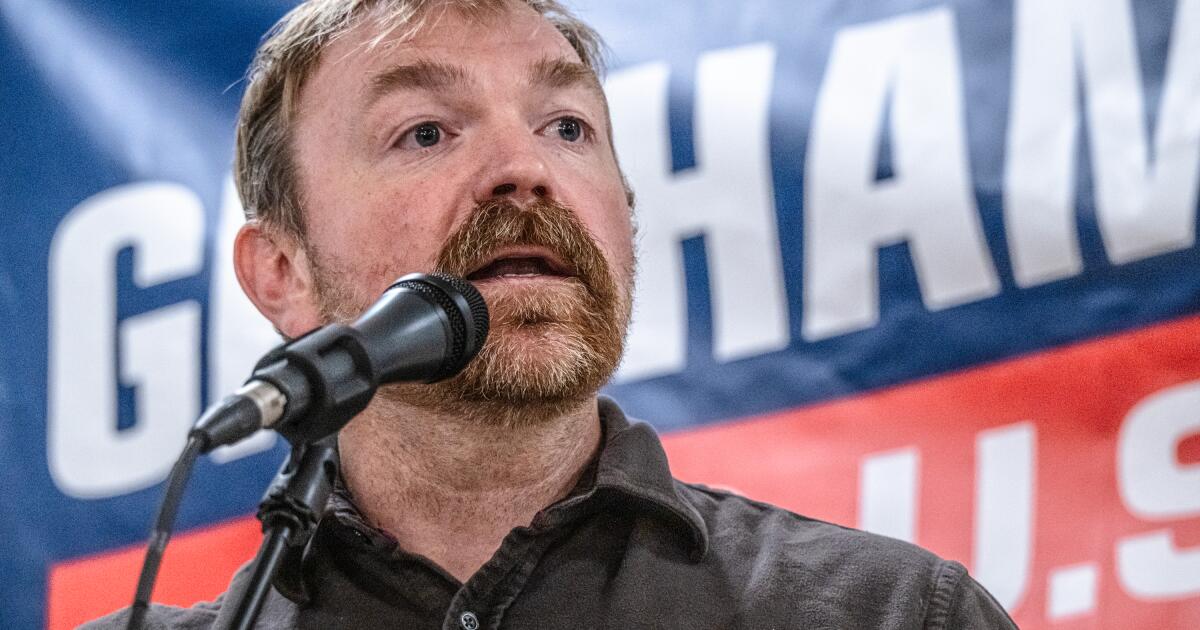
PORTLAND, Maine — This election year is déjà vu for Sen. Susan Collins — the Maine Republican is running for reelection as Democrats pin their hopes on a new candidate to defeat her. Last time, it was state lawmaker Sara Gideon. This time, it’s combat veteran and oyster farmer Graham Platner.
But Collins has proved to be a hard target for Democrats over the years — even for candidates without the baggage of Platner, who has faced criticism for his relationships with women, inflammatory online posts and a previous tattoo recognized as a Nazi symbol. Collins is seeking her sixth term with sky-high name recognition, a record-breaking run of consecutive Senate votes and a history of bringing back federal funding for her state for years.
She is also the rare Republican who sometimes can boost her own popularity back home by keeping her distance from President Trump, and she has perfected that delicate dance even as his tightening grip on the party has cost two of her Senate Republican colleagues their reelection.
Sens. John Cornyn of Texas and Bill Cassidy of Louisiana lost their primaries when facing Trump-endorsed opponents. But despite the president’s complaints about Collins, he did not campaign against her. Years of practice have made her adept at staying close — but not too close — to the president when it is politically advantageous, and moving away when showing an independent streak is helpful.
“She’s shown time and time again where her state’s electorate is. She understands what’s too far, she understands where she needs to be,” said political consultant Matt Mackowiak, who worked for Cornyn’s failed reelection campaign. Trump endorsed Cornyn’s opponent, Texas Atty. Gen. Ken Paxton.
The road to Senate control goes through Maine
The Democrats need to flip four seats to take control of the Senate in November and hope that Trump’s falling approval ratings and the war in Iran — as well as its subsequent effect on oil prices and the economy — could buoy their chances. Maine is among the top targets, along with Alaska, Ohio and North Carolina.
Platner wants to make the case that Collins isn’t as independent of Trump as her reputation suggests — repeatedly noting that she allowed his Supreme Court nominations to go through, which in 2022 led to the overturning of Roe vs. Wade, a landmark 1973 decision that legalized abortion, among other major issues.
“Susan Collins may have started her career decades ago in Washington with good intentions, but she has become just as spineless and corrupt as the establishment she now serves,” Platner said at a victory party on Tuesday.
Platner supporters are ready for change, said John Keenan, of Sullivan, Maine.
“I think Maine has grown tired of the same old system,” he said. “And putting youth into the campaign, with new instead of a rubber stamp, is very refreshing.”
Republicans have already launched their campaign in support of Collins. The National Republican Senatorial Committee posted a pro-Collins video on the social media channel X on Tuesday that resembled a 1980s video game. It stated that Collins “has brought more than $1.5 billion back to Maine” and that Platner “spent time as a kid at a $70,000 a year prep school in Connecticut.”
Trump has often criticized Collins — but not lately
Even as she faces Platner in November, Collins may have to stay wary of Trump. The president has spent years singling her out for daring to occasionally defy him on some issues.
However, he’s refrained from doing so more recently — especially as Collins failed to draw a credible challenger and cruised to a Republican primary victory.
The White House declined to comment. Political advisors close to Trump, however, said the president understands how critical it is that Republicans maintain control of Congress after November, which requires accommodating Collins. Trump understands the need to avoid a Republican wipeout like 2018’s “blue wave” midterms that saw Democrats flip the House and derail much of the last two years of his first-term plans.
“Senator Susan Collins represents the people of Maine first and foremost and has proven herself to be a dedicated public servant,” said Republican National Committee spokesperson Kristen Cianci in a statement.
Collins spokesperson Blake Kernen said the senator “has worked with five different Presidents throughout her Senate tenure, and has never agreed with any of them on every issue.”
“When she agrees with an effort, she will support it; when she disagrees, she does not hesitate to speak up for what she believes is the right outcome for Maine and for America,” Kernen said in a statement.
Other Republicans ran into trouble with Trump
That didn’t work out for some Republican senators.
Cornyn was among his party’s top voices, rising through the ranks after joining the Senate in 2002. Paxton trounced him in a runoff race days after Trump endorsed the attorney general.
In office since 2015, Cassidy voted to convict Trump during his impeachment trial after the U.S. Capitol siege on Jan. 6, 2021. He lost his primary to Trump-endorsed state Rep. Julia Letlow.
Maine figures to be a more competitive race in November — as evidenced by Trump recently refraining from singling out Collins. That’s despite her voting last week with Democrats to block the nearly $1.8-billion fund the president wanted to create to benefit allies that he claims were unfairly targeted by law enforcement.
“She’s always down in the polls and she survives,” Trump conceded when asked about Collins in an interview with the New York Post last week.
Collins defeated Gideon, the Maine House speaker, by almost 9 points in 2020, the same year that Biden beat Trump by a similar margin in the state.
Mackowiak said that “there’s just no pathway to a MAGA senator from Maine.”
“It does appear that the Trump political operation is soberly analyzing the electoral environment in Maine and really kind of follows her lead as it relates to that state and that race, particularly this cycle,” he said.
Maine Republicans are ‘a bit more pragmatic’
Chuck Ellis, a Republican from Westbrook who runs a digital marketing company, said Collins’ reluctance to move in lockstep with Trump can be a plus.
Although there are some “hard-line” voters who may disapprove, Ellis said, “ultimately a lot of your conservatives, your Republicans, are people who are a bit more pragmatic.”
After Collins opposed the White House’s signature tax cut and spending package last year, and voted against a proposal to claw back $9 billion in foreign aid and public media funding, the president complained about her on social media.
“Republicans, when in doubt, vote the exact opposite of Senator Susan Collins,” he wrote.
Then, in January, Trump lashed out at the “stupidity” of Collins and four other Senate Republicans who joined Democrats to start a debate over restricting the president’s use of force in Venezuela.
She later received a profanity-laced call from Trump.
White House may keep a further distance from Collins’ race
As chair of the powerful Senate Appropriations Committee, Collins last week cast her 10,000th Senate vote in a row, setting a record.
“She has been able to do and show that ‘I am bringing money and resources from the federal government to Maine to help Maine,’ ” Ellis said.
The president is unlikely to travel to Maine ahead of November despite visiting other states with key Senate races, like Iowa and Michigan. He could even campaign personally for Paxton.
Vice President JD Vance has been to Maine, where he promoted his anti-fraud task force. Collins didn’t attend Vance’s speech in Bangor last month in which he acknowledged the senator’s distance from the Trump administration.
“If she was as partisan as I sometimes wish that she was,” Vance said, “she would not be a good fit for the people of Maine.”
Whittle and Weissert write for the Associated Press. Weissert reported from Washington.
WASHINGTON — House Republicans will look to get nearly $70 billion for immigration enforcement over the finish line Tuesday, enough to fund a pair of Homeland Security agencies through the next three years and the rest of President Donald Trump’s time in office.
Speaker Mike Johnson will need near perfect attendance and unity on his side to complete weeks of action on the bill. The legislation got sidetracked when Republicans sought to include $1 billion for enhanced security on the White House grounds, including for Trump’s new ballroom, and the Trump administration tried to create a nearly $1.8 billion fund to compensate allies of the president who claim they have been unjustly investigated and prosecuted. Those proposals proved politically toxic and were scrapped.
Now, the bill is focused entirely on immigration enforcement, a topic that Republicans have treated as a defining issue between the two major political parties and one they hope will carry them to victory in this year’s midterm elections. The bill provides $38 billion for Immigration and Customs Enforcement, $26 billion for the Border Patrol and another $5 billion to cover unforeseen costs, fueling Trump’s deportation agenda.
“It’s long overdue,” said Johnson, R-La., of the bill. “We have to fund border security and immigration enforcement, and it’s sad that Republicans have to do it on our own.”
Funding accelerates Trump’s deportation agenda
The funding comes on top of the nearly $140 billion that the Republican-controlled Congress gave ICE and Customs and Border Protection last year as part of Trump’s tax and spending cuts bill.
Democrats objected to giving the agencies more money without significant changes in the way they operate after the deaths of Alex Pretti and Renee Good in Minneapolis. For example, Democrats insisted that agents be required to display their ID badges during enforcement operations and that they get a judicial warrant before entering private property. Instead, the funding will come with virtually no strings attached.
House Democratic Leader Hakeem Jeffries vowed his party would oppose the package.
“We believe that taxpayer dollars should be used to make life more affordable for the American people – not give ICE another $70 billion blank check so that they can unleash brutality on American citizens and violently target law-abiding immigrant communities,” said Jeffries of New York.
Homeland Security faced longest shutdown in history
The package is the result of a monthslong standoff in Congress after Democrats refused to fund the Department of Homeland Security in the wake of the immigration enforcement actions in Minneapolis and other American cities, leading to the longest shutdown in agency history.
Negotiations had been underway with the White House to alter ICE operations as Democrats were demanding. When those negotiations failed, Republicans turned to a complicated procedural maneuver to get around the filibuster and pass the immigration funding with no Democratic votes.
If approved, the package would next go to Trump for his signature, all but assuring an essentially uninterrupted flow of funds for his immigration enforcement and deportation agenda into 2029.
The Senate completed its work on the legislation last week during an all-night session that extended into the early morning hours Friday. The final 52-47 vote on the bill was nearly party line, with Sen. Lisa Murkowski of Alaska the only Republican to oppose it.
Money comes at pivotal time for immigration agenda
The money will come at a pivotal time for the Department of Homeland Security, which is under new leadership after Trump replaced Kristi Noem with new Secretary Markwayne Mullin in March.
While Mullin has vowed to keep the department out of the headlines, the administration is under pressure from anti-immigration advocates to deliver on Trump’s campaign promise of the largest deportation operation in American history.
So far, the administration has not hit its goal of 1 million deportations a year, but Trump’s border czar, Tom Homan, has promised more to come, including hinting at immigration enforcement actions in New York, the nation’s biggest city, which is heavily Democratic.
At the same time, the administration is making it more difficult for legal immigrants to remain in the U.S. by working to end Temporary Protective Status, changing the processes for obtaining green cards and leaving some Dreamers — the young people who were brought illegally to the U.S. as children — reporting delays in renewing their status, which allows them to stay and work.
Tight vote ahead
On the House side, Johnson has little margin for error. Republicans can afford to lose only a couple of votes if every lawmaker is present. GOP leadership opted to avoid any hiccups and sent lawmakers home last week rather than take up the bill early Friday once the Senate had completed its all-nighter.
The bill is just a slim package, without the hundreds of pages of details and directives that typically come from Congress when it provides funding for agencies.
Leading up to the vote, Democrats portrayed DHS as an agency that has used its new resources to buy private jets for its leadership, warehouse immigrants in deplorable conditions and attack U.S. citizens.
“To give these rogue agencies another $70 billion now when they still have $100 billion in the bank from last year would implicate all of us in the escalating corruption and shameful actions of this department,” said Rep. Jamie Raskin of Maryland, the ranking Democratic member on the House Judiciary Committee.
Republicans countered that they were fulfilling their duty to safeguard the nation and support the men and women charged with enforcing the law.
“Democrats can say whatever they want, but what it’s about is public safety. What’s it about is keeping Americans safe,” said Rep. Michelle Fischbach, R-Minn.
Freking and Mascaro write for the Associated Press.
WARNER, N.H. — For Rahm Emanuel, the road to the White House runs through the uphill climbs of rural New Hampshire.
The onetime Democratic congressman, White House chief of staff, Chicago mayor and U.S. ambassador to Japan hasn’t formally announced his ambition to return to power in Washington. But his weekend trip through the state that typically holds the first presidential primary was hardly subtle.
There were the union hall visits and intimate house parties, staples of New Hampshire political rituals. At one event in the backyard of a handsome home in Concord, Emanuel greeted voters and practiced a stump speech that highlighted strains on the middle class and the excesses of the tax system.
And then there was the bike tour.
Over the course of three days, Emanuel pedaled more than 117 miles across New Hampshire from Portsmouth on the coast to Hanover on the Vermont border in what he dubbed the “Spin-Free Tour,” a nod to his blunt demeanor that he sees as an asset for a Democratic Party trying to move beyond its devastating losses in 2024.
“Tough times require a tough leader,” Emanuel told the Associated Press during a break at a coffee shop in Warner. “I don’t think this is just about learning the words to ‘Kumbaya.’”
For someone who has spent the better part of three decades in the highest orbits of political power, the 66-year-old Emanuel is in the unusual position of lacking a natural platform. His likely rivals in a Democratic presidential contest are mostly younger and, as governors, senators or a recently departed vice president, can more easily attract attention.
And despite his thick resume, Emanuel isn’t especially well known outside political circles, as demonstrated by a woman who asked who he was after he left the coffee shop. When informed that it was Emanuel and that he was considering a campaign, she responded, “A campaign for what?”
How Emanuel taps into tenacity to overcome hurdles
Emanuel is tapping into his hard-wired tenacity in hopes of overcoming such challenges.
As many prominent Democrats focus on castigating President Trump, Emanuel has released a flurry of policy proposals addressing everything from social media bans for children to prediction markets and a mandatory retirement age of 75 for those in public office. That would prevent him from seeking a second term if he were elected.
Emanuel is often on the road, talking education in Mississippi and Michigan. He’ll travel to Israel next month to address the U.S.-Israeli relationship as the war in Gaza has spurred new divisions in both political parties, especially among younger voters.
He is a regular guest on podcasts ranging from those hosted by Katie Couric and Kara Swisher to shows focused on fly fishing. He often uses the appearances to knock his own party for overreaching in cultural debates, particularly those involving the rights of transgender people. It’s a message of centrism that has echoes of that of the first president he served, Bill Clinton.
“We did things that were really ridiculous,” he said of Democrats on an episode of Couric’s podcast that posted last week. “Rather than worry about classroom excellence, we were worried about bathroom and locker room access.”
And he hops on the bike.
The tour gives him a chance to both demonstrate his physical fitness at a time of heightened awareness of the nation’s aging political leaders and to introduce himself to the state’s notoriously picky voters before the rest of the field swoops in after the November midterms.
“It is early,” said Rep. Maggie Goodlander, D-N.H., who appeared alongside Emanuel at the Concord house party. “But what I’d say is the people in New Hampshire know how to vet candidates and they’re the most engaged electorate in the country.”
Martha Kruse, a 76-year-old retired special education teacher from Laconia, New Hampshire, is just that type of voter. Active in her local Democratic Party, she traveled to the Concord event to see Emanuel after hearing him in interviews.
“I’m going away really enthused about him,” she said, adding that he was “right on” to prepare a campaign so early.
Riding through the hills of rural New Hampshire
The future of the presidency seemed a world away during a hilly 20-mile stretch of the ride on Saturday, which included an elevation gain of more than 1,300 feet. Along with a cadre of friends and aides, Emanuel cycled past homes where residents were tending to their yards or celebrating a recent graduation on their front patio. He was chatty at times as he rode with the pack and cycled alone at other points, showing little strain in navigating the steep hills.
With summer finally creeping into New England, the humidity was high and the rain was occasionally intense. The group stopped for water and snacks every 10 to 15 miles, huddling under a barn during one rainy stretch. A small group of local activists met up with Emanuel at the coffee shop in Warner, where he held court from a rocking chair.
But the realities of modern politics occasionally asserted themselves. The group cycled past signs praising Trump and denigrating his predecessor, Joe Biden. As the miles dragged on, a chase vehicle crept by periodically with cameras poking out the window to capture scenes that could later be shared on social media, where Emanuel now has an almost daily presence.
And the whir of the midterms wasn’t far away. In neighboring Maine, Graham Platner was contending with a drumbeat of reports about his history with women that has left some Democrats worried that the party’s path to a Senate majority is suddenly imperiled. Emanuel, who helped power Democrats to their sweeping 2006 victories in the U.S. House, said the “jury is still out” on whether Platner can win the Senate race.
“Everybody is holding their breath whether this is the start of something or the end of something,” he said.
Emanuel hopes voices of moderation are prevailing
But as the broader debate over the Democratic Party’s ideological future unfolds, Emanuel said he thought voices of moderation were prevailing. He noted recent wins by Rebecca Bennett, who emerged from a crowded Democratic primary in New Jersey with the nomination for a competitive House seat, along with Josh Turek, the new Democratic Senate nominee in Iowa.
“There’s a bigger character piece to this than ideological,” Emanuel said. “There’s radical moderates and their profile and character speak to kind of fighting a system, which is what’s needed right now.”
The bike tour was certainly not John McCain’s “Straight Talk Express,” the 2000 campaign bus from which the Arizona Republican senator opined on any question that came his way to seize attention and mount a surprise New Hampshire win over front-runner George W. Bush. But some voters said they were open to Emanuel.
Don Daley, a 60-year-old state employee from Concord, watched Emanuel talk from a bench in the backyard of the house party. He said that Emanuel probably “steps on a few toes.”
“But I think that’s what we need right now,” he said. “Some of our Democratic leaders haven’t been strong enough.”
WASHINGTON — Democrats’ path to winning control of the Senate probably runs through Maine — where voters were set to head to the polls Tuesday after several days of growing party anxiety about Graham Platner, who has faced a string of controversies as the likely Democratic candidate.
Democrats not just in Maine but around the country — including in Texas, Iowa and other red states where the party’s mission to flip Senate seats would become more urgent if its prospects in Maine faltered — were closely watching Platner’s performance in Tuesday’s primary.
“They’ve probably become if not less optimistic, at least more nervous over the last 10 days or so,” said Mark Brewer, a political science professor at the University of Maine.
Democrats face a challenging map as they seek to regain control of both chambers of Congress and claw back power in Washington. Unseating Sen. Susan Collins, the veteran Maine Republican, has been viewed as one of the party’s best chances, Brewer said.
Platner’s primary opponent, Maine Gov. Janet Mills, suspended her campaign in late April, clearing his path. He is generally expected to prevail as the Democratic nominee, but what percentage of his party’s vote he captures could help indicate how strong his candidacy will be in the general election, said John Cluverius, director of survey research for the Center for Public Opinion at UMass Lowell, which has conducted polling on the race.
“It’s critical [for Democrats], because without Maine, to win back the Senate you would need to win in states that Donald Trump won overwhelmingly,” Cluverius said.
Platner, an oyster farmer and Marine Corps veteran, emerged as a political outsider and quickly gained popularity.
But apparent scandals followed him. The latest came Thursday, when the New York Times reported that three ex-girlfriends of Platner’s had described his behavior as volatile and, by one account, physically rough. Platner, who denied the latter allegation, had previously addressed controversies related to his texting of women outside his marriage, a Nazi-style tattoo and old Reddit posts.
Over the weekend, Platner projected confidence. He took questions from audience members at a Sunday town hall, and on Friday, the campaign saw its best fundraising day since Mills suspended her bid opposing Platner for the nomination, bringing in $200,000 in 24 hours, a campaign official said.
“Since the beginning, Maine, you had my back,” Platner told supporters at a Friday rally. He drew a standing ovation when he continued: “Now, as every single piece of that past and journey gets dug up, litigated and weaponized, you have my back.”
Platner described the allegations against him as “politically motivated” and false.
The controversies surrounding him could help Collins, who has a track record as a political survivor, Brewer said. In 2020, the last time Collins was reelected, polls predicted she would lose to her Democratic opponent, but she secured reelection, even as the state went for Democrat Joe Biden in the presidential race.
“Her position has probably improved over the last few weeks,” Brewer said. “She has mostly stayed out of the way on this and let the negative stories pile up.
Last week, Democratic leaders largely stood by Platner, as Senate Minority Leader Chuck Schumer indicated the party would continue to back him. Rep. Ro Khanna (D-Fremont) campaigned with him at the Friday rally. Sen. Elizabeth Warren (D-Mass.) recorded a call to prospective voters on his behalf, and Sen. Brian Schatz (D-Hawaii) appeared at a virtual fundraiser, according to a source familiar with the plans.
The political calculus comes down to whether “they would rather have a Senate majority with Graham Platner in it than a Senate minority without Graham Platner in it,” Culverius said.
Democrats must flip at least four Republican seats to take control of the Senate, a difficult task. The Maine seat is the only possible Democratic flip in a state that went for Democratic presidential nominee Kamala Harris in 2024 rather than for President Trump.
Democrats are also looking for victory in Texas, Iowa, Ohio, North Carolina or Alaska, all states that went for Trump in 2024. The party must additionally retain their seats in competitive races in Michigan, New Hampshire and Georgia.
How Platner affects his party’s chances of taking Senate control depends on what happens next, Brewer said.
“What else are we going to see? And I don’t know that anybody knows that at this point,” Brewer said. “I think that’s really what Democrats have to worry about the most. Is this as bad as it gets, or is there other stuff?”
Voters are willing to overlook scandal more readily than in the past, said Brandon Rottinghaus, a political scientist at the University of Houston. And in these midterm elections, Democratic voters view the stakes as “extremely high.”
“Most voters are looking at the prospect of winning and losing,” he said. “Parties are worried about getting the win.”
WASHINGTON — As the U.S. prepares for an extravagant celebration of its founding principles, fewer Americans see their country as exceptional, a new poll finds.
The survey from The Associated Press-NORC Center for Public Affairs Research highlights many Americans’ feeling of unease over the future of its representative government — particularly among young people. It presents a jarring contrast as communities around the country commemorate the nation’s 250th anniversary.
Only about one-quarter of Americans say the U.S. stands above all other countries in the world, the new poll found, while 44% say it’s one of the greatest countries in the world, along with some others. About 3 in 10 say there are better countries than the U.S., an increase from 19% in an AP-NORC poll conducted in June 2016.
Americans remain divided about whether diversity is an essential feature of the U.S.’s identity, and agreement about other aspects of the country’s underlying character appears to be eroding, the survey found. Americans are less likely to see a democratically elected government as “extremely” or “very” important to the United States’ identity as a nation than they were just a few years ago. About two-thirds of U.S. adults now say a democratically elected government is highly important to the U.S.’s identity as a nation, down from 80% in 2021.
“It’s not that the democracy part is not working,” said Derricka Wall, 24, of Chickasaw, Alabama. “It’s the people that are actually being put in office that is the problem.”
Wall believes politicians have damaged America’s governing system, which was designed to ensure representation and guard against government misuse.
America, she said, “is not what it used to be. I feel like our founding fathers would be kind of disappointed with how it is now.”
Rising belief that democracy is not essential to American identity
Young adults are much less likely than older Americans to believe the U.S. is special, compared with other nations, the poll found.
About 4 in 10, 44%, of U.S. adults under 30 say there are other countries better than the U.S., compared with 22% of U.S. adults ages 60 and older.
Fewer, too, see democracy as a key element of the U.S.’s identity. Only about half of Americans under 30 believe this, compared with 81% of those 60 and older.
Wall said the people who established the government with co-equal branches thought they were erecting safeguards to keep any one person or group from attaining too much power. But she believes they didn’t foresee how easily those guardrails would crumble if the people in the system stopped enforcing them.
“I feel like they would actually roll out of their graves,” she said. “I feel they would be very disappointed in us.”
The belief that politics isn’t working for everyday people extends beyond the youngest generations. Kent Stage, 62 and a retired senior enlisted man in the Army, is a registered Republican in Indiana. He does not think the current political system addresses the country’s problems. He’d like to see term limits on politicians and more working-class people serving.
“I’ll trust the ambulance-chasing lawyer and a shady used car salesman before I trust the politician,” he said.
Stage, who is also a former Marine, believes public servants make self-serving choices for their families “while mine and yours still got to hit the old grindstone.”
Many feel it’s harder to get ahead in the U.S.
The survey also finds widespread cynicism about America as the land of opportunity. About half of U.S. adults, 51%, say the American Dream — the idea that if you work hard, you’ll get ahead — once held true but does not anymore. About one-third say it “still holds true” while 15% say it never held true.
Jack Hermanson, a 27-year-old software developer in Denver, said his belief in the American Dream changed when he saw his engineer husband struggle to find a job. “That really shattered my impression that if you work hard, you get what you deserve,” Hermanson said.
Only 22% of Americans under 30 say the American Dream still holds true, compared with 46% of Americans ages 60 and older.
Angela Toombs, 31, works at a senior living facility in Atlanta where her clients talk about how easy it was to buy a house while working their first regular jobs in their 20s and are incredulous about the obstacles facing Toombs’ generation. Toombs recently gave up her own apartment to rent a room in order to save money.
Skepticism about the American Dream is more widespread among Democrats and independents, compared with Republicans. Most Republicans, 57%, say the American Dream still holds true, compared with about one-quarter of independents and 17% of Democrats.
Republicans are also much likelier than Democrats to see the U.S. as exceptional. About half of Republicans say the U.S. stands above all other countries in the world, compared with only 7% of Democrats.
Quintin Sharpe, 28, lives in a resort town on Lake Geneva in Wisconsin. A financial planner who is Republican, he said the American Dream remains accessible and he is proud of the country. “It’s been a great experiment.”
“The opportunity is there for those who want to work for it,” he said. Sharpe believes the country is “a meritocracy, and the best ideas, the best work ethic, those with the best succeed regardless of race, skin color, any of those factors.”
He and his wife will celebrate the country’s 250th anniversary watching the fireworks over the lake.
Divides on whether diversity is essential to U.S.
Just over half of U.S. adults — 56% — say a shared American culture and set of values are “extremely” or “very” important to the country’s identity, down from 65% in 2017. Younger Americans are less likely than older ones to say a singular set of values is important to U.S. identity.
But Americans remain sharply divided on the centrality of welcoming diverse perspectives: About half of adults, 51%, say the ability of people to come from other places in the world to escape violence or find economic opportunities is “extremely” or “very” important to American identity, while 55% say this about the mixing of cultures and values from around the world.
Only about 4 in 10 Republicans see the mixing of cultures and values from around the world as central to the country’s identity, compared with 76% of Democrats.
Rose Nunez, 70, of San Antonio, was a small business owner but now is a caregiver for family members. Nunez, who tends to vote for Democrats, said there is an unease and tension that are just beneath the surface, especially focused on Hispanics. She said some people have started carrying their papers showing their immigration status in case they are challenged.
“It is hard to celebrate when the feelings towards immigrants and communities of color are so strong,” she said of the upcoming America 250 celebrations.
She said even citizens are questioned now. If it gets to a point where being naturalized is challenged, “guess what, my mom would be leaving. She’s been living in this country since she was maybe four years old. She’s 93.”
Fields, Sanders and Riccardi write for the Associated Press. The AP-NORC poll of 2,596 adults was conducted April 16-20 using a sample drawn from NORC’s probability-based AmeriSpeak Panel, which is designed to be representative of the U.S. population. The margin of sampling error for adults overall is plus or minus 2.6 percentage points.
The first rule of a primary election is: Don’t make too much of the results.
The intrepid folks who bother to cast a ballot in these first-round races are largely a group of engaged voters, and drawing conclusions from such a narrow minority is a losing game.
So however the final June results tally out, the lessons learned won’t easily translate to the larger electorate that will almost surely show up in November. But if this election doesn’t tell us much about what fall voters will do, it does tell us something about the Democratic Party that dominates this state: It’s chaotic, to put it gently. And no, that’s not entirely the fault of the “jungle” primary.
Traditional rules seem to have broken down (not a bad thing) and new ones haven’t yet emerged. The old guard has lost control, and maybe vision, and the result is more candidates willing to sidestep seniority and a wait-your-turn mentality to try their luck — especially younger progressives.
Sometimes that chutzpah works, sometimes it doesn’t, but it’s a mirror of the national trend of Democratic infighting and a glimpse into just how fragmented the party has become as it tries to figure out who it stands for and who it supports before the 2028 presidential election.
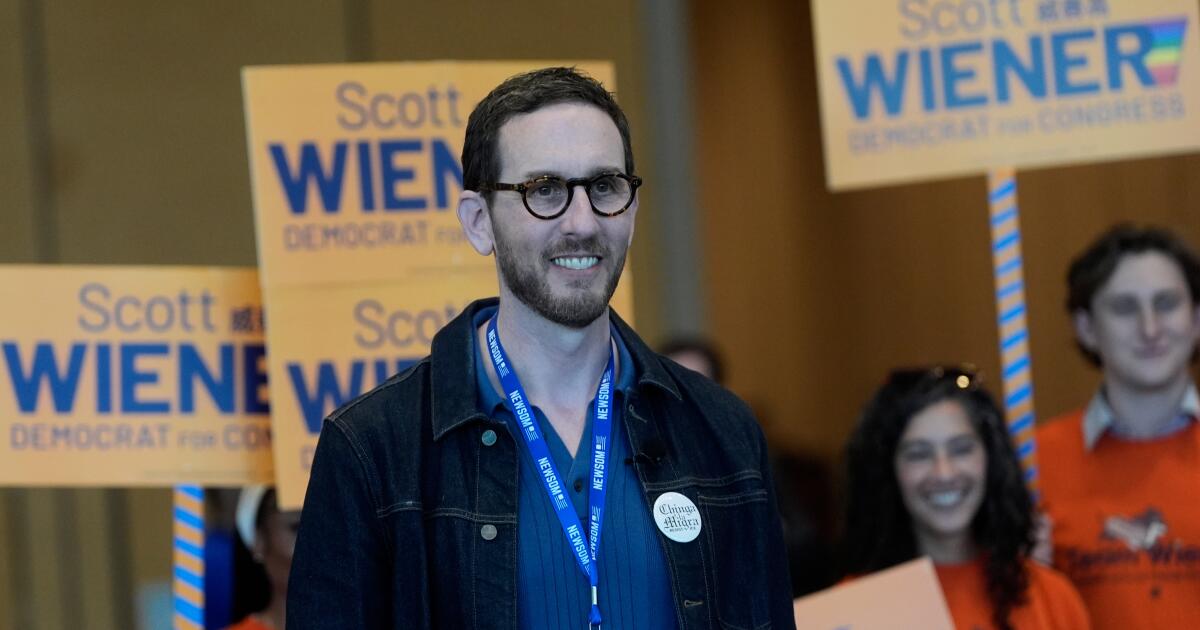
“I feel like I’m definitely running against major institutional forces, but that’s how it is,” state Sen. Scott Wiener told me recently. “At times we see sort of a little bit of a fortress mentality, and other perspectives are not welcome, and younger folks, newer voices are not welcome, and and that’s a dynamic that plays out in a lot of different places.”
Wiener, who could be considered king of the line-jumpers, just took the top spot in the San Francisco-centered race to represent the 11th Congressional District, the seat held by Nancy Pelosi since 1987, when Wiener was 17.
By most accounts, Pelosi and Wiener had a mostly cordial relationship until last year, when he entered the race before she announced her retirement. Though Wiener had been clear for years that he planned such a run when Pelosi stepped down, Pelosi is an icon in the city, beloved by constituents and uncontested as queen of the old guard.
Announcing his campaign before she officially made that decision — or had the chance to choose her successor — sent shock waves through the political firmament. When Pelosi endorsed Supervisor Connie Chan in May, it was seen by many as a sign of her displeasure. Chan, who had struggled to gain traction in the primary, came in second with the Pelosi boost and will face Wiener in November.
Across the state, there were other races with upstart contenders. In Southern California, Jake Levine, a progressive Democrat who served in the Obama White House, took on incumbent Brad Sherman. Sherman, who at 71 has served almost 30 years in Congress, resoundingly beat out Levine by more than 20 points.
In Sacramento, there is Mai Vang, a progressive City Council member, who is challenging Rep. Doris Matsui, another member of the old guard royalty. Vang is in a tie for second place with a Republican contender as remaining votes are counted.
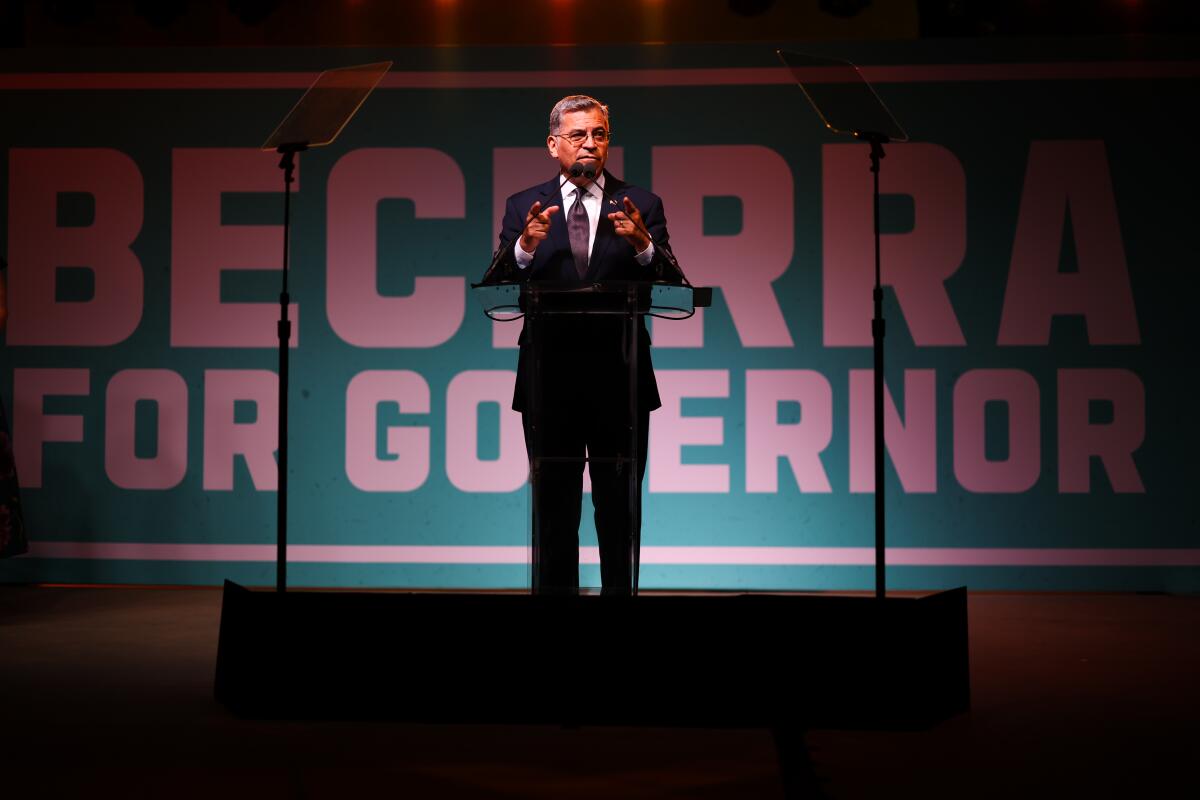
And of course, there is the governor’s race itself, which included a field so determined and uncontrollable even before the fiasco of Eric Swalwell’s sexual misconduct scandal that the state Democratic Party started putting out its own polling in a seeming bid to convince some blue contenders to drop out. It didn’t work. Notably, progressive Katie Porter and moderate San José Mayor Matt Mahan stuck in until the bitter end. But old guard candidate Xavier Becerra came out on top.
If these races have a lesson, it’s that different Democratic voters want different things, but the party hasn’t figured out how to embrace that other than offering up the moderate middle ground.
“This is a big question to this Democratic establishment, about how big of a tent they want to build,” said Irene Kao of Courage California, a progressive advocacy organization.
She said that it “bodes well” that so many strong progressive challengers came out for the primary, because it allows a chance for candidates outside the party power structure to find an audience with voters, even if they are ultimately unsuccessful.
And where voters go, the party will eventually be forced to follow. That doesn’t necessarily mean a more progressive Democratic Party, but it likely means a more inclusive one if they want to lure the kind of low-information and low-propensity voters who make or break a general election.
“People are sick of the games, and sick of people trying to just maneuver things to get their own person in,” Wiener said. “People want to have choices.”
When Nithya Raman stepped up to a podium on the night of L.A.’s mayoral primary election, she thanked her supporters for standing up to the “powerful interests” who spent millions of dollars trying to “preserve this city’s broken and unjust status quo.”
“At a time when so many people have written Los Angeles off or have lost hope in the future of this incredible city,” the democratic socialist L.A. mayoral hopeful said, “you are proof that Angelenos are hungry for change.”
But as election results rolled in, the movement for change was underwhelming, or at least divided. Incumbent Mayor Karen Bass was in the lead, advancing to the November runoff. That left Raman locked in a battle for a second spot with Republican former reality TV star Spencer Pratt.
Bass is one of several high-profile establishment Democrats to emerge on top. In California’s gubernatorial race, centrist Xavier Becerra, a veteran of the Biden Cabinet, advanced to the runoff after being challenged from the left by billionaire green activist Tom Steyer and Democratic former U.S. Rep. Katie Porter. Steyer is now behind Steve Hilton, a Republican, and battling to make the runoff.
Still reeling from the rise of Donald Trump, Democrats in California and beyond are struggling to figure out the future direction of the party.
Some progressives, inspired by Zohran Mamdani’s New York mayoral victory, saw 2026 as an opportunity to move the city further left. But the results have been mixed in key races, with veteran Democrats like Bass and Becerra eking out leads even as polls show dissatisfaction with status quo politics in California.
“This was supposed to be a change revolution, but voters clearly said no to the revolution,” said Sara Sadhwani, a politics professor at Pomona College. “Voters want change,” she noted, “but it doesn’t appear right now that there has been an appetite for a major shift in the ideology of the city or the state.”
Xavier Becerra speaks during an election night event in downtown Los Angeles on Tuesday.
(Eric Thayer/Los Angeles Times)
Becerra emerged as the Democratic favorite late in the election and won support from many establishment party leaders. Pundits said after a wild primary that included the implosion of Democratic U.S. Rep. Eric Swalwell’s campaign amid sex assault allegations, Becerra emerged as a “safe” choice.
Some opponents attacked his moderate views and his willingness to accept campaign donations from big oil companies like Chevron. But that did not stop his rise.
Bass was also beset with challenges, being an incumbent in a city beset with problems.
For her, election night marked a “victory with an asterisk,” Sadhwani said, noting that Bass is first incumbent L.A. mayor in more than two decades to face a runoff. “It would be wrong for Karen Bass to think that this victory … is a ringing endorsement of the work she is currently doing.”
The results underscore Bass’ unpopularity as an incumbent, garnering just 35% of the vote so far. If Raman can catch up and eventually surpass Pratt in the vote count, she could pose a considerable challenge to Bass as more young voters come to the polls in November.
Mike Bonin, a former L.A. City Council member who leads the Pat Brown Institute for Public Affairs at Cal State L.A., said if Bass exceeded expectations it was because they were very low.
“Coming in first in a runoff isn’t a huge victory for an incumbent mayor,” he said. “Two-thirds of the city did not vote for her. That’s not a position of strength.”
James Adams, a political science professor at UC Davis, said that Becerra and Bass coming through indicates the centrist Democratic candidates were in a stronger short-term position than their rivals. But problems loom ahead, he said, as the longtime Democratic establishment that’s been governing California for the last 15 years failed to make notable progress in solving problems with affordable housing, homelessness, public transportation and education.
“I think the Democrats’ prospects are very bright in 2026 given the California Republicans’ dysfunctionality and a complete backlash against Donald Trump,” Adams said. “But I have much bigger concerns about the California Democrats long term, because it seems to me they’re setting a record for most consecutive years of failing to fix the state’s problems while getting reelected anyway.”
Democrats in California, he said, were suffering from being in power too long.
“Whenever one party gets into a long-term, dominant position, usually because the other party is just in the midst of self-destructing … the whole thing ends in tears, because the party that is in a dominant position, they don’t have to be that good.”
As the vote count continues in the mayor’s race, democratic socialists in Los Angeles already have some wins down-ballot.
“We are gaining momentum,” said Leslie Chang, a co-chair of the 5,000-member L.A. chapter of the Democratic Socialists of America, a decentralized anti-capitalist group that advocates for rental protections and defunding the police. Over the last six years, Angelenos have elected four DSA-backed City Council members and a DSA-recommended city controller.
The DSA did not officially endorse Raman, because she entered the race after the group had issued endorsements and another DSA candidate was also running for mayor. However, three of the six DSA-backed candidates for citywide office were projected to win outright.
DSA Councilmembers Hugo Soto-Martinez and Eunisses Hernandez were reelected by such large margins they avoided runoffs. In the city attorney’s race, DSA-endorsed Marissa Roy was in the lead and the mainstream Democratic incumbent became the first city attorney ousted in a primary in nearly a century. City Controller Kenneth Mejia, a progressive anti-establishment candidate who is not a DSA member but an ally of the group, led by nearly 20 percentage points.
When Chang knocked on doors, she said, some voters asked: “Well, what’s the difference between Nithya and Karen Bass?”
A few voters told her that after reviewing Bass’ and Raman’s websites, they found their platforms similar. Chang was surprised. She thought Raman articulated a clear and novel strategy for how to get L.A. out of the housing crisis, but she said some on the left took issue with her working with housing developers to reduce red tape.
Neel Sannappa, chair of the California Democratic Party’s progressive caucus, said Raman was stymied by getting into the race late and having only a few months to campaign. It also didn’t help that a more left-wing challenger, Rae Huang, already had some momentum — not enough to win, but enough to split the left.
“Nithya does represent something real and growing in Los Angeles,” Sannappa said. “There is a hunger for more progressive, left-leaning candidates that want to make sure that we’re investing in people and not so much investing in just police … and being able to build things that are new and innovative.”
Supporters watch election results come in on their phones during Nithya Raman’s election night party at Boomtown Brewery on Tuesday.
(Gina Ferazzi/Los Angeles Times)
Some have criticized Raman’s coalition-building, noting she was not endorsed by her fellow DSA-backed City Council members. Others said the MIT and Harvard graduate, who has been a councilmember for six years, performed tepidly in a May televised debate and suffered from Pratt’s attempts to tie her to the establishment.
“If you’re a part of the institution, which she is,” Sadhwani said, “then you can’t exactly claim that you’re going to bring massive change.”
Sadhwani said that California’s left, in contrast to New York’s, appears to have a charisma deficit. While Pratt and Hilton had an advantage with their television backgrounds, they also spoke “in plain terms about the real problems that the state faces.”
Part of Bass’ success can also be attributed to assembling a coalition that included the L.A. County Federation of Labor, the L.A. police officers union, the L.A. County Democratic Party and immigrant rights groups.
In the mayoral race, Sadhwani said, “the dominant political coalition still has power, money, the organization.”
“If you can garner the support of the unions, then having a broader message, maybe it’s less important,” she said. “You don’t have to work quite so hard, because the unions have the base machine.”
People attend Mayor Bass’ election party for the California 2026 primaries at the LINE Hotel on Tuesday.
(Carlin Stiehl/For The Times)
Yusef Robb, a longtime Democratic strategist who is an advisor to Bass, attributed the mayor’s lead to her campaign’s success in building a broad coalition and communicating across the political spectrum. Most voters, he said, tend to think less about ideology — and whether a Democrat was mainstream or DSA-supported — than candidates’ positions on bread and butter issues.
“Mayor’s races are first and foremost about what people see outside of their front doors, when they walk their kids to school, when they drive to work,” he said. “At the end of the day, the voters look at the field and say, ‘OK, who do I trust to keep my kids from having to skip around a tent on the way to school?’ ‘Who can I trust to hire more officers?’ … and ‘Who can I trust to fight back against ICE in court through executive action and even in the streets?’ And that’s Karen Bass.”
For Democrats in this robustly blue state, part of the challenge in figuring a path forward is that every candidate — even those already in power — pitches themselves as a bona fide progressive against the status quo.
“We have led a grassroots campaign because we want to bring change to our city,” Bass said on election night. “And that’s what we’ve been doing, and that’s what we’re going to continue to do.”
Raman also tried to tout herself as a change candidate. Articulating her platform in broad strokes rather than bread-and-butter detail, Raman said she wanted L.A. to be a place “where government actually functions and delivers every day on this city’s beautiful bighearted values, where we stand up against ICE, where we show up for our gay and trans siblings.”
But as she talked of neighborhoods “full of trees and shade … and people and good food,” she seemed low-key and equivocal. Her message was a far cry from the pressing one U.S. Sen. Bernie Sanders (I-Vt.) put forward in his presidential campaigns, highlighting the millions of Americans working for “starvation wages” and a young single mother in Nevada struggling on $10.45 an hour.
Ultimately, the fight between Bass and Raman, as a struggle between mainstream and progressive Democrats, is complicated by the fact that Bass came up through the progressive wing of the Democratic Party, founding the grassroots Community Coalition in South L.A. in the 1990s.
Campaign worker Khai Dombroe prepares balloons before Nithya Raman’s election night party.
(Gina Ferazzi/Los Angeles Times)
And even though Raman is a DSA member, she has tacked to the center during the campaign, distancing herself from past calls to defund the police by saying she did not want the LAPD to lose more officers.
While Raman and Bass have much in common, the most significant difference between them is on homelessness, Sannappa said. Even though Bass comes from a political tradition of not wanting to criminalize the unhoused, he said, she understood her voters include people wanting to move homeless people off the streets.
“Brass tacks is that we need people that are going to be willing to fight for mental health services,” Sannappa said.
“I think Nithya more so represents the direction where the Democratic Party is going to have to go.”
As L.A. becomes less affordable and homeownership becomes out of reach for many Angelenos, young renters have become a rising political constituency — a shift that many say will likely propel the city leftward.
Bonin said he expected the next new rising Democratic coalition in L.A. to be a labor-renter coalition. He cited Councilmember Soto-Martinez, a renter and union organizer, as probably the best avatar of that.
But as the middle-class splinters along generational lines, other political experts warn that many ordinary Angelenos feel increasingly shut out of L.A. politics.
“Once upon a time the Democratic Party was the party of the working class, and today it has become the party of the educated elites,” Sadhwani said. “Perhaps one of the gifts that Donald Trump has given to Democrats is to force them to contend with the everyday issues of voters, which they seem to have distanced themselves from.”
As many Angelenos feel worse off now than four years ago, Chang said Bass was not directly responsible for every problem. Still, she said, she could have done more to move the city in the right direction.
Delaying the wage boost tied to the 2028 Olympics, she said, was a move that failed working people at a time when many are struggling to make ends meet.
“My fear, of course, is people pivot away from corporate Democrats and they choose the MAGA Republican, because that is the most visible fight,” Chang said. “Or because they think, ‘Oh, well, a democratic socialist running on the Democratic Party line, this is just more of the same status quo.’ ”
WASHINGTON — With virtually no strings attached, Congress is on the verge of providing a sizable infusion of cash to the Department of Homeland Security, powering President Trump’s mass deportation agenda for the remainder of his term in the White House.
The nearly $70-billion package, which cleared the Republican-held Senate in a middle of the night vote and now heads to the House, was declared a “rotten bill” by the Democratic leader and an “ATM for ICE” by pro-immigrant advocates.
But for those aligned with Trump’s campaign promise for the largest mass deportation operation in U.S. history, it all but guarantees an uninterrupted flow of money to carry out the administration’s immigration enforcement operations — and comes on top of some $170 billion Congress already approved for the department last summer, as part of Trump’s big tax breaks bill.
“We’re going to continue to arrest people, we’re going to continue to detain people and we’re going to keep deporting people,” Trump border advisor Tom Homan told CBS News on Friday.
He hinted at summer sweeps of enforcement actions coming next to New York City.
The work of Congress comes at a pivotal time for the Republican president and his party as they face restless voters before the midterm elections. About 1 in 3 U.S. adults know someone who has been affected by Trump’s immigration operations, according to an AP-NORC poll conducted in April. And as America celebrates its 250th anniversary, most say it’s no longer a great place for immigrants.
The funding package from Congress is just a slim dozen-page bill that carries none of the usual guardrails or directives typically demanded in legislation. It turns loose $30 billion for Immigration and Customs Enforcement operations, and billions for the Border Patrol, and others, prepaying the department’s operations into 2029.
“Their options are limitless in terms of what they can do with this money,” said Vanessa Cardenas, the executive director at America’s Voice, a longtime advocacy organization for immigrants.
“That is such a hard thing to accept as a taxpaying citizen that our dollars are going to this massive, mass deportation machine, while Americans are struggling to meet healthcare costs, and have access to food and they’re paying so much in gas.”
The administration has sought to shift the debate over its immigration operations, installing new leadership at Homeland Security in the aftermath of violent scenes of immigration enforcement earlier this year and the shooting deaths of Americans Renee Good and Alex Pretti in Minneapolis.
Rather than the dramatic street sweeps, the administration is working behind the scenes on actions that are stripping immigrant groups of their ability to remain in the U.S., by doing away with Temporary Protected Status or making it more difficult to secure green cards.
The so-called Dreamers, young immigrants brought illegally to the U.S. as children, have reported delays in renewing their Deferred Action for Childhood Arrivals status, exposing them to potential deportation.
But protests on American streets continue, including over detention conditions at the Delaney Hall facility in New Jersey.
At the same time, Homeland Security continues to hire more ICE agents — it’s hosting an employment fair next month in Florida — build more detention facilities and partner with countries around the world to take people who are being deported from the U.S.
In a statement, the department said Trump and Homeland Security Secretary Markwayne Mullin are “laser focused on ensuring the hardworking men and women” of ICE and Customs and Border Patrol are fully funded. It said the package from Congress “will ensure our critical national security operations continue despite any Democrat attempts to hold our great patriotic employees hostage in the future.”
Typically a funding package from Congress would run hundreds pages or more, with a range of specific instructions about how the money can be spent and on what timelines.
Congress, after all, holds the power of the purse, and often uses that constitutional role to put checks on the administration.
But after Democrats refused to fund Homeland Security earlier this year following the violence in Minnesota, Republicans retaliated by using the congressional budget resolution process to muscle the package through on their own, outside the traditional appropriations channels.
It’s the same process both parties have used in the past, most recently on Trump’s 2025 tax cuts bill.
“All this important oversight doesn’t happen,” said Bobby Kogan, a former staff member of the Senate Budget Committee and now at the Center for American Progress, a think tank.
Overnight, Democrats in the Senate worked to exert that authority, offering amendments to ensure Congress had some say in the process. Sen. Dick Durbin of Illinois, for example, sought to protect “Dreamers” from deportation as their DACA renewals are being delayed. But those efforts all failed.
Meanwhile the administration is under enormous pressure to deliver on its promise to boost deportations to some 1 million a year, after the Republican president’s first year numbers fell short.
Mike Howell, president of the Oversight Project, is a leader of the Mass Deportation Coalition that is pushing the Trump administration to stick to its promises.
“Everyone’s talking about it like ICE is about to get another massive cash injection, and that’s not how I see it at all,” he said. “They’re getting like life-support money.”
“We’re not asking them to keep going,” Howell said. “We’re asking them to start.”
Howell said there’s little chance the Trump administration will be able to reach the president’s deportation goals unless it drops its priority to go after what they call the “worst of the worst.”
His group put out a framework earlier this year that proposes more comprehensive sweeps to arrest immigrants, particularly in the workplace. He also wants to see the Trump administration make it more difficult for immigrants who are in the U.S. to use the banking system, get social services and obtain driver’s licenses. Republicans in Congress have offered bills tackling some of those issues.
The administration has been amping up its own rhetoric and recently posted a new website that characterizes immigrants as “aliens” — with outer-space themes — and suggests ways the White House is working to prevent people from staying in the U.S.
The November runoff for state schools superintendent will pit two school board presidents — one a union-friendly liberal and the other a Trump-aligned conservative — against each other.
Republican, Sonja Shaw finished in first place in this week’s primary with 24.5% of votes counted through June 4. Democrat Richard Barrera had19.3%.
Shaw’s margin seems comfortable even with more ballots to be counted, with Barrera firmly in the runoff. The third-leading vote-getter, Wendy Castaneda Leal, was about 10 percentage points behind him.
The race creates a clear contrast between candidates and their vision for California’s schools.
While Shaw, 43, has not typically spoken to Trump’s immigration policies in relation to schooling, she is in accord with the Trump administration education agenda, including banning trans-athletes from women’s and girls’ sports and notifying parents when a child expresses gender-identity issues at school.
Under Shaw’s leadership, the school board in Chino Valley Unified, located in San Bernardino County, also approved a policy that permits parents to challenge books in school libraries.
Barrera, 59, is the board president of San Diego Unified, the second-largest school system in the state. He is a former union official who has developed strong bonds with the teachers union during his long board tenure.
That history helped him win the endorsement of the California Teachers Assn., which poured about $5 million into an independent campaign on his behalf.
Barrera acknowledges that this support made the difference in his leap ahead of other strong Democratic candidates.
Shaw has framed her campaign as a populist effort against a failed and self-interested status quo establishment.
“I didn’t get into this race because I was a politician,” Shaw said in a statement. “I got into it because I was a mom who saw too many families being ignored, too many classrooms falling behind, and too many elected officials unwilling to stand up for our kids.”
Barrera said he is ready to focus on the job of helping students learn more effectively.
“We see examples of schools that are delivering,” Barrera said. “The answers are all around us. The challenge for us as a state is to learn from educators in the local community about what is beating the odds and then take those practices to scale.”
Barrera speaks of an “assault” by the Trump administration on immigrant families: “I’m going to stand up to that assault.”
Barrera, who is a senior adviser to outgoing state Superintendent Tony Thurmond, praises the record of his boss.
Shaw, in contrast, once threw Thurmond out of her local school board meeting.
Lance Christensen, a conservative education analyst who ran unsuccessfully for the office four years ago against Thurmond, is ready for a spirited campaign that “is about to go nuclear.”
“Sonja Shaw pulled out an impressive primary win as an unabashed parental rights advocate while successfully running her local school district,” Christensen said.
“Should Shaw weather the political maelstrom that is about to hit her with tens of millions of dollars from the entrenched left,” he added, “she will have a bigger bully pulpit to shame the people in power who have made California’s education system the laughing-stock of the nation.”
Veteran Democratic political consultant Larry Levine predicted that, in November, Democrats will consolidate around Barrera just like Republicans did around Shaw in the primary — likely leading to a different order of finish in November.
“She consolidated the Republican vote and the Democrats spread like butter on warm bread,” Levine said. “It will be a far different story in the general. CTA will step up with the money to make sure their candidate wins.”
One of the trailing Democrats — former state Legislative leader Anthony Rendon —has already endorsed Barrera.
Rendon said that Barrera “is qualified, shares my values, and has spent his career fighting for public education. He is the candidate who will stand up to and defeat the dangerous, extremist ideology of Sonja Shaw.”
The state superintendent has limited authority over school districts, which are locally managed. The officeholder instead manages the California Department of Education. This agency guides local school districts and also provides partial oversight. The state superintendent also typically takes advantage of the bully pulpit on education issues.
The office has an uncertain future because Gov. Gavin Newsom is pushing a proposal to reimagine the office and redistribute some of its duties.
PORTLAND, Maine — Graham Platner, the insurgent Democratic candidate for U.S. Senate in Maine, will hold his first major campaign rally Friday night as reports continue emerging about his history with women.
Last weekend, his campaign wrestled with stories about sexually explicit messages that Platner sent to several women while he was married. Then on Thursday, The New York Times reported about his relationships with previous girlfriends. Some viewed him positively but others described him as volatile and insulting.
One woman said Platner twisted her arm during an argument and locked her in a room. Platner called that allegation untrue.
But with Maine’s primary around the corner Tuesday and Democrats desperate to rally behind a candidate who can defeat Republican Sen. Susan Collins in November, there’s been little sign of voters or political allies backing away from Platner, who has pitched himself as an imperfect person who has redeemed himself.
Some dismissed news of the text messages as a private matter, one that should be addressed solely by the married couple. Others argue that the need for Democrats to take back control of the U.S. Senate from Republicans is too important to cast aside imperfect candidates.
Yet they’re also wrestling with the question of whether more controversial information surrounding Platner could come out ahead of the November election.
“I think a lot of people are afraid,” said Deb Dagnan, chair of Maine’s Piscataquis County Democrats. “They’re waiting for the other shoe to drop after he gets the nomination. Then what do we do?”
Key to the Senate
Platner is key to Democrats hopes’ to take back the U.S. Senate this year. Yet he’s been bedeviled by near-constant controversies involving his disclosure of a since-covered tattoo of a Nazi symbol, his history of inflammatory online comments and the texting revelations.
Nevertheless, Platner’s most prominent supporters have continued to back the candidate, including Sens. Bernie Sanders, Elizabeth Warren and Ruben Gallego. Platner is scheduled to appear in Bar Harbor Friday evening with progressive Rep. Ro Khanna of California, as well as Democratic candidates for U.S. House and governor, as a part of a “get out the vote” rally in the coastal resort town.
The event is taking place just days ahead of the state’s June 9 primary election, where Platner is expected to secure the Democratic nomination. His top opponent, Gov. Janet Mills, suspended her campaign in late April.
He’ll do so under reignited scrutiny amid reports that he and his wife, Amy Gertner, have had marital difficulties and sought counseling after he allegedly sent sexually explicit text messages to other women.
According to The Wall Street Journal, Gertner had told the campaign in August about the messages, which she had discovered on his phone last year, to make sure they weren’t a liability to the campaign. Platner’s campaign team reportedly decided that the texts were private and being handled by the couple, who were married in 2023.
Genevieve McDonald, a former campaign staffer for Platner, told The Associated Press that the candidate was “sexting multiple women while married” and that “the campaign tried to assess that as an election vulnerability.”
Shortly after the news came out, Platner posted a five-minute video taken by Gertner, who avoided speaking directly about her husband’s reported texts but dubbed the broader coverage as “gossip” and said “being married is hard.”
Voters worry that more scandals lurk
Gertner’s emotional comments about working on her marriage have resonated with some women, who say they are shocked that a former campaign aide would betray someone’s trust and the issue should remain between the couple.
“It’s none of my business as far as I’m concerned,” said Joanne Mason, a local Democratic leader from south-central Maine. “And I would hope that people wouldn’t judge any one person on their own private marriage.”
Valerie Tate, a Democrat from Belfast, described Gertner’s honesty about trying to work on their mental health and marriage as admirable.
“That is not a scandal,” Tate wrote in an email. “That is integrity. Personal growth is not a disqualification from public life. For many of us, it is precisely what made us worthy of it.”
However, Tate conceded that her mind wasn’t fully at ease. With the public still learning about Platner’s past, there is a chance something could emerge as a dealbreaker for voters.
“Of course, there is that concern as there would be in any race with somebody we don’t know all the dramas and the journeys they’ve been on,” she wrote. “Something could come out that would be disqualifying.”
Past controversies simmer
This isn’t the first time Platner has faced questions about his past. He had a tattoo recognized as a Nazi symbol, which he had covered up after starting his campaign.
Platner has said he didn’t realize the meaning of the tattoo. However, a former girlfriend told the Times he joked about it being a Nazi symbol and called it “my Totenkopf.”
There’s also been much attention on Platner’s former Reddit posts, which were dismissive of military sexual assaults and used homophobic slurs, for which he has apologized.
Platner has never held elected office and has fashioned a straight-talking, progressive, populist-style campaign focusing on issues such as income inequality, lack of health care accessibility and the rising cost of housing. In return, he’s attracted thousands at his rallies and campaign events and collected millions in campaign funds to further boost his messaging.
“People want somebody new,” said Paige Zeigler, a former Maine Democratic lawmaker and head of the Waldo County Democrats, on why Platner’s staying power has remained strong. “They want somebody that they feel that they can embrace. And Platner is riding that wave.”
Whittle and Kruesi write for the Associated Press. Kruesi reported from Providence, R.I.
Republicans in the United States Senate have renewed their push to pass a controversial $70bn immigration-enforcement funding bill, a top policy priority for President Donald Trump.
But the effort on Thursday faced a series of hurdles, with Democrats forcing votes on several amendments that highlighted controversies related to the Trump presidency.
Recommended Stories
list of 3 itemsend of list
The rapid-fire votes on the amendments were dubbed a “vote-a-rama“, and they are slated to include issues ranging from Trump’s White House ballroom to his tariff policies and the US-Israel war on Iran.
“Amendment after amendment, vote after vote, Republicans are going to have to answer to the American people,” Senate Minority Leader Chuck Schumer said.
Early on, Republicans were forced to confront a topic that has dominated headlines in recent weeks: Trump’s proposed $1.776bn “anti-weaponisation” fund.
The fund has been controversial on both sides of the aisle, with critics calling it a slush fund for Trump’s allies.
Several Republicans indicated that the optics of such a fund could be politically catastrophic ahead of November’s midterm elections, and the Department of Justice has since backed away from the scheme.
But Trump himself has avoided saying whether the fund was dead, or just on hold.
It was created as part of a settlement following a lawsuit Trump filed against the Internal Revenue Service (IRS), a part of his government, and it was designed to award payouts to alleged victims of politically motivated prosecution.
Senate Democrats have repeatedly called for such a fund to be banned outright, rather than relying on the Trump administration’s commitment not to revive it.
Nevertheless, on Thursday, Senate Republicans rejected the Democrats’ measure to permanently block the fund.
Republican Tom Tillis introduced a second amendment, which would have also banned the settlement fund. Instead, the legislation would have redirected the allocated funds to a separate anti-fraud fund within the Justice Department. That, too, was rejected.
Thursday’s votes on the “anti-weaponisation” fund were just the start of several rounds of voting on issues uncomfortable to the Republican Party.
Schumer, the top Democrat, signalled that other amendments would tackle another part of the IRS settlement: the permanent immunity from tax audits that Trump had secured for himself and his family.
Trump’s controversial immigration enforcement campaign and other issues were also scheduled to be taken up in the day’s amendments.
Senate Majority Leader John Thune said he was not sure whether Republicans would defeat every measure, with some members of the party showing an increasing willingness to stand up to Trump.
“I can’t predict how it comes out,” he said.
Immigration funding bill
The situation on Thursday was the result of a standoff between Democrats and Republicans over the Trump administration’s approach to immigration enforcement.
Democrats had pledged not to approve further funding for Immigration and Customs Enforcement (ICE) and Customs and Border Protection (CBP), following the killing of two US citizens during immigration operations in Minneapolis, Minnesota.
Republicans control 53 seats in the 100-seat chamber, short of the 60-vote threshold needed to overcome a filibuster.
They have instead been forced to pursue a lengthy procedural manoeuvre to bypass the filibuster, which has taken weeks.
The $70bn funding bill had been stalled by the Trump administration’s demand to include $1bn for security upgrades for Trump’s White House ballroom project.
The request came after the president had repeatedly said that no taxpayer dollars would go towards the project.
The security funding, which roiled several Republicans, was subsequently dropped before the voting started.
The Senate’s parliamentarian, an official who interprets the chamber’s rules, had previously ruled that adding ballroom funding to the $70bn bill would make it ineligible for the budget reconciliation process, which allows the passage of fiscal-related bills with a simple majority.
If Senate Republicans remain unified, they are expected to pass the funding bill late Thursday night or early Friday.
The Republican-controlled House of Representatives is expected to take up the bill shortly after.
A day after California’s primary election, President Trump took to social media with baseless claims of election fraud — predictable, but also dangerous.
“Look what’s happening in California, the Dumocrats, right before our very eyes, are stealing the Vote,” Trump wrote in one post.
“There’s BIG cheating by the Dumocrats in California,” he wrote in another, apparently enamored of his latest juvenile slur.
California has once again become the main dish on Trump’s buffet of bull-hockey as he continues to undermine democracy and consolidate authoritarian power, using this disingenuous and patently untrue narrative that American elections are rigged by shadowy Democratic forces working in collusion with illegal immigrants.
The twist this time is that Hilton, the man who wants to represent all Californians, seems to be jumping on the election fraud conspiracy train with the president. I get it, there’s the MAGA base to feed, and it’s a base that feasts on outrage and fakery. Serving up resentment glazed with lies and propaganda has been the MAGA playbook for years under Trump, a strategy that no one can deny has been heartbreakingly effective.
But Hilton is a smart man and must certainly know that voter fraud is rare, to the point of being inconsequential to election outcomes. Hilton by his own admission understands voting patterns, and that in this cycle, Republicans have voted early and often by mail, despite Trump’s claims that all vote-by-mail should be suspect. So Hilton understands that early votes have skewed his way, and that later vote tallies will likely favor Democrats.
And Hilton is definitely intelligent enough to expect that in a state where Democrats outnumber Republicans nearly three to one, he will not keep the top spot in this primary, and a slim chance remains that he will not make it into the top two. That’s just simple math.
So if Hilton truly seeks to represent this state as its top elected executive, now is the time to renounce election fraud myths and stand up to Trump’s lies. If Hilton can’t say that he believes our recent election was free and fair, then he has no business being our governor.
Unfortunately, that doesn’t seem to be the path he’s taking, even as it seems increasingly likely that he will advance to the general election.
This week, speaking with far-right podcaster and former Turning Point USA creative director Benny Johnson (who was allegedly duped into working for a Russian influence operation), Hilton said that while “so far we’re not seeing any signs” of cheating, “we’re going to be all over it. We’re not going to let them do that.”
Hilton was responding to a question from Johnson on whether Hilton will sue over “cheating.”
On a post-election appearance with Laura Ingraham, the conservative Fox News host who has repeatedly promoted the Great Replacement Theory, Hilton delved into more conspiracy.
“Just to really underline the point that you made about the corruption,” he told Ingraham an anecdote about supposed fraud in a previous election cycle when a “whistleblower” at the post office told him that they were instructed that a handwritten postmark was acceptable when sorting ballots to deliver to the county registrar.
“It’s just unbelievable, and of course, that’s why so many people don’t believe the results, but it just undermines confidence,” he told Ingraham, certainly knowing that the post office forwarding a ballot on to a county registrar in no way means it will be certified or counted. Would we really want the USPS deciding which ballots to deliver? Disingenuous on Hilton’s part at best.
“The whole thing is a joke,” Hilton went on to say of California elections, which of course, is absurd.
Thursday, when I asked Hilton’s team to speak with him about his views on voter fraud, they sent back a response that focused on the slowness of the California vote count; voter rolls Hilton has described as “wildly inaccurate,” which is a wildly inaccurate claim; and two instances of actual fraud with voter registration — not examples of votes that were counted.
To be sure, all those items are important. Any malfeasance should be punished, and the system should always strive to improve.
But how hard is it to simply be against fraud, while accurately acknowledging that it is rare and our current system provides accurate results?
I am against voter registration fraud. I am against vote fraud. I am absolutely pro-democracy, including policies such as mail-in voting that increase participation.
I do not believe that there is widespread fraud in the California primary, or in American elections in general, because the evidence does not support that conspiracy. I do not believe that Democrats are running a decades-long, nationwide conspiracy to replace white voters with votes from Black and brown undocumented immigrants, because that is both false and racist.
Pretty basic stuff, and statements in line with the values and common sense of the majority of Californians Hilton says he will represent.
If Hilton can’t come out and clearly say that Trump is wrong — about fraud and about the Great Replacement Theory — can he really be trusted to represent the values of the Golden State?
WASHINGTON — Initial efforts in the Senate failed Thursday to block the $1.8-billion fund that the Trump administration has sought to establish to pay people who claim the government wronged them, though further attempts were likely to come Thursday afternoon.
Republicans narrowly voted down a Democratic amendment to ban the payout fund and then Democrats killed a Republican amendment, which would have prohibited the use of federal money for the fund but would have sent $1.7 billion to the Justice Department’s fraud division.
It was the second effort in Congress to rebuke President Trump in two days, following the House vote Wednesday to rein in Trump’s war powers in Iran.
The dueling amendments were proposed by Senate Minority Leader Chuck Schumer (D-N.Y.) and Sen. Thom Tillis (R-N.C.). They were attached to the reconciliation bill that would fund Immigration and Customs Enforcement and the Border Patrol, a high priority for Republicans.
The votes came as the Senate began a “vote-a-rama,” during which lawmakers were expected to propose a stream of amendments to the immigration bill on various topics.
The Trump administration’s plan for the payment fund — widely seen as a way for Trump to compensate his political allies, including those who participated in the Jan. 6, 2021, attack on the Capitol — set off particular ire from some GOP lawmakers.
The plan has fueled growing unrest within parts of Trump’s party over his governance, compounded by the president’s endorsement of primary challengers to Sens. John Cornyn (R-Texas) and Bill Cassidy (R-La.), as well as Rep. Thomas Massie (R-Ky.), which angered some Republican senators.
Cassidy, who lost his primary and has since voiced strong opposition to Trump’s $1.8-billion fund, became a key player in the Thursday votes, voting down Schumer’s amendment but supporting Tillis’.
On Wednesday, Cassidy joined with Sen. Cory Booker (D-N.J.) to argue in a court filing that the $1.8-billion fund circumvents Congress’ authority and violates the Constitution’s spending and appropriations clauses.
“It is an unconstitutional attempt to spend the People’s money without Congressional approval,” Cassidy and Booker wrote in an amicus brief filed in the federal court case challenging the fund.
The fund was created by the Justice Department to settle a lawsuit brought by Trump against the Internal Revenue Service over the leak of his tax returns. Trump and his sons agreed to drop their personal lawsuit against the government in exchange for the creation of the $1.776-billion fund. Critics immediately questioned the plan, and it drew a rare backlash from Republicans.
In late May, GOP senators derailed plans to vote on the immigration bill over their displeasure with the payout fund and with Trump’s desire to use taxpayer funds for his planned White House ballroom. Senate Republicans removed the ballroom funding from the immigration package Wednesday, another setback for Trump.
The Trump administration sought to back away from its plans for the fund this week, following bipartisan outcry and a federal court ruling that temporarily blocked any payouts from the fund. Acting Atty. Gen. Todd Blanche said Tuesday the administration would end its plans to move ahead with the concept.
But Trump on Wednesday told reporters he didn’t know whether the fund was dead, calling it “a beautiful thing.”
After Schumer proposed the first amendment to ban the fund Thursday morning, the Senate came to a standstill as three key Republican senators deliberated. Schumer framed his effort to ban the fund Thursday as a way to force a referendum on Trump’s plan.
The amendment “offers Republicans a choice: Do you support Donald Trump’s $2 billion taxpayer-funded slush fund, or do you want to protect the American people and their paychecks?” Schumer said on the Senate floor before the vote.
Sen. Bernie Moreno (R-Ohio) urged Republicans to reject the amendment, saying Democrats were planning to “play so many games” on Thursday during the marathon session.
“We are going to fund immigration enforcement and border patrol, and I urge my Republican colleagues to stay united on that singular mission,” Moreno said.
The amendment failed after Cassidy voted against it. Republican Sens. Susan Collins of Maine, Jon Husted of Ohio and Dan Sullivan of Alaska voted in favor.
Schumer’s amendment was uniformly supported by Democrats, including California Sens. Adam Schiff and Alex Padilla.
Tillis, who also voted against Schumer’s amendment, immediately proposed his amendment. Sen. Jeff Merkley (D-Oregon) urged Democrats to oppose it, saying that the proposal would create “a new slush fund” by giving the money to the Justice Department.
“We heard over the last 48 hours that the acting attorney general said that this fund’s not moving forward. All this amendment does is codify what I believe the policy of the DOJ is,” Tillis said on the floor before voting began on his amendment. “This [fund] is unpopular, this administration has said they’re not moving forward with it; this is an opportunity for us to put it to bed.”
Responded Merkley: “Taking one slush fund and eliminating it and then creating a new slush fund still under control of the attorney general is not the way to go. The way to go is to get rid of these slush funds altogether.”
Trump has faced a recent string of failures, including the House vote Wednesday, a court ruling to remove his name from the Kennedy Center and a record-low approval rating among Americans as concern rises about economic issues, gas prices and Trump’s war with Iran.
On Wednesday, Trump lashed out against the four Republicans who backed the House war powers resolution, calling it “an unpatriotic thing” to do and calling the vote “meaningless.”
“They’re GRANDSTANDERS! They should be ashamed of themselves. MAGA!!! President DJT,” Trump wrote.
Times staff writer Ana Ceballos, in Washington, contributed to this report.
WASHINGTON — The Senate is beginning a long series of votes Thursday on legislation to fund President Trump’s immigration enforcement agencies, moving toward passage of a three-year fix as Democrats have blocked the money for months in protest.
The roughly $70 billion bill to fund U.S. Immigration and Customs Enforcement and the Border Patrol would end the blockade by Democrats who demanded policy changes after the fatal shootings of two protesters by federal agents in January. The bill would fund the agencies for three years, through the end of Trump’s term.
First, though, Republicans must beat back a potential gauntlet of amendments that Democrats plan to offer, including to try and permanently ban Trump’s $1.776 billion settlement fund for allies who he believes have been politically persecuted. Democrats have said their first amendment Thursday morning will be to eliminate the fund and send the immigration spending bill back to committee.
Senate Republicans are using a complicated procedural maneuver to get around the filibuster and pass the budget legislation with no Democratic votes. But it has taken weeks to get the bill to the Senate floor as Republicans navigated various obstacles to passage created by Trump and the White House — including a $1 billion proposal for White House security that they eventually scrapped and fierce bipartisan backlash to the settlement fund.
“The thing we’re trying to do here is to keep the focus on funding for ICE and CBP,” Senate Majority Leader John Thune said Wednesday evening, after the Senate voted to start debating the legislation. “This was narrow and targeted from the very beginning and clean, and we’re trying to maintain it that way.”
But it’s unclear if Republicans will have enough votes to fend off the Democratic amendments. Acting Attorney General Todd Blanche said this week that the fund would not move forward, and many GOP senators said Wednesday that they were satisfied with his remarks.
Yet Trump, who has been at odds with Senate Republicans in recent weeks, raised new doubts about the settlement’s future on Wednesday afternoon when he told reporters that the settlement is “very important” and said “I don’t know” whether it is dead or on hold.
“I’d have to ask the lawyers,” he said.
Democrats, Republicans plan to force votes on settlement
To pass legislation through the budget process called reconciliation, the Senate must first hold a long series of votes. Democrats are using that process to try and ban the settlement by law — and also kill the immigration spending bill.
After Trump’s comments about the fund, Schumer posted on X that “this is EXACTLY why” Democrats would be forcing votes to ban it.
Some Republicans also planned to try and put Blanche’s promise in writing. Sen. Thom Tillis, R-N.C., has said he will offer an amendment to block any attempt at resurrecting the fund.
“We’ve got a sufficient number of Republicans who have been very clear they’ve got concerns there,” said Tillis.
ICE and Border Patrol money has been long fight
Democrats say any funding bill for the Homeland Security Department should place restraints on federal immigration authorities, including better identification for federal officers and more use of judicial warrants, among other asks.
After federal agents shot Renee Good and Alex Pretti in Minneapolis, Trump agreed to a Democratic request that the Homeland Security bill be separated from a larger spending measure that became law. But bipartisan negotiations went nowhere, and the DHS funding lapsed in mid-February with no agreement on changes to the Trump administration’s immigration enforcement tactics.
Congress eventually funded the rest of the Homeland Security Department at the end of April with Democratic support. But ICE and Border Patrol remained without regular funding, and Republicans launched a new effort to pass three years of funding for those agencies with no Democratic votes.
Security money for Trump’s ballroom dropped
Work on the legislation was also delayed by Republican opposition to $1 billion in security funding for the White House, including for Trump’s new ballroom, that was added to the original bill.
Democrats and some Republicans questioned using taxpayer money for the massive project, and Republicans did not include it in the final bill when it was released on Wednesday.
Thune said he was working with his GOP conference to try and fight off any amendments and ensure he has enough votes for a simple majority to pass the bill in the 53-47 Senate.
“Keep in mind, we’ve got to keep them all together, make sure we’ve got 50 votes for it,” he said.
Republican House leaders said Wednesday they would like to clear the legislation before the end of the week, if the Senate can finish it. House Majority Leader Steve Scalise, R-La., said that House leaders were having internal conversations about the schedule.
“We just need to make sure everybody’s there,” Scalise said.
Jalonick and Cappelletti write for the Associated Press.
As election officials continued tallying ballots Wednesday, Republican Steve Hilton and Democrat Xavier Becerra continued to lead in the unsettled race to replace termed-out Gov. Gavin Newsom, with billionaire Democrat Tom Steyer hoping for a surge in late-arriving votes to push him into one of the top-two spots to advance to the November general election.
Hilton, a British immigrant and former Fox News commentator, told reporters outside the state Capitol in Sacramento Wednesday morning that he was “very encouraged” by the latest results, though he stopped short of declaring victory.
“It does look as if change is coming to California, and that is good news for everyone, every small business, every working family, everyone who wants to see our state set back on track,” he said.
Becerra and Steyer did not hold public events as of Wednesday afternoon.
Election data analyst Paul Mitchell said it would be nearly mathematically impossible for Steyer to close the gap.
“As we start to get more data, the runway is going to get shorter and shorter,” he said.
He said Steyer, to finish in the top two in the primary, would have to get about 30% of the remaining uncounted votes while Becerra would need to be limited to 15%. The self-funded billionaire has “a very high hill to overcome, and the challenge gets steeper and steeper as we get more data from the counties,” Mitchell said.
“Here in Hollywood’s hometown, we love a good underdog story,” Becerra told cheering supporters at his election night party at La Plaza de Cultura y Artes in downtown Los Angeles.
Becerra spoke about his Mexican immigrant parents and becoming the first in his family to attend college. Though a longtime California politician, Becerra said that his campaign for governor was outspent and that he faced calls to drop out of the race.
“The underdog stayed in the fight,” he said. “Like my parents, I never gave up. … Never stopped believing in the beacon-light goodness of California and thankfully, neither did you.”
His campaign manager, Heather Hargreaves, wrote in a letter to supporters Wednesday that “we’re going to give democracy time to work. County election officials are still counting ballots and don’t expect to know how many people voted in total until” Thursday, when officials are required to report the estimated number ballots left to process.
Billionaires “do everything they can to hoard their wealth and avoid paying taxes, and we see corporations continue to rig the system for themselves — raising your prices to juice their profits. Screw that,” Steyer said at his election watch party at the Regency Ballroom in San Francisco.
Other candidates in the race included Republican Riverside County Sheriff Chad Bianco and Democrats including former Rep. Katie Porter, San José Mayor Matt Mahan, former Los Angeles Mayor Antonio Villaraigosa and state Supt. of Public Instruction Tony Thurmond.
Villaraigosa, Mahan and Porter conceded the race Tuesday night.
California’s 2026 race for governor started slow but ended with a flourish, including the demise of a scandal-ridden Democratic favorite, the anointing of a Republican by Trump and Becerra’s unexpected rise from the depths of the candidate field.
Unlike gubernatorial elections in the last quarter of a century, this year’s race lacked a clear crowd-pleasing front-runner able to win over voters, such as movie star Arnold Schwarzenegger or Jerry Brown, a sage of the California electorate and scion of a storied political family. But it unfolded at a time when the state’s residents are overwhelmed by high housing costs, steep gas prices and overall unaffordability that threatens the “California dream” that once drew millions of people to the state.
“Normal people are not living and breathing politics on a daily basis,” said Tim Rosales, a strategist who ran Republican John Cox’s unsuccessful 2018 gubernatorial campaign. In today’s information-saturated environment, Rosales said, the race and its roster of “extremely milquetoast candidates” didn’t break through until the Swalwell scandal grabbed voters’ attention.
The 2026 gubernatorial primary has been one of the most unpredictable and expensive in decades and a race that was shaped early on by a number of heavyweight Democrats staying on the sidelines.
Though supporters urged them to run, former Vice President Kamala Harris, Sen. Alex Padilla and Atty. Gen. Rob Bonta passed on the race. It was in a state of limbo for months last year as Harris, one of the state’s most high-profile politicians, weighed whether to jump in.
“I don’t ever recall a playing field that looks like this one. Usually there’s a clear front-runner,” said veteran Democratic strategist Darry Sragow. “It’s easy to say that it reflects a lack of talent [but] that’s absolutely not true. Almost any of the candidates running could make a good governor.”
Still, candidates struggled for months to break through to voters.
In February, polls showed the crowded field of Democrats splitting liberal voters and opening a statistical possibility that the party would be boxed out of November under California’s open, top-two primary, which places all candidates on the same ballot. Only the first- and second-place finishers in the primary advance to the general election, regardless of their party affiliation.
Just when Swalwell appeared on the cusp of becoming the Democratic front-runner the San Francisco Chronicle and CNN published allegations that he sexually assaulted a former staffer and acted inappropriately with other women. Swalwell suspended his campaign.
It was Becerra who benefited the most. In less than two months, he vaulted from polling in the low single digits to the top of the field of candidates, according to surveys conducted by UC Berkeley’s Institute of Governmental Studies that were co-sponsored by the Los Angeles Times.
“Becerra caught lightning in a bottle,” Rosales said. “It could have easily gone to any of the other candidates,” but many had baggage. Videos of Porter losing her temper hurt her image, the source of Steyer’s wealth and his unbridled campaign spending weighed on voters’ minds, and Villaraigosa and Mahan were “more centrist than what most Democrats wanted, and so Xavier Becerra was really the safe choice,” Rosales said.
Before Democratic voters began to narrow down their choices, Trump endorsed Hilton in early April. It helped the former Fox News host break away from Bianco, his main GOP rival.
In the days before the primary election, the race solidified into a three-way contest involving Becerra, Steyer and Hilton.
Steyer stepped up his fight in the remaining days, seeking to squeeze into one of the top two spots by battering Becerra in ads and at campaign rallies as a politician propped up by corporate special interests.
“We cannot afford to have a governor who’s been bought off by Big Oil. Period,” he said at a Sunday rally in Los Angeles.
Corporations, along with labor unions and interest groups including the California Assn. of Realtors, had spent more than $18.7 million to boost Becerra, according to the election spending tracker California Target Book. Many of the same groups also gave money to a committee intended to attack Steyer.
As the election neared, Becerra sharpened his attacks against Steyer, calling the billionaire a “liar” and accusing him of trying to buy the election.
“We are not going to let a billionaire or Trump’s handpicked candidate take over this state,” he said during a Sunday rally in Long Beach.
If Becerra faces off with Hilton in November he’ll have a distinct advantage. Democratic voters outnumber Republicans nearly 2 to 1 in left-leaning California.
Winning the general election would make the 68-year-old Becerra the first elected Latino governor of California. At roughly 40% of the state’s population, Latinos are California’s largest ethnic group but have not been represented in the governor’s mansion since 1875, when then-Lt. Gov. Romualdo Pacheco was elevated to fill a 10-month vacancy.
Times staff writers Iris Kwok, Susanne Rust, Andrew Khouri and Christopher Goffard contributed to this report.
WASHINGTON — The House approved a war powers resolution Wednesday that would halt the U.S. military action against Iran, defying President Trump as a handful of Republicans joined with Democrats to end the three-month-long war that has reordered politics at home and abroad.
House Speaker Mike Johnson had tried to prevent an outcome that would show the mounting opposition to the war, abruptly shutting down floor action two weeks ago when the war powers resolution was on the verge of approval. But displeasure has only grown as the conflict drags on and as Trump struggles to negotiate a quick resolution.
The roll call Wednesday was 215-208, and cheers erupted in the House chamber.
“This reckless and costly war of choice needs to end today,” House Democratic Leader Hakeem Jeffries of New York said earlier in the week.
“All we need are a handful of Republicans to join us and we can end this reckless and costly war of choice — a war that has cost the American taxpayer over $100 billion — that’s extraordinary — and left our country in a weaker position relative to Iran.”
Opposition to war grows
It’s the fourth time the House has tried to curb the U.S. war against Iran, and the first time the House was able to pass the measure. The Senate advanced its own war powers resolution last month when a handful of GOP senators broke ranks with the Republican president in a rare show of political pushback from his party.
Each time Democrats have pushed forward the war powers resolution, the vote tallies have inched higher as political unease with the U.S. war swells. Trump had campaigned for the White House on a promise to end U.S. entanglements abroad and focus more on domestic issues, but the war has shifted attention back to the Middle East.
Johnson insisted Trump is “laser focused” on the domestic front, particularly ahead of the midterm elections that will determine control of Congress.
The speaker said he spent three hours at the White House with the president this week as Trump is calling on allies to help reopen the Strait of Hormuz for commerce, especially the flow of oil.
Since the U.S. joined Israel in launching the Feb. 28 strikes on Iran, Americans have seen gas prices spike at the pumps, adding to inflationary pressure on consumer spending.
Iran has been able to interrupt shipping through the Strait of Hormuz, a vital channel for a large segment of the world’s oil, natural gas and related products such as fertilizer.
“We’re working on that final piece,” said Johnson, R-La. “The entire world has an interest in the Strait of Hormuz being reopen for commerce. That what he’s working on.”
While a ceasefire in the conflict was declared in April, it remains uneasy and uncertain. Talks for a more durable end to the fighting have dragged, increasingly complicated by Israel’s broadening war with Iran-backed Hezbollah militants in Lebanon. Meanwhile, military strikes between the U.S and Iran continue to flare.
Congress exerts its war powers authority
The war powers resolution from the House would not immediately stop the war, but it would provide a symbolic if not legal step against further military action.
If approved, it would then go to the Senate, where four Republican senators last month joined Democrats in advancing a similar measure to curtail the U.S. campaign against Iran. The Senate has yet to take a final vote to approve or reject its own war powers resolution.
Secretary of State Marco Rubio warned Wednesday testifying at a House Foreign Affairs Committee hearing that the Iranians would think that the administration’s “hands are going to be tied” if Congress approved a war powers resolution. He said they would think ”we won’t be able to do anything to them, so why make a deal?”
It’s not the only action Congress is taking in the national security arena as Democrats, in the minority, work to peel off Republican support for measures beyond the war against Iran.
The House is also voting Wednesday on another Democratic-led effort that would authorize U.S. support for Ukraine’s military operations as it battles Russia and to help reconstruct the war-torn country. The House this week is also expected to consider a war powers resolution to block U.S. action in Lebanon.
While Congress has the authority under the Constitution to declare war, the president also has power as the commander in chief to engage in military action, creating a legal dispute over which branch of government has ultimate say in matters of war and peace.
Under the war powers act, the White House has a 60-day window to seek approval from Congress for military action. The administration, however, has indicated that because a ceasefire has been declared in the current conflict in Iran, the hostilities have ceased.
Here are five takeaways from a gubernatorial contest that was sedentary and sleepy until, suddenly, it wasn’t.
Flashback!
Three months ago, Xavier Becerra seemed so irrelevant he — along with a clutch of other weak-polling candidates — was conspicuously excluded from a scheduled debate at USC. Today, the Democrat has seemingly punched his ticket to November.
The obvious parallel is with another massive underdog, Gray Davis, who also came from far behind to win the last time a gubernatorial primary held this level of uncertainty and suspense. That was back in 1998.
Like Davis, Becerra has a political persona that could be marketed as a sleep aid. No one will ever mistake either of them for, say, Arnold Schwarzenegger. But Becerra’s even-keeled demeanor seemed the perfect prescription following the overnight implosion of Eric Swalwell’s scandal-scarred campaign while presenting a welcome contrast with the endless Sturm und Drang emanating from Washington, D.C.
Despite California’s star-struck reputation (perpetuated mainly by outsiders), the state has elected far more governors like Davis and Becerra than Schwarzenegger and Ronald Reagan. In fact, other than Schwarzenegger, who prevailed in an unprecedented recall campaign, every candidate following Reagan has successfully run for statewide office at least once before being chosen governor.
Becerra was elected attorney general before heading to Washington to join the Biden administration; his candidacy offered worn-out voters a safe harbor amid the Trumpian tempest.
Cha-ching!
There are things money can’t buy which, Tom $teyer — er, Steyer — is just the latest to discover.
The hedge fund billionaire turned Democratic activist sank more than $215 million — a record — into his gubernatorial bid, after spending nearly $350 million in a failed 2020 try for president.
With roughly 60% of the vote counted, he was running an unimpressive third and hoping a lopsided surge of still-to-be-counted ballots will push him into the top two.
Half a billion dollars, which makes for a pretty pricey, “Meh.”
California has a long record of rejecting money-bag candidates for governor and the U.S. Senate — a pattern stretching back more than half a century. Given that hostile history, Steyer would enter the runoff as a distinct underdog, notwithstanding the many added millions he is poised to spend.
“These filthy rich people who don’t have to deal with the kind of financial struggles that people have in connection with their daliy lives just don’t feel relatable,” said Garry South, who ran Davis’ successful 1998 campaign against the free-spending Steyer of his day, former airline executive Al Checchi.
Given the relentlessly negative campaign Steyer has waged, besieged voters could count on many more ugly months of brutality on the airwaves, on computer screens and in their mailboxes.
The only happy ones would be TV station managers and political consultants cashing Steyer’s super-sized checks.
A self-fulfilling prophecy
It was never likely. But the mere prospect of Democrats being shut out of the November runoff was enough to guarantee such a scenario would not happen in this reliably blue state.
With a large pack of Democrats running and just two serious Republican contenders, Democratic partisans feared their fractured vote would let the GOP nab both spots in Tuesday’s top-two primary.
Much of the freak-out was fed by polls supposedly showing Republicans Steve Hilton and Chad Bianco atop the field. But no candidate ever had much more than a paltry 20% support; for all the heavy breathing, the race was always pretty much a multi-candidate tie.
Fearing the worst, however, voters who normally couldn’t tell a “jungle primary” from a jungle gym began thinking a lot like gimlet-eyed political strategists. Democrats, in particular, held onto their ballots much longer than usual, waiting to see which candidate appeared strongest at the end.
“The decision matrix on this was not just the political insiders, but all the normies who heard there might be two Republicans,” said Paul Mitchell, a Sacramento political data expert who developed a popular online tool handicapping various election scenarios. “They’re talking to friends and families. It was kind of crazy.”
In the end, the race among Democrats became less a contest than a self-fulfilling prophecy. Becerra was seen as the candidate with the best chance of advancing to November, so many voters flocked his way — ensuring he would advance to November.
Now he waits to see whether his opponent will be Hilton or Steyer.
Sacramento still a boy’s club
More than 30 states have elected female governors. A few have done so multiple times. But come January, California — which perceives itself as oh-so-cutting edge on oh-so-many things — will install the 41st in the state’s unbroken line of male governors.
“There’s expectations that are put on a woman” that are different from those male candidates face, said Mindy Romero, director of the Center for Inclusive Democracy at USC. Toughness in a man can be seen as abrasive or off-putting in a women. Acting with authority can come across — at least to some observers — as overbearing.
“A woman’s version of a leader still has to be at least somewhat feminine,” Romero said. “That’s what our society expects. So you have to be tough, but do it with a smile.”
But in Sacramento, within the governor’s suite, California’s highest glass ceiling remains firmly intact.
Youth won’t be served
Last fall, over a plate of enchiladas in downtown San José, Mayor Matt Mahan emphatically ruled out a run for governor.
“I have a wonderful marriage,” Mahan said at the time. “I have two wonderful kids. I loved working in the private sector. I’ve got a lot of great friends … I genuinely want to make our city better, and I love the job.”
He should have stuck to those words.
Instead, Mahan and his wealthy Silicon Valley backers talked themselves into a rushed and premature campaign that was never remotely competitive. Investors might have thought they were getting in on the ground floor of the next Amazon. Instead, Mahan’s candidacy was more like Pets.com, a famous e-commerce flop that came to embody the heedless froth of the dot.com bubble.
But it would be equally premature to write Mahan off.
Decades ago, another youthful big-city mayor ran an ill-considered campaign for governor, finishing a distant fourth and failing to muster even double-digit support. That, however, didn’t hurt Pete Wilson’s political career. Four years later, he was elected to the U.S. Senate en route to two terms as California governor.
At 43, Mahan has plenty of highway ahead and a good deal of political potential. His time may yet come.