Big donors backed Harris in 2024. For 2028, they’re not so sure
WASHINGTON — As Kamala Harris eyes a possible 2028 presidential bid, there is little outward enthusiasm among her biggest 2024 backers to fund a repeat performance, adding to uncertainty about the former vice president’s prospects in what is sure to be a crowded primary field.
The Times reached out to more than two dozen top donors to the biggest pro-Harris super PAC in 2024. Several of them said they do not plan to support her should she choose to run, or declined to talk about her. Others did not respond.
“I don’t think it’s a helpful narrative [for 2028] to start with the 2024 hangover,” said one fundraiser for Harris’ 2024 campaign, who requested anonymity to speak candidly. “There is an enormous appetite for new blood — something fresh, something that really represents the future, not the past.”
That narrative is poised to present Harris’ biggest challenge if she decides to run — particularly if it jeopardizes her ability to pull in crucial funding. Though few in the party want to criticize Harris, few appear inclined to endorse her, and conversations about her prospects often come down to one thing: Democrats’ anxiety about winning.
“She’s run, she’s lost, so the question’s going to be, is there somebody that gives Democratic voters more of a sense that they could win?” said Dick Harpootlian, a longtime South Carolina Democratic strategist. “That’s what all of us are looking for. We want to win in ‘28.”
The chatter among party elites appears at odds with recent polling in Harris’ favor, including in April’s Harvard Center for American Political Studies/Harris Poll, which showed Harris leading the Democratic field with support from 50% of Democrats.
The former vice president has also been met with enthusiasm from audiences in a series of recent speaking stops — including when she told a friendly crowd at a New York conference in April that she “might” run for president.
Harris remains undecided about whether to mount a run, according to a person familiar with her thinking, who said Friday she has been focused on boosting Democrats ahead of the midterm elections, meeting voters and delivering messages about the economy and affordability.
If she were to run, Harris would expect a crowded primary field to split donors and would be aware of the need to overcome the perception of skeptics, this person said — but noted that 2028 would afford a very different dynamic than the circumstances under which she took the nomination in 2024.
“There’s a bit of a ‘doth protest too much’ quality to some of these complaints about the idea of her running,” said the person close to her. “It may be a backhanded way of acknowledging that she’d be quite formidable if she decided to get in.”
Speculation about whether Harris would run again — and whether she should — has swirled since her truncated 2024 campaign ended in defeat to Donald Trump. Harris’ decision not to run for California governor in a wide-open race was broadly viewed as signaling presidential ambitions, and she reentered the public eye with the publication of a book about the 2024 campaign and an associated speaking tour.
Last month, Harris gave her strongest signal yet that she could seek the party’s nomination again, telling the Rev. Al Sharpton at a gathering of his civil rights organization in New York that she was “thinking about it.”
“I know what the job is and I know what it requires,” Harris said at the time.
Harris’ 2024 loss to Trump and failure to capture any battleground states — after entering the race late following President Biden’s exit — was bruising for Democrats. The defeat is lingering longer for some top donors than it did after Hillary Clinton’s loss to Trump in 2016, making them extra wary, said one Democratic political consultant.
“Especially in the donor class, everyone feels burnt,” he said. “People just want to turn the page.”
The Times contacted top donors to Future Forward, the Democratic super PAC that spent the most to back Harris in the 2024 election. All the donors contacted gave at least $1 million and some acted as bundlers for the campaign, soliciting big checks from other donors in addition to their own contributions.
Netflix co-founder Reed Hastings, who gave $1 million to Future Forward in 2024, said he hoped to support a different Californian.
“Gavin is the candidate who can motivate both the left and the center,” Hastings told The Times, referring to Gov. Gavin Newsom.
A bundler for both Harris and Biden said it comes down to who can give Democrats the best chance to succeed.
“I think it is too early to pick a favorite in the 2028 race, but Kamala Harris will not be my candidate,” this person said. “I don’t think she would appeal to a swing voter, and we need swing voters to win.”
Others, including a few party leaders, deflected questions by citing a focus on this year’s midterm elections. Rep. James E. Clyburn (D-S.C.), who last year praised Newsom’s presidential prospects during a visit by the governor, said Tuesday that Democrats should be zeroed in on 2026.
“I’m not thinking about 2028, and if she were to call me I wouldn’t talk to her about it,” Clyburn told The Times when asked about Harris’ chances.
Enthusiasm for Harris and skepticism about her viability in 2028 aren’t mutually exclusive, said the former Harris fundraiser.
“A lot of people love her and also don’t think that she is the answer for 2028,” the fundraiser said.
The attitudes of the donor class and political elite may be at odds with those of regular Americans, particularly Black and working-class voters, the Democratic political consultant said. Few of the possible candidates have the potential to excite Black voters the way Harris does, he said.
If a candidate, whether Harris or someone else, makes a successful case that they can win, Black voters will be “strategic and optimistic enough” to rally around whoever it is, said Keneshia Grant, a Howard University political scientist.
But, she said, “I don’t think that they are going to take well to work by elites or the donor class to sideline Harris if there is no clear, reasonable, exciting, Obama-level, yes-we-can candidate instead of her.”

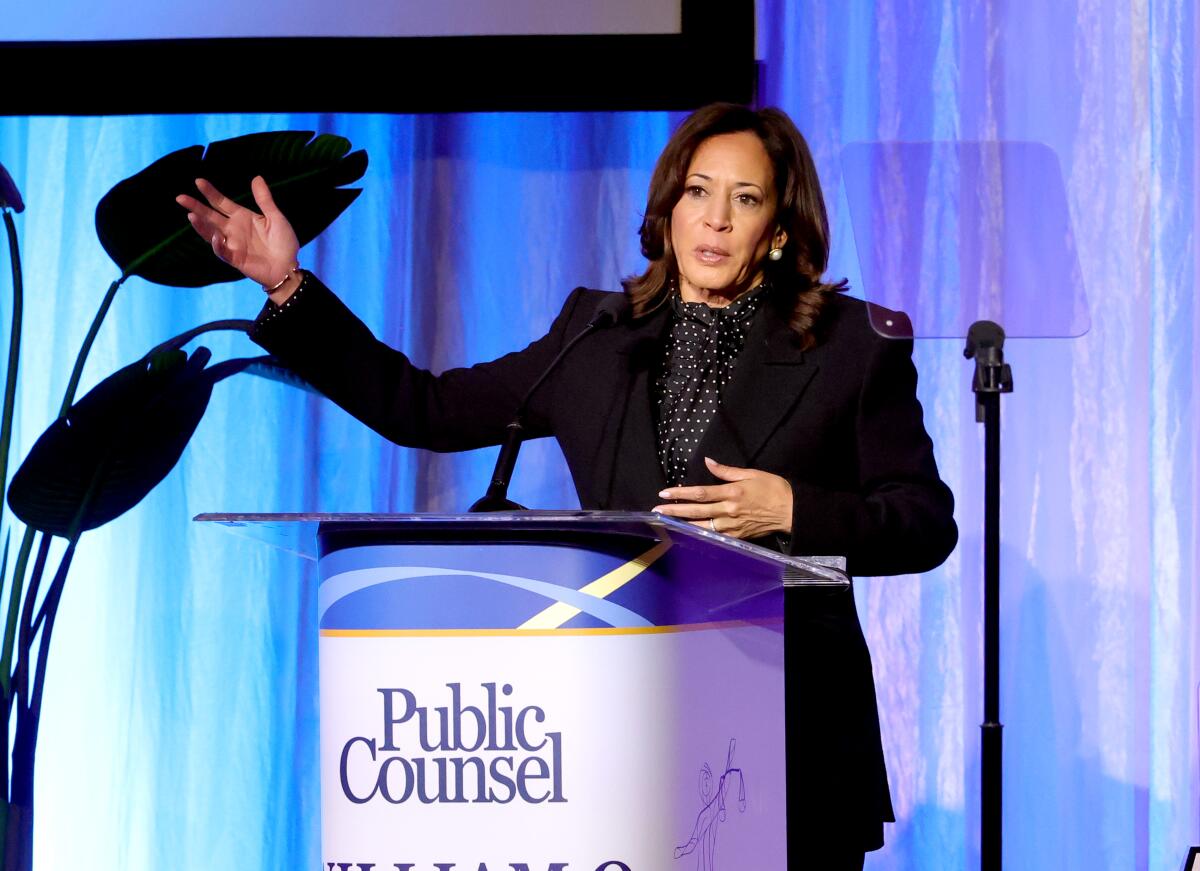
Harris speaks the Public Counsel Awards Dinner on April 29 in Beverly Hills.
(Frazer Harrison / Getty Images)
In recent weeks, Harris has spoken at a fundraiser in South Carolina, a party luncheon in Michigan and a dinner in Arkansas. On Thursday, she was in Nevada to rally Democrats ahead of the midterm primary.
She also joined other likely 2028 contenders at the Colorado Speaker Series in Denver and Sharpton’s conference, accepted an award from the nonprofit Public Counsel at a Los Angeles gala and addressed the National Women’s Law Center gala in Washington to a warm reception, as did Illinois Gov. JB Pritzker.
“She was inspiring, she was hopeful, she pushed back on Trump,” said Jay Parmley, chair of the Democratic Party in South Carolina, where Harris spoke at a party-hosted fundraiser in Greenville on April 15.
South Carolina, a key primary state, could help unlock Harris’ path to the nomination. If Black voters there boosted her to a win, she could build early momentum.
But Parmley said he believed she would have to “get over” the hurdle of convincing voters that she can beat the GOP.
“I don’t think it’s a given she wins here without work,” Parmley said. “She’s going to have to really visit with voters and work just like everybody else.”
Times staff writer Ana Ceballos in Washington contributed to this report.