democratic socialist

A democratic socialist in Wisconsin tests how far left voters want to go in a battleground state

Over the last month, Democratic socialists have notched victories in the liberal strongholds of New York City, Washington, D.C., and Denver.

Now Francesca Hong, a single mother who has worked as a dishwasher and line cook, is trying to do the same with her campaign for governor in Wisconsin, a swing state known for razor-thin election margins where winning over moderate, independent voters is crucial.

Hong’s candidacy has turned the Democratic primary on Aug. 11 into the latest test of just how far left voters are willing to go in the November midterms.

“We do this in Wisconsin, we’re going to change politics across the country,” the 37-year-old Hong said as she headed into the final month of campaigning. “People who are frustrated and have a lot more to lose — and I’m one of those people — are ready to coalesce around someone they can believe in.”

John Ravdabaugh, an undecided independent voter, came away impressed after hearing Hong speak at the retirement home where he lives. Even though the democratic socialist label concerns him, Ravdabaugh said he would consider voting for Hong.

“Every system reaches a point where change is necessary,” he said.

Whoever wins the primary will advance to almost certainly face Republican U.S. Rep. Tom Tiffany, one of the most conservative members of the House, who has President Trump’s endorsement. Tiffany has only token opposition in the primary.

The governor’s race is integral to Democrats’ hopes of earning full control of Wisconsin state government for the first time since 2010, and it will send a signal about where the country’s politics are headed by shaping a key political battleground that helps decide presidential campaigns.

Trump-backed Republican derides Democratic rivals as ‘crazy’

Tiffany has focused much of his criticism on Hong and former Lt. Gov. Mandela Barnes, another Democratic candidate for governor.

“This November, the choice is common sense or crazy,” Tiffany posted on social media in June. Tiffany included screenshots of a Barnes post where he voiced support for cutting prison populations by half and Hong’s posts where she advocates for defunding and abolishing the police.

As a candidate, Hong has not backed away from her calls to defund and abolish the police. Hong also supports increasing taxes on the wealthy and creating a state-owned bank to help pay for free health care and free child care, a $20 minimum wage, and a moratorium on data center construction.

Hong dismisses concerns that she’s too liberal to win over key independent voters in a state Trump carried twice and narrowly lost a third time.

“I worry that’s a miscalculation of where voters are at in our state, that we’re underestimating what people want,” Hong said in an interview.

There’s a history of socialism in Milwaukee

Last month, democratic socialist Janeese Lewis George won the Democratic primary for mayor of Washington, setting herself up to clinch the office in November.

Then three congressional candidates backed by New York Mayor Zohran Mamdani, another democratic socialist, defeated establishment-backed politicians.

And just last week, democratic socialist Melat Kiros beat U.S. Rep. Diana DeGette in the Colorado primary, a stunning victory for the 29-year-old, first-time candidate against an incumbent who took office before she was born.

But those victories have been in either congressional or mayoral races in large urban centers, a far different landscape than Wisconsin.

In 1910, during socialism’s heyday in the United States, Milwaukee sent the first socialist to Congress and was the first major American city to elect a socialist mayor. Milwaukee elected two more socialist mayors before 1960.

Vermont Sen. Bernie Sanders, perhaps the best known democratic socialist, won all but one county in Wisconsin in the 2016 Democratic primary. In 2023, two state lawmakers from Milwaukee revived the socialist caucus in the Legislature, which had been dormant since 1935.

Hong, the first Asian American elected to the state Assembly in 2020, is one of four members of that caucus.

Barnes, 39, served four years in the state Assembly before his four years as lieutenant governor under Democratic Gov. Tony Evers. In 2022, Barnes came within 27,000 votes of ousting Republican U.S. Sen. Ron Johnson.

“I’ve been around longer than anybody fighting these fights,” said Barnes, who grew up in Milwaukee and is vying to become Wisconsin’s first Black governor.

He played down the idea that democratic socialists are surging.

“People aren’t looking for labels, necessarily,” he said. “People are looking for bold solutions.”

Longtime Democratic strategist Joe Zepecki, who is not working for any of the Democrats running this year, said Barnes has an advantage as the most well-known candidate in the race.

“I have believed from the day since Mandela Barnes got into the race, he’s the favorite,” Zepecki said. “It is his race to lose.”

Hong rival leans into electability argument

Lt. Gov. Sara Rodriguez, a former nurse and health care executive who is also running for the Democratic nomination, said she’ll have broader appeal in November. She cites her experience in the private sector and her flipping of a state Assembly seat in a conservative Milwaukee suburb, and she emphasizes her ideas for lowering costs for working people.

“I’m not worried about other candidates in this race,” Rodriguez said in an interview. “What I’m worried about is making my argument to Wisconsinites about why I’m the best person to lead the state, how I am going to fight for them.”

She launched a $1 million television ad campaign this week that features her in nursing scrubs talking about taking on Tiffany and lowering health care costs.

Other Democratic candidates are state Sen. Kelda Roys, who has the endorsement of the statewide teachers union, and Joel Brennan, a former top aide to Evers.

Missy Hughes, the state’s former economic development director, dropped out of the race in June and endorsed Rodriguez. David Crowley, the top elected official in Milwaukee County, dropped out this week and also backed Rodriguez.

Mainstream Democrats worry about winning in November

More moderate Democrats worry that nominating Hong could hurt them in the general election, especially in Wisconsin where independent voters are key in statewide races that are often decided by tiny margins.

Neera Tanden, who leads the Center for American Progress, said “it’s especially important in the age of Trump” to select viable candidates.

“In Wisconsin, whoever wins the general election will be the person overseeing elections in 2028 and whether people are seated in 2029.”

Evers won his two races for governor by just over 1 percentage point in 2018 and just over 3 points in 2022. Trump won Wisconsin by less than a point in 2024, and lost by less than a point in 2020.

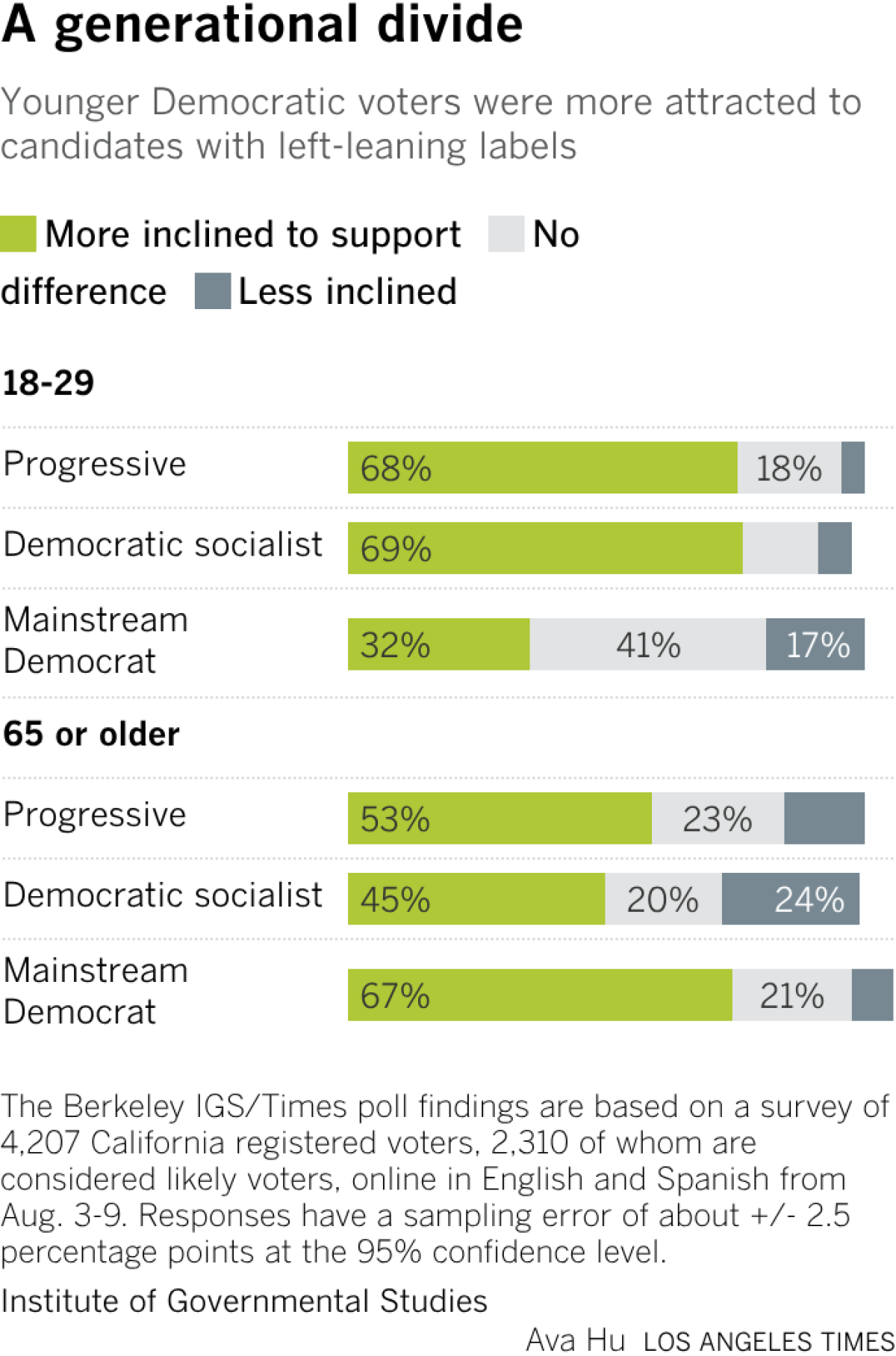
Dave Smith, 72, a retired doctor from Madison who heard Hong speak Tuesday, said the democratic socialist label will be tough for voters of his generation to accept.

“The platform, much of that resonates well,” said Smith, who is undecided whom he will vote for in the Democratic primary. “My vote will likely go to who is the most electable in the fall.”

Bauer writes for the Associated Press. AP writer Nicholas Riccardi in Denver contributed to this report.

Source link

Trump and Republicans return to communist attacks against Democrats ahead of the midterm elections

President Trump and his fellow Republicans are reviving a line of attack against Democrats heading into the midterm elections: They’re communists.

In just the past week, Trump has issued dark warnings that members of the Democratic Party’s ascendant left are communists who want to “completely destroy the traditional American way of life” and even engage in assassinations. Vice President JD Vance has similarly called out communism as a political shift that is “something we haven’t seen in the U.S.” House Speaker Mike Johnson has decried “radical candidates” who are “self-described, self-identifying Marxists.”

The GOP’s ideological focus conflates democratic socialism, which often centers on securing universal healthcare, higher taxes on the wealthy and stricter corporate regulation, with communism, under which private ownership is largely eliminated. It has been building since Zohran Mamdani, a democratic socialist, won the Democratic nomination for New York City mayor last year.

But it’s kicked into a higher gear recently after democratic socialists won several New York City congressional primaries last week. The primary victory on Tuesday by another democratic socialist, Melat Kiros, for a Denver congressional seat suggested the trend may extend beyond Manhattan liberalism.

“The Democrats are making this easy for us,” Rep. Richard Hudson, the North Carolina Republican who leads the House GOP’s strategy and fundraising arm, said in an interview. “They’re nominating extreme liberals, leftists who are out of touch even with mainstream Democrats.”

Republicans are holding onto slim majorities

The messaging effort comes as Republicans scramble to hold onto threadbare congressional majorities in the November midterms. It risks overlooking public frustration, particularly among younger voters, with unfettered capitalism at a time of growing income inequality and rising costs.

But it also gives Republicans a much-needed opportunity to shift the conversation back to territory that is more comfortable for them after their party has spent much of the year on defense over the fallout from Trump’s decision to launch a war against Iran, which contributed to widespread price spikes.

Ralph Reed, the longtime conservative activist who hosted Trump last week at a Faith and Freedom Coalition conference, acknowledged that Republicans are facing steep headwinds this year. But the recent string of wins by democratic socialists, he said, allows Republicans to present a contrast between “common sense and crazy.”

Sen. Bernie Sanders (I-VT) speaks during a Get Out the Vote (GOTV) rally

Sen. Bernie Sanders (I-VT) speaks during a Get Out the Vote (GOTV) rally at Kings Theater on June 18, 2026 in New York City. Sanders joined Mayor Zohran Mamdani ahead of next week’s primary, and the start of early voting on Saturday, as the pair campaigned for Brad Lander, Claire Valdez and Darializa Avila Chevalier, who are challenging incumbents in Democratic primary contests.

(Michael M. Santiago / Getty Images)

Democrats are uncertain over the party’s direction

The renewed push could tug at tensions among Democrats who are largely united in their loathing of Trump but are divided over the party’s direction. This year’s primaries are shaping up as a referendum between centrists who are eager to course correct from what they see as progressive overreach earlier in the decade and a left-wing pushing for even more sweeping change.

“A lot of this anger has been boiling under the surface,” said Joseph Geevarghese, executive director of Our Revolution, which was founded by U.S. Sen. Bernie Sanders, a Vermont independent who caucuses with Democrats. “It’s coming to the fore in this moment in a very powerful way.”

But Rep. Josh Gottheimer, a centrist New Jersey Democrat, called the victories in Colorado and New York “aberrations.”

“We’ve got to fight like hell to keep our party from being hijacked by socialists,” he said. “Most of them are bomb throwers, not problem solvers.”

Nevada Atty. Gen. Aaron Ford easily dispatched a more progressive rival earlier this year in his Democratic bid for governor in a state Trump carried in 2024. As he eyes a general election challenge to Republican Gov. Joe Lombardo, he insisted candidates like those who won in New York don’t represent all Democrats.

He said the Democratic Socialists of America “is not the face of our party.”

Rep. Suzan DelBene, a Washington Democrat who chairs the House Democratic campaign committee, said in a statement that Republicans were “resorting to desperate attacks that aren’t actually about the pocketbook issues.”

Trump risks overreaching with communism argument

Trump and fellow Republicans risk missing the mark when the public’s embrace of capitalism might not be as strong as it was decades ago.

About half of U.S. adults, 54%, have a positive view of capitalism, according to an August poll from Gallup, a slight decline from 61% in 2010. Democrats have driven some of the shift, but favorable opinions of capitalism have fallen among independents as well.

Only 42% of Democrats viewed capitalism favorably, while 66% had a positive view of socialism. The poll found that both younger and older Democrats have warmed slightly on socialism since 2010, but Democrats under age 50 are much less likely to view capitalism favorably. Democrats age 50 or older didn’t shift meaningfully.

“Young voters, who I would argue are driving a lot of the electoral energy that we’re seeing, came of age politically in a post-Soviet world,” Geevarghese said. “The attacks don’t land in the same way when Donald Trump was politically of age.”

Hudson, who is running the House GOP campaign committee, acknowledged the communism line might not resonate in the same way with all voters, particularly younger people. That’s why, he said, it’s important for Republicans to tailor their message to the needs of individual districts.

“I’ve never run cookie-cutter campaigns where we just say one thing over and over everywhere,” he said.

Still, the argument was high on Trump’s mind again on Wednesday as he visited the newly built Theodore Roosevelt Presidential Library in North Dakota. He called the former president a “ferocious opponent of a thing called communism.”

“It’s the biggest threat to our country, including World War I, World War II, Pearl Harbor, September 11,” he said. “It’s a bigger threat, potentially a bigger threat than that, because it’s like a cancer that spreads, and you better stop it fast.”

Beverly Gage, a history professor at Yale University who has written on the rise and fall of Sen. Joe McCarthy, said earlier eras of anti-communism politics took hold because there was a large and active Communist Party in the U.S. and the Soviet Union was the country’s primary foe. But she said Trump’s focus on the issue is notable given his ties to Roy Cohn, a onetime confidant of Trump who earlier worked for McCarthy.

“It’s not very many steps to get from McCarthy to Roy Cohn to Donald Trump,” she said.

California Gov. Gavin Newsom, a potential Democratic presidential candidate, shrugged off Trump’s communism focus as “bunk.” In an interview, he said the direction of the party isn’t all that different from the dynamics he’s navigated for decades in California politics.

“I governed in an environment where the DSA was otherwise known as progressives,” he said. “This dialectic is so deeply familiar to me, and I don’t over read any of it.”

Sloan writes for the Associated Press. AP writer Michelle L. Price contributed to this report.

Source link

L.A. could get democratic socialists in mayor, city attorney spots

Democratic socialists are looking to extend their power in Los Angeles City Hall this fall with their biggest prizes yet: mayor and city attorney.

Mayoral candidate Nithya Raman and city attorney hopeful Marissa Roy, both members of the Los Angeles chapter of the Democratic Socialists of America, are heading into the Nov. 3 general election with strong showings in the June 2 primary as tailwinds.

If she prevails in November, Raman would join the ranks of democratic socialists leading big U.S. cities, including New York’s Zohran Mamdani and Seattle’s Katie Wilson. Washington, D.C., looks to be next: Janeese Lewis George won the Democratic primary for mayor there this month, all but ensuring her a general election win in that deep-blue city.

In Los Angeles, a democratic socialist mayor and city attorney could mean added clout because of an ideological lockstep between the two offices, said Fernando Guerra, a political science professor at Loyola Marymount University. In such a scenario, he said, the city attorney’s office is less likely to be a check against the mayor’s authority to set policy on issues such as land use and public safety.

“It’s incredibly substantive that the city attorney will interpret much of the policy that the mayor may push to be the right policy, and not challenge it,” Guerra said.

The election of Raman and Roy would also underscore the leftward tilt of Los Angeles, which has four City Council members, including Raman, who are DSA members — two of whom were reelected in the primary. City Controller Kenneth Mejia, who was recommended (although not formally endorsed) by DSA, was also reelected.

The DSA champions ideas sharply to the left of more establishment Democrats, such as incumbent L.A. Mayor Karen Bass. The L.A. DSA chapter, for example, says its objectives include abolishing prisons and defunding the police.

DSA-L.A. co-chair Sean Wakasa said his organization is thriving in L.A. and across the country because it has destigmatized the concept of socialism.

“Democratic socialism ultimately, at the end of the day, is about making the politics that working-class Americans can see themselves in,” Wakasa said.

In Los Angeles, Wakasa said, a DSA mayor would be expected to build more public transit, strengthen protections for renters, fight for workers’ rights, raise the minimum wage and defend local immigrants from the federal government.

The city attorney, he said, would be expected to defend working-class Angelenos by enforcing renter protections, resolving wage-theft issues and enforcing sanctuary city policies.

Business groups and public safety advocates have voiced concerns over the prospects of DSA members calling the shots at City Hall.

“They would run roughshod over the city,” said Stuart Waldman, president of the Valley Industry and Commerce Assn. He said Raman and Roy “don’t just drink the DSA Kool-Aid, they live it.”

Waldman said he would expect Los Angeles under democratic socialist leadership to adopt overzealous tenant protection policies that would discourage new rental development. He said they would also seek to weaken the police, leading to a “free-for-all for crime.”

“They would run business out,” Waldman said.

Roy, who has promised to turn the city attorney’s office into “the largest public interest law firm in the city,” targeting wage theft, tenant harassment and other issues, disputed Waldman’s assertion.

“Allowing corporate bad actors to violate our laws doesn’t make L.A. safer or more affordable — enforcing protections for renters, workers, and consumers does,” Roy said in a statement.

Raman said in a statement that she shares “DSA’s commitment to fighting for working people and those who have been left behind by a political system that too often serves powerful interests instead of everyday Angelenos.”

But she also said “there is no liberal or conservative way to fill a pothole.”

“I’ve always believed the most progressive thing you can do is actually make government deliver,” Raman said. “Every time City Hall fails to do that— potholes that don’t get fixed, streetlights that stay dark, 911 calls that go unanswered — it erodes people’s faith that government can solve problems at all.”

Rick Cole, a former deputy mayor of L.A., said the DSA label for both candidates doesn’t mean they’ll adhere to the most dramatized versions of what DSA stands for. Neither candidate is an ideologue, he said.

Raman’s membership in DSA “is a signifier she’s going to be more skeptical of current policing,” said Cole, a Pasadena City Council member. “She’s going to be more focused on affordable housing. She’s going to be more focused on a humane approach to getting people off the streets.”

A poll by the UC Berkeley Institute of Governmental Studies that was co-sponsored by The Times showed that in a head-to-head runoff, Raman was supported by 32% of the registered voters polled, compared with 28% for Bass.

Bass finished first in the primary, ahead of Raman, with former reality TV personality Spencer Pratt finishing in third place.

With Pratt now out, the race is on for both campaigns to appeal to his voters, who are generally considered more conservative. Even so, the Bass campaign said it doesn’t plan to focus on Raman’s DSA affiliation.

“What’s important isn’t labels — it’s what her [Raman’s] record shows, and that’s voting over and over and over to allow encampments near schools and to shrink our police force. It goes against what L.A. needs and what most of L.A. believes,” Bass campaign spokesperson Alex Stack said in a statement.

Raman, who was twice elected to the City Council with DSA support, has voted against additional police hiring and spending and creating new anti-encampment zones around the city.

One irony is that the three other members of the DSA on the City Council — Eunisses Hernandez, Ysabel Jurado and Hugo Soto-Martínez — have all endorsed Bass, citing the mayor’s fierce resistance to the Trump administration’s immigration raids last year, among other factors.

In the primary, DSA’s L.A. chapter recommended Raman but didn’t endorse her, with the distinction being that an endorsement comes with active canvassing and support from DSA members. DSA-LA co-chair Leslie Chang said it wasn’t yet clear whether her group would endorse Raman in the runoff.

A DSA endorsement for Raman now might be a mixed blessing, given that Pratt’s support came from more conservative parts of the city, said Christian Grose, a political science professor at USC.

“Karen Bass is not popular with Pratt voters, and the DSA is not popular with Pratt voters, but that’s who will decide the mayor’s election,” he said.

Roy, a deputy state attorney general, finished first in the city attorney primary by a wide margin and will compete against John McKinney, a deputy district attorney, in the runoff.

McKinney said electing Roy to the city attorney’s office would be like “going back in time” to when George Gascón was the top prosecutor in Los Angeles County, which police and prosecutors said was a disaster for public safety.

In the recent City Council primaries, DSA-endorsed incumbents Hernandez and Soto-Martinez both won reelection easily, while DSA-endorsed Faizah Malik failed to push incumbent Traci Park into a runoff in her Westside district.

In the Council District 9 race, DSA-endorsed community organizer Estuardo Mazariegos will be in a runoff with Jose Ugarte, a former aide to termed-out incumbent Curren Price.

DSA leaders are pleased overall with how their candidates have performed.

“DSA has really claimed a foothold for ourselves in L.A. County politics,” Chang said.

Source link

Democratic socialists surge in mayoral races across the country as anti-Trump fervor rises

As Janeese Lewis George paves a path to the mayor’s office in Washington, D.C., she’s told voters they could have it all.

Her unapologetically expansive, left-wing agenda includes subsidized or even free childcare, increased down payment assistance for homebuyers and community resources to reduce crime, plus a promise to aggressively confront President Trump’s attempts to reshape the nation’s capital.

“People are tired of hearing what government can’t do. They want to hear what government can do,” Lewis George said in an interview before the city’s primary, where she defeated her Democratic opponents and positioned herself to win the general election in November in a city dominated by Democrats.

Lewis George’s victory signals a break with a quarter-century of centrist governance in Washington, and it puts her in the vanguard of democratic socialists who have ascended in urban politics over the last year. Zohran Mamdani toppled Andrew Cuomo, the scion of a political dynasty, on his way to becoming New York City mayor. Katie Wilson won an upset victory to lead Seattle last fall. And this month, Nithya Raman clinched a spot in the November runoff against Los Angeles Mayor Karen Bass.

All of them are members of the Democratic Socialists of America, or DSA. The political organization has seen its membership ranks swell from a few thousand to more than 100,000 nationwide over the last decade after an influx of younger Americans joined following the presidential bids of Vermont Sen. Bernie Sanders, also a self-described democratic socialist.

There’s little sign of national coordination among the candidates, and it’s unclear whether voters are gravitating toward their promises of improved government services, their vows to fight the Trump administration or their critiques of capitalism.

But from coast to coast, confrontational progressives are advancing in mayoral races. City leaders can draw outsized attention for their successes and failures, and democratic socialists will be under pressure from residents to deliver on their vows for a new kind of governance. Whether that translates to national politics is a next test for their movement.

“They are all channeling a displeasure with a status quo and a serious desire for economic populism that the establishment Democratic Party hasn’t been preaching,” said Eric Stern, a Democratic strategist with Fight Agency, a political consulting firm that strategized Mamdani’s mayoral campaign.

Stern added that Democratic voters appeared more willing to support the most progressive candidate in mayoral races rather than in contests for the U.S. House. Candidates like Mamdani and Raman, Stern said, are “daring voters to dream and fall in love not just with the individual candidates but also the political process as a whole.”

A rising left navigates America’s urban challenges

The trend of progressives surging in urban areas may have limits for its broader impact on Democratic politics. Democratic mayors in cities including Atlanta, Houston, Miami and San Francisco won on relatively moderate platforms in recent years.

Progressive have also faced noteworthy challenges. Chicago Mayor Brandon Johnson was endorsed by the city’s DSA chapter during his 2023 mayoral run but has since faced criticism from both moderate and liberal local leaders on issues such as immigration, the local budget and public safety. Recalls and public pressure ousted progressives elected to district attorney offices in multiple jurisdictions over the last five years, when criminal justice reform efforts ran into dissatisfaction over public disorder following the COVID-19 pandemic.

Trump’s hardline immigration and law enforcement tactics have also become a challenge for liberal cities. The president’s agenda poses an especially serious threat to Washington, D.C., because of its status as a federal territory.

“Maybe we take back Washington and run it on a federal basis,” Trump told reporters this month when asked about the potential election of a democratic socialist as the district’s mayor. “We won’t put up with it.”

But progressives hope the current wave of anti-Trump furor in deep blue cities across the country will help buoy the chances of those on the hard left.

“It’s not folks looking for the leftmost option so much as looking for a candidate who’s gonna be on their side,” said Ravi Mangla, speaking for the left-wing Working Families Party. The party often endorses the same candidates as the DSA and is readying to target more mayoral offices in the country’s biggest metropolises this fall and in 2028.

“It’s less about whether you are on the right or on the left so much as whether you are willing to punch up at the powerful,” he added.

Mamdani and Lewis George are both self-described “sewer socialists” who emphasize the need for responsive government services rather than critiques of market economics. The phrase recalls the socialist Gilded Age mayors whom critics derided as too preoccupied with managing public works projects.

The term’s revival is partly a strategic move to align leftist ideas with concerns over affordability and the economy, voters’ top concern in the midterm elections, and shift the public perception of democratic socialists from firebrands who support radical policies to independent-minded public servants.

“This is absolutely a change election and I’m excited to bring the change that people want, which is really putting people first in the city and having the moral clarity and courage to stand up to Trump,” Lewis George said.

For voters the ‘socialist’ label did not seem to matter

While conservatives have used the “socialist” label to attack Democrats as extreme or incompetent, some D.C. voters appeared ambivalent before Tuesday’s primary.

Several lifelong residents said they believed Lewis George was a “fighter” but didn’t think she’d have much of an impact on the local economy, given the city’s status as a federal district.

“I go back and forth on my own labels and whether I am supportive of that movement or not, but I am supportive of making D.C. more affordable,” Owen Fitzgerald, a University of Maryland graduate student, said of his support for democratic socialism.

Fitzgerald voted for Lewis George because she would stand up to Trump and said he’d first learned of her campaign from friends in his neighborhood. But he didn’t know she was a democratic socialist until he saw news reports describing her with the label.

“It sends a cultural message to this administration that the people who are surrounding them in the capital are opposed to their platform, opposed to their political agenda, and I think that it will send a message, both nationally and internationally,” Fitzgerald said.

Brown writes for the Associated Press.

Source link