democratic primary

The Earth is sizzling, but climate isn’t a hot topic for Democrats in this year’s campaigns

Climate change has been the backdrop to Charles Hughes’ entire life, from kindergarten lessons about disappearing habitats to wildfire smoke billowing through the air he breathed while growing up in Colorado. But now that he’s a college student in Massachusetts, he said global warming is rarely a top issue.

“Honestly, it doesn’t come up as much,” said Hughes, who chairs the state’s chapter of the College Democrats.

What a difference six years makes.

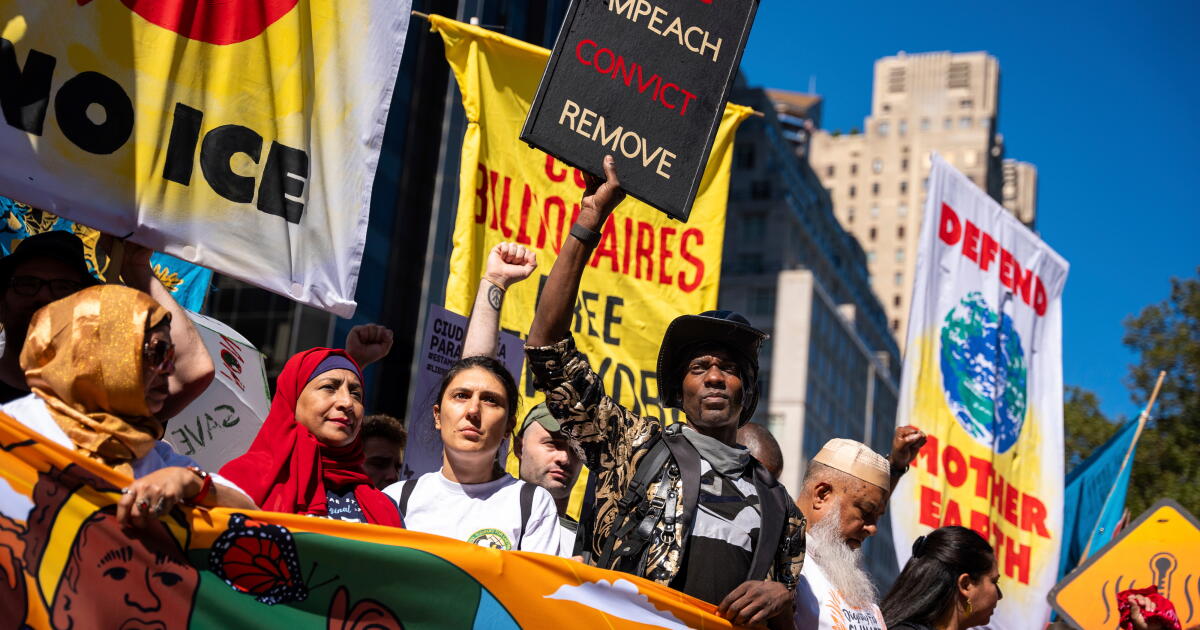
During President Trump’s first term and especially during the Democratic primaries to determine who would run against him in 2020, Democrats spoke constantly about climate change. They used it to rally young voters such as Hughes, fueling protests and sweeping demands to remake the economy with proposals like the Green New Deal.

But there has been a national shift in the conversation that is sharp enough for some researchers to coin the term “climate hushing” to describe it. The Searchlight Institute, a Democratic think tank, urged the party to stop mentioning climate change because it is not a priority for voters. The Sunrise Movement, a left-wing group that pushed global warming as a top issue for young people, switched its mission last fall to a broader mandate of fighting the Republican president.

The shift was encapsulated by the Democratic primary for U.S. Senate in Massachusetts on Tuesday as the incumbent, Ed Markey, 80, fended off a challenge from U.S. Rep. Seth Moulton, 47. Markey still talked about sponsoring the Green New Deal, but focused more on other issues to burnish his left-wing bona fides and prove to voters that he is not too old for the job.

It was the latest example of how climate change has been eclipsed by issues such as affordability, U.S. support for Israel and, above all, how to confront Trump.

“Six years ago, Green New Deal was every phrase out of Ed Markey’s mouth every chance he got,” said Mary Anne Marsh, a veteran Democratic strategist in Massachusetts. That wasn’t the case this cycle. “It’s about who’s best to fight. Period, full stop. Everything falls under that.”

‘People are increasingly freaked out about other issues’

Even if the political discussion on climate change has quieted, the planet has not. Scientists say there is an increasing chance that by the end of the year, 2026 could be the hottest year on record, or at least come close. A strengthening El Nino is forecast to be off the charts, spiking global temperatures.

Some advocates expect the issue to return to center stage if Democrats retake the U.S. House in November and climate-sparked disasters dominate the winter.

U.S. Sen. Sheldon Whitehouse of Rhode Island, a prominent Democratic voice on climate change, said in an interview that ignoring the issue is a major strategic “blunder.”

“Climate change has moved from the science department into the economics department,” he said. “It’s now battering people’s home insurance, property values, pocketbook concerns. So I think it’s a very powerful argument.”

Trump has falsely claimed climate change is “a hoax,” and his administration has undone policies one by one that would make it less damaging in the future.

The Sunrise Movement, founded in 2017 to mobilize young voters over climate issues, announced in October that it was shifting to a broader fight against “fascism.” The group’s executive director, Aru Shiney-Ajay, said that was a prescient move because of reports that federal agents infiltrated protest meetings during Trump’s immigration raids in Minneapolis.

“We just live in a significantly more authoritarian country. Because of that, a lot of the Democratic primaries are about more existential questions,” Shiney-Ajay, whose network generally backs left-wing Democrats, said in an interview. “It has felt less like people care less about climate and more like people are increasingly freaked out about other issues.”

About 6 in 10 Democrats say climate change is “a very big problem” for the country, according to a Pew Research Center poll from April. That is roughly the same as in 2016. Still, climate has often taken a back seat to other issues in Democratic voters’ priorities, such as inflation, healthcare affordability and the role of money in politics.

Affordability concerns have dominated the political debate this year.

McKenzie Wilson of Blue Rose Research, a Democratic data firm, said voters have called for sweeping changes in response to economic discontent, demonstrating a level of anger not seen in years.

“In that kind of environment it’s hard to think about long-term, existential problems,” Wilson said. “If we don’t talk and focus our attention on the number one thing the electorate wants to talk about, as we saw in 2024, we’re not going to be connecting with the electorate.”

‘Don’t say climate change’

That view was summed up by the Searchlight Institute, a Democratic think tank that last year released a provocative suggestion: “The First Rule About Solving Climate Change: Don’t Say Climate Change.”

It contended that voters saw it as such an intimidating, complex issue that Democrats were more likely to win by focusing on other subjects — thus enabling them to regain power and tackle the crisis that they were not talking about.

Leah Stokes, a political scientist at the University of California, Santa Barbara and author of “The Carbon Wave,” a book about Democratic President Joe Biden’s domestic agenda, said it was “galling” when politicians made the issue less of a priority.

“The climate crisis is accelerating and we can’t really not talk about it for like a decade, because the planet will be even more on fire if we do that,” she said.

Anthony Leiserowitz, director of the Yale Program on Climate Change Communication, agreed with those concerns.

“What happens over the course of the next decade will profoundly shape the habitability of the planet for literally thousands of years to come,” he said.

Some are making climate an affordability issue

Climate has come up as part of the national backlash to data centers, but it is only one part of the conversation about the projects’ impact. Many climate advocates are adjusting how they talk about the issue, stressing how green energy can lower prices and ease insurance costs.

“What we’re seeing right now is, whether you’re advocating for healthcare reform or climate action or some niche tech issue, everything is filtered through some cost frame,” said Jared Leopold, a veteran Democratic strategist who has long focused on climate change.

That is how the Green New Deal came up at a recent debate between Markey and Moulton, when a voter asked how each candidate would reduce energy prices. Notably, the questioner asked about increasing nuclear or gas generation, not clean energy, to deal with cost. Markey turned the opportunity into a slam against the president.

“There was a plan in place in order to have a strong, clean affordable energy future for our commonwealth,” Markey said, “and Trump attacked it.”

Tatishe Nteta, a political scientist at the University of Massachusetts Amherst, said that is how Markey has used climate change this election — to signal his willingness to fight Trump as well as his alliance with the left flank of the Democratic Party, which has run up a series of primary wins this year. But other issues have become even more useful in doing that.

“The definition in where you’re at in terms of a progressive candidate and a progressive elected official is your viewpoint on Israel,” Nteta said. “You’re not hearing this in most races, that I’m the candidate who’s going to protect and save our planet.”

Massachusetts’ summer has been the hottest that Eileen Cefail can recall in the 30 years she has worked in the Roofers Local 33 office. “The roofers are tough as nails, and they work so hard, and their work is so grueling,” she said. “This heat has been horrendous for them.”

Cefail is backing Markey in the primary, but climate, she said, was not the main reason.

“He’s always been a union guy,” Cefail said. “He’s just for the labor.”

Riccardi, McDermott and Willingham write for the Associated Press. Riccardi reported from Denver and McDermott from Providence, R.I. Associated Press writer Linley Sanders in Washington contributed to this report.

Source link

Maine Democrats choose Troy Jackson as new Senate nominee

Former state lawmaker and logger Troy Jackson secured the Democratic nomination for U.S. Senate in Maine on Saturday and will face longtime GOP Sen. Susan Collins in November in a race that could decide which party controls the Senate.

Jackson replaces Graham Platner, who won the Democratic primary in June but withdrew from the race this month following an allegation of sexual assault that Platner has denied. Maine Democrats met Saturday to choose a new nominee to face Collins.

Support coalesced around Jackson, a former Maine Senate president and fifth-generation logger from rural northern Maine who campaigned alongside Platner during a failed bid for governor and was a favorite among progressives to replace him.

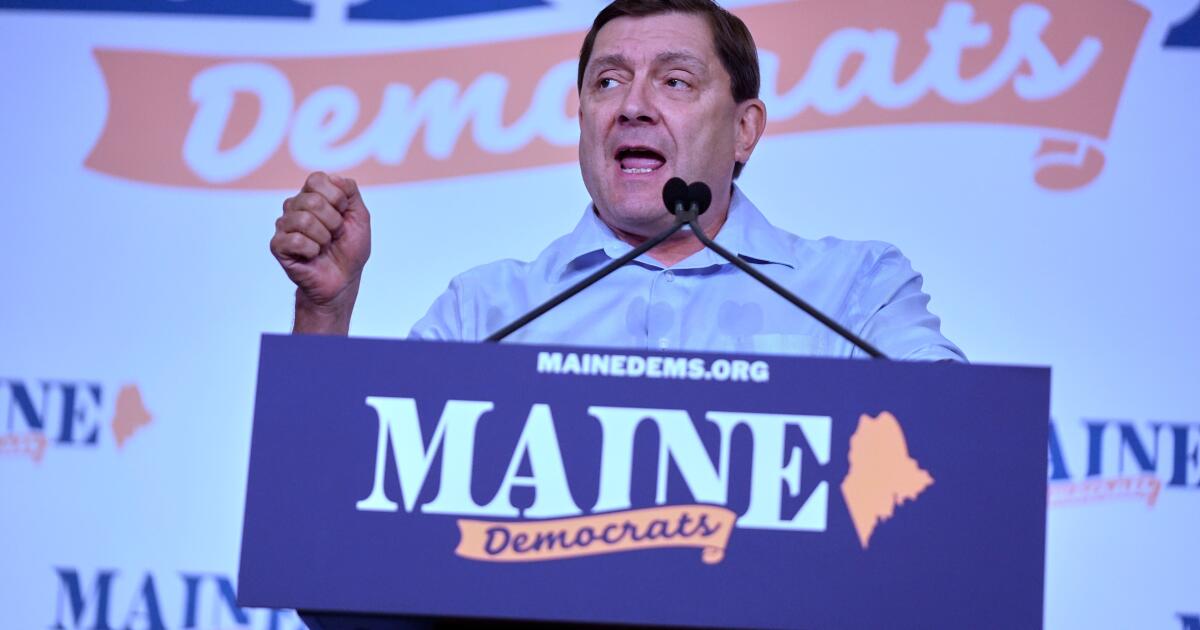
“When the people in power refuse to listen, you have to organize, you have to stand in solidarity, together. And you have to make them listen,” Jackson said during a speech at a last-minute nominating convention held Saturday.

The Maine Democratic Party has been scrambling to choose a new nominee after Platner, who sailed to victory in the Democratic primary in June, was accused by a former girlfriend of sexually assaulting her in 2021. Platner denies the allegation, but quit the race after key supporters called on him to withdraw.

Democrats have seen Maine as the party’s best opportunity to flip a Senate seat this year because it is a competitive Senate race in a state that Donald Trump lost in 2024. But defeating Collins won’t be easy. The five-term incumbent holds a fundraising advantage, while the new Democratic nominee will have less than four months to sell himself to voters.

Maine law gave the state party authority to choose a replacement and required a new nominee to be named by Monday — 99 days before the Nov. 3 election.

Maine Democrats’ never-before-used process of voting on a new nominee involved hundreds of Democratic delegates gathering in Bangor, about 130 miles north of Portland. The delegates were elected at county party meetings last weekend. The nominating convention began Saturday morning and wrapped by noon.

Jackson’s victory was largely expected after his campaign touted that more than 480 delegates selected to go to the convention had promised to vote for him, a progressive who supports Medicare for all and dismantling Immigration and Customs Enforcement. He ended up winning 566 of 571 delegates who cast votes.

Jackson first ran for office as a Republican in 2000 when he sought a seat in Maine’s House of Representatives. He lost, but won two years later when he ran as an independent. He switched to the Democratic Party in 2004 and eventually became the Maine Senate president before leaving the statehouse in 2024.

He came in third while running for governor in this year’s Democratic primary election, but had the backing of Platner, U.S. Sen. Bernie Sanders and Our Revolution, the political organization founded by the Vermont independent.

Other top candidates dropped out

Once Platner dropped out July 10, Jackson and a flood of other former gubernatorial candidates and others jumped in to try to take Platner’s place. But by July 19, most had abandoned their bids, with Jackson emerging as the clear favorite.

Jackson received early support from progressives who had backed Platner before he dropped out. Our Revolution initially backed Jackson for governor and Platner for Senate. When Platner left the race, the group rallied behind Jackson.

Jackson previously ran Maine operations for Sanders’ 2016 presidential bid. This election cycle, Sanders endorsed Jackson for governor and Platner for Senate, though he withdrew his support for Platner after the sexual assault allegation. He said he didn’t plan to weigh in on which Democrat should replace Platner.

Just one other candidate remained in the race for the Senate nomination — women’s health company Chief Executive Saundra Pelletier. She faced long odds against Jackson, who has been a fixture in Maine politics for more than a decade.

Jackson has supported progressive positions such as Medicare for all. He also has called for the abolition of ICE, whose presence in Maine has been hotly debated since an agent fatally shot Johan Sebastián Durán Guerrero, a 25-year-old Colombian national, near his home in Biddeford, Maine.

Maine key to Democrats’ Senate path

Democrats have a narrow path to take back the Senate in November, and it’s unlikely they can do it without a win in Maine. In addition, they need victories in most other competitive races — including in North Carolina, Alaska, Ohio and Texas — and they need to hang on to the seats they already have. That includes open Senate seats in Michigan and Minnesota, where Democratic incumbents are retiring.

Maine’s Democratic primary was one of the early contests where progressives took on establishment-backed Democrats. While Platner faced several controversies during his campaign, he easily outlasted Gov. Janet Mills, who was backed by Democratic Senate leader Chuck Schumer of New York but dropped out before the June 9 primary.

Platner had backing from Sanders as well as Arizona Sen. Ruben Gallego and Massachusetts Sen. Elizabeth Warren. That support disintegrated after the sexual assault allegation surfaced this month.

Midterm messages

Jackson will need to convince the state’s large independent voting bloc that it’s time to replace Collins. Republicans have called Jackson too extreme for Maine voters, and Collins said this week that she knows Jackson well and that his positions are “clearly” in line with socialism.

She noted that Jackson ran democratic socialist Sanders’ first presidential campaign in Maine, adding, “He’s a Bernie Bro.”

Jackson also needs to scramble to make up a fundraising gulf against Collins, who has been raising money for months.

Federal filings show she has raised more than $16 million so far. Jackson’s campaign this week said he raised more than $1 million since jumping into the Senate race.

Jackson said Saturday he believed his team is up to the task.

“We’re not from the left, we’re not from the right. We’re from the bottom, and we are rising,” he said during a speech.

Whittle and Kruesi write for the Associated Press. AP journalist Nathan Ellgren in Washington contributed to this report.

Source link

A democratic socialist in Wisconsin tests how far left voters want to go in a battleground state

Over the last month, Democratic socialists have notched victories in the liberal strongholds of New York City, Washington, D.C., and Denver.

Now Francesca Hong, a single mother who has worked as a dishwasher and line cook, is trying to do the same with her campaign for governor in Wisconsin, a swing state known for razor-thin election margins where winning over moderate, independent voters is crucial.

Hong’s candidacy has turned the Democratic primary on Aug. 11 into the latest test of just how far left voters are willing to go in the November midterms.

“We do this in Wisconsin, we’re going to change politics across the country,” the 37-year-old Hong said as she headed into the final month of campaigning. “People who are frustrated and have a lot more to lose — and I’m one of those people — are ready to coalesce around someone they can believe in.”

John Ravdabaugh, an undecided independent voter, came away impressed after hearing Hong speak at the retirement home where he lives. Even though the democratic socialist label concerns him, Ravdabaugh said he would consider voting for Hong.

“Every system reaches a point where change is necessary,” he said.

Whoever wins the primary will advance to almost certainly face Republican U.S. Rep. Tom Tiffany, one of the most conservative members of the House, who has President Trump’s endorsement. Tiffany has only token opposition in the primary.

The governor’s race is integral to Democrats’ hopes of earning full control of Wisconsin state government for the first time since 2010, and it will send a signal about where the country’s politics are headed by shaping a key political battleground that helps decide presidential campaigns.

Trump-backed Republican derides Democratic rivals as ‘crazy’

Tiffany has focused much of his criticism on Hong and former Lt. Gov. Mandela Barnes, another Democratic candidate for governor.

“This November, the choice is common sense or crazy,” Tiffany posted on social media in June. Tiffany included screenshots of a Barnes post where he voiced support for cutting prison populations by half and Hong’s posts where she advocates for defunding and abolishing the police.

As a candidate, Hong has not backed away from her calls to defund and abolish the police. Hong also supports increasing taxes on the wealthy and creating a state-owned bank to help pay for free health care and free child care, a $20 minimum wage, and a moratorium on data center construction.

Hong dismisses concerns that she’s too liberal to win over key independent voters in a state Trump carried twice and narrowly lost a third time.

“I worry that’s a miscalculation of where voters are at in our state, that we’re underestimating what people want,” Hong said in an interview.

There’s a history of socialism in Milwaukee

Last month, democratic socialist Janeese Lewis George won the Democratic primary for mayor of Washington, setting herself up to clinch the office in November.

Then three congressional candidates backed by New York Mayor Zohran Mamdani, another democratic socialist, defeated establishment-backed politicians.

And just last week, democratic socialist Melat Kiros beat U.S. Rep. Diana DeGette in the Colorado primary, a stunning victory for the 29-year-old, first-time candidate against an incumbent who took office before she was born.

But those victories have been in either congressional or mayoral races in large urban centers, a far different landscape than Wisconsin.

In 1910, during socialism’s heyday in the United States, Milwaukee sent the first socialist to Congress and was the first major American city to elect a socialist mayor. Milwaukee elected two more socialist mayors before 1960.

Vermont Sen. Bernie Sanders, perhaps the best known democratic socialist, won all but one county in Wisconsin in the 2016 Democratic primary. In 2023, two state lawmakers from Milwaukee revived the socialist caucus in the Legislature, which had been dormant since 1935.

Hong, the first Asian American elected to the state Assembly in 2020, is one of four members of that caucus.

Barnes, 39, served four years in the state Assembly before his four years as lieutenant governor under Democratic Gov. Tony Evers. In 2022, Barnes came within 27,000 votes of ousting Republican U.S. Sen. Ron Johnson.

“I’ve been around longer than anybody fighting these fights,” said Barnes, who grew up in Milwaukee and is vying to become Wisconsin’s first Black governor.

He played down the idea that democratic socialists are surging.

“People aren’t looking for labels, necessarily,” he said. “People are looking for bold solutions.”

Longtime Democratic strategist Joe Zepecki, who is not working for any of the Democrats running this year, said Barnes has an advantage as the most well-known candidate in the race.

“I have believed from the day since Mandela Barnes got into the race, he’s the favorite,” Zepecki said. “It is his race to lose.”

Hong rival leans into electability argument

Lt. Gov. Sara Rodriguez, a former nurse and health care executive who is also running for the Democratic nomination, said she’ll have broader appeal in November. She cites her experience in the private sector and her flipping of a state Assembly seat in a conservative Milwaukee suburb, and she emphasizes her ideas for lowering costs for working people.

“I’m not worried about other candidates in this race,” Rodriguez said in an interview. “What I’m worried about is making my argument to Wisconsinites about why I’m the best person to lead the state, how I am going to fight for them.”

She launched a $1 million television ad campaign this week that features her in nursing scrubs talking about taking on Tiffany and lowering health care costs.

Other Democratic candidates are state Sen. Kelda Roys, who has the endorsement of the statewide teachers union, and Joel Brennan, a former top aide to Evers.

Missy Hughes, the state’s former economic development director, dropped out of the race in June and endorsed Rodriguez. David Crowley, the top elected official in Milwaukee County, dropped out this week and also backed Rodriguez.

Mainstream Democrats worry about winning in November

More moderate Democrats worry that nominating Hong could hurt them in the general election, especially in Wisconsin where independent voters are key in statewide races that are often decided by tiny margins.

Neera Tanden, who leads the Center for American Progress, said “it’s especially important in the age of Trump” to select viable candidates.

“In Wisconsin, whoever wins the general election will be the person overseeing elections in 2028 and whether people are seated in 2029.”

Evers won his two races for governor by just over 1 percentage point in 2018 and just over 3 points in 2022. Trump won Wisconsin by less than a point in 2024, and lost by less than a point in 2020.

Dave Smith, 72, a retired doctor from Madison who heard Hong speak Tuesday, said the democratic socialist label will be tough for voters of his generation to accept.

“The platform, much of that resonates well,” said Smith, who is undecided whom he will vote for in the Democratic primary. “My vote will likely go to who is the most electable in the fall.”

Bauer writes for the Associated Press. AP writer Nicholas Riccardi in Denver contributed to this report.

Source link