‘He’s everywhere’: Carl DeMaio’s push to make the GOP relevant again
ROSEVILLE, Calif. — San Diego County Republican Carl DeMaio had a warning for conservatives at a get-out-the-vote rally this month in Placer County.
“You are doomed,” DeMaio said, crooning the phrase like a foghorn. The audience chuckled.
“Doomed” is DeMaio’s description for races that lack a conservative candidate. Skip voting in those, he told the crowd, briskly walking them through the Nov. 3 ballot.

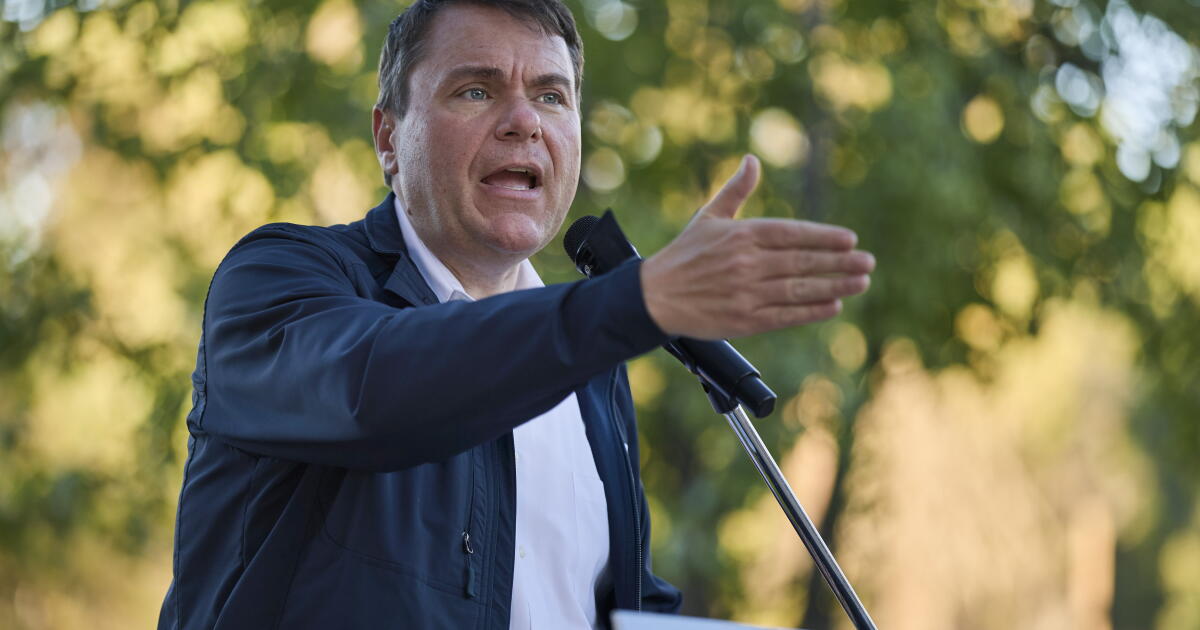
Rep. Carl DeMaio speaks to attendees during a “Beer, BBQ & Ballots” event for Proposition 39 at the Nevada County Fairgrounds.
(Fred Greaves / For The Times)
Microphone in hand, the freshman state legislator paced the floor, threw up his hands and scowled as he declared California a “communist state,” the progressive Bay Area “the gates of hell” and Hillary Clinton “the wicked witch.”
Urging volunteers to door-knock at Republican households, he instructed them to ignore Democratic homes entirely.
“I don’t need to remind them there’s an election going on,” he said, prompting more laughs.
DeMaio, 52, is emerging as a prominent voice for California Republicans, promising a path back to power and delighting audiences with his sharp takedowns of Democrats. His vehicle this election is Proposition 39 — he is coauthor of the ballot measure — which would require Californians to provide ID when voting, an initiative backed by millions of dollars from conservatives and condemned by the state’s Democratic leaders and voting rights experts.

A woman grabs a “Yes on 39” lawn sign at the Nevada County Fairgrounds.
(Fred Greaves / For The Times)
On his YouTube channel, he regularly skewers Gov. Gavin Newsom, the Sacramento “swamp” and the media with shows titled, “Thinking of California? 3 Reasons Not to!” and “Socialism on the CA Ballot in 2026!”
His advocacy group, Reform California, supports conservative candidates and helps raise money. Backed by volunteers, the group is usurping the California Republican Party’s influence, according to both his critics and allies.
DeMaio appears undaunted by his quest.
Registered Democrats outnumber Republicans nearly 2 to 1 in California, control the state Legislature and hold every statewide elected position. In Los Angeles, a democratic socialist running for mayor leads in some polls.
“Republicans are tired of what’s going on in the state of California, and they’re looking for somebody to lead them out of the minority,” said Corey Gustafson, former chair of the San Diego County Republican Party. “Many people think Carl is the answer to that.”
An alternative GOP machine
In an interview at Reform California’s Escondido office, DeMaio said his goal is to restore political balance in the state by electing more Republicans.
“I’m trying to get my party to pull its head out of its ass, be more effective at campaigning, and get its ideas across,” DeMaio said, ticking off values he believes the Republican Party should champion: socially moderate positions, environmental stewardship and challenging big corporations.
Though the GOP has a poor track record on those issues, DeMaio says: “I’m just simply tapping into something that already exists, that just needs leadership.”

Fairgoers listen to Rep. Carl DeMaio in Nevada County.
(Fred Greaves / For The Times)
Nearby, scores of volunteers sat at long tables, stuffing voter guides — approved and printed by DeMaio’s team — into envelopes. It is an immense undertaking, with every guide tailored to the voter’s local election. Volunteers hand-write the voter’s name and address on the envelope to give it a personal touch.
Matt Rexroad, a political consultant who ran an independent expenditure against DeMaio in his 2024 Assembly race, said that he doesn’t like DeMaio’s “combative side” but praised his effectiveness.
“He’s hardworking and he’s everywhere,” Rexroad said. “What the California Republican Party and the various central committees should be doing? He is basically running and setting up a system that’s totally outside of that which answers to him.”
Ahead of the June primary, the state Republican Party sent a cease-and-desist letter to DeMaio challenging his use of its trademarked elephant emblem and the phrase “Official Republican Voter Guide” on Reform California campaign materials.
Republican candidates endorsed by DeMaio ultimately beat out the party establishment-backed candidates in two significant races in the primary.
Matt Shupe, a spokesperson for the state Republican Party, said that Reform California is benefiting from the strong “foundation” that the party built. “We’re stronger when we work together, and we look forward to doing just that,” Shupe said.
Clashes with business and labor
DeMaio grew up in Orange County, attended a Jesuit school in Maryland and graduated from Georgetown University.
His mother died of breast cancer when he was a teenager, essentially leaving him an orphan because his father was not in the picture, according to DeMaio.
He frequently speaks about his childhood adversity. He recalled visiting his mother in the hospital during her illness, describing how she hid her leg under a blanket and joked that doctors had mistakenly amputated it. “She had a great sense of humor,” he said. “I try to also, no matter what, to keep a sense of humor.”
After college, he founded a think tank dedicated to reforming government. He co-wrote a 2003 report with suggestions for closing California’s massive budget deficit after the dot-com bubble left the state reeling.
Former state Sen. Jim Brulte said the Senate Republican Caucus spent several days reading through DeMaio’s recommendations and ultimately adopted several. DeMaio is “wicked smart,” said Brulte, also the former state GOP party leader.

Former San Diego mayoral candidate Carl DeMaio announces a recall effort against San Diego Mayor Bob Filner in 2013 in San Diego.
(Denis Poroy / Associated Press)
Elected to the San Diego City Council in 2008, he cast himself as a fiscal watchdog, challenging labor unions and businesses’ influence.
He lost a bid for San Diego mayor in 2012, and two tries for Congress, and also twice pursued a voter ID ballot measure before aborting the efforts.
In 2018, he led the successful recall effort against state Sen. Josh Newman over the Fullerton politician’s support of a gas tax, part of what DeMaio called a “gazelle strategy” to target seemingly vulnerable Democrats.
In DeMaio’s winning 2024 state Assembly race, he heavily featured former Gov. Pete Wilson and his signature push for border control. “Gov. Pete Wilson was right,” DeMaio’s ad proclaimed, before blaming both major parties for “doing nothing” on illegal immigration for decades.
The first openly gay Republican Assembly member, he represents a suburban and rural district in northern and eastern San Diego County that covers Santee, Poway and the unincorporated communities of Julian, Ramona and Borrego Springs.
He is running for reelection on Nov. 3 against Democrat Gerald Boursiquot, an IT contractor.
Friction in Sacramento
On his first day in office, DeMaio introduced bills to require voter ID at the polls, repeal California’s “sanctuary state” law, and bar elected officials from trading stocks, among others. All died in the Democratic-controlled Legislature.
His relationship with some Democrats worsened this year after he fueled outrage over a bill introduced by a Democratic Assembly member to make confidential the addresses of those providing legal and humanitarian aid to immigrants.
DeMaio dubbed it the “Stop Nick Shirley Act,” in reference to the conservative influencer, and said it would prevent activists from doing their jobs. MAGA loyalists flocked to Sacramento in solidarity.
The Democrats “can’t stand him,” said Roger Niello, a Republican state senator from Fair Oaks. “And I think he takes wonderful pleasure in that.”
Assemblymember Josh Lowenthal, a Democrat from Long Beach, called DeMaio’s views and tactics “repugnant” but said he has a friendship with the politician.
“When the camera is on, he’s antagonistic, bombastic and has the capacity to start a nuclear war,” Lowenthal said. “In private, he’s affable, thoughtful and willing to exchange ideas with anyone.”

Campaign Chair Carl DeMaio speaks during a rally at the Santa Clarita Activities Center in 2021 for
Gov. Gavin Newsom’s ouster.
(Francine Orr / Los Angeles Times)
Now wrapping up his first term in Sacramento, DeMaio said he dislikes living part time in the state capital and avoids its political culture of nightly fundraisers. Instead, he said, he goes to bed early so he can wake up and record his daily show.
“I’m actually an introvert,” he said. “People don’t believe that. When I am not doing politics, I just want to be home with my cats, my partner and just try to disconnect from the world.”
The voter ID push
DeMaio’s Proposition 39 campaign bus pulled up to Folsom last week, part of a 71-stop tour ahead of the election.
“A lot of people, especially in the Trump era, really like someone who’s loud and fighting for them,” said Sadie Foster, a 34-year-old from Sacramento who volunteered serving potato salad at the event. “Even on the Democrat side, you see that.”
DeMaio, speaking to a large crowd, called his voter ID initiative the “most exciting thing on the ballot to get our base to turn out.”
If passed, Proposition 39 would require voters to present identification at the polls or write a government-approved PIN on the back of mail-in ballot envelopes. It would also require county officials to update voter rolls by removing individuals who have moved or passed away.
Opponents, including prominent Democrats and many voting experts, argue that the measure would make voting harder and disproportionately disenfranchise low-income citizens, rural residents and communities of color. They also point to data consistently indicating that voter fraud, including by noncitizens, is exceedingly rare.
President Trump, who remains widely unpopular in California, also supports stricter voter ID laws. Unlike Trump, DeMaio actively encourages mail-in voting.
A spot for the initiative features a woman asking rhetorically, “Can you dislike Donald Trump and still vote YES on Prop. 39 for voter ID? Yes, you can!”
In an interview, DeMaio linked the proposition to what he described as his longtime interest in election integrity. At the same time, no voter wants to see “an ineligible person casting a vote,” he said.
At an online strategy meeting with volunteers last month, DeMaio instructed them to target “low-propensity, lazy Republicans.”
One volunteer suggested tying their campaign to Trump’s offer to pay voters a $5,000 dividend if Republicans keep control of the U.S. Senate and House of Representatives.
“Please,” said DeMaio, sounding frustrated. “Stay on message. Do not get distracted by shiny objects. Because those shiny objects, according to the data, won’t help us win.”