Deluge

Brit tourist hotspot hit by 40ft waves & snow deluge in freak winter storm

An amber weather warning has been issued on an island loved by Brits as locals and tourists have been told to stay ‘vigilant’ amid harsh conditions

A major Spanish island loved by British tourists has been hit by a winter storm that has covered the hotspot in snow and seen it battered by massive waves.

Locals and visitors sought cover from a freak hailstorm that brough extreme weather to Majorca, with a weather warning being issued for today. Tourist resorts on the island were turned white when a blanket of snow fell amid chilly temperatures on the Balearic island. The Spanish weather agency AEMET issued an orange weather warning on Thursday and told people on the island to be careful as even more harsh conditions could batter the holiday hotspot.

AEMET said: “Be vigilant and check the current weather forecast regularly.”

READ MORE: Incredible video shows hailstones ‘the size of baseballs’ battering homeREAD MORE: Massive Storm Alice floods rip through Spanish streets with cars swept away

The agency also warned people to be especially careful while visiting beaches and the coast, as 40ft waves are expected to batter the east of Majorca. The AEMET added: “Damage to people and property is possible, especially to vulnerable individuals or those in exposed locations.”

This storm led to terrifying 90kmph winds, which are expected to continue into the day. The shock winter storm also brought a blanket of snow to the island on Wednesday, amid the hailstorm.

Shocking images showed the size of these pieces of hail that smashed onto the island, with some locals saying they were the size of walnuts.

Yellow weather warnings was issued across the island yesterday but forecasters said the worst of the weather could be seen today.

A winter storm across southern Europe has seen temperatures dramatically drop across the typically mild area – and be a possible reason behind the shock conditions on Majorca.

Weather warnings were also issued on the Spanish mainland, with the heaviest snowfall expected around Santander, Bilbao and the Cantabrian Mountains, where 25cm of snow could drop within 24 hours.

Mountain zones inland from Santander were some of the areas on alert for around 20cm of snow, while several well-known places near Navarre and northern La Rioja could see up to 10cm. Even the normally milder inland region near San Sebastián is forecast to receive around 5cm as the cold air digs deeper across the north coast.

This comes as Brits could also be hit with heavy rain and snow in a storm that could reach the UK in just a few days. As much as 10cm of snow could settle in some parts of the nation.

Weather maps have predicted the chilly weather could sweep across the UK in the early hours of December 4. Rain is set to fall over England, Wales, Northern Ireland and southern parts of Scotland, while central and northern Scotland could see some serious snow.

Maps for December 5 show snowfall in England – initially be centred around the Yorkshire Dales and Pennines before spreading throughout the day. They suggest towns and cities like Manchester, Leeds and Sheffield could also see snow at around 3pm on that Friday.

Source link

‘Deluge’ of House Republicans expected to back a bill to release Epstein files

Lawmakers seeking to force the release of files related to the sex trafficking investigation into Jeffrey Epstein are predicting a big win in the House this week with a “deluge of Republicans” voting for their bill and bucking the GOP leadership and President Trump, who for months have disparaged their effort.

The bill would force the Justice Department to release all files and communications related to Epstein, as well as any information about the investigation into his death in federal prison. Information about Epstein’s victims or ongoing federal investigations would be allowed to be redacted.

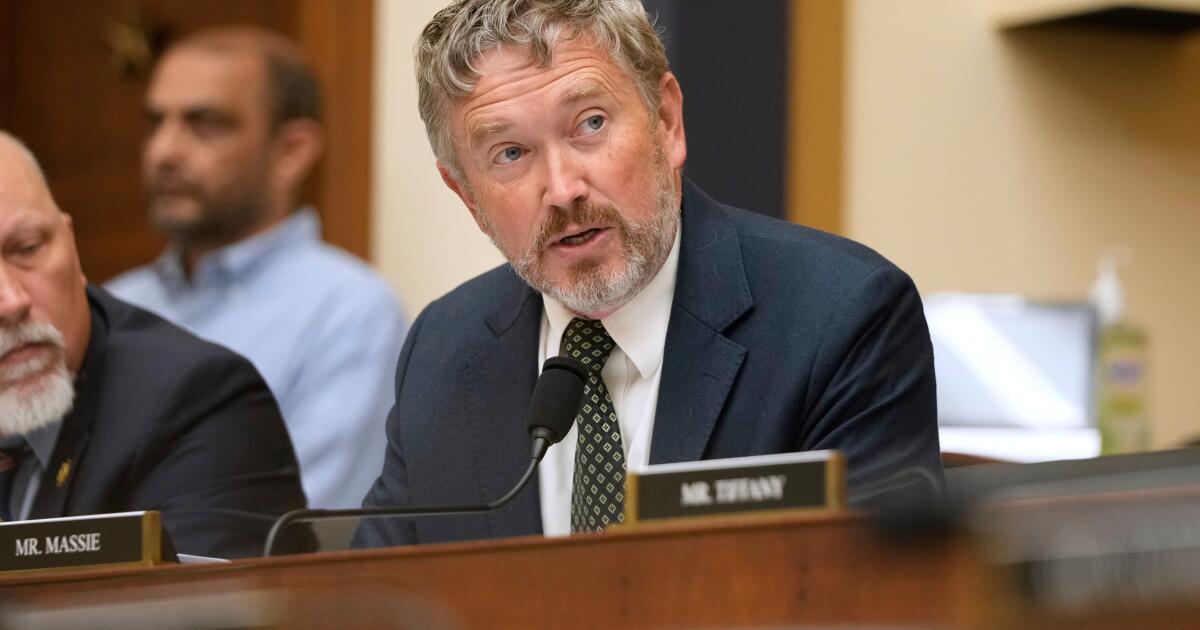
“There could be 100 or more” votes from Republicans, said Rep. Thomas Massie (R-Ky.), among the lawmakers discussing the legislation on Sunday news show appearances. “I’m hoping to get a veto-proof majority on this legislation when it comes up for a vote.”

Massie and Rep. Ro Khanna (D-Fremont) introduced a discharge petition in July to force a vote on their bill. That is a rarely successful tool that allows a majority of members to bypass House leadership and force a floor vote.

Speaker Mike Johnson (R-La.) had panned the discharge petition effort and sent members home early for their August recess when the GOP’s legislative agenda was upended by the clamoring for an Epstein vote.

Democrats also contend that the seating of Rep. Adelita Grijalva (D-Ariz.) was stalled to delay her becoming the 218th member to sign the petition and gain the threshold needed to force a vote. She became the 218th signature moments after taking the oath of office last week.

Massie said Johnson, Trump and others who have been critical of his efforts would be “taking a big loss this week.”

“I’m not tired of winning yet, but we are winning,” Massie said.

The view from GOP leadership

Johnson seems to expect the House will decisively back the Epstein bill.

“We’ll just get this done and move it on. There’s nothing to hide,” the speaker said. He continued to deride the Massie-Khanna effort, however, asserting that the House Oversight and Government Reform Committee has been releasing “far more information than the discharge petition, their little gambit.”

The vote comes at a time when new documents are raising fresh questions about Epstein and his associates, including a 2019 email that Epstein wrote to a journalist that said Trump “knew about the girls.” The White House has accused Democrats of selectively leaking the emails to smear the Republican president, though lawmakers from both parties released emails last week.

Johnson said Trump “has nothing to hide from this.”

“They’re doing this to go after President Trump on this theory that he has something to do with it. He does not,” Johnson said.

Trump’s former friendship and association with Epstein is well-established, and the president’s name was included in records that his Justice Department released in February as part of an effort to satisfy public interest in information from the sex-trafficking investigation.

Trump has never been accused of wrongdoing in connection with Epstein and the mere inclusion of someone’s name in files from the investigation does not imply otherwise. Epstein, who killed himself in jail in 2019 while awaiting trial, also had many prominent acquaintances in political and celebrity circles besides Trump.

Khanna voiced more modest expectations on the vote count than Massie. Still, Khanna said he was hoping for 40 or more Republicans to join the effort.

“I don’t even know how involved Trump was,” Khanna said. “There are a lot of other people involved who have to be held accountable.”

Khanna also asked Trump to meet with some of Epstein’s victims. Some will be at the Capitol on Tuesday for a news conference, he said.

Massie said Republican lawmakers who fear losing Trump’s endorsement because of how they vote will have a mark on their record if they vote “no,” which could hurt their political prospects in the long term.

“The record of this vote will last longer than Donald Trump’s presidency,” Massie said.

A MAGA split

On the Republican side, three Republicans joined with Massie in signing the discharge petition: Reps. Marjorie Taylor Greene of Georgia, Nancy Mace of South Carolina and Lauren Boebert of Colorado.

Trump publicly broke with Greene last week and said he would endorse a challenger against her in 2026 “if the right person runs.”

Greene, a MAGA stalwart throughout her time in Congress, attributed her fallout with Trump to the Epstein debate. “Unfortunately, it has all come down to the Epstein files,” she said, adding that the country deserves transparency on the issue and that Trump’s criticism of her is confusing because the women she has talked to say he did nothing wrong.

“I have no idea what’s in the files. I can’t even guess. But that is the question everyone is asking: … ‘Why fight this so hard?’” Greene said.

Even if the bill passes the House, there is no guarantee that Senate Republicans will go along. Massie said he just hopes Senate Majority Leader John Thune (R-S.D.) “will do the right thing.”

“The pressure is going to be there if we get a big vote in the House,” said Massie, who thinks “we could have a deluge of Republicans.”

Massie appeared on ABC’s “This Week,” Johnson was on “Fox News Sunday,” Khanna spoke on NBC’s “Meet the Press,” and Greene was interviewed on CNN’s “State of the Union.”

Freking writes for the Associated Press.

Source link

Leaked Docs Reveal Meta Cashing In on a ‘Deluge’ of Fraudulent Ads

Meta anticipated earning about 10% of its total annual revenue, or $16 billion, from advertising for scams and banned items, according to internal documents reviewed by Reuters. The documents reveal that for at least three years, the company failed to stop a significant number of ads exposing its billions of users on Facebook, Instagram, and WhatsApp to fraudulent schemes, illegal casinos, and banned medical products. On average, around 15 billion “higher risk” scam ads, showing clear signs of fraud, were displayed daily on these platforms. Meta reportedly generates about $7 billion annually from these scam ads.

Many of these ads were linked to marketers flagged by Meta’s internal systems. However, the company only bans advertisers if fraud is at least 95% certain according to its systems. If less certain but still suspect, Meta imposes higher ad rates as a penalty instead of outright banning them. This approach aims to deter dubious advertisers without fully eliminating them. The company’s ad-personalization system also ensures that users who click on scam ads see more of them based on their interests.

The documents create an image of Meta grappling with the extent of abuse on its platforms while hesitating to take stronger actions that could impact its revenue. The acceptance of revenue from suspicious sources highlights a lack of oversight in the advertising industry, as noted by fraud expert Sandeep Abraham. Meta’s spokesperson, Andy Stone, counters that the documents provide a biased view and argues that the actual share of revenue from scam ads would be lower than estimated. He claimed the plan aimed to validate investments in combating fraud.

Stone mentioned that Meta has significantly reduced user reports of scam ads globally and removed millions of scam ad content in recent efforts. The company aims for major reductions in scam ads in the upcoming year. Despite this, internal research indicates that Meta’s platforms are central to the global fraud economy, with one presentation estimating they contribute to a third of all successful fraud in the U. S. Competitors were noted to have better systems to combat fraud.

As regulators step up pressure for stronger consumer protections, the documents reveal the U. S. Securities and Exchange Commission is investigating Meta for financial scam ads. In Britain, regulators identified Meta as the source of over half of the payment-related scam losses in 2023. The company has acknowledged that addressing illicit advertising may hurt its revenue.

Meta is investing heavily in technology and has plans for extensive capital expenditures in AI. CEO Mark Zuckerberg reassured investors that their advertising revenue can support these projects. The internal documents suggest a careful consideration of the financial impact of increasing measures against scam ads, indicating that while the company intends to reduce illicit revenue, it is wary of the potential business implications.

Despite planning to diminish scam ads’ revenue share, Meta is bracing for regulatory fines, estimating penalties that could reach up to $1 billion. However, these fines are viewed as comparatively minor against the income from scam ads, which already generates significant revenue. The leadership’s strategy shows a tendency to react to regulatory pressure rather than implementing proactive measures to vet advertisers effectively. Stone disputed claims that Meta’s policy is to act only under regulatory threat.

Meta has set limits on how much revenue it can afford to lose from actions against suspect advertisers. In early 2025, a document revealed that the team reviewing questionable ads was restricted to a loss of no more than 0.15% of company revenue, which equated to around $135 million from Meta’s total of $90 billion in the same period. A manager noted that this revenue cap included both scam ads and harmless ads that might be mistakenly blocked, indicating strict financial boundaries in their approach.

Under increasing pressure to manage scams more effectively, Meta’s executives proposed a moderate strategy to CEO Mark Zuckerberg in October 2024. Instead of a drastic approach, they suggested targeting countries where they anticipated regulatory action. Their goal was to reduce the revenue lost to scams, illegal gambling, and prohibited goods from approximately 10.1% in 2024 to 7.3% by the end of 2025, with further reductions planned for subsequent years.

A surge in online fraud was noted in 2022, when Meta uncovered a network of accounts pretending to be U. S. military members trying to scam Facebook users. Other scams, such as sextortion, were also rising. Yet, at that time, Meta invested little in automated systems to detect such scams and categorized them as a low-priority issue. Internal documents showed efforts were mainly focused on fraudsters impersonating celebrities, which threatened to alienate advertisers and users alike. However, layoffs at Meta affected the enforcement team, as many working on advertiser rights were let go, and resources shifted heavily toward virtual reality and AI projects.

Despite layoffs, Meta claimed to have increased its staff handling scam advertising. However, data from 2023 revealed that Meta was ignoring about 96% of valid scam reports filed by users, suggesting a significant gap in their response to customer concerns. The safety staff aimed to improve this by reducing the number of dismissed reports to no more than 75% in the future.

Instances of user frustration were evident, such as a recruiter for the Royal Canadian Air Force who lost access to her account after being hacked. Despite multiple reports to Meta, her account remained active, even sharing false cryptocurrency investment opportunities that defrauded her connections. Reports indicated that she had many people flag her account, but it took about a month before Meta finally removed it.

Meta refers to scams that do not involve paid ads as “organic,” which include free classified ads, fake dating profiles, and fraudulent medical claims. A report from December 2024 stated that users face approximately 22 billion organic scam attempts each day, alongside 15 billion scam ads, highlighting the company’s ongoing struggle to manage fraud effectively. Internal documents suggest that Meta’s efforts to police fraud are not capturing much of the scam activity occurring across its platforms.

In Singapore, police shared a list of 146 scams targeting local users, but Meta staff found that only 23% of these scams broke the platform’s policies. The remaining 77% went against the spirit of the rules but not the exact wording. Examples of unchecked scams included fake offers on designer clothes, false concert tickets, and job ads pretending to be from major tech firms. In one case, Meta discovered scam ads claiming to belong to the Canadian prime minister, yet the existing rules wouldn’t flag the account.

Even when advertisers are found to be scamming, the rules can be lenient. Small advertisers need to be flagged for scams eight times before being blocked, while larger ones can have over 500 complaints without being shut down. Some scams generated significant revenue; for example, four removed ads were linked to $67 million monthly.

An employee initiated reports highlighting the “Scammiest Scammer” each week to raise awareness, but some flagged accounts remained active for months. Meta tried to deter scammers by charging them more in ad auctions, labeling this practice “penalty bids. ” Advertisers suspected of fraud would have to bid higher amounts, thus reducing competition for legitimate advertisers. Meta aimed to decrease scam ads from this approach, which showed some success, resulting in fewer scam reports and a slight dip in overall ad revenue.

With information from Reuters

Source link