delegation

Venezuela’s Rodríguez Hosts US Congress Delegation to Evaluate ‘Joint Agenda’

Rodríguez has hosted several US officials in recent months. (Presidential Press)

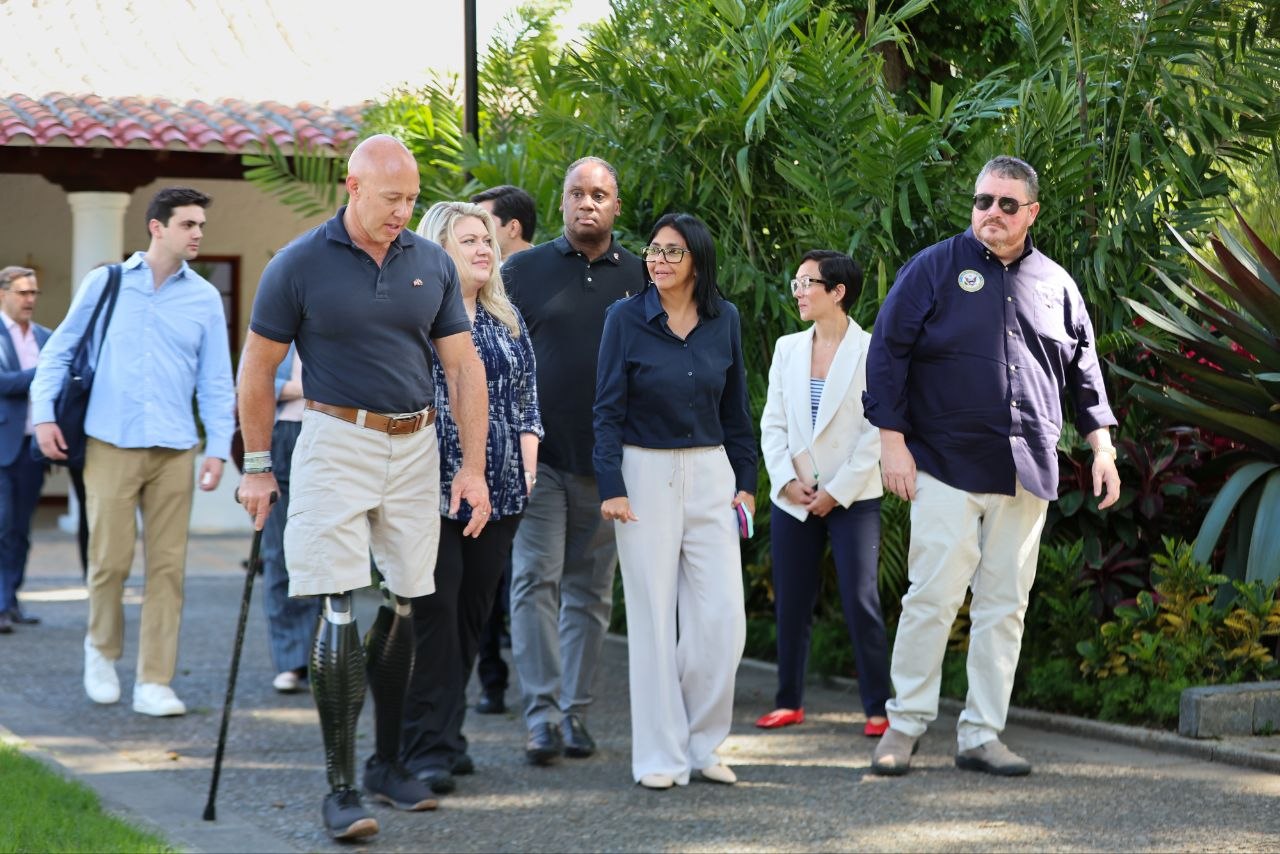
Caracas, July 28, 2026 (venezuelanalysis.com) – Venezuelan Acting President Delcy Rodríguez hosted a US Congress delegation in Caracas on Friday. 

The team of US politicians was led by Florida Republican Representative Brian Mast, a military veteran who also served voluntarily in the Israeli armed forces. It also included Florida Republican representatives Randy Fine and Kat Cammack alongside Illinois Democratic representative Jonathan Jackson. 

According to Venezuelan state media, the high-level meeting saw the two sides “assess progress in bilateral relations and the joint agenda in strategic areas.”

“Both sides reviewed bilateral cooperation schemes geared toward fighting transnational organized crime and border security,” the official report said.

For his part, Fine wrote on social media that he was “honored” to take part in the first congressional delegation to Venezuela in a decade. He added that the US’ January 3 kidnapping of President Nicolás Maduro “set Venezuela on a trajectory to be a key ally” of the US. 

Fine, like Mast, is a major advocate of Israeli interests in the US legislature and has the backing of the American Israel Public Affairs Committee (AIPAC). He has publicly called for starving and dropping nuclear bombs on the Gaza Strip. 

Also participating in the summit were US Chargé d’Affaires in Venezuela John Barrett, Venezuelan Foreign Minister Félix Plasencia, and Vice Minister for Europe and North America Oliver Blanco.

Blanco, who comes from the ranks of the opposition Democratic Action (AD) party, has been the main government liaison with US officials in the country. He was recently appointed First Vice Minister of the Ministry of Foreign Affairs in order to “strengthen Venezuela’s foreign policy and peace diplomacy around the world.”

In addition, the US Congress members held talks with National Assembly President Jorge Rodríguez, who described the meeting as “fruitful” and said discussions focused on “the legislative agenda and international investment.” Rodríguez added that Venezuela took the opportunity to “thank the United States for its support” following the June 24 twin earthquakes.

The US lawmakers held subsequent meetings with officials from Venezuela’s Ministry of Defense and the National Anti-Drug Superintendency (Sunad), according to reports.

Following the January 3 US military strikes and Maduro kidnapping, the Rodríguez-led acting government fast-tracked a diplomatic rapprochement with Washington following seven years of severed ties. Both administrations have opened their respective embassies.

Venezuela’s acting president has hosted a number of US officials in Caracas in recent months, including Energy Secretary Chris Wright, Interior Secretary Doug Burgum, and CIA Director John Ratcliffe.

Last March, Rodríguez had already received a delegation from the US Senate Foreign Relations Committee as part of the ongoing “peace dialogue” between Washington and Caracas.

At that time, the presidential press office said the Senate delegation had traveled to Caracas for a “technical and political” visit intended to continue the bilateral “roadmap” focused on “direct communication to manage historical differences and strengthen energy cooperation in light of global challenges.”

Venezuela and Peru Move Toward Restoring Relations

Caracas’ foreign policy shift has likewise seen authorities mend ties with regional US allies that had sought to isolate the Caribbean nation.

On Friday, the governments of Venezuela and Peru announced the start of a gradual process to fully restore diplomatic relations, which were severed in 2024 after the Peruvian government refused to recognize Venezuela’s official electoral results that saw Maduro secure a third term in office.

“In a first stage, both countries have agreed to reactivate consular relations as an initial step toward the full restoration of bilateral ties,” the foreign ministries of Venezuela and Peru said in a joint statement.

The immediate objective is to guarantee protection and consular services for Venezuelan and Peruvian citizens residing in each country. The diplomatic rapprochement comes days before a change of government in Peru, where conservative leader Keiko Fujimori is set to replace interim President José María Balcázar after a narrow and disputed electoral triumph.

Edited by Ricardo Vaz in Caracas.


Source link

South Africa’s World Cup delegation departs for Mexico without coach | World Cup 2026 News

Bafana Bafana’s departure was delayed due to non-issuance of visas for several players and support staff.

The South African national team members have left for their World Cup training base in Pachuca, Mexico, in advance of their opening game against the tournament cohosts on June 11.

The delegation that left on Monday did not include assistant coach Helman Mkhalele, who has yet to obtain a United States visa.

Recommended Stories

list of 4 itemsend of list

The charter flight departed Johannesburg following a frantic 24 hours after the squad was originally scheduled to leave on Sunday, but was held back by a delay in obtaining visas in what was described as an administrative bungle by the South African Football Association (SAFA).

Mkhalele, a former international winger who played 66 times for Bafana Bafana, including at their World Cup debut in France in 1998, will have to travel later after his visa application was initially denied.

Blaming the US Consulate General in Johannesburg for the delay, SAFA president Danny Jordaan told the South African Broadcasting Corporation, “They refused the visa, but gave no reasons. It is very difficult to deal with the process where you get no information.”

“We don’t know [why it was denied], we are clutching in the dark, but we hope the matter will be resolved [soon]. All of the players are [on the flight] and 99 percent of the technical staff.”

South Africa are due to play Jamaica in a friendly on Friday before taking on Mexico in the showpiece opening match in Mexico City.

“Now we are very happy that we can go to Mexico,” South Africa coach Hugo Broos said. “The past days have been a little bit stressful with all the problems we had, but those problems are behind us now, and we can focus on what’s coming.”

“These 10 days go very fast. Once we get there, we will start working, focusing on the first game against Mexico, so time will pass very quickly. I think everybody is looking forward to starting the World Cup.”

South Africa are in Group A and will face Czechia in Atlanta on June 18 and South Korea in Monterrey, Mexico, six days later.

They are appearing in their fourth World Cup and looking to advance from the group stage for the first time.

INTERACTIVE-Football FIFA How teams are group World Cup 2026-1776670778

Source link

Venezuelan Gov’t Delegation Meets IMF amid Debt Restructuring Plans

Venezuelan leaders have held talks with both the IMF and the World Bank in recent weeks. (Archive)

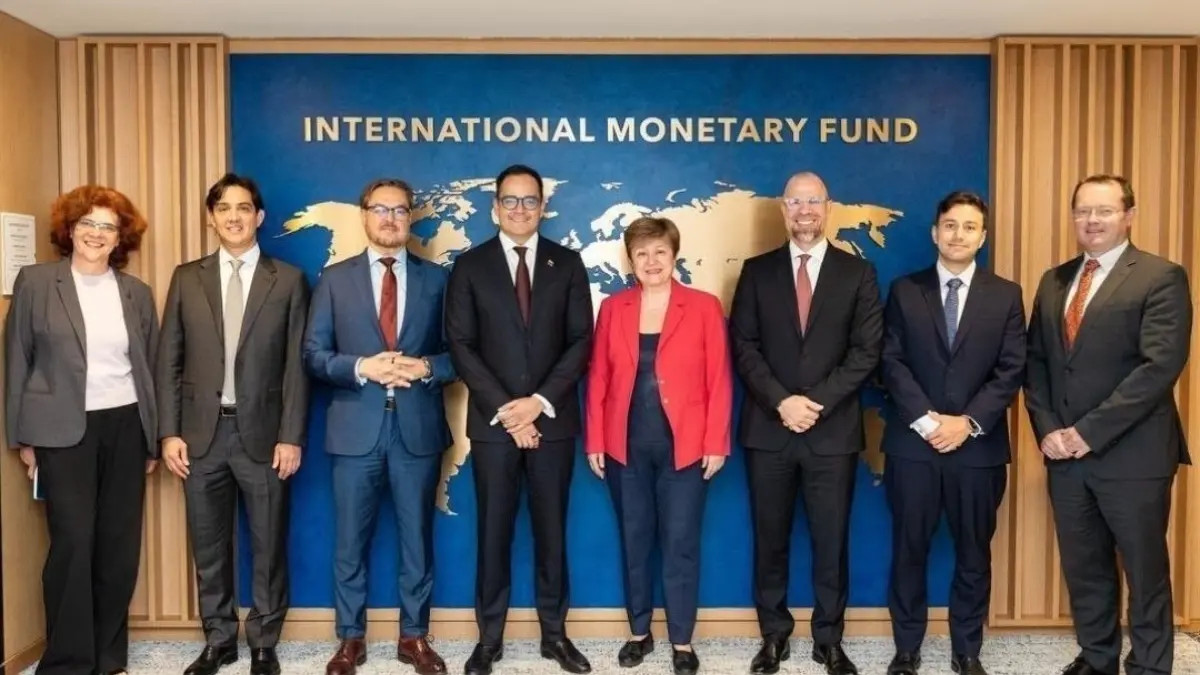
Caracas, June 1, 2026 (venezuelanalysis.com) – A Venezuelan delegation representing the acting Delcy Rodríguez administration held talks with the International Monetary Fund leadership on Saturday in Washington, DC.

The Venezuelan team was led by Economy Vice President Calixto Ortega alongside Central Bank (BCV) President Luis Pérez and other finance officials. In a statement, Caracas called the meeting “productive,” focused on “technical assistance mechanisms” and the Caribbean nation’s efforts to “recover funds” to boost economic recovery.

“With these kinds of meetings, Venezuela ratifies its disposition for dialogue and international cooperation, with independence and self-determination,” the communiqué read. Venezuelan authorities emphasized the country’s “new stage of stability and growth” alongside a commitment to “reestablish ties with multilateral organizations.”

For her part, IMF Managing Director Kristalina Georgieva also classified the meeting as “productive” and reiterated the US-based institution’s disposition to “support efforts to strengthen macroeconomic stability.”

Venezuela reestablished ties with the IMF and the World Bank in April after a seven-year hiatus. The move followed the Trump administration’s recognition of Rodríguez as the South American country’s “sole leader” as part of a fast-tracked diplomatic rapprochement between Washington and Caracas.

The acting president hosted a World Bank delegation on May 15 and emphasized “technical cooperation” prospects.

Though Venezuela has been a member of the IMF and the World Bank since 1946, former President Hugo Chávez effectively disengaged from both bodies in the 2000s, labeling them “instruments of US imperialism” and seeking to create Global South integration and lending alternatives.

The Rodríguez government’s IMF meeting came amid announced plans to execute a “comprehensive and orderly” restructuring of the country’s foreign debt, estimated to be as high as US $170 billion.

Caracas’ liabilities stem from a combination of defaulted bonds and loans, international arbitration awards, and accrued interest. Venezuela began to default on its debts in 2017 as US sanctions heavily aggravated the Caribbean nation’s economic crisis and blocked payments. The restructuring process may be one of the largest in history, surpassing Russia (1998) and Argentina (2001).

The acting Rodríguez government is scheduled to present its macroeconomic framework and public debt sustainability analysis to the international finance community this month. The Trump administration issued a license allowing Venezuela to contract financial and advisory services, but direct negotiations with creditors remain prohibited.

The Venezuelan executive hired Centerview Partners as financial advisor for the debt restructuring process. According to Reuters, the decision was taken without a thorough selection process and on the recommendation of Mauricio Claver-Carone, a former Trump administration official and close associate of Secretary of State Marco Rubio.

Multiple reports in recent days have documented Claver-Carone’s role as a “gatekeeper” for businesses interested in investing in Venezuela as well as a conduit between Rodríguez and the Trump White House.

Venezuelan bonds have risen significantly in recent months as investors expect a windfall after purchasing the defaulted bonds at highly depreciated levels.

Venezuelan authorities have stated that there are “no plans” to take on IMF loans, instead prioritizing access to around $5 billion in Special Drawing Rights (SDR) to address infrastructure and public services needs. The IMF issued the SDRs to help countries deal with a liquidity crunch during the Covid-19 pandemic, but its non-recognition of the Nicolás Maduro government barred Venezuela from accessing its share.

For her part, Georgieva has previously stated that Venezuela “desperately needs help” and that the fund would support a loan program, but that prior steps, including clarity on macroeconomic data, are necessary.

Since the January 3 US military strikes and kidnapping of President Maduro, the Trump administration has extracted significant concessions from the Venezuelan government, including pro-business oil and mining reforms, lucrative deals for Western corporations, and external auditing of the Central Bank. The White House has also seized control of Venezuela’s oil export revenues.

Acting President Rodríguez has additionally installed a commission to evaluate the “strategic” value of Venezuelan state assets and possible privatizations. Plans to reform the country’s tax, labor, and pension laws are likewise underway.

Edited by Lucas Koerner in Caracas.

Source link