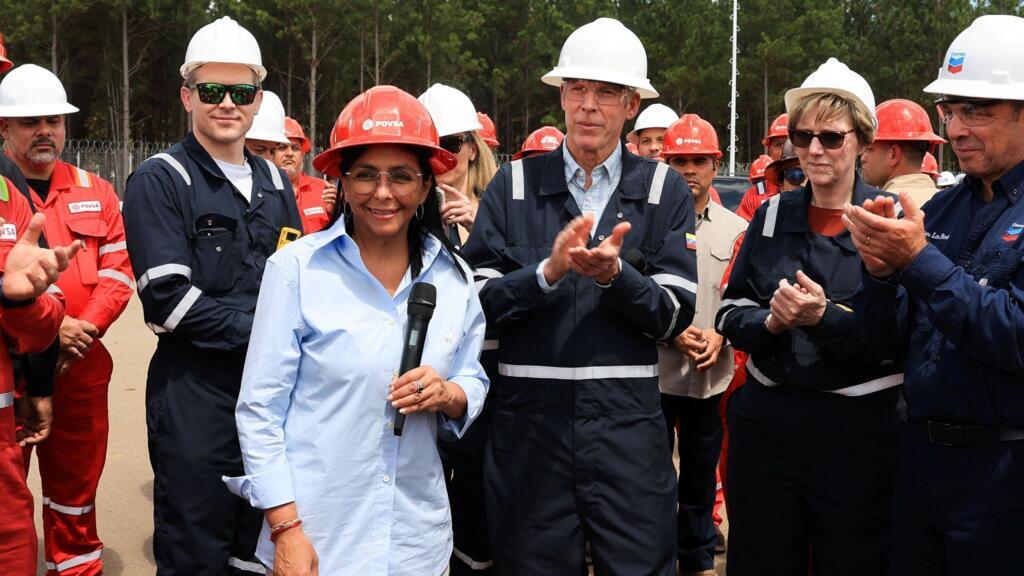
Why Investors Remain Uneasy About Delcy’s Hydrocarbons Law
Many have commented on the recent reforms to the Venezuelan Hydrocarbons regime and its reach. Most people have focused on the irony of Delcy Rodríguez giving away the country’s resources after years of empty anti-US rhetoric and, of course, it is ridiculously tempting to do so. But the long-term questions beyond the political posturing of the US robbing Venezuelan oil linger: is the reform good for Venezuela? Was the previous regime really favorable to the country’s interest? Why has the reaction by major oil companies been rather slow or lukewarm, as the WSJ reported a month ago?
The debate over the adequacy of Venezuelan oil regulations predates January 3. A statist vision has prevailed among political elites for almost half a century. Contrary to the chavista narrative, the oil industry in Venezuela was nationalized by Carlos Andrés Pérez fifty years ago. Up until the 1990s, the State, through PDVSA, performed exclusively primary oil activities: exploration and production. Then, due to the sharp drop in oil prices, the cash-strapped Rafael Caldera government, using a provision of the 1975 nationalization law, had to allow for private investment in primary activities through service agreements with foreign oil companies. These contracts were branded as the Apertura Petrolera, which became a bête noire for the Venezuelan Left, who even tried to stop the process via the Supreme Court.
Chávez put an end to this with his 2001 Hydrocarbons Law reform, migrating from the service agreements to joint venture companies where the Venezuelan state was the main shareholder. The refusal of some companies, like Conoco and Exxon, to migrate to the joint ventures led to several of the arbitration claims against Venezuela. Another contentious aspect of the Venezuelan oil business was that only State-owned companies could directly export oil. Joint venture companies could only sell oil to another PDVSA subsidiary, which led to PDVSA running up huge debts with foreign partners.
The Chávez 2001 model ruled until recently. Only PDVSA directly, or the JVs where PDVSA was a majority shareholder, could perform exploration and production activities and export oil.
The Executive also retained very discretionary power over what is called the government take (the percentage of oil or profits taken as a consideration in agreements with foreign partners in the joint ventures and applicable taxes), which can be used by the government to drive down the profits of its private company partners, a major deterrent for private investment in oil.
Up until very recently, the Chávez 2001 model was ruling: only PDVSA directly, or the joint ventures where PDVSA was a majority shareholder, could perform exploration and production activities and sell oil in international markets.
A similar regime was implemented in Colombia. In 2003, that country reformed its hydrocarbon regime to its current iteration, where it removed the exclusive primary activities rights granted to Ecopetrol, and established that this State-owned company would compete with private companies for exploration through contracts granted by a newly minted hydrocarbons regulator, the ANH. The ANH grants exploration rights under competitive bids where Ecopetrol competes with private companies under the same conditions. The purpose was to simplify the existing bureaucracy and award contracts under competitive, transparent bids, instead of having an all-mighty State company that both drills and decides who drills under very discretionary powers, as is the current case with PDVSA.
This model was behind past reform proposals by the opposition and have been part of the expert discussion on oil reform in Venezuela, and it is also included in María Corina Machado’s oil sector proposal, which received hypocritical criticism from people who remained mum about Delcy’s sweeping reforms. This model is seen as a true break from the previous one, as it takes power away from omnipotent PDVSA and turns it into just another player who has to compete with private companies in competitive bidding before a national, impartial regulator.
The reforms do represent a momentous formal break with the statist oil policy that has prevailed in the country for over 50 years. Under the new Hydrocarbons Law, private companies can perform primary activities through contracts with PDVSA subsidiaries and joint venture companies, and can export oil directly to international markets, paying the government take. The law, enacted on January 29, 2026, also establishes that these contracts can include arbitration clauses, which can provide more certainty and guarantees for potential investors than submitting them to Venezuela’s infamously corrupt and dependent courts. The law also worryingly removes parliamentary oversight over the oil sector.
But the catch is that abiding by the law has never been chavismo’s strong suit, and they had been violating the Hydrocarbons Law since 2018. Under the aegis of the disgraced oil czar/soccer player Tarek el Aissami, PDVSA started signing contracts granting primary activities rights to private companies, as well as the right to directly export oil. This was done on dubious legal grounds under presidential emergency powers. Thus, the 2026 Hydrocarbons Law is only a regularization of a de facto situation that already existed.
The new regulations give a lot of discretionary power to the government to control the performance of the new contracts and to set the government’s take unilaterally.
As with everything in life, the devil is in the details, and the new law is very scant on the details of the new contracts, it seems to have been drafted in a rush. It defines very broadly the terms and conditions of the contracts (the new contracts pertaining to joint venture companies are only mentioned in passing) while at the same time giving the government wide discretionary powers to interpret them, and the last thing any international investor wants is to give chavismo discretionary powers over anything.
Delcy Rodríguez also enacted new regulations of the Hydrocarbons Law (which have not been updated since 1943) and two additional resolutions establishing some parameters for the government take. A centralized regulation of the government take is a welcome change, but the reaction to it has been mixed, as it gives a lot of discretionary power to the government to control the performance of the new contracts and to set the government’s take unilaterally.
The law also fails to incorporate any change to the current structure of the Venezuelan oil architecture. Unlike the reform in Colombia, the new law does not remove the elephantine, vastly discretionary bureaucracy that chavismo created. PDVSA remains the almighty administrator of Venezuelan oil with no independent technical supervision of its role.
So, are the reforms good? They do signify a break from the statist vision of the oil industry, one that does not correspond with the wretched state of the Venezuelan oil sector. However, it is obviously a patched-up, limited instrument enacted by Delcy’s multiuse minions more to appease Donald Trump (even the reaction from American oil companies has been lukewarm) than anything resembling a definitive vision for the Venezuelan oil industry in an era of decarbonization.
The most likely outcome, already playing out according to the WSJ piece, is that the major oil companies (already traumatized by the previous experiences with chavismo expropriation frenzy over 20 years ago) remain skeptical or limit its investment due to the lack of clear guarantees and conditions and smaller, less known and less risk-averse companies are the ones who end up signing these contracts for a short-term gain. Chevron, who is now the most powerful player in the Venezuelan oil business, publicly signaled that the law doesn’t go far enough for them, and, considering their leverage with the Trump administration, it is possible that the Rodríguez regime is forced to further liberalize and refine the text of the law. But under the current conditions of legal uncertainty and arbitrariness no company, whether big or small, will risk investing the vast amount of money needed (about 183 billion dollars) to recover the Venezuelan oil industry after decades of destruction and pillage. Oil companies may be evil, but never stupid.
All of these scenarios have a limited effect on the recovery of the Venezuelan oil industry without a democratic transition because for any law to have a meaningful impact on the economy you need actual rule of law and independent courts, and you also need actual experts drafting the new laws. Not the very few lackeys of the most incompetent government in our history who happen to be proficient in English.