Delcys

The Rise of Delcy’s Chief Enforcer

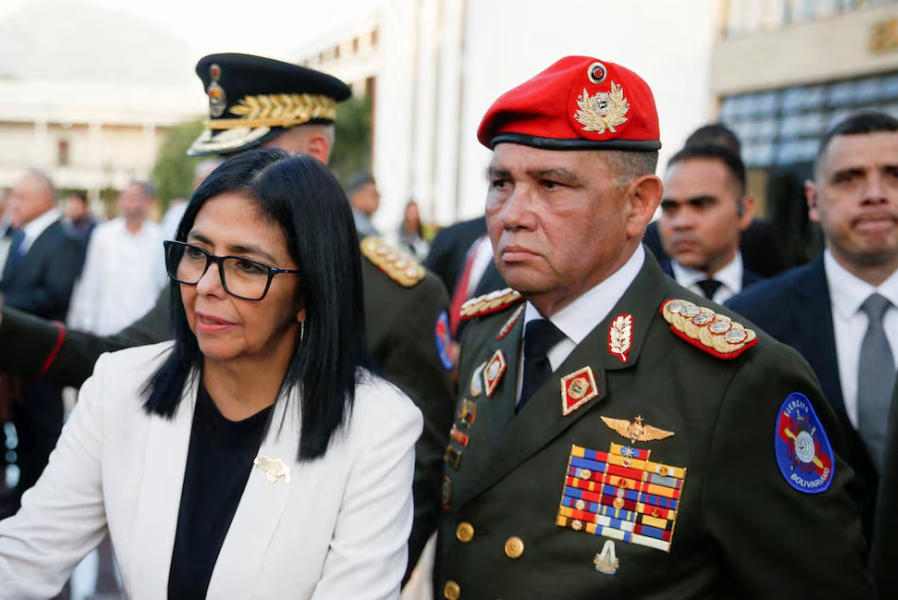
Commander of the Presidential Guard, head of Military Counterintelligence (DGCIM), and now Minister of Defense. The meteoric rise of General-in-Chief Gustavo Enrique González López in the 75 days since January 3 is only comparable to Delcy Rodríguez’s own improbable ascent to Venezuela’s presidency.

In less than three months, González López went from leading the Bolivarian Intelligence Service to commanding the Armed Forces and becoming one of the most powerful figures in the Venezuelan government. His appointment points in several directions: counterbalancing Diosdado Cabello’s power (no longer an ally) in the monopoly of force; shielding the acting president from enemies within chavismo itself; and building a loyal enforcement structure for the new ruling clan.

Amid celebrations of Venezuela’s victory in the World Baseball Classic on March 18, Rodríguez seized the moment to overhaul her cabinet. One of the most radical moves was the dismissal of Vladimir Padrino López, the longest-serving minister in the chavista cabinet. After 12 years at the helm of the Defense Ministry, he will hardly be remembered for defending the nation.

Although rumors had long suggested that Padrino López would soon step down, the selection of his successor caught observers off guard.

There were strong reasons to replace Vladimir Padrino López.

Replacing Padrino with González López raises several questions:

What role will he play in a power structure divided among four family-based factions, consisting of Diosdado Cabello, the Rodríguez siblings, the Chávez family, and the Maduro-Flores clan?

If this marks a new political moment, why recycle officials from the Chávez and Maduro governments?

What is the point of US sanctions if the acting president rewards sanctioned officials with key posts?

Does his appointment guarantee impunity for human rights abuses committed under his command?

And, since it came after official visits from the CIA director and the head of US Southern Command, does it have Donald Trump’s backing?

Neither hero nor martyr

Before examining why González López was chosen, it is clear there were several reasons to replace Padrino López.

On January 3, 2026, when US forces bombed key military infrastructure and captured Nicolás Maduro, the Venezuelan Armed Forces offered no resistance. The attack left 83 dead among those guarding Maduro, including 32 Cubans, while US forces only reported minor injuries. There was no troop mobilization afterward to restore order or deter further attacks.

Padrino appeared only hours later in a solitary video, declaring: “The Bolivarian National Armed Forces inform the world that the Venezuelan people have been the victims of a criminal military aggression by the United States.”

Days later, he justified his inaction bluntly: “It would have been a massacre if we had confronted the Americans.”

When Delcy became the acting minister of petroleum, she appointed González López to a tailor-made role at PDVSA overseeing strategic affairs and production control.

This was not his only failure. In 2021, the FANB lost the so-called Apure war, an operation aimed at expelling FARC dissidents from Venezuelan territory.

The Colombian guerrillas killed 17 Venezuelan soldiers and kidnapped eight more to force negotiations that allowed them to remain in the country. By January 2022, the ELN had finished the job the FANB could not, pushing FARC factions out of the border region.

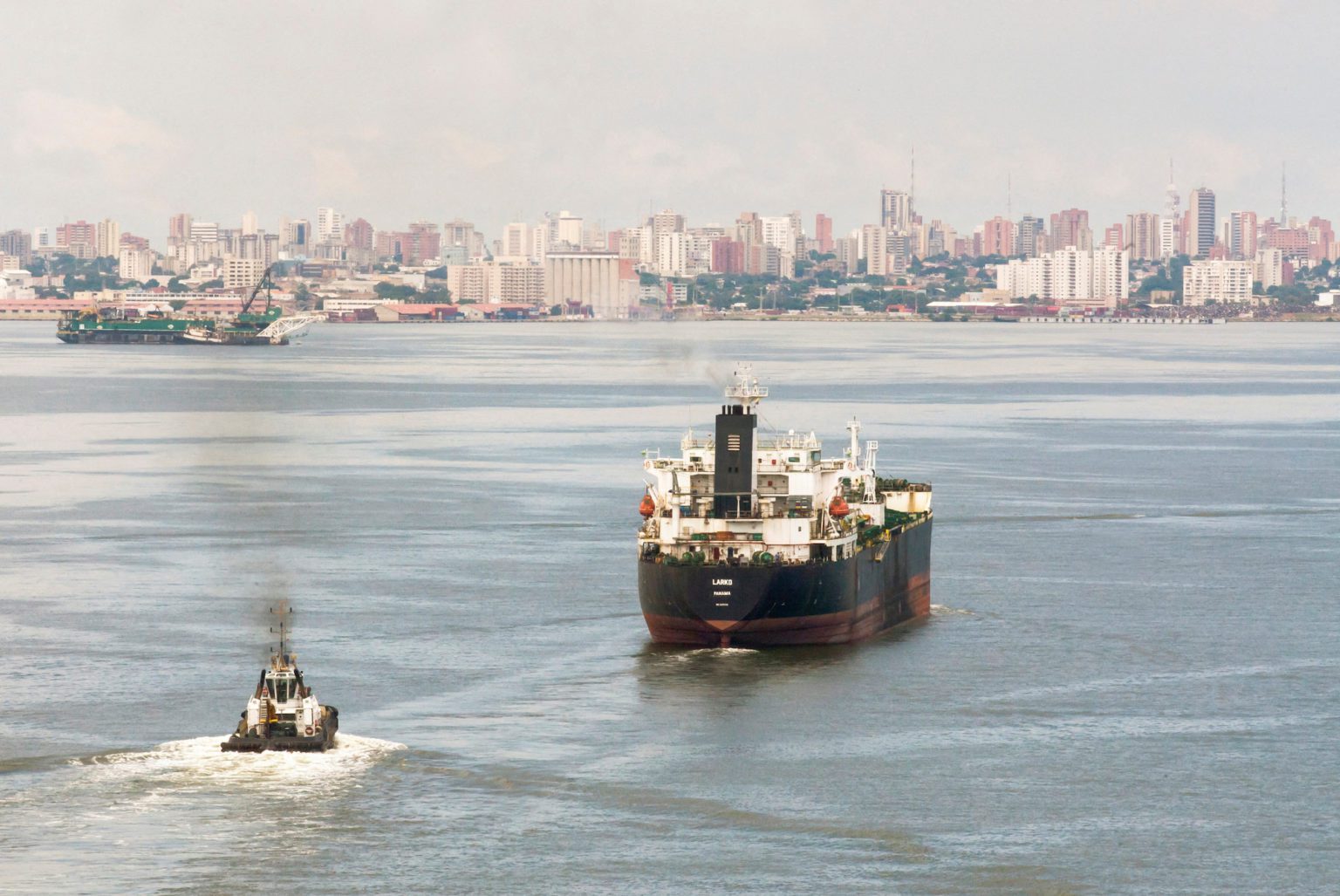
Nor did the Defense Ministry respond to US attacks on more than 20 Venezuelan vessels in the Caribbean. US tactical teams seized at least eight oil tankers without any naval reaction from Venezuela. Padrino also failed to deploy troops to prevent Maduro’s blatant presidential election fraud on July 28, 2024.

Beyond his rank and decorations, Padrino leaves behind another legacy: signing Resolution 008610, which authorizes the use of “firearms or potentially lethal weapons” for public order control.

Why González López?

González López was the first official appointed after Delcy Rodríguez herself. On January 6, 2026, he was named Commander of the Presidential Guard and head of Military Counterintelligence. These roles are clearly designed to protect the new head of state.

Since then, he has been inseparable from Rodríguez: her shadow, her watchdog, the strongman of the Rodríguez clan. His appointment is key to consolidating this new ruling faction. Previous chavista groups had their own enforcers. These are figures with intelligence expertise, coercive power, and influence over security forces and armed groups. González López fills that role for the Rodríguez siblings.

Their Achilles’ heel had been precisely a lack of support from armed elements within the Venezuelan State. For this reason, the Rodríguez siblings could not operate independently from other chavista factions. They had secured economic power and built extensive business ties, including in the oil sector. Rodríguez’s tenure as foreign minister also gave her a broad international network.

The rise of González López could even foreshadow a purge to both consolidate Delcy’s power and polish the image of a criminalized State.

González López has been close to her since at least 2018, when as vice president she oversaw SEBIN, then led by him.

In 2024, when Rodríguez became the acting minister of petroleum, she appointed him to a tailor-made role at PDVSA overseeing strategic affairs and production control. Such position combined security and operational authority.

González López has therefore become Delcy’s trusted operator, the man that can enforce her orders.

At the same time, chavismo has spent 26 years building a system of power rooted in complicity, which explains the constant recycling of officials. Even if the Rodríguez faction wanted to break away, it cannot fully detach from that structure without risking collapse. It still lacks independent foundations.

Blessed and lucky

After overseeing more than 2,000 arbitrary detentions in 2024 as head of SEBIN, being identified as one of Maduro’s torture chiefs, and linked to the deaths of political prisoners, González López has not been punished. He has been promoted.

His appointment disregards warnings from human rights groups and signals that the regime’s institutional chain remains intact—one of chavismo’s enduring strengths. If prosecutions ever come, they will likely follow the familiar script: a few scapegoats.

His rise could even foreshadow a purge to both consolidate Rodríguez’s power and polish the image of a criminalized State.

As the architect of the Operation for the Liberation and Protection of the People (OLP), González López has already demonstrated a zero-tolerance approach to crime. In practice, that policy led to the killing of young men in poor neighborhoods under the banner of law enforcement.

Could Rodríguez appoint a defense minister of this magnitude without a green light from Washington?

His profile aligns with hardline anti-crime and anti-migrant approaches promoted by US policy in recent years, which could appeal to sectors in Washington.

This may help explain why he appears to have received approval from Donald Trump’s team. Could Rodríguez appoint a defense minister of this magnitude without a green light from Washington? Perhaps not. While not every minister requires it, Defense almost certainly does.

Other signs point in that direction: González López appeared as host during John Ratcliffe’s visit (Trump’s CIA director) and was part of the delegation that met US Southern Command chief General Francis L. Donovan. There have also long been rumors of his role as a US intelligence informant. Which is unsurprising, given that intelligence and repression are his specialties.

For now, sanctions imposed under Barack Obama and accusations of crimes against humanity are not part of Venezuela’s new political moment, as Delcy Rodríguez has labelled it.

After two months, the new era seems to prioritize “stabilization, economic recovery, and political transition.” Not human rights, not justice.
Source link

Delcy’s Challenge in the Hormuz Crisis

When the United States and Israel launched joint strikes on Iran on February 28, the Strait of Hormuz—the narrow waterway through which roughly one-fifth of the world’s oil passes each day—effectively ceased to function as a shipping corridor. Iran’s Revolutionary Guard Corps responded by warning off tanker traffic, and within days maritime transit had fallen to nearly zero. The consequences were immediate and severe: Brent crude has not dropped below the $100 threshold since March 13 and touched $119 on March 19 following Israeli strikes on Iran’s South Pars gasfield and retaliatory Iranian attacks on energy infrastructure in Qatar and the UAE. For Venezuela, a country sitting atop the world’s largest proven reserves but producing around 900,000 to one million barrels per day (a fraction of its historical capacity of over 3 million in the late 1990s) the disruption arrived at a peculiar moment. It was not a crisis of Venezuela’s making. But how Caracas responds to it may define the country’s energy trajectory for years to come.

On paper, the arithmetic is striking. Alejandro Grisanti, director of Ecoanalítica, estimates that Venezuela receives approximately $400 million in additional revenue for every extra dollar in the average crude price. This figure, at current price levels, represents a fiscal windfall without precedent in the post-Maduro transition. Venezuelan crude exports had already rebounded sharply in February to around 788,000 barrels per day (up from a depressed 383,000 bpd in January, when the post-Maduro-arrest disruption had frozen trade flows), with US refineries absorbing the majority of shipments directly through Chevron or energy intermediaries. Of course, production and exports are different things: Venezuela produces roughly one million bpd but consumes some 230,000 bpd domestically, meaning effective export capacity sits considerably below gross output.

The Hormuz disruption accelerated the export recovery dynamic: with Gulf supply stranded and Asian buyers scrambling for alternatives, Venezuelan crude became a more attractive proposition. Washington has responded in kind. On March 18, the US Treasury issued a broad license authorizing established American entities to conduct transactions with PDVSA directly, a landmark shift after years of near-total sanctions isolation, explicitly framed as a supply-side response to the Iran war. There are structural constraints baked into the relief: payments cannot flow directly to sanctioned Venezuelan entities but must pass through US-controlled accounts, and transactions involving Russia, Iran, North Korea, Cuba, or designated Chinese entities remain prohibited. The US will allow the oil trade, but it will control the cash flow.

The production ceiling, however, remains a formidable obstacle, and not merely a financial one. Venezuela’s Orinoco Belt produces extra-heavy crude with an API gravity typically in the 8–16° range and high sulfur content, which cannot simply be blended into a market substitute for the medium-sour grades displacing from the Persian Gulf. To reach export markets, Orinoco crude must either pass through an upgrader—facilities like Petropiar, which converts it to a synthetic crude of around 26° API—or be diluted with imported naphtha or lighter crude to create exportable blends like Merey. This means Venezuelan barrels serve a specific refinery profile: predominantly the cooking-capable refineries along the US Gulf Coast, which are well-suited to process heavy, sulfurous feedstocks. They are not a drop-in replacement for Middle Eastern crude, but a complementary supply for a defined segment of global refining capacity.

The US military backstop, the reformed hydrocarbon law, and now the broad PDVSA sanctions relief have together reduced the perception of expropriation risk and policy reversal that kept capital at bay for two decades.

ExxonMobil, whose assets were expropriated twice under chavismo, announced it would send an evaluation team to Venezuela within weeks, with Senior Vice President Jack Williams acknowledging the company’s heavy oil expertise from Canadian operations in Kearl and Cold Lake. The caveat was pointed: “Today it’s uninvestable,” CEO Darren Woods had said in January, and Williams’ more cautious optimism reflects the institutional memory of a company burned twice.

Chevron and PDVSA have meanwhile agreed on preliminary terms to expand Petropiar into the adjacent Ayacucho 8 block of the Orinoco Belt, while Shell is in advanced talks to develop the Carito and Pirital fields in eastern Monagas. These are among the few areas that produce the light and medium crude needed as diluent and blendstock for Venezuela’s heavy exports. Delcy Rodríguez has projected fresh oil investments of $1.4 billion for the year under the amended hydrocarbons law. These are meaningful steps. But a preliminary deal and a production ramp are different things. Rystad Energy estimates that simply holding production flat at around 1.1 million bpd requires $53 billion in upstream investment over 15 years, and getting to 2 million bpd by 2032 would demand $8–9 billion per year in sustained capital.

What has shifted—materially and quickly—is market sentiment about Venezuela as an investable destination, and the trajectory is meaningfully positive. Dozens of US hedge funds, asset managers, and energy investors are organizing trips to Caracas in the coming weeks: Signum Global Advisors is running a two-day conference in Venezuela from March 22–24 with 55 participants, roughly half of whom are bondholders who own or have recently purchased Venezuelan government and PDVSA debt (both in default since 2017).

Separate delegations invited by Trans-National Research and other groups are arriving, with agendas featuring meetings with Rodríguez and PDVSA CEO Héctor Obregón. The interest marks a sharp break from the isolation of the Maduro years. Country risk, while still elevated in absolute terms, has been repriced substantially since January: the US military backstop, the reformed hydrocarbon law, and now the broad PDVSA sanctions relief have together reduced the perception of expropriation risk and policy reversal that kept capital at bay for two decades.

Venezuela’s challenge is to use this window of geopolitical necessity to lock in investment commitments, debt restructuring negotiations, and production agreements that survive the normalization of oil markets.

What investors are now stress-testing is no longer whether Venezuela is open for business, but whether the legal and institutional architecture is durable enough to support long-horizon commitments. As analysts at Debatesiesa have noted in examining Venezuelan financial markets, sentiment can shift on headlines, but binding investment decisions require structural reforms and credible enforcement mechanisms. The framework is improving; the question is whether it improves fast enough, and on a stable enough trajectory, to convert this geopolitical moment into a genuine investment cycle.

The deeper question the Hormuz crisis forces is one of timing and durability. Oil prices are now trading above $110 per barrel and analysts at Wood Mackenzie and Rystad are no longer dismissing scenarios above $150 while the conflict shows no sign of imminent resolution, with Pete Hegseth signaling the “largest strike package yet” against Iran on March 19. The EIA, in its latest forecast issued prior to these newest escalations, projected Brent to remain above $95 through the next two months before falling below $80 in the third quarter of 2026 if supply flows gradually normalize. Whether that normalization materializes is the variable on which everything else depends. Venezuela’s challenge is not simply to capture today’s price premium, but to use this window of geopolitical necessity to lock in investment commitments, debt restructuring negotiations, and production agreements that survive the normalization of oil markets.

The country has rarely faced a more favorable confluence of factors: surging global demand for its barrels, a reformed legal framework for private investment, an unprecedented degree of US political and financial backing, and prices that make otherwise marginal projects viable. Whether Caracas—and the Rodríguez administration in particular—has the institutional bandwidth to convert a crisis into structural recovery, rather than another cycle of windfall and waste, is the defining question of Venezuela’s energy sector in 2026.

Source link