Delcy and Trump: It Is What It Looks Like
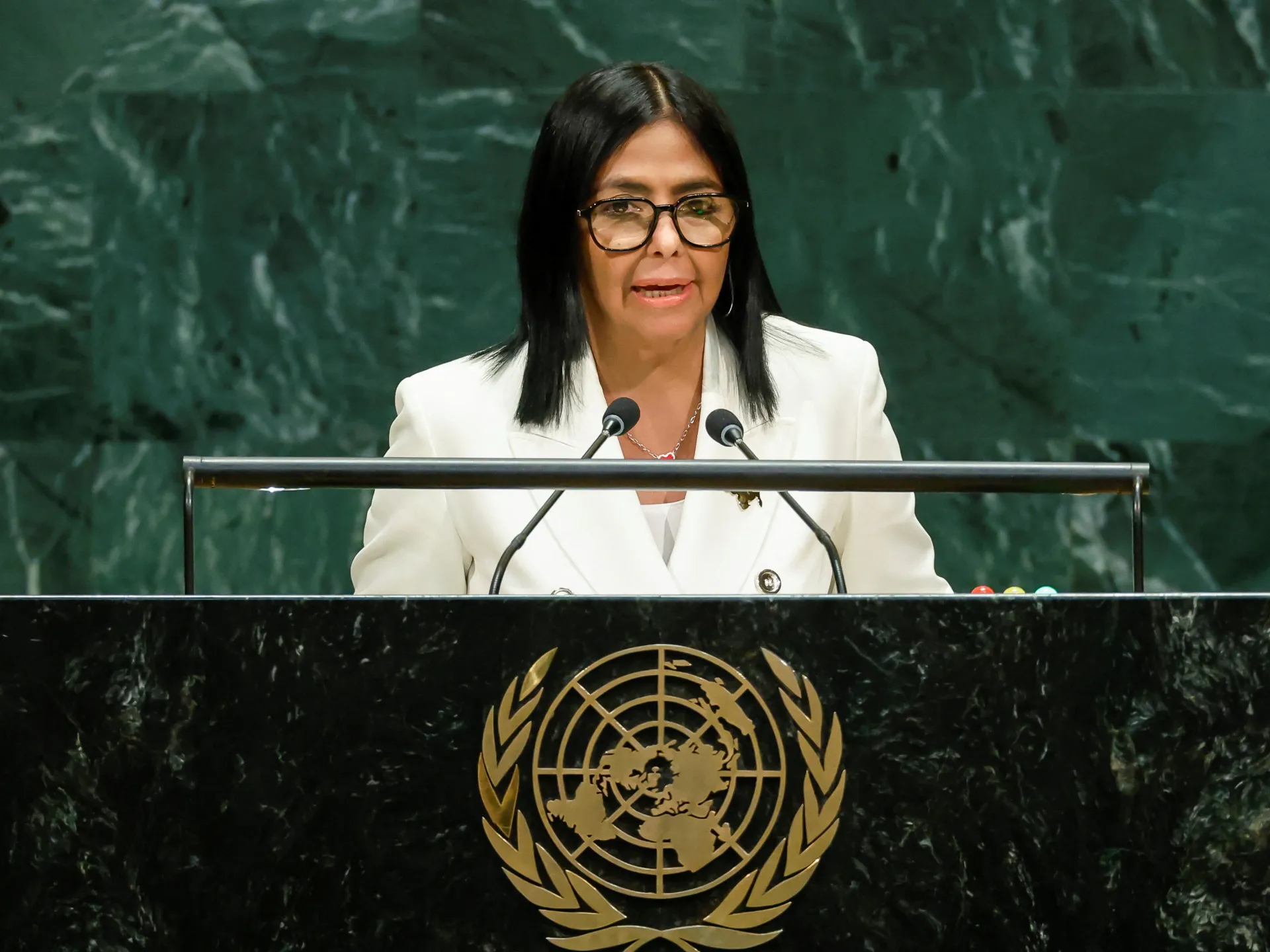
Rodríguez publicly thanked Trump in her UN speech. (Presidential Press)
Photographic evidence
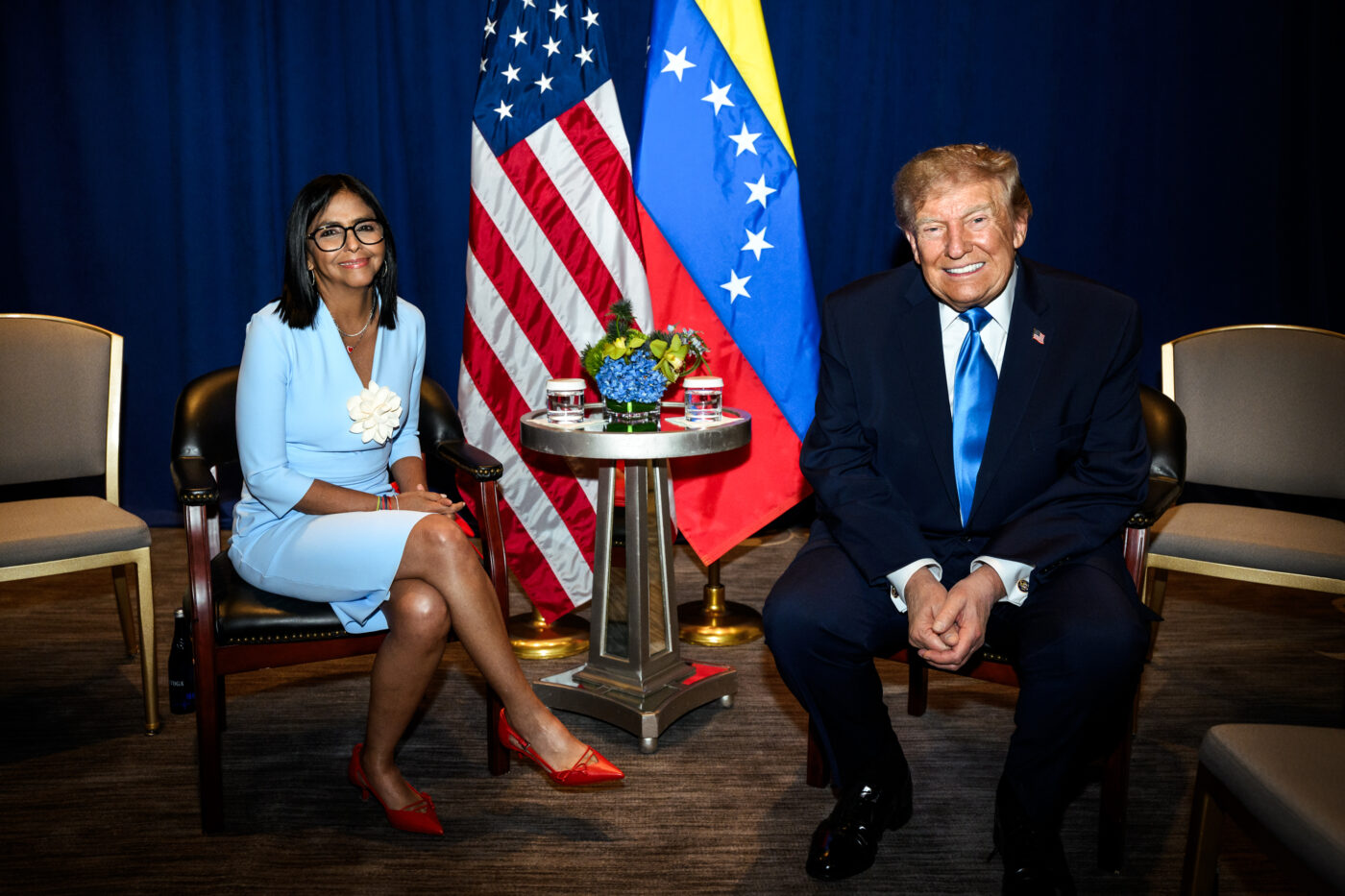
There is a photograph that serves as evidence: Delcy Rodríguez and Donald Trump, together, smiling, in New York. Hundreds of narratives can be constructed around that photo. Diplomatic, tactical, or strategic explanations can be devised. Some may speak of pragmatism, power dynamics, negotiation, or political necessity. All of that is open to debate. But there is something that remains true regardless of any narrative: the photograph is evidence and depicts a specific scene. And that scene is difficult to reconcile with much of the political tradition from which Delcy Rodríguez hails.
Because there is another image from the same day that completes the picture: Delcy Rodríguez approaching [Spanish President] Pedro Sánchez while he is on the phone, waiting for him to finish so she can greet him. The image conveys something difficult to reconcile with the power of the Bolivarian Revolution’s historic leadership: a desire to reach out, almost like a student waiting for the other person to hang up the phone so she can greet him; an attitude that seems a far cry from the dignity and authority with which Chavismo once stood up to global powers. And a few hours later, the photo-op with Trump appears. Two images from the same day that speak for themselves, because diplomacy is one thing, and the position from which it is exercised is another; negotiating is one thing, and showing subordination is another. That is what it looks like.
Chavismo’s tradition
And what we see today is a far cry from Hugo Chávez’s “Go to hell, you fucking Yankees.” It’s a far cry from that rebellious Chavismo that could stand up to the King of Spain, that could publicly confront the United States, and that built much of its political identity around an idea of sovereignty, dignity, and resistance in the face of imperial power. There was a political force there, a capacity to stand up to power, a way of exercising leadership, that is hard to find in these recent images.
When the narrative trumps reality
We live, at the same time, in a dystopian world in which artificial intelligence, technological advances, and algorithms often lead us to be unaware of reality or to experience it from a perspective different from what is actually observed. We can construct stories, narratives, and entire universes around a single scene until the narrative ends up overtaking reality. While the world’s wealthy talk about moving to Mars or colonizing other planets, perhaps the biggest debate we face is much more fundamental: aligning stories, narratives, and algorithmic trends with reality.
Assuming that reality is something different from what we see often leads us to explore ideas, utopias, or even political stances from a perspective increasingly distant from what is actually happening. And perhaps today, a revolutionary leap would be to align reality with what is being recounted or narrated. Ideas, utopias, and political stances need to stem from reality—not from a reality constructed to align with what we need to believe. When the narrative begins to take the place of facts, we stop interpreting reality and start adapting it to our needs.
The power of what is seen
That is why the power lies in what is seen. And what is seen is not just a photograph of Delcy Rodríguez and Donald Trump. That photograph appears in the wake of a US military intervention in Venezuela, which led to the kidnapping of Nicolás Maduro and Cilia Flores, and after Trump publicly took credit for the operation. What we see is Delcy Rodríguez standing before the man who brags about this operation and presents its outcome as a victory. And this matters because the photograph isn’t floating in a vacuum: it has a context—it involves deaths, a military attack, a captured Venezuelan president, strategic resources at stake, and a US president claiming credit for the outcome of that operation.
At this very moment, paradoxically and surprisingly, an entire epic narrative of triumph and “peace diplomacy” is emerging, a grandiloquent celebration of a supposed victory. And the important thing is to state something very simple: defeat is not epic. A defeat can simply be a defeat. What can be discussed is how one faces it, what stance one takes in the face of it, and what dignity one maintains when conditions are adverse. But a defeat does not become a victory simply because we construct a grand narrative around it. Reality retains a dimension that rhetoric cannot erase.
The words of the victor
What we see is a Delcy Rodríguez who tolerates Trump saying outrageous things. Trump spoke of the US operation in Venezuela in terms of victory and the victor; he justified the use of force and even spoke of the spoils that belong to the victor. This is an offensive affront to the dead—who are not only Venezuelans but also Cubans—and, fundamentally, to those killed in an intervention on Latin American soil. That context does not disappear simply because a diplomatic facade is later constructed or by conjuring a strategic explanation for every gesture.
It happened. And it is incomprehensible that Delcy Rodríguez would then appear in a triumphant, smiling manner in the face of that display of power and in the presence of the very person who has abducted Venezuela’s President Nicolás Maduro and Cilia Flores. We can discuss the reasons for the negotiations, the balance of power, the tactical necessities, the circumstances, and the alternatives. All of that is part of politics and can be analyzed. But there is something that comes before all those explanations: what actually happened.
Tactics and consistency
And this raises a question we should not shy away from: What is the difference between Milei’s stance and Delcy Rodríguez’s stance with regard to the US? No doubt, in the coming hours, explanations will emerge aimed at establishing profound differences between the two, and we will be told that they follow different logics, that one expresses subordination and the other a tactic, that one represents a political project and the other a historical necessity. All of that is open to debate. But it is important to look at the concrete attitude, because if politics can always be explained away as a tactic, then consistency begins to lose all specific weight. And when consistency loses its specific weight, almost anything can become a strategy: a concession can be presented as a victory, subordination as pragmatism, a defeat as peace diplomacy, and a photograph as an epic moment. Reality, however, remains.
A model of dignity
If there is a model to look to today—as we saw on January 3—it was Cuban dignity, which fought to the very end against US troops and delivered a fierce, dignified response, despite being outmatched in firepower and at a disadvantage in every respect. At the UN General Assembly, too, it was the Cuban delegation that stood up and walked out [during Trump’s speech]. Therein lies a model of dignity—a model from which to fight and from which to view ourselves. There are moments when politics needs to reclaim the ability to set boundaries against power.
And this matters especially for those of us who see ourselves within a tradition of the left, of sovereignty, of emancipation, and of transformation. Because we cannot lose the ability to recognize a point of reference when we see it. We cannot construct an artificial epic around something that offers us no point of reference. And we cannot turn a scene of subordination into a revolutionary one simply because we need to preserve a certain narrative.
Surrender is also conceptual
If we fall into this pragmatic, tactical logic—where consistency seems to carry little weight and reality can be distorted through grandiloquent rhetoric—we lose something far more important than a short-term political debate: we lose the ability to think. What we see is a very happy Delcy Rodríguez standing next to Trump. What we see is a Venezuelan historical process that we have admired but which no longer serves as a point of reference, because today it is part of mechanisms that strengthen Donald Trump and of a strategic surrender of resources—not only natural ones but also conceptual and ideological ones.
And the latter is perhaps even more important, because it is not just about oil, natural resources, or economic agreements. Symbols, references, words, and political traditions are also being surrendered. A tradition that for years was built around resistance to imperialism may end up being used to legitimize a new relationship of subordination. And when that happens, the surrender is not only material—it is also conceptual. A part of what for years allowed us to construct a worldview, a way of interpreting sovereignty, and a way of understanding emancipation is being surrendered.
Intellectual honesty
So there is no turning back. As a matter of dignity, as activists, it is important not to betray our intellect and to realize that this is what it looks like.
Some will come forward in the next few hours to say, “No, it’s a tactic.” Well, but no revolutionary process has ever come about that way. Can you imagine Fidel Castro celebrating with Kennedy after the Bay of Pigs? It would be something similar. The comparison may seem harsh, but it actually helps us understand the problem: it’s one thing to negotiate with an adversary and quite another to stage a celebration with someone who has just bragged about a military intervention; it’s one thing to manage a defeat and quite another to build an epic out of a defeat.
Back to reality
Perhaps the problem of our time is precisely this: we have learned to construct narratives capable of altering our perception of reality. Artificial intelligence can do it, algorithms can do it, political narratives can do it, the great powers can do it, and we ourselves can do it when we need reality to resemble what we want to believe. That is why, perhaps, a revolutionary leap today is something much more fundamental and, at the same time, much more difficult: returning to reality, aligning what is with what is reported and narrated; not abandoning utopias but preventing them from becoming an excuse to ignore the facts; not abandoning politics but preventing politics from forcing us to deny what is right before us; not ceasing to think strategically but reclaiming coherence as a dimension of strategy.
And perhaps the first obligation of those of us who still believe that politics can transform reality is not to betray our intellect in order to save the narrative. To look at reality, to think from within it, and to hold our ideas up against what is actually happening. Because before any explanation, before any epic, and before any narrative construction, there is something that remains right before us.
It is what it looks like.
Translated by Venezuelanalysis.
Source: Barrio Adentro