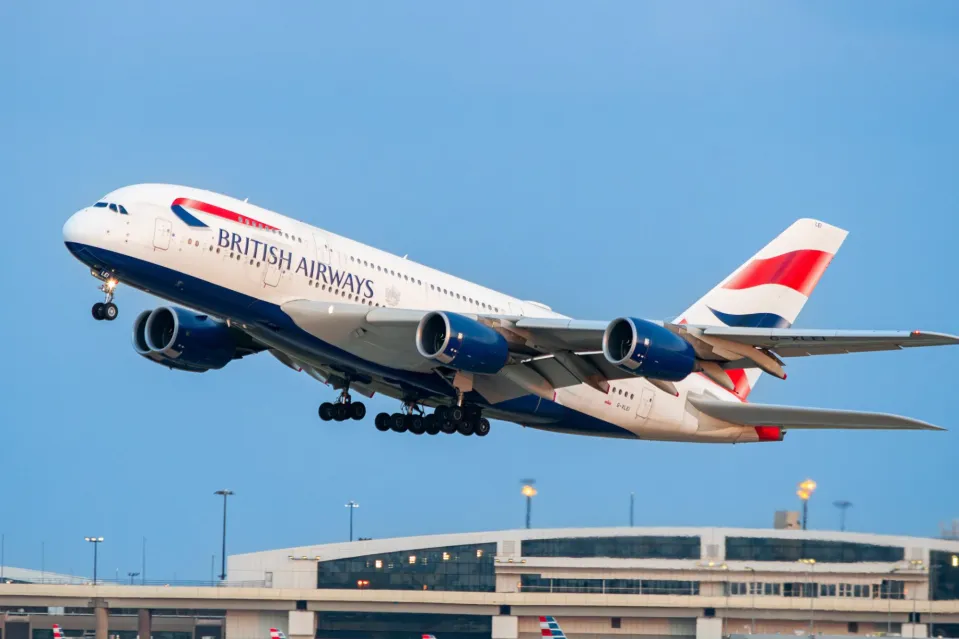
delays

UK has ‘worst airport in Europe’ for delays – and three others in the top 10

Four UK airports have found themselves in the top 10 of the ‘worst for delays’ across Europe, with one securing the top spot following average delays of almost two hours

A UK airport has been named the ‘worst in Europe’ for delays, while three other UK airports also found themselves in the top 10.

New research from AirAdvisor ranked Manchester Airport as the worst airport in Europe for hour-long flight delays. The airline comparison experts analyzed data from 9,594,711 flights across 46 European airports in 2025 to reveal results based on the percentage of flights delayed by 60 minutes or more (weighted at 70 percent) and the average length of those delays (weighted at 30 percent).

This saw Manchester take the top spot, with 6.16 percent of its flights delayed by 60 minutes or more in 2025 and an average delay of 116.7 minutes, which amounts to almost 2 hours. AirAdvisor AirData found that the routes from Manchester most prone to delays were to Amsterdam Schiphol, Paris Charles de Gaulle, and Dublin.

READ MORE: EasyJet’s new 7-hour route to white sand island is ‘longest ever’ with £120 flightsREAD MORE: Experts warning over common items packed in hand luggage that can cause travel disruptions

A Manchester Airport spokesperson told The Mirror: “This analysis of the Civil Aviation Authority’s data is misleading as it ignores important context – context which is directly referenced by the CAA in the notes accompanying the research and in the research itself. Punctuality is affected by factors that are outside of an airport’s control. The two most significant factors contributing to delays in the last year have been industrial action affecting air traffic control in Europe, and the weather. These were exacerbated by airspace restrictions above conflict zones meaning airports with significant long-haul networks, like Manchester, were more significantly affected than others.

“As an industry we are working collectively to achieve the best possible on-time departure rates, while protecting flight schedules and avoiding the need for cancellations.”

But it wasn’t just Manchester that found itself named among the worst. Birmingham, London Gatwick, and London Stansted joined the airport, making the UK the most represented country in the top 10.

London Gatwick was ranked the sixth worst in Europe, with a 5.24 percent rate of hour-long delays and an average delay of 111.88 minutes. According to the data, AirAdvisor found that the most impacted routes from Gatwick were to three major holiday hotspots: Barcelona, Malaga, and Lisbon.

In tenth place was Birmingham Airport, after the experts found that it scored a 5.26 percent rate of hour-long delays and an average duration of 108.01 minutes. The most disrupted routes from Birmingham were said to be flying to the popular destinations of Amsterdam, Dublin, and Paris Charles de Gaulle.

A Birmingham Airport spokesperson said: “Flight delays can happen for several reasons including industrial action and bad weather, some of which are out of an airport’s control. This month over half of all aircraft left on time and we continue to work hard to improve punctuality. Our colleagues work tirelessly to provide brilliant passenger service, with the vast majority of people rating their experience as excellent.”

Meanwhile, London Stansted came in joint tenth with Birmingham, after data found that it had a 5.5 percent rate of hour-long delays and an average delay of 106.24 minutes. AirAdvisor said the most delayed routes from Stansted were to Dublin, Edinburgh, and Istanbul Sabiha Gokcen.

A London Stansted Airport spokesperson told the Mirror: “It’s very important to put this analysis into perspective. The data looks at 46 airports but there are more than 340 major airports across Europe, so this represents a small and self-selective sample. This type of analysis of the Civil Aviation Authority’s data is misleading as it ignores important context – context which is directly referenced by the CAA in the notes accompanying the research and in the research itself.

“It should also be noted this research has been produced by a flight compensation company and looks specifically at delays of more than 60 minutes, which are often driven by wider factors such as air traffic restrictions, industrial action, adverse weather impacts and airline operations, airline crew shortages or delays to inbound flights rather than airport performance.

“Like all major airports operating in busy European airspace, punctuality on certain routes can be affected by congestion elsewhere in the network. We continue to work closely with airlines, air traffic control and partners across the aviation system to reduce disruption and keep journeys running as smoothly as possible for passengers.”

London Gatwick has been contacted by The Mirror for a comment.

Top 10 worst airports in Europe for long delays

  1. Manchester, UK
  2. Palma de Mallorca, Spain
  3. Kraków Balice, Poland
  4. Nice Côte d’Azur, France
  5. Bucharest Henri Coandă, Romania
  6. London Gatwick, UK
  7. Porto, Portugal
  8. Marseille Provence, France
  9. Birmingham, UK
  10. London Stansted, UK

Birmingham, London Gatwick, and London Stansted were contacted for comment.

Do you have a travel story to share? Email webtravel@reachplc.com

Source link

Passport holders urged to change 1 phone setting or ‘risk delays at airport’

Passport holders have been urged to change a key phone setting before they arrive at airports to travel. Failing to do so could see them facing delays in queues

We all love jetting off abroad at this time of year, but sometimes making simple mistakes at the airport can lead to risking delays in queues. While many people worry about their clothing, and what they have packed in their cases, something they should actually be paying more attention to is their mobile phones.

Little you may know, using a certain setting can actually lead to people spending more time in queues at security, and delaying their travel journey. Nobody wants to have to face lengthy queues when they start their holiday so an expert has shared some key travel tips to help passport holders out.

It’s not the only advice of its kind to be shared recently either. Previously, tourists were also advised to take passport action before travelling to reduce the risk of problems at the airport.

You may not realise, but a dim screen is one of the most common reasons boarding passes fail to scan at the gate. Experts say a few simple phone tweaks before you leave home can save serious stress on travel day, and the changes take seconds to complete.

According to William Thackray, IT expert at AGT Computer Services, a dim screen is one of the most frequent and easily avoidable causes of delay at airport security and boarding gates.

He said: “Scanners need a clear, bright image to read a barcode or QR code reliably. In bright airport lighting, a screen that’s sitting at its default brightness – or that’s been dimmed to save battery – can cause a failed scan.

“It sounds trivial, but it holds up the queue and it’s completely avoidable.”

What you need to do

Before you leave the house, drag your screen brightness to maximum. On an iPhone, swipe down from the top right corner to access the Control Centre and pull the brightness slider to the top. For Android, swipe down from the top of the screen and do the same.

While you’re at it, William recommends a few other quick changes that can make the whole airport experience smoother. To begin, he said it’s a good idea to screenshot your boarding pass.

Don’t rely on an app that needs a signal or a Wi-Fi connection to load. A screenshot lives on your phone and opens instantly.

He said it’s also a good idea to turn off auto-lock. If your screen goes dark mid-queue, you’ll be unlocking your phone and re-opening your boarding pass with a line of people behind you.

Go to Settings > Display and bump your screen timeout up to at least two to three minutes before you travel. This could make a big difference.

You should also make sure your phone is fully charged. It sounds obvious, but some airports – especially when travelling to the US – can ask you to power up your device at security.

A dead phone can mean real delays, or worse, having your device taken for additional screening. William added: “None of these things take more than a minute to sort before you leave the house.

“But, on a busy travel day, that one minute of prep can be the difference between breezing through and being that person holding everyone up.”

Source link

Holidaymakers urged to leave these popular items at home or risk airport delays

A skincare expert has shared which beauty products are likely to cause problems at airport security due to hand luggage liquid rules – and how to avoid any hold-ups

With summer getaways fast approaching, countless holidaymakers are gearing up to travel overseas. As skincare continues to surge in popularity, many will be packing their creams and serums – yet skincare specialists are cautioning that transporting these products can prove more complicated than anticipated.

Experts at Landys Chemist have outlined the key ways skincare items can cause issues at airport security.

Skincare specialist Rhysa Phommachanh explained: “Many travellers are now packing full skincare routines in their hand luggage, but it can be confusing knowing which products are allowed. As a general rule, if a product can be spread, rubbed, or sprayed, it will usually fall under airport liquid restrictions.”

For instance, numerous skincare products nowadays appear as jellies, balms and sticks.

All of these are classified as liquids by airport security, as are sheet masks and eye patches.

Failing to adhere to airport security regulations could result in travel disruptions or having your belongings seized.

To conserve luggage space, travellers sometimes transfer larger items into smaller containers to meet requirements.

Nevertheless, these unidentified containers can prompt queries at security and trigger manual inspections, which can prove time-consuming.

It’s also probable that any pressurised containers such as facial mists, setting sprays or spray sunscreens will require manual examination and slow down security lines.

It is crucial to familiarise yourself with the regulations at each airport you pass through, as updated liquid rules are gradually being introduced across the country.

Restrictions may vary from one airport to another, so ensure you are fully aware of the specific guidelines before you board your flight.

When it comes to skincare, a minimalist approach often yields the best results.

As reported by the Express, Rhysa said: “A more simplified approach tends to work best for long-haul travel.

“Basic essentials such as lip balm, a lightweight moisturiser, or a facial mist are usually more than enough to maintain hydration without overwhelming the skin barrier.”

Source link

EU country suspends border system which has caused 4-hour delays

The country has chosen to abandon the new biometric security measures over concerns about queue chaos and flights taking off without passengers

Greece has suspended EU fingerprint and facial scans for British holidaymakers. The country has chosen to abandon the new biometric security measures over concerns about queue chaos sweeping across the continent. Queues have been hitting the country with four hours reported in many destinations, including Greece.

All travellers from the UK and other non-EU countries are supposed to be photographed and fingerprinted at EU airports and border crossings under the new entry and exit system (EES) introduced by Brussels.

Holidaymakers have been cautioned that the new security measure, which is now fully operational, could trigger airport delays of up to four hours. Eleni Skarveli, director of the Greek National Tourism Organisation in the UK, stressed that the decision would “ensure a smoother and more efficient arrival experience in Greece” and would “significantly reduce waiting times” while alleviating congestion at airports.

The EES is intended to replace manual passport stamping and better monitor the 90-day visa-free limit, but its introduction has caused havoc at some of Europe’s busiest airports.

A statement on the website of the Greek Embassy and posts on official social media channels said: “Update for British passport holders travelling to Greece. “In the framework of the implementation of the Entry/Exit System, as of 10 April 2026, British passport holders are exempt from biometric registration at Greek border crossing points.”

There was no further detail of how long the exemption would last, and FCDO travel advice for Greece has not been updated.

Luke Petherbridge, director of public affairs at travel trade organisation Abta, said: “While for many the travel experience remains smooth, we’re disappointed and frustrated to see some passengers being caught up in delays due to EES.

“Abta has been warning destinations and the (European) Commission for some time about the need for proactive steps to be taken to avoid delays, including the full use of contingency measures to stand down biometric checks at busier times, and adequate staffing especially at peak times.”

A total of 122 passengers were reportedly unable to board the flight from Milan Linate to Manchester on Sunday because of delays at passport desks caused by the ramp up of the EU’s Entry Exist System (EES).The 11am departure was held for 59 minutes before departing with the majority of seats empty.

One of the affected easyJet passengers, Kiera, 17, from Oldham, Greater Manchester, said she and her boyfriend arrived at Milan Linate airport at 7.30am on Sunday. She told the BBC: “We got to Border Control and it was a massive queue of people. I wasn’t feeling great anyway because I think I’d got food poisoning.

READ MORE: Full list of airports as easyJet warns of ‘longer queues’READ MORE: Major airline cancels hundreds of flights as ‘last resort’ over Iran fuel crisis

“At about 10.50am they brought some water over for people, and when we got to the front of the queue someone asked us if we were going to Manchester, and told us our flight had just gone.”

Vicky Chapman, 26, from Wirral, Merseyside, was booked on the flight with her family, including her five-year-old son.

She told the Liverpool Echo they arrived at the airport “with more than enough time” but were “refused entry through passport control”.

She continued: “We were then told that we are a ‘no show’ on our flight because we did not get to the gate on time, even though passport control had issues and they would not let us through.

“We were passed from pillar to post for three hours and no-one helped us. “It was so hot in the airport, people were vomiting, people were almost passing out.

“We’re being told that Tuesday is the earliest we can get back, and that we have to fly to Gatwick. We’ve had to pay out of pocket for an Airbnb.”

An easyJet spokesman said: “Due to delays in EES processing by border authorities, some passengers departing from Milan Linate on Sunday experienced very long waiting times at passport control.

“We held flight EJU5420 from Milan to Manchester for nearly an hour to give passengers extra time but it had to then depart due to crew reaching their safety regulated operating hours.

“Customers who missed the flight have been offered a free flight transfer.

“We continue to urge border authorities to ensure they make full and effective use of the permitted flexibilities, for as long as needed while EES is implemented, to avoid these unacceptable border delays for our customers.

“While this is outside of our control, we are sorry for any inconvenience caused.”

Of the 156 passengers reportedly booked on the return flight to Manchester, just 34 made it on board – leaving a staggering 122 stranded in Italy. EasyJet subsequently issued an apology over the incident.

At three of the UK’s “juxtaposed” border controls in Dover, Folkestone and London St Pancras, the pricey EES kiosks remain unconnected to the French police aux frontières IT system. These issues are not expected to be resolved until September, according to the Independent.

Greece is heavily dependent on British tourism, particularly at its bustling island hotspots such as Corfu, Crete and Rhodes, which can welcome upwards of 2,000 UK passengers daily during peak season.

The decision by Athens is widely regarded as a move to offer reassurance to British holidaymakers, and could encourage other Mediterranean nations to follow its lead. Greece is yet to confirm an end date. for its EES exemption for British travellers.

Holidaymakers are already considering switching their summer holiday plans this year, according to travel industry experts.

“Because of the war in the Middle East, Europe is seeing a big increase in interest as a holiday destination this year,” an ABTA spokesman said.

ABTA added that Greece was anticipated to be the fifth most-visited destination by Britons this summer, trailing behind Spain, France, Italy and the USA.

The spokesman said: “I think it’s too early to say what this change might mean for the number of people visiting, particularly as decisions on where to go are based on a number of factors.”

It’s thought travellers now weighing up a continental break may pivot towards Greece to sidestep potential headaches caused by the new scheme. “Greece for me this summer then, was thinking of Tenerife, but no way I’m putting up with those queues and chaos,” one man posted on X.

Another person added: “I work in the travel industry, already had customers worried about this new system believe me, Greece will benefit from this stand!” While a third chimed in: “Perfect – off to the Greek islands this summer – common sense prevails!”

Source link

South Korea opposition leader delays return from U.S.

Jang Dong-hyeok (L), chief of the main opposition People Power Party, speaks during a meeting of the party’s Supreme Council at the National Assembly in Seoul, 02 February 2026. Photo by YONHAP / EPA

April 17 (Asia Today) — Jang Dong-hyuk, leader of South Korea’s main opposition People Power Party, has delayed his return from a U.S. visit by three days at the request of U.S. officials, party aides said Thursday.

Park Jun-tae, Jang’s chief of staff, told reporters at the National Assembly that Jang had originally planned to return later in the day but would now arrive early Sunday.

“While heading to the airport for departure procedures, special circumstances arose, leading to an extension of his schedule,” Park said.

The delay was made at the request of officials from the U.S. Department of State, Park added. He said speculation about possible meetings with Vice President JD Vance or Secretary of State Marco Rubio remained unconfirmed.

Some members of Jang’s delegation have already returned to South Korea, while others remain in the United States.

Jang departed for Washington on April 11 and was initially scheduled to return Friday via Incheon International Airport.

During the visit, he met with U.S. lawmakers including Bill Hagerty and delivered a speech at the International Republican Institute, where he emphasized the U.S.-South Korea alliance.

He also criticized the South Korean government’s policy toward North Korea, arguing it prioritizes dialogue over deterrence and risks weakening trust in the alliance. Jang called for “peace through strength” to counter North Korea’s nuclear threat.

— Reported by Asia Today; translated by UPI

© Asia Today. Unauthorized reproduction or redistribution prohibited.

Original Korean report: https://www.asiatoday.co.kr/kn/view.php?key=20260417010005446

Source link