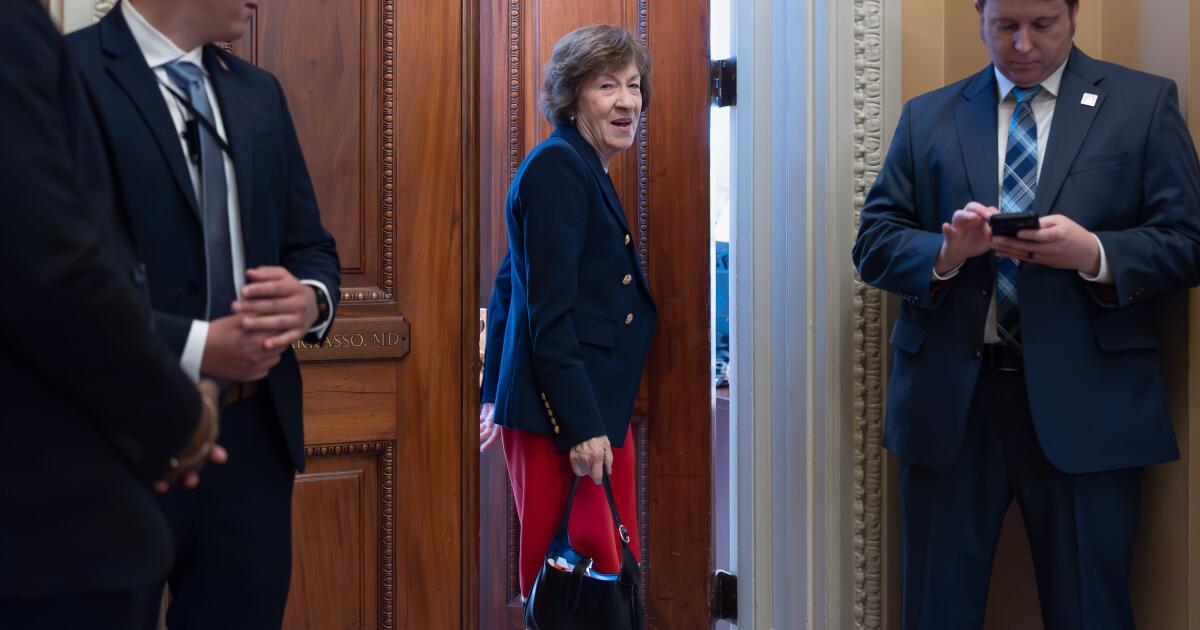
defying

Defying Trump ended some GOP careers. It could help Susan Collins in Maine

This election year is déjà vu for Sen. Susan Collins — the Maine Republican is running for reelection as Democrats pin their hopes on a new candidate to defeat her. Last time, it was state lawmaker Sara Gideon. This time, it’s combat veteran and oyster farmer Graham Platner.

But Collins has proved to be a hard target for Democrats over the years — even for candidates without the baggage of Platner, who has faced criticism for his relationships with women, inflammatory online posts and a previous tattoo recognized as a Nazi symbol. Collins is seeking her sixth term with sky-high name recognition, a record-breaking run of consecutive Senate votes and a history of bringing back federal funding for her state for years.

She is also the rare Republican who sometimes can boost her own popularity back home by keeping her distance from President Trump, and she has perfected that delicate dance even as his tightening grip on the party has cost two of her Senate Republican colleagues their reelection.

Sens. John Cornyn of Texas and Bill Cassidy of Louisiana lost their primaries when facing Trump-endorsed opponents. But despite the president’s complaints about Collins, he did not campaign against her. Years of practice have made her adept at staying close — but not too close — to the president when it is politically advantageous, and moving away when showing an independent streak is helpful.

“She’s shown time and time again where her state’s electorate is. She understands what’s too far, she understands where she needs to be,” said political consultant Matt Mackowiak, who worked for Cornyn’s failed reelection campaign. Trump endorsed Cornyn’s opponent, Texas Atty. Gen. Ken Paxton.

The road to Senate control goes through Maine

The Democrats need to flip four seats to take control of the Senate in November and hope that Trump’s falling approval ratings and the war in Iran — as well as its subsequent effect on oil prices and the economy — could buoy their chances. Maine is among the top targets, along with Alaska, Ohio and North Carolina.

Platner wants to make the case that Collins isn’t as independent of Trump as her reputation suggests — repeatedly noting that she allowed his Supreme Court nominations to go through, which in 2022 led to the overturning of Roe vs. Wade, a landmark 1973 decision that legalized abortion, among other major issues.

“Susan Collins may have started her career decades ago in Washington with good intentions, but she has become just as spineless and corrupt as the establishment she now serves,” Platner said at a victory party on Tuesday.

Platner supporters are ready for change, said John Keenan, of Sullivan, Maine.

“I think Maine has grown tired of the same old system,” he said. “And putting youth into the campaign, with new instead of a rubber stamp, is very refreshing.”

Republicans have already launched their campaign in support of Collins. The National Republican Senatorial Committee posted a pro-Collins video on the social media channel X on Tuesday that resembled a 1980s video game. It stated that Collins “has brought more than $1.5 billion back to Maine” and that Platner “spent time as a kid at a $70,000 a year prep school in Connecticut.”

Trump has often criticized Collins — but not lately

Even as she faces Platner in November, Collins may have to stay wary of Trump. The president has spent years singling her out for daring to occasionally defy him on some issues.

However, he’s refrained from doing so more recently — especially as Collins failed to draw a credible challenger and cruised to a Republican primary victory.

The White House declined to comment. Political advisors close to Trump, however, said the president understands how critical it is that Republicans maintain control of Congress after November, which requires accommodating Collins. Trump understands the need to avoid a Republican wipeout like 2018’s “blue wave” midterms that saw Democrats flip the House and derail much of the last two years of his first-term plans.

“Senator Susan Collins represents the people of Maine first and foremost and has proven herself to be a dedicated public servant,” said Republican National Committee spokesperson Kristen Cianci in a statement.

Collins spokesperson Blake Kernen said the senator “has worked with five different Presidents throughout her Senate tenure, and has never agreed with any of them on every issue.”

“When she agrees with an effort, she will support it; when she disagrees, she does not hesitate to speak up for what she believes is the right outcome for Maine and for America,” Kernen said in a statement.

Other Republicans ran into trouble with Trump

That didn’t work out for some Republican senators.

Cornyn was among his party’s top voices, rising through the ranks after joining the Senate in 2002. Paxton trounced him in a runoff race days after Trump endorsed the attorney general.

In office since 2015, Cassidy voted to convict Trump during his impeachment trial after the U.S. Capitol siege on Jan. 6, 2021. He lost his primary to Trump-endorsed state Rep. Julia Letlow.

Maine figures to be a more competitive race in November — as evidenced by Trump recently refraining from singling out Collins. That’s despite her voting last week with Democrats to block the nearly $1.8-billion fund the president wanted to create to benefit allies that he claims were unfairly targeted by law enforcement.

“She’s always down in the polls and she survives,” Trump conceded when asked about Collins in an interview with the New York Post last week.

Collins defeated Gideon, the Maine House speaker, by almost 9 points in 2020, the same year that Biden beat Trump by a similar margin in the state.

Mackowiak said that “there’s just no pathway to a MAGA senator from Maine.”

“It does appear that the Trump political operation is soberly analyzing the electoral environment in Maine and really kind of follows her lead as it relates to that state and that race, particularly this cycle,” he said.

Maine Republicans are ‘a bit more pragmatic’

Chuck Ellis, a Republican from Westbrook who runs a digital marketing company, said Collins’ reluctance to move in lockstep with Trump can be a plus.

Although there are some “hard-line” voters who may disapprove, Ellis said, “ultimately a lot of your conservatives, your Republicans, are people who are a bit more pragmatic.”

After Collins opposed the White House’s signature tax cut and spending package last year, and voted against a proposal to claw back $9 billion in foreign aid and public media funding, the president complained about her on social media.

“Republicans, when in doubt, vote the exact opposite of Senator Susan Collins,” he wrote.

Then, in January, Trump lashed out at the “stupidity” of Collins and four other Senate Republicans who joined Democrats to start a debate over restricting the president’s use of force in Venezuela.

She later received a profanity-laced call from Trump.

White House may keep a further distance from Collins’ race

As chair of the powerful Senate Appropriations Committee, Collins last week cast her 10,000th Senate vote in a row, setting a record.

“She has been able to do and show that ‘I am bringing money and resources from the federal government to Maine to help Maine,’ ” Ellis said.

The president is unlikely to travel to Maine ahead of November despite visiting other states with key Senate races, like Iowa and Michigan. He could even campaign personally for Paxton.

Vice President JD Vance has been to Maine, where he promoted his anti-fraud task force. Collins didn’t attend Vance’s speech in Bangor last month in which he acknowledged the senator’s distance from the Trump administration.

“If she was as partisan as I sometimes wish that she was,” Vance said, “she would not be a good fit for the people of Maine.”

Whittle and Weissert write for the Associated Press. Weissert reported from Washington.

Source link

South Carolina Senate adjourns without new map, defying Trump

May 26 (UPI) — South Carolina’s state Senate adjourned Tuesday without acting on a new congressional map that would have redrawn voting districts in favor of Republicans.

President Donald Trump has called on states to redraw their voting maps to favor Republicans, especially after a recent U.S. Supreme Court decision that badly weakened a part of the landmark federal Voting Rights Act of 1965 that helped protect minority voting power.

However, as voters started heading to the polls Tuesday for the first in-person voting in primaries, state senators said it was just too late. If the state Senate pushed the map through Tuesday, the state would have had to throw out tens of thousands of ballots that had already been cast that day and schedule a new primary.

“Neither my conscience nor my common sense would allow me to stop an election that is already underway,” Republican state Sen. Richard Cash said during the vote, The BBC reported.

The new congressional map pitched for South Carolina would do away with the state’s only majority Black district, which is represented by Rep. James Clyburn, a Democrat. Clyburn is seeking his 18th term in office this year.

Republicans have a narrow majority in the U.S. House of Representatives, and Trump and other conservatives are calling for district changes to hold on to that majority during the midterm elections in November. Other states, including Tennessee, have already redrawn and approved new maps eliminating majority Black districts.

CNN reported that Trump called Republican state Senate Majority Leader Shane Massey at least twice about the plan, and the president has posted regularly on social media about the matter as well.

“South Carolina Republicans: BE BOLD AND COURAGEOUS, just like the Republicans of the Great State of Tennessee were last week!” the president wrote in a post earlier this month.

South Carolina state senators will likely pick up the matter again after the primary voting ends June 9. State Sen. Brad Hutto, a Democrat, said his party members worked all weekend to make voters headed out to the polls today, The New York Times reported.

“The people in South Carolina were sending us a message that their vote mattered,” he said. “It was important, and they didn’t want us to cancel their vote.”

Democrats had another win in the redistricting wars on Tuesday, with a federal court temporarily blocking Alabama from using its newly redrawn congressional map, which includes only one Black majority district out of seven. The population of Alabama is about 27% Black.

The South Carolina map in question, meanwhile, would have resulted in no Black majority districts out of the state’s seven. The state is about 26% Black, based on 2025 U.S. Census numbers.

Source link

Charlton Athletic: The WSL 2 club defying odds in promotion race

An earlier version of this article was published on 4 April.

Hardly anyone was talking about Charlton Athletic being title contenders before the Women’s Super League 2 season.

So it is no surprise manager Karen Hills feels it would be “one of the greatest achievements of her career” if they were to gain promotion.

With one game remaining, her side sit at the top of the WSL 2 with 42 points, one point ahead of title rivals Birmingham City and Crystal Palace.

Charlton face Birmingham in a massive game on Saturday, 2 May at 15:00 BST, with Crystal Palace taking on relegated Portsmouth at the same time.

As the WSL expands from 12 to 14 teams next season, the top two in WSL 2 will automatically secure promotion to the WSL, while the team finishing third will face bottom-of-the-table WSL side Leicester in a play-off on Saturday, 23 May.

Charlton have led the way for the majority of the campaign, but their form has dipped significantly with three defeats in their past four matches.

With one of the lowest budgets in the league, competing against big spenders Newcastle United and Birmingham, as well as Crystal Palace, it has already been a remarkable campaign for the Addicks.

“If you’d have told me in pre-season this is where we would be at this point, I’d have bitten your hand off,” Hills told BBC Sport.

“These players deserve to be where they are. The amount of work that they’ve put in, the way that they’ve played and the way that they’ve executed everything we’ve asked of them, they deserve all the accolades and the achievements.

“If we were to be promoted then I believe it’s probably one of the greatest achievements in my career.

“Just in terms of where the league is at this moment, what other teams have spent and the calibre of players. I think it would be an unbelievable achievement.”

Source link

Defying protocol, Trump relays details of private conversation with King Charles III

In the world of diplomatic faux pas, it could have been a lot worse.

At Tuesday’s state dinner honoring King Charles III and Queen Camilla, President Trump said that during a private meeting earlier in the day the British monarch had agreed with him that Iran should never be allowed to have nuclear weapons.

“We’re doing a little Middle East work right now … and we’re doing very well,” Trump told the audience. “We have militarily defeated that particular opponent, and we’re never going to let that opponent ever — Charles agrees with me, even more than I do — we’re never going to let that opponent have a nuclear weapon.”

While many Britons would agree with the president’s sentiment, the comment triggered mild consternation among pundits in the U.K.

By convention, people aren’t supposed to relay private conversations with the monarch. That is partly because the king has to remain above the political fray, but also because the sovereign doesn’t have the ability to wade into a public debate and correct the record if he’s misquoted.

“Generally, as a matter of protocol, I think I would expect discussions between heads of state to be sort of behind the scenes, in those closed meetings, for those to be sort of kept private,” said Craig Prescott, an expert on constitutional law and the monarchy at Royal Holloway, University of London. “And, you know, this was something that the U.K. government wanted to avoid.”

There had been a fair amount of jitters before the king’s trip to the United States, which comes amid Trump’s very public frustration with U.K. Prime Minster Keir Starmer over his failure to support U.S. actions in the Iran war.

Like all royal visits, this is a carefully choreographed diplomatic event carried out at the request of the U.K. government, which hopes that warm relations between the king and Trump can help repair the rift.

But Trump is an unconventional leader who has a penchant for breaking protocol, and there were concerns about just what he might say or do.

At least in this case, the king’s comments seemed clearly within the bounds of existing U.K. government policy.

“The King is naturally mindful of his government’s long-standing and well-known position on the prevention of nuclear proliferation,” Buckingham Palace said in a statement designed to provide context to the president’s remarks.

Prescott said that “in a sense, this was always the issue, just what Trump would do or say — would he put the king in an embarrassing position?’’ Prescott said.

“You always had that sort of issue of what he would post on social media,” he said. “And I think, you know, this could have been much, much worse.”

Before the state dinner, Charles gave a speech to a joint session of U.S. Congress. The king received repeated standing ovations during the address, which celebrated the longstanding bonds between the U.S. and Britain while nodding to differences over NATO, support for Ukraine and the need to combat climate change.

Now, from the U.K. government’s point of view, the trip is shifting to safer ground as the king and queen leave Washington behind and head to New York, where the focus will be on the city’s creative industries, rather than politics.

The most difficult part of the trip may be over, Prescott said.

“If this is the only controversy arising out of this phase of the state visit, I think overall this has been an enormous success for the king and the British government, because the king was able to make some quite pointed remarks in Congress and it hasn’t really yielded any sort of negative reaction from the president.”

“In a sense,” he said, “you get the feeling that the king rather charmed Washington with his speech to Congress and, you know, his very witty speech at the state banquet.”

Kirka writes for the Associated Press.

Source link

China posts 5.0% Q1 growth, defying war concerns

People ride on bicycles and scooters on a street, in Shanghai China, 10 April 2026. Photo by ALEX PLAVEVSKI / EPA

April 16 (Asia Today) — China’s economy grew 5.0% in the first quarter, exceeding expectations despite concerns over the impact of the Iran conflict, official data showed Thursday.

The National Bureau of Statistics said gross domestic product rose 5.0% from a year earlier, topping the 4.8% forecast by economists surveyed by Reuters and Bloomberg.

The stronger-than-expected growth was driven by manufacturing and exports. Industrial production rose 5.7% in March from a year earlier, while retail sales increased just 1.7%, highlighting weak consumer recovery.

High-tech industries showed particularly strong momentum. Output in the sector rose 12.5% in the first quarter, with industrial robot production up 33% and integrated circuit output increasing 24%. Manufacturing accounted for about one-third of overall economic growth.

The impact of the Iran conflict has so far been limited. Bloomberg reported that China’s efforts to bolster energy security, along with prolonged deflationary pressures, helped cushion the shock from rising oil prices. However, some effects were visible, including a 2.2% decline in refined oil production in March.

Domestic demand remains a key concern. Real per capita consumption rose just 2.6%, while wage growth slowed. The urban unemployment rate reached 5.4%, the highest level in a year.

Investment indicators were also weak. Fixed-asset investment increased 1.7% in the first three months of the year, while real estate investment fell 11.2%. Private investment declined for the first time outside the pandemic period.

Analysts said China’s economy continues to show an “imbalanced structure,” with growth driven by exports and manufacturing while domestic demand lags. Falling sales of automobiles, home appliances and furniture further point to soft consumption.

Policy responses are expected to remain measured. With growth exceeding expectations, pressure for large-scale stimulus has eased, and the government has set a relatively modest annual growth target of 4.5% to 5%.

Still, targeted fiscal support and cost-cutting measures are likely to continue to address rising energy prices and external uncertainties. Some economists also see room for monetary easing, including a possible reduction in banks’ reserve requirement ratio.

— Reported by Asia Today; translated by UPI

© Asia Today. Unauthorized reproduction or redistribution prohibited.

Original Korean report: https://www.asiatoday.co.kr/kn/view.php?key=20260416010005290

Source link