defensive

U.S. running low on advanced defensive missiles and could be for years

The statistics are sobering — so sobering that Defense Department officials refuse to confirm, deny or discuss them.

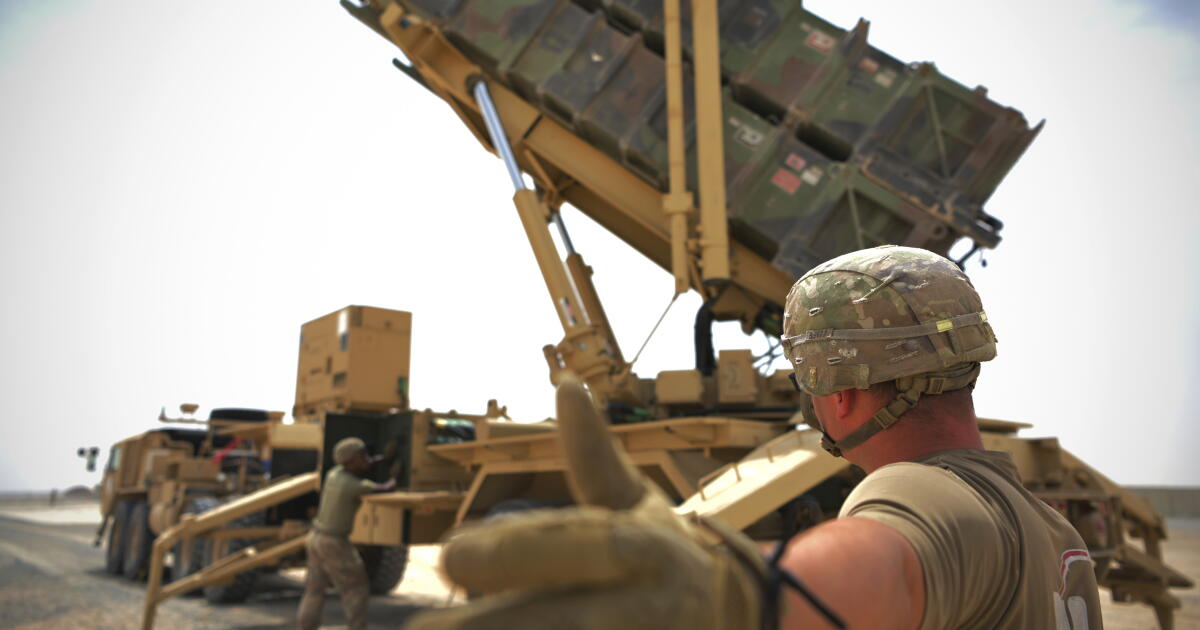
From Feb. 28 through July, the first five months of the war with Iraq, U.S. forces burned through almost 60% of the nation’s advanced defensive missiles — the Patriot and THAAD interceptors that protect American troops.

When the war began, the Pentagon had almost 2,800 Patriot and THAAD missiles in its worldwide inventory, according to a study by the Center for Strategic and International Studies, an independent think tank. By the end of July, that number had dropped to about 1,100, CSIS reported. Almost two-thirds of the Patriots and almost 40% of the longer-range THAAD were gone.

“This is a generational annihilation of our theater missile defense capability,” said Tom Karako, director of CSIS’s Missile Defense Project. “There’s no way you can look at this and not see it’s a setback.”

The White House and the Pentagon have not challenged the CSIS figures, although they have issued sweeping denials that any shortage exists.

“We have far more munitions than anyone in the world, and far more than we need,” President Trump said in July.

That’s true, but misleading. The U.S. military still holds vast inventories of short-range offensive missiles. But the sophisticated defensive missiles that protect U.S. troops no longer are abundant — as even Trump has acknowledged.

“We have certain types of munitions [of which] we have unlimited, virtual unlimited supply,” he said last month. “We have others where it’s a little bit tighter.”

The result is a squeeze that has prompted U.S. commanders to husband Patriot and THAAD interceptors as scarce assets.

For much of August, when a frayed de facto ceasefire was in effect, U.S. forces did not respond with high-end missiles when Iran attacked oil tankers in the Strait of Hormuz.

But when Iran launched rockets against U.S. bases in Jordan last week, Patriots reportedly were used to knock the incoming missiles down. (The Pentagon has declined to confirm or deny those reports.)

The U.S. weapons arsenal “no longer has the capacity to deter a Chinese attack against Taiwan,” the Council on Foreign Relations warned in a report last month. Defense planners share the same concern over a potential Russian assault on the Baltic states.

The conservative Heritage Foundation has forecast that the Pentagon’s inventory of missiles would run out “within the first week of a Taiwan conflict.”

In Europe, a U.S. defense official told the Associated Press last month that the shortfall was “beyond critical.” If Russia attacked a NATO country, the official said, U.S. forces in the area would “take punch after punch in the mouth.”

The core question is whether the United States has so few missiles that it cannot credibly deter China or Russia from attacking their neighbors.

“You’ve got to be strong enough to send a clear message that our enemies should not try anything because we’re a credible force,” said Leon Panetta, President Obama’s former defense secretary. “Now we’re losing a lot of that credibility — and that’s dangerous.”

Knowing that U.S. forces have been left without thousands of weapons needed to deter conflict, Karako said, could in itself be provocative. “It could tempt an aggressor to do something, knowing that we have fewer [missiles] to thwart them.”

The obvious remedy is to build more interceptors — a process Trump and Defense Secretary Pete Hegseth ordered even before the war began. But ramping up missile production won’t immediately replenish the stockpile.

Before the Iran war, defense contractors were producing only about 620 Patriots and 96 THAAD each year — fewer than half the number expended during a few weeks this spring.

At current production rates, it will take at least three years to return the Patriot inventory to its prewar level, and at least four years for THAAD, CSIS reported.

Defense experts warn that the stocks need to be even larger than they were before the war to credibly deter China or Russia.

Mark Cancian, a retired Marine colonel and principal author of the CSIS estimates, says most analysts believe it will take years after replenishing the stocks expended in the Persian Gulf to build a credible deterrent against China.

The Pentagon has enough munitions, both offensive and defensive, to continue fighting the campaign against Iran, he added — but some of those less-sophisticated weapons can be used only at shorter ranges, which means placing more troops in harm’s way.

Cancian said the CSIS figures were based on publicly available Pentagon budget and acquisition documents, updated in some cases from recent press reports — but not from leaks of classified information.

The roots of the missile shortage began long before the war with Iran. Trump and Hegseth are not the only ones to blame, although their belief that Iran would quickly capitulate appears to have been a major factor.

Nor did former President Biden cause the shortage, as Trump has claimed Biden gave several hundred Patriots to Ukraine, but the shortfall is far larger than that.

The underlying problem, defense experts say, is that the United States designed its missile defense programs for a world in which only a few major powers like China and Russia posed serious threats.

But the landscape of military technology has changed. Missiles and drones have become cheaper and easier to acquire, and countries like Iran can strike targets at great distances without making a huge investment in weaponry.

That’s a transformational change — and the Pentagon has been behind the curve, argues Michael C. Horowitz, a senior fellow at the Council on Foreign Relations. “This is the kind of situation in which great-power militaries like the United States struggle,” he said.

So the Trump administration faces several challenges. It needs to replenish its depleted stores of advanced defensive missiles — a process that has only just begun, and which Congress has not yet funded. Meanwhile, Horowitz and others argue, it also needs to build less expensive missile and drone systems to fill the multiyear gap before Patriot and THAAD inventories can be restored.

The Pentagon has begun that process, deploying several relatively inexpensive anti-drone missile systems.

Trump’s One Big Beautiful Bill Act last year included $7.7 billion for low-cost missile and drone programs, but 13 months later, more than 90% of the money remains unspent, Horowitz said.

Source link

Injured USC defensive lineman Jahkeem Stewart will miss season opener

USC sophomore defensive lineman Jahkeem Stewart, who was spotted over the weekend sporting crutches and a boot on his injured right foot, is expected to miss the Trojans’ season opener against San Jose State, coach Lincoln Riley said.

Losing Stewart for longer than that would be a bitter pill for USC to swallow at the start of a highly anticipated season. But while reports have suggested that Stewart is likely to miss USC’s entire nonconference slate with the injury, Riley suggested Tuesday that he could debut as soon as the following Friday, when USC takes on Fresno State in its second game of the season.

“What he’s dealing with right now is minor,” Riley said. “The plan is to probably hold him and I think he’ll be able from that point forward. But it’s certainly not long term. A little precautionary right now.”

Stewart played through a stress fracture in his foot throughout his freshman season after suffering the injury in August. He missed the season opener then as well, but elected not to have surgery, in order to keep contributing to the team.

“I could have got surgery, but I wouldn’t have felt comfortable,” Stewart said earlier this month. “I wouldn’t have felt complete as a human, knowing that I still had stuff in the tank that I could have gave to my team.”

Stewart ended up getting surgery on his foot in December. But when Stewart spoke to reporters during camp, he said his foot felt “1,000%”

But the concern now, as Stewart continues to deal with a foot issue, is whether this injury could continue to linger beyond just a game or two of his sophomore season.

Riley was not sounding that alarm Tuesday. But he also didn’t rule out the possibility that USC may be managing the situation throughout this season.

“We just gotta watch it,” Riley said. “Everybody is different in terms of their size, their biomechanics in terms of how they run and especially guys like Jahkeem who are pretty violent in the way they move and transfer energy on the ground — like there’s some force going into the ground. So yeah, I think some of these injuries are freak things that happen from time to time in this game, that’s part of it. And then there are things that as guys go, and as their bodies evolve and get bigger and stronger, you have to make adjustments on and they have to make adjustments on.”

USC was especially cautious with Stewart’s injury during the week last season, which led Stewart to sit out a significant number of practices. He still played in 11 games, missing the opener and the bowl game. But on average, Stewart played just 21 snaps per game as a freshman.

He was still named a freshman All-American, in spite of the difficult circumstances. All signs pointed toward him taking a major leap as a sophomore.

This latest injury could throw a wrench in that. But Riley expressed confidence in the depth of USC’s defensive interior, which was not something he could’ve said even this time last year.

“We’ve had some young guys emerge in that room, especially who are going to command some looks and some opportunities to play and go prove themselves on Saturdays here right away, and then you combine it with the experience we have in that room,” Riley said.

“We’ll have a good healthy rotation and be able to withstand any dings along the way.”

Source link

UCLA defensive back Cole Martin embodied Bob Chesney’s values

With an ever-present smile, infectious spirit and larger-than-life personality, defensive back Cole Martin is always undeniably himself.

And that was evident when he introduced himself — alongside defensive backs Rodrick Pleasant and Scooter Jackson — to Bob Chesney during the head football coach’s first day in the UCLA facility.

“That’s him from Day One,” Chesney said, noting Martin has never changed the high energy he brought to the program on the day they met.

Martin is no stranger to the Bruins.

The Pasadena native grew up around the program and attended UCLA games at the Rose Bowl, where his dad, Demetrice Martin, was the defensive backs coach from 2012-2017.

“Growing up as a kid running around here, I just want to see this university back on top,” Martin said during UCLA spring workouts.

And while Cole Martin spent his first two seasons at Oregon and Arizona State, the defensive back followed his father back to Westwood ahead of the 2025 season.

During his inaugural year as a Bruin, Martin was one of three players to start all 12 games and ranked fourth on the team in total tackles with 65.

But after a 3-9 season, during which former head coach DeShaun Foster, defensive coordinator Ikaika Malloe and offensive coordinator Tino Sunseri departed the program, Cole entered the transfer portal.

And while his father left for Arizona State to become a defensive analyst, Martin, alongside Jackson and Pleasant, ultimately decided to stay after meeting Chesney and hearing his vision.

“California boys, we are all here after coaches parted and we were up here, and Chesney came and we had a conversation with him and we all got together after and we were like, ‘He’s different,’” Martin said. “Being able to have that conversation and be genuine with your brothers who you had a hard season with, and you got a coach that is trying to change the whole trajectory. You have got to believe in somebody, and he’s somebody you can believe in.”

UCLA defensive back Cole Martin lines up on the field during the Bruins' 2025 spring game.

UCLA defensive back Cole Martin lines up on the field during the Bruins’ 2025 spring game.

(Carlin Stiehl/Los Angeles Times)

After his first meeting with Chesney, Martin withdrew his name from the portal and got to work in Westwood.

While 10 transfers Chesney brought with him from James Madison know his system, Martin has demonstrated a natural understanding of the coach’s values.

Chesney selected Martin to be one of his first ambassadors to regional and national media outlets covering Big Ten football media days in Chicago, joining linebacker Sammy Omosigho and quarterback Nico Iamaleava representing the Bruins. Chesney called Martin an unbelievable leader and said that his energy will give people a window into what his program strives to look like.

“You just felt Cole’s personality and his infectious positivity, and I just said, ‘Man, we need this kid to stay. This kid is what I feel like our team should be like on a day-to-day basis,’ and he’s done a really good job of that,” Chesney said Monday while recalling his first impression of Martin.

Martin said Chesney’s focus on a family culture and competition has helped him thrive in a deep, experienced defensive back group.

“It’s a brotherhood. He does a great job of making sure that everybody buys into building that relationship with your brother next to you, the little things, such as more talking in the locker room, or doing things extra,” Martin said of Chesney. “He’s done a great job at doing that and it feels like a full brotherhood here.”

Chesney said that Cole is recovering from a minor injury during preseason camp, but he refuses to let his absence on the turf affect his impact on the squad.

“He’s been out for a little bit here, working through a muscle thing, but he’s still present,” Chesney said. “You watch him move around; he’s really close right now, and he’ll never stop being himself, which is great.”

Source link

Gardena Serra defensive back Wesley Ace has speed to thrill

Eighth in a series of stories profiling top high school football players by position. Today, Wesley Ace, Gardena Serra defensive back.

Wesley Ace has no complaints when people underestimate his football ability.

“A couple coaches just walk by,” he said of recruiters showing up at practices and bypassing him.

At 5 feet 9 and 180 pounds, the Gardena Serra High cornerback is used to the skepticism because of his size.

“It’s all good,” he said. “My film speaks for itself. If you’re a baller, you’re a baller.”

And Ace is a fast baller, having run the 100 meters last spring in 10.51 seconds at the school that produced state 100-meter champion Rodrick Pleasant. Ace also has video of him running down the speedy Deshonne Redeaux last season to prevent a touchdown against Oaks Christian. Redeaux is a freshman at USC this season.

Playing the nickel position in Serra’s 4-2-5 defensive alignment, Ace contributed 52 tackles. He’s an aggressive tackler. He’s far stronger than people think, bench-pressing 275 pounds.

He’s been playing tackle football only since eighth grade.

“My whole life, I’ve been playing baseball,” he said.

Then he got bored and switched to football.

“I had to get stronger, faster and learn the rules of the game,” he said.

His first position was defensive end. The coach must have wanted someone to be a pest going after quarterbacks with his lack of size.

“I was so fast, big guys that age couldn’t keep in front of me,” he said.

Ace learned to play defensive back and was most effective last season covering slot receivers. This season he’ll get a chance to show what he can do against taller players as a cornerback. He’s confident his speed and strength will make it a smooth adjustment.

“As a defensive back, you’re going to mess up eventually,” he said. “Speed allows you to recover and get back.”

His father, Wesley Sr., was a standout defensive back at Westchester and San Diego State who never encouraged his son to play football because of head injury concerns. He’s been training him while serving as an assistant principal in the Los Angeles Unified School District.

“My dad always says be everything but big,” Ace said.

Don’t be surprised to see Serra taking advantage of Ace’s speed by letting him return kickoffs and make some plays on offense. Regardless, he finds a way to contribute on defense with his quickness, instincts and fearless attitude. He committed to San José State during the summer.

“For sure, I play with a chip on my shoulder,” he said.

Wednesday: Gabriel Goroyan, Westlake kicker.

Defensive backs to watch

Isala Aisa Wily-Ava, St. John Bosco, 6-2, 195, Sr.: Washington commit has been starting so long he might have grey hair

Wesley Ace, Gardena Serra, 5-9, 180, Sr.: San José State commit ran 10.51 seconds for 100 meters

Myles Baker, Sierra Canyon, 6-2, 205, Sr.: UCLA commit is built like the Rock of Gibraltar

Jordan Hicks, Mission Viejo, 6-1, 180, Jr.: Ambitious, confident and decisive on any field

Jaden Walk-Green, Corona Centennial, 6-0, 195 Sr.: Washington commit had 10 interceptions last season

JuJu Johnson, Long Beach Poly, 5-11, 175, Sr.: UCLA commit is most improved player anywhere

Danny Lang, Mater Dei, 6-1, 165, Sr.: USC commit thrives on hand-to-hand combat with receivers

Jaxson Rex, San Clemente, 6-1, 190, Sr.: Put him anywhere on the field and BYU commit would excel

Gavin Williams, Damien, 6-1, 185, Sr.: USC commit will set highest standard at safety this season

Donte Wright, Long Beach Poly, 6-2, 180, Sr.: Miami commit is physical cornerback with speed

Source link

JSerra’s Godschoice Eboigbodin has become a top defensive lineman

Sixth in a series of stories profiling top high school football players by position. Today, Godschoice Eboigbodin, JSerra defensive lineman.

“Bro, we need you.”

That was the heartfelt message from JSerra High football players directed toward Godschoice Eboigbodin as he walked around campus looking like a high school version of Thor with his bulging muscles.

He played basketball for the Lions, but after his sophomore season he decided to try football, since his physical play in basketball led to fouls, something that was legal in football.

“People say I’m aggressive. I fit in with football,” he said.

He has grown to 6 feet 5 and 260 pounds. He still has trouble putting on football pads — “I’m still trying to figure it out” — but as an edge rusher, there’s no telling how far his journey will take him. He committed to UCLA during the summer. He works relentlessly in the weight room gaining strength.

Godschoice Eboigbodin of JSerra makes a shot against Rolling Hills Prep.

Godschoice Eboigbodin of JSerra makes a shot against Rolling Hills Prep.

(Craig Weston)

“The guy can move,” coach Hardy Nickerson said. “He’s an athlete at defensive end. You see that talent playing on Sundays.”

He could be the next success story from Nigeria, where he was born and lived until coming to the area as a freshman while living with a host family, the Franklins. He is the sixth of seven siblings.

He got his first name from the woman who delivered him as a baby while his mother was in labor. He made his first dunk in his backyard when he was 12. The rim didn’t last long.

He has been a very good basketball player for JSerra. Last season, he had a 46-point performance.

But football is the sport he intends to master. He came in as a blank sheet last season and tries to learn every day. He had 2 1/2 sacks in his first season.

“He’s growing as a football baller,” Nickerson said. “He’s made tremendous strides this offseason. He’s going to get turned loose.”

Imagine being a quarterback and seeing Eboigbodin charging ahead with his size and agility.

“I’ve learned you’re fighting against time,” Eboigbodin said. “You got to go fast and get the quarterback before he passes. You got about three seconds.”

He enjoys the Friday night football atmosphere and is fueled by fans cheering.

“The football stands and fans are a different feeling,” he said.

He’s had so many people helping him and rooting for him during his stay. That’s because of his friendly demeanor. He might look intimidating, but his smile and willingness to participate in school gatherings propels others to immediately embrace him. He’s always looking to learn on and off the field.

“I’m excited to just get better,” he said.

And that’s what is exciting about Eboigbodin. He’s not a finished product, but the signs of progress and what he can do with his body on a football field have everyone predicting big days ahead.

“I’m trying to ball out,” he said.

Monday: De’Andre Kirkpatrick, Crenshaw linebacker.

Defensive linemen to watch

Hunter Eligon, Western, 6-3, 285, Sr.: Vanderbilt commit helped Los Alamitos win D2 title last season

Godschoice Eboigbodin, JSerra, 6-5, 260, Sr.: UCLA commit is stronger and learning game fast

Marcus Fakatou, Sierra Canyon, 6-7, 275, Sr.: Ohio State commit is a high school version of Aaron Donald

Sione Felila, Oak Hills, 6-3, 290, Sr.: Had 18 tackles for losses

Elija Harmon, Inglewood, 6-3, 280, Sr. Oklahoma commit coming back from injury

Miles Schirmer, Corona Centennial, 6-5, 280, Sr.: Cal commit is disruptor for QBs and running backs

Kingston Sula, Carson, 6-2, 205, Jr. Had 16 sacks as a sophomore

Elyjah Staples, Marquez, 6-3, 205, Sr.: Cal commit is the City Section’s sack machine

Alifeleti Tuihalamaka, Oaks Christian, 6-4, 260, Sr. USC commit causes lots of problems for blockers

Isaia Vandermade, Santa Margarita, 6-2, 290, Sr.: USC commit couldn’t be blocked during D1 playoffs

Source link