Defense

U.S., Iran trade attacks amid cease-fire, Hormuz tensions

May 28 (UPI) — The U.S. military attacked Iran, Tehran confirmed early Thursday, as Iran announced retaliatory strikes of its own.

Iran targeted a U.S. air base at about 4:50 a.m. local time in response to the U.S. military striking presumed Iranian military assets near Bandar Abbas Airport in southern Iran.

“This response is a serious warning so that the enemy knows aggression will not go unanswered, and that in the event of a repeat, our response will be more decisive and the responsibility and consequences will lie with the aggressor,” Iran’s Islamic Revolutionary Guard Corps said in a statement carried by Iranian state media.

The air base targeted and whether it sustained damage were not known. The U.S. military has yet to comment.

The announcement came as the Kuwait Army said its air defenses were confronting “hostile missile and drone attacks.” While the United States maintains a significant military presence in Kuwait, it was not immediately clear whether those attacks were related to the U.S.-Iran exchange.

Explosions were heard near Bandar Abbas, Iranian state news agency Tasnim reported earlier Thursday.

Citing an unidentified military source, the news agency said the U.S. attack followed the Iranian Navy firing shots toward a U.S. oil tanker that had turned off its radar system and intended to pass through the Strait of Hormuz.

The oil tanker reportedly ended its attempt to transit the vital energy maritime trade route.

Iran has been enforcing has been restricting access through the Strait of Hormuz since the start of the war, permitting only certain vessels through. The United States responded with a military blockade of Iran’s ports, cutting it off from sea-based trade.

The two sides have been in talks since a fragile cease-fire was agreed to last month, with Thursday’s U.S. strikes on Iran the second time it has attacked the country so far this week.

On Monday, the U.S. military attacked southern Iran, describing the strikes as “self-defensive” in nature.

The Trump administration has repeatedly stated that it intends to secure free navigation of the Strait of Hormuz, one way or another, though it would prefer to do so through diplomacy.

Iran’s control of Hormuz is reportedly one of its conditions in negotiations on ending the war. In response to reports carried by Iranian state media that Iran and Oman, which border either side of the Strait of Hormuz, are in talks over control of the choke point, President Donald Trump said the transit route will be open to all countries and under no government’s control.

“It’s international waters. Nobody’s going to control it. We’re going to watch over it. We’ll watch over it, but nobody’s going to control it. That’s part of the negotiation that we’re having,” he told reporters during a Cabinet meeting on Wednesday.

“And Oman will behave just like everybody else or we’ll have to blow them up. They understand that. They’ll be fine.”

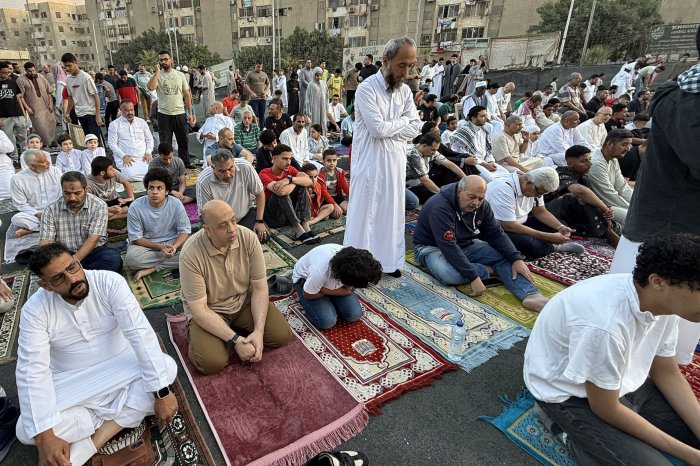
Muslims perform Eid al-Adha prayers at sunrise in Cairo, Egypt, on May 27, 2026. Photo by Ismael Mohamad/UPI | License Photo

Source link

OpenAI names South Korea key partner for AI cyber defense

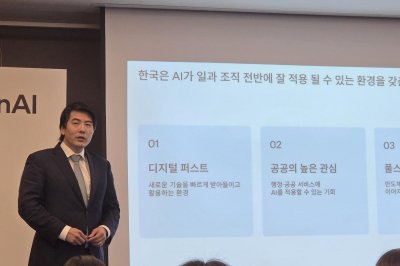
OpenAI Chief Strategy Officer Jason Kwon speaks during a press conference on the Korea Cyber Action Plan in Seoul on Wednesday. Photo by Asia Today

May 27 (Asia Today) — OpenAI said Wednesday it will expand artificial intelligence-based cyber defense cooperation with the South Korean government, public agencies and companies in key industries.

The company announced its Korea Cyber Action Plan during a press conference at the JW Marriott Hotel in Seoul’s Seocho District. The plan is designed to give government agencies, public institutions and companies broader access to OpenAI’s advanced AI cyber models.

Jason Kwon, OpenAI’s chief strategy officer, said AI has entered a third stage as an “intelligence utility,” becoming core infrastructure for the economy and society after earlier phases focused on capability breakthroughs and broader access.

Kwon said South Korea is well positioned to adopt AI because it is a digital-first society that quickly embraces new technologies and has a “full-stack economy” with global semiconductor companies including Samsung Electronics and SK hynix.

“Advanced cyber AI capabilities should not remain in the hands of only a few,” Kwon said. “Korea’s key defenders should be able to use them to strengthen collective security and public safety.”

“Korea is a very important country for OpenAI,” he said. “We hope to become an important partner in Korea’s AI transformation and in strengthening national resilience.”

The Korea Cyber Action Plan is part of Daybreak, OpenAI’s global cybersecurity initiative that aims to build security into systems from the earliest stages of development. OpenAI says Daybreak is designed to help cyber defenders identify threats, generate patches and verify fixes across code and systems.

A key part of the plan is expanding Trusted Access for Cyber, a program that gives verified defensive users access to specialized cyber AI models. OpenAI said in April it was scaling the program to thousands of verified individual defenders and hundreds of teams responsible for protecting critical software.

Kwon said access for the South Korean government to the government version of the program is in its final stage. He said OpenAI is also discussing adoption of the private-sector program with several Korean companies.

Asked about potential misuse of cyber models and data leakage risks, Kwon said OpenAI is controlling risk by granting access only to “trusted defenders” who go through strict verification.

He also said OpenAI supports data residency in South Korea, allowing data to be processed on domestic servers. Public agencies and companies may also choose an option in which data is not stored at all, he said.

Kwon said OpenAI has begun talks with the Korea AI Safety Institute under the Ministry of Science and ICT. He said the company will draw on its experience working with AI safety institutes in the United States and Britain to help South Korea build its own model evaluation capabilities.

Before Wednesday’s announcement, OpenAI had been deepening cooperation with South Korea’s public sector. On May 18, Sasha Baker, OpenAI’s head of national security policy, visited South Korea and demonstrated the company’s latest cyber-focused models to major agencies including the science ministry, the Foreign Ministry, the Interior Ministry, the Financial Services Commission and the National AI Strategy Committee.

On Tuesday, Kwon met with Ryu Je-myung, second vice minister of science and ICT, to discuss AI security cooperation. OpenAI also signed memorandums of understanding with Korea Water Resources Corp. and Korea Technology Finance Corp.

Kwon emphasized the company’s expectations for the Korean market.

“Korea is a country with very favorable conditions to turn AI into national competitiveness,” he said. “Based on ChatGPT, Korea is already one of the top 10 markets globally, and the speed of AI adoption is very fast.”

OpenAI said use of Codex in South Korea is also growing quickly. Weekly active users of ChatGPT Codex in the country have increased tenfold since the beginning of the year, placing South Korea among the top five countries by usage.

More than half of the requests come from non-development work such as document writing, analysis, research and operations, showing the potential for wider enterprise use, the company said.

Kwon said changes in OpenAI’s partnership with Microsoft have made it possible to provide OpenAI API services through a wider range of cloud providers, including Amazon Web Services, and that enterprise growth is expected to accelerate.

On pricing for enterprise services, Kwon said consumer subscriptions and corporate services are different, and that business customers already use contract-based pricing. Over the long term, he said OpenAI aims to provide stronger AI performance at the same cost or lower unit prices so more users can benefit.

— Reported by Asia Today; translated by UPI

© Asia Today. Unauthorized reproduction or redistribution prohibited.

Original Korean report: https://www.asiatoday.co.kr/kn/view.php?key=20260527010008011

Source link

U.S. kills one in latest strike on suspected drug trafficking boat

May 27 (UPI) — The U.S. military has killed another person in its latest strike on a suspected drug-trafficking boat in the Trump administration’s deadly crackdown on alleged narcotics trafficking in interenational waters.

The Tuesday strike was the 58th publicly disclosed by U.S. Southern Command in President Donald Trump‘s monthslong campaign, which has now killed at least 194 people.

SOUTHCOM said three people were aboard the boat and that the U.S. Coast Guard has been notified to conduct search-and-rescue operations.

As with the previous strikes, SOUTHCOM claimed in a statement that “intelligence confirmed the vessel was transiting along known narco-trafficking routes in the Eastern Pacific and was engaged in narco-trafficking operations.”

No evidence has been made public amid the campaign, which began in early September.

A black-and-white aerial video accompanied the SOUTHCOM statement showing a boat racing across the water and then erupting into flames.

SOUTHCOM says the boats are operated by one of 10 drug cartels and gangs that Trump has designated as terrorist organizations. Trump has said the United States is in “armed conflict” with the designated organizations in justifying the use of military force in drug-enforcement operations.

However, his administration has been accused of committing extrajudicial killings with the attacks by numerous legal and human rights organizations, as well as by United Nations experts.

Critics contend that it is unlawful for the Trump administration to use the military for ostensibly law-enforcement operations.

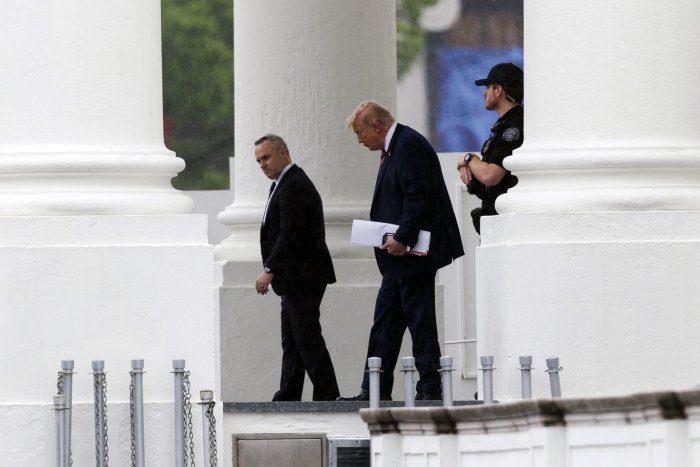
President Donald Trump leaves the White House on Tuesday. Trump is traveling to Walter Reed National Military Medical Center for his annual physical. Photo by Will Oliver/UPI | License Photo


Source link