decide

Here are the big cases the Supreme Court will decide in June

The Supreme Court heads into the final month of its yearly term facing decisions on birthright citizenship, gun rights, transgender athletes and President Trump’s power over independent agencies.

Unlike in years past, the term’s most significant rulings were not left for the last week in June.

The court dealt Trump a major defeat in February by striking down his sweeping worldwide tariffs. The president is likely to suffer a second defeat when the justices reject his plan to revise the citizenship laws via an executive order.

Republicans won when the court struck down a Louisiana congressional district that favored a Black Democrat.

That decision has already shifted several congressional districts toward the GOP, but its greatest impact will be seen in 2028 and 2030.

Republicans are likely to prevail in two other pending cases.

One would free party committees to raise and spend more money to support their candidates. A second would change state laws to bar counting of mail ballots that arrive after election day.

The justices have 26 cases waiting to be decided before they go on a summer recess. Here are the major cases due for decision:

Trump and birthright citizenship

Does the 14th Amendment of 1868 mean what it says about who is a citizen?

It declares: “All persons born or naturalized in the United States and subject to the jurisdiction thereof are citizens of the United States.”

The Supreme Court upheld that understanding in 1898, ruling that Wong Kim Ark, who was born to Chinese parents in San Francisco, was a U.S. citizen at birth. Congress adopted birthright citizenship in the Immigration and Nationality Acts of 1940 and 1952.

But on his first day back in the White House, Trump issued an executive order to deny citizenship to the newborns of parents who in the country unlawfully or temporarily on a student, work or tourist visa.

Judges blocked the order from taking effect, and in April, the justices gave a skeptical hearing to Trump’s lawyers as the president sat in the gallery.

The best outcome for Trump would be a ruling that rejects his executive order based on U.S. immigration law alone. Although a defeat, that could in theory permit Congress to revise the law and deny citizenship to the newborns of so-called “birth tourists.” (Trump vs. Barbara)

Guns and drugs

Can the government make it a crime for “habitual users of unlawful drugs” to have a gun, or does that violate 2nd Amendment rights?

Since 1968, federal law has prohibited gun possession by anyone who is an “unlawful user of or addicted to any controlled substance.”

The 5th Circuit Court of Appeals in a Texas case struck down this provision as unconstitutional, except for someone who is “under an impairing influence” of drugs at the time of his arrest.

The Trump administration appealed and urged the Supreme Court to uphold the law against “habitual users of unlawful drugs,” including regular users of marijuana. (U.S. vs. Hemani)

In a second gun rights case, the court will decide whether Hawaii, California and three other states led by Democrats may forbid licensed gun owners from carrying a firearm into stores or private businesses open to the public unless they have the “express authorization” of the owners. (Wolford vs. Lopez)

Transgender athletes and school sports

Can states maintain separate sports teams for boys and girls “based on biological sex determined at birth” or does excluding transgender girls violate the Title IX law or the Constitution’s guarantee of equal protection?

The justices heard appeals from West Virginia and Idaho after lower courts ruled they had discriminated against transgender girls, and most of them sounded ready to rule for the states.

The only question was whether the court will rule narrowly to uphold laws in the red states or go further to decide how Title IX applies nationwide. (West Virginia vs. B.P.J. and Little vs. Hecox)

Trump and independent agencies

Can the president fire the leaders of special agencies who were given a fixed term by Congress?

For most of American history, Congress created new boards or commissions with a specific mission, such as regulating railroad rates in the 1880s or nuclear power in the 1970s. By law, these agencies are led by a bipartisan board of experts who had a fixed term and could be fired only for cause.

But Trump and the court’s conservatives believe the president has the executive authority to control the government and to fire agency officials — but with one exception. The majority wants to preserve the independence of the Federal Reserve Board. (Trump vs. Slaughter)

Separately, the court will rule on whether Trump had the power to fire Fed Governor Lisa Cook for cause. He alleged she engaged in mortgage fraud and dismissed her in a social media post. The justices blocked her removal and sounded ready to rule she deserved due process of law and a full hearing to contest the allegations. (Trump vs. Cook)

Temporary Protected Status

Can the Trump administration cancel legal protection for more than 300,000 Haitians and Syrians who are living and working in this country?

In 1990, Congress created this protected status for foreign nationals who could not return home safely because of armed conflicts or natural disasters.

The Obama administration extended protection to Haitians and Syrians. Last year, Trump’s then-Homeland Security Secretary Kristi Noem sought to terminate it, but judges blocked her orders because it was still dangerous and unsafe in those countries.

Before the Supreme Court, Trump’s lawyers argued the law forbids “judicial review” of these executive decisions. (Mullin vs. Doe)

Campaign funds and political parties

Do the 50-year-old limits on how much political party committees can raise and spend to directly support their candidates violate the 1st Amendment?

During the Watergate era, Congress adopted limits on money in political campaigns, but the court has struck down the spending limits on free speech grounds. Left standing were the limits on direct contributions to candidates, including from political parties.

Republicans led by then-Sen. JD Vance sued, arguing the party limits were outdated and unwise in an era when super PACs are free to spend huge sums on campaigns. (National Republican Senatorial Committee vs. FEC)

The court also will rule on the GOP’s bid to strike down laws in California and most states that allow for counting mail ballots that were postmarked by election day but arrive a few days later. (Watson vs. Republican National Committee)

Source link

Trump holds Situation Room meeting to decide on Iran deal

A framework agreement to end the U.S. war with Iran is all but settled, pending sign-off from the presidents of the two warring sides, President Trump said Friday, projecting optimism that a deal could finally be at hand.

Yet doubt cast a shadow over the diplomatic process entering the weekend as Trump faced a politically fraught decision to enter an agreement that would invariably require significant concessions to Tehran.

The negotiations have faced severe headwinds in recent days, with both sides accusing the other of violating a fragile ceasefire that has largely stopped the fighting since April.

On his Truth Social site, Trump said he had summoned his top aides to the White House Situation Room to decide on the deal.

The agreement would see an end to the U.S. naval blockade on Iranian ports and the removal of Iranian mines from the Strait of Hormuz, an international waterway through which 20% of the world’s energy supply passes each day. The strait, Trump wrote, will reopen with “no tolls” for “unrestricted shipping traffic, in both directions.”

And “Iran must agree that they will never have a Nuclear Weapon or Bomb,” Trump wrote, noting that Iran’s stockpile of highly enriched uranium, the key ingredient for nuclear weapons, “will be unearthed by the United States (which, it is agreed, is the only Country, along with China, with the mechanical capability of doing so!), in close coordination and conjunction with the Islamic Republic of Iran, plus the International Atomic Energy Agency, and DESTROYED.”

“No money will be exchanged, until further notice,” he added.

Treasury Secretary Scott Bessent also said the deal would require Iran to disavow the continuation of its domestic nuclear program — a diplomatic feat never before achieved throughout a quarter century of international negotiations over Iran’s nuclear work.

It is unclear whether Tehran would go that far. And Iran’s negotiators expressed defiance on Friday, stating that there was “no trust in guarantees or words” from the American side.

“No step will be taken before the other side acts first,” said Mohammad Bagher Ghalibaf, the speaker of Iran’s Parliament. “We do not gain concessions through dialogue, but through missiles.”

It remains unclear when the Trump administration would ease sanctions on Iran, how extensive that relief would be, or what form it would take — questions that fueled Republican criticism of the Obama-era nuclear deal more than a decade ago.

The working diplomatic document would formally extend the existing ceasefire for 60 days, allowing for a more detailed negotiation to take place over Iran’s nuclear program. But the truce as it currently stands is on perilous ground. Iran launched a ballistic missile on Thursday at Kuwait, a close U.S. ally, after American forces took “defensive” actions against Iranian missile launchers and mine laying boats it had launched in the strait.

The war has proven historically unpopular with the American public, and has seen oil prices soar since the U.S. military, in partnership with Israel, launched its first strikes against Iran in February.

Bessent said he is hopeful that oil prices would drop quickly once an agreement is signed. But industry analysts say the effects of the war on the oil market could last for months, if not years, with the stability of traffic through the Strait of Hormuz now in question for commercial shippers.

While oil has dropped to under $100 a barrel, markets appeared skittish on Friday over the prospects for a deal, with mixed messages appearing to emerge out of the region.

It is also unclear whether a U.S. agreement with Iran would in any way bind Israel’s hands in its military operations, either in Iran or in Lebanon, where an Iranian proxy militia, Hezbollah, has vowed to keep up the fight.

Israel has ramped up strikes against Hezbollah targets in recent days, jeopardizing a delicate ceasefire negotiated with the Lebanese government, a deal encouraged by the Trump administration in order to grease the wheels for its talks with Tehran.

Trump has been uncharacteristically silent on the prospects of an agreement in recent days, expressing cautious optimism in limited exchanges with reporters.

“It’s hard to say exactly when or if the president’s going to sign,” Vice President JD Vance, who has led the U.S. diplomatic team, told reporters, noting that “the nuclear stuff” is still subject to negotiation. “We’re going back and forth on a couple of language points.”

“I do think that we’ve made a lot of progress here,” Vance added. “Hopefully we’ll continue to make progress, and the president will be in a position where he can endorse the agreement. But obviously, that’s still TBD.”

Source link

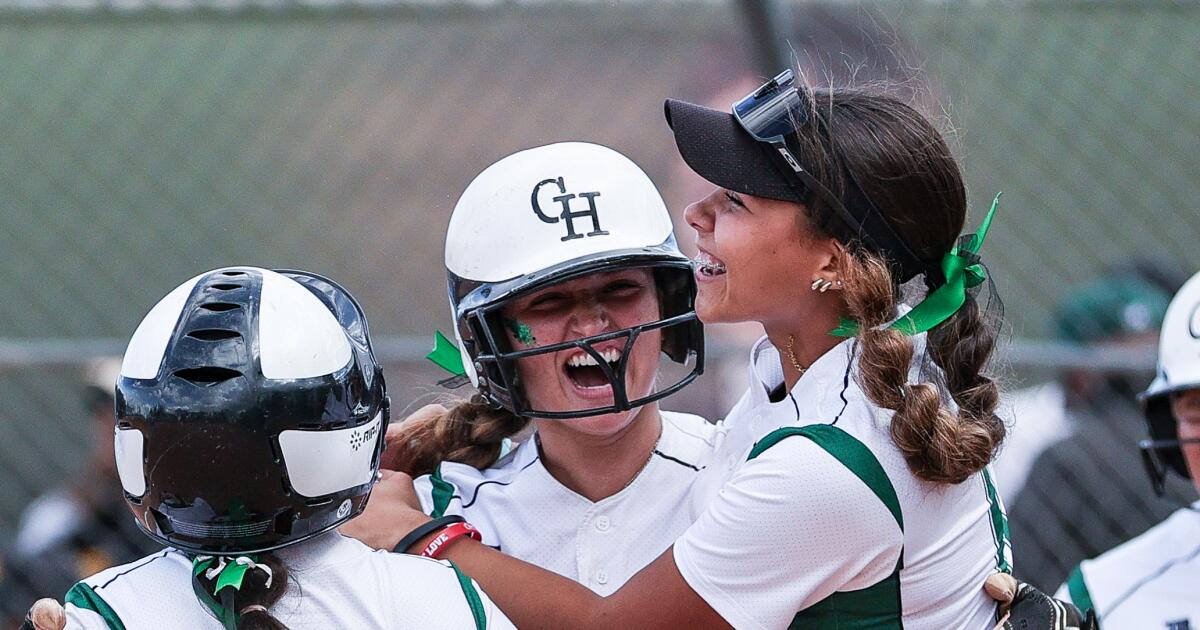
Granada Hills, Carson advance to a fourth straight final meeting to decide City Section softball title

The Granada Hills and Carson softball programs know each other so well they might as well put on their MaxPreps schedule before the season a date for their annual game to decide the City Section Open Division championship.

It’s happening for a fourth consecutive season Friday at 6:30 p.m. at Legacy High in South Gate. Last season, Granada Hills ended a three-game losing streak to the Colts.

On Wednesday, both teams won their semifinal games. Granada Hills’ No. 1 and No. 2 batters in the lineup, Elysse Diaz and Zoe Justman, had big games in a 12-9 win over San Pedro. They combined to go five for eight with five RBIs. Justman had a home run. Gina Evangelista hit an inside-the-park grand slam.

San Pedro scored five runs in the seventh to give the Highlanders a little scare.

At Carson, the Colts came away with a 12-2 semifinal win over Birmingham. Sophomore Anaiyah Popoalii had a home run, double and three RBIs. Olivia Lomeli went three for four with three RBIs. Pitcher Isabella Campos threw a complete game.

Source link

Champions League semi-finals: Ranking top 10 players who could decide ties

3. Julian Alvarez (Atletico Madrid)

Atletico Madrid’s trip to Arsenal in the league phase feels a long time ago, but it will stick in their mind not just for the four goals they shipped, but for their struggles in attack.

Atletico produced only 0.32 xG from open play in that defeat and managed only one shot on target, so, if they are to take anything against Arsenal this time around, getting Julian Alvarez in the game will be key.

The Argentina forward has scored nine goals in the competition this season, more than any Atletico player had managed in a Champions League campaign.

He’s also a menace defending from the front, with a mammoth 853 high-intensity pressures – more than anyone else this season. That’s 70 per game on average.

That work ethic, ruthlessness in front of goal and the wizardry to bend a free-kick into the top corner, as Barcelona found out, make the 26-year-old vital to Atletico’s chances of progressing.

Source link

Virginia redistricting vote: What polls suggest and what voters will decide | US Midterm Elections 2026 News

Voters in Virginia head to the polls on Tuesday to decide on a measure that could redraw the state’s congressional map and potentially shift the balance of power in Washington.

Major political figures, including former President Barack Obama and House of Representatives Speaker Mike Johnson, have weighed in on the high-stakes vote, with nearly $100m spent on campaigning around it.

Part of a broader redistricting battle that began in Texas and spread nationwide, the vote may be the Democrats’ last chance this year to gain seats by changing district maps. The vote comes about six months before the 2026 midterm elections.

Here is what we know:

What is Virginia voting on?

Virginia currently sends 11 members to the House. At the moment, six of them are Democrats, and five are Republicans, reflecting the state’s balance.

Democrats now want to redraw the map to favour them in a way that could help them win up to 10 of the 11 seats. Under the proposal, most districts would be safely Democratic or lean towards the party, with only one strongly Republican.

A breakdown would be:

  • Eight districts would be safely Democratic
  • Two would be competitive but lean Democratic
  • Only one would be safely Republican

If approved, this could give the Democrats several extra seats in Congress, helping them win back or strengthen control of the House in Washington, where majorities are often decided by just a few seats.

That would be a big political shift for the state, which was once closely contested but has become more Democratic-leaning in recent years.

Supporters depart a campaign rally against Virginia Democrats' proposed state redistricting constitutional amendment
Supporters depart a campaign rally against Virginia Democrats’ proposed state redistricting constitutional amendment [FILE: Ken Cedeno/Reuters]

How would the vote work?

Voters in Virginia can cast their ballots either early or on Election Day.

Polling stations will be open across the state on Tuesday:

  • Polls open at 10:00 GMT
  • Polls close at 23:00 GMT

Votes will be counted after polls close, with early results expected later that evening and fuller results overnight or the next day.

What are voters being asked to decide?

The proposed constitutional amendment is the only statewide contest on the ballot.

It reads:

“Should the Constitution of Virginia be amended to allow the General Assembly to temporarily adopt new congressional districts to restore fairness in the upcoming elections, while ensuring Virginia’s standard redistricting process resumes for all future redistricting after the 2030 census?”

A “yes” vote would support allowing the General Assembly to redraw congressional districts before the midterms.

A “no” vote would leave current boundaries unchanged until the next round of regularly scheduled redistricting after the 2030 census.

What do the latest polls suggest?

The result is expected to be close.

A recent poll by State Navigate, a nonpartisan research group, suggests a small lead for supporters, with about 53 percent in favour and 47 percent against.

Why do district lines matter so much?

District lines decide how voters are grouped, which can shape who wins elections.

Moving the lines can make a district more favourable to a Democratic or Republican win, by adding or removing neighbourhoods and communities that lean one way or the other.

It can turn a close race into a safe seat, or the other way around. It affects which communities are kept together and who represents them.

This process, often called gerrymandering, allows parties to draw maps that benefit them.

In a closely divided state like Virginia, even small changes to the map can shift several seats and influence who holds power in Congress.

A 2023 study by Harvard University researchers found that gerrymandering often creates “safe” seats for politicians, meaning their races are less competitive.

In turn, those politicians become less responsive to the needs of their constituents, who become discouraged about voting as a result.

Supporters pray during a campaign rally against Virginia Democrats' proposed state redistricting constitutional amendment
Supporters pray during a campaign rally against Virginia Democrats’ proposed state redistricting constitutional amendment [Ken Cedeno/Reuters]

When could new maps take effect?

If approved, the new map could be used as early as the next election cycle, including the upcoming midterms, depending on legal approval.

However, the plan could face legal challenges. Critics have questioned the ballot wording and the process used by lawmakers.

The Virginia Supreme Court has allowed the vote to go ahead while reviewing those concerns.

If it later finds that rules were broken, the results could be overturned, and the current maps would remain.

Why this vote could shape power in Washington?

A handful of seats could decide control of the US House.

Republicans currently hold a narrow 218–213 majority, but Democrats are seen as competitive heading into the midterms.

Political leaders have underscored the stakes.

Hakeem Jeffries, the Democratic Party’s leader in the House, has pointed to Virginia as a crucial battleground, while Mike Johnson has said the result will be closely watched across the country.

U.S. House Speaker Mike Johnson (R-LA) speaks during a campaign rally
US House Speaker Mike Johnson (R-LA) speaks during a campaign rally [Reuters]

What it means to control the US House

The party with the majority (more seats) in Congress can:

  • Set the agenda, deciding which bills are brought up for debate
  • Control committees, including investigations and hearings
  • Pass legislation more easily (if they stay united)
  • Block bills from the minority party.

The majority party also chooses the speaker of the House, who has major influence over what reaches the floor.

Where else has this happened?

Virginia’s redistricting vote is part of a larger political battle playing out in the US. Republicans in Texas, encouraged by Donald Trump, have redrawn district maps to strengthen their advantage, prompting similar efforts in other states.

In rare cases, voters have been asked to decide directly, including in California last year and now in Virginia.

In California, voters backed the changes despite concerns about fairness. Now it’s Virginia’s turn to decide.

What Democrats are saying, and why?

Democrats argue the plan is a response to Republican actions in other states, not just a power grab.

Leaders like Obama had long opposed gerrymandering in principle, but have now backed the Virginia move, even releasing a video asking voters to go out and vote for the constitutional amendment.

Source link