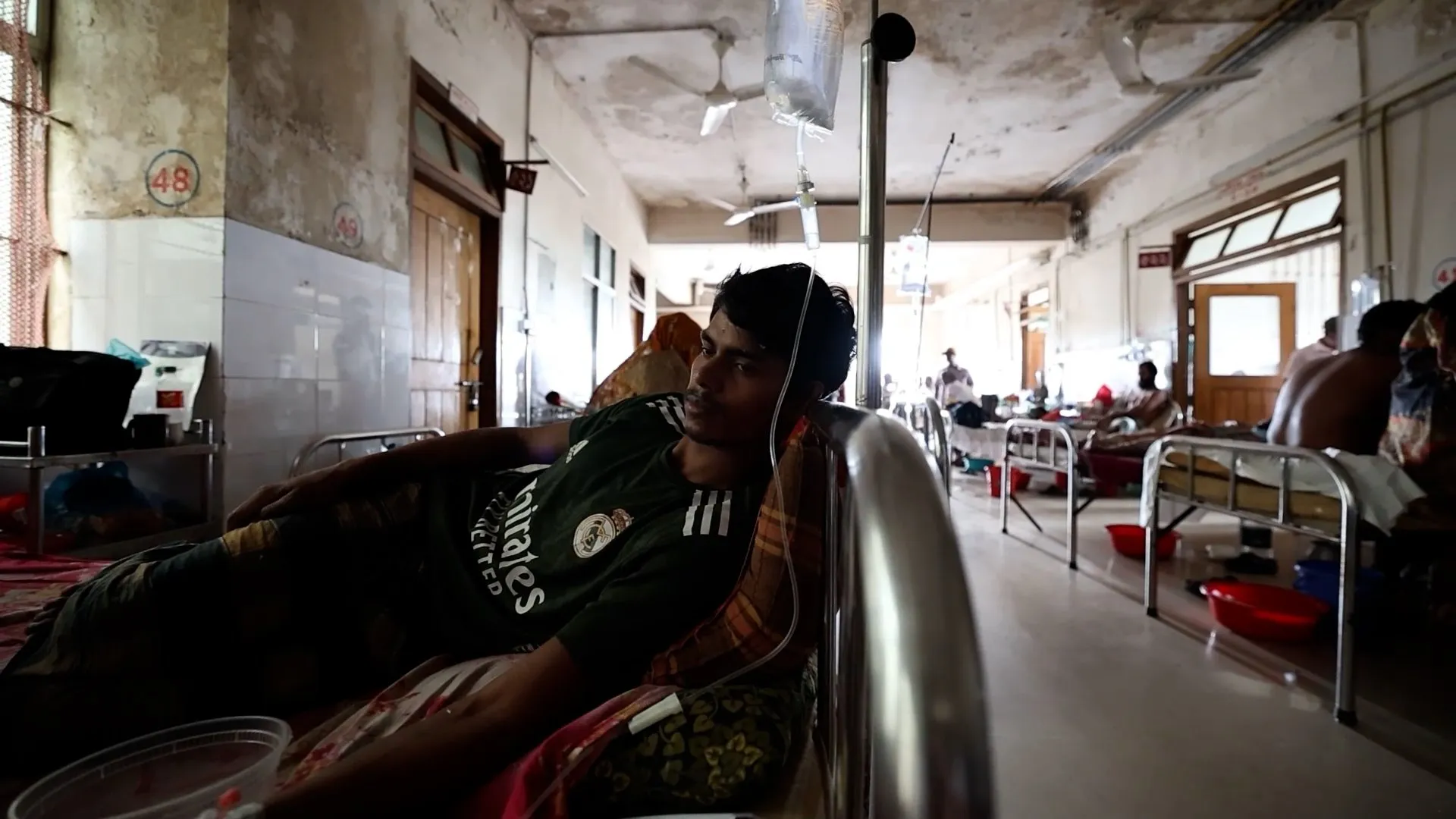
Bangladesh’s health authorities report that at least 233 people have died from the mosquito-borne illness disease dengue fever. Thousands of cases have been recorded across the country since the start of 2026.
Marvin Reid can’t say how many pedestrians he’s seen get hit while trying to brave the North Hollywood intersection of Magnolia Boulevard and Tujunga Avenue. He gave up keeping count long ago.
One afternoon last spring, he watched a man get run over while walking toward a 7-Eleven on the corner. Fortunately, the man popped to his feet “like nothing ever happened” and hustled into the store, Reid said. A week or two prior, he said, an out-of-control motorist nearly plowed into the statue of Amelia Earhart that sits next to a library bearing the famous aviator’s name.
“This is really a bad spot,” said Reid, who has helped run a Jamaican food pop-up at the busy street corner for the past five years. “It doesn’t matter if it’s an old lady crossing the street with a walker.”
The number of Angelenos who die in traffic crashes now regularly outpaces those killed by homicide. From 2016 to 2023, the annual traffic death toll rose nearly 29% overall, and pedestrian deaths jumped roughly 54%. Fatal crashes fell slightly last year, but deaths still exceeded 300 in each of the last three years.
The city is rolling out 125 speed cameras in school zones, known street-racing corridors and places where speeding has contributed to a high rate of collisions — including Reid’s intersection.
But for him, the cameras aren’t a replacement for police traffic enforcement, which he said seems virtually nonexistent.
Even though LAPD squad cars are posted up outside the library “everyday,” he says, they rarely do anything about the drivers who come careening off the exit ramps from the nearby 170 Freeway.
Similar complaints are being echoed around the city. Historically, Los Angeles — like other places across the U.S. — has relied on police stops to produce road safety. But in recent years, public pressure has compelled city leaders to think more critically about whether enforcement can continue without the historical harms that has come along with it.
LAPD data show the department is far less proactive than it used to be.
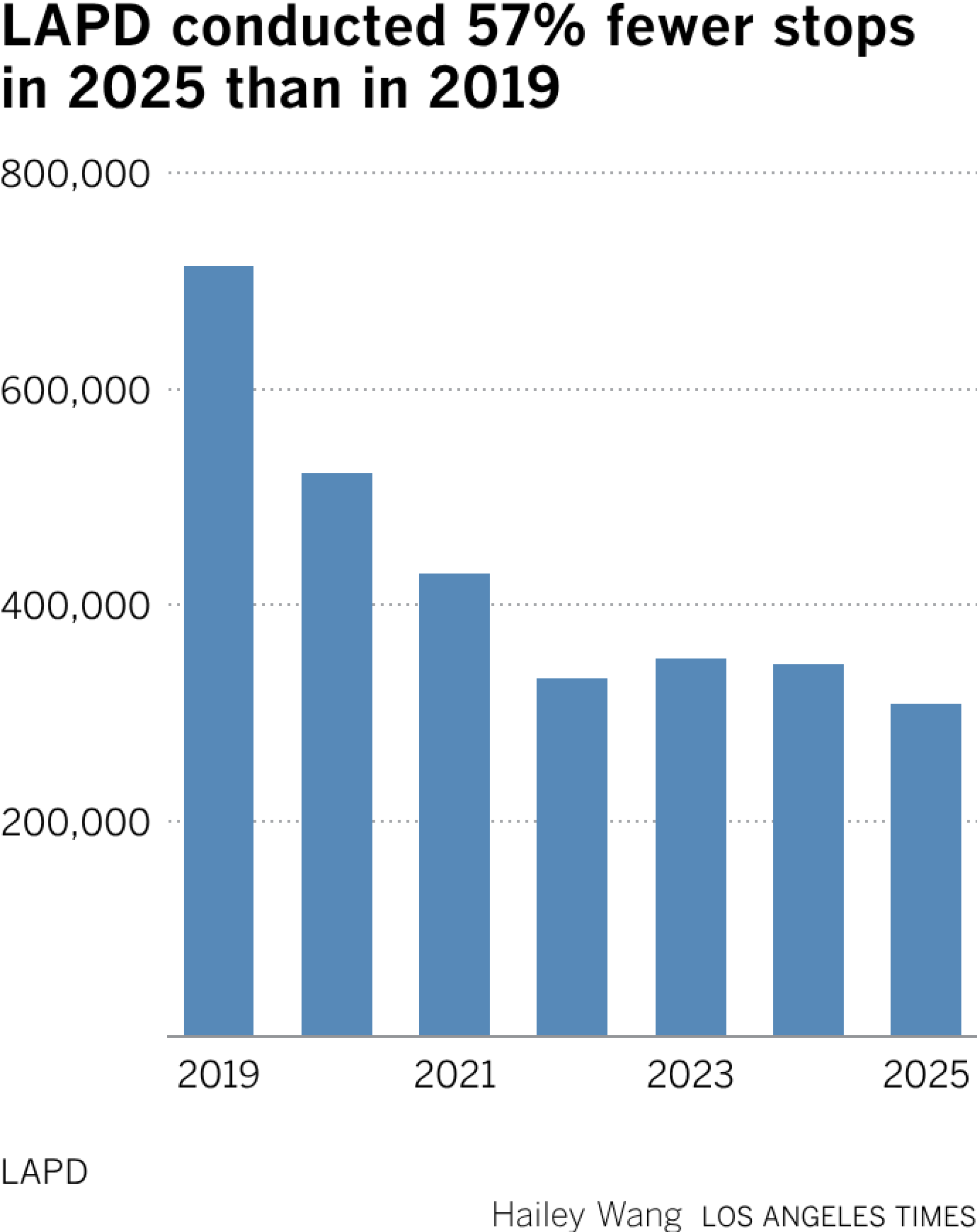
In 2019, LAPD officers made about 713,000 stops across the city; by 2025, that number had decreased to roughly 308,000 — a roughly 57% decline. A Times analysis of police stop data found that the drop-off was especially pronounced in the Central, West Valley, 77th Street and Southeast police divisions.
In some ways, the decline in stops is unsurprising. Other large U.S. cities have seen similar changes in enforcement strategies by police since the pandemic. As the department continues to shrink, LAPD commanders say they have fewer resources to devote to traffic duty. Officials have been under pressure to curb the use of so-called “pretext stops,” in which officers use a minor violation — a broken turn signal, say, or a cracked windshield — as justification to stop someone in order to investigate whether a more serious crime has occurred.
The largest declines were in the Central and 77th Street areas
Change in police stops, 2019 to 2025
LAPD
Hailey Wang LOS ANGELES TIMES
Reform activists and some city leaders argue the stops are fishing expeditions that lead to police abuses — while failing to deliver safer streets.
The practice of pulling over random vehicles, often based on little more than a hunch, has been a cornerstone of the city’s crime-fighting strategy for decades. The tactic is especially prevalent among the department’s elite Metropolitan Division and anti-gang units, several of which have come under investigation in recent years for failing to document the stops and improper searches.
Since 2019, when a Times investigation found significant racial disparities in LAPD crime suppression tactics, officials have slowed — but never abandoned — the practice of flooding neighborhoods with tactical officers to pull people over and search their vehicles.
Four years later, stops for minor violations began dropping again after LAPD overhauled its policies to limit the circumstances under which officers can make pretext stops, joining law enforcement agencies in cities like Philadelphia, Seattle and Berkeley, Calif.
Yet a report published last year found that officers are still disproportionately targeting Black and Latino drivers.
LAPD Chief Jim McDonnell and other department leaders have fought against more restrictions, arguing they risk losing an essential weapon against serious crime.
But in May, the Los Angeles City Council passed a measure urging the Police Commission, the LAPD’s policy-making body, to further limit arbitrary pull-overs for non-moving traffic violations.
While LAPD officials had acknowledged issues in a handful of police divisions, the latest audit found that gang units citywide routinely flouted the department’s rules on pretext stops, including by often failing to obtain proper consent to search the vehicles they stopped. The inspector general’s office also found that gang officers didn’t always turn on their body-worn or dashboard cameras as required during these encounters and at times failed to properly log who they were stopping — resulting in an undercount of “both the number of detentions and the enforcement actions taken,” the report said.
The review, based on a sample of 300 stops as well as interviews with current and former gang officers, also highlighted ongoing confusion about what the department expects its officers to do when pulling someone over.
The findings of the second report — which reviewed pretext stops by officers from other units in January — are expected to be presented at an upcoming commission meeting.
The Los Angeles Police Protective League, the union for rank-and-file officers, and other proponents of pretext stops argue that elected leaders don’t grasp the consequences of doing away with the tactic, which the U.S. Supreme Court has deemed lawful.
Reform advocates have fought to deploy unarmed civilians instead of LAPD officers for traffic enforcement — as the city has already started doing for certain mental health-related calls — but the union has warned that the work is too dangerous. A state bill that would have allowed trained civilian workers to make traffic stops failed to make it through the state assembly.
With the death toll from speeding on the rise, more enforcement is needed, not less, department leaders say. The city, they argue, can’t afford to wait on alternative programs that require study, money and public buy-in that could take years.
Amid the debate over how to proceed, LAPD enforcement hasn’t vanished completely.
Even though the department no longer dispatches officers to the scenes of minor accidents, LAPD statistics show that enforcement the department’s 308-member traffic bureau has gone up. As of July, the number of traffic tickets issued had climbed 44% from the same time last year — increasing to more than 14,600 from around 10,100. Citations for impaired driving have also risen, and the department continues to crack down on street takeovers.
Still, progress toward new, non-police approaches to traffic enforcement has been frustratingly slow in Los Angeles, advocates say.
Advocates have pointed to mounting research in other cities that showed road improvements along high-injury street corridors were more effective than police at changing driver behaviors, ultimately reducing the number of traffic-related deaths and serious injuries more than the threat of being ticketed.
Supporters of so-called “self-enforcing” roads say narrowing lanes can lead to a considerable decline in crashes as drivers reduce their speed and move more cautiously than when the road is less wide. Such changes also reclaim space for protected bike lanes, public transit lines, or safer walkways — after long prioritizing convenience for cars, advocates say.
Car accidents are dangerous for everyone involved, but they have become even more hazardous for pedestrians and cyclists.
Experts cite speeding and cellphone distractions as two of the biggest problems.
Another factor is the proliferation of larger vehicles — a phenomenon known as “autobesity” — which have bigger blind spots and more likely to seriously injure a pedestrian or bicyclist.
Andres Ramirez, executive director for the transportation advocacy nonprofit People for Mobility Justice, said he’s cautiously optimism that the mayor’s promise of a “No Car” 2028 Olympic Games will help fast-track some of the most pressing road safety projects.
“The streets needs to be a lot safer for pedestrians, for bicyclists, different modes,” Ramirez said. “The most obvious way is ensuring that infrastructure projects are prioritized in communities that have long been ignored.”
Pennsylvania has asked the United States Centers for Disease Control and Prevention (CDC) for help containing an expanding measles outbreak that has seen several people die, but says it will withdraw the request unless the federal agency recognises four measles-associated deaths reported by the state.
The CDC, however, said it has not been properly notified of any such request.
Recommended Stories
list of 3 itemsend of list
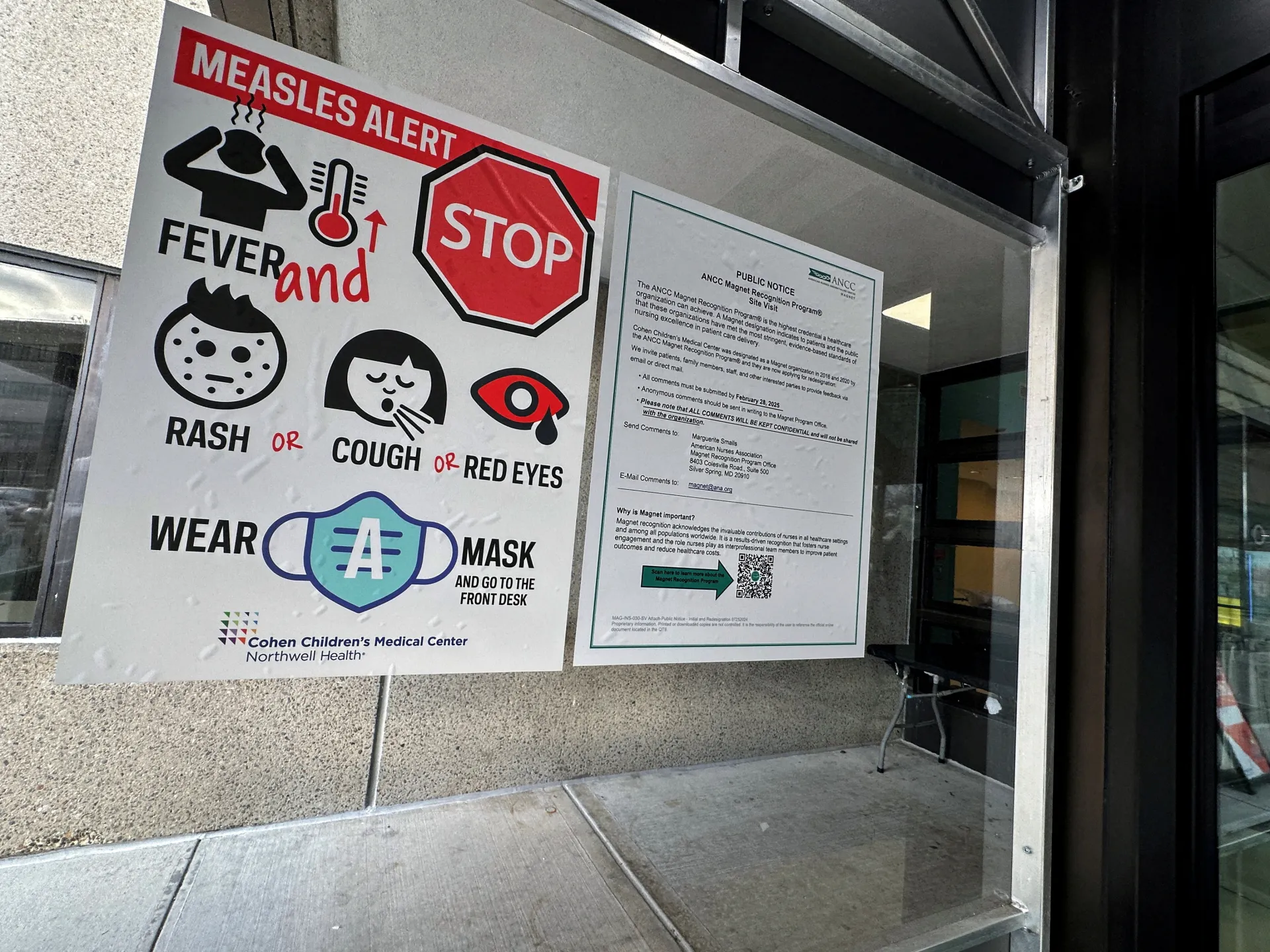
The US is currently seeing the worst measles outbreak in the country since 1991, with several deaths over the last couple of years. Measles was declared eliminated in the US in 2000, but has made a comeback in recent years, which some have linked to a rise in vaccine scepticism. The US state of Pennsylvania has been hit especially hard.
In a letter sent to CDC Director Erica Schwartz on Wednesday, Pennsylvania Health Secretary Debra Bogen said the state had begun the process of requesting emergency assistance from the CDC, known as an Epi-Aid.
“The CDC’s choice not to publicly recognize the deaths undermines our response,” Bogen wrote. “For this reason, if CDC is unable to transparently and accurately communicate information about those measles-associated deaths, the Department will respectfully rescind our request for a CDC Epi-Aid.”
However, in a statement to Al Jazeera, Grace Davis Jamison, press secretary for the US Department of Health and Human Services (HHS), said that the CDC had not received Pennsylvania’s request through its normal channels and that federal outbreak assistance was separate from how the agency tabulates deaths.
“CDC will not allow [Pennsylvania Democratic] Governor [Josh] Shapiro to politicize this process. We owe the American people accurate, consistent, and transparent public health information,” Jamison said. “CDC will not submit to political blackmail that conditions critical public health assistance. The people of Pennsylvania should never be used as leverage in a political dispute over how deaths are classified.”
Disagreement grows as Pennsylvania’s measles outbreak spreads
The dispute over the deaths began in August, when Pennsylvania reported that two unvaccinated people died of measles in Lancaster County, which is located in the South Central part of the state. Lancaster is considered the centre of Pennsylvania Dutch Country and home to the nation’s oldest Amish and Mennonite communities. Both communities have under-vaccinated populations.
The CDC initially included the deaths in its national tally, but subsequently removed them after Health Secretary Robert F Kennedy Jr questioned whether measles had caused or contributed to the fatalities. The agency said at the time that available information did not establish whether measles caused or contributed to the deaths.
Pennsylvania continued to stand by its determination.
The outbreak has spread well beyond its initial epicentre in Lancaster County. On September 13, a county coroner reported that a 40-year-old woman had died from complications associated with measles. The state later confirmed the death as measles-associated and announced two additional deaths on September 15. All four people were unvaccinated, according to the state.
The state reported 393 cases across 28 counties when the first two deaths were announced on August 25. Pennsylvania now reports 731 confirmed cases across 38 counties and 141 hospitalisations. Of those reported cases, only four people, or less than one percent, are vaccinated.
What are officials arguing about?
The disagreement between Pennsylvania and the CDC centres on the distinction between a “measles-associated” death versus a death “caused” by measles. Pennsylvania uses “measles-associated” under its state surveillance definition, while HHS said it is working with the Council of State and Territorial Epidemiologists to establish a standardised definition for measles deaths.
Infectious disease experts warn that the dispute over how to classify the deaths puts the CDC at odds with a long-standing approach to tracking the consequences of measles. Matthew Ferrari, director of Pennsylvania State University’s Center for Infectious Disease Dynamics, told Al Jazeera that “measles-associated” death has long been a standard used by the World Health Organization and CDC.
“It’s the most useful distinction because it is a case that could have been prevented by a measles vaccination, or by early detection and isolation,” Ferrari said. “Measles is severely immunocompromising, so it is very often a secondary infection that is the ultimate cause of death.”
Experts say the CDC’s dispute with Pennsylvania risks distracting from efforts to contain the outbreak. Dr Andrew Pavia, spokesperson for the Infectious Diseases Society of America and professor at the University of Utah, told Al Jazeera the distinction should not be controversial.
“The impact, though, is confusion for the public and erosion of trust in the ability of CDC staff to communicate to the public without political interference,” Pavia said.
HHS said federal outbreak assistance and national mortality reporting are separate processes and rejected the idea that the two should be linked.
How would an Epi-Aid help Pennsylvania?
An Epi-Aid is a CDC mechanism for providing rapid, short-term assistance during an urgent public health problem. The CDC says Epi-Aids generally last one to three weeks, during which they deploy Epidemic Intelligence Service officers to analyse epidemiological data, evaluate surveillance systems, and recommend measures to control and prevent the spread of disease.
The requesting health authority retains overall leadership of the investigation, while CDC personnel provide technical assistance, including epidemiological expertise and access to laboratory resources.
“The most important thing for an effective response is communication and trust,” Ferrari said. “It is important for all partners to agree on the foundational elements of the problem and the metrics for evaluating the severity of the problem.”