Former Liverpool goalkeeper Caoimhin Kelleher says the death of Diogo Jota means performances and results at his old club are not quite as important this season.
Jota scored 65 goals in 182 appearances for the Reds, helping them win the FA Cup and League Cup in 2022 and the Premier League title last season.
Liverpool are currently sixth in the Premier League – 14 points behind table-topping Arsenal – in what has been a testing season for the club on the pitch.
The 27-year-old said that for his former club it was “more about them personally and mentally” than anything else this season.
“Obviously, football is a massive sport and people have an opinion, which is natural. People expect you to move on quite quickly, and I don’t think that’s the case,” Kelleher said.
“I find it a bit strange and a bit difficult when I hear people speaking about the players at Liverpool and the performances, because I don’t think this season is even important from a football aspect for them.”
Those remarks came in the wake of an emotional post-match interview from Liverpool left-back Andrew Robertson after Scotland had qualified for the World Cup.
Robertson said he had “been in bits” because he “couldn’t get my mate Diogo Jota out of my head” in the build up to a thrilling victory over Denmark which clinched their spot at the tournament.
Kelleher, who made 67 appearances in all competitions for Liverpool, having joined the club’s academy in 2015, said coming to terms with Jota’s death had been “a bit easier” since he was no longer at Anfield.
“I stay in touch with some of the guys there, I have a lot of good friends there. It’s a very difficult time for them, a difficult season, with circumstances that people probably aren’t taking into account too much,” explained Kelleher.
“But it’s probably been a bit easier for me, being away from it, and not being in such close proximity to it every day.
“From an individual aspect, for me to leave and play first-team football was obviously right, never mind the tragedy that happened. “
MINNEAPOLIS — The sites of the three consequential deaths span just over two miles of south Minneapolis. George Floyd in 2020, Renee Good and Alex Pretti last month.
The death of Floyd, after a police officer dug a knee into his neck for more than nine minutes, was a catalyst for the nationwide Black Lives Matter protests that sought law enforcement reforms and accountability.
Those of Good and Pretti, shot by federal immigration agents, have similarly sparked demands that federal agents to stop using violence in pursuit of President Trump’s mass deportation effort.
The sites are close enough to walk in an hour. So, on Sunday, I did.
Mementos, drawings, signs and flowers are covered by fresh snow outside of Unity Foods where George Floyd was killed in Minneapolis.
George Floyd
Floyd was killed just outside of Cup Foods, since renamed Unity Foods. On a wall outside the convenience store, Esther Osayande’s painting “Sankofa” depicts a bird with its head turned back, surrounded by flames.
The description says it is a metaphorical symbol used by the Akan people of Ghana to express “the importance of reaching back to knowledge gained in the past and bringing it into the present.”
“Sankofa tells us that we as a people can rise above conflicts of ego and treat all beings we meet as brothers and sisters,” it states.
On the same wall, someone spray painted, “My cries are 4 humanity.”
The memorial, known locally as George Floyd Square, encompasses a nearby covered bus stop, where a visitor had written that “race is a made up idea to keep ppl down.” Against the shelter glass, someone had taped a typed notice of emergency. It lists “martyrs” killed by authorities — Good, Floyd, Philando Castile and others before them.
“This ICE operation is somehow simpler AND more malicious than the kill count accumulated by our PD,” the notice reads. “This is slave catching. This is gestapo.”
A memorial to Renee Good at the location where she was shot in Minneapolis.
Nearly six years after Floyd’s death, some of the memorial art has begun to fade under the sun. A metal archway gives way to a plastic A-frame board describing Floyd and the global movement that his murder inspired.
“George’s name has become a rallying cry for those who believe in a better future, one where all people are treated with dignity and respect,” it reads.
Few people gathered at the memorial Sunday morning, but real and fake flowers, blanketed by snow, covered the site. A family with children got out of an SUV and walked around. A young photographer snapped some shots. And a couple took their time weaving through the makeshift garden.
Floyd’s cousin Paris Stevens is co-chair of Rise and Remember, which preserves the memorial and leads tours of the area. She said the organization wanted to give the community a safe space to grieve, “because everybody has lost someone.”
The thread linking the deaths of her cousin, Good and Pretti, Stevens said, is that they all could have been prevented. The fact that people have begun to visit all three sites is a sign of how unjust killings bring out the humanity in people, she said.
“How do we care for one another in times of need?” she asked. The answer, in part, is found in the artwork, writings and flowers at the three memorials.
“For this to happen, it’s like we’re picking up the ball and running again,” she said. “We’ve been here before and we know what to do.”
A memorial for Renee Good marks the location the 37-year-old woman was shot by ICE agent Jonathan Ross on Portland Avenue near East 34th Street in Minneapolis.
Renee Good
Portland Avenue, where Good died less than a mile from Floyd, is lined with Craftsman-style homes. Many displayed “ICE OUT” or “Black Lives Matter” signs — or both — in their front windows.
One window posed a question: “How many weren’t filmed?”
Stapled to a telephone pole was a letter addressed to federal agents: “It might be hard to understand why almost all Our City’s residents are angry with Your Mission (which has changed radically over the past year). This handbill intends to resolve confusion. I hope it finds you well.”
Another telephone pole struck a different tone:
“ICE ARE TERRORISTS KIDNAPPERS MURDERERS.”
On a wooden fence, Good’s portrait accompanied those of Floyd and other Black men killed by police in Minnesota in recent years, among them Daunte Wright, Winston Boogie Smith Jr. and Amir Locke.
A handwritten sign quoted Good’s last words: “I’m not mad at you, dude.”
Keeping snow off of Good’s memorial — not far from where George Floyd was killed — has been a losing battle.
In the center of Good’s memorial, a man gingerly brushed snow from cardboard signs, shook out bouquets of flowers and wiped off teddy bears. It was a losing battle. Snow was falling, leaving fresh white dots on everything he cleared.
A woman walked up with a handful of yellow tulips. “Hello, is there somewhere I should put these in particular?”
“Anywhere is fine,” said the man.
American, Mexican and LGBTQ+ flags hung from the site. One handwritten note, signed by “A DHS employee,” stated: “We will never forget you.”
A sign hangs between two trees near the Good memorial and reads, “The resistance is rooted in love — ICE out!”
Some mourners had shared small tokens of positivity. “Please take a pocket heart,” read one laminated sign. “Keep it with you to be a constant reminder that you are loved!”
Others, knowing Good had been a poet, wrote poems of their own:
Towards new ages imagined yet still out of hand
We’ll build a place safe for us all where you stood
Where love’s lyrics echo we’ll compose what we can
To that I offer these words, would they were as good as
Good’s.
Among the couple dozen people at the site were Kayla Gardner, 29, and three friends. Gardner said she had brought flowers to place at each of the three memorials.
“I wanted to get to Renee and Alex’s,” she said, “but we didn’t want to leave out George, too. He’s right here.”
A memorial for intensive care nurse Alex Pretti.
Alex Pretti
On a traffic pole down the street, above a “Lost Cat” sign, a note in Spanish warns residents of increased immigration police presence since Dec. 22. It advises residents not to leave their homes unless necessary, to have groceries delivered and to establish an emergency plan for their children.
“These are difficult and uncertain moments for our community,” it says.
Lake Street, a hub of Latino businesses, is about halfway between where Good and Pretti were killed. Murals on side streets depict women cooking tortillas on a comal and musicians playing guitar and accordion. Businesses there have responded to the immigration raids in a variety of ways.
A notice in Spanish posted on the door of a western wear shop says, “Closed for the security of our clients.”
A nearby Ecuadorean restaurant, meanwhile, offers delivery but not sit-down service.
A person wipes tears away while visiting the Pretti memorial on Feb. 1.
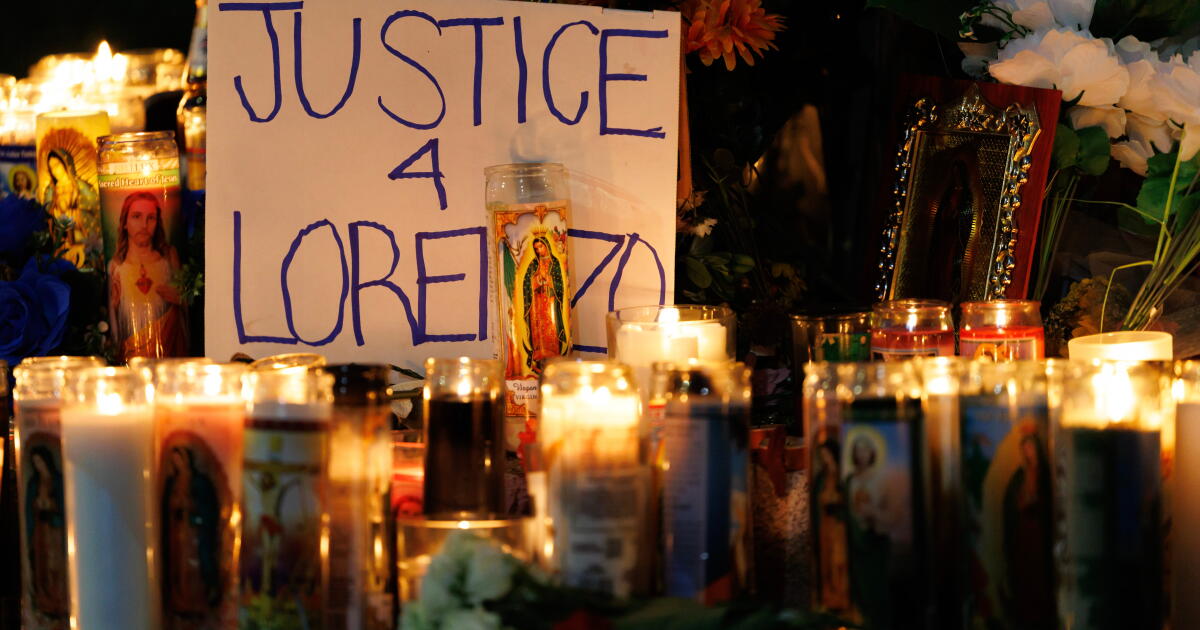
Pretti died near Glam Doll Donuts, along another vibrant stretch of diverse, immigrant-owned restaurants known as Eat Street. As the days went on after his killing, fewer news cameras turned up, but mourners kept coming.
Standing over the memorial that has grown to take up the length of a building, a man in a The North Face jacket sobbed quietly. Another lighted incense sticks and stuck them in the snow.
Votive candles depicted Jesus, the Virgin of Gudalupe and Mister Rogers.
Candles burn near the Pretti memorial. Some depicted Jesus, the Virgin of Guadalupe and Mister Rogers.
A letter offers a source of comfort: “If I have two rooms, one dark, the other light, and I open the door between them, the dark room becomes lighter without the light one becoming darker. I know this is no headline, but it’s a marvelous footnote.”
Also on display were lyrics from Bruce Springsteen’s new protest song, “Streets of Minneapolis,” which call out White House Deputy Chief of Staff Stephen Miller and Home Security Secretary Kristi Noem:
It’s our blood + our bones
And these whistles + phones
Against Miller +
Noem’s Dirty Lies.
New artwork appears daily. An oil painting depicting a smiling Pretti in glasses, a beanie and a scarf, was among the most recent.
Leah Dunbar, 50, was moved to tears looking at it. Dunbar, who lives nearby, had brought Somali chicken sambusas for fellow mourners standing in the cold.
The George Floyd memorial marks the spot at the intersection of East 38th Street and Chicago Avenue where he was killed in 2020 at age 46.
Reflecting on his death, she had asked herself, “What is the good that is coming out of this? Do we have space in our lives to see the good?”
“Of course we do,” she said. “Look — people are making, people are creating, people are sharing.”
Former Los Angeles schools Supt. Austin Beutner said Thursday that he is dropping out of the race for mayor, citing the recent death of his 22-year-old daughter.
Beutner, one of several candidates seeking to oust Mayor Karen Bass in the June 2 primary, made his announcement a month after the death of Emily Beutner, the youngest of his four children.
“My family has experienced the unimaginable loss of our beloved daughter Emily. She was a magical person, the light of our lives. We are still in mourning,” Beutner said in a statement. “A successful campaign, and more importantly the job of Mayor, requires someone who is committed 24/7 to the job. Family has always come first for me. That is where I need to be at this time.”
Beutner’s daughter died Jan. 6 at a hospital, according to officials with the Los Angeles County medical examiner’s office, which has not yet determined a cause.
The announcement comes as the lineup of candidates is still in flux, with Saturday’s filing deadline fast approaching.
L.A. County Supervisor Lindsey Horvath has been weighing a run, as has Maryam Zar, founder of the Palisades Recovery Coalition. Real estate developer Rick Caruso, who lost to Bass in 2022, is once again considering a mayoral bid — even though he publicly ruled that out last month — after The Times reported Wednesday that Bass was involved in watering down an after-action report on the Palisades fire.
Bass’ team said the mayor did not make changes to the report, saying “there is absolutely no reason why she would request those details be altered or erased when she herself has been critical of the response to the fire.”
Bass, who is seeking a second four-year term, already faces challenges from reality television star Spencer Pratt, a Republican who lost his home in the Palisades fire; Rae Huang, a community organizer who is also a democratic socialist; and Adam Miller, a tech entrepreneur and nonprofit executive.
If Bass secures more than 50% of the vote, she will win outright, avoiding a November runoff.
Beutner, who entered the contest in October, spent much of his campaign denouncing Bass’ handling of the Palisades fire, which destroyed thousands of homes and left 12 people dead. The fire severely damaged Beutner’s home in Pacific Palisades and completely destroyed the residence of Beutner’s mother-in-law.
During the early months of his campaign, Beutner also criticized the mayor for hiking the fees that the city charges for trash pickup, sewer maintenance and other basic services.
In his statement withdrawing from the race, Beutner continued to highlight some of the problems he discussed during his campaign.
“Los Angeles is a special place, but every day it’s becoming less affordable, less safe and a more difficult place to live,” he said. “To solve these problems, new ideas are needed along with leadership capable of implementing them.”
Beutner’s daughter, a student at Loyola Marymount University, was found last month by the side of a highway in Palmdale in a “state of medical distress,” according to the Los Angeles County Sheriff’s Department. She later died at a hospital.
After that, Beutner largely disappeared from the public eye, canceling more than a dozen campaign events and asking the public for privacy.
The statements are objectively true: The Timbisha Shoshone have lived in what’s now popularly known as Death Valley for thousands of years. And they still live there, in a small village inside the national park that has about 30 full-time inhabitants.
In 2000, Congress officially recognized these two facts in the text of the hard-fought Homeland Act, which transferred nearly 7,800 acres of land, including the village site, back to the Timbisha Shoshone.
You’re reading Boiling Point
The L.A. Times climate team gets you up to speed on climate change, energy and the environment. Sign up to get it in your inbox every week.
But federal officials have now taken issue with those seemingly innocuous sentences, according to Mandi Campbell, tribal historic preservation officer for the Timbisha Shoshone and a resident of the village.
The rationale? Orders from President Trump and Interior Secretary Doug Burgum directing the National Park Service to review interpretive materials for content that the administration feels “inappropriately disparages Americans.”
Only certain types of Americans, as it turns out: The executive order also has been cited in a lawsuit by the city of Philadelphia as the presumptive reason the NPS removed an exhibit on enslaved people from Independence National Historical Park.
Participants take time out for a photo during a march organized by the Timbisha Shoshone to mark the 25th anniversary of the Homeland Act.
(Kim Stringfellow)
And it’s prompted Lowell National Historical Park in Massachusetts to stop showing films about women and immigrant textile mill workers, according to the New York Times, which also reported that plaques referencing climate change have been removed from Muir Woods National Monument in California and Fort Sumter and Fort Moultrie National Historical Park in South Carolina.
On top of that, Trump officials recently ordered the removal or editing of signs and other materials in at least 17 national parks in Arizona, Texas, Colorado, Utah, Montana and Wyoming, The Washington Post reports.
Back to Death Valley — a name that, by the way, members of the Timbisha Shoshone have never liked. Campbell told me that a celebration of the Homeland Act’s 25th anniversary that took place Friday at the national park’s Furnace Creek Visitor Center was supposed to include the unveiling of updates to its interpretive exhibit. The tribe had planned to place in a display case earrings and a medallion that members once gifted to former park Superintendent J.T. Reynolds to mark the passage of the act, along with some descriptive language, she said.
Ahead of the event, the Park Service submitted the additions to its parent agency, the Interior Department, for review. Campbell said that agency officials replied that not only could the new exhibit not include the new phrases “these are our homelands” or “we are still here,” but that similar language that’s been on display since 2012 would also be placed under review.
Interior Department spokesperson Elizabeth Peace said this is not true. “The Department has a long-standing history of working closely with tribal partners as part of exhibit development and review, and the park was never told they could not use that specific language or phrases,” she wrote in an email.
Peace went on to explain that although the new exhibit is under review pursuant to the executive and secretarial orders — both titled “restoring truth and sanity to American history” — the department hasn’t made any final decisions.
The review, according to Peace, is meant to ensure that parks tell “the full and accurate story of American history,” which includes addressing enslaved and Indigenous people, “informed by current scholarship and expert review, not through a narrow ideological lens.”
So, the 25th anniversary celebration went ahead without acknowledging the ongoing debate about the new exhibit.
There was a march from the village to the visitor center in which tribal members walked behind a banner that read, “We are still here,” which, Campbell said, was meant to echo a protest staged on Memorial Day in 1996 in which the Timbisha Shoshone demanded the restoration of their homelands after negotiations with the federal government broke down. That rally was widely credited with restarting the talks that eventually led to the passage of the Homeland Act.
Three decades later, the struggle continues. “Why do we still have to fight to be heard?” Campbell wondered earlier this week. “We weren’t even in history books. And we still can‘t tell our story. When do we get our chance?”
Despite the recent controversy, the tribe has a good relationship with the Death Valley-based NPS officials, Campbell said, and she’s confident they’ll be able to work through whatever happens next together.
After Friday’s march, tribal council members and park officials gave a series of speeches at the visitor center saluting their strong partnership and all the work that it’s taken to get to this point. Then they took pictures and ate cake.
More recent land news
If you’re a regular reader of this newsletter, you probably are aware of how lawmakers have been using the Congressional Review Act, which enables Congress to overturn recent federal rules with a majority vote, to revoke specific Bureau of Land Management plans that limit mining and drilling in specific places. This was unprecedented until last year but has since been used to throw out BLM plans in Alaska, Montana, North Dakota and Wyoming.
Now, a decision by the Government Accountability Office has cleared the way for Congress to throw out the BLM plan for Utah’s Grand Staircase-Escalante National Monument, which protects the land from mineral extraction, limits grazing and prioritizes conservation. Experts expect Republican Rep. Celeste Maloy or another Utah member of Congress to introduce a bill to do so this year, according to Caroline Llanes of Rocky Mountain Community Radio. If it passes, it would mark the first time the act has been used to roll back protections in a national monument.
Four former U.S. Forest Service chiefs are speaking out against the agency’s move to repeal the Roadless Area Conservation Rule. The 2001 rule protecting 58 million acres of national forests from road building and logging was supported by both political parties, and is needed to protect sensitive wildlife and maintain clean drinking water, argues an op-ed published in the Hill.
The Forest Service has revised its oil and gas leasing rules to “streamline” the permitting process by replacing parcel-by-parcel environmental reviews with a broader review that can sometimes cover millions of acres, reports Jake Bolster of Inside Climate News. Environmental groups told Bolster that the move will increase the likelihood that the agency misses sensitive habitat when deciding where to allow drilling.
Some environmental advocates are concerned about a new order from Interior Secretary Burgum that seeks to expand hunting and fishing access on federal public lands. “It flips conservation on its head and treats wildlife protection as the exception,” said Michelle Lute, executive director of nonprofit Wildlife for All. Others say the directive is more of a statement of values than something that will result in drastic changes on the ground. “It’s a nice nod to the hunting and angling community that acknowledges ‘we know these areas mean a lot to you,’” said Ryan Callaghan, president and chief executive of Backcountry Hunters & Anglers.
A few last things in climate news
Much has been made of a record-setting rainy season that’s helped lift California out of drought. But an extraordinarily warm January has left the snowpack across the Sierra Nevada and much of the Western U.S. far smaller than usual, Times water and climate change reporter Ian James writes. That means more hard times for the snowmelt-fed Colorado River, which provides water for farms and cities across seven states.
Peninsular bighorn sheep seeking to migrate back and forth across the California-Mexico border, as they’ve long done, are now being hampered by razor wire installed by U.S. Customs and Border Protection in the Jacumba Wilderness, according to our wildlife and outdoors reporter Lila Seidman. Similar scenarios are playing out across the Southwest, where the 1,954-mile border cuts through the habitat of more than 80 threatened and endangered species.
This is the latest edition of Boiling Point, a newsletter about climate change and the environment in the American West. Sign up here to get it in your inbox. And listen to our Boiling Point podcast here.
The beloved snooker icon and BBC commentator has died at the age of 79, reports Wales Online.
Sharing the sad news at the close of Wednesday’s edition of the BBC programme (February 4), TV star JB announced: “Before we go we just wanted to take a moment to mention today’s news about the death of former UK snooker champion John Virgo at the age of 79.”
“Many of us also fondly remember him from his commentating work and his TV programmes like Big Break so of course our thoughts are with his family and his friends,” continued the star.
“Of course,” his co-host Alex Jones acknowledged as she sat beside him on the sofa.
Whilst the presenters paid tribute, a photograph of the late snooker legend appeared on screen.
It was revealed earlier in the day that Virgo had died, prompting a wave of sorrow from his fans and the snooker community.
A statement on the World Snooker Instagram account read: “Everyone at World Snooker Tour is deeply saddened to learn of the passing of legendary snooker player and broadcaster John Virgo, aged 79.
“Our thoughts are with his family and loved ones. Rest in peace, JV.”
It was shared on the platform alongside a black and white photograph of Virgo with the dates 1946 to 2026.
Fans have been offering tributes on social media following the announcement.
“Aww he was great RIP,” one person wrote on X, which was formerly Twitter.
“To me John Virgo was like Eddie Butler was to rugby commentary, he was the voice of snooker,” remarked another person. Others hailed him as a “legend”.
One fan of the late snooker ace wrote on the platform: “I grew up watching the snooker decades ago and watching John Virgo was always brilliant. His skill as a player was immense but what a great character RIP.”
“Mr Virgo you were very much loved,” they added in the moving post.
The latest victim succumbing to injuries was an 18-year-old Swiss national.
Published On 1 Feb 20261 Feb 2026
Share
A teenager injured in the fire that engulfed a Swiss Alpine bar during New Year celebrations has died in hospital, according to Swiss authorities, increasing the death toll of one of the worst disasters in the country’s modern history to 41.
Saturday’s death was announced a month after the inferno at the ski resort of Crans-Montana. Another 115 were injured, most of whom remain in various hospitals.
Recommended Stories
list of 3 itemsend of list
“An 18-year-old Swiss national died at a hospital in Zurich on January 31,” the Wallis canton’s public prosecutor Beatrice Pilloud said in a brief statement.
“The death toll from the fire at Le Constellation bar on January 1, 2026 has now risen to 41.”
Pilloud said no further information would be released at this stage by her office, which is investigating the incident.
Those killed in the disaster were aged 14 to 39, but the majority were teenagers. Only four were aged over 24.
Among the dead are 23 Swiss nationals, including one French-Swiss dual national, and 18 foreigners.
Public prosecutors believe the fire started when revellers raised champagne bottles with sparklers attached too close to sound insulation foam on the ceiling of the bar’s basement.
Authorities are looking into whether the foam conformed to regulations and whether the candles were permitted for use in the bar. They say fire safety inspections had not been carried out since 2019.
Swiss prosecutors have opened a criminal investigation into the owners – French couple Jacques and Jessica Moretti – on suspicion of negligent homicide, negligent bodily harm and causing a fire by negligence.
The court of compulsory measures in the southwestern Valais region on January 12 ordered three months of pretrial detention for Jacques Moretti, but on January 23 ordered his release on bail.
The Crans-Montana municipality’s current head of public safety and a former Crans-Montana fire safety officer are also under criminal investigation.
Following the fire, seriously wounded patients were airlifted to various hospitals and specialist burns units throughout Switzerland and four other European countries.
Switzerland’s Federal Office for Civil Protection told the AFP news agency on Friday that at its last count, as of Monday, 44 patients were being treated abroad.
The Wallis health ministry told AFP that 37 patients were still in Swiss hospitals, as of Monday.
The picture is constantly changing, with patients moving between hospitals for different stages of their treatment, and some patients being readmitted. Some remain in intensive care.
The fire has tested relations with neighbouring Italy, which lost nationals in the blaze and has protested the release on bail of the bar’s owner.
Swiss authorities earlier this week said they would grant the Rome Public Prosecutor’s Office access to evidence gathered.
Macaulay Culkin paid tribute to his “Home Alone” co-star Catherine O’Hara following her death at age 71.
O’Hara died Friday at her home in Los Angeles after a brief illness, her agency CAA confirmed. Following the news, Culkin mourned his movie mom on social media.
“Mama. I thought we had time,” the actor wrote. “I wanted more. I wanted to sit in a chair next to you.”
“I heard you. But I had so much more to say,” he continued. “I love you. I’ll see you later.”
O’Hara played the frazzled yet fierce Kate McCallister, mother to quick-witted troublemaker Kevin McCallister, in the iconic “Home Alone” (1990) and its sequel “Home Alone 2: Lost in New York” (1992). The films launched Culkin to fame and have become bona fide Christmas classics, whose emotional core lies in the palpable chemistry between Culkin and O’Hara.
The pair reunited in 2023, when O’Hara honored Culkin at the latter’s Hollywood Walk of Fame induction ceremony, praising the “sweet, yet twisted, yet totally relatable sense of humor” that helped him survive his early launch into the spotlight.
“The reason families all over the world can’t let a year go by without watching and loving ‘Home Alone’ together is because of Macaulay Culkin,” O’Hara said in her speech.
“Thank you for including me — your fake mom who left you home alone not once, but twice — to share in this happy occasion,” she said. “I’m so proud of you.”
News of O’Hara’s death brought tributes from the actor’s film and TV industry peers, including her collaborators from over the years.
Dan Levy, who co-created and co-starred in “Schitt’s Creek” with his father, Eugene Levy, said his TV mom was “extended family before she ever played my family.”
“What a gift to have gotten to dance in the warm glow of Catherine O’Hara’s brilliance for all those years. Having spent over fifty years collaborating with my Dad, Catherine was extended family before she ever played my family,” he wrote on Instagram. “It’s hard to imagine a world without her in it. I will cherish every funny memory I was fortunate enough to make with her.”
Eugene Levy reflected on his five-decade-long relationship with O’Hara.
“Words seem inadequate to express the loss I feel today. I had the honor of knowing and working with the great Catherine O’Hara for over fifty years,” Levy said in a statement. “From our beginnings on the Second City stage, to ‘SCTV,’ to the movies we did with Chris Guest, to our six glorious years on ‘Schitt’s Creek,’ I cherished our working relationship, but most of all our friendship. And I will miss her. My heart goes out to Bo, Matthew, Luke, and the entire O’Hara family.”
Seth Rogen, who recently teamed up with O’Hara on the Emmy-winning comedy “The Studio,” said in an Instagram post that she was among his earliest inspirations.
“I told O’Hara when I first met her I thought she was the funniest person I’d ever had the pleasure of watching on screen,” Rogen said, citing “Home Alone” as “the movie that made me want to make movies.”
“Getting to work with her was a true honour,” the actor, who co-created, directed and stars in the series, continued. “She was hysterical, kind, intuitive, generous… she made me want to make our show good enough to be worthy of her presence in it.”
Other members of “The Studio” crew also honored their late co-star.
Ike Barinholtz, who plays chaotic executive Sal Saperstein in “The Studio,” captioned an Instagram photo of him and O’Hara: “I never in a million years thought I would get to work with Catherine O’Hara let alone become friends with her.”
“So profoundly sad she’s somewhere else now,” Barinholtz added. “So incredibly grateful I got to spend the time I did with her.”
Ron Howard, who made a guest appearance as himself in the show, called O’Hara “a wonderful person, artist and collaborator.”
“I was lucky enough to direct, produce and act in projects with her and she was simply growing more brilliant with each year,” the filmmaker wrote Friday on X. O’Hara appeared in Howard’s 1992 dramedy “The Paper.”
O’Hara’s “Beetlejuice” co-star Michael Keaton also mourned the late actor, tracing their relationship back to well before the beloved Tim Burton movie.
“She’s been my pretend wife, my pretend nemesis and my real life, true friend,” Keaton wrote on Instagram. “This one hurts. Man am I gonna miss her.”
Justin Theroux, who joined O’Hara in 2024’s “Beetlejuice Beetlejuice,” also wrote on Instagram, “Oh Catherine. You will be so missed.”
Burton himself memorialized O’Hara with a cast photo from the “Beetlejuice” sequel.
“Catherine, I love you. This picture shows how much light you gave to all of us. You were a special part of my life and after life,” the venerated director captioned the shot on Instagram.
Martin Scorsese, who directed O’Hara in “After Hours,” said in a statement to IndieWire that her loss feels “impossible.”
“Catherine was a true comic genius, a true artist and a wonderful human being. I was blessed to be able to work with her on ‘After Hours,’ and I’m going to miss her presence and her artistry. We all are,” he said.
“Home Alone” director Chris Columbus said in a statement to the Hollywood Reporter that he was “heartbroken, along with the rest of the world,” upon learning O’Hara had died.
“I was an obsessive fan of Catherine’s brilliant comedic work on ‘SCTV’ and was thrilled when she agreed to play Kevin’s mom in ‘Home Alone,’ ” Columbus said.
“What most people don’t realize is that Catherine carries the weight of 50% of that film. The movie simply would not work without her extraordinary performance. Catherine grounds the picture with a profound emotional depth,” he added. “I will miss her greatly. Yet there is a small sense of comfort, realizing that two of the finest human beings I’ve ever known, Catherine and John Candy, are together again, brilliantly improvising, making each other laugh.”
Meryl Streep, who acted with O’Hara in the romantic comedy “Heartburn,” said in a statement to the Associated Press that O’Hara “brought love and light to our world, through whipsmart compassion for the collection of eccentrics she portrayed.”
Andrea Martin told the outlet that her fellow “SCTV” cast member “is and will always be the greatest. It is an honor to have called her my friend.”
Pedro Pascal, who worked with O’Hara on the sophomore season of “The Last of Us,” said on Instagram that he was thankful the two crossed paths.
“Oh, genius to be near you. Eternally grateful,” Pascal said. “There is less light in my world, this lucky world that had you, will keep you, always.”
Melanie Lynskey, who featured in the first season of “The Last of Us,” called O’Hara “the pinnacle of greatness” in her own social media salute.
“So grateful I got to tell her what she meant to me- how she inspired me, shaped my sense of humour and understanding of the work we do,” Lynskey wrote.
“I’m sure every actor she met told her similar things. She did not behave as though she’d heard it a million times, she listened and accepted it with grace and wit and tremendous kindness,” the Emmy nominee added.
Lynskey recalled interacting with O’Hara at a 2013 Live Read of “Glengarry Glen Ross” and while filming Sam Mendes’ 2009 romantic comedy “Away We Go.”
During both stints, Lynskey said, “I saw [O’Hara] be nothing short of wonderful to every single person she encountered, from the director to the PAs.”
“When people say someone ‘lit up a room,’ this is what they mean,” she said.
“The Last of Us” showrunner Craig Mazin said on Instagram, “I think [O’Hara] would prefer that we keep laughing somehow, or at the very least not cry. Not possible at the moment.”
Others in the industry hailed O’Hara as a generational actor who shined in everything she touched.
“Catherine O’Hara changed how so many of us understand comedy and humanity. From the chaos and heart of ‘Home Alone’ to the unforgettable precision of Moira Rose in ‘Schitt’s Creek,’ she created characters we’ll rewatch again and again,” Kevin Nealon, who, alongside O’Hara, led the claymation sitcom “Glenn Martin, DDS,” wrote on X.
Josh Gad, who worked with O’Hara on the animated comedy series “Central Park,” expressed his disbelief at her death on Instagram.
“Why is the world such a heart breaking place right now? I truly cannot process how to say goodbye to someone so full of life who seemed to just be hitting her prime,” Gad said.
“Goodbye legend. Thank you for making us laugh until we hurt… which is why right now we are all hurting so damned much knowing we will never again get those laughs,” the “Frozen” voice actor added.
“Only one Catherine O’Hara, and now none. Heartbreaking,” echoed actor-comedian Michael McKean, who worked with the late actor on the mockumentaries “Best in Show,” “For Your Consideration,” “Waiting for Guffman” and “A Mighty Wind.”
O’Hara’s fellow “Bartok the Magnificent” voice actor Hank Azaria called her death “a profound loss.”
“Comedy will never be the same without Catherine O’Hara. An inspiration to us all, especially little Bartok,” Azaria captioned a social media clip featuring O’Hara’s character, Ludmilla, in the animated film.
Rita Wilson in an Instagram tribute called her “a woman who was authentic and truthful in all she did.”
“You saw it in her work, if you knew her you saw it in her life, and you saw it in her family,” the actor and singer said, offering condolences to O’Hara’s husband, Bo Welch, and their two children.
As Ellen DeGeneres put it on Instagram, “Sending love to all who adored her, which might just be everyone.”
Actor and professional wrestler Paul Walter Hauser called O’Hara “my Meryl Streep.”
“I could watch her in anything. Didn’t matter how good or bad the film or show was. I wanted to see what she would do,” Hauser wrote on Instagram, citing the actor’s work in “After Hours,” “Waiting for Guffman” and “Best in Show,” among other projects.
“A freaking angel just went home to Heaven. And she’s not home alone,” he wrote.
Ever since the crackdown on protests in Iran between January 8 and 10, there has been contention on what the true death toll of those bloody events is. According to figures provided by the Iranian government, 3,117 people were killed, including civilians and security forces. Yet estimates from outside the country have put the number at anywhere between 5,000 and a staggering 36,500.
This wide range not only reflects the fact that it has been extremely difficult to verify these reports, but also that there has been a concerted effort to use the death count to manufacture global consent for an attack on Iran and, in a deceitful rhetoric, downplay the official death toll of the genocide in Gaza.
Since the outbreak of the protests, there has been a race to estimate and report on the casualties – something I call a “Death Toll Olympics”.
Iran-focused human rights organisations led by dissident activists have been going through all sorts of evidence and testimonies to verify the number of the dead. As of writing this piece, the US-based organisation HRANA (Human Rights Activists News Agency) has cited more than 6,000 deaths and a further 17,000-plus cases under examination.
However, there are valid doubts about the speed of the activist-led verification process.
For every reported death, multiple accounts have to be examined, possible duplications must be identified and eliminated; and dates, locations and specific circumstances must be cross-checked against the timeline of events.
Furthermore, any visual evidence has to be localised and authenticated based on open-source data or corroborated by the accounts of multiple witnesses. From an investigative standpoint, the reliability and quality of activist-led counts that increase rapidly on a daily basis, therefore warrants caution.
The UN Special Rapporteur on Iran, Mai Sato, has cited a conservative estimate of around 5,000 deaths. At the same time, she has mentioned that unverified numbers of up to 20,000 have been reported to her by medical sources.
The described obstacles, and difficulties of verification over the past weeks, have been further exacerbated by Iran’s severely restricted internet access. Despite this, major media outlets have begun distributing much higher figures, solely based on vague anonymous sources who claim privileged access within Iran’s government or health sector.
On January 25, for example, UK-based TV network Iran International published a report claiming 36,500 were killed, citing “extensive reports” allegedly obtained from the Iranian security apparatus – reports it has neither published nor otherwise made transparent.
The same day, United States news magazine Time published an article titled “Iran Protest Death Toll Could Top 30,000, According to Local Health Officials”. It claimed that “as many as 30,000 people could have been killed in the streets of Iran on Jan. 8 and 9 alone” based on the accounts of two senior officials of the country’s Ministry of Health, whose identities were not revealed for security reasons. Notably, the magazine admitted in the text that it did not possess any means to independently confirm that number.
Two days later, British newspaper The Guardian followed the same trend with an article titled “Disappeared bodies, mass burials and ‘30,000 dead’: what is the truth of Iran’s death toll?” The piece introduced the figure of 30,000 based on estimates of an anonymous doctor, who spoke to the newspaper. He and his colleagues in Iran, the outlet admitted, were actually hesitant to provide a concrete figure.
Other media – from the Sunday Times to the Pierce Morgan Uncensored show – have cited papers circulated by Germany-based ophthalmologist Amir Parasta claiming death toll numbers between 16,500 and 33,000. However, the latest available version of the paper, dating back to January 23 uses disputable extrapolation methods to reach its figures. Strikingly, Parasta does not make any secret of his affiliation with Reza Pahlavi, the son of Iran’s ousted Shah
The exiled crown prince and his team, whose extensive social media manipulation and disinformation efforts have been exposed by recent investigations by the Israeli newspaper Haaretz and University of Toronto’s The Citizen Lab, have been key actors in inciting and escalating the recent protests towards confrontation. Accordingly, the fatality numbers disseminated by Mr Parasta cannot be perceived as neutral and constitute partisan estimates at best.
Despite acknowledging their own inability to verify these estimates, the media in question nevertheless put these extreme figures in titles and subheadings. It didn’t take long for other outlets to report on these inflated numbers, referring to these major publications as primary sources. Activists and Western politicians have also used them to push their respective agendas, thereby further fuelling a spiral of disinformation campaigns on social media. – In other words, a “death toll olympics” was born.
All of this has served two ends.
First, it has supported efforts to manufacture consent for foreign military intervention and malicious political action. While the protests were still ongoing, US President Donald Trump repeatedly threatened military action against Iran in the event of a deadly crackdown. As of writing these lines, there has been a significant US military build-up around Iran, effectively thickening the war cloud.
Second, the speculation about the Iranian death toll has helped pro-Israel politicians and commentators in the West to downplay the casualties of the Israeli war on Gaza. In this way, it has become a utilitarian tool for relativising the genocide of the Palestinian people.
Confronted with mounting pressure regarding the death toll, Iran’s President Masoud Pezeshkian ordered the authorities to “publicly publish the names and personal data of those deceased during the recent bitter incidents”. His director of communication has even promised that a procedure has been set up to examine and verify any conflicting claims.
It remains to be seen how effective and transparent the promised procedure will turn out. It is undeniable that thousands have been killed in Iran, mostly by Iranian security forces, amid a multi-day brutal crowd and riot control effort.
Structural obscurity and the restricted access to Iran for independent experts will likely mean that the exact death toll will never be determined. However, the more transparency can be established regarding the scale of the killings, the more likely it is that the perpetrators can be held accountable.
An arduous verification process of the recent deaths is crucial not only for the sake of accountability, but also to expose the media manipulation that is once again preparing the ground for a unilateral US-led act of aggression in the Middle East. In light of this, the “Death Toll Olympics” remains an ignominious disservice to the wretched of the Earth from Palestine to Iran.
The views expressed in this article are the author’s own and do not necessarily reflect Al Jazeera’s editorial policy.
CHILLING dispatch audio has revealed screen legend Catherine O’Hara was “struggling to breathe” before she died early on Friday morning.
O’Hara, 71, best known for her roles in Home Alone, Beetlejuice, and Schitt’s Creek, was reportedly rushed to a Los Angeles hospital in a serious condition.
Sign up for the Showbiz newsletter
Thank you!
Catherine O’Hara, 71, has sadly passed away after a brief illnessCredit: GettyAnnie Murphy and Catherine O’Hara in Schitt’s Creek, 2020, which catapulted her back into the spotlightCredit: AlamyCatherine O’Hara became a household name after appearing in the Home Alone franchise in the 90sCredit: AlamyThe Home Alone star made her final public appearance with husband Bo Welch at the Primetime Emmys in September 2025Credit: GETTY
The Los Angeles Fire Department responded to reports of a medical emergency after a 911 call was placed from her Brentwood home at 4.48am.
Dispatch audio obtained by PageSix revealed the actress was having difficulty breathing in her final moments.
Tragically, she passed away hours later in hospital.
A cause of death has not yet been confirmed, though her talent agency CAA said she suffered from a “brief illness” just before her death.
Tributes to the comedy icon have begun to pour in from across Hollywood after her untimely death.
Macaulay Culkin, who starred as the actress’s son in the Home Alone films, remembered O’Hara as “mama”in a heartbreaking poston Instagram.
“Mama. I thought we had time. I wanted more. I wanted to sit in a chair next to you. I heard you, but I had so much more to say,” Culkin wrote.
“I love you. I’ll see you later.”
O’Hara played Kate McCallister, the mother of Culkin’s character, Kevin, in the first two Home Alone movies.
Heartbroken Macaulay Culkin calls Catherine O’Hara ‘mama’ in a tribute on InstagramCredit: Instagram/culkamaniaCatherine O’Hara and Macaulay Culkin were still close after starring in Home Alone togetherCredit: Alamy
Catherine O’Hara dead at 71
Iconic Home Alone actress Catherine O’Hara died on January 30, 2026. O’Hara was 71.
Biography:
Catherine O’Hara, who was born in Toronto, Canada, began her acting career in comedy in 1974 after joining the cast of The Second City, which was televised in both Canada and the United States.
O’Hara expanded her career in television in the mid-1970s, appearing in small roles on the CBC series Wayne and Shuster, the film The Rimshots, and the children’s series Coming up Rosie.
She gained prominence in Hollywood in the 1980s, after she was cast in the classic horror-comedy film Beetlejuice.
Starring alongside Michael Keaton, Alec Baldwin, and Winona Ryder, O’Hara portrayed Delia Deetz.
In 1990, O’Hara starred alongside child actor Macaulay Culkin in the holiday blockbuster Home Alone.
She reprised her role as Kate McCallister, the mother of the young troublemaker Kevin McCallister, portrayed by Culkin, in the film’s 1992 sequel, Home Alone 2: Lost in New York.
Both installments of Home Alone were massive hits at the box office, and to this date, remain among the most successful Christmas movies of all time.
After the success of Home Alone, O’Hara continued to appear in several films throughout the 1990s, including the comedy-drama The Paper, Waiting for Guffman, and the Western film Wyatt Earp.
O’Hara also had several voice artist appearances, including The Nightmare Before Christmas, Chicken Little, and Monster House, among others.
She had a career resurgence in 2015 when she appeared as Moira Rose in the Canadian sitcom Schitt’s Creek.
In 2025, O’Hara had a main role in the Apple TV+ comedy series The Studio.
Throughout her career, O’Hara received various awards, including two PrimeTime Emmy Awards, a Golden Globe Award, and two Screen Actors Guild Awards.
She had two children with her husband, Bo Welch, whom she met on the set of Beetlejuice.
AWAY FROM THE SPOTLIGHT
O’Hara skipped the Golden Globes on January 11, despite receiving a nomination for Best Supporting Performance by a Female Actor for her role in the Apple+ TV series The Studio.
It was not clear why she did not attend the ceremony.
Catherine O’Hara and Seth Rogen in The Studio currently streaming on Apple+Credit: Apple TVCatherine O’Hara, Patrick J. Adams and Seth Rogen at The Studio world premiere in March 2025Credit: Getty
“She was scheduled to film, but they reworked the schedule to focus on scenes without her character,” the source said.
“It was not widely known she was dealing with any health or major issues.
“I don’t believe she ever filmed anything for season two,” the production insider claimed.
Catherine’s unexpected passing has sent shockwaves through the cast and crew of the Apple+ TV series, who were completely blindsided by the tragic news.
LONG, STORIED CAREER
O’Hara was born in Toronto, Canada, before moving to the United States.
Her career spanned more than 50 years, stretching across TV, movies, and sketch comedy.
She started out in sketch series Second City Television in the mid-1970s.
O’Hara won an Emmy as part of the show.
But she shot to superstardom in the beloved 1990 Christmas movie Home Alone, in which she played Kevin McCallister’s mother.
Catherine O’Hara regained popularity during her run on Schitt’s Creek alongside long-time collaborator Eugene LevyCredit: APEugene Levy and Catherine O’Hara had a long comedy relationship, starring together in Best In Show in 2000Credit: Alamy
She remained close with onscreen son Macaulay Culkin, and supported the actor in 2023 at his Hollywood Walk of Fame ceremony.
Later in her career, she had a pop culture resurgence with smash hit comedy Schitt’s Creek, opposite her longtime friend Eugene Levy.
The show aired from 2015 until 2020, and earned O’Hara two Emmys for her role as eccentric former soap star Moira Rose.
She was featured in a documentary about late Home Alone co-star and close friend John Candy, which premiered in 2025.
O’Hara also stole scenes as heartbroken therapist Gail on The Last Of Us’ second season opposite Pedro Pascal.
Catherine O’Hara Tributes
Iconic actress Catherine O’Hara, who is best known for her role as Kate McCallister in the Christmas classic Home Alone, died on January 30, 2026. She was 71.
Tributes:
Home Alone co-star Macaulay Culkin: Mama. I thought we had time. I wanted more. I wanted to sit in a chair next to you. I heard you but I had so much more to say. I love you. I’ll see you later.”
Home Alone co-star Devin Ratray: “One of the greatest people I ever met. It just doesn’t register. Bewildered and numb.”
The Last of Us actor Pedro Pascal: “Oh, genius to be near you. Eternally grateful. There is less light in my world, this lucky world that had you, will keep you, always. Always. The one and ONLY #CatherineOHara.”
Bravo host Andy Cohen: “Fell in love at first sight on SCTV and it only got stronger. Rest in Peace, Angel Catherine O’Hara.”
Beetlejuice co-star Justin Theroux: “Catherine. You will be so so missed.”
Comedian Tom Green: “I’m so sorry to hear the news that Canadian comedy legend Catherine O’Hara has passed away at 71. She’s kept me and millions of others entertained throughout my lifetime – from her brilliant work on SCTV, to Home Alone, Beetlejuice, Best in Show, Schitt’s Creek, and so many other films and television classics. Her characters brought so much joy and laughter to the world. It’s with a heavy heart that I share this today. Rest in peace, Catherine O’Hara — one of the greatest Canadian comedy icons of all time.”
Catherine O’Hara hosted Saturday Night Live twice, once in 1991 and again in 1992Credit: Getty
Los Angeles mayoral candidate Austin Beutner’s daughter was found by the side of a highway in Palmdale the night she died, according to the Los Angeles County Sheriff’s Department.
A passerby alerted authorities to a woman in a “state of medical distress” shortly after midnight Jan. 6 near Sierra Highway and Technology Drive, said Lt. Michael Modica of the sheriff’s homicide bureau.
Sheriff’s deputies responded to the scene to assist paramedics, who treated Emily Beutner, 22, at the scene, Modica said. He could not say how long Beutner had been by the road, which is surrounded by empty fields.
She was transported to a local hospital, where she was pronounced dead.
Sheriff’s homicide detectives have assumed control of the death investigation. Modica said this is typical when a young person is found in such a situation and should not be taken as an indication of the cause of death, which will be determined by the Los Angeles County Medical Examiner.
Jeff Millman, a spokesperson for Austin Beutner, declined to comment.
Viridiana Aguilar, a spokesperson for the medical examiner, said earlier this month that her agency had not yet made a determination on the cause of death and had requested additional testing.
“Due to the ongoing death investigation, the County of Los Angeles Department of Medical Examiner cannot disclose what testing and/or studies were requested,” Aguilar said. “Deferred cases can take a few months before a cause of death is determined.”
The medical examiner’s website indicates that Emily Beutner died at a hospital and does not list a cause or manner of death.
Beutner, a student at Loyola Marymount University, was the youngest of four children and the only daughter.
Her father, a former Los Angeles Unified school superintendent, is among the challengers seeking to unseat Mayor Karen Bass in the June 2 primary. Others include TV star Spencer Pratt, who lost his home in the Palisades fire, and Rae Huang, a community organizer and housing advocate.
Austin Beutner has sharply criticized Bass’ handling of the fire, which destroyed thousands of homes and left 12 people dead. His own home was seriously damaged in the fire, forcing him to live elsewhere for the past year, and his mother-in-law’s home was destroyed.
Over the course of his career, Beutner did a stint as former Mayor Antonio Villaraigosa’s “jobs czar.” He also spent roughly a year as publisher and chief executive of The Times.
Beutner has not publicly campaigned since Jan. 5, the day before his daughter’s death.
“My family has experienced the unimaginable loss of our beloved daughter. We ask for privacy and your prayers at this time,” Beutner said earlier this month.
Death in Paradise is back for series 15 and new recruit Sergeant Mattie Fletcher will be joining the team in Saint Marie – here’s everything you need to know about the character
Megan Nisbet Content Editor
19:00, 30 Jan 2026
Death in Paradise season 15 cast as Catherine Garton joins line-up (Image: BBC)
Elizabeth Bourgine’s Catherine Bordey, Shantol Jackson’s Sergeant Naomi Thomas, and Shaquille Ali-Yebuah’s Officer Sebastian Rose are all set to return for the 15th season. However, viewers will also meet a new face, Sergeant Mattie Fletcher.
Described as having a “rebellious” streak, Mattie is a fantastic addition to the Saint Marie squad. She’s brought to life by actress Catherine Garton, who steps into the cast following Ginny Holder’sdeparture from her role as Darlene Curtis. But what can BBC viewers anticipate from newcomer Mattie, and who is the actress behind her?
Sergeant Mattie Fletcher is the latest addition to the Saint Marie team. She’ll make her debut in season 15, episode 1, with Detective Sergeant Naomi Thomas (Shantol Jackson) and Officer Sebastian Rose (Shaquille Ali-Yebuah) helping Mattie find her feet.
However, settling in might prove more challenging than expected as secrets from her past start to surface.
Discussing what audiences can anticipate from Sergeant Mattie, Don Gilet, who portrays DI Mervin Wilson, explained: “There’s definitely something of a rebel in Mattie. We haven’t had that rebellious element, really. She’s a bit younger, probably a similar age, give or take, to Officer Seb Rose, but she’s seen a lot more.
“She’s a sergeant and she’s more experienced and is always on the front foot, whereas Seb is going through his rookie stripes. It’s great seeing how the two of them connect – there’s a nurturing side as well as a rebellious side. She’s a great addition to the team.”
Who is Catherine Garton?
Catherine Garton, who portrays Mattie, described her character as “tenacious,” adding: “She’s really fun to play. She’s sassy, but she’s like your big sister who will tell you what’s what, but you can also come to her if you need to. You can have a laugh with her. She’s very passionate about things, about her work and about the people that she grows to love, especially in the team. She’s also very determined, almost too determined sometimes..”
She went on: “Audiences can expect some action. Someone who’s lovable and who’s trying their best, but almost to a fault. She has something to prove to herself and to others and sometimes she can do that to her detriment, but it comes from a place of passion. They will see ups, downs and lots of sass!”.
Catherine Garton takes on the role of new recruit Mattie, having previously appeared in The Gray House as Talulah and Ibiza Narcos as Kelly. Catherine recently graced our screens in Russell T Davies’ Doctor Who spin-off, The War Between the Land and the Sea.
This festive BBC series featured Catherine as Corporal Jane Hart throughout all four episodes.
The filming for the spin-off concluded in 2024, and it was only after wrapping up that Catherine learned she had secured the role of Sergeant Mattie Fletcher, a new regular on Death in Paradise. She amusingly revealed that she was shopping in TK Maxx when her agent broke the news.
She recalled: “I was in the shoe section, one shoe off, sliding another one on and my agent called me and told me. It was a moment!”.
Speaking about her experience filming in Guadeloupe, where the fictional town of Saint Marie is located, Catherine enthused: “I loved it – everyone was really welcoming. Before going to Guadeloupe, I didn’t quite know what to anticipate, then it exceeded any expectations I could have had. I love the island. Guadeloupe is like a postcard. It’s quite unreal. Every time I walked out I was like ‘this exists, wow!’. It’s absolutely stunning. Everyone’s nice. I love the culture. The food’s great. Everyone I work with is great. I don’t have any complaints!”.
When asked about meeting the rest of the cast and crew, Catherine admitted: “It was intimidating at first, because this is the biggest kind of role I’ve ever had, but everyone was just so nice and so welcoming. I remember the first time I saw Shantol and the biggest smile ever. I feel like I have family there now.”
Death in Paradise season 15 kicks off on BBC One and BBC iPlayer at 9pm on Friday, 30 January.
CATHERINE O’Hara has died unexpectedly on Friday, months after her final appearance alongside her husband Bo Welch.
Fans are reeling following the announcement, which did not reveal the Schitt’s Creek star’s cause of death.
Sign up for The Sun newsletter
Thank you!
Catherine O’Hara, seen at the Primetime Emmy Awards in September 2025, has died at age 71Credit: FilmMagicThe Home Alone star made her final public appearance with husband Bo Welch at the Primetime Emmys in September 2025Credit: Getty
Catherine, 71 when she died, made her final appearance alongside her husband Bo back in September.
Photos show the couple dressed to the nines.
The Home Alone actress is wearing a black gown while her hubby sports a chic suit.
Her shoulder-length blonde hair was down with a slight curl in the ends.
She wore subtle makeup, including a nude lipstick color.
Catherine appeared in good spirits during the evening out.
She and Bo posed for photos together.
At times, he stood behind her with his hands on her hips.
OUT OF SIGHT
Months later, Catherine was nominated for a Golden Globe award.
She was schedule to appear at the January 11 awards show, where she was nominated for Best Supporting Performance from a Female Actor for her role in the Apple TV series, The Studio.
Unfortunately, she did not attend.
RIP
TMZ broke the news of Catherine’s death on Friday afternoon.
Sources with direct knowledge confirmed the iconic actress’ passing to the outlet.
A cause of death was not immediately available for the star.
Catherine O’Hara dead at 71
Iconic Home Alone actress Catherine O’Hara died on January 30, 2026. O’Hara was 71.
Biography:
Catherine O’Hara, who was born in Toronto, Canada, began her acting career in comedy in 1974 after joining the cast of The Second City, which was televised in both Canada and the United States.
O’Hara expanded her career in television in the mid-1970s, appearing in small roles on the CBC series Wayne and Shuster, the film The Rimshots, and the children’s series Coming up Rosie.
She gained prominence in Hollywood in the 1980s, after she was cast in the classic horror-comedy film Beetlejuice.
Starring alongside Michael Keaton, Alec Baldwin, and Winona Ryder, among others, O’Hara portrayed Delia Deetz.
In 1990, O’Hara starred alongside child actor Macaulay Culkin in the holiday blockbuster Home Alone.
She reprised her role as Kate McCallister, the mother of the young troublemaker Kevin McCallister, portrayed by Culkin, in the film’s 1992 sequel, Home Alone 2: Lost in New York.
Both installments of Home Alone were massive hits at the box office and to this date remain among the most successful Christmas movies of all time.
After the success of Home Alone, O’Hara continued to appear in several films throughout the 1990s, including the comedy-drama The Paper, Waiting for Guffman, and the Western film Wyatt Earp.
O’Hara also had several voice artist appearances, including The Nightmare Before Christmas, Chicken Little, and Monster House, among others.
She had a career resurgence in 2015 when she appeared as Moira Rose in the Canadian sitcom Schitt’s Creek.
In 2025, O’Hara had a main role in the Apple TV+ comedy series The Studio.
Throughout her career, O’Hara received various awards, including two PrimeTime Emmy Awards, a Golden Globe Award, and two Screen Actors Guild Awards.
She had two children with her husband, Bo Welch, whom she met on the set of Beetlejuice.
While the exact cause of death has not been revealed, Page Six reported that she was rushed to a Los Angeles hospital in “serious” condition.
Paramedics were called the the actress’ home home at 4:48 a.m. on Friday morning, a Los Angeles Fire Department spokesperson confirmed to the outlet.
She was in “serious condition” when she was transported to the hospital.
PAYING TRIBUTE
Tributes to the actress flooded social media almost immediately after her death was announced.
“RIP Catherine O’ Hara. I know John Candy greeted her with open arms.”, one fan wrote.
Another posted on X: “Catherine O’Hara was an absolute genius for the entirety of her career.
“She will be terribly missed.”
A third posted: “Catherine O’Hara will be remembered most as the mom in the first two Home Alone movies
“But I’ll always remember her as Delia Deetz in BeetleJuice. RIP to a legend.”
ICONIC ROLES
Throughout her long career in Hollywood, Catherine appeared in many iconic films and TV shows.
She was an actress for more than 50 years.
Catherine got her star in the sketch series Second City Television in the 1970s.
She’s known for starring in Home Alone, Beetlejuice, Beetlejuice Beetlejuice, The Nightmare Before Christmas, Home Alone 2, Schitt’s Creek and more.
WASHINGTON — The Justice Department has opened a federal civil rights investigation into the shooting of Alex Pretti, the Minneapolis resident killed Saturday by Border Patrol officers, federal officials said Friday.
“We’re looking at everything that would shed light on what happened that day and in the days and weeks leading up to what happened,” Deputy Attorney General Todd Blanche said during a news conference. “That’s like any investigation that the Department of Justice and the FBI does every day. It means we’re looking at video, talking to witnesses, trying to understand what happened.”
There are thousands of instances every year when someone is shot by law enforcement, Blanche said, but not all are investigated by federal authorities.
“There has to be circumstances or facts or maybe unknown facts, but certainly circumstances, that warrant an investigation,” he added.
The Department of Homeland Security also said Friday that the Federal Bureau of Investigation will lead the federal probe.
Homeland Security Secretary Kristi Noem first disclosed the shift in which agency was leading the probe during a Fox News interview Thursday evening. Her department said earlier this week that Homeland Security Investigations, a unit within the department, would be heading the investigation.
“We will continue to follow the investigation that the FBI is leading and giving them all the information that they need to bring that to conclusion, and make sure that the American people know the truth of the situation and how we can go forward and continue to protect the American people,” Noem said, speaking to Fox host Sean Hannity.
Homeland Security spokesperson Tricia McLaughlin confirmed Friday that the FBI will lead the Pretti probe and that HSI will support them. Separately, Customs and Border Protection, which is part of DHS, is doing its own internal investigation into the shooting, during which two officers opened fire on Pretti.
DHS did not immediately respond to questions about when the change was made or why. The FBI did not immediately respond to a request for comment.
It was also not immediately clear whether the FBI would now share information and evidence with Minnesota state investigators, who have thus far been frozen out of the federal probe.
In the same interview, Noem appeared to distance herself from statements she made shortly after the shooting, claiming Pretti had brandished a handgun and aggressively approached officers.
Multiple videos that emerged of the shooting contradicted that claim, showing the intensive care nurse had only his mobile phone in his hand as officers tackled him to the ground, with one removing a handgun from the back of Pretti’s pants as another officer began firing shots into his back.
Pretti had a state permit to legally carry a concealed firearm. At no point did he appear to reach for it, the videos showed.
“I know you realize that situation was very chaotic, and that we were being relayed information from on the ground from CBP agents and officers that were there,” Noem said during the interview with Hannity on Thursday. “We were using the best information we had at the time, seeking to be transparent with the American people and get them what we knew to be true on the ground.”
The change comes after two other videos emerged Wednesday of an earlier altercation between Pretti and federal immigration officers 11 days before his death.
The Jan. 13 videos show Pretti in a winter coat, yelling at federal vehicles and at one point appearing to spit before kicking out the taillight of one vehicle. A struggle ensues between Pretti and several officers, during which he is forced to the ground. Pretti’s winter coat comes off, and he either breaks free or the officers let him go and he scurries away.
When he turns his back to the camera, what appears to be a handgun is visible in his waistband. At no point do the videos show Pretti reaching for the gun, and it is not clear whether federal agents saw it.
Steve Schleicher, a Minneapolis-based attorney representing Pretti’s parents, said Wednesday the earlier altercation in no way justified officers fatally shooting Pretti more than a week later.
In a post on his Truth Social platform early Friday morning, President Trump suggested that the videos of the earlier incident undercut the narrative that Pretti was a peaceful protester when he was shot.
“Agitator and, perhaps, insurrectionist, Alex Pretti’s stock has gone way down with the just released video of him screaming and spitting in the face of a very calm and under control ICE Officer, and then crazily kicking in a new and very expensive government vehicle, so hard and violent, in fact, that the taillight broke off in pieces,” Trump’s post said. “It was quite a display of abuse and anger, for all to see, crazed and out of control. The ICE Officer was calm and cool, not an easy thing to be under those circumstances!”
Biesecker and Santana write for the Associated Press. AP reporters Alanna Durkin Richer and Eric Tucker contributed to this report from Washington.
Jesy Nelson opened up about her daughters’ ‘life or death’ diagnosis and GP failuresCredit: SkyJesy is campaigning to raise awareness of SMA and campaigning for the condition to be added to the NHS newborn heel-prick testCredit: Sky
In an interview on Sky News’ The UK Tonight programme, the former girl band star admitted that the condition was only picked up on when they were six months old – by her mum.
Although health visitors and GPs performed regular checks, the early symptoms of the rare genetic disease – specifically a lack of leg movement – went unnoticed.
The 34-year-old teared up as she explained her campaign for the UK to include SMA screening in the routine newborn heel prick test.
Speaking to host Sarah-Jane Mee, she said: “People are starting to take notice and take it seriously, but it never should have took for me to come along for it to be taken seriously and that’s the part that makes me feel so angry.
“This isn’t just anything. This is a matter of life or death for someone’s child and who gets to decide that?
“Who has the right to decide whether my child is going to be in a wheelchair or not when we’ve literally had three life-changing treatments since 2018?
“The fact that it’s still a thing and we’re still having to scream and shout about it is just mad to me.”
She promised: “I will not stop on my socials talking about it. Trying to do as much TV… yes, it’s big but there’ll still be lots of other people that don’t know about this, so I’ve got to stay noisy.
Following a conversation with UK Health Secretary Wes Streeting, she admitted: “It is so difficult… it’s like, yes, I had that open and honest conversation with you and you said all the right things, but what are you going to do now?
“Now that I’m not in front of you, are you going to continue?”
She reflected on the missed opportunities during early check-ups and urged: “The fact that there were healthcare visitors around my house a lot and we took them to the GP and not one of them saw any of the signs.
“Thank God for my mum, because I dread to think what position I’d be in now if my mum hadn’t have said anything to me.
“It’s one of them things that I constantly go over and I have to sometimes stop myself from doing it because I will drive myself insane.”
Jesy added that the painful diagnosis has changed her outlook for her daughters’ future.
She said: “I don’t want people to think that if you’ve got disability that that defines you because it definitely doesn’t.
“But I’ll openly say if I could have it the other way, I definitely would. Why wouldn’t I want my children to walk and live a fulfilled life?
“I just pray that it does get changed and it does become part of the heel prick test, because the amount of heartbreak and hurt that I’ve had to endure, I’ll never be able to explain it.”
The high-risk pregnancy included a 10-week hospital stay and life-saving emergency surgery.
The Brit Award-winner has launched a petition to force the Government to enforce a non- invasive £4 blood test at birth.
Symptoms of SMA depend on which type of condition, but the most common include floppy or weak arms and legs, as well as swallowing and breathing problems.
If untreated, the life expectancy of a baby with SMA Type 1 is two years and intervention is considered critical in limiting long-term impacts.
It could help avoid 33 babies a year left needing a wheelchair for life.
Jesy spoke to Sky News about the twins’ health battleCredit: SkyOcean and Story have Spinal Muscular Atrophy Type 1 — the most severe form of a rare diseaseCredit: Instagram/JesynelsonThe couple parted ways following the birth of their twin daughtersCredit: jesynelson/Instagram
Spinal Muscular Atrophy: Signs and symptoms
Spinal muscular atrophy is a disease which takes away a person’s strength and it causes problems by disrupting the motor nerve cells in the spinal cord.
This causes an individual to lose the ability to walk, eat and breathe.
There are four types of SMA – which are based on age.
Type 1 is diagnosed within the first six months of life and is usually fatal.
Type 2 is diagnosed after six months of age.
Type 3 is diagnosed after 18 months of age and may require the individual to use a wheelchair.
Type 4 is the rarest form of SMA and usually only surfaces in adulthood.
What are the symptoms?
The symptoms of SMA will depend on which type of condition you have.
But the following are the most common symptoms:
• Floppy or weak arms and legs
• Movement problems – such as difficulty sitting up, crawling or walking
• Twitching or shaking muscles
• Bone and joint problems – such as an unusually curved spine
• Swallowing problems
• Breathing difficulties
However, SMA does not affect a person’s intelligence and it does not cause learning disabilities.
How common is it?
The majority of the time a child can only be born with the condition if both of their parents have a faulty gene which causes SMA.
Usually, the parent would not have the condition themselves – they would only act as a carrier.
Statistics show around 1 in every 40 to 60 people is a carrier of the gene which can cause SMA.
If two parents carry the faulty gene there is a 1 in 4 (25 per cent) chance their child will get spinal muscular atrophy.
After an enormous storm dumped 3 feet of snow on Mammoth Mountain, rookie ski patroller Claire Murphy and a partner scrambled to help make the resort safe for guests ahead of a very busy — and very lucrative — Presidents Day weekend.
In howling wind and blowing snow, the patrollers labored to clear enormous piles of fresh, unstable powder from a steep, experts-only run, one of a group appropriately named the “Avalanche Chutes.”
Ski patrollers use hand-held explosives, and their own skis, to deliberately trigger small slides in the chutes before the resort opens, to prevent an avalanche from crashing down later in the day on thousands of paying customers gliding happily — and obliviously — along the much gentler slopes below.
Mammoth Mountain ski patrol members Claire Murphy, left, and Cole Murphy (no relation) both died while doing avalanche mitigation on the mountain.
(Courtesy of Lisa Apa; Tracy Murphy)
But something went horribly wrong that day. Instead of remaining safely above the sliding snow, Murphy and her partner got caught in it. He was buried up to his neck but survived. She was trapped beneath the collapsing wall of white and got crushed to death against a towering fir tree. She was 25 years old.
The avalanche that killed the young patroller on Feb. 14, 2025, stunned Mammoth’s tight-knit ski community. Her friends and colleagues were consumed with grief, but most regarded it as a freak accident, something that hadn’t happened before and was unlikely to be repeated.
But then, less than a year later, it happened again.
Share via
In late December — after a “Christmas miracle” storm dumped more than 5 feet of snow on the previously parched resort — 30-year-old ski patroller Cole Murphy (no relation to Claire) and his partner were hurrying to clear the same chutes before the busiest week of the year.
They, too, were caught in a deliberately triggered slide. Cole’s partner suffered a serious leg injury, but he survived.
Signs on top of Lincoln Mountain at Mammoth advise skiers that the runs are for experts only.
Cole was swept away and carried hundreds of feet down the mountain, where he suffocated beneath more than a meter of avalanche debris, according to two sources. Both were involved in the effort to save Cole, but asked not to be identified because they are not authorized to speak to the media.
With the sudden deaths of two young patrollers in such a short span, and in such distressingly similar circumstances — Claire and Cole came to rest within a few hundred yards of each other — questions began to swirl.
Were the resort’s managers pushing too hard to open the mountain after major storms? Had training standards slipped, pushing relatively inexperienced ski patrollers into dangerous situations? Are young ski patrollers afraid to speak up, even when they think they’ve been asked to take unreasonable risks?
Lisa Apa, Claire Murphy’s mother, said she begged mountain officials to take a hard look at their training and safety procedures after her daughter’s death — to figure out what went wrong and make sure it never happened again.
They blew her off, she said.
A small memorial remains at a tree, where an avalanche claimed the life of ski patrol member Claire Murphy.
When she heard about the second death, Apa said she immediately fired off a text to a senior ski patrol manager at Mammoth: “You killed another ski patroller … you’ve learned nothing!”
She told a Times reporter last week, “Claire would be f—ing furious if she knew this happened a second time.”
Mammoth Mountain officials have remained measured in their public response.
In a statement emailed to The Times, Mammoth Mountain President and Chief Operating Officer Eric Clark wrote that, after Claire Murphy’s death, the ski patrol had been empowered to “pursue a slower, phased opening of the mountain on storm days.”
After Cole Murphy’s death 10 months later, Clark wrote that resort managers “immediately instituted” measures to “de-pressurize storm mornings,” giving ski patrol more time to work and more latitude to keep chair lifts closed until the mountain is deemed safe.
In a follow-up interview, Clark insisted the pressure on Mammoth’s managers to open quickly after big storms comes from customers desperate to ski fresh powder, not from corporate executives chasing profits.
Chair 22 takes skiers to the top of Lincoln Mountain at Mammoth, where two ski patrollers have been killed by avalanches in the last year.
“Maybe 10 years ago that was different,” Clark said. But after the most recent accident, the message from the resort’s owners — Alterra Mountain Co., a privately held, multibillion-dollar conglomerate that owns 19 resorts across the U.S. and Canada — was to use caution.
“Make sure you’re taking your time,” Clark said they told him.
Apa, who sobbed talking about her daughter, gasped when she heard that.
Of course senior executives offer reassuring words after a tragedy, she said. But as a former business journalist, who once anchored a show called “Street Smart” on Bloomberg TV, Apa said she spent her career around top corporate officers. Anyone who believes profit motive doesn’t drive such decisions is naive, she said.
“Maybe you’re not getting a phone call, or an email, from the CEO saying, ‘get this mountain open today!’” she said. But any manager who develops a reputation as someone who’s afraid to open after a storm, on the busiest day of the year, “won’t be around very long,” she said.
No doubt, many skiers are desperate to hit the slopes after a storm brings fresh powder.
The sensation of floating down the hill with almost no resistance is dreamlike and addictive. No other conditions compare.
That’s why social media is full of influencers bragging about their epic “pow days,” and why hordes of paying customers start champing at the bit when the mountain is covered in a fresh blanket of white, but the ski patrol won’t let them at it.
A former Mammoth ski patroller recalled years of riding lifts with eager customers complaining that the steepest runs with the deepest powder were still closed for avalanche control.
Mammoth Mountain‘s summit is more than 11,000 feet high and averages nearly 400 inches of annual snowfall.
“I’d point to all of the mountains around Mammoth,” he said. There are dozens of beautiful, towering summits in the surrounding eastern Sierra with absolutely no rules and nobody to stop an adventurous soul from climbing up and skiing down.
But there are no chairlifts, so getting up those mountains is a physically exhausting test of will. And there’s no avalanche control, so you’re on your own when it comes to determining which slopes are safe, which are death traps.
“If you’re such an expert, why aren’t you over there,” the ski patroller said he’d ask, usually ending the conversation.
Within the boundaries of commercial ski resorts, avalanche control takes many forms.
At Mammoth, the steepest slopes near the 11,000-foot-high summit are controlled with a howitzer — an actual cannon. When the resort is closed, crews fire explosive shells across a valley up into the highest, heaviest and most threatening piles of fresh snow. Their aim has to be excellent, since stray shrapnel can do serious damage to ski lifts. But it’s a remarkably efficient way to get enormous quantities of snow sliding down the mountain without putting anyone at risk.
The ski patrol office at the top of Lincoln Mountain.
Another option is called a “Boom Whoosh,” which looks like an industrial chimney and is installed just above spots where dangerous piles of snow frequently accumulate. It works by remote control, igniting a mixture of hydrogen and oxygen — like lighting a gigantic camping stove — to create a shock wave that triggers an avalanche. Mammoth has one at the moment, near the summit above a run called Climax, and officials are hoping to install more.
Then there’s the old-fashioned technique: sending ski patrollers into the steepest, most technical terrain with backpacks full of explosives.
That’s what happens in the Avalanche Chutes — known locally as “the avis” — a handful of natural rock and snow slide paths carved by thousands of years of erosion into the side of a 10,000-foot sub-peak called Lincoln Mountain. Patrollers start early in the morning after a storm and ride a snowcat — like a school bus on tank treads — to a plateau just above the chutes.
Big red signs with black diamonds are everywhere on Lincoln Mountain, indicating its trails are for experts only. The chutes are the steepest trails of all, marked on maps with two black diamonds, the highest rating possible. Casual skiers go weak in the knees at the thought of making a wrong turn onto a vertigo-inducing “double-black.”
After hopping out of the snowcat, patrollers divide into pairs and work their way toward the chutes. Sometimes the wind is so strong it scours nearby boulders free of snow, so they have to take off their skis and climb over the bare rocks in their awkward, plastic boots to get to the edge.
Once in place, one of the patrollers tosses a hand-held explosive — it looks like a cartoon stick of dynamite — down the hill. The patrollers cover their ears, wait for the boom, and hope the explosion has loosened the big stuff and sent it sliding.
Then they ski down in carefully choreographed zigzags, sometimes hopping up as they go, to dislodge any remaining loose slabs beneath their feet.
A view of the Avalanche Chutes at Mammoth, where two ski patrollers have died in the last year.
The key to “ski cutting,” as it’s called, is to make sure your partner is anchored in a secure spot, usually off to the edge of the chute and out of the way of a potential slide, before you start moving.
In normal conditions, it’s just another day at the office. But after a massive “atmospheric river” storm, the risks increase.
This season’s Christmas storm was a monster, and it arrived with the biggest crowds of the year.
To keep the customers happy, Mammoth executives opened the lower part of the mountain on Christmas Day, the portion least exposed to avalanche risk. But there was so much fresh snow, patrollers spent the day digging out people who had simply gotten stuck in huge drifts, even on the relatively flat terrain.
And then, in the early afternoon, Raymond Albert, a 71-year-old regular known to fellow skiers as “every day Ray,” was spotted in a pocket of deep, fresh snow beside a well-traveled run near the bottom of Lincoln Mountain.
He had somehow popped out of his skis, which were behind him, and pitched forward, ending up with his head in the snow and his feet in the air, according to a written report of the incident provided to his family.
Looking down one of the Avalanche Chutes at Mammoth Mountain.
It’s unclear how long he was in that position before bystanders dug him out. When ski patrollers arrived he had no pulse. With so much fresh snow on the ground, the patrollers struggled to find a firm enough surface to lay him on his back and perform CPR. They finally used a bystander’s legs as a makeshift platform, according to the report, but could not revive him.
In a normal week, Albert’s death would have been big news, but it received almost no public attention because early the next morning, Cole Murphy and his colleagues headed up Lincoln Mountain to clear the chutes.
It’s still not publicly known what caused the slide that buried Murphy and his partner, but according to two people involved in the effort to save Murphy’s life, witnesses said that an avalanche triggered by an explosive in a neighboring chute might have “propagated” horizontally to where Murphy and his partner were working — taking them by surprise.
Resort officials declined to answer detailed questions about either Claire or Cole Murphy’s deaths, saying their lawyers advised them not to offer specifics during ongoing investigations by the California Division of Occupational Safety and Health.
As soon as Cole Murphy disappeared in that wall of white, the clock started ticking. More than 90% of avalanche victims survive if they can be freed within 15 minutes, according to the Utah Avalanche Center, but the odds drop “catastrophically” after that.
It took Cole’s desperate colleagues 18 minutes to locate him and dig him out, sources said. When they finally pulled him free, his skin was blue and he wasn’t breathing, the sources said.
He was airlifted to a hospital in Reno and pronounced dead days later.
Tracy Murphy, Cole’s mother, said her son loved Mammoth Lakes and the tight bonds he forged on that “little island” of outdoor enthusiasts, surrounded on all sides by hundreds of miles of mountains and desert.
After Claire’s accident, Tracy Murphy said her son was “shaken to the core.”
Cole’s roommate was the patroller in the chute with Claire that day, she said. Last month, the roommate was among the patrollers frantically trying to dig Cole free.
She’s waiting for OSHA’s report, but for now, Murphy said, “I believe that Mammoth would not have knowingly put any patroller in danger. I feel, in my heart, that this was just an extremely unlucky event.”
Her son had been on the job for a few years before his accident; Claire Murphy had been a ski patroller for only a couple of months before hers.
The wind was howling “like a jet engine” that day, according to accounts Apa received from ski patrollers who were there.
The witnesses told Apa that Claire’s partner triggered the fatal avalanche with his skis, and was quickly swallowed by it. But he survived, at least in part because he was about 6½ feet tall and his head remained above the debris.
It’s still a mystery why Claire was in the path of the slide, but the difficulty of hearing and seeing each other amid the wind and blowing snow probably played a part, Apa said.
Seconds after the slide began, it slammed Claire into the tree. When her colleagues dug her out, she was upright, with her back pinned against the trunk. She was facing uphill, Apa said, looking straight at the wall of snow bearing down on her.
Claire probably had no time to react, Apa said, pausing to steady herself before finishing the thought, but she hoped her daughter didn’t suffer. “It kills me to think of her trapped there, scared,” she said.
After hearing about the accident, Apa raced to Mammoth from the East Coast on a private jet provided by the mountain. She implored doctors to keep Claire’s heart beating until she arrived, she said. “I can’t come to a dead body, you have to keep her alive so I can hold her hand,” she begged.
Lisa Apa, left, with her daughter Claire Murphy.
(Lisa Apa)
Apa arrived in time to spend a few days in a Reno hospital with her unconscious daughter. She washed and braided her hair, read her letters from people wishing her well, and thought about what she wanted to say to the other young women on the ski patrol.
“Don’t get out of the snowcat if you’re scared,” she said she told them at Claire’s memorial service and in private conversations. “Go back down the mountain if you think what they’re doing is wrong. You have to say something, you have to.”
But that’s tough, Apa acknowledged, because there are only so many ski patrol jobs in the country, and most of those women had been dreaming about it since they were little girls.
Becoming persona non grata at either of the two big companies that dominate the U.S. ski industry — Alterra and Vail Resorts — could be a career killer, patrollers fear.
Apa said she is still haunted by the possibility that concern for their jobs prevents patrollers from pushing for safer working conditions, and that what happened to Claire and Cole will soon be forgotten.
On a cold, crisp day last week, beneath an almost impossibly peaceful cobalt sky, a reporter skied the Avalanche Chutes with a group of locals including a former patroller and a professional mountain guide who trains clients on avalanche safety.
There had been no significant fresh snow for weeks, so no one was worried about avalanches. Alone on the broad, steep face, the only sound came from the metal edges of skis biting into the hard surface.
The group pointed their skis toward a stand of tall fir trees hundreds of feet below. Some of them had been snapped in half by previous avalanches, one was still caked on its uphill side with thousands of pounds of snow.
And one, just below it, had a recent boot track around its base. A photographer trained his sharp eye on a faded strand of red cloth, light as gossamer, pinned to the trunk at eye level. Dried rose petals hung around it.
WASHINGTON — Democratic senators are narrowing a list of demands for changes to U.S. Immigration and Customs Enforcement with a partial government shutdown looming by week’s end, hoping to pressure Republicans and the White House as the country reels from the deaths of two people at the hands of federal agents in Minneapolis.
Senate Minority Leader Chuck Schumer (D-N.Y.) has not yet outlined what his caucus will ask for before a crucial Thursday vote on whether to move forward with spending legislation that funds the Department of Homeland Security and a swath of other government agencies. Democrats were to meet Wednesday and discuss several possible demands, including forcing agents to have warrants and identify themselves before immigration arrests, and they have pledged to block the spending bill in response to the violence.
“This madness, this terror must stop,” Schumer said, calling for immediate changes to ICE and U.S. Border Patrol.
Senate Majority Leader John Thune (R-S.D.) has said he is waiting for Democrats to outline what they want and he suggested that they need to be talking to the White House.
It was unclear how seriously the White House was engaged and whether the two sides could agree on anything that would appease Democrats who are irate after federal agents fatally shot U.S. citizens Renee Good and Alex Pretti this month.
With no evident negotiations underway, a partial shutdown appeared increasingly likely starting Saturday.
Democrats weigh their demands
As the Republican administration pursues its aggressive immigration enforcement surge nationwide, Democrats have discussed several potential demands in the Homeland Security bill.
Those includes requiring judicial warrants for immigration arrests, mandating that federal agents have to identify themselves, ending arrest quotas, sending agents back to the border and forcing DHS to cooperate with state and local authorities in investigations into any incidents such as the two shooting deaths in Minnesota.
Sen. Chris Murphy (D-Conn.) said Democrats are looking at changes that will “unite the caucus, and I think unite the country,” including ending the “roving patrols” that Democrats say are terrorizing Americans around the country.
“None of this is revolutionary,” said Murphy, the top Democrat on the subcommittee that oversees Homeland Security spending. “None of this requires a new comprehensive piece of legislation.”
Schumer and Murphy have said any fixes should be passed by Congress, not just promised by the administration.
“The public can’t trust the administration to do the right thing on its own,” Schumer said.
Republicans say any changes to the spending would need to be passed by the House to prevent a shutdown, and that is not likely to happen in time because the House is not in legislative session this week.
“We can have conversations about what additional oversight is required, what additional laws we should consider, but not at the expense of shutting down the government,” said Sen. John Cornyn (R-Texas).
Many obstacles to a deal
Despite some conversations among Democrats, Republicans and the White House, it was unclear whether there could be a resolution in time to avoid a partial shutdown.
The House passed the six remaining funding bills last week and sent them to the Senate as a package, and that makes it difficult to strip out the Homeland Security portion as Democrats are demanding. Republicans could break the package apart with the consent of all 100 senators, which would be complicated, or through a series of votes that would extend past the Friday deadline.
It was unclear whether President Trump would weigh in.
Republican leaders had hoped to avoid another shutdown after last fall’s 43-day closure that revolved around Democrats’ insistence on extending federal subsidies that make health coverage more affordable for those enrolled in the Affordable Care Act marketplace.
Even if the Senate could resolve the issue, House Republicans have made clear they do not want any changes to the bill they have passed. In a letter to Trump on Tuesday, the conservative House Freedom Caucus wrote that its members stand with the president and ICE.
“The package will not come back through the House without funding for the Department of Homeland Security,” according to the letter.
Democrats say they won’t back down.
“It is truly a moral moment,” said Sen. Richard Blumenthal (D-Conn.). “I think we need to take a stand.”
Jalonick and Freking write for the Associated Press.
Wainwright’s family were in the stands when he won his first cap in Wales’ historic 13-12 win against South Africa in Bloemfontein – the only time the men’s national team has won a game against the Springboks on their soil.
The prop from Prestatyn, then with Saracens after earning a move from Rygbi Gogledd Cymru (RGC), helped win a scrum penalty that set up field position for Josh Adams’ late try that was converted by Gareth Anscombe.
Wainwright was able to celebrate with his father, who was instrumental on his rise to Test level.
“He was a huge influence,” said the prop. “We were best friends and he did everything with me.
“He was one of the biggest support networks for me and when I got the call-up I thought about him a lot, it was quite emotional.
“We’d speak about everything and he’d watch every game. When I was at the Scarlets he would tell me what to pick up on after every game.
“He was unbelievable for me and that’s why getting this call up was a bit emotional for me. He would have been proud of me – 1,000%.”
A former rugby league player and a construction worker, Shaun ensured that Sam was able to give RGC his full attention.
“I told him I wanted to follow his route and have the rugby alongside it, but he would never let me do it,” said Wainwright, whose exploits earned a chance with Saracens in 2019.
“He said ‘I do this, not you – you just focus on the rugby’. I was part-time at RGC and got a wage, but my dad just told me to eat and sleep rugby.”
The family of David Adam Williams, better known as YouTube personality Adam the Woo, has shared his cause of death. The travel vlogger’s father revealed in a Monday Facebook post that his son died of natural causes.
“Our beloved Son … your beloved friend … died, in essence, of a heart attack in his sleep from health issues he probably never knew he had,” wrote Jim Williams, who said he had received his son’s medical examiner’s report earlier that day. “Now, we can all stop guessing. Be grateful the Lord allowed him to die at home and not in a foreign country. Be grateful he was found by friends (as hard as that was) and not some nameless stranger.”
Jim Williams shared that Adam Williams’ official cause of death was atherosclerotic and hypertensive cardiovascular disease, with obesity as a contributory factor. According to the American Heart Assn., atherosclerotic cardiovascular disease is caused by plaque buildup on arterial walls. Hypertensive heart disease is related to high blood pressure.
Williams, known for his theme park and urban exploration videos, was found dead in his Celebration, Fla., home on Dec. 22. He was 51.
A self-described “‘80s pop culture nerd with a desire to travel and video what I see,” he had posted more than 4,000 videos about his adventures at Disney and Universal Studios theme parks, pop culture conventions, movie filming locations, abandoned cities and more since 2009 across two YouTube channels. Combined, his channels had more than 1 million subscribers.
“If you never met Adam, I want you to know, that how you saw him on video, that was our son,” Jim Williams said in a Jan. 11 YouTube video about his son. “That was how Adam lived his life. He was always courteous, he was always kind, he was always patient with people. He was always gentle, even when he had to correct people. … He would stop and talk to everybody.”
Williams, who had addressed his Facebook message to Adam’s friends and fans, concluded his post with gratitude: “Thank you for loving Adam.”
Only a few parts of this long-forgotten railway line remain standing, but it once carried up to 2,000 people a year on their final journeys along with their mourning loved ones clad in black
Brockwood Cemetery still has a few remaining sections of track where the London Necropolis Railway ran(Image: Surrey Advertiser – Grahame Larter)
The Victorians have a reputation for dealing with death in strange ways, from photographing the dead to their obsession with Memento Mori objects, reminding them of the inevitability of death. But one almost forgotten part of Victorian history is particularly creepy and involves a long-abandoned railway line.
Early into Queen Victoria’s reign, the city faced a horrific problem. It had doubled in size thanks to the Industrial Revolution, bringing the population up to 2.5 million, many of whom lived in crowded, unsanitary conditions, causing outbreaks of conditions such as Cholera. London was the largest city in the world, but it also had insufficient sewage facilities and poor water quality, leading to disease and death. A Londoner born in the 1840s had an average life expectancy of just 36.7 years.
London’s churches soon found their graveyards were full to capacity, leading to the horrific practice of exhuming the recently deceased to make way for newer burials. As a solution, a huge new cemetery was planned in Brookwood, Surrey, but the plodding horse and carriages of the time would have taken hours to transport a body to this location. Therefore, the idea for the London Necropolis railway was formed.
The London Necropolis railway station was built next to Waterloo, and had a beautiful, ornate exterior typical of Victorian architecture. Here, the bodies of people of all ages and social classes were readied for their final 23-mile journey to the new Brookwood Cemetery in leafy Surrey, a world away from the grubby streets of London.
Coffins were issued a one-way ticket, while the mourners accompanying them would get a return ticket to take them back into the city after the service. Once the trains arrived in Brookwood, they made two stops in the Anglican and Nonconformist parts of the cemetery, depending on the religion of the deceased.
While all sorts of people were laid to rest in Brookwood, the rich, of course, enjoyed a better class of funeral than the Victorian poor. A first-class funeral came with a choice of burial plots and the ability to erect a permanent memorial. Those who chose a second-class funeral could put up a gravestone or other memorial for an additional cost, but if they failed to do so, the grave could end up being reused.
In third class were people who had a pauper’s funeral, paid for by their local parish. While these people weren’t given their own gravestone, they did get separate graves, which were much more dignified than the horrific burial practices going on at London’s graveyards at the time. The London Necropolis Company (LNC) carried out the burials, and about 80% of the funerals it held were third class, for those whose families couldn’t afford a service.
First and second class passengers had a separate waiting area, and their loved ones’ names were announced as their coffins were carried onto the train, a ceremonial touch not afforded to those headed to unmarked graves.
As London grew, and with the building of the London Underground, proper sewage systems, and overground railways, many churchyards stood in the way. The Necropolis Railway took on a huge new project, relocating the bodies from 21 churchyards across the city to the Surrey cemetery
Trains ran daily, and Sundays were a particularly busy day for funerals. It was the only day of the week when many workers had off, and by scheduling their loved ones’ funerals, they could avoid taking an extra day off.
The London Necropolis Railway ran until 1941, when a World War Two bomb destroyed the London station and track. By that point, funeral directors were increasingly using motorised hearses, and in the post-WW2 reconstruction of the city, the destroyed funeral train service wasn’t seen as a priority.
Visit Westminster Bridge House and you can still see some of the façade of the old station building, although the old sign is boarded up. However, in Brookwood Cemetery, the remains of this unusual chapter of history are still on display. You can still see parts of the track, and plaques commemorate the 200,000 people who reached their final resting place on this unique train line.
Have a story you want to share? Email us at webtravel@reachplc.com