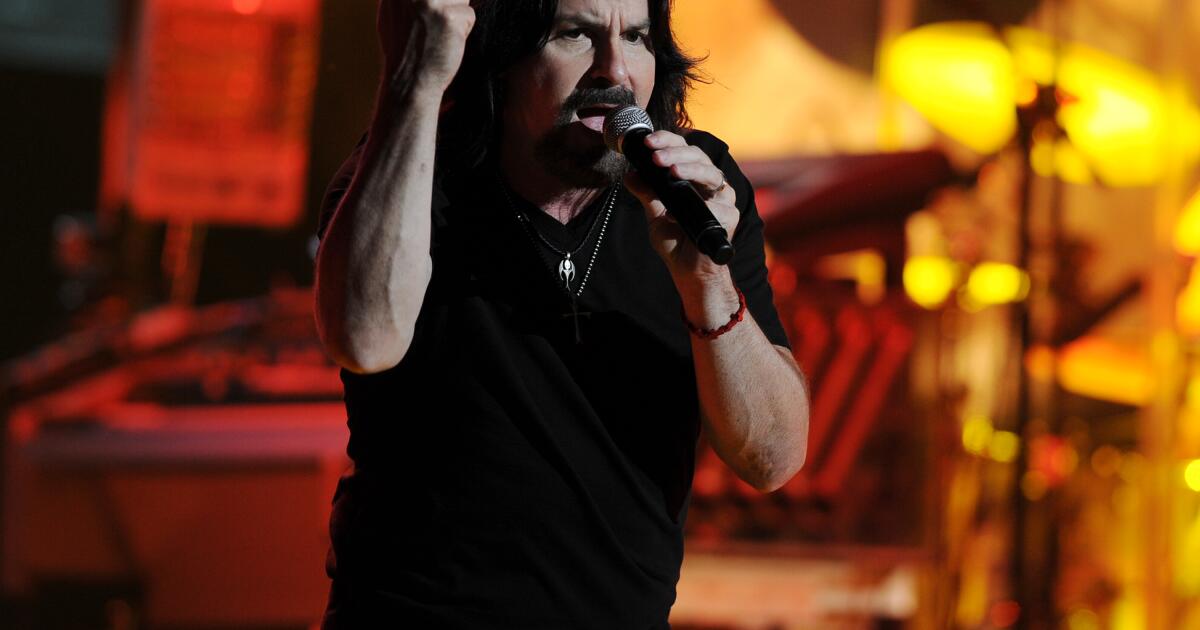
Tommy DeCarlo, a longtime fan of Boston who became the classic rock band’s lead singer in the late 2000s, has died. He was 60.
DeCarlo died Monday following a battle with brain cancer, his family announced on Facebook.
“[H]e fought with incredible strength and courage right up until the very end,” the family’s statement said. “During this difficult time, we kindly ask that friends and fans respect our family’s privacy as we grieve and support one another.”
Born April 23, 1965, in Utica, N.Y., DeCarlo said he first started listening to Boston — the 1970s rock band known for its instrumental overtures and hits including “More Than a Feeling,” “Don’t Look Back” and “Peace of Mind” — as a young teenager, according to the group’s website. The vocalist credited his love for Boston’s original frontman Brad Delp and his desire to sing along with him on the radio for helping to develop his own singing voice.
After Delp’s death in 2007, DeCarlo, then a manager at a Home Depot, sent a link to his MySpace page filled with Boston covers as well as an original song in tribute to Delp to the Boston camp, hoping for a chance to participate in a tribute show for the singer. They kindly turned down his offer.
But eventually, Boston founder and lead songwriter Tom Scholz heard DeCarlo’s cover of “Don’t Look Back” and invited the singer to perform a few songs with the band at the tribute. That tribute show would be DeCarlo’s first time ever performing with any band in front of a crowd, but it wouldn’t be his last. He continued to perform with the band at live shows for years, and even joined them on some tracks for their 2013 album, “Life, Love & Hope.”
DeCarlo also formed the band Decarlo with his son, guitarist Tommy DeCarlo Jr. In October, the singer announced he was stepping away from performing due to “unexpected health issues.”
“[P]erforming and sharing music with all of you around the world has been one of the greatest joys of my life,” DeCarlo wrote in his Facebook post. “I can’t thank you all enough for the incredible love, support, and understanding you’ve shown me and my family during this time. It truly means the world to us.”
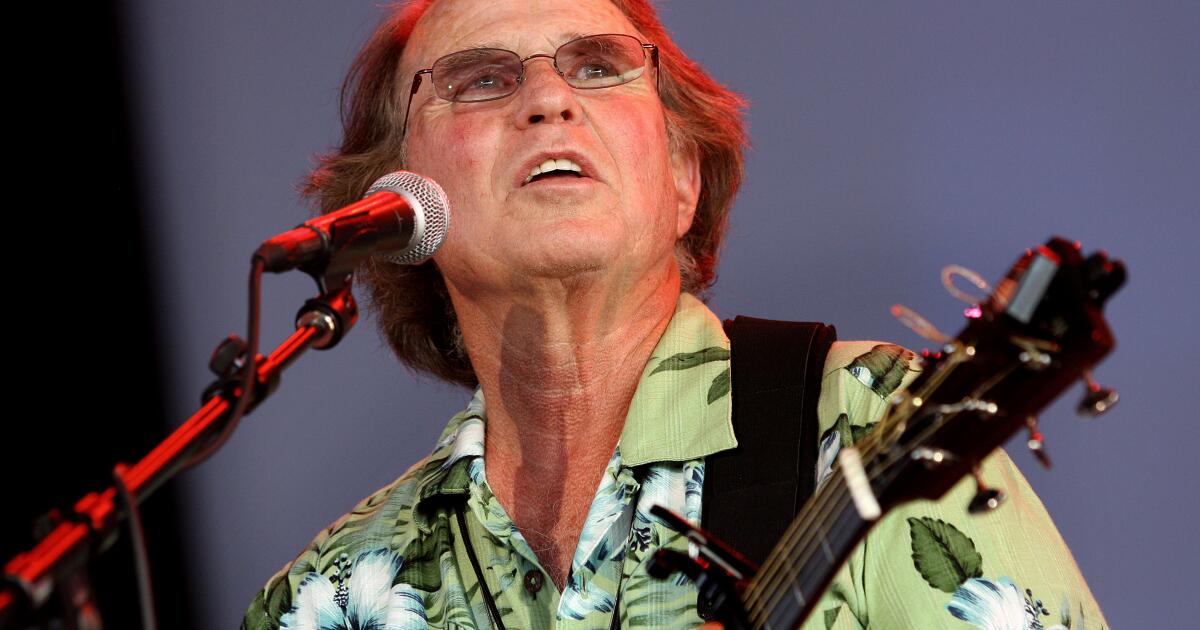
Joe McDonald, lead singer and songwriter of Country Joe and the Fish — the band known for its resounding anti-war chant at Woodstock — has died. He was 84.
His wife, Kathy McDonald, announced his death Sunday morning. He died Saturday in his Berkeley home due to complications from Parkinson’s disease.
As a formative member of the American counterculture in the 1960s and ‘70s, McDonald leaves a legacy of bridging contemporary political satire and brazen anti-war sentiments with the early sounds of acid rock.
“We’re just so proud of him. He’s our hero. He instilled in us that we have to speak up when we can, on whatever platform we can, about issues that we feel are important,” said his daughter Seven McDonald, a film producer, music manager and writer.
“While he was a very serious, earnest activist, he also had such an acute sense of cynical humor that is so fantastic and was capable of scathing satire,” her brother Devin added. “He’s most famous for that, but he also did so many heartfelt benefits for different causes.”
The siblings, who spent their childhoods on the road and in recording studios with him, joke that he was always doing a benefit show.
The musician was born on Jan. 1, 1942, in Washington to Worden McDonald and activist Florence (Plotnik) McDonald, who were both members of the Communist Party. The family soon moved to the Southern California city of El Monte, where Joe McDonald was raised.
His musical roots reach back to when his father taught him to play the guitar at 7 years old. But before embarking on his career in music, McDonald enlisted in the Navy at age 17. He served as an air traffic controller at the Atsugi, Japan, air facility for three years. Upon coming back to the states, he tried out college for a short time before dropping out and moving to Berkeley.
Before experimenting with an early variation of Country Joe and the Fish alongside guitarist Barry Melton in the mid-1960s, McDonald started a small magazine called Rag Baby. Once the group was solidified, they decided to turn their folksy roots electric and made the move to San Francisco — just before the city’s legendary Summer of Love.
The group, born out of the Bay Area psychedelic rock scene, was soon signed by Vanguard Records and in 1967 released its debut album “Electric Music for the Mind and Body.” At the time the band’s label and producer were hesitant to let the musicians fully express their politics, and excluded the soon-to-be-hit anti-war anthem “I-Feel-Like-I’m-Fixin’-to-Die Rag” with the catchy chorus that began, “And it’s 1, 2, 3 what are we fighting for?”
Instead, they went with tracks like “Superbird,” a spoof of President Lyndon B. Johnson, which received little to no backlash. When the second album came around, the band was allowed to run with “I-Feel-Like-I’m-Fixin’-to-Die Rag” as the title track. Trouble started to arise with the anti-Vietnam war anthem when the group changed the beginning chant of F-I-S-H to a more profane four letter word that starts with an “F.”
They performed this altered cheer at a gig in Massachusetts, where McDonald received a charge for inciting an audience to lewd behavior and a $500 fine. With this police run-in, Country Joe and the Fish received a slew of press, riling up the public ahead of their Woodstock performance.
The moment the band members began this chant at Woodstock became arguably the biggest moment of their careers, with over 400,000 people joining in. It’s a moment of protest that has gone down in history.
Not long after the festival, the band went their separate ways. McDonald continued to release solo music that stuck with the similar themes of politics and the Vietnam War.
“He took the toll for taking the stand,” said Seven. “He was not the biggest pop star, because he just opted to speak his mind and do his thing.”
In 1986, McDonald released “Vietnam Experience,” an album full of songs analyzing its long-term impacts on his generation. And in 1995 he was “the driving force” according to an Associated Press story, behind a war memorial to honor Berkeley veterans killed in the Vietnam War.
He told The Times in 1986 that he had “an addiction to Vietnam … I’ve been doing work with veterans now for 15 years, and I probably know more about Vietnam veterans than any other person in the entertainment industry.”
“I’ve always believed that the veterans are a basic element to the understanding of war,” he added, “and the understanding of war is the only path to peace.”
McDonald is survived by his wife of 43 years, Kathy; his five children, Seven, Devin, Ryan, Tara Taylor and Emily; a brother, Billy; and four grandchildren.
Hello! I’m Mark Olsen. Welcome to another edition of your regular field guide to a world of Only Good Movies.
If you are anything like me, you felt pretty out of sorts this week, not sure how to process the news that we are suddenly, apparently, a nation again at war. It can make the movies seem frivolous — a glorious, privileged sandbox to stick your head in — but it is also times like these that make them seem most vital and necessary: a place to focus energy and anxiety and maybe figure things out.
I was particularly struck by something New York Times critic Wesley Morris said in an appearance on the podcast “The Big Picture.” He was ostensibly talking about the downside of the Paramount-Warner Bros. merger news (“These people are f— with our dreams here” is how he began) but he landed on why movies matter in their moment, crucial to “how we develop as a culture, how we come to understand ourselves as a people, what this country ought to or should look like 40 years from now.”
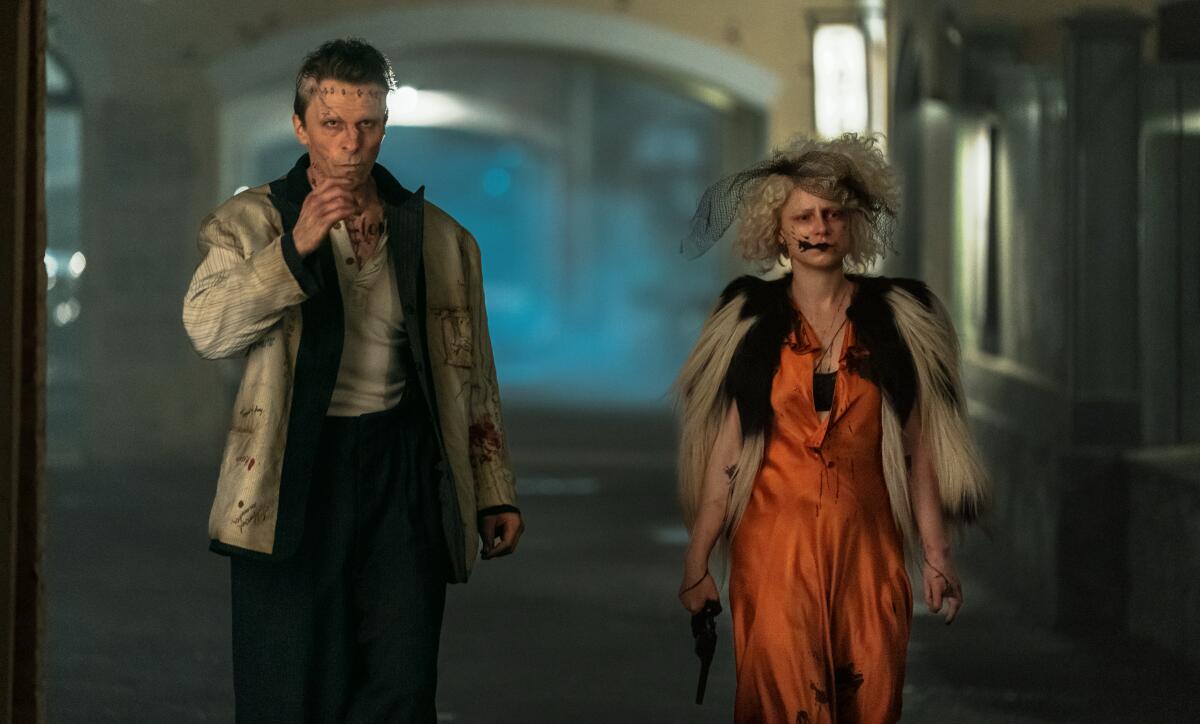
The week’s big new release is Maggie Gyllenhaal’s “The Bride!” a sort-of adaptation of 1935’s “Bride of Frankenstein” starring Jessie Buckley and Christian Bale that is also very much its own thing, purpose-built to drive some people up a tree and already sharply dividing critics.
Christian Bale and Jessie Buckley in the movie “The Bride!”
(Niko Tavernise / Warner Bros. Pictures)
In her largely positive review, Amy Nicholson calls the movie “an unhinged scream,” adding, “‘Every wacky second, you’re well aware how perilously close it is to falling apart at the seams. This spiritual sequel to ‘Frankenstein’ is a romantic tale of obsession, possession and fantasy — adjectives that also apply to its filmmaker, Maggie Gyllenhaal, who expends massive quantities of energy jolting it to life. She succeeds by the skin of her teeth.”
I interviewed Gyllenhaal about “The Bride!” — including the significance of that exclamation point in the title. There have been numerous reports about a back-and-forth between the filmmaker and execs at Warner Bros. and Gyllenhaal didn’t shy away from talking about it. She had specific praise for Pam Abdy, co-chair and co-chief executive of Warner Bros. Motion Picture Group.
“Something really alive was born, and I think the movie is better for the work that she and I did together,” Gyllenhaal told me. “I know that’s an unusual thing to say. I know that you have lots of people saying like, ‘Ah, the studio f— my movie up.’ That is not my experience. It’s really not.”
Louis Malle’s ‘…and the Pursuit of Happiness’
A scene from Louis Malle’s documentary “…and the Pursuit of Happiness.”
(Janus Films)
On Saturday, in a co-presentation of 7th House at the Philosophical Research Society and El Cine, the will be a 16mm screening of director Louis Malle’s 1986 “…and the Pursuit of Happiness,” a documentary made for television that explores the immigrant experience in America. The French-born filmmaker traveled across the U.S. interviewing recent arrivals from all walks of life.
Writing about the film in 1988, The Times’ Kevin Thomas called it “an often amusing and always insightful survey of the contemporary emigre experience. … an irresistible array of vignettes depicting cultural accommodation and assimilation in all its variety.”
I got on a video call this week with 7th House programmer Alex McDonald and El Cine founder Mariana Da Silva to talk about why this movie matters now.
The movie is streaming on the Criterion Channel right now. Why was it important to also put this movie in front of audiences right now?
Alex McDonald: I think Mariana and I are on the same page with this. I never let streaming or home video availability deter programming. Growing up, the theater was a holy place, a cathedral of congregation. I feel like these films are meant to be seen with an audience. And thankfully, I feel like our audience recognizes that as well, even if the film is out there. Particularly in our current moment, it’s a very prescient film and it’s one that will be all the more powerful within community.
Mariana Da Silva: I agree fully. One of the biggest things within our program is the communal aspects — just seeing the same people come back, that trust that develops with the audience. The best part I love about going to movie theaters is standing outside with people I maybe would never speak to and having a conversation about a film.
A scene from Louis Malle’s documentary “…and the Pursuit of Happiness.”
(Janus Films)
Do you respond to a movie like this as a sort of time capsule of how things were, or is it important to you that it is saying something about what’s happening right now?
McDonald: That’s something I’m very conscious of when I program repertory titles. When I program social, politically minded films, a lot of what I’m trying to do is to show that the issues within these things have not really changed — the ways in which things have progressed, the way in which we have regressed. Malle has such a humane view on all of these people in the film. He narrates but he doesn’t really editorialize. He just sort of observes, and in doing so, he’s making the most compelling argument for the richness of diversity and everything that these people contribute to this country, what they lose in assimilation, what they have to give up and what they bring. There’s a complexity to it. There are certainly dissenting voices in it and those resonate differently now.
It wasn’t perfect then. Obviously, there’s always been conflict, but I think there was an open-heartedness that has really shifted. And this is kind of a poignant reminder of what we need to try to get back to and recognize.
Da Silva: If we were able to have these conversations more openly, it would put us all on an even playing field. Humans are flawed. There’s been a lot of miseducation. In this moment, especially for me as somebody who is an immigrant, I feel like there’s so many people who I know who are so liberal and so aware, but then they don’t really understand the experience of the immigrant. And it’s not their fault in any capacity. They just haven’t been exposed to somebody like me before.
I think we can all come together on the things we celebrate, but we also need to be very open and come together on the things that we differ on too.
Points of interest
‘Good Night, and Good Luck’ in 35mm
George Clooney, left, and David Strathairn in the 2005 movie “Good Night, and Good Luck.”
(Melinda Sue Gordon / Warner Independent Pictures)
On Sunday afternoon at the Los Feliz Theater, as part of the American Cinematheque’s ongoing “Sunday Print Edition” series, there will be a 35mm screening of George Clooney’s “Good Night, and Good Luck,” introduced by The Times’ own Rosanna Xia.
Starring David Strathairn as pioneering television journalist Edward R. Murrow at the height of the McCarthy era, the film was nominated for six Oscars, including picture, director, actor and original screenplay.
As Kenneth Turan wrote in his original review, “‘Good Night, and Good Luck’ couldn’t be more unlikely, more unfashionable — or more compelling. Everything about it — its look, its style, even its sound — stands in stark opposition to the trends of the moment. Yet by sticking to events that are half a century old, it tells a story whose implications for today are inescapable. … The son of a TV anchorman, Clooney had the nerve to believe that a drama of ideas could be as entertaining as ‘Desperate Housewives.’ He insisted that a fight for America’s soul, a clash of values over critical intellectual issues like freedom of the press and the excesses of government, had an inherent intensity that would carry everything before it. And it does.”
‘Days and Nights in the Forest’ 4K restoration
An image from Satyajit Ray’s 1970 drama “Days and Nights in the Forest.”
(Janus Films)
Now playing at the Laemmle Royal in a new 4K restoration undertaken by the Film Foundation is Satyajit Ray’s 1970 “Days and Nights in the Forest.” In this examination of masculinity and class, four male friends drive from the bustling city of Kolkata to a rural village, mixing with the locals with volatile results.
In a special video introduction, Wes Anderson, a longtime admirer of Ray, admits he lifted a scene from “Days and Nights” for one of his own films — 2023’s “Asteroid City” — and says, “Anything by Satyajit Ray must be cherished and preserved, but ‘Days and Nights in the Forest,’ I think you will agree, is one of the special gems among his many treasures.”
‘Grease 2’ returns
Michelle Pfeiffer on the set of “Grease 2” in 1981.
(Vinnie Zuffante / Getty Images)
The Cinematic Void series at the American Cinematheque will show 1982’s pastiche musical “Grease 2” on Monday. Directed by choreographer-turned-filmmaker Patricia Birch, the film is, of course, a sequel to 1978’s megahit “Grease” but it is also very much its own thing. Largely dismissed on initial release, it has found a growing following over the years thanks in large part to its extremely engaging young cast, including an on-the-rise Michelle Pfeiffer.
In his initial review (more complementary than one might expect), Kevin Thomas wrote, “There’s so much youthful talent and vitality in ‘Grease 2’ that it’s depressing to discover it is so unblushing and relentless and paean to ignorance. … This is a pity, because Birch displays an organic sense of how to make dance evolve out of the kids’ everyday activities — converging en mass at Rydell High on the first day of school or having fun at the bowling alley. But Birch has scant opportunity beyond letting us know she cares for these ignoramuses, most of who seem likable enough beneath aggressively crude exteriors.”
Anti-fascist films at UCLA
Ingrid Bergman and Charles Boyer in the 1948 drama “Arch of Triumph.”
(Enterprise-UA / Photofest)
The ongoing series at the UCLA Film and Television Archive titled “From John Doe to Lonesome Rhodes: Anti-fascism from the Archive” hits a real stride this weekend for two nights of restored rarities. On Friday comes a restored 35mm print of 1948’s “Arch of Triumph,” directed by Lewis Milestone and starring Ingrid Bergman, Charles Boyer and Charles Laughton in a romantic drama of refugees in 1938 Paris. Also playing is Arthur Ripley’s rare 1944 emigree drama “Voice in the Wind.”
Much of the press around the film at the time of its release had to do with the challenge of bringing the racier aspects of the novel by Erich Maria Remarque (“All Quiet on the Western Front”) to the screen. As producer David Lewis told The Times’ Philip K. Scheuer, “I promise you that as Joan, Ingrid Bergman will set the town on its ear. They’ll never think of her as anything but sexy again.”
Saturday brings the world premiere of the 35mm restoration of Walter Comes’ 1947 “The Burning Cross,” in which a returning veteran is recruited into the KKK. John Reinhardt’s 1948 “Open Secret,” about antisemitism, will also play in a 35mm restoration.
The series concludes next week with a 35mm screening of Elia Kazan’s 1957 “A Face in the Crowd,” starring Andy Griffith in an examination of the dark side of populist politics and media manipulation.