The new parents shared their happy life update in a joint Instagram post Monday featuring the public social media debut of their new bundle of joy.
“We took Labor Day literally this year,” Palvin wrote in the caption accompanying a photo of she and Sprouse holding their baby girl between them. The snapshot captured the family of three from the back as they watch a Dodgers game on TV while wearing matching jerseys.
The model debuted her baby bump in May at the Cannes Film Festival, where the couple posed together while walking a red carpet. They also announced that they were expecting on social media. Sprouse later shared in a July episode of his “Wildmen” podcast that they would be having a baby girl and that he was “excited to be a girl dad.”
On Tuesday, the actor once again took to his podcast to share some new tidbits about his daughter and life as a new parent.
“She’s very lovely, her name is Sylvie,” Sprouse said of his daughter. “Sylvie Sprouse. And she’s a very well-behaved baby.”
The former Disney Channel star also shared some details about Sylvie’s birth including some of the different options at Cedars-Sinai Medical Center.
“There’s moments when I look at Sylvie and I’m like, ‘This is the coolest thing ever,’” Sprouse said of being a new dad. “She’s looking at me and her eyes are opening … she’s looking at me and she smiles or something and it’s the cutest thing. My heart like jumps out of its chest.”
The “Suite Life of Zack & Cody” star and Victoria’s Secret model first met in 2017 and have been in a relationship since 2018. They were married in 2023.
“Real Housewives of New Jersey” star Teresa Giudice is asking for privacy for her daughter Milania Guidice after an incident at the airport resulted in police intervention.
On Wednesday, Tampa International Airport police were called to step in when Milania, 20, reportedly became emotional and ran away from her reality star mom, older sister, Gia Giudice, and a counselor traveling with the family. Police bodycam footage, obtained by TMZ, revealed the family was fighting over a recent health scare involving Milania.
In the video, the family is in an elevator with police, and Teresa is heard explaining that her daughter “had fentanyl in her system” and that she wants to save her daughter’s life. “You’re reckless,” Teresa says to Milania. “After you get help, you never have to speak to me again.”
Milania retorted that she “was laced” and said, “I go to college.” Milania, who attends the University of Tampa, then asked if she was going to be placed “back in the psych ward.” Earlier in the clip, a police officer is heard explaining that Milania had been released from a Baker Act facility and was being transported to a rehabilitation facility.
“As a mother, there is nothing more important to me than the health, safety, and well-being of my children,” Teresa wrote in a statement on Instagram on Monday. “The past few months have been incredibly difficult for our family, and I feel it is important to say something while also protecting my daughter during an extremely vulnerable time in her life.
“Milania has experienced tremendous heartbreak and significant psychological trauma after losing two of her best friends. Grief affects everyone differently, and watching your child try to process that kind of loss is something no parent can ever truly prepare for.”
In July, Milania’s best friend, Victoria Zardoya, died on a weekend trip to Tampa, during which the 20-year-old sustained fatal injuries when she fell while exploring the ruins of Ft. Dade from the Spanish-American War with a group of friends.
It’s unclear who the second friend is.
“Right now, my only focus is my daughter — making sure she is surrounded by love, family, support, and the care she needs,” Teresa’s statement continued. “I understand that because our family has lived much of our lives in the public eye, there will naturally be questions and speculation. But Milania is my daughter before she is anything else. She is a young woman going through an incredibly difficult and deeply personal time, and she deserves the opportunity to heal without every moment of her pain being analyzed publicly.
“I am asking, from one mother to another, and from one family to all of you, to please show Milania compassion and kindness and allow her the privacy she needs right now,” the statement concluded.
In May, Milania was arrested and charged with simple assault after an incident at the New Jersey home of Teresa and Luis “Louie” Ruelas, Milania’s stepdad. Milania allegedly punched someone in the forehead, who was referred to in court by the initials “LR.”
If found guilty, she faces up to six months in jail, probation and a $500 fine. Her next hearing is Tuesday.
Kelsey Parker has been seen on her first family outing with newborn daughter RiverCredit: Click News and MediaShe revealed last week her and boyfriend Will Lindsay had welcomed their little oneCredit: Click News and Media
River’s birth came after the devastating loss of Kelsey’s son Phoenix, who was stillborn shortly before his due date last year.
Kelsey – who shares Aurelia, six, and Bodhi, five, with late husband Tom – appeared ever the doting mum on an outing with her family this weekend.
Sign up for the Showbiz newsletter
Thank you!
Enjoying a day out to the park near their South London home, Kelsey was seen planting a kiss on daughter River’s head.
The newborn was sweetly dressed in a white babygrow and hat, as older sister Aurelia helped cradle her.
Eldest daughter Aurelia was ever the doting sister on the outingCredit: Click News and MediaKelsey welcomed Aurelia and Bodhi with her late husband Tom ParkerCredit: Click News and MediaIt’s the first time the family have been seen publicly since announcing River’s birthCredit: Click News and MediaWill appears to be stepping in to fatherhood smoothly with Kelsey by his sideCredit: Click News and Media
In more snaps from the day out, Kelsey was glowing as she pushed River around in a pram while new dad Will wrapped his arm around her.
Aurelia and Bodhi joyfully walked beside the couple.
Last week, Kelsey confirmed her daughter had arrived safely as she said via Instagram: “Welcome to the world, River. Our little bit of hope.”
Kelsey was married to singer Tom from 2018 up until his death four years ago.
He passed following a two-year battle with terminal brain cancer.
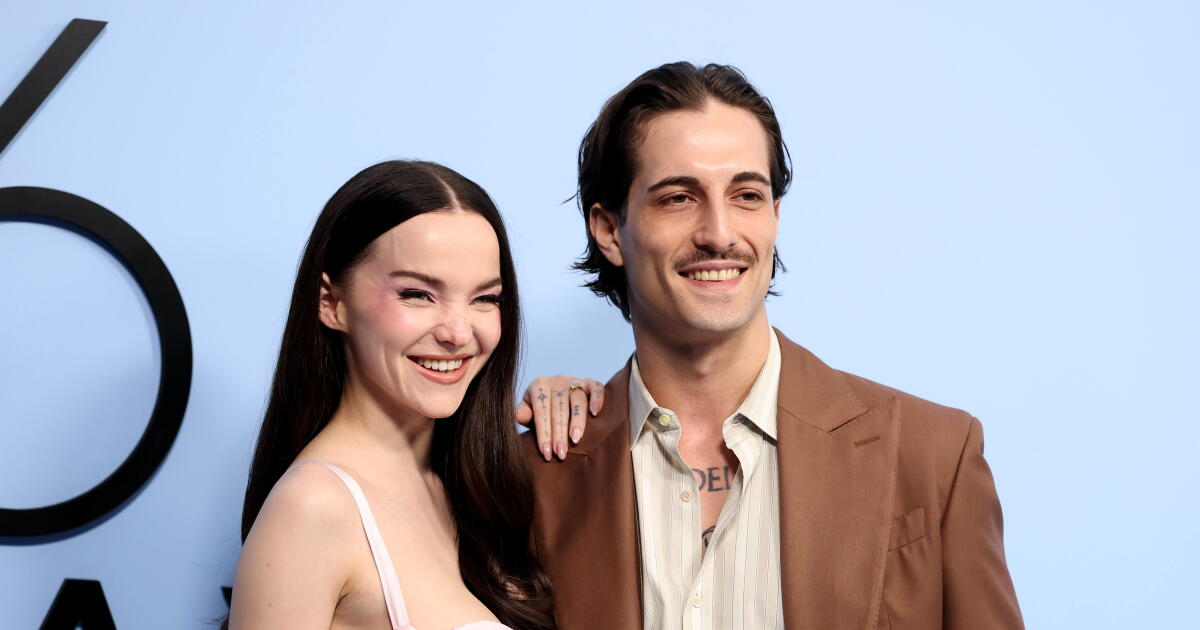
Dove Cameron and Damiano David have tied the knot!
The 30-year-old former Disney star and pop starlet married the 27-year-old Italian rock singer in a civil ceremony Thursday at the town hall in Montalcino, Italy, per Vogue, which first shared details of their nuptials.
The couple began dating in 2023 after meeting at the MTV Video Music Awards a year prior, where they were both contending for best new artist — Cameron took home the prize.
After a long stretch on Disney playing identical twins on the show “Liv and Maddie” and the daughter of Maleficent and Hades in the “Descendants” film series, Cameron successfully entered the mainstream music landscape with her sultry vocal flair. In 2022, she released the smoky electro-pop, queer anthem “Boyfriend,” which reached No. 16 on the Billboard Hot 100 chart, and the theatrical “Breakfast,” a man-eater melody that declares she’s in charge.
David is the frontman of the Italian rock band Måneskin, which formed in Rome in 2016 and won the Eurovision Song Contest in 2021 with their song “Zitti e Buoni.” Now David is focused on his solo career; in 2025 he released his debut album, “Funny Little Fears,” which reached critical acclaim on various European charts, reaching gold status in France, Italy and Poland.
Cameron revealed the pair’s engagement in January, uploading a picture to her Instagram account that zoomed in on the engagement ring. The proposal took place in an “intimate moment” back in October 2025, the “56 Days” star would later tell Vogue in a Jan. 26 article.
The couple — who live in a quiet Rome neighborhood — kept hush about the wedding plan details, sharing with Vogue earlier this month only that a date was set for September.
ZAYN Malik has shared rare snaps of the daughter he shares with Gigi Hadid as the youngster turned six over the weekend.
Taking to social media to give fans a glimpse inside Khai’s special day, the former One Direction star posted pictures from the celebrations, although his ex Gigi couldn’t be seen.
Zayn shared some rare snaps from daughter Khai’s sixth birthday celebrationsCredit: InstagramZayn lit the candles on Khai’s towering birthday cakeCredit: Instagram
The 33-year-old wrote: “Khai’s 6th birthday this weekend!! Big thank you to everyone who made it extra special.
“@americandream – Nickelodeon Universe & Hasbro Arcade. The girls had the BEST time! And… @thelondonbaker the cake is epic, as always. Thank you!”
Sign up for the Showbiz newsletter
Thank you!
Zayn and Gigi’s only child could be seen surrounded by friends as she blew out the candles on a towering birthday cake.
Other snaps showed Khai playing arcade games and celebrating beside mountains of colourful balloons.
Khai blew out the candles on a towering birthday cake surrounded by friendsCredit: InstagramThe youngster enjoyed a fun-filled day at Nickelodeon UniverseCredit: InstagramKhai was treated to an epic birthday cake as she turned sixCredit: InstagramZayn and Gigi pictured together in 2016 before their splitCredit: Getty
Born into an African American family with a grim history of enslavement, Marian Anderson was determined from an early age to master the art of singing for the concert hall. A contralto of great range and warmth, Anderson’s abundant gifts as a performer of spirituals, arias and German Leider brought her global fame even as she endured the indignities of racial discrimination at home. Her Easter Sunday performance at the Lincoln Memorial in 1939 in front of 75,000 spectators remains a touchstone of defiance in an age of racial violence.
Anthony Tommasini’s excellent biography of Anderson, “Voice of A Century,” reclaims the singer as a great artist who only embraced her power as a symbol of racial equality much later in life. I spoke with Tommasini about Anderson, Franz Schubert and Albert Einstein.
You’re reading Book Club
An exclusive look at what we’re reading, book club events and our latest author interviews.
By continuing, you agree to our Terms of Service, which include arbitration and a class action waiver. You agree that we and our third-party vendors may collect and use your information, including through cookies, pixels and similar technologies, for the purposes set forth in our Privacy Policy such as personalizing your experience and ads.
✍️ Author Chat
Anthony Tommasini’s biography reclaims Anderson as a great artist who embraced her power as a symbol of racial equality later in life.
(Ahna Tessler Photography)
I feel like people know Marian Anderson in the abstract, but they regard her as a symbol rather than an artist. And among the virtues of your book is that you reestablish Anderson’s legacy as a great singer and performer.
She was a contralto, which is the lowest female vocal register. But that register had such resonance, and she had complete control over it. She also had enormous range; the uncanny, beautiful thing about Anderson’s voice is that when she started ascending even into the soprano sphere, she held those notes so beautifully. They were emanating from below, grounded in that low voice. It made for a mesmerizing sound. I’ve made a playlist to accompany the book.
She embodied this kind of fierce dignity and grace in the face of racial discrimination. But as you point out, she was reluctant to make herself a symbol of the civil rights movement, preferring to let audiences focus on her artistry.
In 1939, she was banned from performing in Washington’s Constitution Hall because of her race, and her manager, with help from Eleanor Roosevelt, arranged a performance in front of the Lincoln Memorial on Easter Sunday. Yet, the night before the performance, she was trying to get out of it. She felt the whole affair had turned into a civil rights demonstration. When it came time to write her memoirs in 1956, she wanted to excise the event from the book. She felt that what she could do is be an example of excellence and possibility for aspiring black artists.
She did play to segregated audiences, even long after she had become a national star.
[This type of segregated performance featured what] was called vertical seating. But she refused to forsake her career, which she had worked so hard to attain, and so she played these segregated shows. Eventually, there was a performance in Virginia which was boycotted, and that sort of broke the trend. She then performed in front of an integrated audience in Florida.
There is an encounter with Albert Einstein, of all people, who counsels her to take a stand against these racist booking policies.
In 1937, she showed up for a concert in Princeton, New Jersey, only to discover she was being refused a room at the Nassau Inn. As it turns out, she had a friend in Princeton who had seen her at Carnegie Hall and had meekly gone backstage to meet her. This was Albert Einstein, who was teaching at Princeton University at the time, and who offered to put Anderson up for the night at his house. He really pressed her on being more outspoken on racial equality.
Anderson played Europe multiple times in the 1930s, right before the rise of Hitler and the Third Reich. As you write, German audiences were blown away by Anderson’s mastery of their music, specifically Franz Schubert’s Lieder, or art songs, which were among Anderson’s most beloved repertoire.
So extraordinary, right? She also made two tours of the Soviet Union during that time. They went crazy for her in the Scandinavian countries, as well. But for the German audiences who are so nationalistic about their Leider, it was confusing. They couldn’t imagine how a Black American woman could sing their music so beautifully.
Anderson was the first Black soloist to perform at the Metropolitan Opera in New York, in Verdi’s opera Un ballo in maschera.
That was really a huge risk and a huge leap for her. She wasn’t a trained opera singer, and she had to dig deep into that material. She was already 58 by that time. There is a radio recording of the performance. There’s this dignity, like she’s calling upon this power. It’s exhausting and it’s draining, but it’s also exhilarating.
This Q&A was edited for length and clarity.
📰 The Week(s) in Books
Book jacket for “Body Language” by Meg Howrey
(Los Angeles Times illustration; jacket from Doubleday)
Marlon James has published his highly anticipated new novel “The Disappearers,” a sprawling story about gay culture in ’80s Jamaica, and Mark Athitakis is quite taken with it. “James is … determined to unwind the cliches of gay fiction: the tragic victim, the heartwarming gestures of solidarity, the blunt porniness,” he writes. “Mere survival will have to be enough for most of these characters; the sense of fear is pervasive, but so is a determination to work through it.”
What’s it like to be the primary dissenting liberal voice on Fox News? Stephen Battaglio found out when he talked to Jesssica Tarlov about her hybrid memoir and self-help book “I Disagree.” “I have a good amount of shyness to me,” she tells Battaglio. “I have a lot of imposter syndrome. I’m constantly in wonder that I ended up getting to do this and that hopefully, am the right person to do it.”
Finally, Emily Wilson, the classicist who has been a lightning rod of controversy over her disparaging remarks in regard to the film version of “The Odyssey,” is going to translate Homer’s epic for a second time, reports Emily St. Martin.
📖 Bookstore Faves
The Hammer Museum’s gift shop is one of the best art book shops in L.A.
(Eric Petschek)
Sure, the Hammer Museum’s gift shop stocks the requisite art-themed mugs, tea towels and tchotchkes, but it’s also one of the best art book shops in L.A. Inside the sleekly designed Hammer Store is a vast inventory of monographs, children’s books and critical texts about modern and contemporary art. In an email exchange, store managers Sara Beattie and Brooke Berlin tell us what museumgoers are buying right now.
Hammer’s store is really the best museum bookshop in L.A. How do you decide what to put on the shelves?
We’re an eclectic bunch of book nerds and love the written word. We start by looking at upcoming programming, exhibitions and the season, and we buy accordingly. And we have a great team that gives us suggestions. We’ve learned to trust our instincts. The Hammer is an experimental institution, and we approach our buying in that spirit.
Do you have patrons that are not necessarily there to check out museum exhibits?
Of course! We’re not only a museum, but a cultural center, which means there’s always something happening — like mindful meditation on Thursdays, or family programming on weekends, or people coming in just to enjoy a meal at Lulu.
What kinds of books tend to do well for you?
Art monographs, especially on contemporary or Los Angeles artists; books about living more conscientiously; and everyone loves a children’s book (even if it’s just to heal your inner child). We love finding unique books that can’t be found elsewhere. Whenever we can, we work with small presses and book distributors. They often make books that can only fully be enjoyed or understood by seeing them in person.
Is there any particular title that is presently selling well?
Why do we still enjoy art books, when we can look at millions of paintings and sculptures on the internet?
Why go outside if you can look through a window? There is a lot of talk of people returning to the analog or physical media, and that includes renewed interest in physical books. BookTok is huge. People love talking about books and showing off their special deluxe book editions on TikTok. Art books by their very nature are deluxe, image filled and thoughtfully designed. A well-produced book is an art object in itself. Nothing beats the experience of paging through a beautiful book. That experience can’t be replicated on a screen.
The Hammer Museum store is located at 10899 Wilshire Blvd., Los Angeles.
LILA Moss stole the show at H&M’s London Fashion Week show.
The star proved the apple doesn’t fall far from the tree as she followed in her mum Kate Moss’s heeled footsteps and took to the runway.
Lila Moss tole the show at H&M’s London Fashion Week event in a slashed PVC dressCredit: GettyLila is the daughter of famous catwalk star Kate Moss – but is determined to pave her own wayCredit: Getty
I’m told despite being one of the biggest names at the event and being the daughter of an industry legend, Lila refused to have any special treatment.
In fact, sources tell me Lila has secretly been battling vile treatment at shows over the past year due to her nepo-baby status.
Sign up for the Showbiz newsletter
Thank you!
She’s told pals how she has been given “icy treatment or totally ignored” behind the scenes as she battles to carve out a career in her own right.
A source said: “Lila was booked in the standard way, just like all the other models.
“She didn’t ask for any special treatment due to her status—in fact, it’s the opposite.
“Over the past year, she’s confided in pals that many other models give her the cold shoulder or totally ignore her altogether.
“She’s not said these words, but essentially it’s jealousy—people judge her and brand her a nepo before they have even met her.
“Yes, being Kate’s daughter has opened a lot of doors, but Lila wants to be successful in her own right.
A runway mole said that Lila does not get any special treatment on the catwalkCredit: GettyShe’s told pals how she has been given ‘icy treatment or totally ignored’Credit: Splash
“There have been many times over the years where backstage she is left all on her own.”
Lila is the daughter of Kate Moss and magazine editor Jefferson Hack.
In 2018, she was snapped up by Marc Jacobs to front his Marc Jacobs Beauty range.
In 2021, she made her Fashion Week debut by walking for Miu Miu at Paris Fashion Week.
Lila said Kate tried to put her off becoming a model at firstCredit: GettyShe was scared that Lila may fall into the same traps she did in her youthCredit: Getty
Speaking in 2022, Lila admitted her mum tried to put her off modelling.
She told British Vogue: “My mum always put me off.
“She was always like, ‘If you wanna do it, you can, but I wouldn’t recommend it’.
“When I was younger, she was scared that I’d fall into the same trap, I think.”
Kate has previously spoken candidly about the pressures of being a model.
She told Vanity Fair in 2012: “Nobody takes care of you mentally.
“There’s a massive pressure to do what you have to do.”
Thousands of people cheered as they welcomed Syrian icon Assala Nasri back at a sold-out concert in Damascus. She spent more than 15 years in exile after publicly supporting the 2011 uprising against the government of Bashar al-Assad.
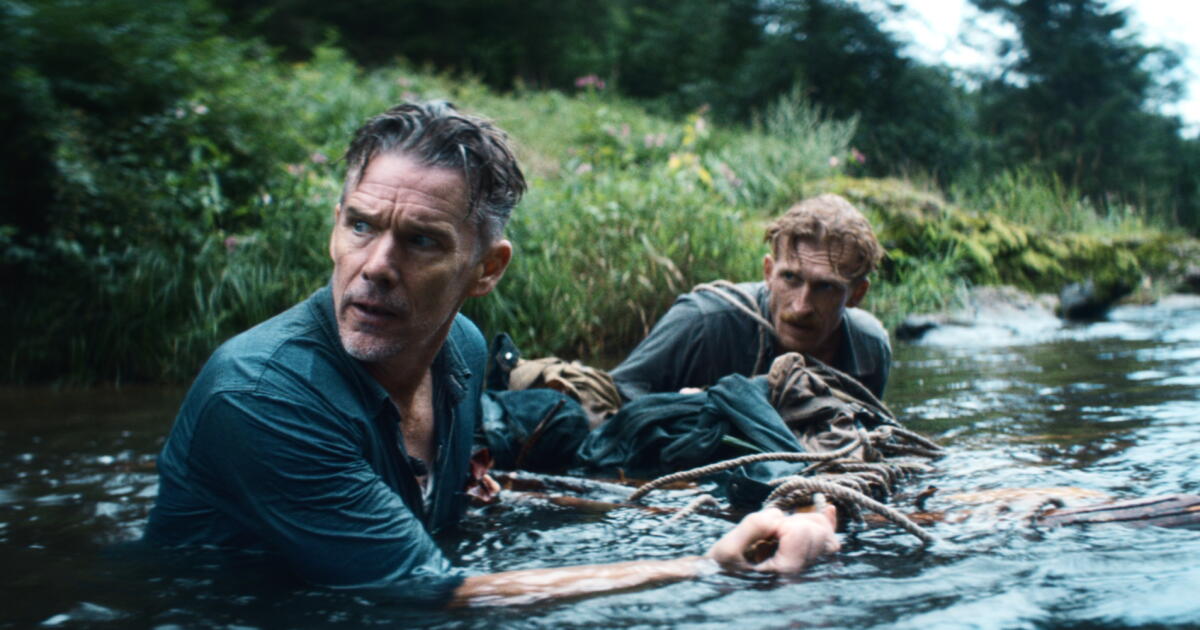
Somewhere in the overlap between William Friedkin’s 1977 action thriller “Sorcerer” and Kelly Reichardt’s 2020 Pacific Northwest pioneer indie “First Cow” lies Padraic McKinley’s directorial debut “The Weight.”
“Sorcerer” is about a group of fugitives driving a load of dynamite across the jungle; “The Weight” follows a group of Depression-era convicts transferring gold through the forest. “First Cow” is about the sweetness of friendship and French pastries in the wilds of Oregon during westward expansion; “The Weight” is about the corrupting forces of capitalism. McKinley’s movie marries the instincts of modern indie filmmaking with a New Hollywood ethos, while bringing an authenticity to the details of the period.
We follow the story of Murphy (Ethan Hawke), a World War I vet and single father in Eugene, Ore., struggling to provide for his daughter, Penny (Avy Berry), three years into the Great Depression. After an unfortunate run-in with the law, Murphy finds himself in a prison labor camp, building a road and trying to shorten his sentence so he can get out before his daughter is adopted by a new family.
Opportunity presents itself in Murphy’s foreman, Clancy (Russell Crowe), who takes a shine to him after he fixes his car and devises an ingenious way to remove boulders without dynamite. Cuddly but dangerous, Clancy makes a seemingly simple offer to Murphy: He and three friends can earn their freedom if they hike a load of gold out of a mining camp on the eve of President Franklin D. Roosevelt confiscation of all gold stockpiles.
The how and why details aren’t that important; the story is merely that the prisoners have to get from point A to point B through a rugged forested terrain, under the watch of two intimidating chaperones, Amis (Sam Hazeldine) and Letender (George Burgess). A mining camp servant, Anna (Julia Jones), joins their group as a runaway and while it seems a straightforward task, the arduous and brutal journey is one that is liable to turn these convicts into runaways.
Murphy’s gang weren’t really outlaws to begin with — he was imprisoned for defending his daughter from some undercover cops, while Singh (Avi Nash) was arrested for his associations with socialism. Olson (Lucas Lynggaard Tønnesen) was part of a group going after a judge for seizing Scandinavian farms, while the most hardened criminal among them is Rankin (Austin Amelio), who grew up in juvie. But in order to survive the woods, Murphy will have to dig deep into his wartime past and rely on his own skills and smarts to make out it out intact.
McKinley pours his craft into authentically representing the era, from the perfectly worn denim of the costumes to the refreshingly real and craggy faces of the cast (and thank goodness Hawke and Crowe are respectably aging into their character-actor looks). The Bavarian forest beautifully stands in for 1930s Oregon and cinematographer Matteo Cocco balances ’70s-inspired slow zooms with composed, high-contrast images that hark to early 20th century styles of photography. A score by Latham and Shelby Gaines balances discordant, atonal tones with suspense-driven sound design that captures the creaking noises of the forest and the concealed dangers it holds.
McKinley stages a few bullet-sweating sequences of peril, including a particularly brutal transport of gold bars across a crumbling rope bridge and an underwater accident exacerbated by floating logs. Both are nail-biters but you can’t help but think he could have pushed it even further. Tonally, the film is torn between wanting to be brutally bleak and offering some kind of hope for Murphy and his precocious, adorable daughter.
When “The Weight” leans into its nasty, mean and grim moments, it gets at something that seems closer to truth than the saccharine resolution we fear is coming. It seems like McKinley wants to deliver a crushing blow, but then feints at the last minute, opting for a more optimistic kind of fantasy.
Politically and culturally, what “The Weight” speaks to is as ugly as the violence that occurs in the mud and fog of the forest. But it ends on an oddly cheery note that doesn’t square with what we’ve seen. It’s a cutesy ’70s nod that feels more “Smokey and the Bandit” than “Sorcerer.” The bolder choice would have been to commit to expressing the despairing lessons of this world. We want to see these characters changed by what they’ve experienced, even if it’s dark. We want to see them actually carry the weight.
Katie Walsh is a Tribune News Service film critic.
‘The Weight’
Rated: R, for language and some violence/bloody images
Coronation Street actress Sally Dynevor has been a Weatherfield icon for more than 40 years
Met Gala: Phoebe Dynevor stuns in custom Victoria Beckham gown
Coronation Street legend Sally Dynevor is not the only actress in her family, and Netflix fans are sure to recognise her eldest daughter.
In 1986, Sally, 63, burst onto screens as Sally Seddon on the long-running ITV soap. She was first seen waiting for a bus when Kevin Webster (played by Michael Le Vell) drove past in his van and accidentally splashed her with water.
Initially, Sally was only supposed to appear on Corrie for a short stint, but she soon became the mechanic’s girlfriend and grew into the funny busybody fans know and love today.
Sally and Kevin welcomed two daughters into the world, but their romance didn’t stand the test of time, and Sally eventually found love with Joe Metcalfe (Joe Duttine).
Away from the ITV soap, life is much simpler for the actress, as she has been married to her screenwriter husband, Tim Dynevor, since 1995.
Happy couple Sally and Tim share three children: daughters Phoebe, 31, and Hattie, 22, and son Sam, 29. Both of the girls have followed in their footsteps and are enjoying careers in television.
Hattie stars on the BBC drama Waterloo Road, playing Libby Guthrie, the daughter of history teacher Neil (Neil Fitzmaurice), and has so far appeared in series 13 – 17.
She also appeared in the recently released gripping Netflix series Legends as Arabella, which also stars Steve Coogan and Tom Burke.
Who is Phoebe Dynevor?
Phoebe launched an acting career on the BBC drama Waterloo Road, playing Siobhan Mailey between 2009 and 2020.
She went on to land the role on the Netflix series Bridgerton, playing Daphne, the wife of Simon Basset, the Duke of Hastings, played by Regé-Jean Page, between 2020 and 2022.
She has since starred in a long list of popular television shows, including The Musketeers, Dickensian, Snatch, and Ten Percent. Away from the small screen, Pheobe has starred in the movies The Colour Room, Inheritance, and Thrash.
Phoebe recently married actor and producer Cameron Fuller at a chateau located in Provence, France. Her husband is the son of producer Brad Fuller, who specialises in horror films, including The Purge franchise and A Nightmare on Elm Street.
On-screen, Cameron, 32, has appeared in shows such as The Last Ship, Insecure, Into the Dark, and The Goldbergs.
He has also worked as a producer on numerous films, including The Astronaut, Dead Sea, and The Girl in the Woods.
Taking to Instagram on Thursday (September 17), the new Mrs. Fuller shared two photographs from the big day, including a black-and-white picture of her and her new husband kissing under a floral-adorned wooden arch. “Married my best friend,” she sweetly captioned the post.
Proud mum Sally was quick to respond, as she gushed in the comments section of her daughter’s post: “Best weekend of our life. Beautiful Phoebe and Cameron. Love you both so much.” Sister Hattie also shared: “The best weekend ever.”
THE daughter of late actress Dame Diana Rigg has admitted to an unusual tribute of eating her ashes prior to live shows.
Rachael Stirling, 49, followed in her acclaimed mother’s footsteps by becoming an actress.
Diana Rigg’s daughter has revealed an unusual tribute to her late motherCredit: GettyRachael Stirling followed in her mother’s footsteps by also becoming an actressCredit: Steve Meddle
Viewers may have seen Rachael pop up in shows including The Bletchley Circle, Detectorists and an episode of Doctor Who alongside Diana.
In her new book, All About My Mother, Rachael opened up about a surprising pre-show ritual.
Sign up for the Showbiz newsletter
Thank you!
She wrote, as quoted by Daily Mail: “I would love to have a nightly glass of champagne before going on stage, but these days it would equate to a drinking problem.”
Rachael’s alternative on a new play’s opening night, however, is “a grain or two of my mother’s ashes“.
Michelle Keegan has shared a rare snap of her daughter, PalmaCredit: Instagram/michkeeganMichelle recently dropped out of a new ITV drama that’s set to begin filming in NovemberCredit: Getty
The 39-year-old leftITVbosses baffled by her decision to turn her back on the lead role in a big budget production, focusing on a working-class barrister.
DJ Mark Wright and actress Michelle Keegan married in 2015Credit: GettyThe 39-year-old withdrew from the new drama as she wanted to ‘focus on her family’Credit: Getty
Sources said it was “a huge blow” as she had committed to the drama a few months ago and a filming start date had been decided.
Michelle, who decided not to go ahead with the series written bySherlockwriter Steve Thompson, has said she wanted to focus on family life.
A source said: “Michelle was really keen to take on the meaty role, but the heavy filming schedule would take her away from daughter Palma for too long.
“The hours were quite intense and the project was starting straight after her Netflix drama The Woods and she just couldn’t commit.
“She is dedicated to her acting career, but like all working mums has to prioritise being there for her family, juggling work, parenting and being present for Palma.”
Mark and Michelle, who married in 2015, live in a £3.5million mansion near his family in Essex.
As a young sportswriter studying journalism at the University of Missouri, Seth Wickersham looked to Los Angeles for inspiration. At the campus bookstore, Wickersham bought his first sportswriting anthology, “The Last of the Best,” a collection of columns from the Los Angeles Times’ Jim Murray, one of four sportswriters ever to win a Pulitzer Prize.
Collections of work from Murray, Rick Reilly, Frank Deford and others offered Wickersham a road map for the career he wanted to build — and he has, with 26 years’ worth of work at ESPN meriting an anthology of his own. “Be on That Hill: Stories From the Summits of Sport,” which will hit bookshelves Sept. 22, is Wickersham’s third book. He said assembling an anthology is both “the coolest thing you could ever imagine happening” and “this weird mind warp.”
“When you’re just on a treadmill like I’ve been, the years just go,” says Wickersham, who’s been covering sports since he was hired by ESPN The Magazine straight out of college. “You don’t realize it, but then you take stock of it, and you’re like, ‘Holy cow, I’ve been doing this 26 years …’ It’s surreal to go back and look at it.”
Football has always been Wickersham’s first love — he weaved his journey as a high school quarterback into “American Kings” — but his latest book features stories about a college basketball coach on the job hunt and an NHL enforcer’s attempts to avoid head injuries.
“I’m trying to write about people who have a certain level of inner turmoil,” Wickersham says, “whether it’s Sean McVay after he wins the Super Bowl, or Jerry Jones when he’s threatening to sue the NFL to stop Roger Goodell from signing a contract extension.”
The sports media industry has changed dramatically since Wickersham’s career began. ESPN The Magazine no longer exists. Access to coaches and players is increasingly hard to secure. But Wickersham’s journalistic goals are the same today as they were when he bought Murray’s anthology.
“I want to be a link on a chain,” he says. “It’s hopefully an installment of a body of work that one day might help me be a link on a chain of the best who did this.”
This Q&A was edited for length and clarity.
You’re reading Book Club
An exclusive look at what we’re reading, book club events and our latest author interviews.
By continuing, you agree to our Terms of Service, which include arbitration and a class action waiver. You agree that we and our third-party vendors may collect and use your information, including through cookies, pixels and similar technologies, for the purposes set forth in our Privacy Policy such as personalizing your experience and ads.
✍️ Author Recommendations
In addition to Jim Murray’s anthology, here are some other sports books that have inspired Wickersham.
“The Breaks of the Game” by David Halberstam: This is the Pulitzer-winning Halberstam’s first sports book, following the 1979-1980 Portland Trail Blazers. “When it comes to trying to decode a team, that’s the standard,” Wickersham says.
“Joe Namath and the Other Guys” by Rick Telander: Namath, the Hall of Fame New York Jets quarterback, serves as an example of quarterbacks’ rising celebrity profile in “American Kings,” and Telander is one of Wickersham’s favorite sportswriters. “The portrait he gave of Joe Namath in his twilight was just so rare,” Wickersham says. “I don’t think a book like that has ever been done.”
“When Nothing Else Matters” by Michael Leahy: Another book about an athlete in his twilight. This one documents Michael Jordan’s time with the Washington Wizards. “He worked his tail off as a reporter and really gave a brutally honest glimpse into what it was like to live and play with Michael Jordan the last few years of his career,” Wickersham says.
“The Franchise” by Michael MacCambridge: Wickersham read this history of Sports Illustrated in college. “It really not only gave a glimpse into how so many of these great stories by my heroes … were done,” he says, “but also how those guys got hired at Sports Illustrated. It was like a job road map.”
📰 The Week(s) in Books
Our fall book recommendations answer your call for learning and discovery this season.
(Kissi Ussuki / For The Times)
Our Fall Preview includes 29 books to keep on your radar this fall, as well as television and movies we’re excited about.
This week, we caught up with Raine De Leon, owner of Sons and Daughters Books, a formerly online bookstore that opened a brick-and-mortar location earlier this year. Here’s what they had to say about their IRL location, the local bookshops that inspired them and more.
This interview was edited for brevity and clarity.
Your bookstore began as an online store in 2024. What motivated you to open an online store? How did it grow from there?
A brick-and-mortar was always the end goal, since I wanted a physical space for writers, readers and other artists to come together for events and community building. Originally, the online store was actually an online poetry journal, where I published poets from around the world, wrote reviews, and held virtual readings. I wanted to translate that into an in-person experience.
What other bookstores, in Los Angeles or elsewhere, served as inspiration for the type of bookstore you wanted to open?
Skylight Books in Los Feliz and Village Well Books and Coffee in Culver City really inspired how I wanted the store to feel: warm, inviting and dynamic enough to serve both a neighborhood and a larger L.A. audience. I took inspiration from the Painted Porch in Texas in regard to curating the selection of books in the store. City Lights in San Francisco was also a huge inspiration for not only my store, but my life in general. The place it holds in the history of its community, the history of publishing and the history of poetry are profound, and I am trying to emulate that legacy as best I can.
What inspired the name Sons and Daughters Books?
The poet Charles Olson wrote a landmark essay, “Projective Verse,” in 1950. In it, he talks about poetic lineage and influence, and he says something to the effect of “We are the sons of the poets who came before us,” and that really spoke to me. I expanded it out to “Sons and Daughters,” with that same sentiment, to be a little more inclusive.
What type of selection can people expect at Sons and Daughters Books?
Our selection is almost all new books with focus on fiction, poetry, social sciences and more. We also have a cart of used books out on the floor every day, and on Sundays I bring out two more carts of used books.
For the new books, I selected each book in the store myself. I may not have read every book on these shelves, but I went line by line in our inventory sheets to select books that I wanted people to be aware of. Even though I am the only staff member, our “Staff Rec” table features reviews and picks from those closest to me. I wanted our selection to be extremely specific to me, my loved ones and the community the store is now in.
In the time you’ve been open, what events have been the most popular? Any particular upcoming events you’re excited about?
Our two most popular events are definitely our weekly stand-up comedy open mic night and our thriller book club.
September is our fullest month yet in regard to events, and I’m very excited for a few. We have two book launch events. The one on Sept. 26 is for “Valley Girl Manifesto” by Noelle Cope, a collection of both poetry and prose. The other, on Sept. 19, is for “Anger Is a Gift,” a new poetry anthology from FlowerSong Press. Both celebrate poetry, locality and connection.
Our full events calendar, which continues to grow, also features community workshops, silent reading clubs and more.
Sons & Daughters is located at 7817 Melrose Ave., Los Angeles.
A few months after Mark Walter became the chairman and majority owner of the Dodgers, he was told a fan in one of Dodger Stadium’s upper decks was upset about a mix-up with his tickets.
On most days, that would be an issue for an usher to handle. Not on this day.
Walter and team president Stan Kasten decided to address the problem, climbing the narrow stairwell to the top level where they found the fan and listened to his complaint.
“Obviously the guy was floored just to see me, let alone to see Mark,” Kasten said. “Mark, he’s incredibly comfortable around people. Not just his peers, but average fans. Because he considers himself an average fan.”
The Dodgers’ billionaire owner, hardly an average fan, is under intense scrutiny these days, following the sale of his controlling interest in the Lakers and a federal investigation into his business dealings. The drama has come as a surprise to some who know Walter, who has earned respect for his financial acumen and, despite his purchases of high-profile sports teams, has tended to dodge publicity.
He put together the ownership group that bought the Dodgers in 2012. Since the purchase, the team has played in five World Series, winning three, and finished first in the National League West 12 times in 14 seasons. It’s the greatest sustained run of excellence in baseball in more than a generation.
Walter waves to the crowd during the Dodgers’ ring ceremony in March.
(Jessie Alcheh/MLB Photos via Getty Images)
If the Dodgers win a third straight World Series this fall, they will become the first team to three-peat this century. And much of the credit for that would go to Walter, who has funded a front office that consistently has outspent the rest of Major League Baseball, signing seven players to contracts worth more than $2 billion combined in the last six years alone.
Now Walter faces questions about his future owning the Dodgers. Last month, his companies became the focus of two federal inquiries and a Delaware insurance regulatory review.
He is helping pay off some of his companies’ loans and sold the Lakers at a record valuation of $12.5 billion, a deal Walter’s holding company, TWG Global, says was not forced by the inquiries. Still, the sale raised questions about whether he will sell his ownership stakes in other sports properties, including English soccer club Chelsea, the Cadillac Formula One racing team, the WNBA’s Sparks and the Professional Women’s Hockey League.
Walter declined to comment for this article.
Kasten insists Walter has no plans to divest from the Dodgers. “The sports portfolio is going to remain intact,” Kasten said. “It’s important to Mark. I can’t tell you how important the Dodgers are to him.”
Still, Kasten acknowledges the decision to sell the Lakers to former Disney chief executive Bob Iger and venture capitalist Joshua Kushner just 14 months after agreeing to buy the team “was not a planned thing,” either.
Walter hoists the World Series trophy next to MLB Commissioner Rob Manfred last November.
(Rob Tringali/MLB Photos via Getty Images)
Like most of the middle-class kids in the class of 1978 at Jefferson High in Cedar Rapids, Iowa, Walter worked in high school.
“He pumped gas and he played golf,” recalled Cathy Boland Polito, Walter’s date for the senior prom who is now a retired medical technologist living in Oro Valley, Ariz.
Walter hardly stood out in his graduating class of about 350 students. He was athletic but not a stud. He was a good student, especially in math, but not a nerd.
“He was friendly. He was nice,” Polito said. “Everybody sort of knew him.”
Walter talks with Dodgers president Stan Kasten during the playoffs last year. “I can’t tell you how important the Dodgers are to him,” Kasten says.
(Michael Reaves / Getty Images)
Walter went to Creighton University , where he studied accounting and business while playing intramural sports and participating in the philosophy society. Three years later, he earned a law degree from Northwestern.
Walter met his wife, Kimbra, in Chicago, where they raised their daughter, Samantha.
After a decade split between a Chicago law firm and First Chicago Capital Markets, a financial services and securities brokerage, Walter founded an investment firm, Liberty Hampshire Co., in 1996. While there he met J. Todd Morley, who connected him with the Guggenheim family fortune. The introduction quickly led to the formation of Guggenheim Partners, an investment and advisory financial services firm that works with insurance services, among other assets, and one that has a Wall Street reputation for being low-key but aggressive.
Before the COVID-19 pandemic closed Guggenheim’s offices, the lobby of the firm’s Chicago headquarters on the 49th floor of the AT&T Center boasted one of Monet’s “Water Lilies” paintings, which hung behind the receptionist’s desk inside a glass case with an alarm. A Picasso brightened another office upstairs.
Walter with Guggenheim Baseball Management partners Peter Guber, left, Stan Kasten and Magic Johnson at Dodger Stadium in 2012 after the group bought the Dodgers for $2 billion.
(Damian Dovarganes / Associated Press)
A company insider not authorized to speak publicly told The Times in 2012 that Walter was a disciplined, focused and careful investor.
“He is a guy with one of the great financial minds of our time,” the person said.
For Walter, 66, who grew up playing youth baseball about 50 miles from the Iowa cornfield that became Kevin Costner’s “Field of Dreams,” that financial success was all well and good. But the longtime Chicago Cubs season-ticket holder really was a die-hard baseball fan whose dream was to own a sports franchise.
Walter first explored a purchase of the Houston Astros, who eventually were sold to Houston businessman Jim Crane for $615 million ahead of the 2012 season. So Walter pivoted and formed Guggenheim Baseball Management, a group that included Kasten, Lakers Hall of Famer Magic Johnson, movie producer Peter Guber and investors Bobby Patton and Todd Boehly, to buy the Dodgers for $2.15 billion, a record at the time, in March 2012. Part of the money Walter invested in the deal came from the insurers he controlled, although that deal was vetted by state insurance regulators.
MLB engineered the sale of the Dodgers after previous owner Frank McCourt filed for bankruptcy.
“The market drove the price,” Walter told The Times after the sale closed, calling the investment “a multigenerational thing my daughter’s granddaughters will own.” Walter’s daughter, who grew up joining family trips to Los Angeles for Dodgers games, is a marketing manager at TWG Global.
1
2
1.WASHINGTON, DC – JULY 02: U.S. President Joe Biden (C) holds the jersey given to him by Los Angeles Dodgers Chairman Mark Walter during an event with the 2020 World Series champions in the East Room of the White House on July 02, 2021 in Washington, DC. The Dodgers defeated the Tampa Bay Rays to win the championship series at the end of an abbreviated season due to the coronavirus. (Photo by Chip Somodevilla/Getty Images)(Chip Somodevilla / Getty Images)2.WASHINGTON, DC – APRIL 07: (L-R) Los Angeles Dodgers pitcher Clayton Kershaw, U.S. President Donald Trump, and Los Angeles Dodgers Owner and Chairman Mark Walter pose with a jersey presented to Trump as he hosts the 2024 World Series champions in the East Room of the White House on April 07, 2025 in Washington, DC. The Los Angeles Dodgers defeated the New York Yankees with a 7-6 victory in Game 5. (Photo by Kevin Dietsch/Getty Images)(Kevin Dietsch / Getty Images)
Today, the team is the most lucrative in the sport and is on pace to become just the second this century to draw more than 4 million fans in consecutive seasons. The Dodgers could be sold for a valuation of $10 billion to $13 billion — at the higher end, three times as much as the record sale price for a major league team — an industry source told The Times on the condition of anonymity.
Through it all, Walter mostly has shunned attention. The exception is participating in on-field championship celebrations and joining the team for trips to the White House during the Trump and Biden administrations.
His smooth run was interrupted during the Dodgers’ run to the 2024 World Series when Walter suffered a stroke that kept him from the victory celebration. His recovery reportedly was arduous; Walter struggled to speak clearly for months and didn’t return to public view until the Dodgers’ season-opening series in Japan the following spring.
Walter didn’t publicly step down from any roles after the stroke, holding on to control of a vast portfolio. Since buying the Dodgers, he has invested in European soccer, women’s hockey and basketball, squash and auto racing. He also bought several historic buildings in the resort town of Crested Butte, Colo., where he and his philanthropist wife own a home. In 2013, the couple purchased the Wild Oak Plantation, a 17,000-acre wildlife preserve in northeast Florida, where the Walters now spend most of their time.
Kimbra has served on the boards of Chicago’s Lincoln Park Zoo, OneGoal nonprofit and Goodman Theatre and is active in the family’s charitable organization, TWF Causes, which focuses on social impact and conservation work, including owning or supporting several major conservation and private reserve properties in Africa.
The family has a limited political footprint, with Walter donating to the Democratic National Committee and the campaigns of then-presidential candidate Barack Obama and then-Chicago mayoral candidate Rahm Emanuel. The majority of their donations, however, run through their family foundation and the Dodgers Foundation.
“For us, my wife and I, and all of my partners believe that corporations have to be corporate citizens, and individuals who benefit from them, or who have built them, need to give back,” Walter told ESPN soon after buying the Dodgers. “You can’t take it with you, and you ought to do something philanthropic with it.”
But while he’s put money into charitable projects, he’s invested his heart and soul in the Dodgers, Kasten said.
“He cares deeply about it,” the Dodgers president said. “He’s living through every play, every out, every at-bat.”
However much longer Walter remains invested in the Dodgers — financially, at least — could come down to math.
Justice Department prosecutors, the Securities and Exchange Commission and a Delaware insurance regulator are investigating whether Walter funneled as much as $21 billion from the portfolios of two insurance companies he owns into private credit for loans to other companies he also controls while reporting just a fraction of the loans’ value. The Wall Street Journal and the Athletic reported Walter used billions of dollars of those insurance premiums to buy sports teams.
Such “related party transactions” are legal, within limits, but are required to be reported to guard against conflicts of interest and to protect clients.
In Walter’s case, the related-party loans f initially were reported at between $1 billion and $1.4 billion when the true total actually was between $16 billion and $21 billion. The reclassification meant the affiliated investments jumped from 2% of one insurer’s portfolio to about 40%, according to Fitch Ratings.
No formal charges have been filed, and TWG Global, the multinational holding company led by Walter, is cooperating in the investigation. Walter has declined to be interviewed or to respond to written questions about the investigation, but his representatives have strongly denied any improper behavior, describing reports of the probe as “substantial speculation and misinformation” advanced by “unnamed sources and self-serving interests.”
“It does not inspire confidence to know that this kind of wild understatement happened,” said Andrew Granato, a law professor at the University of Texas at Austin who specializes in corporate finance and insurance. “It also doesn’t inspire very much confidence in the system of insurance regulation we have, that there could be this big of a mess that was not caught for years.”
Walter hired veteran Goldman Sachs lawyer David Markowitz to be his chief legal officer and reportedly is exploring the sale of his 12.8% stake in the Chelsea soccer club to Clearlake Capital, a Santa Monica-based private-equity firm whose Puerto Rican-born co-founder, José E. Feliciano, recently bought the San Diego Padres.
A source close to Walter not authorized to discuss it publicly told The Times he has an interest in selling Chelsea if the terms are right but insisted there is no desire to sell the Sparks, the PWHL, his investment in professional squash or, more prominently, his stake in the Dodgers.
While Kasten and TWG Global officials insist the Dodgers aren’t for sale, uncertainty likely will linger at least until all investigations are completed.
Times staff writer Mirjam Swanson contributed to this report.
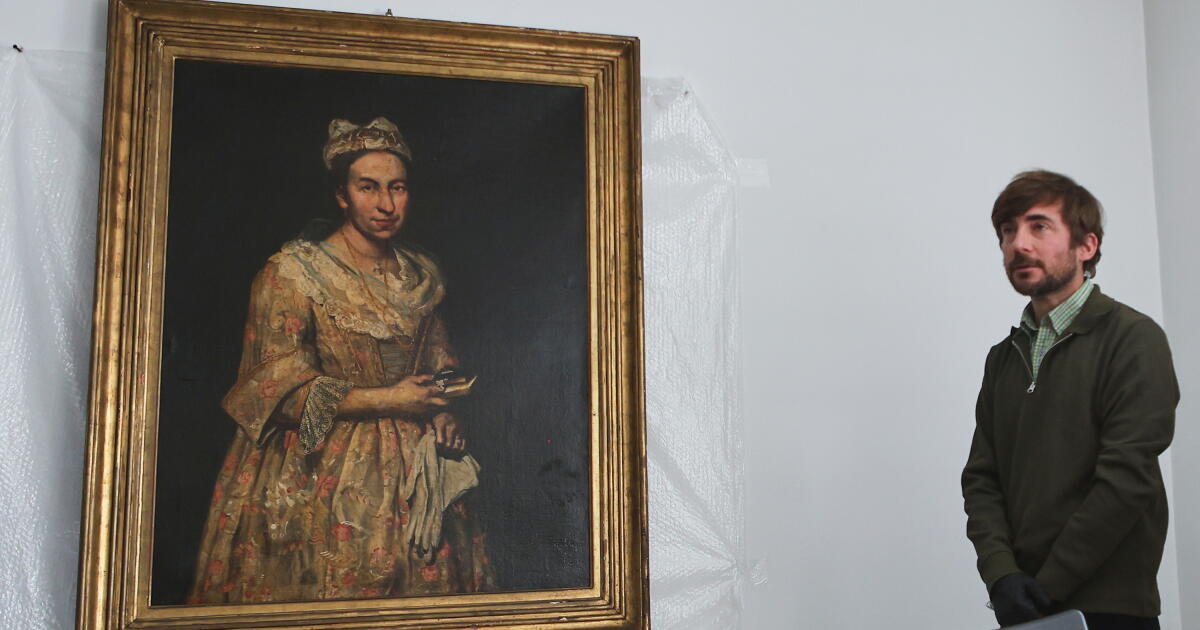
BUENOS AIRES — A long-lost Italian portrait looted from a prominent Jewish art dealer during World War II was set to be returned to his heir after an Argentine court on Friday approved a deal under which the daughter of a fugitive Nazi official agreed to give up her claim rather than face trial.
The agreement paves the way for the long-sought return of “ Portrait of a Lady ” to Marei von Saher, the sole surviving heir of Dutch-Jewish art dealer Jacques Goudstikker, whose celebrated collection was sold under duress to Nazi officials after Adolf Hitler’s Germany invaded the Netherlands in 1940.
Patricia Kadgien, the daughter of the late high-ranking Nazi official Friedrich Kadgien, and her husband, Juan Carlos Cortegoso, were charged with aggravated cover-up last year after authorities said they hid the 18th-century painting despite knowing it was being sought by Argentine and international investigators.
Under the agreement, a copy of which was obtained by the Associated Press, the couple agreed to give up any claim to the work and consent to its return to Von Saher in exchange for avoiding a criminal trial and spending two years under court supervision. During that time, they must make payments to a hospital in Argentina’s coastal city of Mar del Plata, where they live, and keep authorities informed of their whereabouts.
The deal ends a generations-long search for the missing portrait and a yearlong legal saga that began in August 2025. Dutch reporters investigating Friedrich Kadgien, a fugitive Nazi financial official who fled to Argentina after World War II, spotted “Portrait of a Lady” hanging above a green velvet couch in an online real estate listing for his daughter’s rustic home in Mar del Plata.
The listing disappeared within hours of the Rotterdam-based newspaper Algemeen Dagblad publishing its findings. Police raided the home several times but failed to find the painting. More than a week later, Kadgien’s lawyer turned it over to authorities.
For decades, the portrait had been identified as a work by the Italian Baroque painter Giuseppe Vittore Ghislandi. It appeared under that attribution in Goudstikker’s collection records and was exhibited as a Ghislandi in Amsterdam before the war. But a court-ordered examination by Argentina’s National Academy of Fine Arts reached a different conclusion, attributing the work to the Italian artist Giacomo Antonio Melchiorre Ceruti.
Experts authenticated the painting as part of Goudstikker’s collection and estimated its value at about $290,000.
Goudstikker was one of Europe’s leading art dealers before World War II, known for a collection that included works by Rembrandt and Vermeer. He died in a shipwreck while fleeing Amsterdam with his family as German forces swept into the Netherlands in May 1940.
An estimated 1,100 works from his collection were illegally sold to Hermann Göring, known as Hitler’s right-hand man, who amassed a vast art collection during the war. It remains unclear exactly how “Portrait of a Lady” came into the possession of Kadgien, Göring’s financial advisor, who handled foreign currency, precious metals and the sale of confiscated property for the Nazi regime.
Kadgien fled Europe after Germany’s defeat, first for Switzerland and later Argentina. He died in the South American country in 1978 without having been arrested or charged with war crimes.
Lawyers for Von Saher, who now lives in Greenwich, Conn., and spent decades trying to recover her family’s looted art, said she has agreed to let the painting be exhibited in Argentina before being returned to her.
During last year’s raids on homes owned by Kadgien and her sister in Mar del Plata, Argentine police also seized two 19th-century paintings, along with other prints and engravings. Authorities are still investigating whether any of them may also have been looted during World War II.
Farella and Calatrava write for the Associated Press. AP writer Isabel DeBre in Buenos Aires contributed to this report.
Wendell Berry, a Kentucky farmer and writer whose work advocated fiercely for working landscapes and working people, died “suddenly and peacefully” on Monday at his home in Port Royal, Ky., according to his family. He was 92.
His daughter, Mary Berry, confirmed his death. On Thursday, she told The Times that her father, until about six months ago, was still writing regularly in his cabin on the banks of the Kentucky River, a place he called “camp,” where many of his more than 50 volumes of poetry, short stories, essays and novels were written.
Berry championed sustainable farming and rural community preservation and railed against industrial agriculture and corporate agribusiness.
“He was fierce and he was fearless, and he remained fearless,” she said, explaining that her family taught her the erosion of rural places wasn’t inevitable but “destruction by design,” engineered by corporate interests and political policies.
Berry, whose writings were often fueled by an anger toward the forces that have driven the destruction of the rural land and communities that he dedicated his life to defending, softened in his final years, according to his daughter. “He was always a tender man, and that part of him got stronger. He was rereading a lot of books that he had loved in his life, and he told me he was looking for the tenderness in the books, and that’s a lovely thing.”
Berry’s most influential work began with a list of the problems he’d observed in modern agriculture, scribbled onto a legal pad as he traveled the long stretch of road between Kentucky’s Henry County and Spokane, Wash., where Berry would deliver a speech at the “Agriculture for a Small Planet” symposium in 1974.
“I was asked to talk about labor-intensive microsystems agriculture. That’s not my language, and it’s not the sort of language that I wish to use because it’s the way people speak when they don’t want to be understood by most people,” he began.
Berry spoke of the six generations of farmers who worked his land before him, and the concerns for farming communities and their agricultural economy that he inherited from his father. He decried “the experts and politicians who have prescribed, encouraged, and applauded the disintegration of such farming communities all over this country into our allegedly miraculous modern American agriculture.”
The speech would later become Berry’s 1977 manifesto “The Unsettling of America: Culture & Agriculture,” which launched a sustainable-farming movement and cemented Berry’s authority on agrarian issues on the national stage.
Beyond his cultural critiques, Berry wrote notable novels including “The Memory of Old Jack,” “Jayber Crow” and “Hannah Coulter.” He was a prolific poet as well. His verse included his debut collection, “The Broken Ground,” and his celebrated Sabbath Poems series, which explored living in harmony with the land.
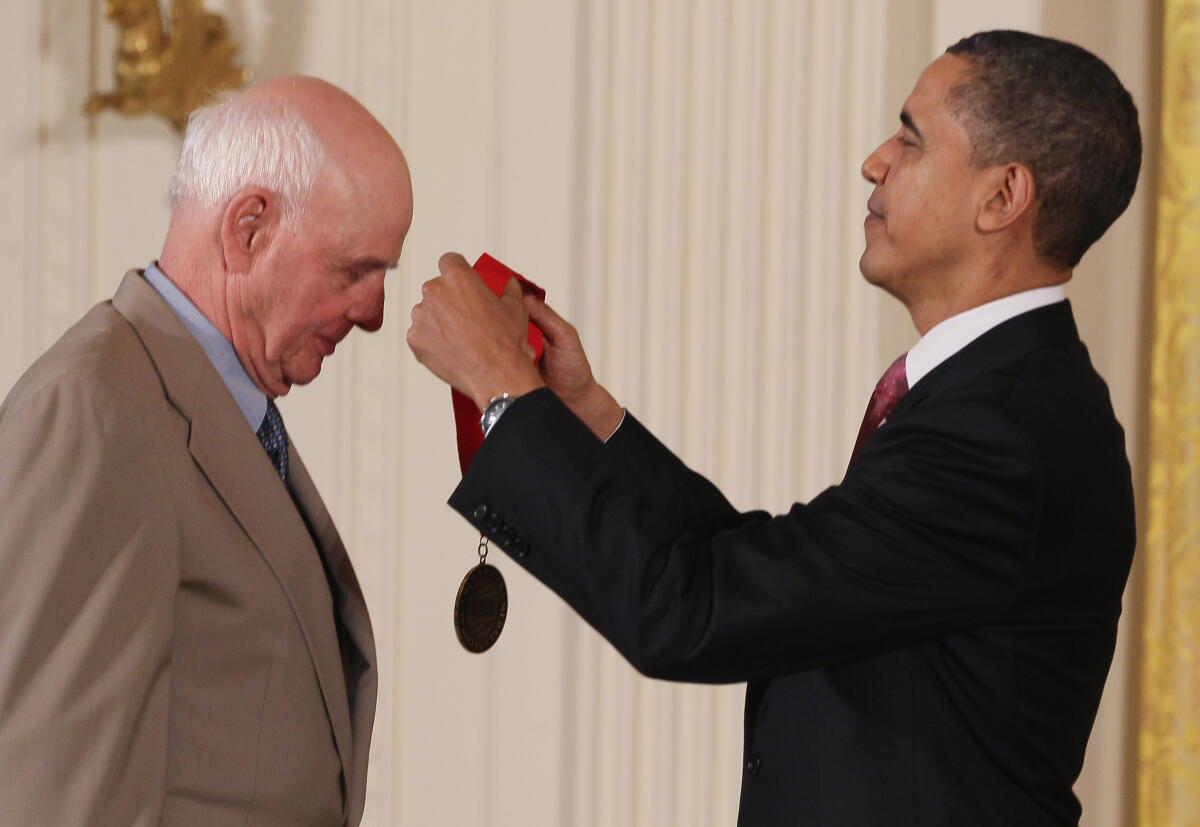
Over the course of his career, he was honored with the T. S. Eliot Prize, the Aiken Taylor Award for Modern American Poetry and the Richard C. Holbrooke Distinguished Achievement Award from the Dayton Literary Peace Prize, among other accolades. In 2010, Berry was awarded the National Humanities Medal by then-President Obama for his achievements as a poet, novelist, farmer and conservationist. In 2016, he was the recipient of the Ivan Sandrof Life Achievement Award from the National Book Critics Circle.
Wendell Erdman Berry was born on Aug. 5, 1934, in Louisville, Ky., to John Marshall Berry Sr., a lawyer and tobacco farmer, and Virginia Perry Berry. Wendell was the eldest of four children, two boys and two girls. In high school, his parents shipped him off to Millersburg Military Institute, a former military boarding school in Kentucky, where rather than conform to the teachings, he later wrote that his takeaway was, “Take a simpleton and give him power and confront him with intelligence — and you have a tyrant.”
He went on to study English and creative writing at the University of Kentucky. There he met and wooed Tanya Amyx, who would become his wife and the mother of his two children, Mary and Pryor. He landed a Wallace Stegner writing fellowship at Stanford in 1958, and in 1961 he was granted a Guggenheim Fellowship, which allowed him to pack up the family and live in Tuscany and southern France.
After Berry’s scholarly pursuits took him to the West Coast, then Europe, then the East Coast, where he taught at New York University, he accepted a job at the University of Kentucky, allowing him to return home and back to his roots, on a farm near the river.
Then-President Obama presents the 2010 National Humanities Medal to Wendell Berry during a ceremony March 2, 2011, in the East Room of the White House.
(Mark Wilson / Getty Images)
“Within a few years, Mom and Dad were raising 85% of the food we were eating,” Mary told The Times. “We had a milk cow, raised hogs for our own use, and by the time I was a teenager, I resented the whole thing pretty seriously, and I remember saying to them more than once, ‘I did not choose to live this way, and I don’t know why we have to do everything the hardest way possible.’ We had no television. … But I was in a heck of a position with my parents because I never really thought they were wrong about anything, and I still don’t.”
When Mary would gripe, she said, her dad would laugh or “just keep working.” But “he talked about what we were doing and why we were doing it,” she said. “He told my brother and me from the time I can remember to look and see that this is good and don’t forget, and I have not forgotten.”
In 2011, when Berry was nearly 80 years old, he joined a high-profile sit-in at the office of Kentucky’s then-Gov. Steve Beshear to protest the destructive mountaintop strip-mining of coal. In an interview with Bill Moyers shared by the Berry Center in 2025, Berry said that he and his compatriots had had enough of the state government ceding control of resources to the coal companies. “In our society,” he said, “people with money are bigger and more powerful and more noticeable and count more as citizens than people without much money. … So we did confront the governor and tell him we weren’t going to leave.”
His attempt at civil disobedience was turned on its head when the governor invited Berry and the Kentucky Rising activists to stay.
“We did stay,” he said. “The whole weekend.”
“We were beautifully treated by the security staff and people who sent us food and bedding and good wishes and even came in and gave us massages. And it was altogether one of the loveliest weekends I’ve ever spent in my life.”
Berry continued writing into his old age.
Next month, Counterpoint Press will posthumously release “Dispatches From Rural America,” a collection of 15 essays. In one, “The Problem Is Industrialism,” Berry wrote about a 2021 conversation he had with a friend of more than 40 years, author Wes Jackson.
“To the extent that we were talking in earnest, our subject was the set of calamities that the media and the commentators frequently take up, typically dealing with each one in isolation from the others and representing each as an emergency more or less apocalyptic, and in tones recalling a number of vernacular alarms, from ‘Last chance for beer’ to ‘Prepare to meet God.’”
He continued later that the two discussed how industrialism “grows only by consuming, once and for all, the living world.”
Mary said she wanted people to know that, yes, her father was worried and wouldn’t have written so much if he weren’t terribly concerned about the future of rural America, but she wants people to understand that he was a man of great hope.
“Hope he felt was a duty, and I learned that from him,” she said. “As he said in one of his many poems, hope is what we owe people younger than ourselves.”
Mary said she was continuing her father’s work through the Berry Center, a nonprofit that aims to put Berry’s writings to work and advocates for farmers, land-conserving communities and healthy regional economies.
Berry is survived by his wife of nearly 70 years, Tanya, his daughter Mary, son Pryor, five grandchildren and four great-grandchildren.
Parents recount desperate attempts to save their children after a ferry capsized off Northern Cyprus on 30 August. As search operations continue, their 12-year-old daughter and six-year-old son are among the 18 people still missing, while at least eight people have died.