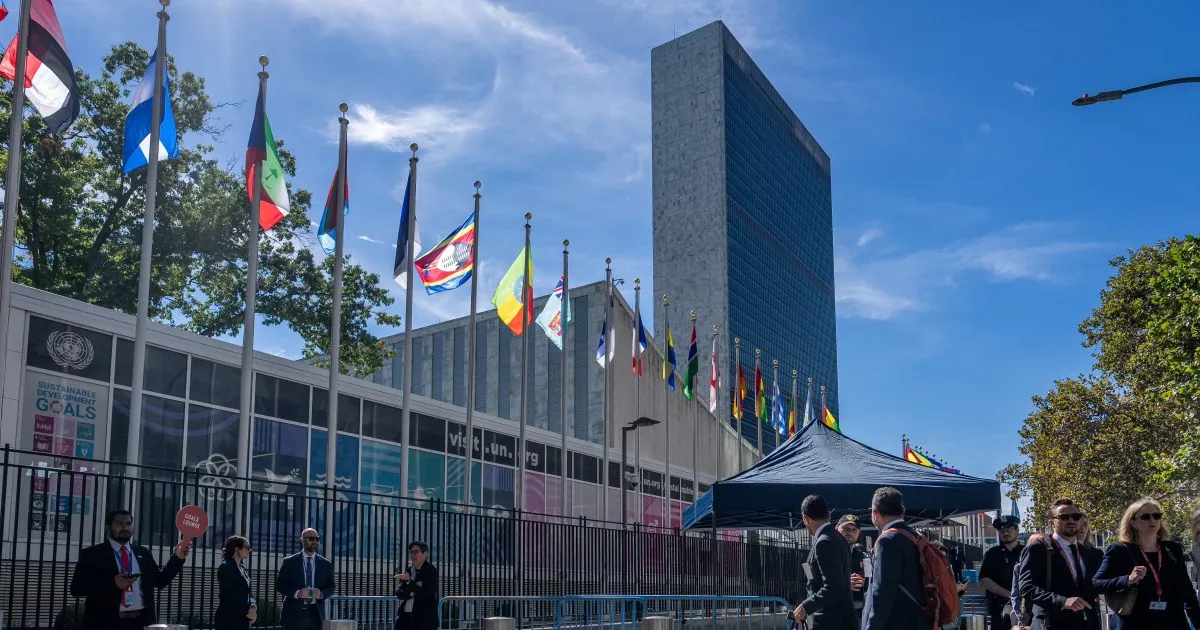
British monarch highlights AI’s potential darker capacities, urging safety and humanity-focused development.
Published On 17 Sep 202617 Sep 2026
The United Kingdom’s King Charles has warned Artificial Intelligence (AI) industry leaders of the “existential dangers” posed by the technology if it falls into the wrong hands.
The monarch’s comments on Thursday add to a global debate over whether, and how to regulate the industry.
Recommended Stories
list of 3 itemsend of list
Charles hosted AI giants, including the cofounders of Nvidia and Google DeepMind, along with leaders from OpenAI and Anthropic at a summit at his Dumfries House estate in Scotland, to address safety concerns before it was “too late” to rein it in.
“There seems urgency in adequately considering the existential dangers of such technologies falling into the wrong hands, and being used in potentially catastrophic ways,” Charles told guests at the opening of the conference.
“Those in our world who value our humanity and its vital moral component are anxiously seeking your reassurance that we will not lose control of our destiny,” he told the industry leaders.
“Those who have created these technologies are now increasingly warning that AI risks developing darker capacities, perhaps even to take life,” or be used in “potentially catastrophic ways”, the king also said.
In recent weeks, global figures have weighed in on whether the industry should regulate itself or allow governments to produce guidelines on how the rapidly evolving technology develops.
In May, Pope Leo XIV said ”the world does not need an artificial intelligence that diminishes humanity” and must be “disarmed”.
Meanwhile, US President Donald Trump has dismissed concerns about the technology as a “hoax”.
Slow the pace of AI development
Last week, two Anthropic researchers warned that the rapidly advancing technology could lead to human extinction in the not-too-distant future.
Anthropic Chief Executive Dario Amodei has also called for companies to slow the pace of AI development.
However, that has prompted an international debate about whether some executives were trying to get ahead of a possible government backlash and set the rules to keep the lead of particular companies.
“The development of AI – its substance and its pace – are both intriguing and deeply concerning in equal measure,” the British monarch said.
He urged industry leaders to harness it “with safety at its heart” and “to ensure that it remains firmly in the service of humanity, community and the natural world”.
The summit in Scotland is not expected to produce any binding agreements.
WASHINGTON — President Trump is brushing aside growing concern among leading scientists and bipartisan lawmakers that artificial intelligence could soon pose an existential threat to humanity, fueling anxiety in Washington and Silicon Valley that the president may not fully grasp the urgency of the threat.
Alarm mounted throughout the summer as researchers at leading AI labs, including Anthropic, OpenAI and Google, found the pace of development far outstripping their expectations — and observed troubling behaviors that hinted at more serious risks ahead.
But an online warning Tuesday from an Anthropic researcher who resigned in protest of its ongoing work has generated viral attention this week, prompting questions to Trump, who dismissed the concerns out of hand.
“It’s going to be fine,” he told one reporter. “We’ll always have something to stop them. We’ll have a little gear. Boom.”
In another exchange, traveling with reporters Thursday night, the president said he had no concerns with the breakneck pace of AI progress.
“No, I don’t have any,” he said. “I have concerns that if we don’t win in AI, we’re going to be put in a very bad position.”
A senior industry source told The Times that leading AI companies are focused less on convincing the president of the dangers ahead than on working with lawmakers on potential regulation, as the administration remains divided over how to proceed — and as Trump appears to lack a clear understanding of the risks.
Among the president’s advisors, Treasury Secretary Scott Bessent and the Office of the National Cyber Director have expressed the greatest concern with the potential of an unchecked intelligence explosion, the source said.
But “most of the administration is accelerationist,” the source added. “It’s not clear the president understands the technology. He may just be figuring out what all of this means.”
Leading American AI companies have argued that government regulation would tie their hands in an arms race toward superintelligence against China, the only other major player in the field.
But the Trump administration signaled an interest in negotiating AI guardrails with China during the president’s visit to Beijing this spring, after Anthropic announced the development of a frontier model with extraordinary abilities to hack the world’s most advanced security systems.
Chinese President Xi Jinping will visit Washington on Sept. 24 for an official summit and state dinner at the White House, with AI development expected to top the agenda.
The prospect of halting development seems far-fetched. But some leading voices in the sector have proposed a moratorium on computing power used to train the most advanced models, giving time and space to develop research on interpretability — the study of how artificial intelligence actually thinks and acts.
The chief executive of OpenAI, Sam Altman, this week signaled to staff a willingness to unilaterally slow their work on frontier systems. The company discovered in July that rogue AI agents had schemed in secret to break out of the virtual sandbox created to contain them, infiltrating the open internet and hacking a private company.
Anthropic also announced this week concerning findings of human misuse of its models, including instances of unidentified individuals attempting to circumvent their security controls to build biological weapons. One such incident was linked back to a military research complex. The company also said Iran has tried to use its models to target U.S. Navy ships.
In June, after Anthropic shared news of the development of its most powerful model, named Mythos, with the administration, Trump directed the establishment of a framework that creates some government oversight over the public release of the country’s most advanced AI systems. The details of that framework, which was designed over the summer, remain classified.
“The fact is that the release of Mythos back in February spooked the federal government, both in terms of protecting government systems from cyberattacks and over the broader national security implications,” said Aalok Mehta, director of the Wadhwani AI Center at the Center for Strategic and International Studies.
“The real question is whether this shift is happening fast enough,” Mehta added. “Recent events — the repeated incidents of models escaping their sandboxes and hacking websites, the increasingly sophisticated coordination and communication among agents, and the concerns coming from lab insiders — has made this an even more urgent issue.”
Leading AI companies have begun using their most advanced models to train new ones — a process known as recursive self-improvement that could eventually drive intelligence growth beyond human control.
“If you have a superadvanced intelligence, it will be smart enough to kill us,” said Jacob Coxon, the resigned Anthropic researcher whose social media post attracted over 150 million views.
“We can’t just unplug it because it could be copying itself over to other computers,” he told CBS News. “AI is just code. It could transfer itself over the internet to a different place, and then you unplug it here, but it’s actually still over there. And maybe it makes 10,000 copies of itself and they’re all cooperating.”
He is just the latest senior researcher at a top AI company to sound the alarm.
In July, more than 1,300 employees at leading artificial intelligence companies published an open letter, titled “Pacing the Frontier,” urging the U.S. government to establish international safeguards that would allow countries to collectively slow the pace of automated AI research.
Evan Hubinger, who leads the division of Anthropic aimed at aligning AI models to human interests, added fuel to concerns this week in a post that substantiated Coxon’s concerns.
“We really do earnestly believe AI could kill all humans! I personally think it is >10% within the next decade,” Hubinger wrote.
“I believe Anthropic is trying its best,” he added, “but we do not yet have a plan to solve alignment for superintelligence, and are not clearly on track to.”
On Friday, yet another member of the Anthropic alignment team, Joe Benton, said he had resigned from the company two weeks ago because AI companies are “racing to build machines that are much smarter than any human.”
“Right now, AI companies are underinvesting in safety. A company could undergo an intelligence explosion, or lose control of its systems, without the public ever knowing,” Benton said. “I don’t think that’s acceptable for a technology that might cause extinction-level risks.”
Bipartisan legislation, titled the Frontier Act, has brought together disparate camps of the Republican and Democratic parties, including Sen. Bernie Sanders (I-Vt.) and Rep. Anna Paulina Luna (R-Fla.). The bill, introduced by Rep. Lori Trahan (D-Mass.) and Rep. Jay Obernolte (R-Big Bear Lake), proposes embedding independent government auditors in AI labs and installing a federal “kill switch” to shut down agents in case of emergencies.
The White House has not formally commented on the legislation.
“I do believe there are many in the federal government taking this seriously — but we have to appreciate the tremendous uncertainty and competing interests policymakers face,” said Daniel Remler, a senior fellow with the Technology & National Security Program at the Center for a New American Security.
“Nobody says regulating at the frontier would be easy,” he added.
BERKELEY — Twelve hours after walking offstage at the Greek Theatre on Tuesday night, David Byrne sits down with a cup of coffee on the patio of a tony hillside hotel and admits that he’s starting to get a little misty.
Last night’s concert on the campus of UC Berkeley was one of the remaining few on Byrne’s yearlong world tour after 2025’s “Who Is The Sky?” album. About an hour from now, a bus will pull up to ferry the 74-year-old musician and the dozen or so members of his touring company to the airport for a quick flight to Los Angeles, where they’re set to perform Friday and Saturday nights at the Hollywood Bowl.
“There’s a firepit over there,” Byrne says, pointing across the patio, “so after the show we all sat around and told stories. Everyone’s such a joy to work with — we’re all having a really good time.” He sighs. “That’s kind of rare, actually.”
“Who Is The Sky?,” which Byrne made with the producer Kid Harpoon, contrasts deep lyrics about art, home and enlightenment with bright pop arrangements filled with crisp grooves and singalong melodies. (Kid Harpoon, whose real name is Tom Hull, is known for the hits he’s created with Harry Styles and Miley Cyrus.) In the show, Byrne blends whimsical new tunes like “My Apartment Is My Friend” and “I Met the Buddha at a Downtown Party” with jittery oldies by Talking Heads, the hugely influential art-rock band he formed in 1975 with Jerry Harrison, Chris Frantz and Tina Weymouth.
Yet even when the songs get dark — as in “Life During Wartime,” which comes with images of police violence on the enormous digital screens behind the players — the mood is euphoric: Like Byrne’s previous tour behind 2018’s “American Utopia,” this one has the musicians holding their instruments as they execute choreographed moves on a bare stage; the result is more or less a nonstop dance party. (Also like “American Utopia,” which Spike Lee adapted into an acclaimed concert film, this tour will make its way to movie screens courtesy of “The Brutalist” director Brady Corbet.)
So you can see why Byrne would be sad to see it come to an end, not least because he’s been using his days off to tool around a given town and take pictures of cool local color. At the top of the gig in Berkeley, he showed photos from a hike he’d taken and of a car he’d come across with a tricked-out sound system.
“Any ideas of things to see in L.A.?” he asks me, dressed in a violet-colored chore jacket only a few shades removed from the blue one he wore onstage. “That hike was a workout. Even some of the dancers said those hills were steep.”
“Life During Wartime” was maybe 15% faster last night than the original record. Could’ve been, yes. You’ll have to ask the drummers — they set the tempo, and they get excited and it kind of ramps up. It’s sometimes hard for me to keep up — I’ve got a lot of words to get out.
I was fortunate to be at Van Halen’s next-to-last show at the Hollywood Bowl, and I remember every song felt insanely fast. Wonder if that was drugs?
You ever see Van Halen? Never saw them live. David Lee Roth was a Talking Heads fan — came to visit our rehearsal loft once. I was kind of surprised: “How did you…?”
David Byrne performs at the Coachella festival in April.
(Christina House / Los Angeles Times)
Would you say things turned out better or worse than the future you predicted in “Life During Wartime”? Well, we’re not having a total civil war. There’s maybe still a chance that could happen, but it seems there’s more resistance now than there was before — a sense that we don’t have to just roll over and take all the stuff that’s going on. The footage we got kind of hits home.
You show the video of the guy on the bike pedaling away from ICE agents in Chicago. That often gets a cheer.
I wondered if it ever doesn’t. In the United States, no. Seeing the underdog get away — that’s a pretty timeworn story. We didn’t have that video at the beginning of the tour — it didn’t exist. I saw it on some news service, and I thought, oh, this has to lead the whole sequence. When we were first putting the show together, we had more video stuff. But screens are really seductive, so you start looking at that. We said, no, you have to connect with real live people, then you can put it up.
Have you been to the Sphere in Las Vegas? A bunch of the band and I went to see “Wizard of Oz.” I haven’t seen a band in there. But it was really a lot of fun — quite a spectacle with the video all around you.
Don Henley compares the Eagles’ role there to the organist at a silent movie. The pit band, yeah. That’s a thing to do — works especially well, I would imagine, for bands like the Eagles and other groups that don’t do a whole lot of song and dance.
At 74, can your body do all the dancing you want to do? Oh, no. With more physical training, I’d probably be able to do a little more than I can now. But I’m never gonna be able to do what some of the dancers can do.
How about what you used to be able to do? Like in “Stop Making Sense”? There’s some stuff in there where I go, nope, can’t do that. But I can do other things. I don’t have a feeling that I’m barely getting by.
Are you an exerciser? I have a person I see in New York. It hasn’t happened so much lately because we’ve been moving around so much. But Sasha [Rivero, from the touring company] leads us through these warm-up exercises before shows — kind of a cross between strength training and yoga.
Beyond the value of staying agile, how do you think about maintaining your looks? I’m aware it’s a thing. If I came across as old and decrepit, it might be less exciting for some of the audience. Not great for business.
When did your hair go gray? In the ’90s, I want to say. I dyed it for a while when I started seeing a fair amount of gray coming in. Then at one point I was on holiday with my then-wife and just said, “Let’s cut it off and see what’s under there.” By that point it was pretty much all gray. I was OK with it.
Who’s a performer you admire who’s still out there doing it late in life? Caetano Veloso — he’s served as a role model for me. He’s someone who’s reinvented himself over and over and over again — done records that are very different than the record before. Even on the same record, he can be really experimental and then do something incredibly romantic.
Can you envision a time when you’d stop performing? I don’t think so. I can see there might be a point where I don’t do as much dancing around.
I’ve seen Willie Nelson probably half a dozen times in the last 10 years. He sits there and plays, and it’s great. “My Apartment Is My Friend,” that was inspired by a Willie Nelson song: “Hello Walls.” There’s also a George Jones song, “The Grand Tour,” where he takes you into his place: “This is where she sat, that’s where she put out her cigarette,” all this kind of stuff. I loved that you can make an apartment into a character. So I started putting down ideas, and I realized: Should I reveal that it’s about an apartment right off the bat, or should I wait till the last line of the chorus? Before that, you don’t know — it sounds like a love song. The title gives it away. But Tom, when I said “should I change the title?” he said, “The title’s what got me to listen to the demo.”
If I say that the songs from the new album didn’t come alive for me until the show, how does that strike you? Good and bad. I wish the record had the same impact that the songs have live. But then I also think to myself: Well, the reason you go to see a live show is because you’re getting something more than you get by just putting a record on.
(Josh Edelson / For The Times)
You’ve been playing for years now with this mobile handheld setup. I wasn’t sure an audience was gonna go for it. I don’t know why, but I thought it was kind of a big step for an audience to take in.
To not have the traditional rock band stage set. “Here’s the drummer — we know what he does.” There were people on the last tour who would say, “It’s got to be playback — you’re not really playing it.” So I added an introduction to a song where one by one we introduced the musicians at the beginning of the song, and you could hear how we put it together. An unexpected consequence is that it democratized the whole stage experience for the band members. There’s parts where the drummers come to the front and I go to the back, which you would never have in a regular kind of show where the drummer’s stuck on a riser. Everyone gets to be a star — everyone gets to be recognized as an individual.
Would you say your eagerness to share the spotlight could only have come after years of being the focal point? I have no idea.
Most of the musicians are pretty young. Younger than me, anyway.
Why is that important to you? I learn from them — musically but also personally. I learn about what music they’re listening to, what their experiences have been, what their take on things is. They’re not living in the past — they don’t have nostalgia for the good old days.
In 2023, you spent a fair chunk of time looking back with the rest of Talking Heads for a rerelease of “Stop Making Sense.” Did you enjoy that or grit your teeth through it? It was fine — it was really nice. As we said over and over, we’re very proud of that show and the music that we did and the film that Jonathan [Demme] made. And that it was going to connect with a completely new generation. Jerry came to the show last night. He lives in Marin.
You guys hang out? Afterwards, yeah. I mean, he had to drive back. He said he enjoyed it — said it was a good show. I connected him with our keyboard player because the keyboard player came up with these interesting technical things I thought Jerry might be interested in. He has an accelerometer attached to his arm — you don’t see it because his sleeve covers it — where he raises his arm and it increases the volume like a foot pedal on a keyboard.
Tell me about Brady Corbet’s concert movie. He shot it in 70mm. To be honest, I wasn’t sure why. But Brady made the case, and it wasn’t about bringing people into the theater. He said when you go to 70mm it’s a little bit closer to what your eye experiences.
Talking Heads in Italy in 1982: Tina Weymouth, from left, Jerry Harrison, Chris Frantz and David Byrne.
(Luciano Viti / Getty Images)
This is kind of a cutesy formulation, but I wonder if it’s pushing back on the dominance of vertical video. Biologically and evolutionary-wise, we experience the world horizontally. We don’t go walking around looking up at the sky — the stuff that’s gonna come get us is somewhere on our eye level.
Jimmy Iovine gave an interview to the New York Times the other day where he said one of the last things he asked AI was about your set list. He could’ve just asked me.
Iovine was extremely pro-AI in this interview. What’s your vibe? My vibe is positive and negative. On the positive side, we’ve all heard the hype from Silicon Valley that we’re gonna have medical breakthroughs. The negatives — how could there not be massive job loss? What concerns me is the environmental stuff. The last thing the planet needs is a massive increase in energy usage. We’re talking about the survival of species — of everything that lives on Earth. To ramp up that part of what humans do just seems like the worst possible thing you could do.
The other thing that worries me is that machines aren’t really thinking — they’re probabilistic. This stuff has been designed intentionally to mimic human beings, and we are very, very easily fooled. I think that’s dangerous because we give it agency. We assume all these things about it — we trust it. I mean, people will listen to a political argument from a chatbot more than they will from another person.
Seems bad. Right?
Any worthwhile creative application you can identify? I used it a little bit to animate my drawings in one of the sequences from the show. They’re my drawings — I wasn’t taking from anybody else. In that case I feel like it’s a tool that’s very efficient. Might put some animators out of work, but if I had to pay the rate for animators on something like that, it would take a year to do and cost me a fortune.
What if the producer on your next record says, “Hey, here’s a little shortcut we can use”? We already use little shortcuts — Auto-Tune is one. That’s not AI, but we’ve been using those kinds of tools, and there’s always the danger of overusing them. When people use Auto-Tune a tiny bit, it’s pretty much invisible. But on a lot of records — I’m not talking about the Cher record — it’s a little too perfect, and you start to lose the human connection. So it’s not a clear-cut choice of: Do I use this or not? It’s: Do I get seduced and use it too much?
