WASHINGTON — Federal immigration officers opened fire on a Dominican man in New York because he drove his car into officers’ vehicles and they believed their lives were in danger, a senior Immigration and Customs Enforcement official said Friday.
The 28-year-old man, whom New York City police identified as Oscar Belgal, was shot “superficially” in the neck as ICE officers attempted to arrest him, said Marcos Charles, head of ICE’s Enforcement and Removal Operations. Authorities have not released details of Belgal’s condition.
Officers used their vehicles to block the man as he attempted to drive away, but he accelerated toward them, Charles said during a news conference with U.S. Homeland Security Secretary Markwayne Mullin in Washington. The Department of Homeland Security said the news conference was about the “dangerous consequences of sanctuary city policies.”
“Our officers, using their training and believing that their life and the life of the partners and the general public were in danger, used their training and fired weapons,” Charles said.
Belgal had his 5-year-old son in the car with him when the shooting happened, officials said.
Mullin said ICE agents didn’t know the child was in the car, but that Belgal “was aware” and chose to put the boy at risk by trying to evade officers.
ICE previously tried to detain Belgal, Charles says
Belgal was associated with a robbery crew that used mopeds and weapons, and was convicted of grand larceny last year and sentenced to five years of probation, Charles said, adding that he evaded officers in September when ICE tried to arrest him for deportation.
The Legal Aid Society, which was representing Belgal in an ongoing drug case, called Friday for a “full and transparent” investigation of the shooting, the officers involved to be held accountable and an end to “ICE’s escalating presence in New York City.”
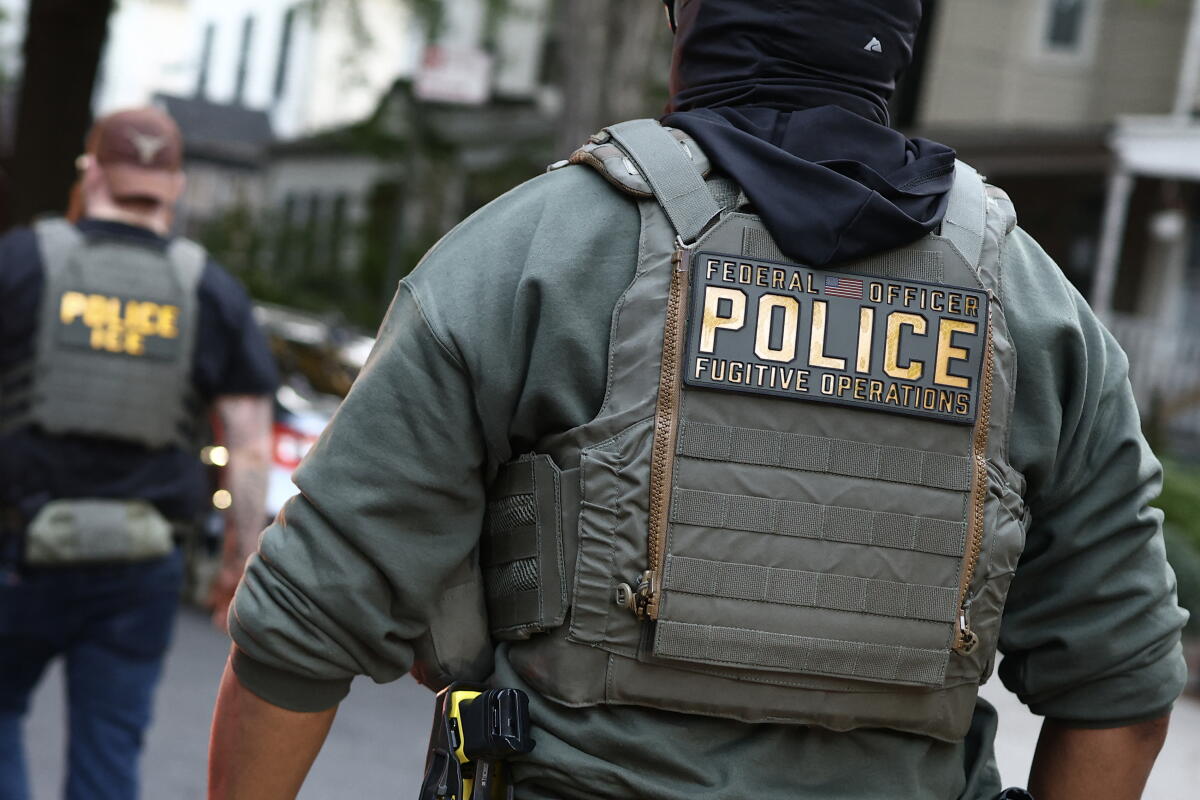
Federal agents walk near the scene where a man was shot by an ICE officer during an operation in the Bronx borough of New York on Oct. 8, according to local media and police.
(Charly Triballeau / AFP via Getty Images)
Belgal has pleaded not guilty to narcotics-sale charges in the drug case. The Legal Aid Society did not comment further.
New York City Mayor Zohran Mamdani and New York Gov. Kathy Hochul, both Democrats, said late Thursday that they had pressed Mullin and Republican President Trump to release Belgal, but to no avail. They also urged the administration to immediately release ICE officers’ body camera footage of the shooting and to halt immigration enforcement operations in the city.
Mullin said Belgal was being held in a “highly secured” detention facility outside New York City but declined to say where.
Attorneys representing Belgal filed an emergency petition Thursday night calling for his release. A hearing is scheduled for Friday afternoon.
He also confirmed ICE officers were wearing body cameras that were activated, but didn’t say when any of that footage would be released. Under agency policy, bodycam video can be released within 72 hours if “determined that it is in the best interests of the agency.”
On Friday, New York City police released footage from its officers as they arrived at the scene following the shooting. The department previously said its officers were not involved in the arrest and not at the scene when the shooting happened.
The video shows a city officer responding to a chaotic scene where Belgal — sitting on the ground with his hands behind his back and head drooping to one side — was surrounded by several officials. The video shows officers lifting Belgal and placing him in a black SUV. Police said he was taken to a hospital.
“Yo put pressure. Put pressure,” an officer can be heard saying as the SUV reverses down the block.
New York City Police Commissioner Jessica Tisch said Belgal was pulling into a parking space when a federal officer in plainclothes approached with his gun drawn, followed by another federal officer who also wasn’t in uniform. Belgal started to pull the car forward, and at least one of the officers fired seven rounds, hitting the man below his left ear.
Protesters and local officials decried the shooting as an example of the dangers of the Trump administration’s immigration crackdown.
New York City Mayor Zohran Mamdani arrives to speak to the media about the ICE shooting in the Bronx borough of New York on Oct. 8. Mamdani said he would ask President Trump to remove federal immigration agents from the city as tensions flared over the latest shooting involving ICE.
(Charly Triballeau / AFP via Getty Images)
Homeland Security Secretary Markwayne Mullin takes questions from reporters during a news conference at U.S. Immigration and Customs Enforcement headquarters on Friday in Washington, DC. Mullin, joined by ICE officials, addressed Thursday’s shooting of a man in New York City by a federal immigration agent as he spoke out against sanctuary city policies.
(Kevin Dietsch / Getty Images)
“There is no justification for what we have seen today,” Mamdani said late Thursday at the scene of the shooting.
Federal officers who surrounded the vehicle wore construction vests and masks, making it difficult to identify them as immigration officers, he said.
Mullin criticizes NYC’s immigration policies
Mullin devoted much of Friday’s news conference to criticizing Mamdani and New York City’s limits on cooperation with ICE. The Democrat, who took office in January, has restricted local cooperation with immigration enforcement operations and repeatedly called for the abolition of ICE.
“Sanctuary politicians, they create an environment for criminal activity to thrive, not for the American citizens to be safe,” Mullin said.
Homeland Security Secretary Markwayne Mullin takes questions from reporters during a news conference at U.S. Immigration and Customs Enforcement headquarters on Friday in Washington, DC. Mullin, joined by ICE officials, addressed Thursday’s shooting of a man in New York City by a federal immigration agent as he spoke out against sanctuary city policies.
(Kevin Dietsch / Getty Images)
ICE has asked local officials in New York to hold onto more than 14,000 people for federal officers to collect and place in immigration detention, he said.
“Silence. Absolute silence is what we have gotten back,” the secretary said. “Why would they release these individuals back onto the streets?”
“We’re enforcing our nation’s laws. We’re not picking and choosing,” Mullin continued. “Why is that controversial? We should all want law and order on our streets.”
ICE has justified other shootings with perceived threats to officers
During Trump’s second term, Homeland Security has often accused suspects of attempting to ram officers with vehicles or otherwise pose a threat and using that as justification for opening fire. But evidence from other shootings involving immigration enforcement officers has sometimes called into question that rationale.
In the Jan. 7 shooting death of Renee Good in Minneapolis, Homeland Security officials initially claimed an ICE officer opened fire in self-defense after Good attempted to run him over with her vehicle. Videos filmed from multiple angles challenged the administration’s narrative.
On July 10, ICE officers fatally shot Lorenzo Salgado Araujo in Houston as the Mexican national was driving his construction crew to a job site. DHS maintained Salgado Araujo rammed an ICE vehicle, but the three men inside his vehicle disputed the narrative.
Last year in a Chicago suburb, immigration officers fatally shot Silverio Villegas González after they say the Mexican national drove at them and dragged one with his car, causing “serious injuries.” But body camera videos from local police showed the agent who shot Villegas González walking around afterward and dismissing his own injuries as “nothing major.”
Santana and Marcelo write for the Associated Press. Marcelo reported from New York. AP reporters Anthony Izaguirre and Jennifer Peltz in New York City and Ryan Foley in Iowa City, Iowa, contributed to this report.
The shooting prompted protests in New York City as officials defended ICE and Mayor Zohran Mamdani condemned the incident.
Published On 9 Oct 20269 Oct 2026
The United States Department of Homeland Security has defended Immigration and Customs Enforcement’s (ICE) shooting of a man in New York City while his child was present. Federal officials used the incident to criticise sanctuary-city policies that limit cooperation with federal immigration authorities.
New York officials have condemned the shooting and have called for ICE to end its operations in the city.
Recommended Stories
list of 3 itemsend of list
The shooting took place on Thursday afternoon when ICE officers attempted to arrest a man identified by New York City police as Oscar Belgal.
Homeland Security officials gave their account of the incident on Friday during a news conference, saying that Belgal refused to exit his car when approached by officers and then accelerated, striking two ICE vehicles.
They said officers then opened fire, grazing Belgal’s neck while his five-year-old child was in the back seat.
According to Homeland Security officials, Belgal received first aid and was taken to hospital before being transferred to a secure detention facility outside New York state. They did not disclose where Belgal is being held.
Department of Homeland Security (DHS) Secretary Markwayne Mullin said that the agents did not know the child was inside the vehicle when they fired.
ICE senior official Marcos Charles said agents had attempted to arrest Belgal as part of an investigation into suspected gang involvement in an earlier shooting of a US Customs and Border Protection officer.
According to US officials, Belgal is an undocumented migrant from the Dominican Republic who had previously evaded arrest and received a five-year sentence for grand larceny in April 2025.
“[Belgal] was a thug,” Mullin said at the Friday news conference. “The absolute worst of the worst.”
Mullin confirmed that officers were wearing body cameras but the footage has not been made public. New York City police released bodycam footage on Friday of police officers on the scene who had responded to a 911 call about the incident.
In other violent incidents involving federal immigration officers, video evidence has contradicted initial accounts from ICE and Homeland Security officials, including in Minneapolis, where footage of the fatal shootings of Alex Pretti and Renee Good challenged federal officials’ descriptions of the encounters.
The latest shooting prompted protests on Thursday night in the Bronx, where the shooting took place, with demonstrators condemning ICE and calling for the agency to be abolished. Tensions rose after NYPD officers clashed with some of the protesters.
New York City Mayor Zohran Mamdani condemned the shooting and said he had called US President Donald Trump to demand an end to ICE enforcement in the city.
Speaking to reporters late on Thursday at the scene of the shooting, Mamdani said he had tried unsuccessfully to secure Belgal’s release in phone calls with Trump and Mullin.
“These actions are making the city less safe,” Mamdani said. “ICE is rotten to its core.”
Mullin accused Mamdani of prioritising politics over public safety and said Trump had offered to transfer Belgal to New York police custody if they pursued charges. Mullin said Mamdani refused this offer.
New York City mayor Zohran Mamdani gives an update about the Immigration and Customs Enforcement (ICE) shooting in the Bronx borough of New York, October 8, 2026 [AFP]
Something’s in the air this fall — and it’s not just the autumnal chill. For some reason, survival thrillers are all the rage; there are even two featuring a man and his dog. First, we had Ridley Scott’s “The Dog Stars” with Jacob Elordi and a Belgian Malinois traversing a postapocalyptic landscape.
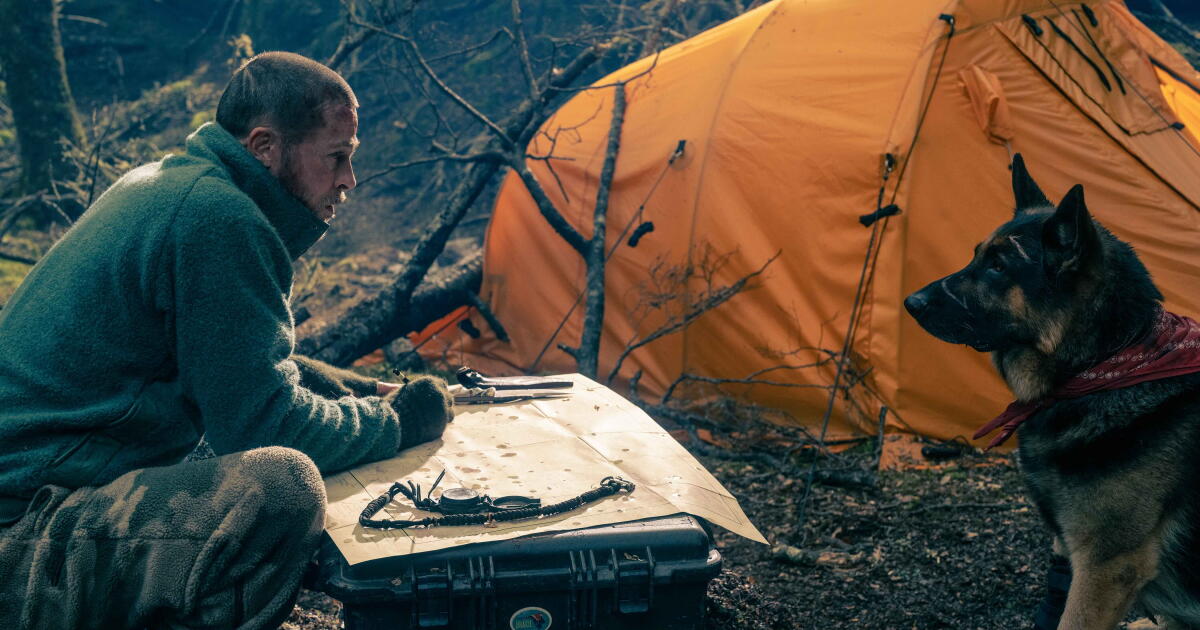
The latest is “Heart of the Beast,” an Alaskan-set story about two combat veterans — one human, one canine — who set out for a post-retirement camping trip and find themselves in a perilous situation after the human, retired Special Forces officer James (Brad Pitt), suffers a heart attack while piloting his seaplane. James and his combat dog Odin survive the crash, just barely, but they’re stranded deep in the wilderness, miles from civilization.
The film is directed by David Ayer, a purveyor of wild action flicks and ballads of masculinity; the screenplay is the debut effort of Cameron Alexander. Their intent is to deliver something muscle-bound and emotional — if a man can’t cry about an Army dog, what can he cry about? But until the last two minutes of the film, “Heart of the Beast” is essentially “Homeward Bound” for adults. You know, the 1993 kids adventure film featuring a golden retriever, a bulldog and a cat named Sassy who have to make their way home through the wild. Marry the structure of that film with a Jack London-inspired milieu, add some blood, gore and rather cheesy Iraq war flashbacks, and you have “Heart of the Beast.”
We watch James as he’s rained on, chewed on, pulls trunks out of an icy lake, falls off a log, breaks his arm, faces down a bear, fights off wolves, sustains many head injuries and inexplicably keeps going, in hopes of saving if not himself his dog, the most important creature in his life.
And oh, is Odin worth it. Played by four different dogs named Uber, Seeka, Ryker and Hondo, the performance that these dogs collectively deliver is worthy company to an Oscar winner — the dogs may even eclipse Pitt for sheer screen presence. With every whimper, sigh, howl, bark and head tilt, these dogs create an empathetic portrayal of a highly intelligent creature that has been through battle and has the scars (and nightmares) to prove it. Odin is a bionic dog, with titanium teeth and a prosthetic foot from injuries sustained during wartime, but nothing slows him down, not even a plane crash. However, the film does have its limitations when it comes to the other wildlife, all digitally created and the CGI isn’t convincing in the slightest.
“Heart of the Beast” is an onslaught of danger and misery, alleviated only by the pleasure of watching James’ survival skills and ingenuity. This man makes a lot of mistakes on this journey (he’s constantly calling himself “stupid” and “dumb”), but he’s also kind of a MacGyver. He starts a fire with cotton balls and Neosporin. He carries an alarming number of knives. He splints his own arm. If anything, it’s an excellent lesson on carrying the right gear and always taking medical supplies on a camping trip — if you ever go camping again after this.
Pitt typically excels when there’s a little (or a lot) of levity for him to exercise his loose-limbed charms and there’s precisely none of that in “Heart of the Beast.” Ayer pushes the emotional and physical extremes and it feels like a dirge: a forced march through the muddy Alaskan wilderness with plenty of body horror on top. The one moment of camaraderie comes in the beginning, when James shares a beer with a mysterious stranger (J.K. Simmons) who happens upon his camp and might even be an apparition of an old miner. James does share moments of affection and victory with Odin but there’s nothing to relieve the constant danger, even though structurally, the film has already sapped its potential suspense.
“Heart of the Beast” has its highs and lows but cinematically, it’s a mixed bag — entirely predictable and just not great. Nevertheless, there’s no denying that the star of the movie is indeed Odin and he’s a very, very good boy.
Walsh is a Tribune News Service film critic.
‘Heart of the Beast’
Rated: PG-13, for violence, peril, bloody/injury images and some language
Emmerdale’s Joe Tate takes a sickening revenge on Caleb and Ruby Miligan next week, as spoilers reveal the moment he buries Ruby alive in a coffin, leaving her facing death
Emmerdale spoilers: Joe buries Ruby alive
Ruby in Emmerdale could die next week, as Joe Tate’s extreme revenge plan sees her buried alive.
Caleb Miligan and his wife face danger as Joe wants payback, blaming them for the death if his partner Dawn Taylor. So when Joe asks Graham Foster for a favour, we later see exactly what Joe has planned for them.
Spoilers for next week reveal that Joe struggles to deliver the eulogy at Dawn’s funeral, so Kim steps in. As Kim vows to keep the family together, a grieving Joe walks away. As Joe approaches a grave, it becomes apparent he’s buried Ruby alive.
As Joe torments a weakened Caleb about his wife Ruby, she wakes up in a coffin, unable to escape. As Ruby slips unconscious, Caleb begs Joe to release her but he refuses.
Vinny admits to Nicola and Joe that he was responsible for the car accident that killed Jimmy and Dawn. As Nicola heads to the pub to confront Gabby, she publicly reveals how Vinny caused the fatal crash while on the phone to Gabby.
Cain tells Moira that Sadie opened up to him about the loss of their child. Sarah and Jacob are relieved when Ross confirms he has no intention of fighting for custody of Leyla.
Lewis worries about his future with Vinny, while Kev panics that Nicola will find out he knew about Vinny causing the crash. It comes as scenes this week sparked death fears for Charity.
In the latest episode, Charity was struggling with Sarah refusing to change her statement – the police statement that had her charged with murder. Things came to a head when drugs were found in Charity’s cell, and she was told she would need to undergo a full body search.
Charity experienced a panic attack as memories of her horrifying assault at the hands of Dr Todd came flooding back, as the police prepared to force the search. Charity was placed in segregation after lashing out, where she was clearly traumatised.
As Mack feared for his wife’s safety and feared how she would cope if she remained in prison, Mack warned Sarah that she could have another death on her hands, meaning Charity, if she didn’t tell the truth. But will Charity be released?