According to Acting Atty. Gen. Todd Blanche and other top administration officials, the U.S. Secret Service did a fine job protecting President Trump and Cabinet members from the gunman who breached the White House Correspondents’ Assn. dinner Saturday.
“That horrible act was stopped because of the courage and professionalism of law enforcement — the officers who responded without hesitation and did their jobs as they were trained to do,” Blanche said Monday.
However, according to a detailed accounting filed Wednesday by federal prosecutors in the criminal case against suspect Cole Tomas Allen, the performance of the nation’s preeminent protection agency was marred by inattentiveness and misfires and saved by “extraordinary good fortune” and the gunman falling to the ground.
“The defendant, armed with a 12-gauge shotgun, a .38 caliber pistol, two knives, four daggers, and enough ammunition to take dozens of lives, was apprehended by [Secret Service] officers mere feet away from the ballroom where his primary target was located, along with other members of the Cabinet,” prosecutors wrote Wednesday, in a filing arguing for Allen to be held in detention pending trial on one charge of trying to kill the president and two firearms charges.
Contradicting a prior claim by Blanche that officers had “promptly tackled and detained” Allen, prosecutors wrote that the 31-year-old tutor from Torrance simply “fell to the ground” after blowing past a team of agents just two open flights of stairs from the ballroom.
They wrote that one officer fired at Allen five times, but never hit him.
The same officer saw Allen fire his shotgun “in the direction of the stairs leading down to the ballroom,” prosecutors wrote, and officers later discovered “one spent cartridge in the barrel and eight unfired cartridges in the magazine tube.”
Prosecutors said nothing about the Secret Service officer who Blanche said was shot in his ballistic vest during the incident — adding to speculation that the officer may have been shot not by Allen, but by a fellow officer, or not at all.
Agency critiqued before
In all, the court filing brought further into focus a chaotic Secret Service response that appeared flawed from the start, including in a video Trump posted shortly after the incident in which agents appeared to be idling around an unobstructed entrance when Allen ran past them.
It added to concerns that law enforcement, security experts and members of Congress had raised about the performance of an agency that has been repeatedly called on to improve after previous attempts on Trump’s life. At a 2024 campaign rally in Butler, Pa., a gunman fired a bullet that grazed Trump’s ear, and that same year, another assailant prepared to shoot him from the unsecured perimeter of a Florida golf course.
Robert D’Amico, a former FBI deputy chief of operations for hostage rescue teams who is now a security consultant, said the security failures he saw in the Secret Service’s preparation for Saturday’s dinner — including its failure to set up basic barriers to prevent people from sprinting into the secured area — were stunning, especially given the past threats and the fact the nation is at war with Iran.
“It’s for a person like Trump, who’s had two assassination attempts before and is at war with Iran, which has terrorist training and proxies up, and you still don’t have the basics?” D’Amico said. “It’s unfathomable.”
Other concerns have been voiced by members of Congress, including Republicans.
The House Oversight Committee has requested a briefing from the Secret Service, and Sen. Josh Hawley (R-Mo.) has called for a hearing before the Senate Homeland Security and Governmental Affairs Committee, which also investigated the Butler incident.
In a letter urging the hearing, Hawley said the latest incident “raises questions about presidential security arrangements, potential resource needs, and the degree to which reforms previously proposed by Congress have been adopted.”
House Speaker Mike Johnson (R-La.) told Fox News that from “a layman’s perspective,” event security “looked a little lax in terms of getting into the building,” and that it “doesn’t sound like it was sufficient.”
Sean M. Curran, director of the Secret Service, has been on Capitol Hill in recent days briefing lawmakers.
He told CBS News that agents did a “great job,” but also that the incident remains under review. White House Press Secretary Karoline Leavitt has said that White House Chief of Staff Susie Wiles would be leading discussions on potential updates to Secret Service plans for securing the president.
Fear of graver threats
Blanche has argued that proof of the Secret Service’s effectiveness at the press gala was in the result: Allen was stopped, Trump and other officials were unharmed and no one was killed, despite Allen’s alleged intent.
However, the concerns being raised have to do with the vulnerabilities that were exposed as much as those that were exploited.
Because the dinner was not designated a major “national special security event” — such as a political convention — there were no trained counterassault agents on standby to prevent a breach or to take down a person with a weapon, officials have said.
Law enforcement experts said that was clearly a mistake given so many top officials — Trump, Johnson, Vice President JD Vance, Secretary of State Marco Rubio, Treasury Secretary Scott Bessent and Defense Secretary Pete Hegseth, among others — were in the room.
Such a gathering could have been targeted by foreign adversaries or others with far more experience, less regard for human life and much greater firepower than Allen, experts said.
“Most of my military friends are all saying the same thing,” said D’Amico, who is also a former infantry platoon commander in the U.S. Marines. “If you had had a team of three or four [gunmen], they would have gotten to [Trump].’”
In the initial criminal complaint against Allen, prosecutors included the text of an email Allen sent to family just as he was preparing to rush the security perimeter, in which he allegedly wrote that he had chosen to use buckshot in order to “minimize casualties” and prevent bystanders from being wounded by more powerful bullets penetrating walls.
He also allegedly wrote that he was willing to “go through most everyone” at the event to get to top administration officials, but that guests and hotel staff were “not targets at all.”
In Wednesday’s filing, prosecutors describe Allen’s actions as “premeditated, violent, and calculated to cause death,” and say he was “laden with weapons” as he breached security. But none of those weapons included assault-style rifles that can fire multiple bullets rapidly and have been used to kill civilians in mass shootings across the country for years.
The filing described Allen — a Caltech graduate and high school tutor — not as some trained tactical expert, but as an ideologue who spent part of his Amtrak journey from California to Washington waxing poetic about the landscape around him, describing Pennsylvania’s woods as “vast fairy lands filled with tiny trickling creeks in spring.”
Could have been worse
D’Amico said he and other Marines learned early on in Iraq that entrances to secured locations have to be designed in a “serpentine” fashion, forcing anyone approaching to move more slowly through the area and giving security officers more time to assess their intentions. And at an event the size of the correspondents’ dinner, with so many top officials gathered in a public hotel, you would want to make entrances “even more difficult.”
And yet no barriers seemed to be in place at the event, he said — something anyone trained more than Allen could have capitalized on.
“If they just had come through in a team of three or four who were coordinated and trained, there absolutely would have been penetration into the ballroom,” D’Amico said. “It would have been a gunfight.”
Allen himself questioned the security at the event, according to court records, allegedly writing that he had walked into the Washington Hilton with multiple weapons and no one considered “the possibility that I could be a threat.”
He wrote that if he “was an Iranian agent, instead of an American citizen,” he “could have brought a damn Ma Deuce in here and no one would have noticed” — referring to a powerful machine gun.
“It is fortunate he was only armed with what he had,” said Ed Obayashi, a California law enforcement expert on use of force.
WASHINGTON — Directly outside the Washington Hilton ballroom, as the yearly White House Correspondents’ Assn. dinner got underway Saturday, a Times reporter had just entered the men’s room when he heard a handful of loud pops ring out.
Inside the ballroom, thousands of journalists and politicians began to duck for cover as the event devolved from a celebration of free speech to a scene of fear.
The Times had six reporters at the dinner, seated at a table near the right side of the stage.
The Times reporter in the restroom, Gavin Quinton, heard the gunfire around 8:30 p.m. He had left The Times’ table minutes earlier, moving past the TV cameras and up toward the raised terrace near the ballroom’s security entrance. He crossed paths with CNN anchor Wolf Blitzer.
Outside the restroom, Cole Tomas Allen, 31, had broken into a sprint through the metal detectors, security footage would later show, getting within feet of the ballroom entrance.
Five or six shots fired by Secret Service agents missed Allen before agents brought him down near a staircase leading to the main floor, where Trump sat prominently in view.
A federal agent was hit in the chest in the exchange of gunfire but was wearing a bullet-proof vest and not seriously injured.
Inside the restroom, Quinton crouched near a corner. Others rushed into the room, including three hotel security guards who flung themselves in so quickly their backs slammed against the tiled wall. Within moments, a Secret Service agent positioned himself at the bathroom entrance, his pistol drawn.
“Head count?” he asked.
“A dozen — no, 15!” someone shouted back.
People stayed locked in bathroom stalls. Some tried to overcome the poor cellphone service to call loved ones. Confused, the mix of tuxedo-clad attendees, uniformed hotel guards and waitstaff tried to piece together what had happened.
“He had a gun,” one of the hotel guards said.
Another witness told Quinton that he initially thought Blitzer had been the shooter’s target.
“I look around and I hear shots as I’m opening the door. And I turn and I see him,” the man said of the gunman. “I look again and I’m like, ‘Oh, they just shot someone.’ ”
Blitzer, who was tackled to the floor by officers during the incident, would later say that “the first thing that went through my mind was whether he was going to shoot me.”
As the group speculated over whether the shooter had died in the volley, one man wondered aloud whether the event would continue. Initially thinking the gunman must have been killed, Quinton replied no.
“Why not?” the man asked. “It’s a bad guy who’s dead. It was a good f— ending. Seriously.”
The Washington Hilton has hosted the annual correspondents’ dinner for decades. The event, referred to locally as “Nerd Prom,” now comes with a slate of pre-parties and after-parties.
This was the president’s first appearance at the dinner since 2015; he had skipped it during his entire first term.
Questions now surround the security protocols. Guests faced little screening to enter the hotel on Saturday — a quick flash of a paper ticket — before heading down escalators to the only area with magnetometers, where bags were also searched.
Trump had entered the ballroom at 8:15 p.m. as the Marine band played “Hail to the Chief.”
Twenty minutes later, videos show, Secret Service officers with ballistic vests and long guns barked instructions to clear a path as they rushed into the ballroom and onto the stage.
One agent pulled Vice President JD Vance away. Another escorted Trump, who appeared to trip, but later explained he had been urged to drop to the floor.
Other officials — Secretary of State Marco Rubio, Defense Secretary Pete Hegseth, FBI Director Kash Patel, Homeland Security advisor Stephen Miller — were quickly whisked away too.
At The Times’ table in the ballroom, nothing appeared amiss at first.
Waiters had just begun to clear plates of spring pea and burrata salad. The reporters did not hear the gunshots, but watched as the room fell silent and others began to drop from their seats and duck under the floor-length white tablecloths.
One reporter lost a shoe in the process and then feared a gunman would spot it. She dragged it under the table.
They stayed in place for several minutes, texting loved ones and waiting for an all-clear, but none came.
From under the tablecloth, reporters heard someone yell out, “God bless America! USA!” They feared that was the shooter.
It turned out to be Dan Scavino, White House deputy chief of staff. The chant did not catch on.
Eventually, others could be heard speaking loudly and dishes clanking. Guests began to peek out from under their tables and warily stand up. Uneasy laughter flickered about the ballroom.
Cellphone service inside the ballroom was spotty. There was confusion at first about whether a shooting had occurred or whether plates dropping to the floor had been mistaken for gunshots.
“I thought it was a tray going down,” Trump said later.
Just before 9 p.m., Weijia Jiang, a senior White House correspondent for CBS News who is president of the White House Correspondents’ Assn., told guests the program would “resume momentarily.”
A half hour later, Jiang returned to the stage and announced that law enforcement had requested guests leave the premises. She said Trump had told her no one was hurt and that he, the first lady and members of the Cabinet were safe.
In closing remarks, Jiang said journalism is a public service “because when there is an emergency, we run to the crisis — not away from it.”
“And on a night when we are thinking about the freedoms of the 1st Amendment, we must also think about how fragile they are,” she said. “I saw all of you reporting, and that’s what we do.”
Law enforcement and media leaders offered conflicting guidance. Quinton was among the first to evacuate the building, though the vast majority of guests waited inside for longer.
On his way out, he noticed a metal detector had already partially been dismantled when the shooter ran through.
Quinton passed the grounded shooter, restrained on his stomach, near the staircase just 20 or so feet from the bathroom entrance. He lifted his phone and recorded a brief, shaky video of the scene before security forced him out of the hotel and onto the street.
The entire spectrum of emotion was on display when security finally ordered everyone to evacuate. Women in gowns ran in fear. One man sobbed into the sleeves of his evening jacket.
Photos on social media showed others stopping to take selfies. Some drank wine straight form the bottle.
Quinton spotted the presidential motorcade outside of the hotel lobby at about 8:45 p.m. Around the same time, an ambulance arrived as about 100 event attendees were escorted out of the secured event perimeter.
More law enforcement was inside the hotel as guests exited the building, including agents from the Secret Service, ATF, FBI and the Department of Homeland Security. National Guard soldiers replaced celebrities and politicians at the red carpet entrance.
Outside, Metropolitan police ushered people north on Columbia Road NW. Hungry guests in tuxedos filed into a nearby 7-Eleven. The dinner’s main course — prime beef and Maine lobster — had not been served.
At the White House afterward, Trump said the event would be rescheduled.
“We’re not going to let anybody take over our society,” he told reporters who had rushed to the news conference still dressed in gowns and black tie. “We’re not going to cancel things out because we can’t do that.”
Meanwhile, the night’s after-parties continued, though organizers attempted a more somber tone. MS NOW, for instance, told those who had RSVP’d that their “Democracy After Hours” party would be a “space for friends and colleagues to be together.”
“People were still partying, still hitting WHCD afterparties last night,” she wrote. “Epstein corruption, an escalating Iran conflict, and an active shooter— and Washington just… kept going. The cognitive dissonance is the system.”
On Sunday morning, the Washington Hilton appeared back to normal, except for the presence of journalists using the hotel as a backdrop for their live shots.
Cole Tomas Allen, the suspected gunman who rattled the nation’s top leaders by exchanging gunfire with federal authorities after racing through the secure perimeter of a press gala in Washington late Saturday, had made a long journey from Southern California and written a “manifesto” threatening Trump administration officials before the short-lived attack, officials said.
Allen, a 31-year-old Caltech graduate and high school tutor from Torrance, is believed to have taken a train first to Chicago and then on to D.C. before checking into the Washington Hilton with two guns he had previously purchased, authorities said.
The attacker managed to bypass several layers of security at the White House Correspondents’ Assn. dinner before being taken down by armed agents outside the ballroom where President Trump and an array of other top federal officials were seated.
Allen could not be reached for comment, nor could an attorney for him be identified as of Sunday.
According to Trump, Allen had also authored a “manifesto” prior to the attack, which he had shared with family and which his brother had flagged to local law enforcement in Connecticut. The New York Post reported that Allen described himself in the document as the “Friendly Federal Assassin” and revealed he intended to kill Trump administration officials.
New London (Conn.) Police Deputy Chief John Perry said that around 10:30 p.m. a man came into the lobby of the agency’s headquarters to report that he’d received a troubling email from Allen. The relative initially thought it was spam, but then saw the news of what unfolded in D.C. and felt he needed to report it.
Perry would not say what was in the email, and did not know exactly what time it was sent. But the relative said he only saw and opened it around 10 p.m. “I think he was watching what was going on and kind of put two and two together and said I need to go to my local PD,” Perry said.
Police officials provided the email to the Secret Service and FBI, he said. Trump said the document would be released, but it had not been as of Sunday. Officials said criminal charges against the suspect were pending, with an initial court appearance likely Monday.
Late Saturday, both local and federal law enforcement, including from the FBI, swarmed the Torrance neighborhood where Allen is believed to have lived in a home with his family, with Torrance police clearing the road and putting up police tape along part of the street. A man who responded to a knock on the front door said, “Not right now,” and declined to comment further.
The thwarted attack marked the latest in a string of incidents in which gunmen have gotten dangerously close to Trump, renewing questions about the safety and security of the nation’s commander in chief at a time of intense political division at home and roiling conflicts abroad.
Trump was grazed on the ear by a bullet at one of his presidential campaign events in Butler, Pa., in 2024 — the first of two attempts on his life during that campaign cycle. The other involved a gunman targeting the president as he golfed in Florida, before federal agents intervened. Earlier this year, a gunman was killed at the president’s Mar-a-Lago club, after breaching a security perimeter.
On Sunday, questions swirled as to how such a security lapse could have happened again — and whether large, high-profile events are safe for top officials in a nation where firearms are easy to obtain and ubiquitous.
Acting Atty. Gen. Todd Blanche, in an interview on “Meet the Press” Sunday morning, said federal authorities believe the suspect had set out alone “to target folks that work in the administration, likely including the president,” but that a motive was still being determined and evidence still being gathered — including from devices taken from Allen and in interviews with people who know him.
“As of now, we don’t have any connection to any particular policy directive of President Trump or Iran or anything else that we’re doing in this country, but we are looking into it,” he said.
Blanche also downplayed the threat posed to Trump, other officials in the room such as Vice President JD Vance and First Lady Melania Trump, and the hundreds of other attendees to the annual event — suggesting Allen had essentially been stopped in his tracks shortly after making his break through a checkpoint of metal detectors and federal agents, dramatic video of which Trump posted online.
“Let’s not forget that the suspect didn’t get very far. He barely broke the perimeter,” Blanche said. “And so while this was extraordinarily dangerous and put a lot of lives at risk and there’s no doubt that that’s something that we’re going to have to learn from over the next couple weeks, the system worked. We were safe, President Trump was safe. His Secret Service agents kept him safe. All of us were safe.”
Blanche’s assessment of the attacker’s breach past security — which he said was only “by a few feet” — was disputed by some.
According to other attendees, including Times journalists, event staff were checking tickets, though not very thoroughly, at multiple points prior to escalators that descended to the metal detectors where Allen allegedly dashed past armed security.
The detectors were right outside the event hall and where the bathrooms for the event were located, and the assailant was taken to the ground about 10 to 15 feet beyond them, attendees said. The shots — including two from the gunman, according to Blanche — were heard in the ballroom.
Allen, who graduated from Caltech in 2017 with a degree in mechanical engineering and is registered to vote with no party preference, made a $25 political contribution earmarked for then-Vice President Kamala Harris’ campaign challenging Trump for the presidency in 2024.
While at Caltech, he was a teaching assistant and a member of the school’s Christian fellowship and the Nerf club, according to his LinkedIn profile. He later studied computer science as a post-graduate student at CSU-Dominguez Hills.
Allen was named teacher of the month in December 2024 at C2 Education, which specializes in college test preparation, tutoring and academic advising. A representative for C2 Education was not immediately available for comment.
According to the New York Post, Allen himself had derided the event security in his writings beforehand, describing finding far less security at the hotel than he had expected when he arrived, armed, to check in.
“I expected security cameras at every bend, bugged hotel rooms, armed agents every 10 feet, metal detectors out the wazoo. What I got (who knows, maybe they’re pranking me!) is nothing. No damn security. Not in transport. Not in the hotel. Not in the event,” he wrote, according to the Post. “I walk in with multiple weapons and not a single person there considers the possibility that I could be a threat.”
Authorities did not detail Allen’s alleged travel route to D.C., other than to say it was by train. In response to questions about whether Allen had taken Amtrak to get to Washington and whether his luggage would have undergone any security screening, Amtrak said only that it is cooperating with federal authorities.
Trump also zeroed in on security at the hotel being inadequate, in addition to posting the video of the suspect rushing past security and multiple pictures of him detained on the floor of the hotel.
While praising the federal agents who took the attacker down, Trump suggested that events with top U.S. officials should be held in more secure facilities — such as the giant ballroom he is trying to build on the White House grounds after demolishing the former East Wing.
“What happened last night is exactly the reason that our great Military, Secret Service, Law Enforcement and, for different reasons, every President for the last 150 years, have been DEMANDING that a large, safe, and secure Ballroom be built ON THE GROUNDS OF THE WHITE HOUSE,” Trump wrote on social media Sunday. “This event would never have happened with the Militarily Top Secret Ballroom currently under construction at the White House. It cannot be built fast enough!”
Weijia Jiang, president of the correspondents’ association, said in a statement Sunday that the group’s board “will be meeting to assess what happened and determine how to proceed.” She also thanked the U.S. Secret Service and other law enforcement for keeping people safe, and praised journalists in the room for leaping to work to inform the public of what had occurred.
Times staff writers Richard Winton, Ben Wieder and Justine McDaniel contributed to this report.
WASHINGTON — A man who stole a purse from then-Homeland Security Secretary Kristi Noem while she dined at a restaurant under the protection of Secret Service agents was sentenced on Wednesday to three years in prison for a string of thefts in the nation’s capital.
Mario Bustamante Leiva did not recognize Noem when he grabbed her Gucci handbag from the floor of a restaurant where she was eating with her family in April 2025, according to the U.S. attorney’s office. Noem’s purse had credit cards and about $3,000 in cash. Police recovered it from Leiva’s motel room.
Bustamante Leiva, a 50-year-old native of Chile, is facing deportation after his sentence imposed by U.S. District Judge Trevor McFadden.
“Bustamante Leiva came to Washington illegally to prey on citizens of the district,” said Jeanine Pirro, U.S. attorney for the District of Columbia, in a statement. “His pattern of theft ends here.”
Noem, who is identified only by her initials in court filings, acknowledged the incident in a statement last year that referred to Bustamante Leiva as a “a career criminal who has been in our country illegally for years.”
He pleaded guilty in November to three counts of wire fraud and one count of first-degree theft. He was charged and convicted of robbing two other people and charging fraudulent purchases to their credit cards.
Bustamante Leiva was charged along with a second suspect, Cristian Montecino-Sananza, who was sentenced in March to 13 months of incarceration for his role in one of the other thefts.
Investigators said they identified Bustamante Leiva as a suspect in the thefts after he used a stolen gift card to make a purchase.
WASHINGTON — The Justice Department has subpoenaed several witnesses to testify before a federal grand jury in Washington as part of its investigation into former CIA Director John Brennan, three people familiar with the matter said Monday.
The subpoenas were issued in recent days and represent an effort by the Justice Department to press forward with the investigation even as a Florida-based career prosecutor who’d been helping lead the inquiry left the case after expressing doubts about the legal viability of a potential prosecution.
A former Justice Department lawyer who served as a top prosecutor in the 1980s and later supported legal efforts by President Trump to overturn his 2020 election loss has since been sworn in to serve as a special counselor to the attorney general, and is expected to work on the investigation.
The months-old Brennan investigation is one of several criminal probes the Justice Department has opened over the last year against Trump’s perceived adversaries. It centers on one of the Republican president’s chief grievances — a U.S. intelligence community finding that Russia interfered on his behalf during his successful 2016 presidential campaign.
The subpoenas were described by people with knowledge of them who spoke on condition of anonymity to the Associated Press to discuss an ongoing criminal investigation. At least three were said to have been issued, said two of the people. CBS News earlier reported the issuance of subpoenas.
Brennan served as CIA director under President Obama and was in that role when the intelligence community in January 2017 published an assessment detailing Russian interference aimed at helping Trump defeat Democratic nominee Hillary Clinton in 2016. An investigation led by special counsel Robert S. Mueller III concluded that Russia meddled on Trump’s behalf and that his campaign welcomed the assistance, but it did not find sufficient evidence to prove a criminal conspiracy.
The Justice Department last year received a criminal referral from Rep. Jim Jordan of Ohio, the Republican chairman of the House Judiciary Committee, alleging that Brennan made false statements before the panel in 2023 about the preparation of the intelligence community assessment. Brennan and his lawyers have vigorously denied any wrongdoing.
The investigation has been unfolding for months in Florida, with investigators having lined up interviews and issued subpoenas for records. The latest subpoenas seek grand jury testimony in Washington, an indication that prosecutors expect they would have to bring any criminal case in Washington since that is where Brennan’s testimony took place.
On Friday, it was revealed that a key national security prosecutor in Florida who’d been handling the investigation, Maria Medetis Long, left the case. She expressed doubts about the case and was removed, another person familiar with the matter said.
The Justice Department since then has tapped Joseph diGenova, 81, a Trump loyalist who served as the U.S. attorney in Washington for part of the 1980s, to serve as a special counselor to the attorney general. He was sworn in Monday in Florida and is expected to work on the Brennan investigation.
DiGenova supported Trump’s false claims that the 2020 election was stolen from him. He made headlines that year when he said Chris Krebs, a top Trump administration cybersecurity official who said the election was not tainted by fraud, should be killed. DiGenova later apologized and a lawsuit filed against him by Krebs was withdrawn.
Tucker writes for the Associated Press. AP writer Alanna Durkin Richer in Washington contributed to this report.
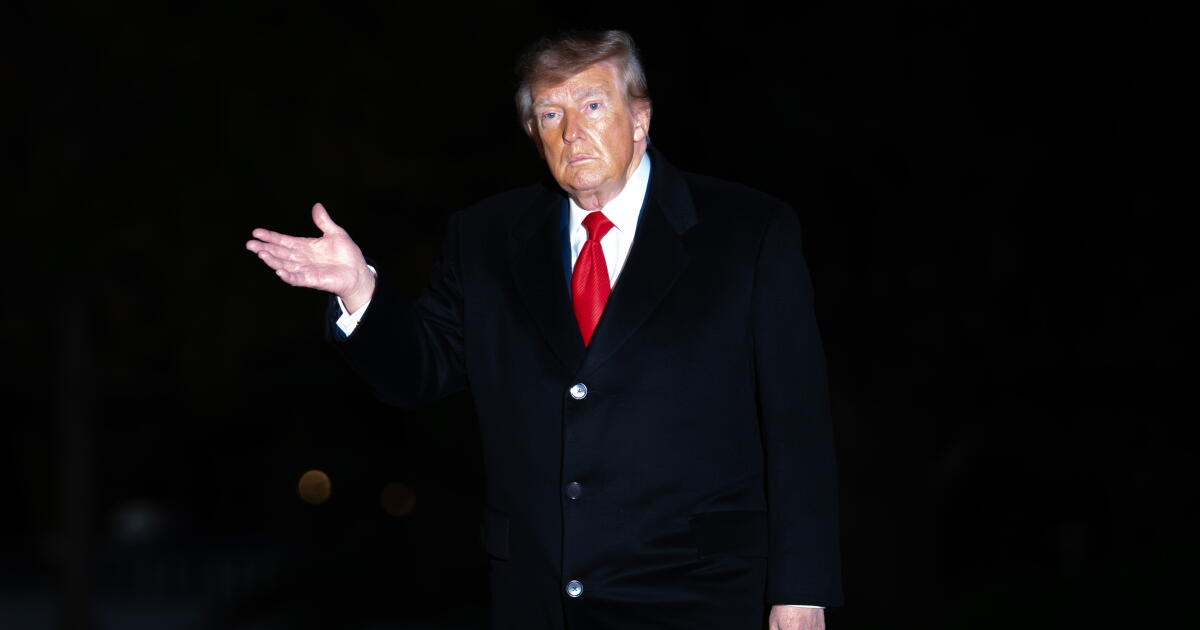
More than a century after the Gilded Age, we have entered another: The gilded age of Trump.
A little over a year after President Trump was sworn into office for the second time, the country has borne witness to a striking aesthetic makeover of the White House and Washington, D.C. A week ago, when the Trump-packed Commission of Fine Arts approved a 24-karat commemorative coin stamped with Trump’s image, that makeover ascended to staggering new heights.
The coin, which breaks with the country’s longstanding tradition of not featuring a living person on its currency, joins a swiftly growing list of other Trumpian imprints on arts and culture, including architectural choices deemed gaudy and garish by experts and laypeople alike.
Plenty of people are on guard against these changes. This week a coalition of eight cultural heritage and architectural organizations, including the National Trust for Historic Preservation and the American Institute of Architects, filed a lawsuit to require the Trump administration to comply with historic preservation laws and get congressional authorization before making any changes to the Kennedy Center.
“The Kennedy Center is not a personal project of any president. It is a national cultural monument built to honor John F. Kennedy and to serve the American people. Federal law requires transparency, expert review, and public participation before it can be fundamentally altered,” Rebecca Miller, executive director of the DC Preservation League, said in a statement.
The same could be said of the White House, the Smithsonian, the NPS and the United States Mint. But Trump doesn’t care about due process, congressional approval or the courts. Time and again he has shown his willingness to go it alone when making big decisions that affect not only America but the world. This includes his actions in Venezuela and Iran. But if he decides he wants to take the Kennedy Center “down to the steel,” as he once threatened, there isn’t really anything that can stop him.
The gilded age of Trump proves that the look of things really does affect how the country sees itself — and how it acts as a result of its new self-image. Golden gaudiness conjures thoughts of empire and imperial rule, but it is also unserious and incidental, bombastic and self-centered. The Trump aesthetic screams, “Me, me, mine!” A willingness to tear down historic structures without care for their symbolic meaning reveals an inability to learn from the past, a tendency that has proved frighteningly perilous.
Will the leader who rises after Trump tear down all that Trump has built? And even if they do, can the damage really be undone?
I’m Arts editor Jessica Gelt, keeping it small and simple for posterity. Here’s your arts and culture news for the week.
You’re reading Essential Arts
Our critics and reporters guide you through events and happenings of L.A.
By continuing, you agree to our Terms of Service, which include arbitration and a class action waiver. You agree that we and our third-party vendors may collect and use your information, including through cookies, pixels and similar technologies, for the purposes set forth in our Privacy Policy such as personalizing your experience and ads.
FRIDAY
Laura Aguilar The late trailblazing photographer’s exploration of her queer Chicana identity against the natural backdrops of Southern California and the Southwest is on display in the exhibition “Body and Landscape.” More of the artist’s work will be on display starting Sept. 20 in “Laura Aguilar: Day of the Dead.” Through Sept. 7. The Huntington, 1151 Oxford Road, San Marino. huntington.org
Cassandra Kulukundis holds the first-ever Oscar for casting for her work on “One Battle After Another” during the Academy Awards, March 15, 2026.
(Robert Gauthier/Los Angeles Times)
The Art of Casting With Cassandra Kulukundis recently winning the first Oscar in the category for her work on Paul Thomas Anderson’s “One Battle After Another,” what better time to learn more about the subject? The academy’s video presentation goes inside the casting process with casting directors discussing their craft and includes previously unseen auditions and screen tests. Through July 6. Academy Museum, 6067 Wilshire Blvd. academymuseum.org
Brahms & Beethoven Uzbek pianist Behzod Abduraimov performs Beethoven’s “Piano Concerto No. 3” as Paavo Järvi conducts the L.A. Phil in Brahms’ “Second Symphony” and Schumann’s “Overture, Scherzo and Finale.” 8 p.m. Friday and Saturday; 2 p.m. Sunday. Walt Disney Concert Hall, 111 S. Grand Ave., downtown L.A. laphil.com
A performance of “Escape.”
(Traj George Simian)
Escape Diavolo reprises this production featuring its trademark blend of dance, movement and storytelling as 22 artists challenge their abilities against a variety of architectural structures. 8 p.m. Fridays and Saturdays; 6 p.m. Sundays, through June 14. L’Espace Diavolo, 616 Moulton Ave. diavolo.org
Arshile Gorky: Horizon West In the summer of 1941, the Armenian immigrant artist, his soon-to-be wife Agnes “Mougouch” Magruder and the artist and furniture designer Isamu Noguchi drove from New York City to L.A. Gorky was emerging as one of the most important figures in the nascent Abstract Expressionism movement, and his cross-country adventures had an enormous impact on his art, which is explored in depth in this exhibit. A selection of landscapes include Gorky’s rich, surrealistic paintings and drawings from before, during and after the life-changing trip. (Jessica Gelt) Through April 25. Hauser & Wirth West Hollywood, 8980 Santa Monica Blvd. hauserwirth.com
A New Song: Langston Hughes in the West The exhibition reveals Hughes’ time spent in California, Nevada and Mexico during the Great Depression, World War II and into the 1950s, when he produced significant work, including lectures, film scripts, plays and his first book of short stories. Through Sept. 13. California African American Museum, 600 State Drive, Exposition Park. caamuseum.org
The White Album Arthur Jafa’s 2018 30-minute experimental film, a social critique of whiteness, uses found and produced footage to demonstrate how the creative work of Black Americans has been co-opted by white culture throughout history. Through Aug 30. UCLA Hammer Museum, 10899 Wilshire Blvd., Westwood. hammer.ucla.edu
SATURDAY
Akira Kurosawa’s “Seven Samurai,”starring Takashi Shimura, from left, Toshiro Mifune and Yoshio Inaba.
(Janus Films)
Darkness and Humanity: The Complete Akira Kurosawa The 1954 classic “Seven Samurai,” starring Toshiro Mifune, kicks off this comprehensive retrospective of the great Japanese filmmaker’s work. 6 p.m. Saturday; series continues through May 30. Academy Museum, 6067 Wilshire Blvd. academymuseum.org
from rock to rock… aka how magnolia was taken for granite Choreographer Jeremy Nedd’s exploration of the hidden poetry, virtuosic freedom and ownership features five performers examining “the Milly Rock,” a viral dance move. 8 p.m. UCLA Macgowan Hall, Freud Playhouse, 245 Charles E. Young Drive East. cap.ucla.edu
A Queer Arcana: Art, Magic, and Spirit On The exhibition collects an intergenerational group of Queer artists whose work examines hidden and mystical knowledge to find sources of connection and transformation. Through Oct. 18. Palm Springs Art Museum, 101 Museum Drivepsmuseum.org
Ralph Steadman More than 140 original artworks and ephemera, including sketchbooks, handwritten notes and personal photographs are included in “And Another Thing,” a traveling exhibition tracing six decades of the artist and illustrator’s career. Through May 9 Torrance Art Museum, 3320 Civic Center Drivetorranceartmuseum.com
Tonality The vocal ensemble performs “Refuge/Requiem,” a program that includes Caroline Shaw’s 17th-century-influenced contemporary work “To the Hands,” and “1605 Requiem,” composed for the funeral rites of Empress María by Tomás Luis de Victoria. Presented with the Wallis. 7:30 p.m. All Saints’ Beverly Hills, 504 N. Camden Drivethewallis.org
SUNDAY To Sleep With Anger Written and directed by the protean Charles Burnett, this film does more than vividly illuminate South-Central’s rarely portrayed Black middle class. A deft domestic horror story, it’s a contemporary tale with a folkloric twist that has old friend Harry (Danny Glover) visiting a married couple and gradually revealing himself to be a trickster with trouble on his mind. With a terrific ensemble headed by Mary Alice and Paul Butler as the couple in question. (Kenneth Turan) 7 p.m. The 35mm screening includes a Q&A with the filmmaker and Ashley Clark, author of “The World of Black Film: A Journey Through Cinematic Blackness in 100 Films.” Beginning at 6 p.m. Clark will sign copies of the book. Billy Wilder Theater, UCLA Hammer Museum, 10899 Wilshire Blvd., Westwood. cinema.ucla.edu
TUESDAY Philip Glass’ Cocteau Trilogy Pianists and siblings Katia and Marielle Labèque perform the composer’s triptych inspired by the films of Jean Cocteau. Part of the LA Phil’s “Body and Sound” festival. 8 p.m. Walt Disney Concert Hall, 111 S. Grand Ave., downtown L.A. laphil.com
Mary Halvorson The contemporary jazz musician, guitarist and composer and new quartet project Canis Major — featuring Dave Adewumi on trumpet, Henry Fraser on bass and Tomas Fujiwara on drums — perform an evening of music designed for deep listening and total immersion. 7 p.m. Getty Center, Harold M. Williams Auditorium, 1200 Getty Center Drive, L.A. getty.edu
Arts anywhere
New releases of arts-related media.
Album cover for “Evening Light: Raga Cycle I.”
(Cantaloupe Music)
Evening Light: Raga Cycle I The first release of an eight-album series in which American composer and pianist Michael Harrison collaborates with a global assortment of artists combining Eastern and Western musical traditions. Each chapter represents three hours of day or night following the Indian raga time cycle. For “Evening Light,” Quebec-based Brazilian vocalist Ina Filip co-composed the music with Harrison. Also appearing on the album are American composer Elliot Cole on synthesizer, French composer Benoit Rolland on electro-acoustics and Bangladeshi tabla virtuoso Mir Naqibul Islam. Cantaloupe Music: download ($10).
Book jacket for “Stephen Sondheim: Art Isn’t Easy” by Daniel Okrent.
(Yale University Press)
Stephen Sondheim: Art Isn’t Easy Part of Yale University Press’ Jewish Lives series, Daniel Okrent’s new biography of the award-winning composer-lyricist who took Broadway musicals to new heights “is a brisk, engaging read that avoids hagiography,” writes Julia M. Klein in a review for The Times. “Okrent highlights the emotional frailties that coexisted with the brilliance and generosity. He seeks to liberate Sondheim’s reputation from the encrustation of myth and to demystify his relationships, while offering a succinct analysis of his achievements. That’s a tall order for a compact book, especially given its subject’s long, complicated life. Okrent’s failings are, unsurprisingly, primarily those of omission.” Yale University Press: 320 pages, $35
Martha Graham Dance Company: We Are Our Times A two-part documentary goes behind the scenes with the troupe as it prepares for its 100th anniversary celebration. Producer-directors Peter Schnall and Cyndee Readdean followed the dancers from rehearsal to premiere on a global tour, capturing their artistic routines and everyday lives. Episode 1, “American Spirit,” 9 p.m. Friday; Episode 2, ““Athletes of God,” 9 p.m. April 3 on PBS. Streaming at pbs.org and on the PBS app.
Culture news and the SoCal scene
Pritzker Prize-winning architect Frank Gehry is photographed in May 2019 with a model of the Grand Avenue Project at his L.A. offices.
(Jay L. Clendenin / Los Angeles Times)
Can downtown L.A. still benefit from the vision of late-great architect Frank Gehry, who put so much time and energy into lifting the area up? Times classical music critic Mark Swed says yes in an optimistic column noting that, “So many plans Frank Gehry imagined for L.A. still remain. Gehry bequeathed blueprints and models, sketches and concepts, for his large and devoted team of younger architects and next-generation visionaries equipped to fabricate our way out of angst.” The time to build, Swed writes, is now.
Freelance writer Jane Horowitz got the skinny on the fifth edition of High Desert Art Fair, which arrives in Pioneertown this weekend, transforming “the rooms of the historic Pioneertown Motel into exhibition spaces for 20 galleries and publishers, while expanding into a broader mix of programming — something akin to a mini Coachella Valley Music & Arts Festival. This year’s edition includes an opening night party with a DJ set by street artist Shepard Fairey, panel discussions, guided meditation and even a sound bath.”
Monty Python” alum Eric Idle poses for a portrait at the Hollywood Pantages.
(Jason Armond / Los Angeles Times)
Malia Mendez sat down with British comedy legend Eric Idle to talk about his spoof musical “Spamalot,” which arrives at the Pantages more than a decade after its last stop at the stage. Over a margarita with a side of chef olives, Idle opened up to Mendez about “his earliest forays into comedy, his legendary run and subsequent break with his former ‘Monty Python’ castmates, and why ‘Spamalot’ arrives in L.A. at the perfect time.”
Times theater critic Charles McNulty headed to the Matrix Theatre to watch Rogue Machine’s production of Jackie Sibblies Drury’s Pulitzer Prize-winning 2018 drama “Fairview.” He writes that the play is “a shape-shifting work that eludes an audience’s assumptions at every turn,” and concludes that the new production “may struggle with the slipperiness of Drury’s writing.” The dramatic construction, however, is solid enough to withstand some of the overly broad strokes of the staging.”
Richard Neutra imagined his first Los Angeles project, the Jardinette Apartments, as a prototype for future garden apartment buildings.
(Myung J. Chun / Los Angeles Times)
Sam Lubell wrote a fascinating story about the painstaking rehabilitation of Modernist architect Richard Neutra’s first L.A. commission: the Jardinette Apartments in Hollywood. The building was hailed a structural and technical breakthrough when it opened in 1928, but it soon dropped from public view and sank into disrepair. The new owner spent more than $5 million on the historic preservation project and the complex may soon go on the market.
Enjoying this newsletter? Consider subscribing to the Los Angeles Times
The Hammer Museum Gala on Oct. 8, 2022, in Los Angeles.
(Michelle Groskopf / For The Times)
The Hammer Museum has announced the honorees for its annual gala. They are artist Betye Saar and television creator Darren Star. The highly anticipated event, set to take place in the Hammer’s garden courtyard on May 2, aims to honor impactful artists while raising funds to support the museum’s exhibitions and public programs.
The 80th Ojai Music Festival, set to take place June 11-14, recently announced this season’s programming and artistic collaborators. Much of this year’s event will be devoted to unpacking and performing works that have been central to the 2026 festival’s music director‘s artistic life. “Esa-Pekka Salonen is one of the most vibrant and adventurous creative forces in our musical world,” said Executive Director Ara Guzelimian in a statement. “It has been an absolute joy to dream up programs together that focus on numerous personal dimensions — his work as composer and conductor, his rich associations with and remarkable history in Los Angeles, the formative influence of his teachers and the giant musical figures of 20th century music, his deep friendships with many peer composers, and his championing of a new generation of composers.”
Washington National Opera Artistic Director Francesca Zambello, who was instrumental in the company’s decision to leave the Kennedy Center after Trump’s takeover, was inducted into the Opera Hall of Fame at the OPERA America Salutes Awards Dinner on March 20, at the Plaza Hotel in New York City.
March 24 (UPI) — Authorities in Washington, D.C., are hunting for at least two suspects after a U.S. Park Police officer was shot while on undercover duty in the nation’s capital.
The shooting occurred at about 7:30 p.m. EDT Monday near the 5000 block of Queens Stroll Place SE and the 4600 block of Hillside Road SE, the Metropolitan Police Department said in a statement.
U.S. Park Police Deputy Chief Scott Bretch told reporters in a press conference that the officer was riding in an unmarked police car as part of an ongoing U.S. Park Police investigation when the office was “ambushed” by at least two gunmen.
The officer was struck by gunfire, he said. Authorities said police did not return fire.
Bretch said the police vehicle continued down the street until it pulled over, where the wounded officer received first aid before being airlifted to the hospital with non-life-threatening injuries.
Bretch would not say what kind of investigation U.S. Park Police was working on or how the suspects fled the scene. It was unclear how many police officers were in the targeted police car.
Chief Carroll joins U.S. Park Police Chief Brecht to provide an update on the U.S. Park Police officer injured in a shooting in the 5000 block of Queens Stroll Place, SE. pic.twitter.com/mrgu1m84hi— DC Police Department (@DCPoliceDept) March 24, 2026
Interim Metropolitan Police Chief Jeff Carroll said that they believe the suspects had targeted the U.S. Park Police officer in the vehicle for being law enforcement.
Authorities are searching for two suspects both described as Black males. One was dressed in a white hoodie with blue jeans, and the other was dressed all in black with a white stripe down his sleeves and pant legs.
D.C. Mayor Muriel Bowser said she had been briefed on the shooting.
“Our prayers are with the officer for a quick recovery and we are grateful for all our law enforcement officers and first responders for their quick response,” she said in a statement.
Attorney General Pam Bondi said she was also briefed on the shooting by Bowser and Carroll, stating the FBI and other federal law enforcement agencies will assist the Metropolitan Police Department “in any way we can.
“Please pray for the officer’s recovery,” she said.
PHILADELPHIA — On the night reigning NCAA champion Florida was eliminated by Iowa, UCLA tried to follow the Hawkeyes’ lead against Connecticut, the team that had worn the crown the previous two years.
And for the second straight game they were hoping to win without leading scorer Tyler Bilodeau, whose sprained knee still hadn’t healed enough for coach Mick Cronin to risk putting him on the floor.
Seventh-seeded UCLA battled, managing to take a brief lead in the second half. But in the end, No. 2 Connecticut’s size and power were too much for the Bruins to overcome in a 73-57 loss in the second round of the NCAA tournament Sunday.
Four players scored in double figures for UCLA. Xavier Booker finished with 13 points, Eric Dailey Jr. had 12 points and Donovan Dent and Skyy Clark each finished with 11. But the Bruins couldn’t contain Connecticut forward Alex Karaban, who erupted for 27 points, as the Huskies advanced to the Sweet 16 to play No. 3 Michigan State in Washington, D.C., on Friday.
The Bruins got off to a good start, building an 18-12 lead before the Huskies caught fire, hitting seven straight shots at one point to seize a 38-33 halftime lead.
Connecticut’s Tarris Reed Jr., center, tries to work past (from left) UCLA’s Trent Perry, Donovan Dent and Eric Dailey Jr. during the first half Sunday.
(Matt Rourke / Associated Press)
UCLA (24-12) started the second half on a 6-0 run, regaining a 39-38 edge on a corner jumper by Clark.
Connecticut (31-5) didn’t wait long to retake control, going on a 14-0 run over the next five minutes, with Karaban scoring 10 points over that span.
UCLA answered with an 8-0 run, with Dailey’s three-point play cutting Connecticut’s lead to 56-52 and reigniting the Bruins’ hope of an upset. Connecticut, however, responded with a decisive 9-0 run, taking a 67-54 lead with 4:24 left.
UCLA struggled with its shooting most of the night, going 19 for 49 (39%) in comparison to Connecticut’s 23 for 49 (47%). Both teams had the same number of free-throw attempts (21), but the Bruins made just 67% of their shots and the Huskies made 90%.
In 1994, then House Speaker Newt Gingrich promised to post all congressional proceedings on the Internet as a way of launching what he called a “civilizational upheaval” in which “regular people in little towns”–not well-moneyed lobbyists–would manage affairs in Washington. In 1996, the representative from Georgia, swayed by the futurism of writer Alvin Toffler, helped pass the Electronic Freedom of Information Act, which required federal agencies to grant Americans prompt access to any information in their databases that could help “ensure an informed citizenry.”
Three years later, Gingrich’s revolution, far from online, is nowhere in sight. Rather than complying with the 1996 law, most parts of the executive, legislative and judicial branches of the U.S. government stand in blatant violation of it.
While the Supreme Court of Mongolia has its own official Web site, the U.S. Supreme Court doesn’t, forcing Americans to search through unofficial Web sites in hope of finding its briefs and opinions. While the Congressional Research Service makes its reports on vital issues like HMO reform instantly available online to legislators, taxpayers, who fund those studies, can get them only through the mail from their members of Congress.
If you are a soldier who believes he was made ill by the military’s anthrax vaccine, for example, you might want to know what was said in Tuesday’s hearing of the House Committee on Government Reform, in which Rep. Henry A. Waxman (D-Los Angeles) and leading scientists discussed how the government should weigh a vaccine’s risks against its benefits. The full text of the hearing was available Tuesday to anyone who could afford a subscription to a private online data service.
Those hoping to access such supposedly public information on the Web, however, were out of luck. The House Government Reform Committee’s Web site lists transcripts from only a hodgepodge of committee hearings. The most recent transcript available at that site is from June.
Today, Sens. Patrick J. Leahy (D-Vt.) and John McCain (R-Ariz.) plan to hold a press conference in which they will release a study by two Washington public-interest groups on how federal agencies have failed to comply with the 1996 law. McCain and Leahy, along with David E. Price (D-N.C.) and Christopher Shays (R-Conn.) in the House, have introduced similar bills to require Congress to put Congressional Research Service documents online within 30 days. The measures currently are in the House and Senate rules committees.
Fundamental change won’t occur until national leaders like President Clinton, Senate Majority Leader Trent Lott (R-Miss.) and House Speaker J. Dennis Hastert (R-Ill.) call upon all government agencies to honor the letter and spirit of the 1996 law.
Reforming the Congressional Research Service is only a baby step toward the revolution that legislators promised so bombastically. But it’s as good a place as any to start.
To Take Action: Rep. David Dreier (R-San Dimas), chairman, House Committee on Rules, (202) 225-2305, www.house.gov/dreier, click on “Feedback”; Sen. Mitch McConnell (R-Ky.), chairman, Senate Committee on Rules and Administration, (202) 224-2541, e-mail, senator@mcconnell.senate.gov