
D.C.s

D.C.’s fireworks show for July 4 will start later, last longer, organizers say

June 30 (UPI) — This year’s July 4 fireworks display in Washington, D.C.,will be the largest ever held there, organizers said Tuesday.

The pyrotechnics on the National Mall will also start later as the capital marks the nation’s 250th anniversary.

Jeff Carroll, interim chief of the D.C. Metropolitan Police Department, said the holiday will have “the largest display of fireworks our city has ever seen,” CBS News reported.

A representative for Freedom 250, the public-private partnership established by the Trump administration for the anniversary, said the fireworks will not begin until 10:30 p.m. and may start as late as 11 p.m., The Washington Post reported. Usually, the fireworks display starts about 9:30 p.m. However, Trump has said that he’ll speak at 9 p.m., calling the event “a rally.”

While the fireworks are usually about 17 to 25 minutes long, they are expected to be about 40 minutes long Saturday, The Post said. The event is also expected to include hours of military flyovers earlier in the day.

The event also has new rules banning attendees from bringing coolers, chairs, bags and more than one bottle of water. Tara McLeese, special agent in charge of the Secret Service’s Washington field office, said those who plan to watch the fireworks from the Washington Monument grounds should expect “TSA-style” security, CBS News reported.

As of Tuesday, the predicted high for Saturday in Washington, D.C., is 101 degrees, according to The Weather Channel. Record-breaking heat is expected to affect much of the United States this week.

A Freedom 250 representative said there will be four free hydration stations at the event and that organizers were “closely monitoring conditions.”

Stephen Vitale, CEO of Pyrotecnico, the company putting on the 2026 fireworks show, said it plans to set off more than 850,000 fireworks from 10 locations around the area, The Post reported. Vitale said the typical July 4 show over the National Mall has about 20,000 fireworks.

“Size always helps, but it’s about the beauty and the memories that people will have for generations,” Vitale said. “Fireworks are magical to people, and we help people walk away believing that’s the best fireworks display that they have seen or ever will see.”

Officials at Ronald Reagan Washington National Airport said July 17 that it is expected to be closed July 4, with no scheduled flights toor from the airport after noon. They cited the flyovers and other aerial displays.

A collection of baseballs signed by former United States presidents is on display at a press preview event for Christie’s free “America at 250: Important Artifacts and Documents of History” exhibit in New York City on June 25, 2026. Photo by John Angelillo/UPI | License Photo

Source link

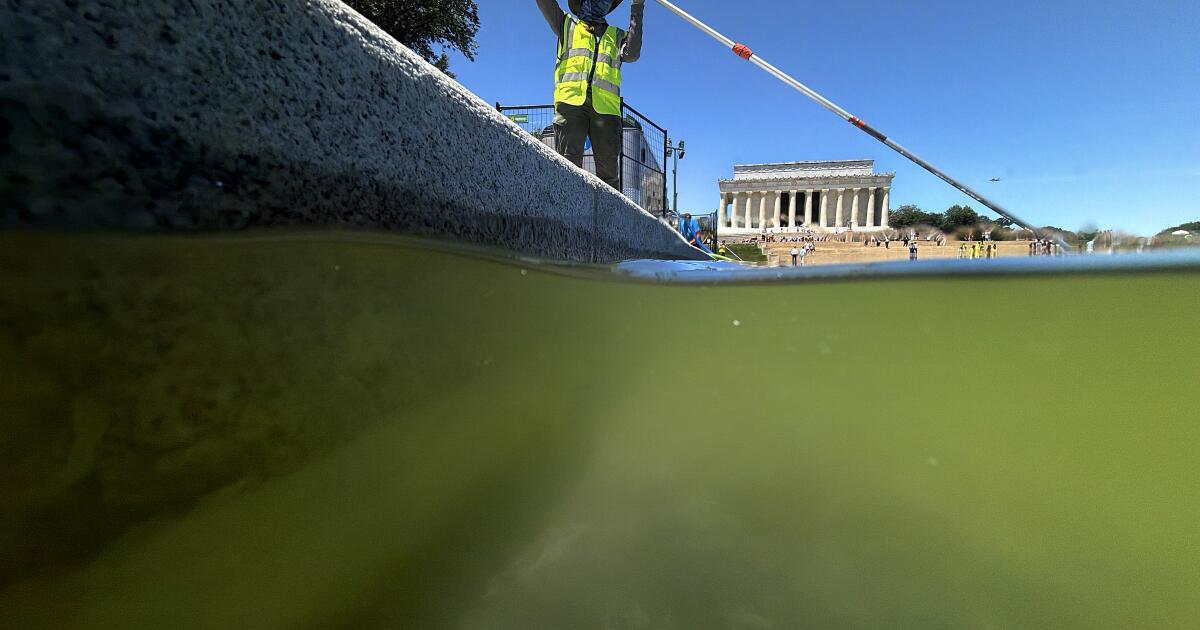
Algae persist in Washington, D.C.’s Reflecting Pool, despite administration’s efforts to clear murky waters.

Just days after the Trump administration completed millions of dollars in renovations on the Lincoln Memorial Reflecting Pool to make it American flag-blue, residents and online users noted it had turned a phosphorescent green.

Here’s why:

The calm, still waters of the Reflecting Pool make it an ideal nursery for algae growth. Algae need nitrogen and phosphorus to grow, and the Reflecting Pool is primarily fed by the Potomac River, which gets heavy doses of those nutrients from nearby urban and agricultural lands.

The Potomac also absorbed one of the largest sewage spills in U.S. history earlier this year when a pipe burst five miles upstream of Washington, although that event probably happened too long ago to contribute to the algal bloom today.

Untreated sewage is high in nitrogen and phosphorus. When nutrient levels are high, feasting algae can quickly reproduce.

The Department of the Interior said when the algae first appeared that it was “residual,” from the supply lines to the pool.

Experts also speculate that the darker blue color may be helping the Reflecting Pool absorb more heat. The higher temperatures promote algae growth by allowing their metabolisms to shift into overdrive.

Summer temperatures in D.C. aren’t helping. This week, temperatures are as high as 95 degrees in the city, prompting a heat alert.

The combination probably explains the excessive growth, turning the water surface an opaque green and preventing onlookers from seeing the new blue hue of the concrete basin.

Algae are important and beneficial organisms when the ecosystem is in balance. They’re the base of the aquatic food chain, fed on by herbivores of all shapes and sizes, including shrimp and juvenile fish, which in turn feed organisms higher up the food chain. The single-celled organisms use the power of the sun to produce energy through photosynthesis, similar to houseplants on your balcony.

In an effort combat the algae in the Reflecting Pool, employees of the National Park Service were seen pouring in gallons of hydrogen peroxide, a chemical commonly used in pool maintenance.

The Department of the Interior also is employing a “high-tech nanobubble ozone technology” to destroy the cells of the algae.

Ozone — yes, the same irritant that is in smog — is a gas composed of three oxygen molecules, and the small size of the bubbles allow the most gas transfer into the water, where it can damage algal cells, similar to how it irritates our lungs.

This only treats the symptoms, however. Generally, ozone nanobubbling is effective as a temporary solution for algae blooms. Longer-term fixes would have to address what makes the Reflecting Pool so ideal for algae, such as its depth, darker color and inflow of nitrogen and phosphorus.

In California, ozone nanobubbles also have been used in a project to improve water quality in the Tijuana River. The 120-mile river that runs near the border in northern Mexico and Southern California was the site of a pilot study in 2025. The U.S. section of the International Boundary and Water Commission reported that the nanobubbling reduced “odors and bacteria,” but the project concluded prematurely after a flood swept some of the instrumentation into the river.

Source link