Cyprus

Latest Foreign Office travel advice for Cyprus, Turkey and Egypt

Amid the ongoing conflict in the Middle East, the Foreign, Commonwealth and Development Office (FCDO) has provided travel updates, including for Cyprus, Turkey and Egypt

The Foreign Office has provided travel advice for Cyprus, Turkey and Egypt amid the Middle East conflict.

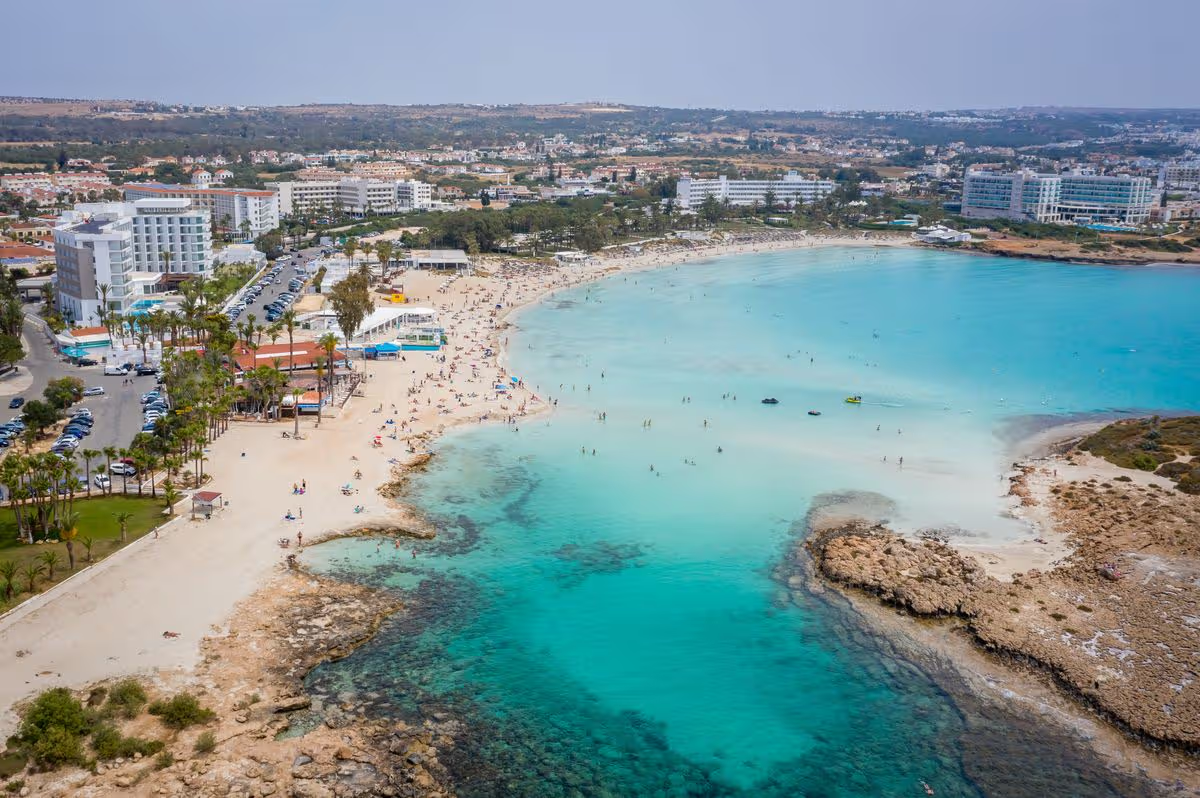
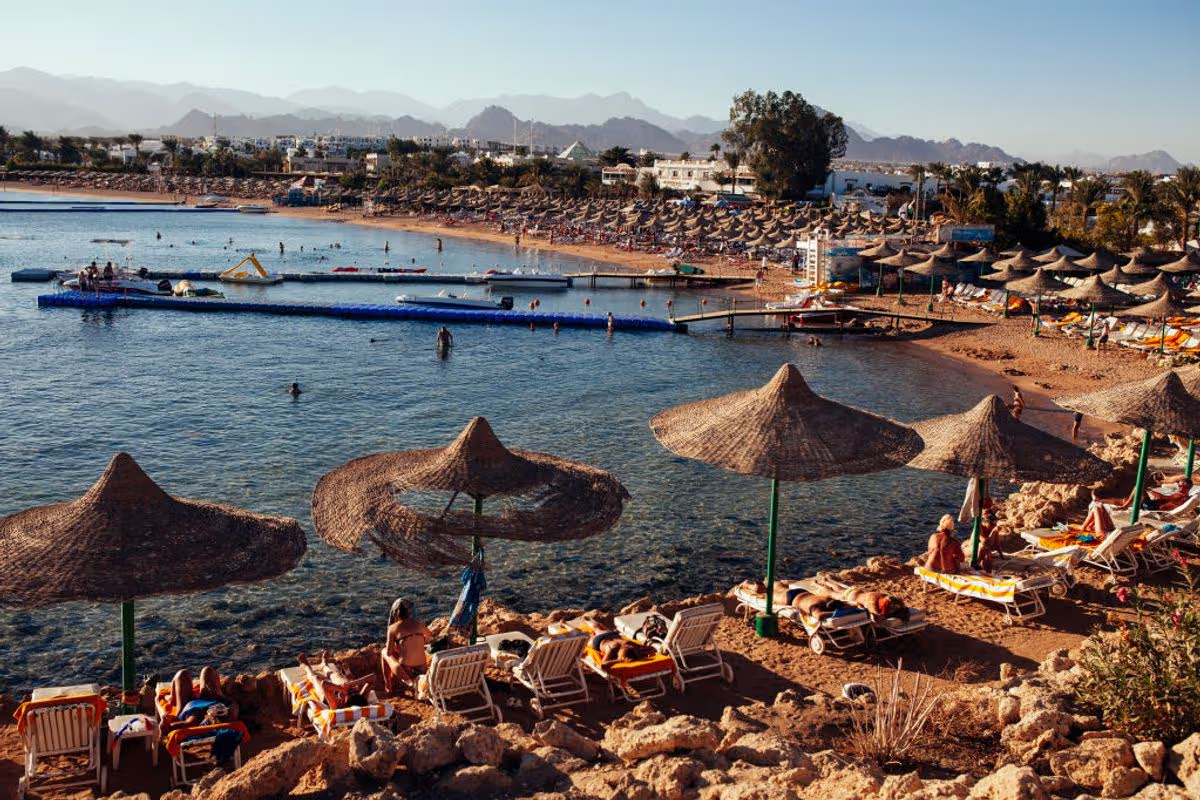
The three countries are popular holiday destinations among Brits, thanks to their sand beaches, crystal-clear blue waters, diverse landscapes and sprawling resorts along the coastlines. They also deliver sunshine and warm weather from early Spring right through until Autumn, and are typically an affordable option for those seeking a sun-soaked getaway.

Many Brits have already secured their getaways to Cyprus, Turkey and Egypt, whether that’s for a stay over Easter or during the summer holidays, or have plans to hit ‘book’. However, the location of the holiday hotspots closer to the conflict in the Middle East than other popular destinations has made the latest Foreign, Commonwealth and Development Office (FCDO) travel advice all the more important.

READ MORE: Major airline plunges into administration as all flights and bookings cancelledREAD MORE: ‘Newest’ town in the UK has beautiful riverside walks and a charming tea room

As of Tuesday, 10 March, the Foreign Office has not added Cyprus, Turkey or Egypt to its ‘no travel’ list. However, there have been several updates that Brits should be aware of. Here’s everything you need to know…

Cyprus

The latest update from FCDO on Thursday, 5 March, which remains in place today, warned that “terrorist attacks in Cyprus cannot be ruled out”. It read: “There is a high threat of terrorist attack globally affecting UK interests and British nationals, including from groups and individuals who view the UK and British nationals as targets. Stay aware of your surroundings at all times.”

The advice adds that terrorist attacks “could be indiscriminate, including in places visited by foreign nationals.” Following the update, the FCDO said the UK Counter Terrorism Policing has information and advice on staying safe abroad and what to do in the event of a terrorist attack.

Despite this, there is currently no advice against travel to Cyprus. However, the Foreign Office warned that the “regional escalation poses significant security risks and has led to travel disruption,” and that “no travel can be guaranteed safe.”

Turkey

The Foreign Office has warned against travel to some areas of Turkey, “due to fighting and a heightened risk of terrorism”. This ‘do not travel’ warning applies within 10km of Turkey’s border with Syria, which was in place before the Middle East conflict. However, there is no FCDO guidance against travel to any of the popular tourism areas such as Antalya, Bodrum, Dalaman and Izmir, which are 1500-1600km from the border with Iran.

There is also a country-wide warning of “high threat of terrorist attack globally affecting UK interests and British nationals”. The FCDO said most of these attacks have taken place in southeast Turkey, Ankara and Istanbul. It should be noted that similar warnings have been in place for a number of other countries long before the Iran war.

In an update last week, the FCDO warned that the “regional escalation poses significant security risks and has led to travel disruption”. However, it does not advise against travel to other areas in Turkey, with most flights and holidays currently going ahead.

Egypt

As it stands, the Foreign Office “advises against all travel to parts of Egypt” and “against all but essential travel to parts of Egypt”. One warning in place is against travel to within “20km of the Egypt-Libya border, except for the town of El Salloum”, where the FCDO advises “against all but essential travel.”

There are also travel restrictions in place for other parts of Egypt, including North Sinai, the Northern part of South Sinai, the Eastern part of Ismailiyah Governorate, the Western Desert, the Hala’ib Triangle and the Bir Tawil Trapezoid.

The FCDO has also warned of a “heightened risk of regional tension” and “escalation that could lead to travel disruption and other unanticipated impacts” for Egypt. There is also a “high threat of terrorist attack” warning in place for Egypt, which was in place prior to the Middle East conflict.

However, the Foreign Office does not advise against all travel to Egypt. They added that around one million Brits travel to Egypt each year and “most visits are trouble-free.”

If you’ve got a holiday on the horizon, it’s best to keep in contact with your holiday provider – although they are currently focusing on those with imminent travel plans. However, given the ever-changing nature of the situation, travel guidance can shift rapidly, and it’s important to check any restrictions before travelling or booking a holiday.

The above travel advice remains current as of Tuesday, 10 March, but it’s best to consult the most recent Foreign Office advice for your destination before finalising any travel arrangements. You can visit the Foreign Office website for information on travel restrictions for each country.

Have you been impacted by travel disruptions? Email webtravel@reachplc.com

Source link

Brits are cancelling their holidays to Cyprus despite it being on the safe travel list

CYPRUS has been drawn into the Iran conflict – which has had a knock on effect on holidays.

The European country was hit by an Iranian drone earlier this month, after landing on RAF Akrotiri base on the island.

Brits are cancelling their holidays to Cyprus despite it still being safe for travelCredit: Getty
The country is the only one in Europe to have been drawn directly into the Iran crisisCredit: Alamy

This led to a temporary closure of the airport, cancelled flights and a number of British schools.

Despite this, Cyprus remains on the safe to travel list, with no further escalations and flights back to normal.

The only warning on the UK Foreign Office website is in regards to “regional escalation poses […] has led to travel disruption.”

However Cyprus is seeing a drop in tourism, after it became the only European country affected by the conflict.

TRAVEL ADVICE

Is Cyprus safe to travel to? Latest holiday advice after flights cancelled


HOP TO IT

The best UK family days out from £10 to completely FREE in the Easter holidays

Local business owner Vassilis Georgiou told the Guardian that people are “thinking twice” about visiting.

He explained: “It may be early days but I’ve been here since 1992 and suddenly hoteliers are saying bookings are down.”

Nick Aristou, who owns three hotels in Cyprus, said they’d had around 200 cancellations this month.

He told the i: “Most of the cancellations, I would say about 90 per cent, are all for March, about 10 per cent for April.”

And Thanos Hotels’ Panos Kyprianou, with four hotels on the island, said cancellations were coming from Brits with 65 cancellations for April.

Hr added: “Right now, April, is about 10 per cent behind what it was last year.”

But Agia Napa Municipal Sectary Mr Fotos Kikillos said while they were “hearing of cancellations” he reaffirmed that life was still “very safe” on the island.

He added: “People are enjoying themselves – there’s no sense of fear. The last thing we want in Cyprus is to be dragged into this war.”

With the tourist season officially starting in the beginning of April, it is expected that everything will be back to normal on the island, despite fears of summer cancellations.

Last week, Cyprus’ foreign minster Constantinos Kombos told the BBC: “I don’t think that anyone should be in two minds, given the fact that the situation, as I have been describing right now as we speak, has been perfectly normal.

“All activity is normal. Air traffic is going back to 100 per cent what it was before the incident.

“So I don’t think this is something that should be affecting people’s decisions.”

“After all, this is part of the regional situation. It’s not the Republic of Cyprus that has been targeted. It has been the British bases.

“And the security factor in terms of people feeling that everything is being done that is humanly possible to protect both citizens, residents, and visitors to Cyprus. The security apparatus is in place to try to do exactly that.”

Cyprus is one of the more affordable areas of Europe to visit, especially now.

According to Cirium, there are around 125 scheduled flights from the UK to Cyprus over the Easter holidays, working out to 25,000 passengers.

If you were to travel there next month, seven-night holiday packages can be found for as little as £169 each.

Even two-week holidays can be found for under £300 each.

Ryanair currently has flights to Cyprus for around £25 each way next month too.

Flights and holidays are still going aheadCredit: Getty

Source link

Europe commits to expanding Iran campaign as Israel strikes southern Lebanon

New signs of a widening regional conflict emerged Thursday as the war with Iran entered its sixth day, with European allies pledging warships and access to military bases for the U.S. campaign, Israel intensifying strikes in Lebanon against Hezbollah militants, and Kurdish forces preparing for a potential incursion into northern Iran.

Iran continued retaliatory missile and drone attacks against Israel and U.S. military sites across the region. The strikes hit at least “10 countries that did not attack [Iran],” British Prime Minister Kier Starmer said at a news conference Thursday.

Starmer announced new military deployments and confirmed the U.K. will allow American forces to use British bases for defensive operations against Iran. The move was a reversal of Starmer’s initial cautious approach, which drew criticism from President Trump, who said, “He’s no Winston Churchill.”

“I took the decision that the U.K. would not join the initial strikes on Iran by the U.S. and Israel,” Starmer said. “That decision was deliberate. It was in the national interest. And I stand by it. But when Iran started attacking countries around the Gulf and the wider region, the situation changed.”

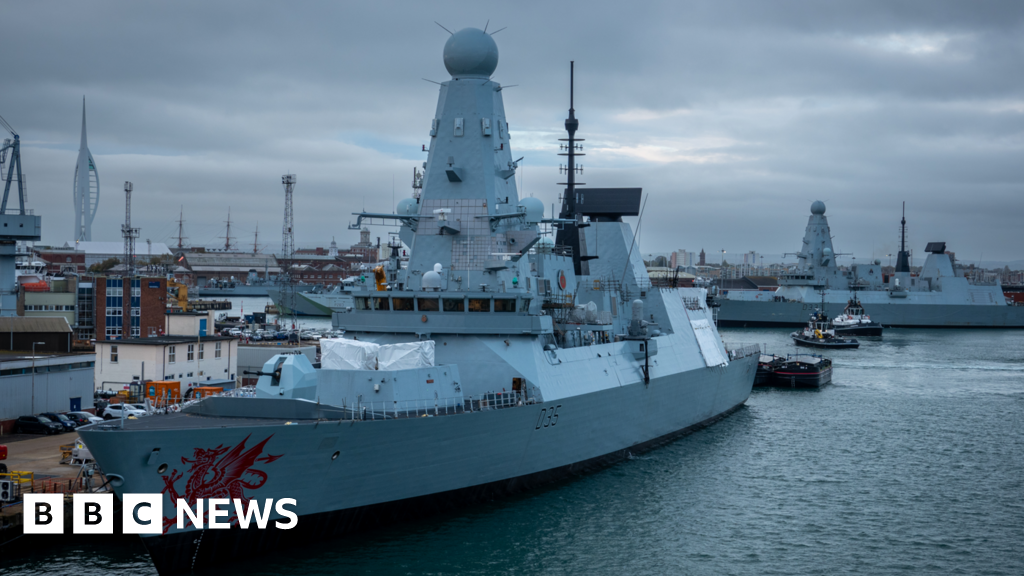
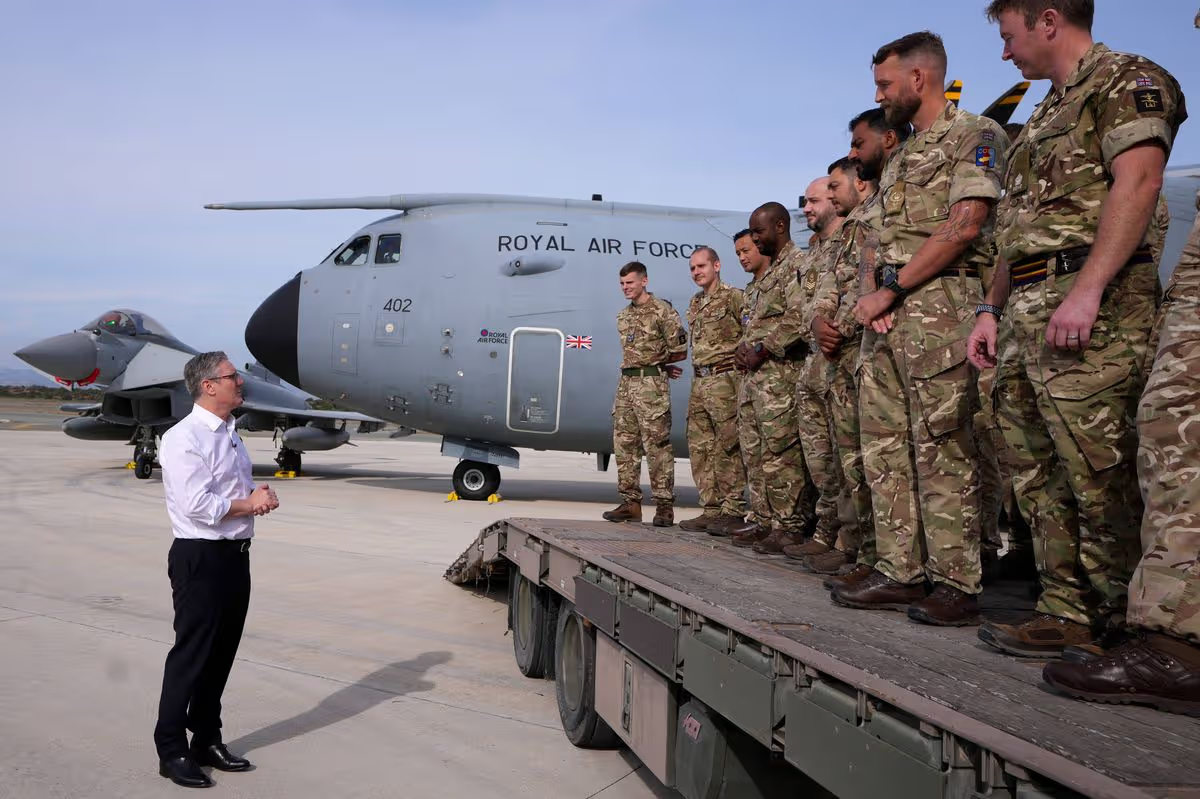
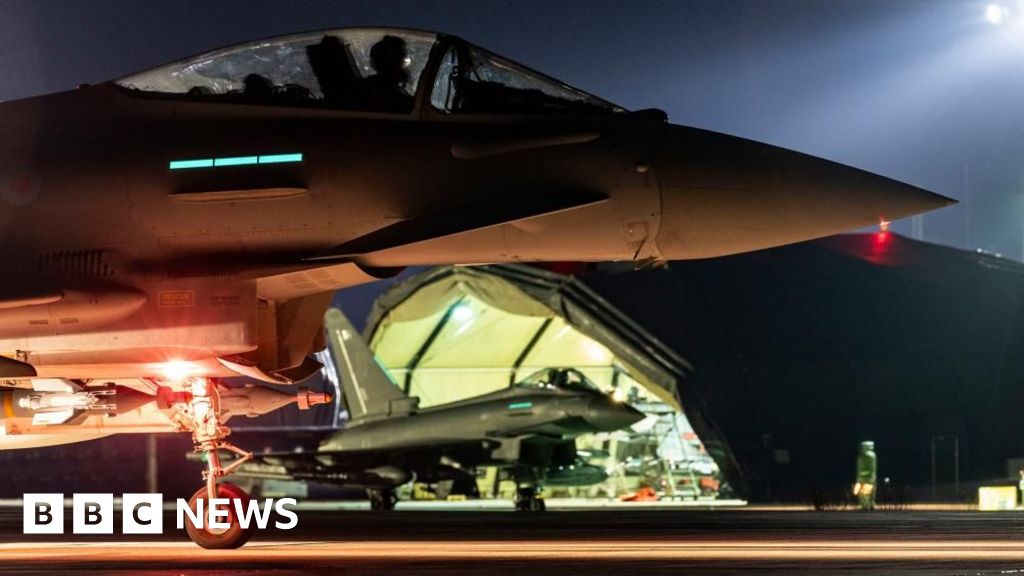
The United Kingdom will send four additional RAF Typhoon jets to reinforce its squadron in Qatar, deploy Wildcat helicopters with anti-drone capabilities to Cyprus and dispatch the Royal Navy destroyer HMS Dragon to the eastern Mediterranean.

The moves place Britain among the most active European partners supporting the U.S. war effort, as Starmer warned that the conflict will likely “continue for some time,” he said. It comes after an Iranian drone struck a British military base in Cyprus on Monday, which has led to a mounting of European naval resources.

Located just 150 miles from Israel in the eastern Mediterranean, the island of Cyprus has emerged as a strategic — and exposed — nerve center in the U.S. offensive against Iran. It hosts vital British military bases and acts as an intelligence, surveillance, and logistics hub in countering Iranian influence and proxy attacks.

On Thursday, Italy’s defense minister, Guido Crosetto, said Thursday that his country would follow the lead of France, Spain and the Netherlands to aid in the defense of Cyprus.

“Within the EU it made sense to send a message of support to Cyprus,” he said.

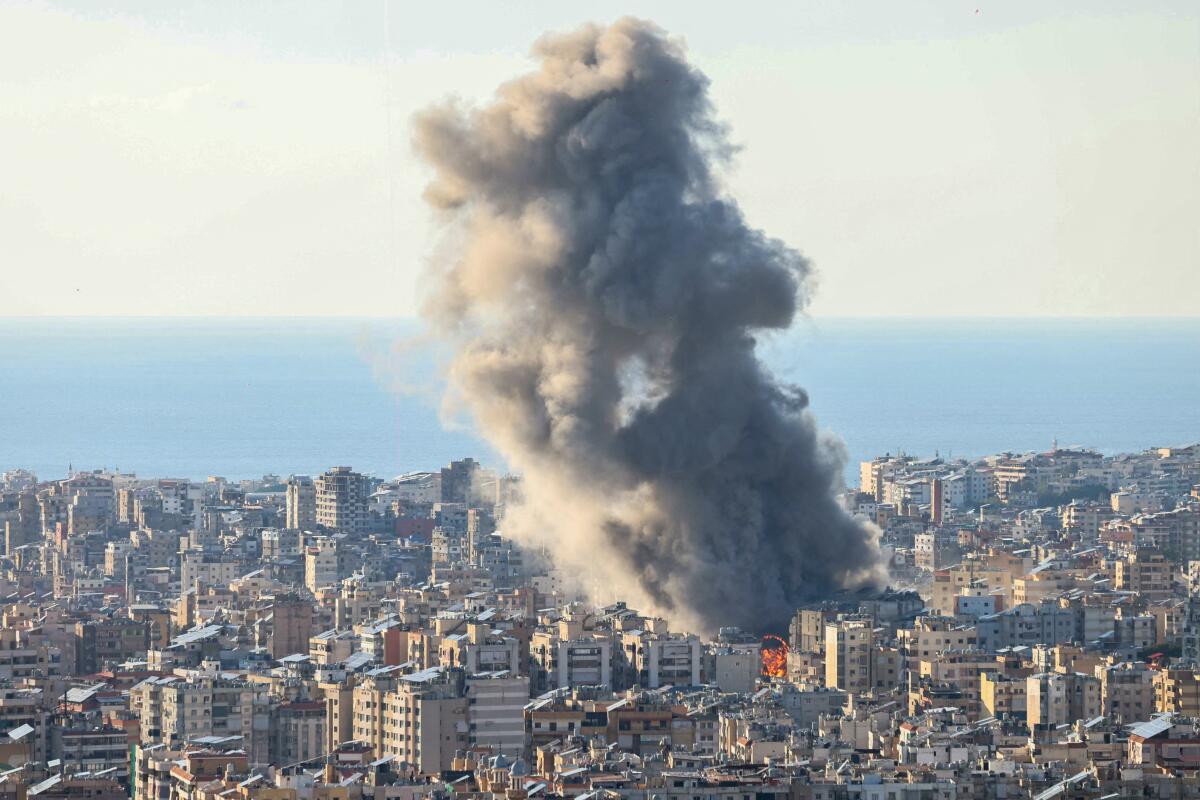
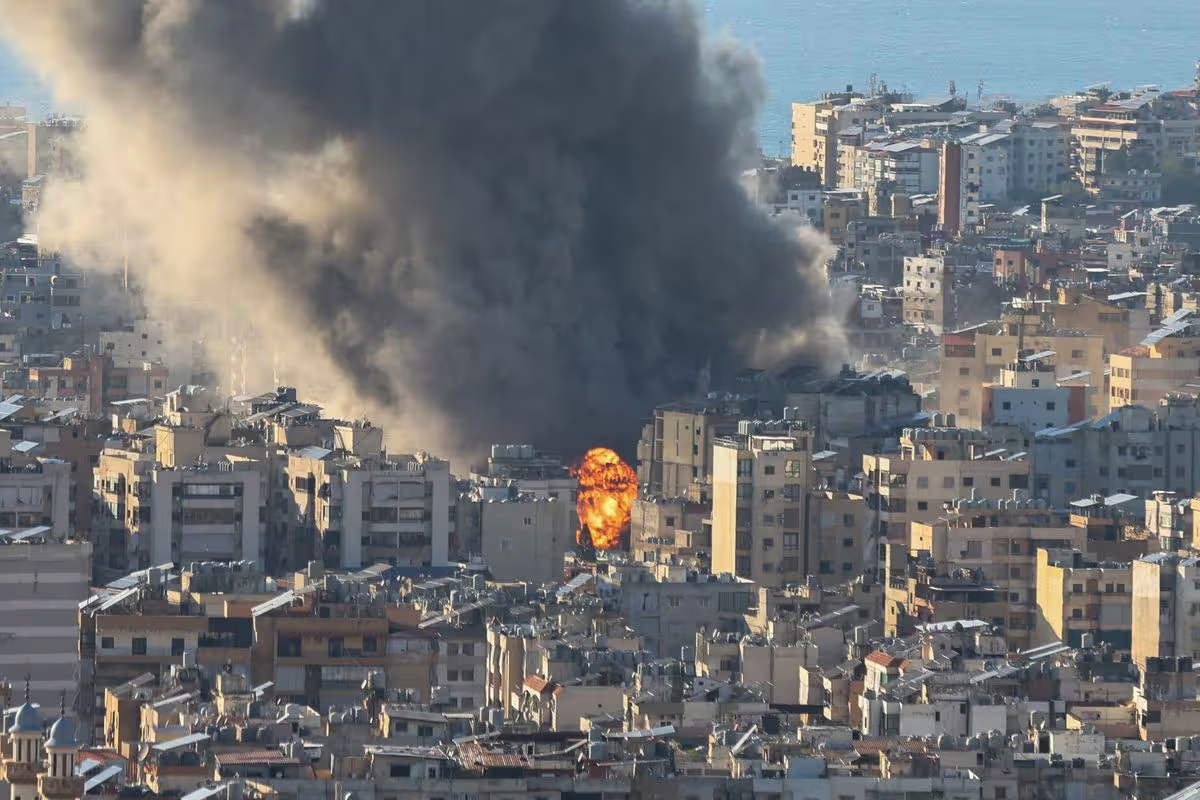
Smoke plumes billow following Israeli bombardment on Beirut

Smoke plumes billow following Israeli bombardment on Beirut’s southern suburbs on Monday.

(Ibrahim Amro/AFP via Getty Images)

Spain announced Thursday it would dispatch its advanced frigate Cristóbal Colón to Cyprus, after initially maintaining a “no to war” stance.

France also authorized temporary access to U.S. aircraft on bases located on French soil, a French army general staff official told Reuters.

And Germany, a country that has explicitly ruled out military participation in war with Iran and has criticized the legality of the initial U.S.–Israeli strikes, said Western powers must prepare for further escalation.

“Europe must remain united in the face of this crisis,” German Foreign Minister Annalena Baerbock said during an emergency meeting of European leaders. “We will not allow ourselves to be divided while regional stability is threatened.”

Meanwhile, conflict has reached a fever pitch between Israel and Hezbollah, the Lebanese-based Iranian proxy and key pillar of what Iran has called the “Axis of Resistance.” Overnight, Israel launched heavy airstrikes across southern Lebanon and issued urgent evacuation warnings for the southern suburbs of the capital, Beirut.

The outbreak of hostilities in Lebanon marks the end of a Israeli-Hezbollah truce and the opening of a major second front in the war with Iran. The fighting erupted after Hezbollah launched a barrage of drones and rockets at Israeli military sites—a retaliation for the joint U.S.-Israeli assassination of Iranian Supreme Leader Ayatollah Ali Khamenei.

Lebanon’s health ministry reported that at least 102 people have been killed by the Israeli strikes so far. In the Beirut suburbs, the Israeli military ordered residents of the Hezbollah-dominated Dahieh district to “save your lives and evacuate your homes immediately.”

“Dahieh? There’s not going to be a Dahieh any more,” one young man said as he talked to a family member on the phone at a media vantage point in the nearby hills.

The widening conflict has also drawn in Ukraine, which has some of the world’s most extensive experience in defending against Iranian-made Shahed drones. Such drones have been deployed by Russia in its war on Ukraine.

Ukraine President Volodymyr Zelensky said late Wednesday that the United States and other allies in Europe and the Middle East have sought Kyiv’s “expertise and practical support” to help them stop Iranian drones.

“Of course, any assistance we provide is only on the condition that it does not weaken our own defense in Ukraine and that it serves as an investment in our diplomatic capabilities,” Zelensky said in a social media post. “We help protect against war those who help us — Ukraine — bring the war to a dignified conclusion.”

While the aerial and naval battle intensifies across the Middle East, a ground war may also be on the horizon.

People arrive to sign a condolence book in memory of Iran's Supreme Leader Ayatollah Ali Khamenei

People arrive to sign a condolence book in memory of Iran’s Supreme Leader Ayatollah Ali Khamenei at the Embassy of Iran in New Delhi, India, on Thursday.

(Raj K Raj/Hindustan Times via Getty Images)

The United States and Israel have increased coordination with Kurdish armed groups along Iran’s western frontier, hoping to exploit longstanding tensions between Tehran and Kurdish factions opposed to the Iranian government, Kurdish officials told the Associated Press.

Iranian forces have already launched missile and drone strikes against Kurdish-controlled areas in northern Iraq following the initial U.S.–Israeli assault on Iranian targets.

Those strikes targeted areas around the city of Erbil and on Kurdish opposition groups operating near the Iranian border, locations where U.S. military forces and diplomatic facilities are also present.

Officials have not publicly confirmed whether Kurdish groups will mount cross-border operations, but security analysts say an incursion into Iranian territory could open a new front in the conflict.

U.S. Central Command, meanwhile, is asking the Pentagon to send more military intelligence officers to its headquarters in Tampa, Florida, to support operations against Iran for at least 100 days, but likely through September, according to a notification obtained by Politico.

The moves come as the House prepares to vote Thursday on a war powers resolution that would withdraw U.S. forces from hostilities in Iran, and limit the president’s power to wage war in the region. A similar measure failed Wednesday in the Senate, mostly along party lines.

Quinton reported from Washington and Bulos from Beirut.

Source link

Foreign Office Cyprus update: terror attacks cannot be ruled out

The Foreign Office has issued fresh security warnings for British tourists after a drone strike on RAF Akrotiri raised fears the Middle East conflict could spill into the Mediterranean

Britons heading to Cyprus have been issued a fresh security warning after the Foreign Office said terror attacks “cannot be ruled out” on the popular holiday island.

The updated travel advice came days after a suspected drone strike hit the RAF’s Akrotiri airbase on March 2 2026, in an incident linked to the escalating war in the Middle East. Officials say the attack caused only minimal damage and no casualties – but it has raised fears the conflict could spill closer to Europe.

The Foreign, Commonwealth and Development Office (FCDO) updated its guidance on Thursday, warning travellers about the risk of further incidents and urging British nationals to stay alert.

It said: “Regional escalation poses significant security risks and has led to travel disruption.”

Cypriot authorities have warned that the island could be drawn into the crisis because of the British sovereign bases at Akrotiri and Dhekelia, which are used for operations across the region.

With British and allied aircraft operating from RAF Akrotiri, security analysts suggest the island has gained strategic importance in the current confrontation involving Iran and its proxies. RAF Akrotiri is the UK’s largest overseas airbase and has been deployed for missions against ISIS in Syria and Iraq as well as strikes on Houthi targets in Yemen.

Against that backdrop, the Foreign Office has updated its Cyprus guidance to say terrorist attacks remain a possibility. It also warned that the wider regional situation could affect travel.

The FCDO urged Brits visiting the island to:

  • monitor local and international media
  • follow instructions from local authorities
  • keep travel plans under review
  • ensure travel documents are up to date

Officials also said Brits inside the British sovereign base areas should follow instructions issued by the Sovereign Base Areas Administration.

Hundreds of thousands of Brits visit

Cyprus is one of the most popular holiday destinations for UK travellers, with hundreds of thousands of Brits visiting each year. While officials stress that tourist areas remain open and functioning normally, the updated warning reflects growing concern that the regional conflict could bring further security incidents.

The Foreign Office said travellers should remember that “no travel can be guaranteed safe” and urged anyone visiting the island to sign up for government travel alerts.

Source link

Foreign Office issues fresh Cyprus travel update for Brits

A major travel update has been issued by the Foreign, Commonwealth and Development Office for Brits travelling to Cyprus as tensions in the Middle East escalate

The Foreign, Commonwealth and Development Office (FCDO) has issued an update on travel to Cyprus, amid the ongoing conflict in the Middle East.

Today (Thursday, 5 March), the FCDO has warned that “terrorist attacks in Cyprus cannot be ruled out”. In the updated advice, the Foreign Office stated: “There is a high threat of terrorist attack globally affecting UK interests and British nationals, including from groups and individuals who view the UK and British nationals as targets. Stay aware of your surroundings at all times.”

They added that terrorist attacks “could be indiscriminate, including in places visited by foreign nationals.” Following the update, they stated that the UK Counter Terrorism Policing has information and advice on staying safe abroad and what to do in the event of a terrorist attack.

READ MORE: British Airways announces charter flight in Oman for stranded Brits in Middle EastREAD MORE: ‘We’re trapped 3,000 miles from UK after holiday – the last five days have been hell’

While there is currently no advice against travel to Cyprus, the Foreign Office warns that the “regional escalation poses significant security risks and has led to travel disruption”. The UK government also warned of a suspected drone strike at the RAF Akrotiri base that took place on March 2.

“On 2 March 2026, the Sovereign Base Areas Administration confirmed a suspected drone impact at RAF Akrotiri. British nationals in the Sovereign Base Areas should follow instructions from the Sovereign Base Areas Administration British Bases Cyprus Facebook. British nationals in the Republic of Cyprus should follow any instructions from Cypriot local authorities,” the guidance reads.

“For British nationals, they advise the following:

  • “Read If you’re affected by a crisis abroad – GOV.UK. This includes guidance on “how to prepare for a crisis” with suggestions on what you might include in your emergency supplies and “what to do in a crisis”
  • “Sign up to FCDO Travel Advice email alerts
  • “Monitor local and international media for the latest information
  • “Sign up to local information alerts/resources and follow the instructions of the local authorities
  • “Keep your departure plans under review, and ensure your travel documents are up to date”.

On Wednesday (March 4) it was also confirmed that various airlines had cancelled flights from the UK to parts of Cyprus amid tensions in the Middle East, including easyJet, Ryanair, British Airways and TUI. Following the Foreign Office update, airlines may issue further updates on travel to Cyprus, but this is yet to be confirmed at the time of writing.

If you have an upcoming holiday, it’s best to stay in touch with your holiday provider – although they are prioritising people who are travelling imminently. As the situation is ever-evolving, travel advice can change quickly, so it’s best to check the latest Foreign Office travel advice for a destination before making any travel plans.

For more information on travel advice for Cyprus, or other areas in the Middle East, you can visit the Foreign Office website. You can also find more information on how to minimise your risk if there’s a terrorist attack while you’re away on the government website.

Do you have a travel story to share? Email webtravel@reachplc.com

Source link

Is Cyprus safe to travel to? Latest holiday advice after flights cancelled following Iran strike

CYPRUS is one of the European countries that has been drawn into the Iran crisis.

Flights were cancelled earlier this week after a drone strike from Iran hit an RAF base, resulting in a major airport being temporarily evacuated.

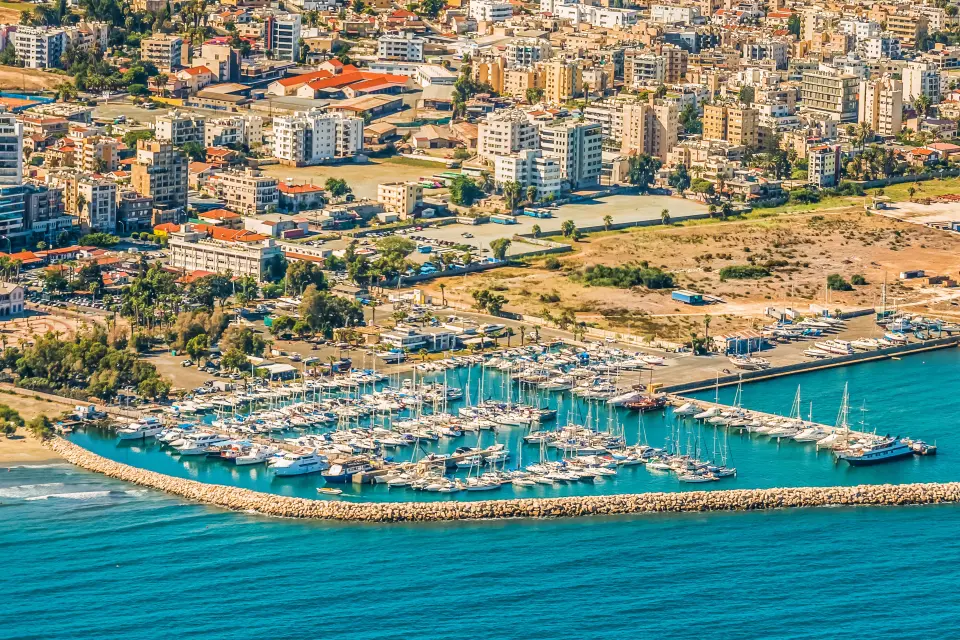
Aerial view of the coastline and city architecture of Larnaca, Cyprus, with a marina full of boats.
Everything you need to know about travel to Cyprus right nowCredit: Alamy

Here is everything you need to know about travelling to Cyprus right now.

Is Cyprus safe to travel to?

Cyprus is still on the safe travel list, with no areas deemed too dangerous for travel.

However, there is some updated advice following the RAF base attack.

The UK Foreign Office website currently states: “On March 2, 2026, the Sovereign Base Areas Administration confirmed a suspected drone impact at RAF Akrotiri.

GROUNDED

More flights to Cyprus cancelled – affecting easyJet, Tui and BA passengers


TRAVEL ADVICE

Is it safe to travel to Turkey? Latest holiday advice and flight news

“British nationals in the Sovereign Base Areas should follow instructions from the Sovereign Base Areas Administration British Bases Cyprus Facebook British nationals in the Republic of Cyprus should follow any instructions from Cypriot local authorities.”

This is mainly for Brits living in the area, rather than tourists in the resorts of Larnaca and Paphos.

The latest travel advice for the rest of Cyprus states: “Regional escalation poses significant security risks and has led to travel disruption.”

Are flights to Cyprus affected?

Some flights to Cyprus have been cancelled in recent days.

EasyJet and British Airways cancelled a number of flights from the UK on Monday and Tuesday.

Today, easyJet cancelled four flights from the UK today – London Gatwick flight to Larnaca, as well as flights from BristolManchester and Edinburgh to Paphos.

TUI cancelled four flights to Cyprus, affecting flights from BournemouthEast Midlands, and Cardiff to Paphos.

A TUI spokesperson told Sun Travel: “In light of the evolving situation in the Middle East, we have taken the decision to cancel the four TUI Airways flights scheduled to travel to Cyprus on March 4.

British Airways cancelled its London Heathrow flight to Larnaca today as well.

Brits with flights later this week should keep on eye on the current status as they could still be cancelled at short notice.

What if I have a holiday booked to Cyprus?

With travel still deemed safe in Cyprus, holidays are still going ahead.

If you decide to cancel, you will be left out of pocket as tour operators are under no obligation to issue a refund.

The Sun’s Head of Travel Lisa Minot said: “Only if the advice were to change, would your travel company have to offer you the chance to amend your travel to a different date or offer you a full refund.

“We have had lots of questions about holidays to Cyprus – both Larnaca and Paphos, later in June, July and September and the advice really remains the same.

“Unless you have paid a minimal deposit, you should continue to make payments.

“If you cancel now you could lose money – and discover that holidays are significantly more expensive when you look to book again.”

“What is important is to make sure you have bought good travel insurance NOW to cover you in the run up to your holiday dates. A lot can happen in the coming months.”

The Sun’s Head of Travel has answered some other questions regarding holidays right now.

Aerial view of Limassol city, Cyprus, showing the coastline, sea, and architecture.
Cyprus holidays are still going ahead, although some flights have been cancelledCredit: Alamy

Source link

Why are the US and Israel framing the ongoing conflict as a religious war? | Israel-Iran conflict News

As conflict in the Middle East enters its fifth day on Wednesday, American and Israeli officials are pushing rhetoric suggesting that the campaign against Iran is a religious war.

On Tuesday, Muslim civil rights organisation, the Council on American-Islamic Relations (CAIR), condemned the Pentagon’s use of this rhetoric, deeming it “dangerous” and “anti-Muslim”.

The United States and Israel began their attack on Iran on Saturday and have continued to carry out strikes on Iran since then. In retaliation, Iran has hit back at targets in Israel, and US military assets in Bahrain, Saudi Arabia, Qatar, the United Arab Emirates, Iraq and Cyprus.

A US watchdog has reported that US troops have been told the war is intended to “induce the biblical end of times”. US Secretary of State Marco Rubio also recently stated that Iran is run by “religious fanatic lunatics”.

What are American and Israeli leaders saying?

US watchdog Military Religious Freedom Foundation (MRFF) said it has received emailed complaints that US service members were told the war with Iran is meant to “cause Armageddon”, or the biblical “end times”.

An unnamed noncommissioned officer wrote in an email to MRFF that a commander had urged officers “to tell our troops that this was ‘all part of God’s divine plan’ and he specifically referenced numerous citations out of the Book of Revelation referring to Armageddon and the imminent return of Jesus Christ”.

The MRFF is a nonprofit organisation dedicated to upholding religious freedom for US service members.

The officer claimed the commander had told the unit that Trump “has been anointed by Jesus to light the signal fire in Iran to cause Armageddon and mark his return to Earth”.

Israeli and US leaders have also resorted to religious rhetoric in public.

Last month, Mike Huckabee, the US ambassador to Israel, told conservative US commentator Tucker Carlson during an interview that it would be “fine” if Israel took “essentially the entire Middle East” because it was promised the land in the Bible. However, Huckabee added that Israel was not seeking to do so.

Speaking to the media on Tuesday this week, Rubio said: “Iran is run by lunatics – religious fanatic lunatics. They have an ambition to have nuclear weapons.”

And, the previous day in a Pentagon news briefing, US Secretary of Defense Pete Hegseth said: “Crazy regimes like Iran, hell-bent on prophetic Islamic delusions, cannot have nuclear weapons.”

In its statement, CAIR claimed that Hegseth’s words are “an apparent reference to Shia beliefs about religious figures arising near the end times”.

On Sunday, Israeli Prime Minister Benjamin Netanyahu referenced the Torah, comparing Iran with an ancient biblical enemy, the Amalekites. The “Amalek” are known in Jewish tradition as representing “pure evil”.

“We read in this week’s Torah portion, ‘Remember what Amalek did to you.’ We remember – and we act.”

CAIR said: “We are not surprised to see Benjamin Netanyahu once again using the biblical story of Amalek – which claims that God commanded the Israelites to murder every man, woman, child and animal in a pagan nation that attacked them – to justify Israel’s mass murder of civilians in Iran, just as it did in Gaza.”

The statement added that every American should be “deeply disturbed by the ‘holy war’ rhetoric” being spread by the US military, Hegseth and Netanyahu to justify the war on Iran.

“Mr Hegseth’s derisive comment about ‘Islamist prophetic delusions’, an apparent reference to Shia beliefs about religious figures arising near the end times, was unacceptable. So is US military commanders telling troops that war with Iran is a biblical step towards Armageddon.”

Why are US and Israeli leaders framing the conflict with Iran as a religious war?

By attempting to frame the conflict as a holy war, leaders are using theological beliefs to “justify action, mobilise political opinion, and leverage support”, Jolyon Mitchell, a professor at Durham University in the UK, told Al Jazeera.

“Many on both sides of this conflict believe that they have God on their side. God is enlisted in this conflict, as with many others, to support acts of violence. The demonisation and dehumanisation of the enemy, the ‘other’, will inevitably make building peace after the conflict even harder,” Mitchell said.

“There are several overlapping reasons, and they operate at different levels: domestic mobilisation, civilisational framing, and strategic narrative construction,” Ibrahim Abusharif, an associate professor at Northwestern University in Qatar, told Al Jazeera.

Domestic mobilisation refers to rallying a country’s own people. Leaders can frame conflict as religious and hence morally clear and urgent, rallying public support, he said.

In a video circulating on social media this week, Christian Zionist pastor and televangelist John Hagee is seen delivering a sermon promoting the US assault on Iran. Hagee said that Russia, Turkiye, “what’s left of Iran” and “groups of Islamics” will march into Israel. He said that God will “crush” the “adversaries of Israel”.

“Religious language mobilises domestic constituencies,” Abusharif said, explaining that in the US, this connects deeply with many evangelicals and Christian Zionists, because they already see Middle East wars as part of a religious “end times” story.

“References to the ‘end times’, the Book of Revelation, or biblical enemies are not incidental; they activate a cultural script already present in American political theology.”

Civilisational framing refers to the creation of an “us vs them” dichotomy, casting the conflict as a clash between whole ways of life or faiths, not just a dispute over borders or policy, he added. Hence, statements such as Hegseth’s reference to “prophetic Islamic delusions” simplify the terms of the war in the minds of ordinary people.

“Wars are difficult to justify in technical strategic language,” Abusharif said.

“Casting the conflict as a struggle between ‘civilisation and fanaticism’, or between biblical ‘good and evil’, transforms a complicated regional confrontation into a moral drama that ordinary audiences can easily grasp.”

“Israeli leadership has long used biblical referents as political language. We all are familiar with it. The narratives have become globalised. In Israeli political discourse, this language situates contemporary conflict within a long historical narrative of Jewish survival, and it signals existential stakes,” Abusharif said.

Have US or Israeli leaders made religious references before?

Netanyahu and other Israeli officials have used the term “Amalek” before in reference to Palestinians in Gaza during Israel’s genocidal war in Gaza.

Historically, during wars or military confrontations, US presidents and senior officials have also invoked the Bible or used Christian language.

President George W Bush invoked similar language after the September 11, 2001 attacks.

On September 16, 2001, Bush said: “This crusade, this war on terrorism, is going to take a while.” The Crusades were a series of religiously framed wars, mainly between the 11th and 13th centuries, in which the papacy fought against Muslim rulers for territory.

The White House later tried to distance Bush from the word “crusade” to clarify that Bush was not waging a war against Muslims.

Abusharif said that the war on Iran is about power and politics, but using religious rhetoric energises supporters and “moralises” the conflict.

“The war itself is not theological. It is geopolitical. But the language surrounding it increasingly draws on sacred imagery and civilisational narratives. That rhetoric can mobilise supporters and frame the conflict in morally absolute terms,” Abusharif said.

“Yet it also carries risks: once a war is cast in sacred language, political compromise becomes harder, expectations become higher, and the global perception of the conflict can shift in ways that complicate diplomacy.”
Source link

Latest Foreign Office travel advice for Turkey, Cyprus and Egypt

The Foreign Office has updated its advice for a number of destinations including Cyprus, Turkey, and Egypt as the Middle East war continues following US-Israel strikes on Iran

The Foreign Office has updated its travel advice for a number of destinations including Turkey, Cyprus and Egypt amidst the chaos of the Middle East war, following US-Israeli strikes on Iran.

Although at the time of writing the UK government isn’t advising against travel to all of these destinations, it has updated its advice around “regional tension” and possible escalations in the areas. For Brits who have travel plans booked, as there isn’t an advisory against travel in general to these countries, holidays and flights in theory can go ahead as planned.

If you’re due to travel in the next few weeks but don’t want to because of the ongoing conflict, you do have a few options. It’s unlikely that you’ll be able to cancel and get a full refund, but get in touch with your tour operator or airline, as they may allow you to rebook your trip to a later date, without charging you a fee.

READ MORE: UK government set to start flights back from Middle East as cancellations near 10,000

If a company cancels your holiday or flight, then it’s a different story; in this case, you are entitled to a full refund. You may be offered rebooking options which you can take, but if you’d rather get your money back then you are entitled to do so. The same applies if the Foreign Office does issue a ‘do not travel’ warning, as it has done with the UAE. In this case, firms and airlines need to cancel your trip and offer you a full refund. If you try and travel against Foreign Office advice, your travel insurance will be invalidated.

It’s worth noting that airlines and holiday companies are currently prioritising customers due to travel within the next couple of weeks – if your trip is a few months away, you may be asked to get back in touch closer to the time.

Check out the latest travel advice for Cyprus, Turkey and Egypt below.

Cyprus travel advice

Currently, the Foreign Office doesn’t advise Brits against travel to Cyprus, with most holidays and flights currently going ahead. However, the UK government has warned of a suspected drone strike at the RAF Akrotiri base that took place on March 2. “British nationals in the Sovereign Base Areas should follow instructions from the Sovereign Base Areas Administration British Bases Cyprus Facebook. British nationals in the Republic of Cyprus should follow any instructions from Cypriot local authorities,” the guidance reads.

READ MORE: TUI gives major update on Cyprus holidays and confirms next flight dates

Authorities have also updated advice to warn of the “regional escalation” in the area. “Regional escalation poses significant security risks and has led to travel disruption,” it states, adding: “British nationals should:

  • “read If you’re affected by a crisis abroad – GOV.UK. This includes guidance on “how to prepare for a crisis” with suggestions on what you might include in your emergency supplies and “what to do in a crisis”
  • “sign up to FCDO Travel Advice email alerts
  • “monitor local and international media for the latest information
  • “sign up to local information alerts/resources and follow the instructions of the local authorities
  • “keep your departure plans under review, and ensure your travel documents are up to date.”

Turkey travel advice

Currently, the Foreign Office doesn’t advise Brits against travel to Turkey in general, with most holidays and flights currently going ahead. There is a ‘do not travel’ warning within 10km of Turkey’s border with Syria “due to fighting and a heightened risk of terrorism”, but this was in place before the Middle East conflict.

Like Cyprus, the advice has also been updated to warn of the “regional escalation” in the area. “Regional escalation poses significant security risks and has led to travel disruption,” it states, adding: “British nationals should:

  • “read If you’re affected by a crisis abroad – GOV.UK. This includes guidance on “how to prepare for a crisis” with suggestions on what you might include in your emergency supplies and “what to do in a crisis”
  • “sign up to FCDO Travel Advice email alerts
  • “monitor local and international media for the latest information
  • “sign up to local information alerts/resources and follow the instructions of the local authorities
  • “keep your departure plans under review, and ensure your travel documents are up to date.”

Egypt travel advice

The Foreign Office has updated its Egypt travel advice to warn Brits of “a heightened risk of regional tension” following the Middle East conflict. Its latest advice explains: “There is a heightened risk of regional tension. Escalation could lead to travel disruption and other unanticipated impacts.

“British nationals should take sensible precautions, considering their own individual circumstances. These include:

  • read If you’re affected by a crisis abroad – GOV.UK. This includes guidance on “how to prepare for a crisis” with suggestions on what you might include in your emergency supplies and “what to do in a crisis”
  • sign up to FCDO Travel Advice email alerts
  • monitor local and international media for the latest information
  • sign up to local information alerts/resources and follow the instructions of the local authorities
  • stay away from areas around security or military facilities.”

Currently it doesn’t advise against all travel to Egypt, however it does advise against travel to certain regions of the country. It’s worth noting these advisories are unrelated to the Middle East conflict, and were already in place. These include warning against all but essential travel to the Egypt-Libya border, North Sinai, Northern part of South Sinai, Eastern part of Ismailiyah Governorate. There is also advice against travelling to the Western Desert including the area west of the nile Valley and Nile Delta Regions, although there are some exceptions such as Luxor and Valley of the Kings (check the Egypt travel advice for full details).

Source link

Foreign Office warns British tourists on Cyprus to do 5 things now – see the full list

RAF Akrotiri on Cyprus was hit by a drone, which has threatened the safety of British military personnel, and now the Foreign Office has issued a warning to tourists there

British tourists on Cyprus should follow five key steps to ensure their safety, the Foreign Office says.

Visitors on the island in the Mediterranean Sea have been ordered to keep their departure plans under review and ensure their travel documents are up to date amid the conflict in the Middle East. RAF Akrotiri on Cyprus was hit by a drone on Monday, after which 60 flights to and from Cypriot airports were cancelled.

The UK will send HMS Dragon, one of the Royal Navy’s six Type 45 air defence destroyers, but tourists should also take action. The Foreign, Commonwealth and Development Office (FCDO)’s website reads: “Regional escalation poses significant security risks and has led to travel disruption.”

READ MORE: Iran war LIVE as Ali Khamenei’s son Mojtaba named as new Supreme LeaderREAD MORE: US commander tells troops Trump was ‘chosen by Jesus to unleash Iran Armageddon’

As Birmingham Live reports, the FCDO’s full five tips are;

  • read guidance on “how to prepare for a crisis” on the FCDO website, with suggestions on what you might include in your emergency supplies and “what to do in a crisis”
  • sign up to FCDO Travel Advice email alerts
  • monitor local and international media
  • sign up to local information alerts/resources AND follow the advice of local authorities
  • keep your departure plans under review AND ensure your travel documents are up to date

The conflict and tension in the Middle East and Gulf states continues. Donald Trump, though, has said he is “not happy” with the UK after it did not initially allow the US to use its bases for strikes on Iran, and added that Keir Starmer is “not Winston Churchill”.

It is the latest in a series of broadsides from the US president over the UK’s position on the Middle East war. Meanwhile, the Foreign Secretary confirmed that a Government charter flight will take off from Muscat, Oman, “in the coming days” to bring vulnerable British nationals back.

The HMS Dragon, due to be sent from Portsmouth in Hampshire and crewed by more than 200 people, is designed for air defence, it is equipped with a Sea Viper anti-air missile system. Defence Secretary John Healey said: “We are moving quickly to further reinforce our defensive presence in the Eastern Mediterranean.

“HMS Dragon brings world-class air defence capability, and our Wildcat helicopters are armed with Martlet missiles to counter the growing drone threat.

“I am deeply proud of the professionalism and bravery of our Armed Forces personnel who have in recent days, successfully taken action across the region to protect our allies and defend British interests.”

Dozens of countries remain on a list, compiled by FCDO, which Brits should not visit due to the ongoing conflict. These include holiday hotspots, such as Egypt and the United Arab Emirates.

Source link

TUI gives major update on Cyprus holidays and confirms next flight dates

Many TUI customers due to fly in the next few days will be awaiting news of whether their flights and package holidays are cancelled. The travel operator has now issued a major update on the situation

TUI has cancelled more flights to Cyprus as a UK Royal Navy warship heads for the region.

Sir Keir Starmer said HMS Dragon – a Type 45 Destroyer – will be sent to that section of the Mediterranean. The PM has also spoken with Cypriot President Nikos Christodoulides to let him know the UK is also “sending helicopters with counter-drone capabilities”.

It comes a day after the runway of the British air base in Cyprus, RAF Akrotiri, was hit by a drone. The Ministry of Defence said it caused “minimal damage”.

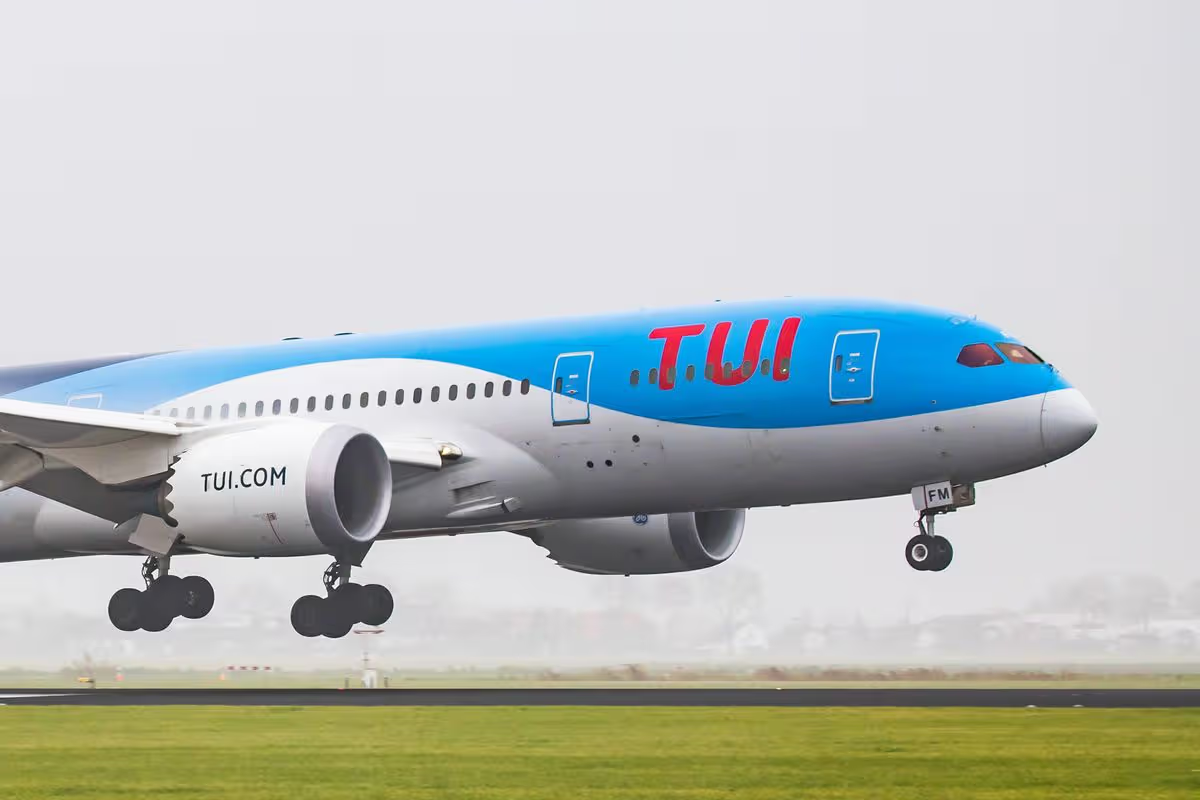
Today, flights to Cyprus’s two commercial airports were cancelled, with easyJet, Ryanair and TUI scrapping services. This afternoon, German travel giant TUI issued a major update on its coming Cyprus flights.

The spokesperson said: “In light of the evolving situation in the Middle East, we have taken the decision to cancel the four TUI Airways flights scheduled to travel to Cyprus on Wednesday, 4 March. We appreciate this may be disappointing news for those due to travel, and we are truly sorry for the disruption to our customers’ holiday plans. Our customer service teams are fully mobilised, and every affected customer will be contacted directly to discuss the options available to them.

“We want to reassure all customers that we are closely monitoring developments and keeping the situation under constant review.”

As for next steps, TUI has said: “Customers will be contacted directly and offered the option to amend their booking fee-free, with a rebooking incentive, or to receive a full refund.”

It also confirmed that its next TUI Airways flights to Cyprus are scheduled to operate on Saturday (March 7). TUI said: “At this stage, these flights are planned to run as normal. However, we continue to monitor the situation closely and, as it remains dynamic, schedules may be subject to change.”

Passengers flying out on Saturday should keep an eye on TUI’s travel alert page, as well as check its app for updates, and keep up to date with international news.

Flights cancelled on Wednesday, 4 March:

  • TOM7318 – East Midlands Airport to Paphos
  • TOM6312 – Cardiff Airport to Paphos
  • TOM6354 – Bournemouth to Paphos
  • TOM2336 – Manchester to Paphos

TUI’s website also has advice for customers currently in Cyprus. It says: “The safety of our customers is always our top priority. Our teams are working with our airline partners to monitor the situation and make arrangements to bring you back to the UK once it is safe to do so. We are working though bookings in date order and will call you to discuss your options. However, if you would prefer, please call us on 0203 451 2688.

“If you choose to call us, please be aware that we are receiving an exceptional volume of calls and there may be some delay in your call being answered.”

READ MORE: TUI, Emirates, British Airways and easyJet latest updates on when flights might resumeREAD MORE: TUI issues update for Brits impacted by Middle East travel advice

The Foreign, Commonwealth & Development Office (FCDO) does not currently advise against travel to Cyprus, but many airlines have been cancelling their flights in light of the current situation.

The FCDO advises that Brits planning a holiday in Cyprus should sign up to FCDO Travel Advice email alerts, monitor local news, and regularly review departure plans as the situation can change rapidly.

Have a story you want to share? Email us at webtravel@reachplc.com

Ensure our latest stories always appear at the top of your Google Search by making us a Preferred Source. Click here to activate or add us as your Preferred Source in your Google search settings.

Source link

Foreign office travel advice for holidays to Turkey, Cyprus, Egypt in wake of Iran war

Check the latest air travel status including departures from popular holiday destinations such as Dubai, Cyprus and Egypt after the Iran war forced airports to close and airlines to cancel flights

The war in Iran has plunged air travel into its biggest crisis since the pandemic as airports shut across the world and airlines cancel huge numbers of flights.

Conflict between Iran, the US and Israel has spread across the Middle East and triggered widespread airspace closures, sparking major disruption to flights, and leaving thousands of British tourists stranded abroad.

Popular holiday destinations including Egypt, Abu Dhabi and Dubai are among those to ground all flights or severely limit departures, but the ‘ripple effects’ are also impacting travel to and from a number of other countries, including Cyprus and Turkey.

Here’s all the latest on flight cancellations, cruise ships and your rights if something goes wrong:

Ensure our latest headlines always appear at the top of your Google Search by making us a Preferred Source. Click here to activate or add us as your Preferred Source in your Google search settings.

READ MORE: First Dubai flights as Emirates and Etihad operate very limited routesREAD MORE: Cyprus flights update as easyJet, British Airways and Ryanair cancel routes this week

Which destinations are affected?

The UK Foreign Office now advise against all but essential travel to the UAE, Qatar and Bahrain.

Airspace closures mean flights to and from the United Arab Emirates (including Dubai and Abu Dhabi), Qatar, Saudi Arabia, Lebanon, Kuwait and Oman are almost entirely cancelled, with aviation largely reserved for military and cargo flights.

If you have a flight due soon to one of these countries, you should get in touch with your airline as soon as possible.

While flights to and from Cyprus, Egypt and Turkey are going ahead largely as scheduled, they may be subject to short-notice delays or cancellations, so you should check regularly with your airline before you travel.

Dubai and UAE travel advice

The Foreign Office advises against all but essential travel to United Arab Emirates.

Your travel insurance could be rendered invalid if you travel against this advice.

British nationals currently in the country should stay indoors due to risk of missile attacks, and the current advice reads: “Remain indoors in a secure location, avoid all travel and follow instructions from the local authorities.”

Cyprus travel advice

After a suspected Iranian-made drone was fired at the RAF base at Akrotiri, the Foreign Office updated its advice to read: “Regional escalation poses significant security risks and has led to travel disruption.

“British nationals in the Sovereign Base Areas should follow instructions from the Sovereign Base Areas Administration. British nationals in the Republic of Cyprus should follow any instructions from Cypriot local authorities.”

Turkey travel advice

The Foreign Office advises against all travel to within 10km of the border with Syria due to “fighting and a heightened risk of terrorism”.

Egypt travel advice

There is “heightened risk of regional tension” which “could lead to travel disruption and other unanticipated impacts”, the Foreign Office said.

Which airlines have cancelled flights?

A handful of flights will bring British nationals stranded in the Middle East back to Britain today – but the majority of departures from the region remain cancelled.

The current Emirates flight status is that the airline plans to operate two flights to Heathrow, and one each to Gatwick and Manchester. At least some of these flights will be operated by the airline’s A380 jets, which can each carry up to 615 passengers depending on how they are configured.

Emirates usually operates 146 weekly flights to the UK, which is the equivalent of about 21 per day.

Etihad Airways has scheduled one UK flight on Tuesday, from Abu Dhabi to Heathrow.

Qatar Airways, which usually serves Heathrow and Gatwick from Qatar, said on Tuesday morning that its operations remain suspended because of the closure of Qatari airspace.

British Airways has cancelled its timetabled flights to Heathrow from Abu Dhabi, Amman, Bahrain, Doha and Dubai on Tuesday.

The airline told passengers: “We are closely monitoring the situation and have cancelled a number of our flights to the Middle East.

“Safety is always our top priority and we would never operate a flight unless it was safe to do so.”

Passengers with bookings on certain routes up to March 15 are being allowed to amend the date to fly on or before March 29.

Virgin Atlantic axed a flight from Dubai to Heathrow.

What about connecting flights?

You could also be affected if you’re due on a flight that changes at an airport disrupted by the war – such as Abu Dhabi, which acts as a major hub for connecting flights to Thailand, Vietnam, India, Australia and New Zealand. Check with your airline in advance if you’re in any doubt.

What if I’m stuck abroad?

British nationals currently in the Gulf have been advised by the Foreign Office to remain indoors and follow local authorities. Plans for evacuation repatriation flights are going ahead, but at a very limited capacity, and you should not make plans around these until you have been contacted by British consular staff.

What are my rights if something goes wrong with my flights?

Don’t cancel your own ticket if your destination or connecting flight is affected – instead, wait for the airline to cancel the flight.

If you cancel voluntarily, you will likely forfeit your right to a full refund or rebooking under UK air passenger rights.

It’s important to check your travel insurance, as standard policies will usually cover extended emergency medical expenses if you are stranded abroad – but many exclude cancellation or curtailment costs arising directly from acts of war.

What about cruise ships?

Thousands of cruise line passengers are currently trapped in ports in the Middle East due to the war in Iran.

At least six well-known ships from big companies, including TUI, are reported to be at a standstill and awaiting news of when they can leave.

Cruise liners affected include TUI Cruises’ ships Mein Schiff 4 and Mein Schiff 5, which are stranded in the ports of Abu Dhabi and Doha. The cruise line has had to cancel its upcoming departures due to the lack of operating repatriation flights.

The MSC Euribia remains docked in the port of Dubai, under strict security measures, with embarkations suspended until further notice.

The ships Celestyal Journey and Celestyal Discovery have also had their departures cancelled and are being kept under supervision in regional ports.

TUI Cruises said in its latest alert: “We are currently monitoring the evolving situation in the Middle East region and the latest guidance from the UK Foreign, Commonwealth & Development Office (FCDO).”

Disruption ‘could last weeks’

Last night, US president Donald Trump said the joint US-Israel military operation in Iran could last four to five weeks or “far longer”.

Aviation consultant John Strickland said it could take weeks to clear the backlog of passengers, even if the conflict ends sooner.

He said: “It’s a bit uncertain (when that will happen) because of course it will depend on how long the airspace restrictions remain in place.

“But factoring in the high volumes of normal daily traffic and the high capacity of aircraft such as the A380 and the Boeing 777, plus the fact that other flights covering similar routes operate at high occupancy, then it will certainly be quite a period of time which would likely run into weeks.”

Source link

Ryanair, easyJet, TUI, BA and Jet2 updates as Cyprus airport evacuated

Passengers have been evacuated from Paphos International Airport in Cyprus amid reports of an unidentified drone flying into its airspace. Here are the latest updates from airlines with flights to the island.

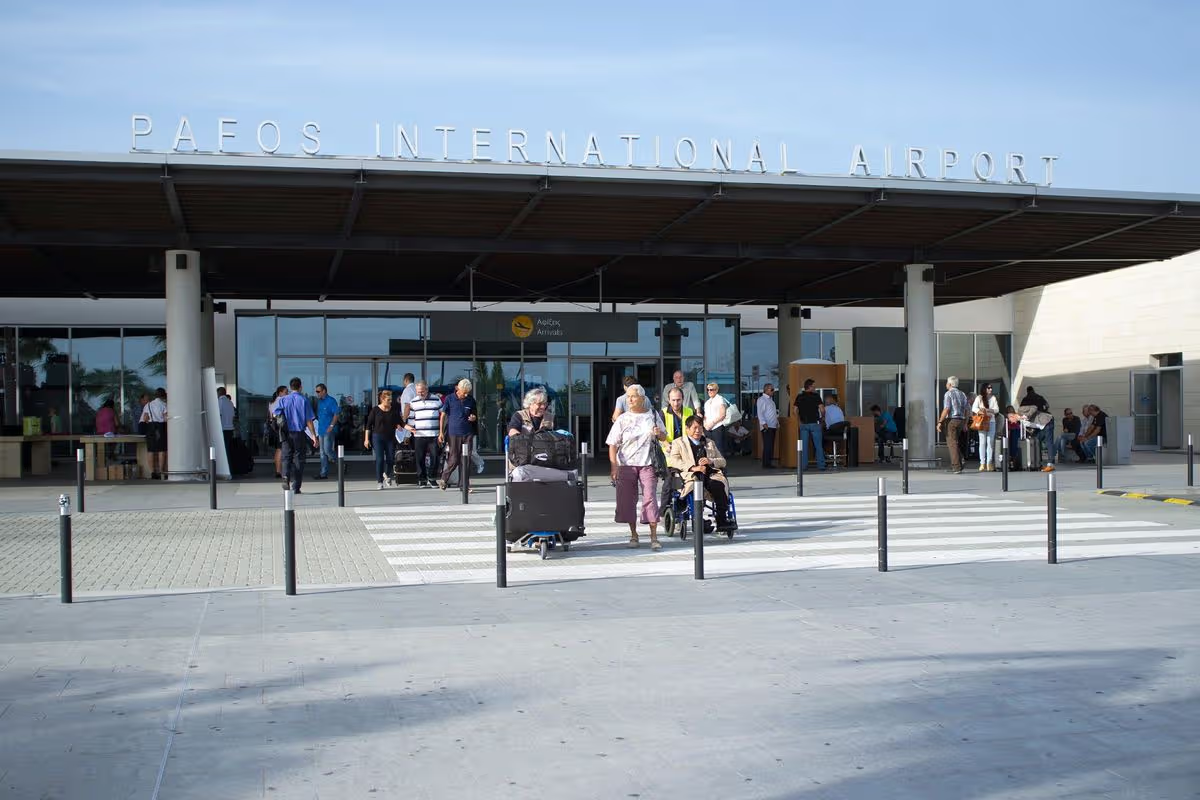
Paphos International Airport in Cyprus ordered an ‘immediate and total evacuation’ this morning (March 2) amid reports that an unidentified drone had been flown into its restricted airspace.

Some European airlines including easyJet have already been cancelling their flights to Larnaca International Airport, a major hub for package holidays, after a drone strike hit the RAF base in Akrotiri in Cyprus.

Cyprus is a popular destination for Brits, with over 1.3 million visiting each year, and with the busy Easter period on the way, many holidaymakers may be wondering how this will affect their travel plans. Around 60 flights have been cancelled to the island today, and airlines will be closely monitoring the situation in order to make a decision on resuming flights in the coming days and weeks.

Check out updates from airlines including British Airways and easyJet below. Travellers to the island should also keep up to date with FCDO advice for Cyprus, as the situation is likely to change quickly.

British Airways (BA)

BA said in its latest statement: “We are closely monitoring the situation and have cancelled a number of flights to the Middle East. We understand it is a difficult time for customers in affected destinations and we are in contact with them to offer reassurance and support. Safety is our top priority and we will only operate a flight if it is safe to do so.”

It added: “We have cancelled flights to Amman, Abu Dhabi, Bahrain, Dubai, Doha and Tel Aviv up to and including the 05 March and today’s Larnaca service [March 2].

“We have actioned a flexible customer booking policy which allows all customers due to travel between London Heathrow and Abu Dhabi, Amman, Bahrain, Doha, Dubai, Tel Aviv in the coming days the option to change their flights for free or get a refund. Customers travelling to Larnaca can rebook for free.

“We are advising customers to check their flight status on BA.com for the latest updates before travelling to the airport due to the evolving situation.”

EasyJet

EasyJet has been advising passengers on X (formerly Twitter) to check its Flight Tracker for the latest information on whether their Cyprus flight will be delayed or cancelled.

An easyJet spokesperson told The Express: “Due to the events overnight affecting the RAF base in Akrotiri in Cyprus, as a precaution, three return flights between Paphos and Larnaca and the UK today will not be operating.

“Flights from 3 March are currently operating as planned but we would advise customers due to travel to and from Cyprus over the coming days to check our flight tracker for the latest information.

“We are doing all we can to minimise the impact for our customers and are providing options for rebooking including on other airlines or a refund as well as hotel accommodation and meals for those who require them.”

TUI

A TUI spokesperson said: “The safety of our customers is our highest priority, and we are closely monitoring the situation in the middle east and surrounding regions. We are currently operating our Cyprus program as planned, but as this is an evolving situation, that could be subject to change.” Paphos and Larnaca airport shows TUI flights scheduled from Wednesday onwards, with no cancellations or delays showing at the time of writing.

TUI has also previously released a statement for customers due to fly out to the UAE or Qatar up to and including March 8, advising: “our pre-travel team will be in contact with you ahead of your departure date.” It also advises: “We are working though bookings in date order and will call you to discuss your options. However, if you would prefer, please call us on 0203 451 2688.” Should the current situation extend to Cyprus, it’s likely the process would be the same.

READ MORE: Emirates, British Airways and Wizz Air’s latest updates on UAE flight cancellationsREAD MORE: What travel insurance will actually cover if you’re affected by UAE travel chaos

Jet2

Jet2 flights scheduled for Tuesday and Wednesday (March 3 and 4) are not yet showing as cancelled or delayed on the Paphos Airport website. Customers who have asked for advice via Jet2’s official X account have been advised to contact the Jet2 pre-travel team via Whatsapp to discuss their options.

Ensure our latest stories always appear at the top of your Google Search by making us a Preferred Source. Click here to activate or add us as your Preferred Source in your Google search settings.

Source link

RAF Cyprus base hit, U.K., allows U.S. to fly missions from its bases

March 2 (UPI) — A British airbase on Cyprus was struck by a drone, forcing the evacuation of the facility from where RAF Typhoon warplanes are flying sorties to defend Gulf countries under attack from Iran and as many as 300,000 British nationals visiting or living in the region.

Foreign Secretary Yvette Cooper told Sky News that the runway at RAF Akrotiri was hit in the strike late Sunday and that “all of the precautionary measures are being taken around the base,” which is near Limassol in the southwest of the island.

No casualties were reported and the Ministry of Defense said damage had been “minimal” and that the base remained operational, but that families of service personnel and all non-essential staff had been relocated to safe locations off-base.

“Our armed forces are responding to a suspected drone strike at RAF Akrotiri in Cyprus at midnight local time. Our force protection in the region is at the highest level, and the base has responded to defend our people. This is a live situation and further information will be provided in due course,” the MOD said.

The military was mounting an effort to reassure residents of villages near the base that the threat was to the base and that there was no risk to them or their property.

The attack came around one hour after British Prime Minister Keir Starmer issued a pre-recorded statement posted to social media saying he had given permission to the U.S. military to fly “defensive” missions out of Britain’s base on Diego Garcia in the Indian Ocean and RAF Fairford in England.

Earlier Sunday evening, the MOD said an RAF Typhoon fighter jet patrolling the Persian Gulf successfully deployed an air-to-air missile to down an Iranian drone headed toward Qatar. The aircraft was operating out of Qatar after the RAF’s 12 Squadron deployed to the emirate in January as part of a U.K.-Qatar defense pact.

On Saturday, Starmer said Britain was not and would not participate in the military offensive launched by Israel and the United States, having earlier declined to allow U.S. military aircraft involved in the operation to use British bases either.

In his message, Starmer insisted that it remained the case that the United Kingdom was not involved but that developments over the weekend had changed the situation with attacks on interests of Britain and its partners in the Gulf, who were explicitly asking for back up.

“Over the last two days Iran has launched sustained attacks across the region at countries who did not attack them. They’ve hit airports and hotels where British citizens are staying. This is clearly a dangerous situation. We have at least 200,000 British citizens in the region — residents, families on holiday, and those in transit.

“Our Armed Forces who are located across the region are also being put at risk by Iran’s actions. On Saturday, Iran hit a military base in Bahrain, narrowly missing British personnel,” said Starmer.

He said Britain had made it clear it was staying out of the strikes on Iran because it believed the best way forward for the region and for the world was a negotiated settlement but that Iran had still attacked British interests and put Britons in the region at “huge risk along with our allies.”

Gulf countries had asked Britain to do more to defend them and it was his duty to protect British lives, Stamer said.

He explained that he had decided to grant a U.S. request to use British bases for the “specific and limited defensive purpose” of destroying Iranian missiles in their storage depots and the launchers they are fired from on the basis of “collective self-defence of longstanding friends and allies, and protecting British lives.”

With airspace closed across the region, hundreds of thousands of British nationals in Israel, Bahrain, Kuwait, Qatar and the United Arab Emirates are unable to get out.

Foreign Office sources told the BBC no evacuation was imminent but the government was preparing for potential scenarios if commercial flights remained grounded.

Cooper said she still hoped to be able to work with commercial airlines to bring people home in previous similar situations.

The Liberal Democrats and Green Party vowed they would force Starmer’s Labour government to seek authorization from parliament for the decisions he was making.

“No matter how the Prime Minister tries to redefine offensive as defensive, this is a slippery slope. He must not let Trump drag Britain into another prolonged war in the Middle East. Starmer must come to Parliament on Monday, set out the legal case in full, and give MPs a vote,” the Liberal Democrats’ leader, Ed Davey, said in a post on X.

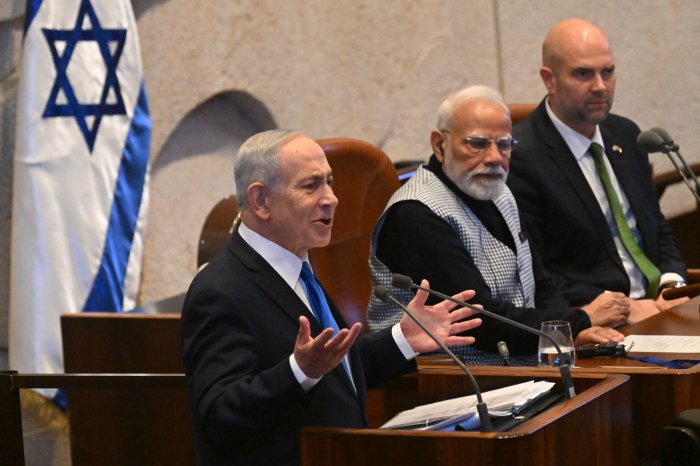
Israeli Prime Minister Benjamin Netanyahu (C) speaks adjacent to Indian Prime Minister Narendra Modi in the Knesset in Jerusalem on February 25, 2026. Photo by Debbie Hill/UPI | License Photo

Source link

Cyprus airport evacuated as easyJet and British Airways among 60 flights to island cancelled over Iran attacks

A NUMBER of airlines have cancelled flights from the UK to Cyprus after the evacuation of Paphos Airport.

More than 60 flights to and from Cyprus airports have been cancelled this week after the runway at major British RAF base in Cyprus was struck by an Iranian drone.

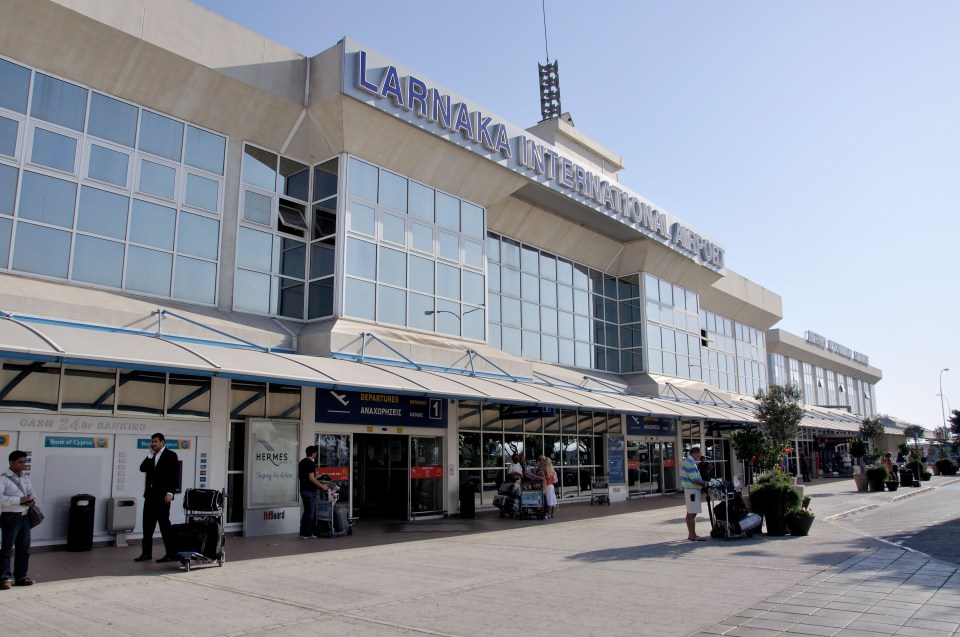
The exterior of Larnaca International Airport's main terminal building, with passengers entering and exiting.
More than 60 flights have been cancelled to and from CyprusCredit: Alamy

This includes 42 flights to Larnaca, and 18 flights to Paphos, according to Hermes Airport who operates them both.

Local media previously reported that all easyJet flights were cancelled between the UK and Cyprus until Thursday, however the airline confirmed just three have been cancelled so far today.

An easyJet spokesperson said: “Due to the events overnight affecting the RAF base in Akrotiri in Cyprus, as a precaution, three return flights between Paphos and Larnaca and the UK today will not be operating.

“Flights from March 3 are currently operating as planned but we would advise customers due to travel to and from Cyprus over the coming days to check our flight tracker for the latest information.

GROUNDED

Thousands more flights and holidays cancelled as all travel to UAE banned

“We are doing all we can to minimise the impact for our customers and are providing options for rebooking including on other airlines or a refund as well as hotel accommodation and meals for those who require them.

“The safety of our customers and crew is our highest priority and we continue to closely monitor the security situation in the region.”

British Airways has also cancelled a Larnaca flight today.

They said in a statement: “We are closely monitoring the situation and have cancelled a number of our flights to the Middle East.

“Safety is always our top priority, and we’re contacting our customers to advise them of their travel options.”

While no casualties were reported in the attack , the base is moving families and temporarily relocating non-essential staff.

Three British schools on the island have also been closed with immediate effect.

A Ministry of Defence spokesperson said: “The safety of our personnel and their families is our absolute priority.

“Our base and personnel continue to operate as normal protecting the safety of Britain and our interests.”

EasyJet flies to both Paphos and Larnaca in Cyprus from several UK airports including London Gatwick, Manchester and Bristol.

Hundreds of other flights have been cancelled today as air travel continues to experience disruption caused the conflict in the Middle East.

Dubai Airport – one of the world’s busiest with up to 2,500 flights a day – remains closed for the third day running.

British Airways has cancelled a number of flights to the Middle East, which includes from London Heathrow to Dubai, Doha, Abu Dhabi and Amman.

A number of Virgin Atlantic flights have been cancelled to the UAE, with others rerouted.

Flight compensation rules

A look at your rights if a flight is delayed or cancelled, when your entitled to compensation and if your travel insurance can cover the costs.

What are my rights if my flight is cancelled or delayed?

Under UK law, airlines have to provide compensation if your flight arrives at its destination more than three hours late.

If you’re flying to or from the UK, your airline must let you choose a refund or an alternative flight.

You will be able to get your money back for the part of your ticket that you haven’t used yet.

So if you booked a return flight and the outbound leg is cancelled, you can get the full cost of the return ticket refunded.

But if travelling is essential, then your airline has to find you an alternative flight. This could even be with another airline.

When am I not entitled to compensation?

The airline doesn’t have to give you a refund if the flight was cancelled due to reasons beyond their control, such as extreme weather.

Disruptions caused by things like extreme weather, airport or air traffic control employee strikes or other ‘extraordinary circumstances’ are not eligible for compensation.

Some airlines may stretch the definition of “extraordinary circumstances” but you can challenge them through the aviation regulator the Civil Aviation Authority (CAA).

Will my insurance cover me if my flight is cancelled?

If you can’t claim compensation directly through the airline, your travel insurance may refund you.

Policies vary so you should check the small print, but a delay of eight to 12 hours will normally mean you qualify for some money from your insurer.

Remember to get written confirmation of your delay from the airport as your insurer will need proof.

If your flight is cancelled entirely, you’re unlikely to be covered by your insurance.

Etihad, Emirates and Qatar Airways passengers are also all facing cancelled flights.

As many as 94,000 Brits are thought to be still stranded abroad, with the Foreign Office working a rescue mission.

Aerial view of Larnaca International Airport in Cyprus with planes parked at the terminal and a highway and landscape in the background.
EasyJet and BA have cancelled flights this week to CyprusCredit: Alamy

Source link

Turkey and Cyprus travel advice for Brits as Foreign Office issues warning

The Foreign Office has updated its travel advice for Turkey and Cyprus amidst the ongoing conflict between Iran, the US and Israel

Travel warnings have been issued for Brits in both Cyprus and Turkey as the conflict between Iran, the US and Israel enters its fourth day.

A huge swathe of the global airspace has been shut down completely as the conflict spreads further across the region. Israel and Hezbollah in Lebanon have exchanged strikes, with the Lebanese health ministry announcing that Israeli attacks in Beirut and southern Lebanon have killed at least 31 people, with 149 injured

On Sunday, an Iranian missile strike killed nine people in the Israeli city of Beit Shemesh, while Iranian officials reported that at least 153 people were killed after a strike on a girls’ school. Iran’s President Masoud Pezeshkian called the incident a “barbaric act”.

Have you been impacted by the conflict? If you’re safe to do so, please contact webtravel@reachplc.com

READ MORE: ‘Several’ US military jets crash in Kuwait as smoke seen near embassyREAD MORE: Death toll of Ian strikes so far as US continues combat operations and more countries are hit

It is important to note that at the time of writing, the Foreign, Commonwealth and Development Office (FCDO) has not issued ‘do not travel’ warnings for either Turkey or Cyprus. Such alerts are key because they signal extremely high risks – such as conflict, terrorism, or civil unrest – that often instantly invalidate travel insurance, leaving tourists personally liable for accidents or medical bills.

However, the FCDO does advise against all travel to within 10km of the border with Syria “due to fighting and a heightened risk of terrorism”, warning that “your travel insurance could be invalidated if you travel against advice from the FCDO.”

On Sunday, the FCDO updated its Turkey travel advice for those planning to cross the border from Iran to Turkey. The border remains open visa-free for people travelling on UK or Iranian passports.

“If you are a British national intending to cross the land border from Iran into Turkey, you must request facilitation from the British Embassy in Ankara by contacting the FCDO before travelling to the border. You must state which border point you intend to use and provide personal details (name, date of birth, details of travel document used to enter Turkey). Also indicate whether you are contacting from Iran or from the UK on behalf of a relative,” the FCDO update reads.

“If you intend to leave Iran overland, you do so at your own risk. In Iran, holding a British passport or having perceived connections to the UK can be reason enough for the Iranian authorities to detain you. “

Concerns are also growing for Cyprus, which sits less than 100km from the coasts of Lebanon and Syria. This morning it was reported that the RAF base Akrotiri in Cyprus has been hit by a one-way attack drone. No one was reported injured.

In response to the attack, the base is moving families and temporarily relocating non-essential staff. Around 30,000 Brits live in Cyprus and 1.3million visit from the UK each year.

The Foreign Office travel advice for Cyprus was updated this morning (March 2). The latest advice reads: “On 2 March 2026, the Sovereign Base Areas Administration confirmed a suspected drone impact at RAF Akrotiri. British nationals in the Sovereign Base Areas should follow instructions from the Sovereign Base Areas Administration British Bases Cyprus Facebook. British nationals in the Republic of Cyprus should follow any instructions from Cypriot local authorities.”

The FCDO has also issued general advice for people in the region. It urges British nationals to take “sensible precautions, considering their own individual circumstances.” These include:

  • Read if you’re affected by a crisis abroad – GOV.UK. This includes guidance on “how to prepare for a crisis” with suggestions on what you might include in your emergency supplies and “what to do in a crisis”
  • Sign up to FCDO Travel Advice email alerts
  • Monitor local and international media for the latest information
  • Sign up to local information alerts/resources and follow the instructions of the local authorities

The governmental body has also launched a central advice hub where all the latest updates can be found. British nationals in Bahrain, Israel, Kuwait, Palestine, Qatar and United Arab Emirates can register their presence to receive direct updates from the Foreign Office.

Make sure to check the Foreign Office advice regularly if you’re travelling to or are in the region. The advice is updated often.

Source link

Netanyahu says Israel will forge regional alliance to rival ‘radical axes’ | Israel-Palestine conflict News

Israel to join with India, Greece, Cyprus and other Arab, African, Asian countries that ‘see eye to eye’, says PM.

Israeli Prime Minister Benjamin Netanyahu has announced that Israel plans to build a network of allied nations in or around the Middle East to collectively stand against what he called “radical” adversaries.

Netanyahu made the comments on Sunday while announcing the upcoming visit to Israel of Indian Prime Minister Narendra Modi, whose country the Israeli leader said would be part of the “axis of nations that see eye to eye” with Israel.

Recommended Stories

list of 3 itemsend of list

Netanyahu, who is wanted by the International Criminal Court on war crimes charges, also referred to Greece, Cyprus and other unnamed Arab, African and Asian countries.

“In the vision I see before me, we will create an entire system, essentially a ‘hexagon’ of alliances around or within the Middle East,” Netanyahu said, according to the Times of Israel.

“The intention here is to create an axis of nations that see eye to eye on the reality, challenges, and goals against the radical axes, both the radical Shia axis, which we have struck very hard, and the emerging radical Sunni axis.”

Modi said he fully agrees with Netanyahu on the “bond between India and Israel”, including the “diverse nature of our bilateral relations”.

“India deeply values the enduring friendship with Israel, built on trust, innovation and a shared commitment to peace and progress,” Modi wrote in a post on X.

Since the start of Israel’s genocidal war on Gaza, its assaults have been weakening the Iran-led “axis of resistance”, including Hezbollah in Lebanon. Israel and Iran also directly clashed last June in a 12-day war, in which the US military also joined to attack Iran’s nuclear sites.

Netanyahu did not elaborate on what he meant by “emerging radical Sunni axis”, but he has previously identified the Muslim Brotherhood as its leading element.

Relations between Israel and several predominantly Sunni Muslim states have soured amid the bloodshed in Gaza, including with Turkiye, whose President Recep Tayyip Erdogan has sharply criticised Netanyahu, and Saudi Arabia, which has accused Israel of genocide.

Prospects for normalisation between Israel and Saudi Arabia also appear to be eroding. In recent months, the kingdom has rebuked Israel’s recognition of Somalia’s breakaway region, Somaliland, as well as the Israeli moves towards annexation in the occupied West Bank.

Since 2020, Israel has pushed to establish formal ties with Arab and Muslim states as a way to shore up its regional standing as part of the US-backed so-called “Abraham Accords”.

Under that framework, Israel has been enjoying close relations with the United Arab Emirates, Bahrain and Morocco.

Source link