RM, leader of K-pop’s BTS, curates his first museum show at SFMOMA
The leader of the world’s biggest band is nervous.
“I think I revised this speech about 10 times, but somehow the more I worked on it, the more confused I became, like always,” said K-pop star and BTS rapper RM on Tuesday at a preview of a show he has co-curated at San Francisco Museum of Modern Art called “RM x SFMOMA: Between You and Me”
Three years ago, RM held an anonymous show in South Korea, but this is the first proper exhibition he has staged. For many of his fans — some of whom wait outside the museum trying to get a glimpse of him — his favorite activities, including museum-hopping, bicycling and being out in nature, come as no surprise. There is even a word for it: “namjooning,” a play on the singer’s first name, Namjoon. But still, the exhibition is the rare chance to view RM as a serious art collector; someone who values Korean identity in art but also loves works from many genres, eras and countries.

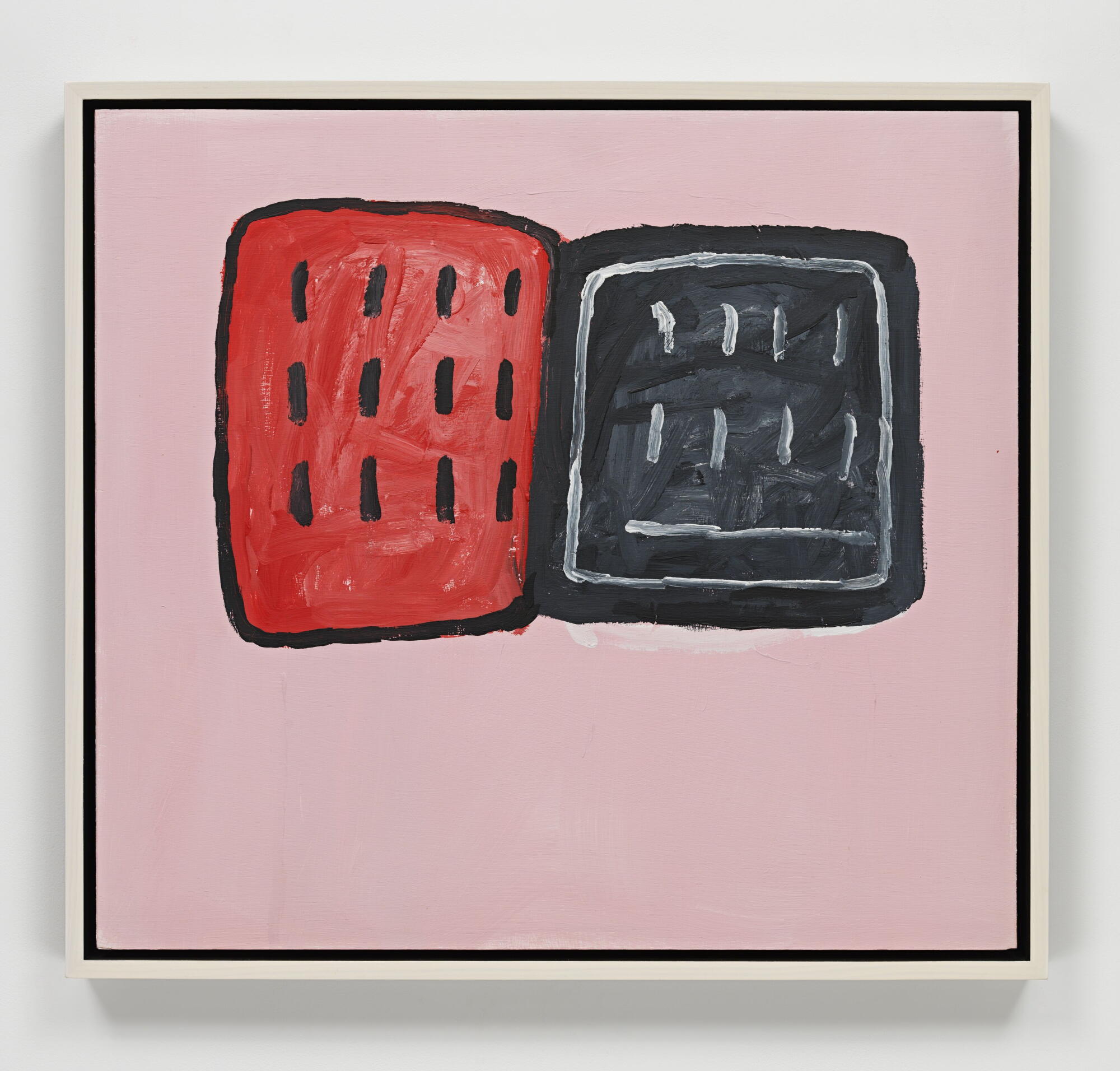
Philip Guston, Untitled (Red and Black Book), 1969; from the collection of RM.
(The Estate of Philip Guston / Hauser & Wirth)
Dressed in a gray T-shirt, dark collared shirt and leather pants, RM’s hair is a light burnt sienna color matching the fur of the stylized tiger on the screen behind him. From a 17th century painting by Lee Won-chan, it’s from his personal collection of more than 400 artworks. For this exhibition, 142 pieces owned by RM will be shown alongside 36 works from SFMOMA for a total of 178 works on display.
RM sees “Between You and Me” as an introduction to his inner life and reflection of contrasting aspects of his personality, whether as a public figure interacting with his adoring fans or an erudite intellectual and avid reader with a reputation as a clumsy and lovable goofball.
RM was on a hiatus from BTS and on the cusp of beginning his mandatory military service in South Korea when SFMOMA first approached him for the project two years ago. As it came to fruition, he sought to answer two main questions when contemplating which works of his collection to share with the public.
Does the artwork move him deeply? And, if the work is from a noncontemporary artist, does the piece have something to communicate in 2026?
“In an age where everything is consumed so fast,” RM explained, “I believe the attitudes of some of the past artists can resonate even more deeply today.
“I’ve always dreamed of seeing different places, times, boundaries and backgrounds all mixed together in harmony,” he continued. “It could be a mess because I’ve never formally studied, and I’m not a ‘curator, curator,’ but in any field sometimes an outsider can bring in a new breeze.”

Wonwoo Lee, “Candy,” 2023; from the collection of RM
(Wonwoo Lee / PKM Gallery)
It’s not RM’s first time working with a museum. In 2023, he partnered with Los Angeles County Museum of Modern Art to provide guided audio narration for “The Space Between: The Modern in Korean Art”.
At SFMOMA, RM was joined in his effort by two co-curators: SFMOMA project manager América Castillo and assistant curator of painting and sculpture Hyoeun Kim.
Kim, who has long championed Korean artists internationally, was particularly impressed with the diversity of Korean art that RM has amassed, including its “remarkable range.”
“His collection began with 6th century works, moved through the Joseon Dynasty, and continued to major Korean modern and contemporary art. It spans nearly 1,500 years,” Kim said during the preview.
The show is arranged in eight parts and begins with a large white wall at the entrance with the title of the show scrawled in RM’s handwriting. Handwritten touches are found everywhere — “Plz take it in with your eyes and heart” is scribbled on the floor in both English and Korean. The wall text for each piece, which also includes a QR code for audio narration, is composed by RM in both languages.

An inscription on the floor of an SFMOMA exhibit curated by RM of BTS features RM’s writing as part of the wall (and floor) text.
(Christine Terrisse.)
Guests will also receive a zine-style pamphlet with the same homespun appeal explaining each of the eight sections in RM’s words alongside a diagram of the room.
“Blue Water” centers the work of Kim Whanki, the late globe-trotting abstract artist and the first RM says he “fell for.” In addition to Whanki and works by Vija Celmins and Tony Feher, some RM fans might recognize one of Roni Horn’s glass cylinder sculptures from a now-archived Instagram post where it was casually displayed in RM’s apartment.
There’s even a room filled with especially eclectic pieces called “i don’t know..but i like it.” By way of explanation, RM said, “Sometimes I don’t really know why I collected all these things.”
The last room, “Umber” or “Dasaek” (referring to the color of Korean rice fields) might be the most meaningful to the singer. It features works by the late artist Yun Hyong-keun, for whom RM has a particular personal affinity. The cover for his debut solo studio album, “Indigo,” depicts Hyong-keun’s 1972 painting “Blue,” and the album’s lead track, “Yun,” a collaboration with Erykah Badu, kicks off with recorded dialogue from the artist.
Back in 2018, around the same time RM began his art journey with not much formal training in art history, co-curator Castillo began her career with SFMOMA.
At the time, she was in awe of the power of art to connect with people, but frustrated that more people from unconventional backgrounds weren’t being given opportunities to curate major shows, thereby shaping the stories told. Her work on this exhibition is part of a continuing mission to bridge the art world and the ordinary person.

Chang Ucchin, “Road,” 1986, from RM’s collection.
(Chang Ucchin Foundation / Seoul Auction)
This mission guided her through the process of selecting works by famous artists from SFMOMA’s collection to contextualize RM’s pieces from lesser-known but equally important names.
“The first time we pulled a list on the SFMOMA side, we had like 500 options we then dwindled down,” she said in an interview while standing in the “Umber” room. “There were some artworks and specific artists that we knew from the get-go we wanted to be in the show. We wanted them to have a moment. Mark Rothko was definitely one of them.”
The sole Rothko piece in SFMOMA’s collection, “No. 14,” (1960) is featured in one of the final rooms in the exhibition. Adjacent to it is “untitled” (1986-90) by Hyong-keun. In the exhibit pamphlet, RM notes that Hyong-keun’s paintings are often compared to Rothko’s, but “their darkness is not the same.” “To my eyes, if Rothko’s darkness is one that ‘opens’ then Yun’s is the darkness that remains after he endured everything he possibly could,” he writes.
As RM steps into the spotlight of the art world, he is learning to become comfortable with the uncomfortable in-between spaces he occupies. “I started this with an innocent heart. As I’m standing here talking to you, I still feel like I’m always drifting and floating somewhere, ” he said, adding that the feeling comes when he’s in the U.S. but also when he’s in his hometown of Seoul. “It’s not a very pleasant feeling. I think I’ve leaned on art a lot because of that feeling.”
Before the preview, BTS fans, called the ARMY, passed out small gifts to the press, and afterward donors lined up for a special reception. RM’s mother, father and sister even arrived to celebrate, but he didn’t have much time to hang around. He was scheduled to depart for Bogotá, Colombia, to join his bandmates on the Latin American leg of their ARIRANG stadium world tour.
It is time to leave the quiet of the museum for the roar of the crowd.
“RM SFMOMA: Between You and Me” opens to the public on Oct 3, and runs through Feb.7, 2027. For more information visit sfmoma.org