Several Palestinians were rushed to hospital with severe injuries after an Israeli air strike hit a crowd near the Al Jazeera Club in central Gaza City. Near-daily Israeli attacks have killed more than 700 people since the so-called “ceasefire” entered into effect in October 2025.
WASHINGTON — Inside the Supreme Court, as justices heard oral arguments in the case over birthright citizenship, President Trump became the first sitting president to attend such a proceeding.
Outside the court, the great-grandson of Wong Kim Ark — the San Francisco man whose landmark Supreme Court case affirmed birthright citizenship in 1898 — addressed a crowd of hundreds of people.
“Wong Kim Ark’s victory ensured that people like me and millions of others would be recognized as fully American, not outsiders in the country of our birth,” said Norman Wong. “This case transformed the 14th Amendment from words on paper into living promise. Today, that promise is still being tested.”
Surrounded by protesters in favor of birthright citizenship was a lone counter-protester. The woman, who wore a red baseball cap and a sweatshirt stating “Chicago flips red,” yelled into a megaphone as speakers addressed the crowd.
“Freedmen stand with Donald Trump,” she said as the Rev. William Barber II spoke. “America first. Americans first.”
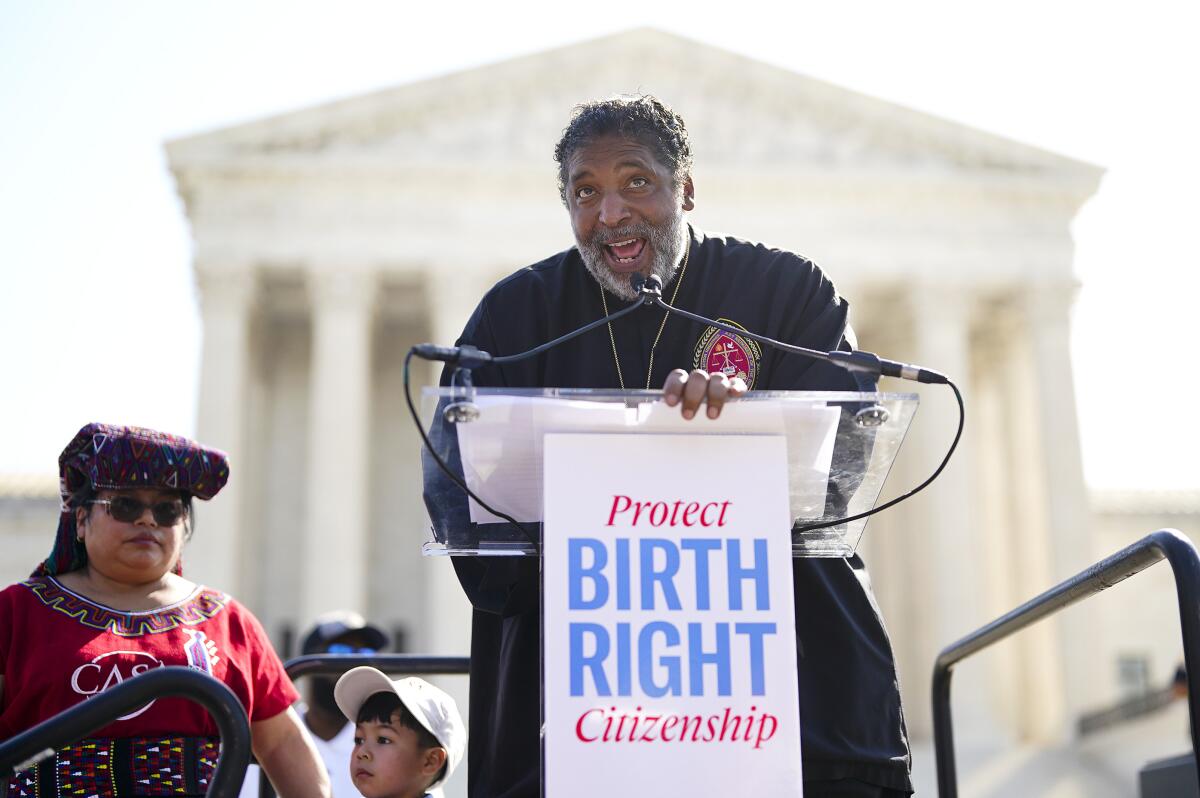
The Rev. William Barber II speaks during a rally on protecting birthright citizenship outside the Supreme Court on Wednesday.
(Al Drago / Getty Images)
Undaunted, Barber noted that the 14th Amendment, ratified in 1868, makes clear that anyone born in the U.S. is a citizen.
“The 14th Amendment protects babies from a caste system,” Barber said. “They didn’t allow evil in 1868, and we’re not going to allow evil in 2026.”
“Stop lying, pastor,” the woman taunted him.
After Barber finished his remarks, the woman was drowned out by Aretha Franklin’s “Respect” playing over the speakers.
Inside the building, justices heard arguments over a Trump executive order which aimed to end birthright citizenship. The administration has argued that children born of parents who are in the country illegally or temporary visas should be denied citizenship.
A man from Cameroon said he chose to speak out because he doesn’t want future generations to become stateless and feel what he has felt. The man said he had been authorized to work in the United States Temporary Protected Status until the Trump administration terminated it last year.
“I know what it feels like to have your sense of belonging taken from you overnight,” he said.
Nancy Jeannechild, 69, traveled from Baltimore with a handwritten sign asking the justices to “Do your job.” She said Trump has amassed too much power and that the Supreme Court hasn’t stood up to him enough.
“This is another opportunity for them to do the right thing, and I hope that they will,” she said. “Just because Trump doesn’t like it doesn’t mean it’s not what’s in the Constitution.”
Araceli Hernandez, 29, attended the rally with her 1-year-old son. She said she immigrated from Honduras five years ago and that her son being born here means he has better opportunities to study, access to healthcare and a safe environment to live in.
“We came to represent the children who are not yet born because they also have a right to have a better future in this country,” she said.
Sen. Alex Padilla (D-Calif.) said he was confident birthright citizenship would prevail because the Constitution is clear. The fight is personal, he said, as the a proud American and son of immigrants.
“The moment I was born on U.S. soil I was born a citizen, and I’ll be damned if Donald Trump tries to take that away from me,” he said. “What’s on the line isn’t just a question about citizenship — it is about upholding the Constitution, respecting the rule of law and keeping the promise that the 14th Amendment has held for more than 150 years.”
After the arguments wrapped up, Cecilia Wang, who led the defense of birthright citizenship for the American Civil Liberties Union, addressed the crowd. She said she was confident that the Trump administration would lose the case.
“Whether you’re an indigenous American, whether you are descended from African Americans who were enslaved and free, whether you are the descendant of someone who came on the Mayflower or someone who arrived just before your birth, we all are Americans alike,” she said. “That is the principle that we stood up for together, all of us, in the Supreme Court of the United States today.”
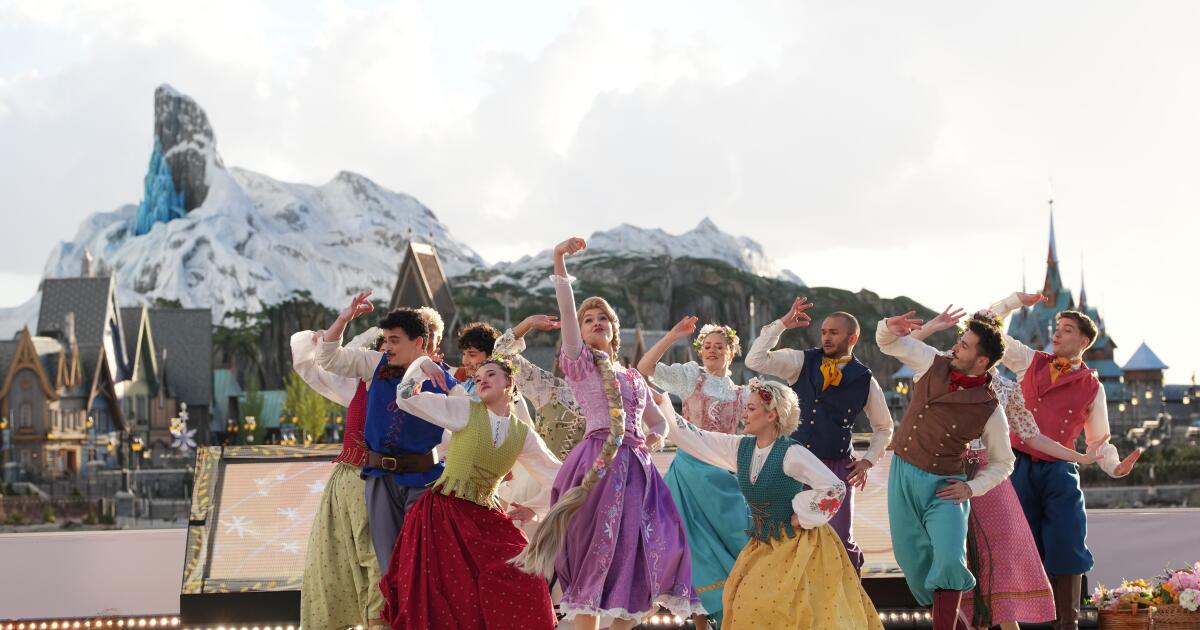
CHESSY, France — A 118-foot mountain of ice rose over the suburban Paris countryside this weekend as Disney opened its Arendelle kingdom to the world — Elsa’s palace glowing at the summit, a “Frozen” Nordic fishing village below, and the company’s new chief executive standing before a crowd of celebrities.
World of Frozen, an immersive land themed to the blockbuster animated franchise, opened Sunday as a centerpiece of a $2.2-billion transformation at Disneyland Paris.
The transformation renames one of Disneyland Paris’ two parks from Walt Disney Studios Park to Disney Adventure World. The inauguration drew Penélope Cruz, Naomi Campbell and Teyana Taylor.
It is the largest expansion in the 34-year history of Disneyland Paris, and one node in a roughly $60-billion global build-out of Disney’s parks, resorts and cruise lines.
A new CEO’s first stage
It is also the first major international stage for Josh D’Amaro, who took over as Disney’s CEO on March 18 — 11 days before the French gates opened — after nearly three decades in the company’s theme parks division.
The parks-and-experiences business reportedly generated 57% of the company’s $17.5 billion in segment operating income last year, the force that observers say propelled D’Amaro from parks chief to the corner office.
“The Walt Disney Co. was built on one man’s dream, and for more than 100 years we’ve shared that dream with the world,” D’Amaro told the inauguration crowd.
“Storytelling is fundamental to everything that we do, whether that’s on screen or stage, in our theme parks, on our cruise ships, or even at home.”
He called the opening “a transformational moment” and paid tribute to the creative team behind the attraction, including “Frozen” writer-director Jennifer Lee — who are all now at work on “Frozen 3.”
An Associated Press journalist accompanied D’Amaro on the “Frozen” ride Saturday night.
The carriage splashed through water to childlike cheers from riders and laughter from the new CEO as they glided past Elsa singing in the dark. Some stepped off lightly wet.
The evening’s emotional peak came when Lou, an 11-year-old whose wish was granted through Make-A-Wish France, took the stage to sing a few notes of “Do You Want to Build a Snowman?”
A next-generation robotic Olaf walked out to join her. It was the 25,000th wish fulfilled for a sick child at Disneyland Paris since 1992.
A French reversal
On Friday, D’Amaro had stood alongside Emmanuel Macron at the resort.
The French president used the visit to claim the park as a national economic asset, calling Disneyland Paris “the leading tourist destination in Europe” and describing it as “a genuine ecosystem of success.”
Macron said the latest expansion would create 1,000 additional direct jobs.
“Since the beginning, that’s 13 billion euros invested on this territory,” Macron said, a figure equivalent to about $15 billion.
Disneyland Paris says it has recorded more than 445 million visits since 1992, accounting for 6.1% of France’s national tourism revenue.
Macron’s presence underscored a remarkable reversal.
When the park opened as Euro Disney in 1992, French intellectuals derided it as a “cultural Chernobyl.” The president at the time, Francois Mitterrand, dryly derided the new attraction as “not exactly my cup of tea.”
Now a French president was standing in front of cameras calling it an engine of national prosperity.
European roots
“‘Frozen,’ of course, has its roots in European storytelling,” said Michel den Dulk of Walt Disney Imagineering.
“It’s very loosely based on Hans Christian Andersen. So to have a northern European, charming wooden little village here in Disneyland Paris — it just made sense.”
The new Tangled family ride, too, draws from European folklore — the Brothers Grimm’s Rapunzel.
The land re-creates Arendelle around a lagoon, its timber buildings painted in muted Scandinavian pastels, facades adorned with rosemaling, a traditional Norwegian decorative art.
At the center is Frozen Ever After, a boat ride featuring state-of-the-art animatronics and immersive projection effects.
Guests can meet Anna and Elsa inside Arendelle Castle, have a conversation with a responsive baby troll named Mossy who talks back, and watch a lagoon celebration called the Snow Flower Festival — featuring an original song.
Visitors praised the scale of the mountain and the detail of the village, even after delays and minor glitches.
“Despite the wait, it was well worth it. The attention to detail is incredible, and the perspective of the ice mountain is breathtaking,” said Daniel Weber, 41, an architect from Munich, Germany, after the ride Sunday.
“You forget you’re outside Paris. For a few minutes, it really feels like Arendelle,” said Léa Moreau, 27, a graphic designer from Lille, France.
Beyond World of Frozen, the rebranded park brings a vast new lake called Adventure Bay, a Tangled family ride, 15 new dining locations — including the posh Regal View Restaurant — and a nighttime spectacular called Disney Cascade of Lights featuring more than 380 drones.
A Lion King land, already under construction, will follow.
More than 90% of the second park’s offerings will have been redesigned since it opened in 2002, and Disney says the footprint will roughly double once the full transformation is complete.
Disney’s streaming has swung from deep losses to profitability, but the parks remain the company’s most dependable earnings engine — and D’Amaro is the man who ran them.
“We continue to dream bigger and bring stories to life in brand new ways,” D’Amaro told the crowd.
Pyrotechnics lighted up Arendelle Village.
The ice palace on the mountain turned blue.
And 34 years after Euro Disney became a punchline, a brand-new kingdom opened in the fields east of Paris — for the first time in forever.
Ranting about the decline of comedy specials while releasing a new one at the same time feels a bit like an oxymoron. But somehow it still makes sense coming from alt-comedy pioneer David Cross, who isn’t just complaining; he’s finding his own route to making specials feel special again. The only way to do that is by putting one out in the manner he’d like to see more often — starting by making the whole crowd stand up too.
Capturing the energy of a concert at the famous 40 Watt Club in Athens, Ga., was the first step in differentiating “The End of the Beginning of the End” from the typical hour you watch on a big streamer. And, with this new special, Cross is able to get back to his own beginnings of touring across the country with love bands as his openers, performing for crowds for as long as he could until he had to run offstage to pee.
Premiering the special earlier this month on his website (and on April 7, it will be available on YouTube via production company 800 Pound Gorilla), Cross is hoping the special connects with comedy fans in a way that we’ve forgotten specials could.
This interview has been edited for length and clarity
Your new special is called “The End of the Beginning of the End.” What does that title mean to you as it relates to the impending doom of what we’re all living right now.
David Cross: Well, you can look at it in a couple different ways. To me, it signifies that the beginning of the end has occurred. And we are now at the end of the beginning of the end. And from where you go with that, that’s for you to decide.
One of the things I love about the special is the fact that you shoot it at a club in the style of a live–music concert.
I’ve shot specials in theaters and it’s just different, not that one is better than the other, but they’re just different. You have a different relationship with the audience. When I first started touring, I would go to music venues and I’d have a band open for me and then I would just go up and pretty much [perform] as long as I could until I had to pee. Sometimes I’d have a band playing, sometimes two bands, then I’d go out. And I did that a couple of times, and then stopped doing that and did theaters, and I decided for the last two specials I’m going to go to, when I shoot it, I’ll go to a music venue, and I was at the 40 Watt Club in Athens this last time, I was at the Metro in Chicago before that, both places I played on earlier tours, and, you know, it’s not seated. People are standing there at the stage, and I prefer it. It’s more fun. It’s not as lucrative but, to me, a more fun show to do.
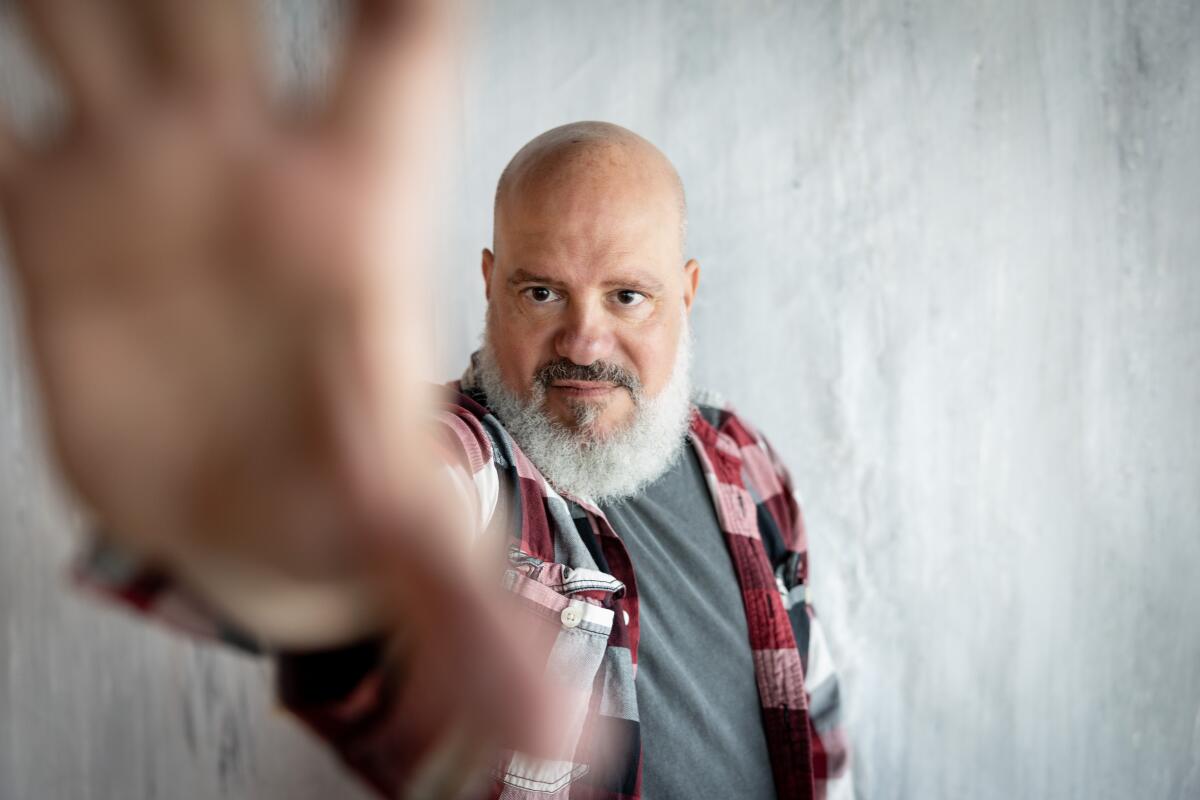
Comedian David Cross
(Jason Armond / Los Angeles Times)
The ambience of it was great.You can hear people shouting and drinking and having a good time, and the crowd work is also a little more spontaneous and fun than it would be in a regular venue.
Yeah, well, there’s more opportunity for that. But my thing has never been about crowd work. I like engaging with it, it’s kind of a nice distraction from the set that you’ve been doing 100 times, 150 times at that point. So it’s always fun to have that thing happen and that feeling of spontaneity. And like the guy [who I talk to in the crowd during the special], I could not have asked for [someone better]. I mean, even if it was scripted, it wouldn’t have been as good. The guy who [I talk to] during the stuff about hiking Machu Picchu [with Bob Odenkirk], that’s just… [chef’s kiss].
Speaking of Bob Odenkirk, you guys have this long relationship. How would you describe the dynamic of working with Bob and just how you guys bounce ideas off each other?
I mean, it’s great. We have an inordinate amount of respect for each other, both as people and as creative partners. And so there’s never any real issues. There’s things we will definitely disagree with, but we’re both decent people. So you know somebody backs off and says, “OK, let’s do it that way.” But even then, there aren’t that many of those [issues]. We just have really worked well at building something or molding it, creating it and shaping it. And our aforementioned hike to Machu Picchu, we have a documentary about that, that will be premiering at a fancy festival at some point in the near-future. And so we got that doc and we’ve been working on that. And for the way we work now, because he lives in L.A. and I live in New York, and it’s been like that for a while, he’ll write a bunch of stuff, I’ll make notes, I’ll write my things, send it back. And so we’re able to do that and not necessarily have to be in the same room because we’ve had 30-plus years of working with each other.
It’s a kind of like an unspoken language you guys probably have in terms of comedy, which is super important, I imagine, just for collaborating.
Yeah, and it’s something we discovered very early on … before there was even “Mr. Show,” what would ultimately become “Mr. Show,” when we got together to write sketches for this bigger kind of comedy collective thing, and these shows that we would all do with each other, for each other, and the stuff that we would write together was just, like, really good, easy writing — again, one person adding this thing and one person saying here’s a switch yeah and another person adding this thing in. It was fun, it’s cool, still is. One thing he doesn’t get credit for is he’s a really decent human being. And with all the awfulness in the world that’s magnified, every sense is bombarded with it — it’s just good to be hanging with somebody whose energy is a good person, a decent person and an equitable, nice guy, so that’s good as well.
Comedian David Cross poses for a portrait ahead of his comedy special “The End of the Beginning of the End.”
(Jason Armond / Los Angeles Times)
One thing you guys also have in common is you both have kids, and he has a comedy show for kids called “The Appropriate Show.” Have you taken your daughter to see it?
It’s a sketch show [in which] all the sketches are appropriate for kids to watch. And the sketches have been done in other sketch shows onstage, live. And he puts together this thing once, twice a year here in L.A. And I took my daughter to it last year. It’s just sketches that kids can [understand]. At least if they don’t understand the actual references they get the archetype. “Oh, that’s the boss, that’s that uh… And it’s great, it’s a really cool idea uh… “ And would an ass— think of [a show like] that? No, one good decent person; a good man. But listen, this interview isn’t about me, it’s about Bob Odenkirk, so let’s get back to that.
Well, speaking of having comedy geared toward kids, your daughter’s at an age where she’s probably consumed or seen some of your comedy at this point.
Not, not really. No, no.
Do you shield her from your stuff, or are you not so concerned about it?
I don’t actively shield her, but I don’t introduce her to anything. So I was a little bummed out, and I got over it pretty quickly, but when I found out that she had seen a little bit of “Alvin and the Chipmunks,” and only because I don’t want to spoil the enjoyment of what movies are and what kids’ movies are and how things work. And I feel like that would introduce an element of reality that I want her to be able to just enjoy these things without — she’s seen “Kung Fu Panda”when she was younger, like, I don’t know, three, four, five times, has no idea that I’m in that, that my voice is in there. She knows I do stand-up, she gets that now. And when she was younger, she’d say, “Daddy’s silly for a living.” … I’m just trying to ride the balance of letting her have those childhood joys and experiences.
Comedian David Cross.
(Jason Armond / Los Angeles Times)
Does having a kid make you think about what’s coming up in the future of comedy, or what kids are gonna maybe find funny, or what they find funny now? Do you have any thoughts on kid comedy in general?
Not really. I mean, I can see that she and her friends, who are kind of like-minded, are naturally funny, and then that’s kind of encouraging and heartwarming and they’re silly, but I’ll be long gone when that generation is is providing comedy. And I’m still, although I’ve kind of given up, I’m still trying to grasp what works now. I mean, it’s short-term TikTok, Instagram stuff. There are some amazing, like really, really great things being done as far as film sketches for YouTube channels. “Almost Friday,” they’ve got genius-level stuff. I mean, really good. And where the sketch goes in a place, you’re never ahead of it, goes in a place where you’re not expecting. It’s really well written and well performed.
What are your thoughts on what a comedy special is nowadays or what it should be?
I mean, that’s a great question. I think anybody who plays with the form, whether I think it’s that funny or not, is different. But I’m happy when anybody kind of tries at least to play with a form. I just went to Rory Scovel‘s taping last week of his latest special. I don’t know when that’ll air, but if you’ve seen the beginning to his first special, stuff like that where you’re like, “Wait, what’s happening? What’s going on?” I love stuff like that.
I still get excited to watch specials by some of my favorite comics, but there’s a quality that’s missing. And these are stand-ups I love, and they’re not that great. They’re not bad but they’re not special, you know? And all those guys I mentioned, and more, have great specials. Like, you can go back and they’re great. And I don’t know why that is. I mean, there’s still funny stuff, but I don’t ever want to get to that place where its just feels a little phoned-in a little bit… that is, in part, why the last two specials were shot in this more intimate setting that feels special. And … as I said, the energy’s different, it’s a little bit different, and it’s less slick. It feels like you’re in the moment. You don’t need a million dollars to shoot a special. You don’t 28 camera angles, it‘s just bull—. And it takes something away.
Comedian David Cross
(Jason Armond / Los Angeles Times)
It all should feel the right amount of unsafe as well, I think.
That’s never gonna happen at a theater show. You’re never gonna feel that. And I don’t know, it really does feel almost like maybe we peaked in a sense, like there’s too much, and because of that, these things aren’t special. They’re not revelatory, they’re not unique. I dunno, can 18,000 people in an arena really relate to a … billionaire talking about how they’re gonna get canceled. I mean, is that a thing I guess? Those other big, slick specials that are shot in, like, a 3,200-seat, 3,500-seat theater, it just feels like, “Oh this person is up there and I’m listening to their jokes.” There’s nothing wrong with that. They’re often very funny jokes, but it doesn’t go beyond that. It’s just like, “All right, tell me your joke.” It might as well be an audio thing, you know?
Well, hopefully the robots aren’t coming for your job anytime soon.
Absolutely not. I mean, this could be naive, but I feel 100% safe that you are never going to replicate an evening of stand-up at a nigtclub like that. And not sitting down at tables while you’re having drinks and waitresses are coming by. I’m talking about everybody’s up on the stage, sold-out, maximum capacity; everybody’s there, focused, we’re all sharing that thing. You can’t. AI’s not going to be able to do that.
Yeah, the robots can’t do that, Terminator can’t do that..
Oh, I forgot about Terminator. He could do that. G— it.
“What happened to my dreams? Simply put: they changed,” reads Phil Augusta Jackson aloud to a crowd in a furniture store. Tonight’s theme is change. From a podium, the television writer reflects on the long, thorny odyssey of his career. A pinball machine blinks in the background. Behind him, dreamy abstract prints hang on the wall, their shapes seeming to melt in the unseasonable spring heat.
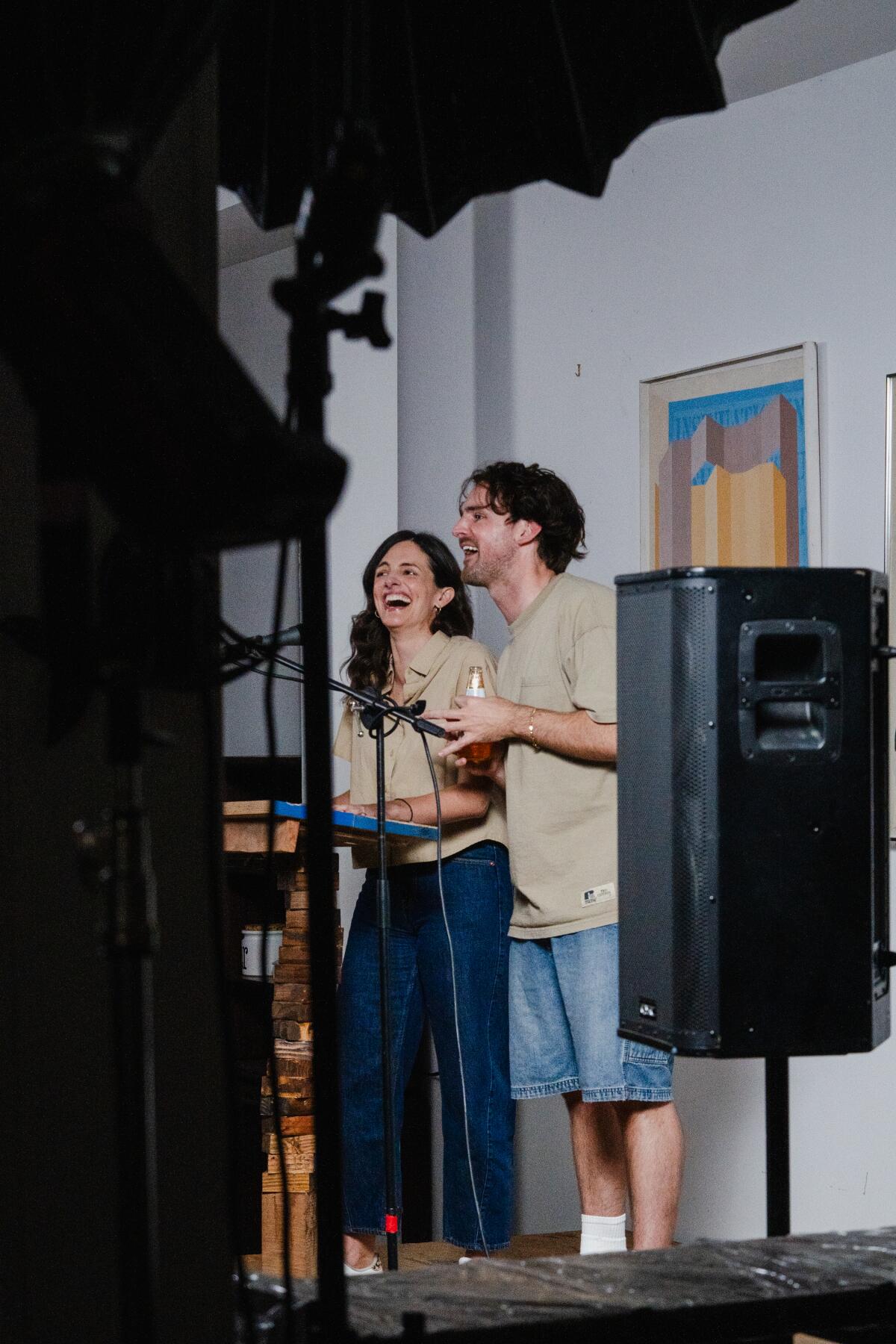
Alongside mid-century furnishings and art in Echo Park, siblings Madeline Walter and Evan Walter host their wildly popular reading series, Essays. It’s a warm spring night. In a tender essay, Evan considers what he’s inherited from his idiosyncratic father. “I scream-sneeze like him now,” he reads. “It feels like a mess figuring out what parts of your parents you’re going to keep.”
In March 2024, the Walter siblings began the reading series in a friend’s backyard. “It was cold and wet, and we were so nervous nobody would come,” says Madeline. Since then, the show has moved through a series of venues before settling into a home at The Hunt Vintage. In just two years, it has grown into a local phenomenon, regularly drawing crowds of more than 150 people into the singular space.
The idea for Essays took shape during a conversation about creative constraints. Both writers and comedians, the siblings wanted to host a show that pushed beyond snappy punchlines and polished half-truths. “The objective is different from just being funny,” Madeline says. “It’s to tell me about yourself. Tell me something you’re thinking about.”
Siblings Madeline and Evan Walter host a popular monthly reading series called Essays at Echo Park’s Hunt Vintage.
(Ryan Wall )
Like many readings across Los Angeles, Essays taps into a growing appetite for sincerity. “People are really craving a space where you can be funny, be vulnerable, laugh at yourself — and where there’s an earnestness,” Evan says. That sensibility feels familiar to them. They grew up in what Madeline describes as a “very NPR-coded household that loved David Sedaris-style stuff.” She adds: “Doing something in the essay space feels like a surprising return to form.”
“One of my roommates describes it as a church-like experience, because everything is just so emotionally0driven and connective,” says Kaitlyn Kilmer, a longtime attendee.
The legacy of the series has begun to ripple outward. Their reading series has created a complementary Substack. Kilmer is now hosting a reading in her living room among friends.“We decided that we wanted to do our own, so I gathered a few friends who had been fans of the Essays show,” she says.
Essays exists in a larger network of reading series that make up Los Angeles’ diverse and ever-evolving literary scene. “There are so many readings now,” explains non-fiction writer Diana Ruzova, who frequently attends readings. “I’m not mad at it, though, mostly grateful that L.A. has a thriving literary community.”
In Los Feliz, Skylight Books continues to host intimate book launches for some of the most anticipated literary releases, drawing local favorites and celebrities.
“Our vibe is cozy,” says Mary Williams, general manager of Skylight Books. “We set up chairs under the big tree that grows in the middle of the store, and we hope this is a go-to place for our community to see their favorite authors while mingling with other book lovers.”
Elsewhere, at Heavy Manners Library, the tone of literary events leans more toward the experimental. “Experimental, unpolished writing can be shared and reflected on in an accessible, communal setting,” says program assistant Jane Shin.
This spring, literary events across the city run the gamut — from independent book fairs to poetry workshops, from the bizarre to the deeply vulnerable — welcoming everyone from curious newcomers to die-hard bookworms.
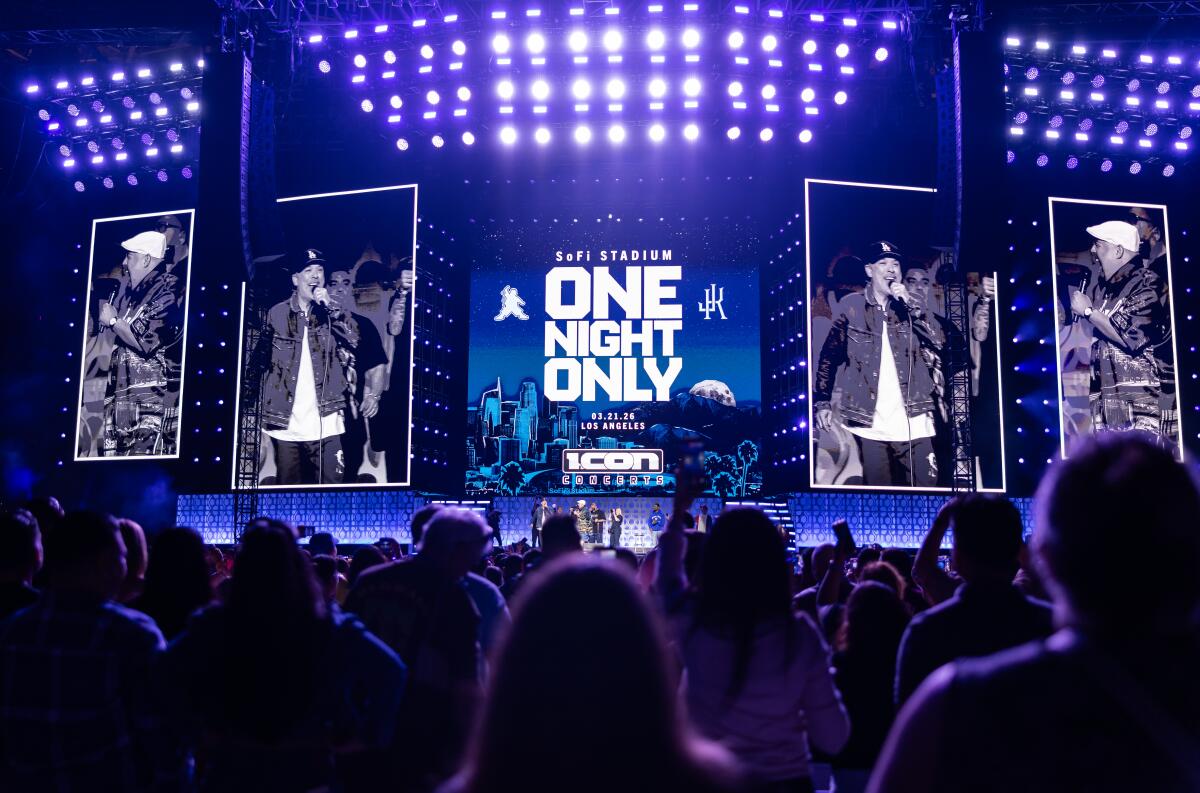
Comedians Jo Koy and Gabriel “Fluffy” Iglesias are used to delivering big laughs on large stages. But in the world of major L.A. venues, there’s big, there’s massive, and then there’s SoFi Stadium.
The show starring both comedians was billed as a record-breaking feat for stand-up when they sold out the 70,000-seater. Though the pressure to fill up the stadium was off, it still remained to be seen how the two comics would make their most dedicated fans laugh from more than a football field away. By that criteria, Saturday night was definitely a win.
Kicking off the early portion of the show at 7 p.m., fans were already filling the seats as opening acts from Iglesias’ camp, including Matt Golightly, Joey Guila, Alfred Robles, Martin Moreno (who celebrated his 58th birthday on stage) and ventriloquist funnyman Jeff Dunham got the crowd warmed up for about an hour before Iglesias took the stage first.
Comedians Jo Koy and Fluffy perform Saturday at SoFi Stadium.
(Christina House / Los Angeles Times)
It was almost 8 p.m. when Iglesias emerged following a video skit playing on the jumbo screens and the stadium’s massive halo scoreboard with his funny misadventures of a routine doughnut run at Randy’s Donuts that turned into the plot of “Sons of Anarchy” spinoff “Mayans M.C.” featuring lead actors Emilio Rivera, a.k.a. Miguel Golindo, and Clayton Cardenas, known for playing Angel Reyes. Reyes caused the first major eruption of noise in the crowd by pressing a detonation device that triggered columns of smoke that filled the stage as Fluffy made his entrance in a white flat cap and custom Los Angeles button-up to greet the sold-out stadium.
“Thank you for being here, all I have to say is we did it!” Iglesias proclaimed as the crowd cheered.
Pointing and waving to fans in the nosebleeds, he took time to embrace the moment that topped his previous triumph of performing at Dodger Stadium.
Fluffy takes the stage at SoFi Stadium in Inglewood.
(Christina House / Los Angeles Times)
Though the stage couldn’t have been bigger, both comedians used their ability to make a large event feel intimate by drawing the crowd in through storytelling and making them feel like they were part of a conversation. Iglesias set the tone of his set right away by telling us about the chisme (a.k.a. salacious gossip) surrounding his newly married stepson that weaved into stories about his travels all over the world including his controversial stop at the Riyadh Comedy Festival.
Iglesias also took a pause to relate one other historic fact about the two stadiums in L.A. he’s now been able to sell out.
Santino Villalovos of Tracy, Calif., shows his Fluffy tattoo during the Jo Koy and Fluffy show at SoFi Stadium.
(Christina House / Los Angeles Times)
“The two biggest shows in comedy were Dodger Stadium and SoFi Stadium. … And what did they both have in common? They both featured a Mexican,” he said.
Even though he thought about retiring as a comedian after filling up Dodger Stadium (twice) to film his special “Stadium Fluffy,” Iglesias said the SoFi show inspired him to keep pushing himself. And alongside Koy he knew they could do it.
Fans react to special guest Jamie Foxx during Jo Koy’s performance at SoFi Stadium in Inglewood on Saturday.
(Christina House / Los Angeles Times)
“Jo I know you’re in the back, thank you for trusting me man, we did it brother. And I’ll say it in front of an entire stadium, love you. Things like this for me is a huge deal because it inspired me and gave me another reason to keep doing what I love to do. And tomorrow I’m gonna be in the same situation I was after Dodger Stadium — what am I gonna do now? But until then I’m enjoy the hell outta tonight and I still have more stories to share with you.”
Fluffy’s most controversial (and true) bit of the night was breaking the news to his fans that his name is mentioned in the Epstein files, which sent collective shock through the stands.
“I’ve never been to the island, I’ve never been on the plane and I have never met Jeffrey Epstein,” he clarified.
Fans light up SoFi Stadium during Fluffy’s set on Saturday.
(Christina House / Los Angeles Times)
The comedian said that according to reports in the Epstein files, the late convicted pedophile apparently tried to buy tickets to his show at an Improv in West Palm Beach, Fla., in 2014 but was told by his assistant via email that both his shows were sold out.
“Jeffrey Epstein, one of the most diabolical human beings to ever walk the face of the earth. Had the ability to connect with politicians, with influencers, with celebrities. He put people in very compromising positions. He got people on planes. He put people on islands. He was involved in trafficking. He was able to accomplish all these evil, crazy things, but at the end of the day, he still couldn’t get tickets to see my show,” Iglesias said.
Jo Koy reveals himself with the Jabbawockeez at SoFi Stadium.
(Christina House / Los Angeles Times)
After a brief intermission, things transitioned to Jo Koy’s portion of the show featuring warm-up sets from TikTok skitmaster King Bach and longtime friend and stand-up star Tiffany Haddish, who came to the stage looking ready for the red carpet with a flowing silk dress, hair blowing in the man-made wind to deliver her brand of high-energy stories about becoming a real estate tycoon in South-Central.
When it was Koy’s turn to enter the stadium, he slipped in undercover, dressed as one of the Jabbawockeez — the legendary masked hip-hop dance troupe that danced onstage to a medley of West Coast hip-hop dressed in red with acrobatic swagger. At the end of a brief routine, Koy unmasked himself as one of the dancers, eliciting cheers from the crowd as his son helped him change onstage into his regular attire, Dodgers hat and a jean jacket.
Jo Koy performs at SoFi Stadium in Inglewood on Saturday.
(Christina House / Los Angeles Times)
Always a man of the people, his set also reminded us that he’s also a man of the pets, specifically dogs, launching into a long bit that felt worthy of a slightly more adult version of a Pixar movie. But beyond jokes and stories, Koy kept coming back to the idea that laughter, more than fame, marketing or money, is what helped the comedians’ big plans for SoFi come together.
“This place is full, all the way to the top, people laughing and having a good time. I know there’s a lotta s— going happening in the world right now but guess what, we don’t wanna hear it right now. We came to have a good f— time. I’m not here to debate s—, everybody’s in here, everything they said wasn’t supposed to happen happened. Look around, every f— color of the rainbow is in SoFi Stadium tonight.”
Jamie Foxx, left, sings with Jo Koy at SoFi Stadium.
(Christina House / Los Angeles Times)
The vibe of the set was all about escaping the problems of everyday life. For most of the night that was taken care of by comedy. And sometimes that escapism was aided by the power of R&B. Twice during the night Koy shocked the crowd with special guest sing-alongs, first with Babyface coming out to serenade the crowd with a brief yet un-relenting hit fest he wrote and/or sang including “Can We Talk,” the ‘90s hit he wrote for Tevin Campbell, and the Boyz II Men anthems “I’ll Make Love to You” and “End of the Road.”
The second surprise came courtesy of Jamie Foxx, who popped out in shades and 10-gallon hat to sing the Ray Charles homage-driven hook of Kanye West’s “Gold Digger.”
Aside from any historic accolades, Saturday night was the culmination of a show that was a year in the making and a victory lap for the careers of two comics who’ve been in the game for decades. It was also a moment where comedy’s past met its stadium-size future in the L.A. comedy world. Though it’s hard to say when the next big comedian will have enough fans to fill a stadium in L.A., Saturday didn’t feel like it was the last time comedy fans will show up to fill SoFi for a pair of comedians who put in the work to make themselves a team worth rooting for.
A crowd celebrating Chaharshanbe Suri in Tehran were forced to flee after gunshots disrupted their event. Iranian security forces have reportedly been breaking up gatherings marking the Persian festival this week.