As technology becomes more and more advanced and accessible to people, cruise ships have to put rules in place to make sure passengers are safe, and their privacy is protected
Having one item onboard could leave you in lots of trouble (stock)(Image: Getty Images)
People are being warned that they could be fined or kicked off a cruise ship they’re a passenger on for wearing 1 luxury item when onboard. Several cruise companies have introduced a number of new rules in 2026 to ensure the safety of passengers travelling on board.
As technology continues to advance and people snap up the latest gadgets, cruise operators are keeping their policies up to date to safeguard holidaymakers and protect their privacy while travelling at sea. Whether you’re sailing with Disney, Virgin, P&O or Fred. Olsen., each cruise liner has their own set of rules that could land passengers in trouble.
Don and Heidi, a couple who have clocked up 100 cruises between them, regularly share updates and handy tips on TikTok, and have been keeping a close watch on shifting cruise policies over recent months.
With the rise of people wearing smart glasses, such as the very popular Meta Glasses, cruise ships have been forced to take steps to protect their passenger’s privacy when they’re traveling on cruise liners.
Don said: “Cruise lines are instituting new policies and in 2026, these behaviours will get you fined, banned, or removed from the ship entirely.
Content cannot be displayed without consent
“One, recording other passengers without their consent using technology like Meta Glasses is a serious violation of privacy policies and fellow cruisers are reporting it.”
One of the cruise companies who has banned the items is Royal Caribbean who quietly updated its prohibited items list to tighten onboard safety and cybersecurity.
Recently, Royal Caribbean updated the verbiage on its prohibited items list to read: “‘Smart’ glasses from any of several manufacturers that can record video and audio are not allowed to be used in certain areas onboard the ship, including, but not limited to, public restrooms, Youth Program areas, medical areas, as well as the casino.”
Royal Carrabian’s app confirmed that if a guest fails to abide by the policy, the chief security officer and captain are authorized to confiscate the smart glasses.
Don continued: “Two, flying a drone from the ship is banned on nearly every cruise line. Get caught launching one and you’ll be escorted off at the next port.
“Three, fights on cruise ships are all over the news and lines are done looking the other way. Passengers involved in physical altercations are now being banned from certain cruise lines for life.
“Four, getting caught with prohibited items in checked luggage and you get escorted to a security meeting. Try to bring something more serious on board and you could be handed over to authorities at the next port.
“Five, this isn’t optional. It’s international maritime law. Skip the muster drill and crew will track you down to complete it. Refuse entirely and you’ll be removed from the ship before a set sail.
“Six, lighting up on your balcony, in your cabin, or anywhere else outside the designated smoking areas can get you fined and repeat violations can get you escorted off the ship.
“This includes vaping. Don’t forget to share this one with your cruise mates for your next sailing.”
The right-wing president highlighted anti-crime operations and economic progress, while critics warned of abuses.
Published On 24 May 202624 May 2026
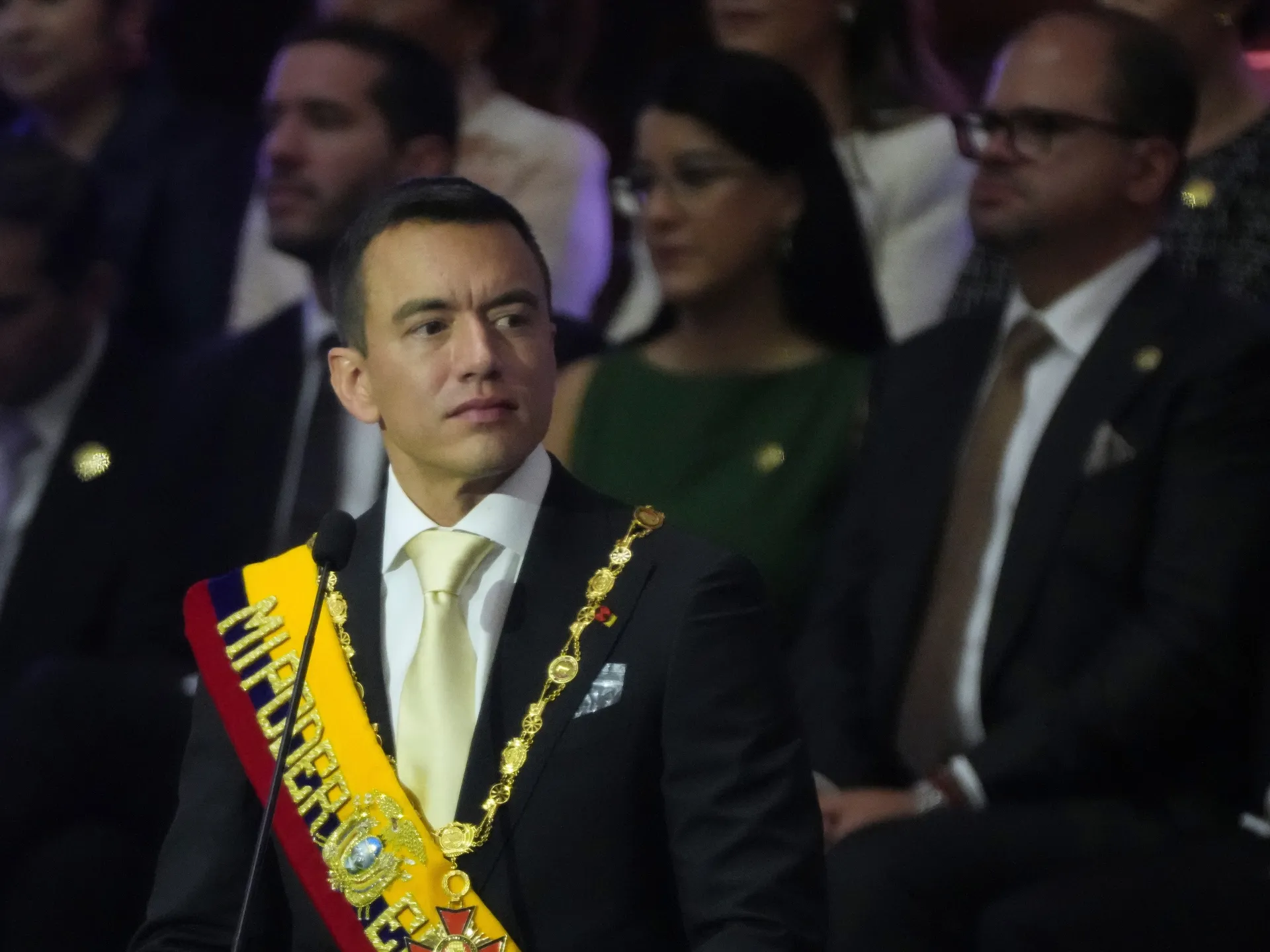
Ecuadorian President Daniel Noboa has used his State of the Union speech to tout his United States-backed crime-fighting strategies as well as improvements to the economy.
Addressing the National Assembly in the capital Quito on Sunday, Noboa cited the extradition of a dozen crime bosses to the US and the seizure of almost 300 tonnes of drugs as examples of what he described as his decisive and effective approach.
Recommended Stories
list of 3 itemsend of list
“We will seek them out, find them and extradite them,” Noboa said of wanted criminals. He also asserted that the South American country cannot develop “if families live in fear”.
Organised crime is the leading concern among Ecuadorians this decade, after a spike in homicides during the COVID-19 pandemic.
Since 2021, Ecuador has struggled to contain drug violence as rival cartels partner with local gangs to battle for control of routes and coastal ports used to smuggle cocaine. The country is wedged between Colombia and Peru, the world’s top cocaine producing countries.
Last year, Ecuador recorded its highest homicide rate in decades, with approximately 50 murders for every 100,000 residents, according to the Ministry of the Interior.
In response, Noboa, who was reelected last year to a four-year term, has used a state of exception to allow the military to implement a variety of crime-fighting strategies, including joint patrols with police officers and property searches without warrants.
Earlier this year, Ecuador’s military also carried out an operation with US forces against a training camp allegedly used by Colombian drug traffickers, attacking the site with drones, helicopters and boats.
Noboa’s approach, however, has come under criticism from civil society groups, who say his iron-fisted methods have failed to reduce crime while putting civilians in danger.
Glaedys Gonzalez, an analyst for the Andean region at the International Crisis Group, said on Sunday that Noboa may have been optimistic in his speech regarding the country’s security.
“Progress on violence is far from being achieved,” Gonzalez said. “It is evident that the situation in Ecuador has reached unprecedented levels.”
Sunday’s speech also promoted Ecuador’s economic progress, with Noboa telling lawmakers that poverty dropped from 26 percent to 21.4 percent in 2025. Extreme poverty, he added, went down from 10.4 percent to 8.4 percent.
Noboa was first elected in 2023 during a snap election triggered when then-President Guillermo Lasso dissolved the National Assembly and shortened his own term.
Convictions handed down amid an intensified crackdown by Bahraini authorities on individuals accused of having ties to Tehran.
Published On 24 May 202624 May 2026
Bahrain has sentenced nine people to life in prison for carrying out what authorities describe as “hostile and terrorist acts” in cooperation with Iran’s Islamic Revolutionary Guard Corps (IRGC).
Two other defendants were also jailed for three years each after being convicted of collaborating with the IRGC in what prosecutors described as “terrorist and espionage” activities, state media reported on Sunday.
Recommended Stories
list of 3 itemsend of list
The convictions were handed down during an intensified crackdown by Bahraini authorities on individuals accused of ties to Tehran. The crackdown followed a wave of Iranian strikes on Bahrain after the United States and Israel launched their war on Iran in late February. Iran began striking all of its Gulf neighbours in response, saying it was targeting American interests, including military bases.
Prosecutors said some of the defendants photographed vital and strategic sites in Bahrain on behalf of the IRGC. Others were accused of facilitating the transfer of funds from Iran to Bahrain, including through cryptocurrency transactions, to finance the operations. Authorities also alleged that individuals inside the country were recruited to support some of the plans.
Bahrain began arresting individuals allegedly linked to Iran in March, shortly after the conflict began.
Earlier this month, authorities detained a further 41 people.
Less than two weeks later, more than 60 people were stripped of their citizenship for allegedly supporting Iranian attacks on Bahrain and “colluding with foreign entities”.
The London-based Bahrain Institute for Rights and Democracy described the move as “dangerous” and said it constituted a clear violation of international law.
Other Gulf states have also arrested individuals accused of cooperating with Iran. Last month, the United Arab Emirates said it had dismantled a group allegedly planning to carry out what officials described as “terrorist acts”.
Bahrain is home to a large Shia population. Many of its members have long accused the authorities of political and economic marginalisation. The government denies discriminating against Shia citizens, accusing Iran of fuelling unrest in the country.
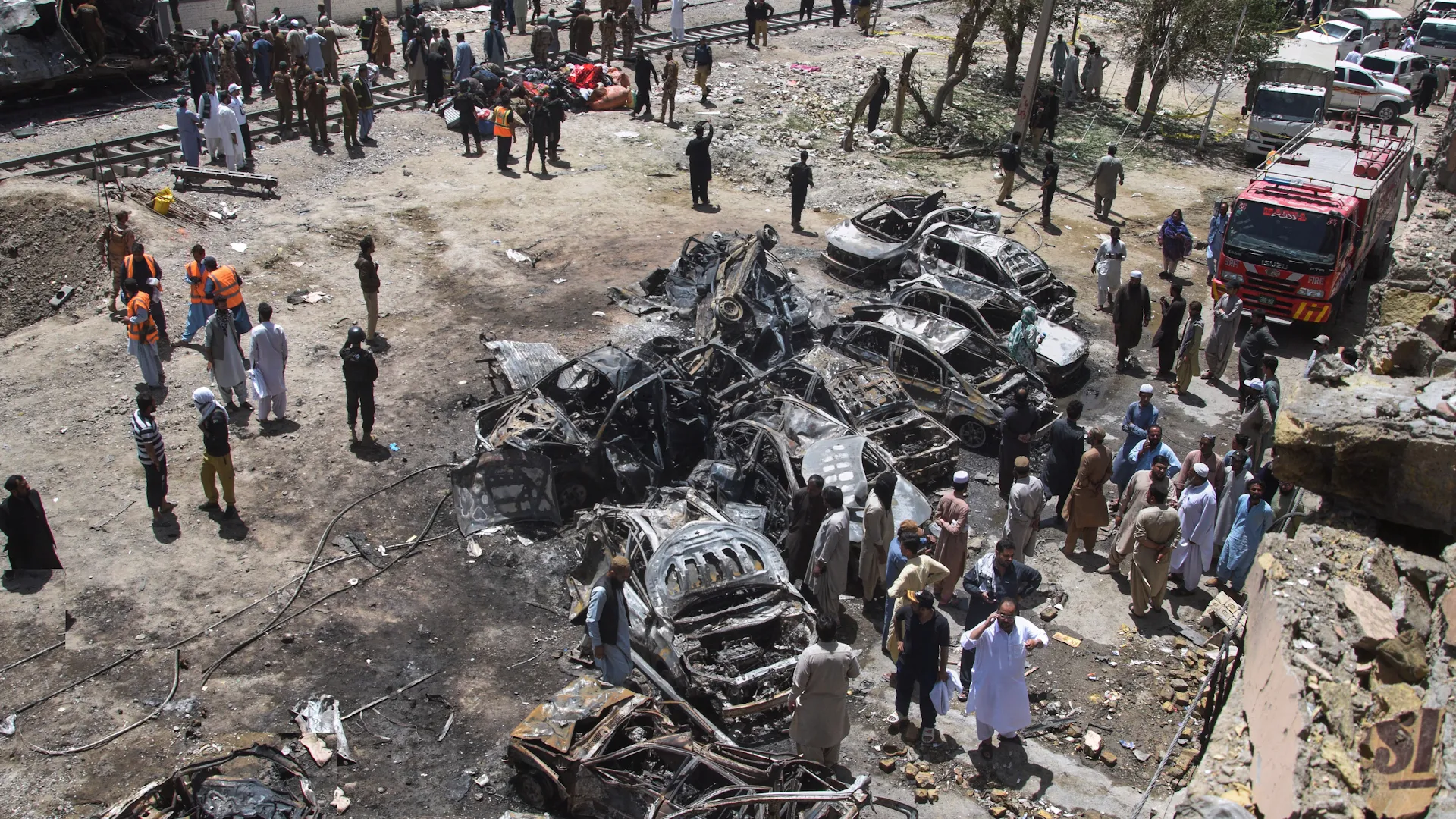
A Baloch separatist group has claimed responsibility for an attack on a train carrying soldiers in Quetta, Pakistan. The suicide car bombing killed at least 24 people and injured dozens more, including women and children.
Homicides in Los Angeles are down to levels not seen since the 1960s. Neighborhoods once awash in gang violence now sometimes go weeks, even months, without a shooting. And the follow-home robberies and street takeovers that captured the public’s attention in recent years have largely subsided.
By many measures, the city is safer than it has been in generations — and yet voters following L.A.’s hotly contested mayoral race might think the opposite.
The challengers to Mayor Karen Bass have zeroed in on homelessness and public drug use to argue she hasn’t delivered on public safety, while also criticizing how the Police Department has operated and been funded during her tenure.
Mike Bonin, a former L.A. City Council member, said the fact that Spencer Pratt — the former reality TV star who has been attacking Bass from the right — has gained so much traction in the race is proof of how Bass and other candidates to the left have failed to change “prevailing narratives that the city is unsafe.”
Mayoral candidate Spencer Pratt hosts a campaign block party on 10th Avenue in Los Angeles on May 20, 2026.
(Robert Gauthier / Los Angeles Times)
Pratt has been particularly active on social media, where he has shared artificial-intelligence videos created by fans depicting him as various superheroes coming to the rescue of a city that, under Democratic rule, has turned into a dystopian hellscape.
In a March 26 post on Substack, Pratt railed against the thousands of drug-related calls that emergency officials respond to every month. He has said that if elected mayor, he would order the police and fire chiefs and the county health director to “treat every encampment as a grave-disability zone.”
“No new laws needed,” he wrote. “No endless task forces.”
Flanking Bass on the left is Nithya Raman, a progressive City Council member who was once the mayor’s political ally.
Raman has argued that Bass has thrown too much money at the LAPD, with raises for police officers coming at the expense of other basic services such as park maintenance and street paving. Raman said the LAPD pay increases have “bankrupted” the city, depriving other services of much-needed funding. In campaign ads, Raman has cast herself as a more sensible alternative to Bass. Raman has said she would work to reduce traffic deaths and prioritize safety on the city’s buses and trains.
When she first ran for office in 2020, Raman called for defunding the police, saying the Los Angeles Police Department should be a “much smaller, specialized armed force.” Since then, however, she has voted for some budgets that increased spending on law enforcement.
In response to questions from The Times, Raman said she would work to find ways to overhaul public safety.
“I’ll propose budgets that expand unarmed response, work with LAPD to improve 911 response to more quickly answer calls for help that don’t require armed officers, and will appoint leadership at the Police Commission who will actively partner with the City Council to work on reform,” she said.
Representatives for Pratt and Bass didn’t respond to requests for interviews with the candidates.
Bonin said Bass — who supported various police reform measures while Congress — has shocked some of her supporters with how “aggressively pro-police she has been.”
When she ran for mayor in 2022, Bass vowed to retool the recruitment and hiring process in order to restore LAPD staffing to 9,500 officers. That hasn’t happened. The number of sworn officers recently fell below 8,600, despite Bass striking a deal with the police union to offer higher starting salaries and new retention bonuses.
Mayor Karen Bass takes part in a candidate forum on May 5, 2026, in Sherman Oaks.
(Eric Thayer / Los Angeles Times)
On Thursday, the City Council approved a $15-billion budget for the upcoming fiscal year, which included funds to hire 510 new officers — just enough to offset turnover and maintain current staffing levels.
Raman has said the LAPD should not shrink any further because there aren’t enough officers to respond to 911 calls “in a timely fashion.”
Samantha Stevens, a Los Angeles political consultant and former legislative staffer, said people seem willing to back Pratt because he acknowledges that their sense of safety has been shaken — even if he has offered few concrete details about how to tackle crime beyond cracking down on homelessness.
Pratt’s critics say that his plan relies on funneling homeless people into a shelter system that doesn’t have the capacity to handle them all. Others have noted that the aggressive tactics he has proposed would probably face legal challenges.
L.A. City Councilmember Nithya Raman, who is running for mayor, makes a campaign stop at the site of a home burned in the Palisades fire.
(Eric Thayer / Los Angeles Times)
“He’s kind of a case study in somebody who has a lot of opinions but has no idea of how the city is run,” Stevens said.
Fernando Guerra, a political science professor at Loyola Marymount University, said Pratt seems to have tapped into a deep well of discontent among Angelenos who believe that crime and homeless have spiraled out of control. The challenge for Bass, he added, is that although the numbers suggest that crime has decreased, many people associate the sight of encampments spilling onto public sidewalks as “a breakdown” that indicates the city is becoming less safe.
“You want to go back to the days of Daryl Gates, you’ve got Pratt,” he said, referencing the former LAPD chief whose controversial police sweeps in the late 1980s yielded thousands of arrests while alienating large segments of South L.A.
“If you want more of the same from the past 20 years, you’ve got Bass,” Guerra added. “And if you want something new, then you’ve got Raman, but she has to explain what exactly she wants to do.”
Although Pratt and Raman appear to be the strongest challengers to Bass, several long-shot candidates have also made public safety a key issue in their campaigns. Some have gone after Bass for her support of LAPD Chief Jim McDonnell. Hired by Bass in 2024, McDonnell has touted the impressive drop in crime under his leadership, but also faced criticism over an uptick in shootings by police and aggressive crowd control tactics during protests against the Trump administration’s immigration policies.
Police Chief Jim McDonnell attends a news conference at LAPD headquarters on May 21, 2026.
(Genaro Molina / Los Angeles Times)
Rae Huang, a minister and housing rights advocate, said if elected mayor she would immediately replace McDonnell with someone who has the “ability to really reimagine what public safety really looks like.”
“I’m the only one with the guts to say that out loud,” Huang told The Times during a recent campaign stop at a bookstore in the West Adams neighborhood.
In social media posts and interviews, Huang has frequently referred to the LAPD as “one of the biggest legal gangs in the world,” and said she would work on diverting money from the police budget to scale up programs that have shown promise in sending unarmed specialists to deal with emergencies that involve people experiencing mental health crises.
The city is already running two such pilot programs, but under Bass they have remained underfunded, Huang said. Last week, the City Council signed off on expanding one of the programs.
Huang said she would also invest more heavily in addressing the city’s lack of affordable housing, which she said is an underlying cause of crime and homelessness.
The Los Angeles Police Protective League has poured hundreds of thousands of dollars into attack ads against Huang and Raman.
Adam Miller, a tech entrepreneur, has tried to strike a balance in his mayoral campaign, advocating for changes while acknowledging that many people still feel unsafe despite the historic drop in violent crime.
He criticized a recent vote by the L.A. City Council to limit so-called pretextual stops, in which officers pull people over for minor traffic infractions in order to investigate more serious offenses. The stops have been blamed for enabling racial discrimination.
Miller said that “constraining the Police Department is the opposite of what we should be doing.” He called for “leveraging” AI and modernizing the department’s archaic computer systems, which he said could allow the LAPD to catch up to other agencies that have embraced new technology.
Miller told The Times that he recently went on a ride-along with officers from the Rampart Division, which he said was eye-opening.
“At the highest level I think Angelenos don’t feel safe anymore,” he said. “They don’t feel safe in their neighborhoods, but more recently they don’t feel safe even in their own homes.”
Statistically speaking, the city might be safer than it’s been in decades, he said — but that doesn’t necessarily matter to voters.
“I don’t think it’s just perception,” he said. “I think it’s reality that crime has spread.”