Ukraine’s President Zelenskyy denounces ‘horrific crime’ after 31-year-old attacks clergy and worshippers in border town.
Published On 24 Sep 202624 Sep 2026
One person was killed and four others injured when a man armed with a knife attacked clergy and worshippers at a Catholic monastery in southern Poland.
Police said the 31-year-old attacker, a Ukrainian national, went on a stabbing spree at the 17th-century Benedictine abbey in Jaroslaw, some 30km (19 miles) from the border with Ukraine, on Thursday morning.
Recommended Stories
list of 2 itemsend of list
The suspect, who had entered Poland from Germany earlier in the day, reportedly grabbed a knife from the abbey’s kitchen and attacked four men and one woman, including a priest in a confessional, police said.
“Three of the victims are clergy members and two are laypeople; one person has died,” said prosecutor Bozena Harasz-Wołoszyn. Two others were in “critical, life-threatening condition”.
Polish media identified the man who died as a priest. Police did not immediately confirm the identity of the deceased.
Prosecutors said the attacker was headed for a nearby border crossing back into Ukraine but instead went to the abbey.
The motive remains unclear, and doctors will assess whether he was under the influence of alcohol, Harasz-Wołoszyn said.
A man stands behind police tape at the site of a knife attack in Jaroslaw, southeastern Poland, on Thursday [Gazeta Jaroslawska via AFP]
Leaders respond
Polish Prime Minister Donald Tusk said the “murderer” would be “punished with the full severity of Polish law”.
Ukrainian President Volodymyr Zelenskyy called the attack a “horrific crime”.
“The perpetrator of this evil must bear full responsibility in accordance with the law … We are shaken by this evil. Justice must be done.”
The mayor of Jaroslaw, Marcin Nazarewicz, declared a period of mourning until the end of the week.
Stabbings, particularly at religious sites, are extremely rare in Poland, one of Europe’s most Catholic countries.
After the aircraft touched down in Birmingham, airport police boarded the plane and escorted the four adults off
08:39, 23 Sep 2026Updated 08:40, 23 Sep 2026
Moment police escort passengers off UK easyJet flight
A group of adults were escorted off an easyJet flight by police after allegedly vaping throughout the five-hour journey. Passenger Annalise Galstaun captured the moment four adults were removed from the plane by airport police after it landed at Birmingham Airport.
Annalise was travelling from Larnaka International Airport in Cyprus to Birmingham on the evening of September 16 when the incident unfolded. Sitting just two rows behind the group, she said she saw EasyJet cabin crew warn them multiple times to stop vaping during the flight.
But despite the repeated warnings, Annalise claimed the passengers continued to vape discreetly, hiding the devices behind their legs while sitting in their seats.
After the aircraft touched down in Birmingham, airport police boarded the plane and escorted the four adults off, causing a 25-minute delay on the tarmac.
Annalise said: “They were warned a few times by EasyJet staff but continued to vape on the sly throughout the journey, hiding the vapes behind their legs on the seat.
“I felt quite annoyed as we were delayed around 20/25 mins grounded on the floor waiting for them to be escorted.
“There were children on board crying as it was about 11pm and we were just stuck on the tarmac.”
EasyJet said in a statement: “Flight EZY6610 from Larnaca to Birmingham on 16 September was met by police on arrival due to a group of passengers behaving disruptively onboard.
“Our cabin crew are trained to assess all situations and to act quickly and appropriately to ensure that the safety of the flight and other customers is not compromised at any time.
“We take these incidents seriously and do not tolerate disruptive behaviour onboard.
“The safety and wellbeing of our customers and crew is always easyJet’s highest priority.”
US-led anti-cartel alliance backs sanctions against crime groups after Trump urges stronger action.
United States President Donald Trump has pledged to use “unmatched military might” against drug cartels in the Western Hemisphere during a meeting of the Washington-led Shield of the Americas coalition in New York City.
In a meeting with leaders and foreign ministers from the anti-cartel alliance, Trump on Tuesday urged member countries to join the US in targeting 24 criminal organisations, which he earlier described as the “ISIS of the Western Hemisphere”.
Recommended Stories
list of 3 itemsend of list
He said he was asking “all nations in the Shield of the Americas to formally designate narco-terrorists as common threats to stability and apply crushing sanctions” against all of the groups. The meeting took place on the sidelines of the annual United Nations General Assembly (UNGA) in New York City.
The coalition’s 15 governments later issued a joint statement saying they intended to impose asset freezes and visa restrictions on members and supporters of the groups and to pursue criminal charges against them.
At the top of the list are two groups that have been declared “terrorist” organisations by Washington: Mara Salvatrucha (MS-13) – one of Central America’s most powerful criminal gangs – and Tren de Aragua, a Venezuelan gang that is also active in Colombia, Peru and Chile.
The list also includes major Mexican cartels, Colombian armed groups such as the National Liberation Army, Brazil’s Primeiro Comando da Capital and Comando Vermelho groups, and Peru’s Shining Path.
Al Jazeera’s Alessandro Rampietti, reporting from Bogota, Colombia, said the statement was largely symbolic for now, because each country must follow its own legal procedures.
“For example, here in Colombia, it will require a law to pass in Congress. We understand that the government here has asked Congress to move forward in drafting such a law. So while the consequences may not be immediate, this is clearly an important step towards building what the US has been trying to do in Latin America [through] this alliance,” he added.
The coalition is made up of governments closely aligned with Trump, including Argentina, Ecuador and El Salvador, whose leaders he has praised or endorsed. Colombia and Peru joined after Trump-aligned presidents took office in recent months.
Brazil and Mexico have not joined.
US Secretary of State Marco Rubio, who also attended, praised “the emergence of strong leaders who are committed to the challenge of taking on transnational terrorism”.
The gathering was the administration’s latest effort to rally the region behind a more aggressive approach to drug trafficking. Since returning to office last year, Trump has designated cartels as foreign terrorist organisations and ordered dozens of strikes on boats in the Caribbean and eastern Pacific that US officials say were carrying narcotics bound for the US.
The strikes have killed more than 223 people, and UN experts say they violate international law and could amount to crimes against humanity.
The Trump administration’s National Security Strategy, released late last year, laid out plans for a revamped Monroe Doctrine, the 19th-century policy asserting US primacy in the hemisphere that critics associate with decades of US intervention.
Trump has also spoken of retaking the Panama Canal and annexing Greenland and Canada. On Tuesday, he signed an agreement on Greenland that stopped short of his demand that the island become US territory.
The focus on the hemisphere has raised concerns across the region.
Brazilian President Luiz Inacio Lula da Silva, in his UN speech, bristled at the approach, warning countries in Latin America and the Caribbean of “renewed hegemonic temptations”.
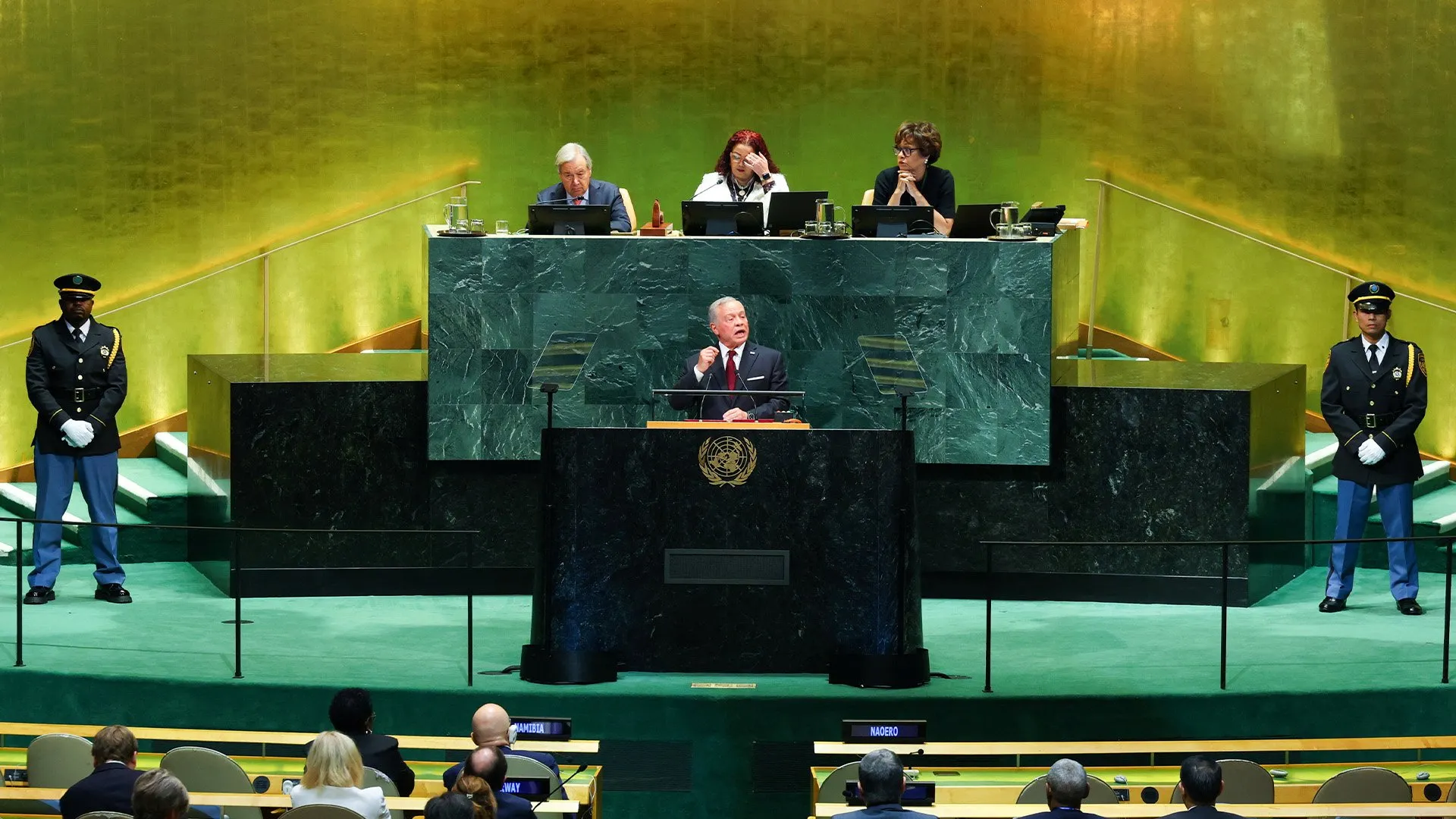
Jordan’s King Abdullah II decried Israeli settler incursions in the occupied West Bank as a strategy of ‘forced displacement’ that should be considered a war crime.
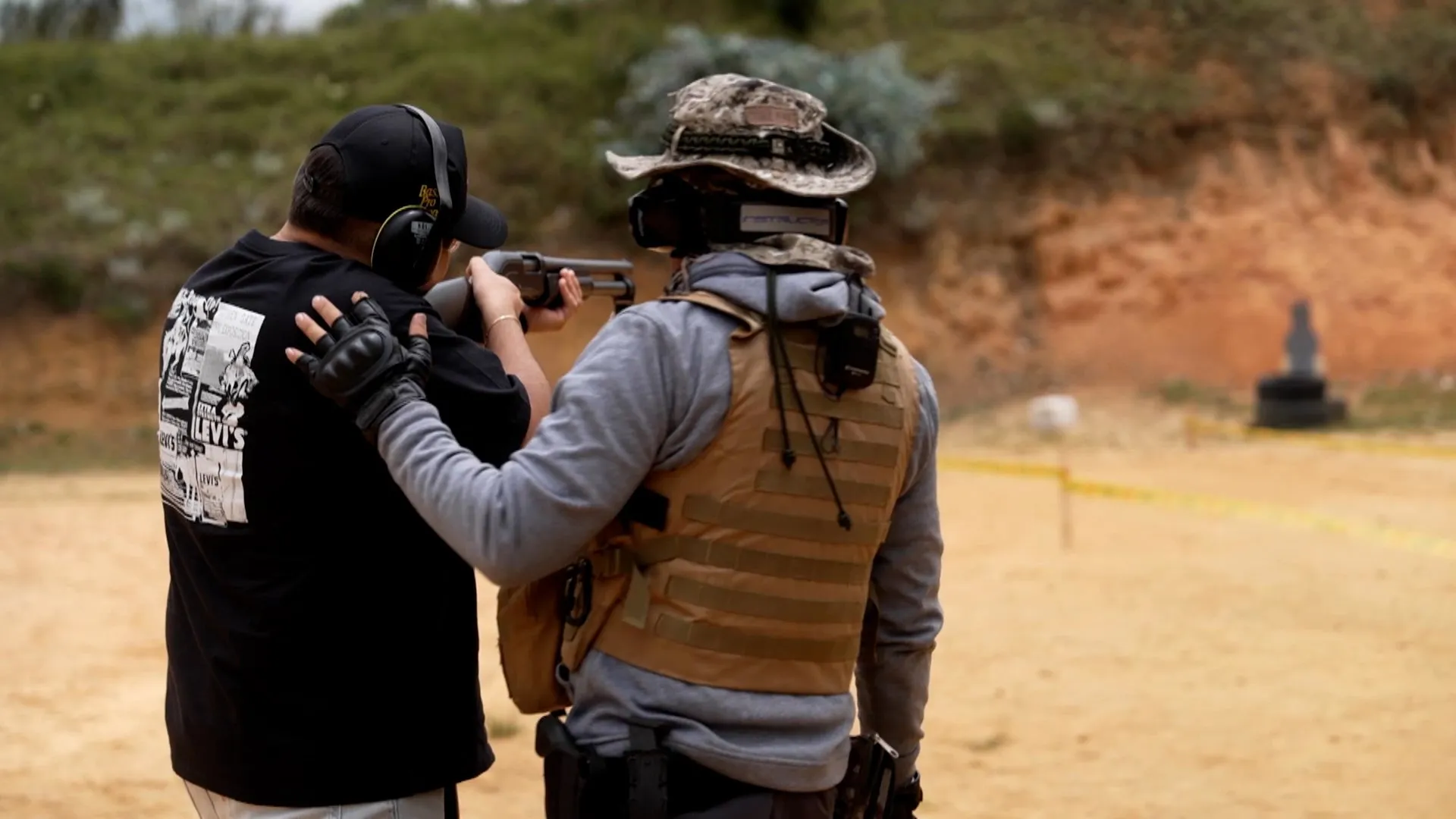
Colombia has loosened gun laws after more than a decade of restrictions. The government says it will help people protect themselves, but some fear it will lead to an increase in even more violence.
The series is hosted by BBC Silent Witness expert Jo Millington
Forensic Scientist Jo Millington will be at the heart of a brand new series (Image: True Crime)
True crime fans do not want to miss a brand new chilling documentary series, plunging viewers into the heart of a crime, and it’s coming sooner than you think.
UK Forensic Breakthroughs is a brand new release, dropping today (September 22) on the True Crime channel. Spanning across 10 episodes, each instalment will focus on its own murder case where scientific breakthroughs and microscopic evidence secured justice for grieving families.
From the murder of a Witney local, whose investigation was the first time in the UK fibre mapping technique was used, and the conviction of a serial arsonist in Cornwall, forensic scientist Jo Millington will give exclusive access to the experts behind the investigations.
Jo Millington has been a forensic scientist for over 30 years, even working behind the scenes on BBC’s Silent Witness. An official synopsis teases: “A rare in-depth dive into the unseen world of forensic science – from ballistics and fibre analysis to forensic ecology and fire investigation. Firsthand testimony from detectives and leading forensic experts directly involved in the cases.
“Ten real UK murder cases where scientific breakthroughs and microscopic evidence secured justice for grieving family, friends and all those impacted by the crime.”
Premiering at 10pm tonight on the True Crime channel, the series will show how forensic science continues to shape major criminal investigations across the UK.
Speaking exclusively to Reach ahead of the show’s new launch, Jo Millington said UK Forensic Breakthroughs stands out from other crime shows, adding: “The first difference is that it puts forensic science at the heart of the show, which normally sits on the periphery in the shadow.
“Over a 10 part series, we’re using the programme to kind of assure a spotlight on forensic science. And more importantly, the scientists that do forensic science, every single day.”
Giving unprecedented access into the world of a forensic scientist, dubbed the “unsung heroes of investigations”, tonight’s episode will explore the story of Edwin Hiles who was found murdered in his own home, but a pioneering fibre mapping technique was used to link one suspect to the crime.
With episodes released weekly, one particular instalment viewers do not want to miss is episode 8 where teams take a deep dive into the world of forensic archaeology and forensic anthropology.
Jo added: “The teamwork that was involved in recovering Natalia Doherty’s body from a clandestine burial site is one of the most painstaking tasks that I have encountered in forensic science.
“Every layer of soil, every root system, and every fragment of evidence had the potential to reveal how her grave had been created, when it was dug and whether it had been disturbed over time.
“Caroline Sims’ archaeology team worked centimetre by centimetre – to record the grave’s construction, the position of the remains and to methodically recover every item from within it.
“Their meticulous approach ensured that the burial itself became evidence, allowing detectives to understand not only where Natalia had been hidden, but how her body had been concealed for so many years.”
TRUE CRIME is available on Sky, Virgin Media, Freeview, Freesat and Freely as well as for streaming via TRUE CRIME UK (FAST), accessible on platforms including Prime Video, Rakuten TV, Pluto TV, Plex, LG Channels, Samsung TV Plus, ITVX and 5.
UK Forensic Breakthroughs premiers tonight at 9pm on True Crime
Jason Eaton faces up to life in prison after a jury rejected his insanity defence.
Published On 21 Sep 202621 Sep 2026
A jury in the US state of Vermont has convicted a man of attempted murder for shooting three Palestinian college students in 2023, rejecting his defence that he was not guilty by reason of insanity.
Jason Eaton, 51, faces up to life in prison for the attack near the University of Vermont campus in Burlington. It left Hisham Awartani paralysed from the waist down and wounded his friends Tahseen Aliahmad and Kinnan Abdalhamid.
Recommended Stories
list of 4 itemsend of list
The jury deliberated for several hours on Monday before reaching its verdict after a week-long trial that included testimony from the three men and psychiatric experts called by both the defence and prosecution.
Eaton was ordered jailed pending sentencing, which has yet to be scheduled.
Awartani and Aliahmad, who were sitting in the front row of the courtroom, smiled and hugged people around them as the verdict was read.
Eaton did not dispute that he shot the three men in November 2023. Instead, his lawyers argued that he should be found not guilty by reason of insanity.
The defence said Eaton was suffering from a delusional psychotic disorder and believed the CIA and Israel’s Mossad were transmitting messages to him through FM radio.
Joshua O’Hara, the supervising attorney at the Chittenden County Public Defender Office, told jurors that Eaton believed the intelligence agencies had enlisted him to “overwatch duty” to protect a Jewish family living across the street and that God was commanding him to act.
Prosecutors rejected the insanity defence, telling jurors that a state psychiatrist had concluded Eaton did not have a mental disease or defect and that the evidence showed he intended to kill the three men.
‘He pulled out a handgun and started shooting’
Awartani, Aliahmad and Abdalhamid, now 23, grew up together in Ramallah in the occupied West Bank before moving to the US for university.
They were visiting Awartani’s grandmother in Burlington over the Thanksgiving holiday when they went for a walk near the University of Vermont campus after dark.
Awartani testified that the friends were smoking cigarettes and speaking a mix of English and Arabic. Two of them were wearing keffiyehs.
He said Eaton was standing on the porch of the apartment building where he lived before approaching the friends without saying anything.
When Eaton was about five to 10 feet (1.5 to three metres) away, Awartani testified, he pulled out a handgun and began shooting.
Awartani, then a student at Brown University, was shot in the chest and left paralysed from the waist down. Aliahmad, who attended Trinity College, was shot in the collarbone, while Abdalhamid, a Haverford College student, was shot in the right buttock.
The shooting prompted calls for a hate crime investigation, but no hate crime charges were filed.
Police later found three shotguns in Eaton’s apartment as well as a Ruger .380-calibre handgun that crime laboratory testing identified as the weapon used in the shooting.
Imran Khan’s family and PTI officials say three of the jailed former PM’s sisters have been detained in Lahore ahead of a September 27 march on Islamabad demanding his release. Authorities have confirmed Aleema Khan was ordered to be held for 30 days.
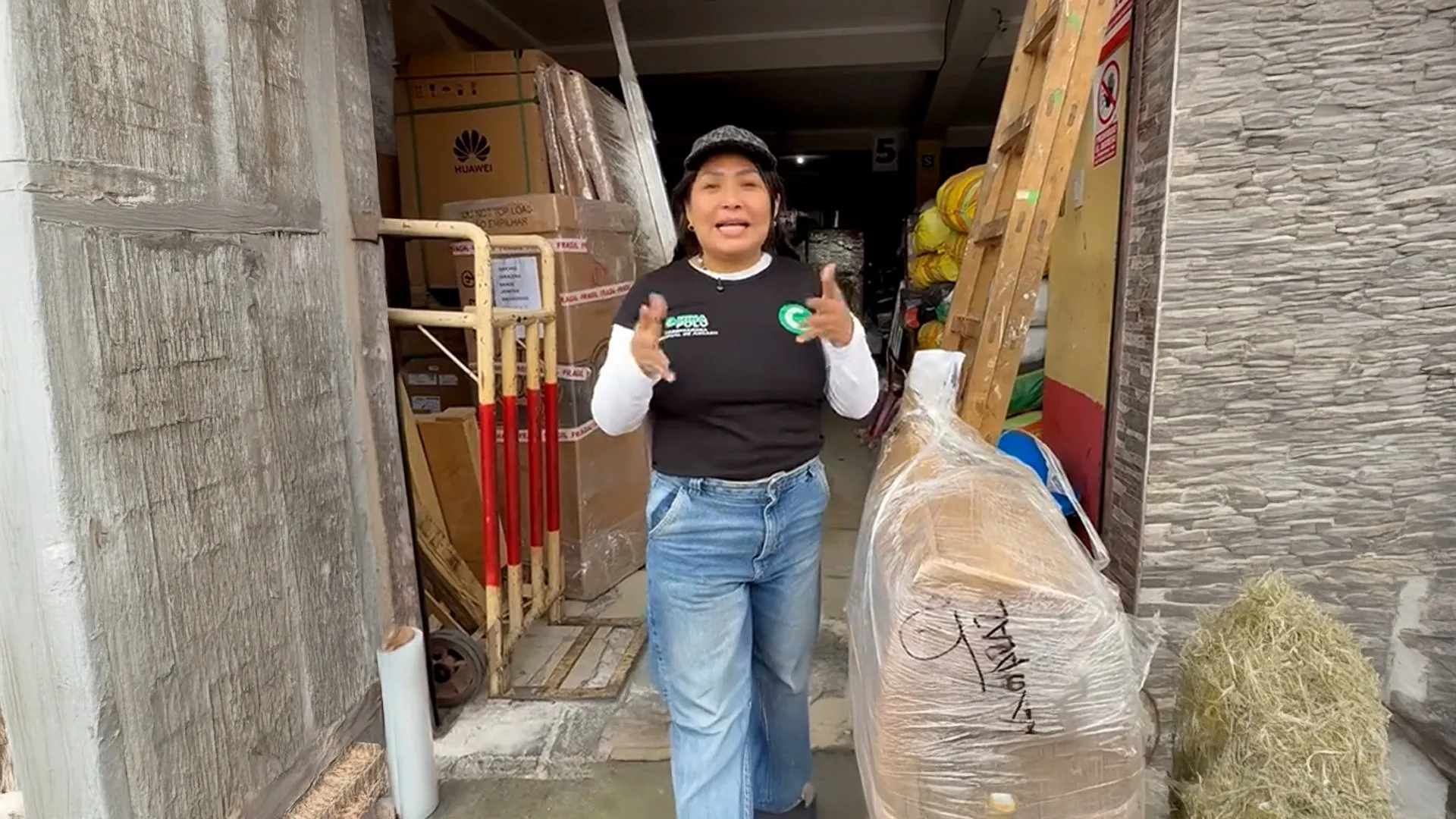
A Peruvian journalist running for political office has been shot dead while out campaigning. Susy Aponte Polo, known as China Polo, was killed just a week after revealing she had received death threats over her investigation into a police chief.
SACRAMENTO — Gov. Gavin Newsom on Saturday signed legislation to increase security for the state’s voting systems and protect Californians’ ability to cast ballots in an effort to guard against potential interference in the Nov. 3 election, including by the Trump administration.
Newsom pointed to the Trump administration’s recent effort to restrict mail-in voting through the U.S. Postal Service, which was struck down by the U.S. Supreme Court, and the presence of federal monitors at California polls last year as evidence that Trump “will continue his efforts to interfere with the November election.”
“Donald Trump won’t stop until he can exert dictatorial control over your free vote and disenfranchise millions of people this November. California will stop him at every opportunity,” Newsom said in a statement.”We have no bigger task than fighting to protect the right to vote from interference and meddling — the future of democracy is on the line. These bills today build upon the wall California has built to safeguard our electoral process.”
The governor signed the package of bills at the Japanese American National Museum in Little Tokyo, where a year earlier federal agents gathered outside a political rally he was hosting. Then Border Patrol Sector Chief Gregory Bovino, who had been leading the immigration operations in California, was among those outside the event, joined by agents in helmets, camouflage, masks and holding guns. Newsom described their presence as political intimidation.
One bill Newsom signed Saturday cites efforts to “weaponize law enforcement authority for political purposes,” including Republican “Sheriff Chad Bianco’s seizure of ballots in Riverside County,” and the election monitors sent by the U.S. Justice Department to polling sites in five counties during a 2025 special election on redistricting.
Such moves “have given rise to unprecedented concerns about law enforcement interference” in elections and “[demonstrate] that these threats are not merely hypothetical,” the bill by Sen. Tom Umberg (D-Santa Ana) reads.
The law, Senate Bill 884, which takes effect immediately, requires counties to open ballot drop-off locations 30 days before an election — two days earlier than usual — and allows counties to ban electioneering, or trying to influence voters’ decisions, within up to 200 feet of polling sites. It also bans police from making arrests near voting locations except for crimes against people, property, or disrupting the voting process.
Bianco, a GOP candidate for governor who placed fourth in the primary, drew swift condemnation and legal challenges this spring after he ordered deputies to seize more than 650,000 ballots from the Riverside County elections office. Voting rights groups and Atty. Gen. Rob Bonta challenged the move, which is being decided by the California Supreme Court.
Bianco carted off truckloads of ballots from the Riverside County Registrar of Voters in February after securing a warrant based on claims that the office allowed fraudulent votes in the special election to redraw California’s congressional districts under Proposition 50 in 2025.
Earlier this year, Newsom signed a bill preventing local and federal law enforcement agencies from taking ballots without a warrant.
On Saturday the Democratic governor signed a bill making it a felony to seize or order the seizure of ballots, election records or voting machines. Future seizures could be punishable by up to four years in prison.
“The federal administration and those seeking to spread lies about our democracy continue to call for interference in elections in ways we have never seen before in this country,” Assemblymember Gail Pellerin (D-Santa Cruz), the bill’s author and a former longtime county elections chief, said last month. “AB 282 helps ensure that every lawfully cast vote can be counted, and that the will of the voters of every political party will be respected.”
Republican lawmakers argued in previous hearings that the bill is unnecessary because it is already a crime to steal ballots.
Another bill, Senate Bill 259, makes it a crime to interfere with a mail ballot on the way to or from a voter or order the seizure of ballots that are in transit to a local elections office.
Newsom signed Assembly Bill 1664, which requires elections officials to immediately notify the attorney general and secretary of state immediately upon learning of any warrants, subpoenas or law enforcement investigations involving election records or voting equipment.
Newsom also signed bills to boost protections under the California Voting Rights Act, including an explicit ban on voter suppression and expanded access to election materials in languages other than English.
The governor also signed legislation to require more transparency from social media influencers who are paid by political campaigns. The measure, Assembly Bill 1130, came in the wake of a controversy in the June primary election when social media influencers took on a more visible role in the campaigns.
Candidates including Democratic billionaire Tom Steyer paid thousands of dollars to influencers who posted videos endorsing Steyer or talking about him in a positive light. These videos did not always disclose that influencers were paid by a candidate’s campaign.
Lawyers criticised mass arrests under emergency powers that allowed authorities to detain people without charge.
Published On 17 Sep 202617 Sep 2026
The Caribbean country of Trinidad and Tobago has ended a state of emergency that granted the government extraordinary powers to combat crime, including the ability to imprison people without charge.
The country’s prime minister told parliament on Wednesday that the government would not extend the state of emergency. One was issued in 2024 and another in 2025, with extensions lengthening both. Instead, the government would seek a “permanent legal framework”.
Recommended Stories
list of 3 itemsend of list
“The proposed legislation will establish a permanent legal framework for targeted operations against violent crime, gangs, illegal weapons and the criminal networks that finance them, while providing safeguards for law-abiding citizens, judicial oversight and parliamentary accountability,” Prime Minister Kamla Persad-Bissessar said in a social media post.
The government had faced criticism for a campaign of mass arrests that suspended key civil liberties in what it said was in the name of cracking down on crime and those the government deemed threats to security. A prominent businessman and his wife were among those arrested over alleged involvement in a plot to assassinate the prime minister, but were never charged and later released.
The measures were last extended in June, with the prime minister stating that more than 5,800 people have been arrested since a March extension. About 2,250 of those have yet to be charged, and it remains to be seen whether they will be released now that the state of emergency has ended.
Lawyer Criston Williams told The Associated Press news agency that he expects some of those detained without charge to bring lawsuits against the government and called for the Inter-American Commission on Human Rights to investigate possible abuses by the government.
“They are transported to us blindfolded, shackled, hands behind their backs, a gray knapsack over their heads,” he said, adding that meetings with lawyers took place in the presence of five armed men from law enforcement, “who refer to themselves as operator one, two, three, four, five. There’s a camera above, so guess what, there’s nothing like attorney-client privilege.”
Police reported a record 624 killings in the country of about 1.4 million people in 2024, a figure that police say dropped to 369 in 2025. Police state that 255 killings have been recorded this year, compared with 268 over the same period in 2025.
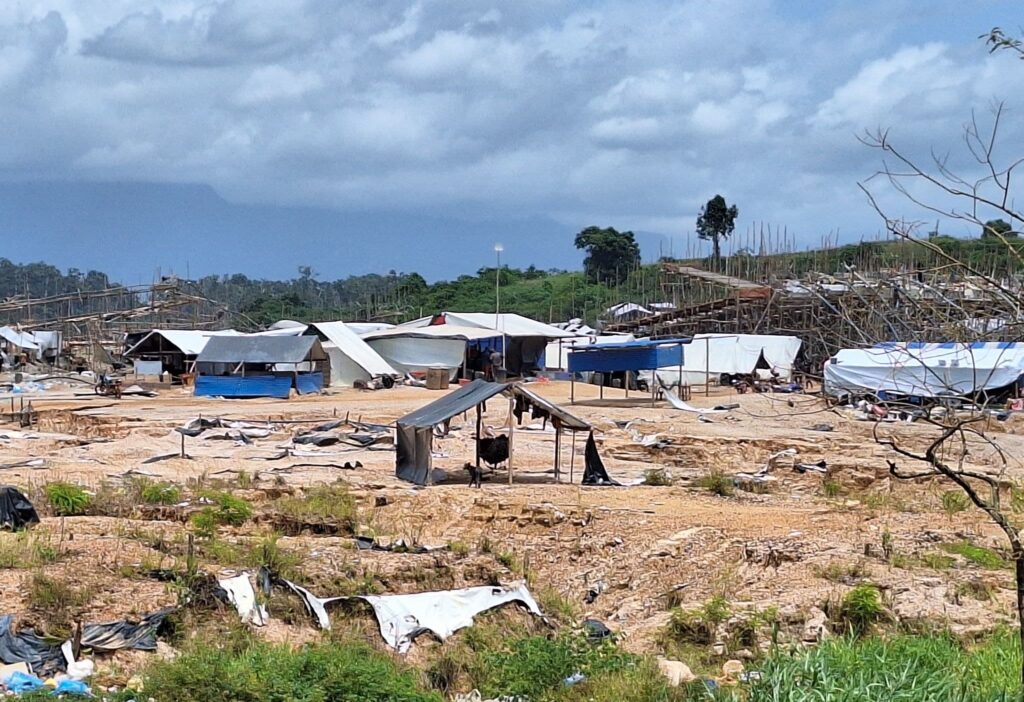
The picture above—courtesy of Gold Reserve—shows the ground of the Siembra Minera project, which the Canadian mining company recently retook.
Delcy Rodríguez has made her moves in the barracks, where she had no major influence before January 3. Several of the appointments are linked to the mining area. She gave Rafael Prieto Martínez, who had been military chief in Bolívar, the direction of the Strategic Operational Command (CEOFANB), the highest body for planning, direction and operational strategic control of the Venezuelan forces. There were also changes in Guayana’s Strategic Comprehensive Defense Region (the REDI or military region where the Orinoco Mining Arc is located) and in Bolívar’s Comprehensive Defense Operational Zone (ZODI). Rodríguez also put in charge people she completely trusted in civilian gold-related positions. For instance, the current president of the Central Bank of Venezuela, Luis Pérez, is also head of the newly created Vice Ministry of Gold.
Gold mixes with the government and now also with the United States. On June 8, troops flooded Guasipati and Tumeremo, when a group of American investors arrived to tour several gold mines and processing plants of the Venezuelan Mining Corporation (CVM).
They weren’t doing some pleasurable sightseeing. The roads’ craters have not been repaired for years. Tin shacks and shops occupy the sidewalks. At night, some lamp posts illuminate the streets only in case there is electricity. The region was not always this chaotic. Decades ago, the hotels there were not for miners but for tourists going to or coming from La Gran Sabana, the eastern sector of the Canaima National Park. During the nineties, there were two large international mining companies that had concessions to exploit the Las Brisas-Las Cristinas axis, where the country’s most important gold reserves are located. In Las Brisas del Cuyuní, an extensive gold and copper deposit near Kilómetro 88, Canadian company Gold Reserve established a mining project to extract minerals. The deposit has estimated reserves of more than 10 million ounces of gold and 1.4 million pounds of copper.
Canadian mining company Crystallex International Corporation operated at Las Cristinas, a site bordering Las Brisas and located near the town of Las Claritas. Its reserves are estimated at over 17 million ounces of gold.
During the nationalization process undertaken by Hugo Chávez between 2008 and 2010, both mines were expropriated. The president declared their concessions void, prompting the companies to demand multi-million dollar compensation from Venezuela through international arbitration proceedings.
Whether for theft, robbery, gunshot wounds, homicide, or acts challenging The System, punishments could range from mutilation to murder.
In their place, the chavista government allowed armed criminal “syndicates” (sindicatos) to establish themselves there and in all the mining towns of the south. These groups exercise power through violence and extortion, keeping miners in conditions of modern-day slavery.
Since at least 2012, control of the area was held by the Las Claritas Syndicate, led by AKA Juancho. He received support from the then-Governor of Bolívar, Francisco Rangel Gómez, and his Secretary of Citizen Security, Julio César Fuentes Manzulli—an Army brigadier general who also served as director of the Bolívar Police. Both men purchased gold and diamonds from Juancho to sell abroad. This relationship was exposed by Army First Lieutenant Jesús Leonardo Curvelo in a report presented to the National Assembly in 2016.
In 2015, AKA Johan Petrica, a leader of the Tren de Aragua, arrived in the area, formed an alliance with Juancho and established the local criminal organization known as The System. Petrica’s presence in Las Claritas led to speculation that AKA Niño Guerrero had taken refuge there after the Venezuelan government dismantled the Aragua Penitentiary Center (known as Tocorón prison, famous for being the original headquarters of the Tren de Aragua) in 2023.
The entire town had witnessed the actions of The System and agreed that any transgression came at a price. Whether for theft, robbery, gunshot wounds, homicide, or acts challenging The System, punishments could range from mutilation to murder. In 2020, organizations like Human Rights Watch documented an incident where a female miner who stole 10 grams of gold from a colleague was tied to a tree and beheaded with a chainsaw; in another case, a 17-year-old who was also accused of stealing gold was made to clasp his hands as if in prayer before being shot seven times and ordered to flee for his life.
Both Trump and Delcy Rodríguez reported only the killing of Niño Guerrero, offering no word on the whereabouts of Juancho, Petrica, and their lieutenants.
Surveillance throughout the town was constant. Lookouts (known as gariteros) kept a close watch on every movement from street corners, while checkpoints were deployed along the roads leading to the mines to monitor access to the deposits. The crimes The System committed to enforce its control were often followed by actions designed to portray it as a benefactor to the town. The local health clinic was always well-stocked with medicines and supplies, boasting high-quality equipment that nearby public clinics lacked. Miners enjoyed a form of “health insurance” provided by The System, which covered the treatment of any wounds or injuries sustained during gold extraction. The System organized toy giveaways for all the children at Christmas and during the Children’s Day celebrations held every July. Mother’s Day and Father’s Day were celebrated at the Las Claritas sports court, where gifts were distributed to those being honored. “In 2025, Juancho and El Viejo handed out about 200 motorcycles on Father’s Day. Everyone who went there left with a motorcycle,” Julio remarked.
Both Trump and Rodríguez reported only the killing of Niño Guerrero, offering no word on the whereabouts of Juancho, Petrica, and their lieutenants. Everyone in the town who was asked agreed that the armed group’s leaders had fled before the military arrived, knowing a “change of government” was imminent. Witnesses in Santa Elena de Uairén—located more than 230 kilometers south of Las Claritas—stated on Monday, June 8 (the day before the incursion), that they had spotted several members of The System, including Juancho, at the Escamoto checkpoint. That post is near the military fort of the same name, less than nine kilometers from the Venezuela-Brazil border. Those who saw them could not be certain that Niño Guerrero was among the group.
In early July, Wesley Costa de Oliveira—a commissioner with the Civil Police of Roraima state, Brazil, specifically the Unit for the Repression of Criminal Organizations (DRACO)—told this investigation that he was not surprised members of The System might be taking refuge in his country, given the weak border controls. Another official from Brazil’s Federal Police confirmed to this project that their government suspected the leaders of this organization were within its territory.
A week after the raid in Las Claritas—on June 16—police in Roraima state revealed that initial progress in “Operation Northern Route” had struck a portion of the Venezuelan criminal gang’s structure in Brazil, resulting in the arrest of 25 people across Roraima, Amazonas, São Paulo, Rio de Janeiro, Minas Gerais, and Paraná.
While uniformed personnel exploit their power in Las Claritas, there is still no news regarding which companies will arrive to take over the deposits. Criminal leaders continue their operations quietly in other cities.
The most prominent figure arrested was businessman Gustavo Vieira Rufino, identified as the financial manager for the TDA. He allegedly moved over 300 million reais (nearly 60 million dollars) in crypto-assets to launder capital derived from illicit activities.
Ana, a local hairdresser, recalled that El Callao was under military control during the Las Claritas-Kilometer 88 operation due to the presence of US investors visiting government recovery plants—such as El Chocó, El Perú, and the headquarters of the now-defunct Minerven. This state of affairs lasted for a week, until the foreigners departed.
In Las Claritas, while uniformed personnel exploit their power, there is still no news regarding which companies will arrive to take over the deposits. Meanwhile, in El Callao, Tumeremo, and El Dorado, criminal leaders continue their operations quietly.
Although El Callao breathes easier following the operation, for Ana, the ousting of The System offers hope that the town might return to what it was in the 1990s: a tourist stop where downtown shops sold gold jewelry at prices far lower than those found in the country’s major cities.
The interviewees’ identities have been changed for their safety.This report was supported by the Pulitzer Center.
Text and photos: Lorena Meléndez | Coordination and editing: Ronna Rísquez | General direction: Milagros Salazar | Design and infographics: ET
Prosecutors said that the group worked on behalf of Russian intelligence services to carry out attacks and murders around the world.
Published On 16 Sep 202616 Sep 2026
Five people have been charged over alleged Russian intelligence-linked plots involving surveillance, recruitment and planned killings, according to an indictment unsealed by the United States Department of Justice.
Prosecutors said on Tuesday that the group worked on behalf of Russian intelligence services to carry out attacks and murders internationally, including within the US, and that all five remain at large.
Recommended Stories
list of 3 itemsend of list
The defendants were identified as Russian national Yuri Khrameev, 63, his son Kirill Khrameev, 27, Cubans Oemis Romagoza Durruthy and Yaidel Delgado Suarez, both 35, and 22-year-old Venezuelan Angel Eduardo Castro.
All five were charged with conspiring to finance terrorism, while Khrameev, Suarez and Castro face additional charges of conspiring to commit murder for hire.
At a news conference, Attorney General Todd Blanche said the plots included attempts to kill a Russian dissident believed to be living in the Washington, DC area.
Justice Department officials said the network had recruited several people in the US to carry out surveillance on Russian dissidents, targeting individuals both domestically and in Lithuania.
In one instance, a recruit was reportedly promised $40,000 to make a US-based target “disappear”. A separate recruit was allegedly offered $25,000 the previous year to kill someone in Lithuania.
Russia’s embassy in the US has not commented on the case. Moscow has consistently rejected accusations that it has orchestrated assassination operations on foreign soil, including in the US.
This is an abridged version of the original story in Spanish, the second part of award-winning investigative journalism project Dorada Opacidad. We will publish the second (and last) part of this investigation tomorrow.
When they pass through the streets of the Las Claritas–Kilómetro 88 mining corridor in Bolívar state, southern Venezuela, a thick, yellowish cloud of dust blankets them like a veil. The sound is unmistakable: a convoy of 15, 20, or 25 motorcycles riding together. Aboard are soldiers from the Orinoco Mining Arc Protection Group (GPAMO)—a unit conceived and activated in 2022 under the command of the Strategic Operational Command of the Bolivarian National Armed Forces (CEOFANB) to safeguard the deposits. They had never been there before June 9, 2026, when three rockets, shot by a US aircraft, shook the area’s flimsy houses. Now, GPAMO is the law.
Although some cover their faces, Rafael knows them well. He owns one of the gold mills operating at the El Mecatico mine—one of many in an area that holds the world’s fourth-largest gold deposit, according to a 2018 certification by Canadian mining company Gold Reserve. Standing beneath the tin roof that shelters his business, he explained that he would soon have to pay the GPAMO 20 grams of gold (roughly 2,000 US dollars) in exchange for a registration form that in theory is free. He is also required to make monthly payments to remain on the site.
For Rafael and the residents of Las Claritas, everything changed on the morning of June 9, when they woke up to find the area occupied by the military. In the early hours, dozens of vehicles transported hundreds of troops from various branches of the Bolivarian National Armed Forces (FANB)—such as the Special Affairs Directorate (DAE) of the General Directorate of Military Counterintelligence (DGCIM)—who patrolled the streets alongside unidentified men dressed in black and carrying long guns. Meanwhile, a pair of military aviation Cougar helicopters flew just above the rooftops of the houses.
The objective of that mobilization was to dismantle “The System.” That was the name given to the criminal alliance between Juan Gabriel Rivas Núñez—known as “Negro Juancho”—and Yohan José Romero (nicknamed “Johan Petrica” or “El Viejo”), one of the leaders of the “mega-gang” born in the Tocorón prison: the Tren de Aragua. For over a decade, this criminal alliance had dominated the territory containing one of the world’s largest gold mining complexes—Las Brisas-Las Cristinas—and had subjugated the local population through torture, mutilation, and murder.
All signs pointed to a “change of government”—a term used in the Venezuelan criminal underworld to describe one criminal group replacing another in a territory.
The residents were so terrified that they remained locked themselves in their homes for days. Rafael did not hear the explosions that rang out mid-morning in Brisas de Cuyuní, near the Kilómetro 88 mining area, because he had gone to his ore mill in the early hours of the morning without noticing the military deployment. Hours later, the military arrived in El Mecatico to destroy the warehouses and properties belonging to The System. This operation was repeated at other mines, as well as at hotels, homes, and businesses in the town.
To determine who truly holds power along the Las Claritas-Kilómetro 88 corridor and in the southern mining towns extending as far as Guasipati, a team of reporters from the Alianza Rebelde Investiga (ARI) and Convoca toured the region as part of the investigative series Dorada Opacidad (Golden Opacity). Interviews with more than twenty sources—ranging from merchants, mill operators, police officers, and local residents to religious figures and local government officials—made it possible to map out the new criminal landscape of the Orinoco Mining Arc.
For days, information about the events was available only through social media or details gathered by journalists working remotely. The first official explanation did not come from any Venezuelan authority, but from Donald Trump. Three days after the bombings, the president stated that his country’s Southern Command had launched a “kinetic attack” to “take out” AKA Niño Guerrero—the nickname of Héctor Rusthenford Guerrero Flores, the most prominent leader of the Tren de Aragua—with the collaboration of the Delcy Rodríguez government.
A new criminal governance
From then on, a military-imposed order took hold in Las Claritas. Rafael recounted that shortly after the town was seized, all mine workers were summoned to a meeting where a FANB captain urged them to keep working without pause, as they had to “produce as Commander Delcy Rodríguez ordered.”
All signs pointed to a “change of government”—a term used in the Venezuelan criminal underworld to describe one criminal group replacing another in a territory, without necessarily putting an end to criminal activities.
That call for productivity came with no guarantees. The mill operator, his shoulders slumped in despair, recalled the sense of security The System had once provided: he could leave his tools outside and stay at his mill until midnight. After the military incursion, however, he had to finish his work and leave before 6:00 pm for fear of being robbed, as happened to others in the mine.
The military has displaced the armed group in the Las Claritas-Kilómetro 88 area, but shares control with criminal mafias in El Dorado and Guasipati.
Since the military took control to oust The System, extortion of merchants, gold buyers, and even random passersby had become commonplace, according to several sources on the ground consulted for this investigation. Soldiers seized sacks of gold-bearing sand left behind by members of The System in order to process them and extract the gold, recounted Óscar, speaking from a shop on the town’s main road. “A captain who extracts gold every day exchanges 5,000 or 6,000 dollars in cash, and asks a friend to convert it to USDT [a cryptocurrency] and send it to Puerto Ordaz,” he said.
Military personnel capitalized on the gold-bearing sands that The System had not processed. Photo: Lorena Meléndez G.
According to witnesses, soldiers confiscated motorcycles and vehicles belonging to people with no ties to The System and spread fear across all the mining towns in southern Bolívar, about whether FANB would bomb all territories within the Mining Arc where armed groups operate, or the joint operation with the Americans would end in another massacre of workers by military forces.
However, local residents confirmed that the intervention was limited to Las Claritas-Kilómetro 88. Meanwhile, in towns like El Dorado, Tumeremo, and El Callao, criminal gangs continue to reign, albeit more discreetly and without the brazen displays of the past.
Former Bolívar lawmaker Américo De Grazia claimed on social media that The System’s ringleaders had returned to their old territory, though locals dispute this. Yet De Grazia’s account is not far-fetched: locals told the ARI and Convoca team that some of The System’s bosses—including the men known as Juancho and Johan Petrica—had left Las Claritas a few days before the military incursion. Apparently, they had been tipped off and fled. They were spotted trying to lay low near the Brazilian border.
What does seem clear is that in the Las Claritas-Kilómetro 88, the military displaced the armed group, but in El Dorado and Guasipati, they share control with criminal mafias—albeit maintaining a lower profile to preserve appearances before the Venezuelan government’s new partners: American businesspeople.
The American footprint
Five days after Maduro was taken away, Delcy Rodríguez announced a package of legislative amendments designed to appease Washington—such as a reformed mining law, whose latest version offers low taxes and numerous concessions to foreign capital that was previously unwelcome.
The new legislation, enacted in April, repealed the decree that had reserved the exploration and exploitation of gold and other strategic minerals for the State, paving the way for private and international companies to engage in these activities through concessions lasting up to 50 years.
Furthermore, it established special payments (up to 1% of gross production under the concession contract for the National Mining Fund and a royalty of up to 13% for the State), a tax of up to 6% regulated by the government, and incentives such as exemptions from the Large Assets Tax, as well as special contributions mandated by four other laws—including the Law on the Protection of Social Security Pensions—all aimed at benefiting the new companies operating in Venezuela’s mining sector.
Alongside the law’s approval, the United States also took action: in March, it issued licenses allowing American companies to purchase, transport, and resell Venezuelan gold. On September 2, the Treasury Department’s Office of Foreign Assets Control (OFAC) expanded the scope of these licenses, authorizing US companies to participate in the export, sale, purchase, storage, transport, processing, and refining of minerals of Venezuelan origin, including gold. It also permitted the supply of specific goods and services for mineral operations, as well as the negotiation and execution of contracts within the mining sector.
This entire framework has enabled Rodríguez to consolidate her economic team within the government through the appointment of key officials—both civilian and military—to positions within the Mining Arc. Their key figures are positioned not only within the executive branch but also across the State-owned enterprises involved in the business, and among military personnel capable of guaranteeing gasoline supplies and mine operations.
The interviewees’ identities have been changed for their safety.This report was supported by the Pulitzer Center.
Text and photos: Lorena Meléndez | Coordination and editing: Ronna Rísquez | General direction: Milagros Salazar | Design and infographics: ET
Some fans claim Nintendo’s latest update about new film is ‘criminal’
Fans were stunned that a trailer was not shown for the film(Image: Nintendo)
Nintendo shared a huge update during a special presentation.
Fans have admit they are left in tears over an ‘insane’ decision regarding the upcoming live-action Legend of Zelda movie. The adaptation is set to hit the big screen next year.
This afternoon (September 9) the popular games company behind the franchise hosted a special ‘Nintendo Direct’ in celebration of the 40th anniversary of the series. The main event for the presentation was the first reveal of gameplay for the upcoming remake of classic Nintendo 64 title, Ocarina of Time.
However, game designer Shigeru Miyamoto who helped create Legend of Zelda and other iconic series such as Super Mario Bros, Star Fox and Pikmin began the presentation by sharing the latest behind the film. He confirmed the release date of April 30, 2027 and also the title.
Unlike the game series, which usually utilises subtitles, the film will just be called The Legend of Zelda. Miyamoto told fans that they will “understand why it is called that” when they watch the movie for themselves.
He also explained that the film is a unique story that takes inspiration from plotlines and concepts from multiple titles across the series.
However, despite many predictions, there was no trailer or footage of the film itself shown. This did not sit well with many fans, who slammed the decision.
Several did not waste time in sharing their thoughts on social media. One posted: ” No trailer of the Zelda movie is insane to be honest.”
One agreed: “Holding a standalone Zelda direct and not having a movie trailer ready for it is absolutely insane.” Another added: “So there isn’t a Zelda movie trailer today… I mean it’s fine the movie isn’t out till April but this was the perfect time to release even just a glimpse.”
Someone else claimed: “No Zelda movie trailer is criminal I do have to say.” One person asked: “I thought we were having the Zelda movie trailer too?! What happened?!”
A person who tuned into the Direct commented: “I’m crying. No Zelda movie trailer, not even a teaser.”
Ahead of The Super Mario Bros Movie and The Super Mario Galaxy Movie, Nintendo often shared cast and trailers during their Direct presentations. However, it was announced that future news about the Zelda movie will be shared via their app.
Some of the cast is known for the Zelda film including Benjamin Evan Ainsworth playing Link and Bo Bragason taking on the role of Princess Zelda . The title is set to feature Sam Neil’s final performance before his death but his role is still not known.
The Legend of Zelda will release in cinemas April 30, 2027.
Cape Town and Rio de Janeiro are two cities on most people’s bucket lists, but which one reigns supreme when it comes to the best – one writer compares the two
(Image: Getty Images/Publisher Mix RF)
Days shaped by sand, surf and salt air. Nights by bars, beats and grills. All played out in a city somehow woven between soaring mountains and sun-swept shores. Sounds good, no? Well this is both Brazil’s Rio de Janeiro and South Africa’s Cape Town. Then chuck in vibrant waterfront neighbourhoods, primeval hiking trails, world-class food and drink, plus a melting pot of cultures and you’ve got what it takes to be the greatest city in the world. Which is what both have boldly claimed.
But they both can’t be right, so which takes the crown? I’ve lived in samba-soaked Rio, and recently spent a month exploring the city straddling Africa’s southern tip, so may just be qualified enough to have a say in the debate that’s enraged Brazilians and South Africans online. The neutral voice of reason ’n’ all that.
Weather
Rio has a glorious tropical climate. Hot and humid, with sweltering summers often as high as 40C. You’ll rarely feel cold, but if you’re of a sensitive disposition, it may be too much heat to handle. Plus biblical rains can wash your trip away.
Conversely, Cape Town has a Mediterranean-style climate. Dry, warm summers with highs of a perfect 30C. Fantastic if it weren’t for one thing – the wind. Known as the “Cape Doctor”, it’s like nothing I’ve ever experienced. Sweeping in off the ocean, it can make a hot summer’s day feel like autumn. Worse, it can be downright violent, turning beaches into giant sandblasters, stinging your skin, near blinding you. Bad doctor.
Verdict: Rio is the winner.
Beaches
Oh my, what an amazing array of beaches they both have, like no other city in the world. Apart from each other, of course. Both have smaller arcing sands near the city centre, becoming longer and more pristine the further out of town you head.
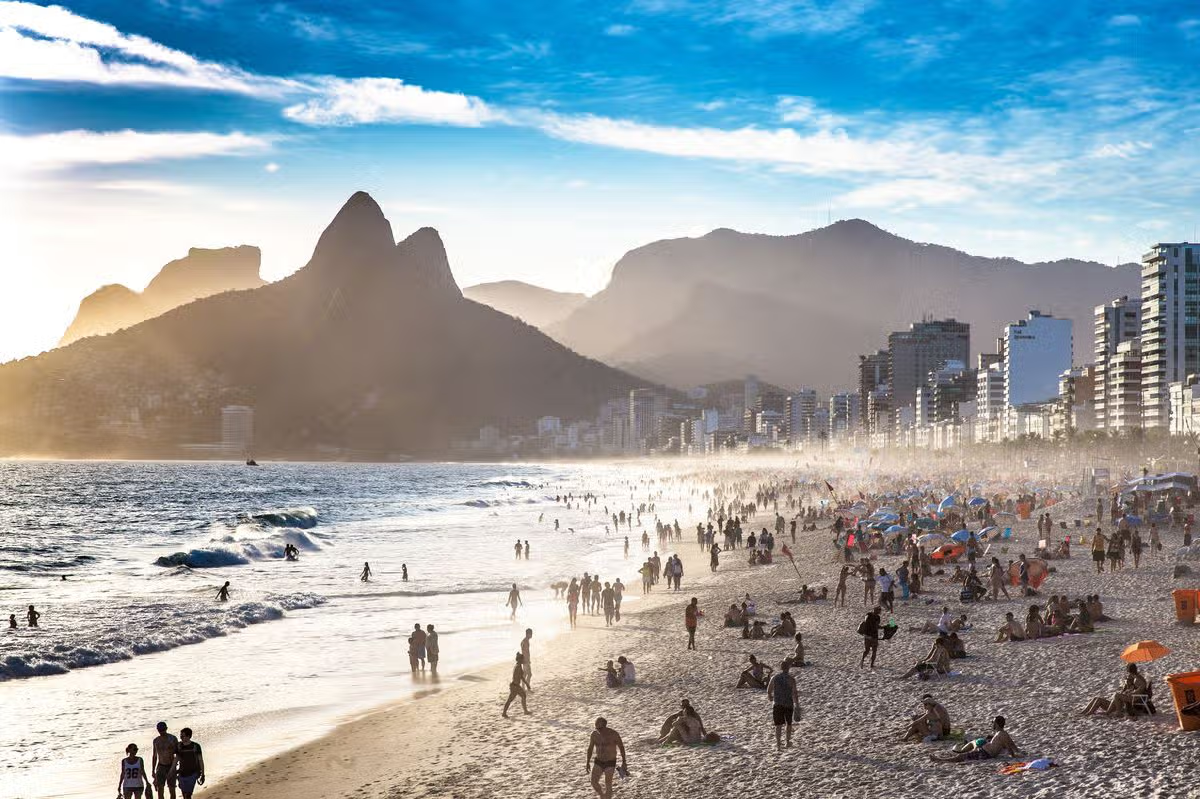
Just south of the centre, Rio has the world-famous Copacabana and Ipanema beaches, broad stretches of golden sand where the whole city decants to at weekends to let it all hang out in too-scant swimwear.
Cape Town has the likes of smaller yet very pretty Sea Point, Clifton and Camps Bay, which were far more debonair than I expected. More like the Cote d’Azur than the Cape of Good Hope.
Further up the coast, Rio has beautiful Barra, and Cape Town kite-surf strewn Bloubergstrand, giant stretches of glorious open coastline pounded by those big blue waves.
But the key difference is that Rio’s waters are much warmer, whereas Cape Town’s side of the Atlantic is surprisingly cold year-round, plus that wiiiind, meaning you don’t see many people swimming – the complete opposite of Rio.
Verdict: Rio takes the crown.
Mountains
Both have an imperious plethora of peaks. Cape Town’s most famous is Table Mountain, which your eyes can dine upon from all over the city. Rio’s is craggy Corcovado, atop which the statue of Christ offers redemption to thousands of tourists daily. But there are countless breathtaking viewpoints from many other fantastically surreal mountains, plus hiking trails that transport you into oh-so-big nature – lush jungle in Rio, temperate forest in Cape Town – a world away from the urbanity below.
Verdict: All too amazing to call. Draw.
City centres
Surprisingly, their city centres are the least impressive aspect. Both have smallish downtowns and historical quarters, which are nice but nothing impressive compared to some global cities. Much better are the colourful colonial-era neighbourhoods – Lapa in Rio, Bo Kaap in Cape Town – where you can join the tourist hordes to get your Insta-pics.
Down by the water, Rio’s Port Zone has cool museums and galleries, while Cape Town’s upmarket V&A Waterfront is very pretty with great views and shops, albeit a tad generic. Then both have plush beach front neighbourhoods, where you can whimsically while away days on the golden sands or trendy terraces.
Verdict: Again, too close to call. Draw.
Food and drink
Both have excellent culinary scenes, especially their meats and barbecues. Yum. But Cape Town has a much broader option of cuisines and restaurants, local and international, and during the entire month I was there I didn’t have a single bad meal. Caipirinhas and other potent cocktails get the party rocking in Rio, but Cape Town’s wines are next level. Despite being of proud Provençal stock, I can freely admit their rosés were the best I’d ever tasted. Perfect sundowners.
Verdict: Cape Town is the clear winner here.
Prices
Both have similar prices, which are considerably cheaper than the UK and Western Europe. Decent budget meals are around £4-£10, and mid-level accommodation around £50-£100pn. There are plenty of upmarket options, which are also relatively good value for money.
Verdict: Draw.
Nightlife and music
Both cities come alive even more when the sun sinks into the ocean. Your more mainstream bars and restaurants line the beachfronts, while cool bar-clubs are found in the more hipster hoods of Ipanema and Lapa in Rio, and Bree St and Woodstock in Cape Town.
Both cities are home to world-class music, Rio sways to the sound of samba, rap and “funk”, whereas in Cape Town it’s Afro house, amapiano and 3-step that get things thumping.
Verdict: Cape Town (but mostly due to my penchant for house music), although if we were judging it on Carnival season alone, nothing comes close to Rio!
Vibe
Brazilians are famously some of the most friendly and welcoming people in the world, which is true for Rio, but like any big city, you get plenty of miserable buggers too. People of all shades were friendly with me when I was in Cape Town, yet seemingly not that much with each other.
Sadly, both cities are still riddled with historical divisions between class and race, yet in Cape Town the legacy of Apartheid looms large indeed, and as a tourist you unfortunately won’t see much of the native African side of the city. The division feels tense.
Verdict: Rio.
Overall verdict
My biggest gripe with Cape Town is that as a tourist, you only really see the predominantly rich, white neighbourhoods that feel more like Canada, the US and Australia than Africa.
In Rio, though, everywhere is very Brazilian, no matter the social makeup of the area. Plus the beaches are a leveller, especially Copacabana where the whole city congregates for communal sun-worshipping, eating, drinking, sport playing, and strutting of stuff, no matter if black, white or brown, muscle-bound or beer-belly beautiful – nobody seemingly cares.
And that, for me, is the key difference – which is why Rio is my overall winner.
Many true crime fans said it was a ‘wild’ watch as they tune in for the first time
The documentary can be streamed on Netflix(Image: NETFLIX)
An “insane” true crime documentary available to stream online is guaranteed to have your jaw on the floor.
There is an abundance of documentaries and films to watch on Netflix, but there is one particular watch that viewers say did not get “enough recognition” when it was first released.
Premiering in 2019, Bikram: Yogi, Guru, Predator examines the dramatic rise and fall of the controversial founder of hot yoga, Bikram Choudhury.
Directed by Academy Award winner Eva Orner (Taxi to the Dark Side), the film details how the controversial founder built a global fitness empire before it collapsed following numerous sexual abuse allegations.
An official synopsis on Netflix reads: “Arriving in Beverly Hills from Calcutta, India in the early 1970s, Choudhury quickly cultivated a celebrity following and built a global fitness empire that furnished him with extreme wealth.
“But by the 2010s, as numerous sexual abuse allegations emerged and stories of his aggressive, cult-like training environment surfaced, the lawsuits started to mount and Choudhury’s unorthodox teaching style became front-page news.”
It later adds: “BIKRAM: YOGI, GURU, PREDATOR, a Netflix original documentary, shines a light on the stories of the women who took him down and explores the contradiction of how this healing discipline could simultaneously help and hurt so many.”
Recently, one true crime reviewer took to social media having recently watched the documentary film, as they branded it an “insane” watch.
Sharing a video explaining the synopsis of the documentary, they wrote: “This true crime documentary will have your jaw on the ground.”
In the clip, they added: “This insane true crime documentary didn’t get enough recognition when it first came out.” One person replied: “Ohhh I loved this one crazzzyyyy”, as another commented: “Yes this was WILD!!!!”
A third added: “There’s a podcast about this too. Very strange, weird story.” A fourth wrote: “Oh yea this was a good one lol.”A fifth said: “That was a b***** crazy doc!! Too cray cray!!” Another stated: “I saw this already and I screamed at that ***!!! Absolutely insane!!”
Over on IMDb, one reviewer previously said: “The documentary was impeccably put together and a must watch for any yogi.”
Another wrote: “‘Bikram: Yogi, Guru, Predator’ is an exceptionally well made and well constructed documentary. It’s also one that, by the end, will probably also make you very angry for a variety of reasons.”
Bikram: Yogi, Guru, Predator can be streamed on Netflix
Colombian authorities blame ELN rebel group for attack that reportedly included drones dropping explosives on compound.
Published On 5 Sep 20265 Sep 2026
Colombian authorities have said that at least three soldiers have been killed and several more injured after an attack on a military compound by an armed group that included drones used to drop explosives.
The Colombian army said on Saturday that the attack had been carried out by the rebel National Liberation Army (ELN) the night before in the municipality of Ocana, which is in the area bordering Venezuela. Two soldiers were killed in the clashes, along with a third who died after receiving medical attention. Four were injured.
Recommended Stories
list of 3 itemsend of list
“To the ELN I say with absolute clarity: for every police officer or soldier you kill, I will bring down on you the full weight and legitimate force of the State,” President Abelardo de la Espriella said in a statement on social media condemning the attack.
Authorities said that drones dropped explosives onto the compound in the department of Norte de Santander before fighting took place within the facility. The news service AFP reported that at least 20 drones loaded with explosives were utilised in the attack, citing an unnamed security official.
De la Espriella won office pledging to return Colombia to militarised confrontation with armed groups and criminal organisations that have jostled for influence across the country, despite concerns that it could lead to surging violence and possible rights abuses.
Deadly attacks by armed groups have continued to rattle the country since his inauguration.
The attack on Friday took place in the northeastern Catatumbo region, where the ELN is based and where the government has carried out military raids against armed groups.
De la Espriella has also promised closer ties with the United States, which has sought to expand its military involvement in the region under the so-called “Shield of the Americas” initiative.
US Secretary of State Marco Rubio is set to meet with de la Espriella, a former lawyer who previously represented leaders of paramilitaries, in the Caribbean city of Barranquilla next week.
Costa Rican President Laura Fernandez has suggested that United States military operations in the country’s territory could bring national security benefits.
But she added caveats. In an interview published on Friday, Fernandez emphasised to the news service Reuters that such measures would require approval from the national legislature.
Recommended Stories
list of 3 itemsend of list
She also added there were no plans in the works for US forces to operate in the country.
“It would obviously be very good for national security if it were about pursuing a common objective against transnational crime, transnational drug trafficking, transnational terrorism,” said Fernandez, a right-wing populist who took office in May.
Fernandez succeeded her mentor, former President Rodrigo Chaves, after a February election in which concerns about security and rising violence in the Central American country played a prominent role.
Though she ran on a tough-on-crime platform, Fernandez has said that she is not currently considering a state of emergency to address the problem.
Such emergency declarations typically suspend key constitutional rights, in favour of giving police or the military added powers to crack down on violence.
That model has been popularised under the right-wing president of El Salvador, Nayib Bukele.
But critics point out that the states of emergency are meant to be short-term measures, not permanent ones. El Salvador has been under an emergency declaration since 2022, with the government extending it dozens of times.
Crime has become a top voter concern in Costa Rica. The Central American country’s homicide rate has doubled in the last decade, reaching 17.2 per 100,000 inhabitants in 2023.
That figure still places the country’s average well below many others in the region, but the change, partly attributed to increased drug trafficking activity, has startled many residents.
Fernandez’s remarks also reflect growing pressure from the US to reduce crime across the Western Hemisphere.
Since returning to office for a second term, US President Donald Trump has pushed to expand his country’s influence across Latin America, notably through military engagements.
Earlier this year, he launched the “Shield of the Americas”, also known as the Americas Counter Cartel Coalition (ACCC), to bring together right-wing leaders across the region to address drug trafficking.
Trump used the inaugural meeting to encourage Latin American governments to embrace a military-driven approach to crime, despite concerns about human rights.
He has also carried out and threatened military operations in sovereign countries, on the premise of combatting crime.
Some countries, such as Mexico, have baulked at the prospect of US military forces carrying out operations on their territory. Critics point to Washington’s long record of interventions and rights abuses in the region.
But other countries have been more receptive. US forces, for instance, have recently carried out military operations with the right-wing government of Ecuador, in an effort to lower crime rates.
Ecuador’s armed forces, however, have been accused of crimes such as torture and enforced disappearance, abuses that experts warn could be worsened by support from the US.
A July report from Human Rights Watch warns that the military collaboration between Ecuador and the US has already had dire consequences.
Ecuadorian fishermen have reported facing attacks at sea, and in one case, Ecuadorian soldiers allegedly detained and tortured four Colombian farm workers, using methods such as mock executions, beatings and electric shocks.
That incident reportedly took place during a raid near the border carried out with US support.
“The two countries’ security relationship is deepening at a moment when both governments have engaged in serious human rights violations fueled by their insistence on framing their confrontations with organised crime groups as a kind of war,” the report says.
Those raids come after Ecuadorian voters rejected a referendum last year that would have allowed foreign countries to set up military bases in the country.
Two Muslim female journalists allege they were detained and brutally assaulted by police in India’s capital, Delhi. Police have denied the allegations, claiming the journalists were brought to the station over an illegal parking dispute.
WASHINGTON — Less than a week before eight people — including six Asian women — were killed in the Atlanta-area shootings congressional Democrats introduced legislation that would bolster the Department of Justice’s ability to address COVID-19 hate crimes.
The bill, introduced by U.S. Rep. Grace Meng (D-N.Y.) and Sen. Mazie Hirono (D-Hawaii), has been co-sponsored by more than 60 lawmakers and on Friday was endorsed by President Biden, who condemned the “ongoing crisis of gender-based and anti-Asian violence” and urged Congress to “swiftly pass the COVID-19 Hate Crimes Act.”
“It’s time for Congress to codify and expand upon these actions — because every person in our nation deserves to live their lives with safety, dignity and respect,” Biden said.
The bill would require at least one Department of Justice employee to facilitate fast reviews of federal, state and local COVID-19 hate crimes for at least a year, according to a draft provided by a Hirono spokeswoman.
It would also require the department to issue guidance to state and local law enforcement agencies on how to establish an online hate crime reporting system in multiple languages.
The system would “allow more victims to come forward,” A.B. Cruz III, president of the National Asian Pacific American Bar Assn., said in a statement.
The bill would also require Atty. Gen. Merrick Garland and Health and Human Services Secretary Xavier Becerra to work with the COVID–19 Health Equity Task Force and advocates to give guidance on how to discuss the pandemic without using incendiary language.
The bill would not drastically change the legal landscape as it relates to hate crimes but would spotlight how it intersects with COVID-19, said Anthony Michael Kreis, a law professor at Georgia State University College of Law.
Since virus-fueled lockdowns went into effect last March, thousands of Asian Americans have reported having faced racist verbal and physical attacks or have been shunned by others, according to a report by Stop AAPI Hate. The group, whose acronym stands for Asian American and Pacific Islander, received reports of 3,795 incidents over the last year, with 68.1% involving verbal harassment and 11.1% involving physical assaults.
Among the incidents, Asian Americans reported being punched while riding the subway in Washington, taunted with racial slurs in New York and coughed on while being blamed for the novel coronavirus in Dallas.
Then-President Trump last year said little to discourage the attacks but often used racist language to describe the deadly virus, calling it “kung flu” and the “China virus,” even after being warned that his rhetoric was incendiary. Meng said many Republican lawmakers “trafficked racist, bigoted terms to describe COVID-19.”
“In doing so, their language stoked people’s fears and created an atmosphere of intolerance and violence, which persists even today,” Meng said.
The bill would define COVID-19 hate crimes as violent offenses motivated by the real or perceived relationship to the spread of the coronavirus and the real or perceived background of a person, including their ethnicity and national origin.
Kreis said it’s unclear how adding a COVID-19 distinction to a federal hate crime would benefit existing law. The law, in practice, draws connections between current events and discrimination. For example, the law can already be used to prosecute crimes against LGBTQ people whose attackers express anti-HIV/AIDS sentiments, he said.
Kreis said that though anti-Asian slurs are seen as an expression of hate by the American public and, by extension, juries, anti-Asian imagery is not as noticeable in American society. This often requires prosecutors to handhold juries to connect the dots to understand what hate crimes against Asian Americans look like, he said.
“We need a lot more cultural competency in the ways in which anti-Asian stereotypes can manifest,” Kreis said. “That’s a hard endeavor we as a society need to tackle.”
Times staff writer Chris Megerian contributed to this report.
Haitian foreign minister says renewal is necessary to ensure safety ahead of elections scheduled in December.
Haiti’s Foreign Ministry has called on the United Nations Security Council to renew the mandate of an internationally backed security force meant to tamp down the powerful armed groups controlling parts of the country.
On Thursday, Foreign Minister Raina Forbin reiterated her view that the Gang Suppression Force (GSF) needed to be fully deployed to her country, with support from the international community.
Recommended Stories
list of 3 itemsend of list
Its mandate, however, is slated to expire on September 30, unless the UNSC acts to extend its mission.
“We need technical, financial, logistical and safety support that is up to the challenge,” said Forbin. “We must now move from solidarity to action.”
Her remarks came at a meeting of the Organisation of American States (OAS), focused on the continued gang violence in Haiti.
Forbin gestured to a pressing need in her country. This year alone, in the three months from April to June, an estimated 1,408 people were killed in Haiti, with 656 injured. Much of that violence was attributed to gangs.
Haiti is also pushing ahead with long-postponed general elections. Critics, however, fear that the violence could disrupt the elections and weaken public confidence in the outcome.
Political instability in Haiti has been heightened since the assassination of former President Jovenel Moise in 2021. Armed groups have flourished in the vacuum, assuming control over large swaths of the capital of Port-au-Prince and displacing more than one million people.
Authorities have struggled to address either the out-of-control violence or the deeper causes of instability in the country, including poverty and government corruption.
The upcoming elections, the first in a decade, are currently scheduled to take place on December 13. But officials have questioned whether they will take place, given conditions on the ground.
OAS Secretary-General Albert Ramdin said that the regional body would deploy an Electoral Observation Mission to help support a credible vote, urging greater assistance for Haiti’s provisional electoral council.
He added that about one million identity cards must also be produced and distributed before voting can take place.
“Haiti is at a critical juncture,” Ramdin said in a statement on Thursday. “Our responsibility is clear: to strengthen security efforts, advance electoral preparations, fulfill existing commitments and ensure that international cooperation translates into tangible improvements in the daily lives of the Haitian people.”
But international assistance efforts have also drawn criticism, with many Haitians sceptical of outside interference in their country.
Officials within such international forces have also bemoaned a lack of steady support. Before the GSF, Kenya had led a Multinational Security Support (MSS) to support Haitian police, only to withdraw in April, after failing to meet its funding and deployment goals.
The UN Security Council voted to create the GSF task force in October 2025 as a replacement for the MSS. The mission was given a 12-month mandate.
The GSF is authorised to pursue “counter-gang operations to neutralize, isolate, and deter gangs”, either independently or in cooperation with Haitian police and its military.
Human rights advocates, however, note that such international support has been lacking for Haitians fleeing the violence.
Many Haitians have been forcibly returned to the country after fleeing for safety. A UN official informed an emergency meeting of the UNSC last week that nearly 200,000 people have been sent back to Haiti during the first eight months of this year.
That amounts to a 20,000 increase over the same period last year.