creative

‘Creative’ Laws Underpin LatAm’s Fintech Expansion

Strong regulation and dynamic regulators are helping nurture a fintech boom across the region.

This article appears in the October issue of Global Finance Magazine.

The number of fintech startups in Latin America has grown by 340% over the past six years as these companies take a leading position in areas such as financial inclusion, cross-border payments, and instant payments. 

Nubank reached a milestone in January, becoming the largest private bank in Brazil with over 112 million users, according to the Central Bank of Brazil. The instant payment system Pix now accounts for more than half of transactions in the country and has some 170 million users, with 80% to 95% of the country using the service.

“Creative laws are not always good laws. So you can have very creative regulation that is not necessarily very good regulation,” said Eduardo de Los Heros, legal manager at Bitso, a Mexican cryptocurrency trading service and fintech. “Brazil has very advanced regulation for digital payments, and El Salvador has made Bitcoin its calling card to position itself as the crypto regional hub.”

Brazil, Colombia, and Mexico account for about 57% of all Latin American fintechs, with remittances, loans, and financial management the main segments. In Mexico, the arrival of Mercado Libre and its subsidiary Mercado Pago, as well as Nubank, has forced traditional banks to offer their own digital alternatives.

“Mexico and Brazil, as the biggest economies, are pushing towards regulation. El Salvador is small but dynamic and has a fantastic regulatory sandbox,” said Daniel Leiva, partner at Torres Legal in El Salvador. “Then there are countries that are also pushing forward, like Colombia and Argentina. Argentina is fighting to integrate fintechs into the economy.” 

With a Fintech 2.0 Law due in Mexico, the market is starting to mature as adoption of digital banks and payment schemes increases across the region. Mexico now has over 1,000 fintech companies, second in the region only to Brazil. 

“This famous law has the objective to develop open finance as well as public access to user data of Mexican financial projects,” said de Los Heros, “creating clear regulations for virtual actors, tokenization, and stable coins.”

That would not be a minute too soon, as Mexico’s rapid fintech expansion has outstripped the Comisión Nacional Bancaria y de Valores (CNBV)’s ability to regulate, Leiva said.

De Los Heros does not believe the law will be ready this year; there is no publicly available draft of the law, nor is a draft bill before Congress or the Senate. Yet, speaking at the Fintech Festival 2026 in February, CNBV President Ángel Cabrera claimed that Mexico was technologically ready for Fintech 2.0, adding, “The CNBV’s vision is to build an ecosystem of digitally born entities that generate value where cash still predominates today.” 

Leiva points to El Salvador as another example of dynamism in the industry. 

With one regulator, the National Commission of Digital Assets (CNAD), working in tandem with the Central Bank of El Salvador, the focus has been on neutral laws; CNAD regulates certain types of activities, like crypto, without marrying the law to specific technologies. A broader scope allows for quicker adoption and avoids delays in achieving regulatory consensus on specific blockchain models, for example. This enables distributed technologies and similar models to be regulated more effectively. 


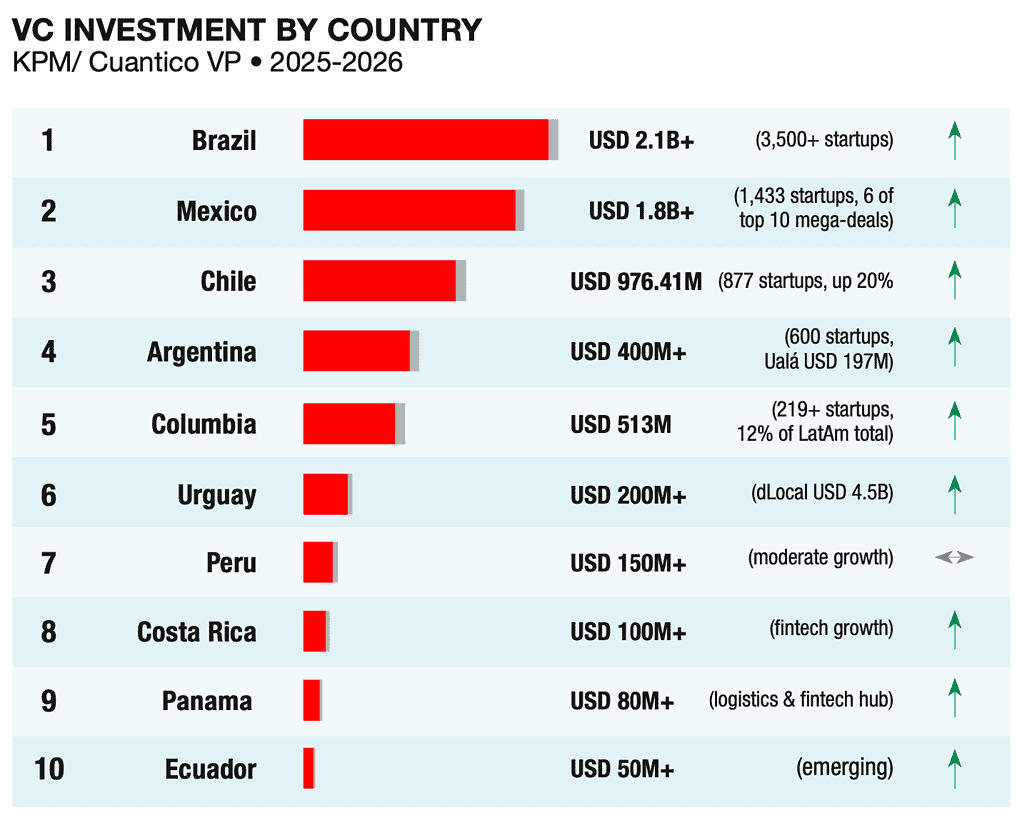
Brazil and Mexico concentrated 78.5% of all regional VC in 2025. Fintech captures 61% of capital. 
Source: KPMG, Cuantico VP, StartupBlink • 2025-2026
(Brazil and Mexico concentrated 78.5% of all regional VC in 2025. Fintech captures 61% of capital.
Source: KPMG, Cuantico VP, StartupBlink • 2025-2026)

From Sandboxes to Standards

Colombia’s instant payment system, Bre-B, was launched by the Banco de la República last October. Bre-B aims to connect traditional banks, fintechs, and digital wallets through a single public digital platform. By August, it had recorded 1.51 billion transactions and more than 35 million users; 171 financial institutions had integrated by then. Those numbers could be even better if the bank had been less passive and restrictive over the past couple of years, according to Leiva. 

Eduardo De Los Heros,
Bitso
Eduardo De Los Heros,
Bitso

That said, Colombia’s fintech sector is at a crossroads, with rapid uptake butting up against a new regulatory framework. The Banco de la República and the Superintendencia Financiera de Colombia have instituted new regulations to protect consumers, ensure financial stability, and combat money laundering. Fintechs now have to adhere to the same standards as traditional banks, including rigorous know-your-customer protocols.

“I am not convinced that excessive regulation is the ideal mechanism for the financial services users,” says de Los Heros. “But in regions like Latin America, where there’s not always advanced banking options, it can be that regulation brings positive effects, at least because it protects users against possible abusive practices by stock markets, financial entities, or virtual service providers.”

Peru’s attempts to integrate banks, fintechs, and users on a single inter-platform payment system under one legislative umbrella are also attracting attention. The Andean nation has “a high index of unbanked people,” de Los Heros said, and in theory, having a unified system with a single platform could speed mass adoption. “We have to see how an interactive interbanking and inter-platform payment system could be adopted region-wise. It’s more important to have an interbanking system that works than an inter-platform system that is not adopted.”

In the medium term, both de Los Heros and Leiva foresee a maturing market with heightened regulatory scrutiny. More regulation does not necessarily mean a more restrictive environment in a region where institutions have been praised for creativity and dynamism, and where central banks responded to the Covid-19 pandemic in ways that avoided the inflationary pressures other countries endured.

Daniel Leiva,
Torres Legal
Daniel Leiva,
Torres Legal

“Powerhouses like Nubank or Mercado Libre didn’t exist 25 years ago, so creating regulation for them is complex,” Leiva said. “I firmly believe the big actors like Nubank will move into other regions. They will go global. We’re going to have to implement new regulatory mechanisms, like allowing a banking license to be used across Central America.”

Latin America can build on its reputation for forward thinking and dynamic legislation, he added.

“Through new mechanisms of payment, like Pix, [Brazil, Mexico, and El Salvador] are the three regional pillars of legislative development,” he said. “Very interesting things are coming, and you could say Latin America is the lungs of fintech laws globally.”

Not everything is rosy, and de Los Heros is particularly concerned with the implications of AI and how to regulate it.

“AI causes me to lose sleep,” he said. “I really doubt that the industry has all the controls needed. To protect financial systems and society against the unmeasured use of AI and its consequences, we might have to start from zero to establish a lot of norms that we haven’t even thought about yet.”

Nic Wirtz is a contributing writer based in Guatemala.
Source link

Forget Tarantino, Jumbo’s dancers are driving a wildly creative L.A. scene

Every so often, an aspiring screenwriter wanders into the dim red glow of Jumbo’s Clown Room hoping to interview one of the dancers. “They’re like: ‘I’m writing a screenplay. Can I interview you?” says Cecilia Fairchild, one of the longtime dancers at the renowned East Hollywood bikini bar.

Her response is usually some version of this: “I’m like, ‘Why are you writing about that? Don’t you know we are all writing that too? Leave us alone,’” Fairchild says with a mischievous laugh. What bothers Fairchild is the assumption behind it — that the dancers are voiceless and helpless. Worst of all, they’re presumed to have stories worth mining but not the ability to produce literature themselves.

Jumbo’s has a longstanding reputation of being part of L.A.’s literary lore.

In the 1970s and 1980s, Charles Bukowski — L.A. nightlife’s debaucherous poet laureate — was rumored to haunt the bikini bar in its early days. David Lynch wrote his classic screenplay “Blue Velvet” at the bar. (According to local legends, the iconic opening shot of “Blue Velvet” came to Lynch when he spotted a dancer with only one ear.) Writer and director Quentin Tarantino reputedly wrote at the bar. But while Jumbo’s has garnered a mythology as a magnet for filmmakers, writers and musicians who collect impressions, the dive’s dancers have shifted from being the subject to the artists.

Many of Jumbo’s dancers write fiction and memoir, host literary salons across Los Angeles and find ways to tell their own stories rather than serve as muses. “It’s funny because I wish that male auteurs would tell the story of customers. I want a sniffer’s memoir. I think that’s a real point of view,” Fairchild says. (Speaking of alienation and horniness, the dancer has been meaning to crack the Marcel Proust canon.)

Cecilia Fairchild writes inside Jumbo's Clown Room.
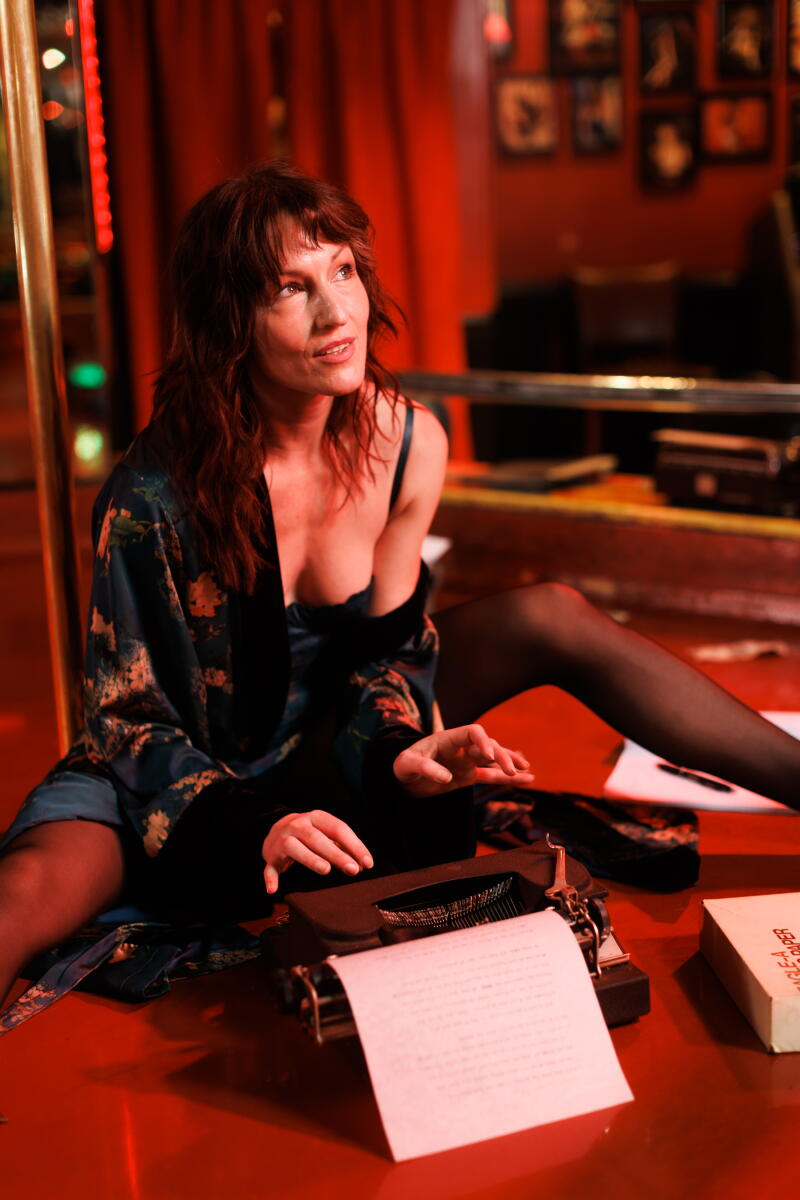
Honey Ryder (Claudia Musikul) types on the bar inside Jumbo's Clown Room.

Honey Ryder (Claudia Musikul) types on the bar inside Jumbo’s Clown Room. (Carlin Stiehl / For The Times)

Fairchild is a playwright, poet and memoirist. Her recently completed memoir, “The Poison + The Spit,” traces a life of tumultuous love affairs and a stint dancing in New Orleans, rendered in prose that is whimsical, surreal and deeply emotional. The dancer also hosts the Downpour, a popular monthly literary salon at Bar Covell, and recently directed “Fool in the Pool,” a play that premiered at El Condor in Silver Lake this summer.

Her writing style mirrors her dancing: kinetic, wild and unpredictable. She sometimes takes the stage in roller skates, dancing to David Bowie. Her memoir achieves that same sense of hypnotic motion. “The memoir is so heavy,” she says. “Everything was so sad that I needed some lens to look at it that was fun, zippy and crazy.”

For Fairchild, dancing and writing possess the same need to expose oneself. “Vulnerability is one of the most interesting things about dancing,” she says. “There really is the potential to look into people, and they look into you, and you wordlessly share something with them that is half sexual and half this other thing.”

Meanwhile, Danielle Henderson — another dancer and aspiring novelist at Jumbo’s who writes under the pen name D.M. Faulk — has been working on a science-fiction novel titled “Meridian.” The book imagines a dystopian American wasteland where pregnant women are surveilled and controlled. She has been a longtime science-fiction fan since she and her father watched “Jurassic Park” and “Planet of the Apes” when she was a child.

 Jumbo's Clown Room's Caroline Blaike (Caroline Moyer), Honey Ryder (Claudia Musikul), and Cecilia Fairchild

Long treated as passive muses by visiting writers, Jumbo’s dancers — from left, Caroline Blaike (Caroline Moyer), Honey Ryder (Claudia Musikul), and Cecilia Fairchild — are reclaiming the narrative as active poets, memoirists and screenwriters.

(Carlin Stiehl / For The Times)

Unexpectedly, the Jumbo’s comically tiny dressing room became the inspiration for her novel. In 2022, when Roe v. Wade was overturned, conversations between dancers about reproductive rights ignited in the dressing room, which in turn informed her novel.

“A lot of those conversations happen in the dressing room. I’m incredibly inspired by the women I’m with who are incredibly sex positive and strong.” That ethos informed Henderson’s protagonist, Zayla.

In recent years, the bar has become a local author hangout. Allie Rowbottom, the author of the recent buzzy adult film novel “Lovers XXX,” discovered the bar in 2011 on the occasion of writer Elizabeth Hall’s birthday party. “I recall sitting front row on novelist Jon Lindsey’s lap, raining dollar bills on dancers performing intricate, beautiful athletic feats,” Rowbottom says. “I spent more than I could afford that night and have been back often since.”

Increasingly, Jumbo’s has cemented itself as a watering hole to the local writing scene. “Two years ago, I rented out a few tables for Jon Lindsey’s birthday, attended by Los Angeles literati like Tea Hacic-Vlahovic, Sammy Loren, Morgan Krantz, Tex Gresham and Nada Alic,” she adds.

According to Rowbottom, Jumbo’s is rife for literary inspiration. “To me, Jumbo’s feels uniquely dedicated, as a venue, to intersecting sex and art, despite the obvious dissonance of selling either,” she says. “I suspect such is what has historically made it a rich spot for writers, dissonance and tension being of utmost importance to good literary work.”

From left, Caroline Blaike (Caroline Moyer), Honey Ryder (Claudia Musikul), Cecilia Fairchild and Stephen (Aaron Laughton)

From left, Caroline Blaike (Caroline Moyer), Honey Ryder (Claudia Musikul), Cecilia Fairchild and Stephen (Aaron Laughton) inside Jumbo’s Clown Room.

(Carlin Stiehl / For The Times)

A charged scene in L.A. writer Aiden Arata’s critically-acclaimed 2025 essay collection, “You Have a New Memory,” features a night out at Jumbo’s Clown Room. “The dancers are starlets, athletes, artists; the theme is clown, and also longing — longing is a high form of physical comedy,” says Arata. “It possesses that heady mix of scuzz and glamour that can trick you into thinking your life is about to change.”

Jumbo’s burgeoning literary interest revives a hotly debated question: Who gets to tell the stories of sex work? For decades, the club has inspired celebrated writers and filmmakers, but Claudia Musikul — a dancer at Jumbo’s and a screenwriter herself — hopes its literary legacy will increasingly belong to the people at its core: the dancers.

“I hope that everybody can actually get their work out there because I feel it’s much deserved,” says Musikul. “You’ve probably heard about Bukowski, David Lynch doing ‘Blue Velvet’, or Anthony Bourdain. That’s all really cool, but in a way, it’s the actual dancers’ turn to have that kind of recognition.”

Musikul primarily writes screenplays about strippers, a subject she believes is seldom represented authentically. She has been in writing partnerships and workshops while developing scripts centered on dancers. In a sea of films depicting sex work, she cites Paul Verhoeven’s “Showgirls” as a film that resonates with her experience.

“‘Showgirls’ is my very favorite movie,” she says. “It’s my very special place in my heart movie.”

For Caroline Blaike, a poet and dancer at Jumbo’s, the connection between dancing and writing lies in observation. Years of performing have made her acutely attentive to the people who pass through the club, a voyeuristic habit that carries over into her poetry.

“When you’re a dancer, you’re very observant. You watch every person that walks in,” she says. “I feel like the way dancing makes you observe people helps you write from a perspective that other people can then relate to.”

Blaike has been working on a poetry collection that explores love, queerness, desire and personhood. “It’s gotten a little sexier over time, which is kind of fun,” she says. “I also just write about love, being gay, just existing. It can be a little aggressive, but people seem to like it, so that’s good.” She writes these poems from her prized typewriter — a “1951 Olympia typewriter that is my child.”

Among Blaike’s earliest literary touchstones was Maya Angelou. She still remembers encountering Angelou’s line in her poem “Still I Rise,” “I dance like I have diamonds at the meeting of my thighs,” and being stunned by it.

“I was like, ‘Oh, you can write that? That’s amazing,’” she says.

The literary ambitions at Jumbo’s extend well beyond the stage. Stephen Laughton, one of the club’s security guards, jokes that he leads a double life. By night, he keeps watch at the door; by day, he is an award-winning playwright. He’s recently been named the new associate artistic director of the Echo Theater in Atwater Village, and Laughton’s served as the writer-in-residence in the astrophysics department at the Natural History Museum in New York. Last November, his latest play became the first in the world to be staged in a planetarium.

“It’s this crazy, beautiful science play about two guys who meet in a club that explores mental health in the LGBT community, human interaction, time and astrophysics,” Laughton says.

Like many of his co-workers, Laughton has found himself turning Jumbo’s into copy. The club, he suggests, has a way of compelling everyone who works there to write about it.

“I think that probably what we’re all going to realize is that we’re all writing a version of the exact same story,” Laughton jokes.

Blaike argues that the dancers’ diverse talents are a key reason why Jumbo’s Clown Room has become such a beloved institution in the city. “It attracts confident, creative women who work there,” says Blaike. “Our community of women is supportive of each other and each other’s endeavors. … It really does facilitate that.”


Source link

‘The Visit’ at Pasadena Playhouse reunites the creative team from ‘Amadeus’

What do you do when a creative team mounts an acclaimed production of a beloved play, breaking box office records as one of the most successful shows in your theater’s more than 100-year history? For the Pasadena Playhouse, the answer was clear. You get them back on the boards as soon as possible — say, six months later.

Which is how it came to pass that more than a dozen creatives behind Peter Shaffer’s “Amadeus,” including director Darko Tresnjak and actor Jefferson Mays, have returned to the historic theater for a new production of Swiss dramatist Fredrich Dürrenmatt’s revenge tragicomedy “The Visit,” running through Oct. 4.

“It feels like we just cleaned out our dressing rooms and we’re moving back in,” notes Mays.

The cast and crew of a stage play pose for a group portrait.

The cast and crew of the adaptation of Friedrich Durrenmatt’s “The Visit,” at the Pasadena Playhouse. Many have returned to the venue after helping stage the hit production of “Amadeus” there in April.

(Carlin Stiehl / For The Times)

“Amadeus,” which ended its run in April, was a critical and box office hit, so popular that after tickets were gone, additional shows were added — which also quickly sold out. Danny Feldman, producing artistic director of the Pasadena Playhouse, puts it simply: “Theater is a team sport, and when you’ve got a winning team, you want to keep playing together.”

It was during tech for “Amadeus” that Tresnjak told Feldman of his love for “The Visit,” which he first directed in college. “I quite literally found my calling in life because of it,” says Tresnjak.

Feldman was also a fan — of both the play and working with Tresnjak — and quickly scheduled the show for the new season.

“Our job is to give artists a home where they can stretch and take risks,” says Feldman. “Audiences got to experience this artistic synchronicity during ‘Amadeus,’ and we’re so excited they get to deepen their relationship with these artists as they watch ‘The Visit.’ ”

The respect is mutual. Mays, who has won almost every major theater award in existence including a Tony and an Obie, says the Playhouse is one of the best he’s ever worked at. “It’s certainly the most healthy,” he notes. “They are unabashed theater fans and lovely people.”

Only days earlier, Mays had given what could be perceived as a backhanded compliment. “I said, ‘You don’t run a theater at all, you run a high school drama club,’ ” Mays recalls. “I meant that in the way it’s infused with joy and a sense of play and support and that we can do anything with impunity and embarrass ourselves and they will be there to pick us up and dust us off. It’s just a gorgeous feeling.”

While Mays brought Tresnjak to “Amadeus,” this time the director asked the actor to join “The Visit.” Mays admits he wasn’t very familiar with the text. Tresnjak’s production, which utilizes the 1956 adaptation by Maurice Valency, centers on the small town of Güllen, which is facing financial ruin.

Two actors sit in a theater.

Actors Jefferson Mays and Melinda Page Hamilton star in an adaptation of Friedrich Durrenmatt’s “The Visit,”at Pasadena Playhouse.

(Carlin Stiehl / For The Times)

The townspeople are preparing to welcome back former resident and potential patron Claire Zachanassian (Melinda Page Hamilton), who has become the richest woman in the world since leaving. It turns out, Claire is more than happy to help. But there is one condition: Someone must kill her former lover Anton Shill (Mays), who impregnated and abandoned Claire in their youth.

Audiences expecting an easy villain and a clear case of right and wrong will be surprised as the narrative unfolds with an examination of community, complicity and corruption within institutions of power.

Tresnjak says “The Visit” can’t be described as one thing. “I don’t want to call it a feminist revenge fantasy because that belittles it,” he says. “It’s also an inversion of a medieval mystery play where the Earth Mother is not benevolent. It’s also a fun, nifty stage thriller.”

And as relevant as the day it was written, Tresnjak adds. Dürrenmatt penned “The Visit” as a critique of Switzerland’s neutrality after World War II, which he saw as an abandonment of ethics driven by capitalism.

Tresnjak says he recently directed a scene where one townsperson urges the others to hold out against Claire’s proposition of murder, on the same day news broke that the U.S. Department of Education had pressured the American Bar Assn. to end Diversity, Equity and Inclusion efforts. “It made me think how in some ways, the citizens of Güllen are better off than we are,” Tresnjak says

“It really is more timely than ever,” agrees Mays, who wonders if that might keep audiences away. In 2007, he starred in the World War I drama “Journey’s End,” which went on to win a Tony Award for best revival. “It was a beautiful play, but nobody came,” he says. “We were at war with Afghanistan and Iraq, and people had enough of war. Sometimes you hold the mirror up to the world, and it reflects it too well.”

Mays jokes he said yes because “it was only fair after I hornswoggled Darko into ‘Amadeus.’ ” The actor is known not just for his versatility but for displaying it in rapid succession. He won the 2004 Tony Award for playing more than 40 characters in “I Am My Own Wife,” and his 2022 adaptation of “A Christmas Carol” saw him take on more than 50 characters.

Mays admits the role of Anton is “a strangely passive and reactive role that I’m still not sure I’m entirely right for,” even going so far as to say, “I can name 10 actor friends who would be better.” But he was bowled over by the director’s passion. “It’s so thrilling when someone approaches you with something they are burning about, and I couldn’t say no.”

Indeed, Anton has a lot to react to; Hamilton’s Claire is the proactive role, forcing the action at every turn. Hamilton is known to TV audiences for her roles on “Mad Men” and “Desperate Housewives,” but she previously worked with Tresjnak on “Bell, Book and Candle” and “Rear Window” and is a big admirer of his work.

A woman smiles on an outdoor patio.

Melinda Page Hamilton plays Claire in an adaptation of Friedrich Durrenmatt’s “The Visit.” She is one of a handful of cast and crew that didn’t appear in “Amadeus” this spring.

(Carlin Stiehl / For The Times)

“I also tried to see ‘Amadeus,’ but I couldn’t get tickets,” she says with a laugh. She was thrilled to get a call from Tresnjak, who felt it was important to cast L.A. actors and enjoys working with previous collaborators — to the point where he didn’t hold auditions.

“I think traditionally Claire has been portrayed as crazy and evil, and that didn’t interest Darko,” Hamilton says. “I also think post-Epstein, post-#MeToo, post sheer volume of terrible behavior that men get away with, it has a different resonance today.”

Tresnjak says the role of Claire has long been special to him. “This is a woman who owns everything she is, who never tells a single lie or tries to obscure what she wants,” he says. “She is simply making society look at itself.”

Tresnjak’s upbringing was largely influenced by his mother, Maria, an immigrant from Yugoslavia (now Serbia) who served as a military skydiver in World War II. “My mother was a very strong woman, a woman who fought for what she believed in,” he says. “I have no interest in doing something like ‘Streetcar,’ where a woman is being driven out of her mind. I enjoy characters with agency.”

A man is reflected in a window.

Director Darko Tresnjak has long wanted to stage a production of Friedrich Durrenmatt’s “The Visit,” a play dear to his heart for many years.

(Carlin Stiehl / For The Times)

And he’s thrilled to have found a home that supports his vision, praising Feldman and associate artistic director Jenny Slattery, who was his student when he taught at UC San Diego. “They’re not afraid of big swings and of taking chances, and not only do people seem to appreciate that, they’re coming to see it,” he says.

With two productions in a year, is it too early to hope that this team has found a recurring home at the Pasadena Playhouse? Tresnjak demures, “I wouldn’t want to put that pressure on Danny and Jenny,” but admits he would be thrilled to return. “Of course, I’m very happy here.”

Mays is equally game. “It’s such a rare and wonderful thing in this country to have a sense of company,” he says. “To have so many actors and designers back from ‘Amadeus’ and to return to a place of such support; it feels like something that rarely exists anymore.”

The Visit

Where: Pasadena Playhouse, 39 S. El Molino Ave., Pasadena

When: 7:30 p.m. Wednesdays and Thursdays; 8 p.m. Fridays; 2 and 8 p.m. Saturdays; 2 p.m. Sundays; 7:30 pm Sept. 22; and 7 p.m. Oct 4. Ends Oct. 4.

Tickets: Start at $48

Contact: (626) 356-7529 or pasadenaplayhouse.org

Running time: 1 hour, 45 minutes (with no intermission)

Source link