Tricky moral ambiguities fuel a courtroom drama in ‘Fjord’
Winner of the Palme d’Or at this year’s Cannes Film Festival, still among the most prestigious prizes any movie can claim, “Fjord” aims for both a quiet, subtle power and the directness of a sledgehammer. It speaks to the skill of Romanian writer-director Cristian Mungiu, along with the star power and acting prowess of its leads, Sebastian Stan and Renate Reinsve, that the film achieves those goals, creating a mix of feelings including ambivalence, shock and dismay over what people will do to one another in the name of a common good.
Having recently moved from Bucharest to a remote village in Norway, a conservative, devoutly Christian couple and their five young children have begun to insert themselves into the fabric of their new community. Mihai, the Romanian father (Stan), is a little intense and gloomy; Lisbet (Reinsve), a Norwegian, is shy but kind, and their focus seems clearly on what they see as a warm, loving homelife.
But when their children are suddenly taken into protective custody over allegations of abuse, they find their world turned upside down. Eventually, the father asks a prosecutor with equal parts anger and exasperation, “Am I on trial for my beliefs?”
The official answer to that question, more or less, is both no and yes. The government’s position is that the children cannot be placed back into a home where they will be harmed, whether that means physical violence or indoctrination in ideology counter to that of the state’s, such as no dancing, no internet and that being gay is wrong.
Based on actual events involving a Romanian family in Norway in 2015, “Fjord” is purposefully designed to make a viewer — any viewer — question their assumptions and predispositions regarding the relationship between personal liberty and state power. While this may all sound a bit reactionary or like shooting fish in a barrel, Mungiu wisely complicates matters.
The filmmaker, a previous Palme winner for his 2007 abortion drama “4 Weeks, 3 Months and 2 Days,” presumably knows that the majority of the audience for his international art-house domestic drama will be more aligned with the liberal, progressive politics of the Norwegian state than the religious, conservative couple at the story’s center. So most audiences will automatically be put into the purposefully uncomfortable position of siding with people they would never see themselves inclined to agree with. It is Mungiu’s sharpest and most illuminating maneuver.
Once the story moves to the courtroom, “Fjord” begins to resemble 2023’s “Anatomy of a Fall” — another Cannes-winning champ released in the U.S. by boutique distributor Neon — for the way in which it allows American viewers a glimpse into another country’s legal system. It comes off as more conversational and slightly more chaotic than what we are used to in our own domestic courtroom procedurals. As the government prosecutor, Norwegian actor Christian Rubeck gives a smug and condescending tone to nearly every word out of his mouth, becoming the closest thing the movie has to a villain.
Having previously appeared together in the offbeat comedy “A Different Man,” Stan and Reinsve keep the story from feeling like a dour exercise. As Mihai, Stan puts across a low-simmering rage at being put in the position of defending himself at all, while grappling with how to maintain what he sees as his natural role of patriarchal control. Reinsve, known for more outwardly dynamic roles in “The Worst Person in the World” and “Sentimental Value,” here conveys a subdued nuance as Lisbet struggles with understanding her place between her husband and her children.
The moment when the couple’s infant child is taken from them by the authorities is devastating, each of them capturing a sense of helpless isolation from themselves, their community and each other.
Special mention should also go to the performances by Vanessa Ceban and Jonathan Ciprian Breazu as the couple’s teenage children, also to Henrikke Lund-Olsen as a neighbor girl who becomes close to them. These young performers are the film’s secret weapon, since in practical, lived terms they bear the brunt of the existential hand-wringing on the part of all the adults. And too often they become an afterthought.
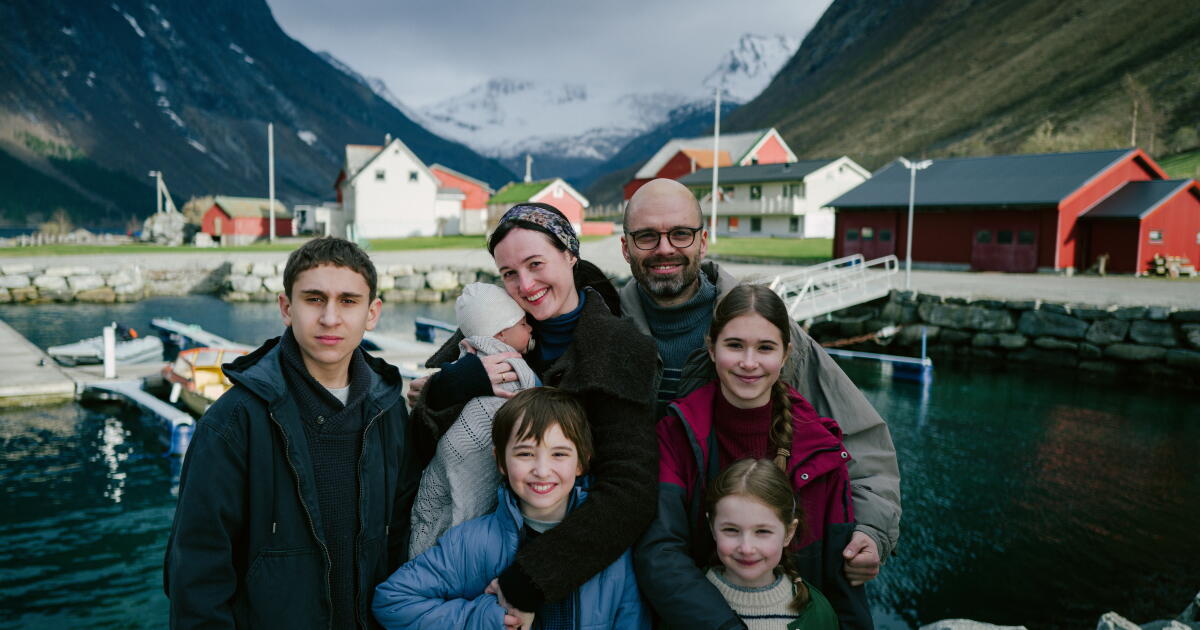
The poster and key image from the film is a smiling snapshot of Mihai and Lisbet with their children, a seemingly happy family. Or are they? For a movie so steeped in ambiguity and nuance, it also often states its case quite plainly, such as when the couple’s lawyer says no one can really know what goes on in another family. The film asks one to look closer, not just at others but also at one’s own accepted opinions, assumptions and preconceptions. But it ends up with an outcome that feels as sadly inevitable as it is heartbreaking — an ethical knot that cannot be undone.
‘Fjord’
In English, Romanian, Norwegian and Swedish, with subtitles
Not rated
Running time: 2 hours, 26 minutes
Playing: Opens Friday, Oct. 9 in limited release