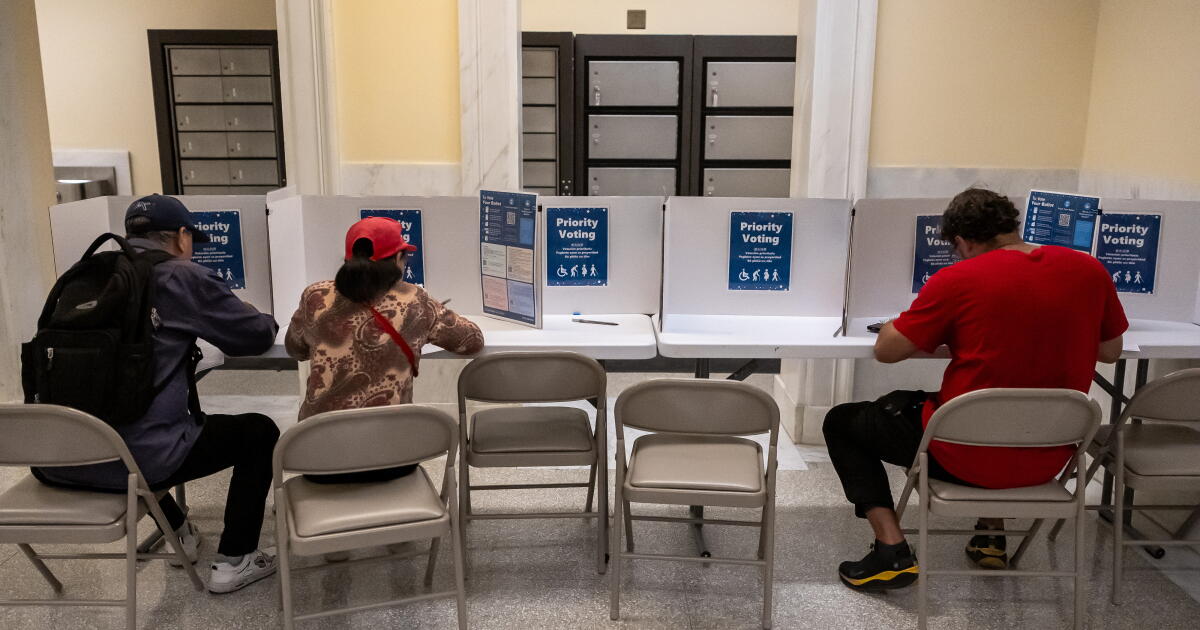
The Trump administration on Thursday sued California over its handling of voter fraud claims, asking a federal court to immediately bar the state from counting ballots from about 20,000 voters statewide — many in Los Angeles County — whom the administration alleges are “likely noncitizens.”
The lawsuit is highly unusual, particularly given that California voters have already begun voting in the Nov. 3 midterms via mail ballots, experts said.
It’s also highly inappropriate and based on questionable federal data that have proved wildly inaccurate in other states, state officials said.
“This is a sad, desperate attempt by Trump to use his politicized Justice Department to try to suppress California voters just three weeks before Election Day,” Gov. Gavin Newsom wrote on X. “Courts have made clear the federal government has no role in running state elections. We will defend free and fair elections in the Golden State and call out every authoritarian attempt to undermine our democracy.”
U.S. Atty. Gen. Todd Blanche, in his own statement, defended the lawsuit.
“State-facilitated voter fraud is unacceptable in the United States of America,” he said. “If found responsible in a court of law, the State of California will have seriously undermined confidence in our electoral system and violated laws that protect our nation’s representative system of government.”
The lawsuit states that “as part of an investigation into unlawful voting,” U.S. Citizenship and Immigration Services conducted a “multiagency and multilevel review” of state voter and federal citizenship data and determined with “high confidence” that around 20,000 “likely noncitizens” are registered to vote in the state.
It then forwarded those names to Homeland Security Investigations, which conducted its own investigation and concluded the same, the lawsuit says.
“This means that, consistent with state law, nearly 20,000 noncitizens in California have been sent a vote-by-mail ballot to participate in the federal election (or will receive one), with many addresses listed in Los Angeles County,” the lawsuit alleges.
The lawsuit comes two days after Acting Deputy Atty. Gen. Trent McCotter wrote to California Secretary of State Shirley Weber and Dean Logan, head of the L.A. County Registrar-Recorder/County Clerk’s office, giving them 48 hours to set aside the same ballots in order to investigate those voters’ citizenship status.
McCotter had said the Trump administration would be forced to file for emergency relief in the courts if Weber and Logan did not comply.
The lawsuit comes about three months after Homeland Security Secretary Markwayne Mullin wrote his own letter to Weber, alleging that there may be more than 190,000 noncitizens registered to vote in California.
The lawsuit makes no mention of that prior estimate, or why Homeland Security’s initial estimate was so much larger than its current estimate. It does say that USCIS identifying with “high confidence” that a voter is a likely noncitizen “means that the match between voter information on the voting roll and USCIS’ internal records is strong and consistent based on multiple identifiers that support a strong identity link.”
It also said, “The Federal Government notified California months ago that numerous noncitizens may be registered to vote in California. Despite knowing that California must send vote-by-mail ballots to every registered voter, the State made no serious attempt to work with the Federal Government to determine whether noncitizens are registered to vote.”
The Department of Homeland Security did not immediately respond to a request for more information as to how the 190,000 figure dropped to 20,000.
In a letter back to McCotter, Weber noted both figures and accused the Trump administration of pushing forward to disenfranchise voters at the last minute before the midterms based on shoddy data work and no certainty that those voters are ineligible.
“Nowhere has the federal government clarified the basis for suspecting — not even confirming with any level of certainty — the listed individuals are non-citizens. And as one court recently noted, the federal government’s citizenship records are ‘known to be unreliable,’” Weber wrote, referring to a case brought against the Justice Department by the organization Common Cause. “To give just one example, in a similar incident in the State of Nevada, DHS initially alleged that Nevada’s voter roll included nearly 16,000 potential non-citizens. However, after working with the State of Nevada, DHS officials failed to establish that a single non-citizen was on the voter rolls.”
Weber called it “remarkable” that the Justice Department would demand that her office “review and confirm the citizenship status of each of the approximately 20,000 individuals on the list on the eve of an election and within a mere 48 hours” despite providing no clear evidence that those individuals are wrongly registered.
“This is an emergency of the DOJ’s creation,” Weber wrote. “California’s election administration will continue to be governed by applicable federal and state law, not by unsubstantiated claims and outrageous demands.”
First Assistant U.S. Atty. Bill Essayli, the lead federal prosecutor in Los Angeles, posted about the lawsuit on X, noting the 48-window given to Weber and Logan had lapsed and writing, “Time is up for California.”
“This is not political or controversial,” he wrote. “We will not allow California to dilute the votes of American citizens.”
The Trump administration’s lawsuit says that while the U.S. “actively investigates and prosecutes incidents of unlawful voting,” it “is not practicable or feasible for the United States to investigate before the 2026 election concludes thousands, let alone tens of thousands, of individuals that two federal investigative offices identified on the California voter roster as likely being sent vote-by-mail ballots.”
Because of that, it argues, “California is thus knowingly imposing an obstacle on the United States’ ability to enforce [federal election law] by facilitating unlawful voting rather than working with the Federal Government to prevent it,” and the state is therefore legally barred from sending mail ballots to the 20,000 voters Homeland Security has flagged.
It asks the federal court in the Central District of California to declare the state’s actions — including providing and counting ballots for those 20,000 people — to be barred by law and in violation of the Supremacy Clause, and to issue an injunction barring the state from counting those ballots in federal elections “until those individuals’ citizenship status can be verified.”
The Trump administration’s attempts to use immigration data to reach conclusions about California voter rolls and intervene in California’s election is already being challenged in a separate federal case in the district of Washington, D.C., brought by attorneys with the UCLA Voting Rights Project on behalf of the Coalition for Humane Immigrant Rights, or CHIRLA, and a California voter named Pedro Trujillo.
The UCLA attorneys filed their own emergency petition Thursday to preclude the Justice Department from moving forward with such actions against California, citing the letters McCotter sent to Weber and Logan.
A judge in that case ordered the parties to meet and file a status report with the court by Friday as to when each side would be able to brief the court on the issue.
Times staff writer Brittny Mejia contributed to this report.