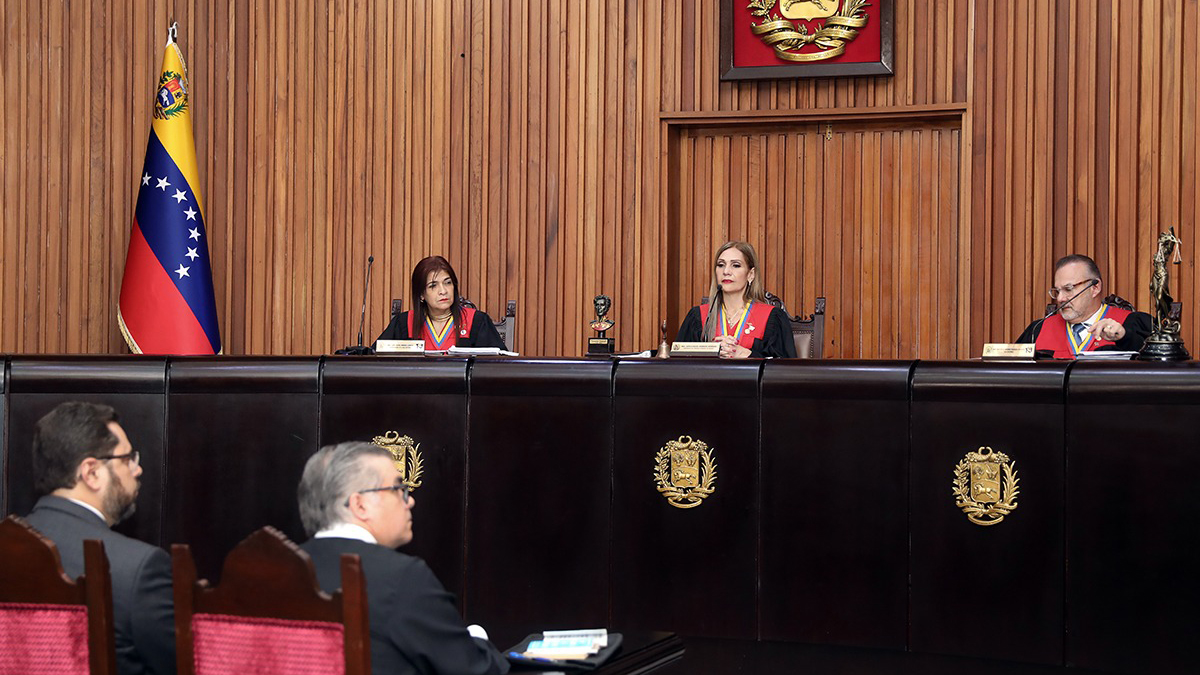
A Proper Supreme Court Should Be the Cornerstone of Venezuela’s Transition
Is it a good idea to begin the transition through the Supreme Court (TSJ)? Perhaps. In any case, it is the path charted by Secretary of State Marco Rubio, who—following January 3rd—wields enormous influence over Venezuela’s interim authorities and all opposition players, including María Corina Machado.
Marco Rubio himself stated this on October 9, with Dinorah Figuera by his side: “To achieve a peaceful transition—which is what we desire, a peaceful transition toward a permanent and lasting democracy— a great deal of hard work must be done, along with some patience, and free and fair elections. But beyond mere free and fair elections, there will be a need for institutions that not only uphold democracy but also sustain stability, progress, prosperity, and freedom for the people of Venezuela for the foreseeable future.”
Those institutions are, fundamentally, the Supreme Court of Justice (TSJ) and the National Electoral Council (CNE). In that order.
The argument is simple yet very powerful. We have seen in Venezuela that it is possible to win an election (such as the National Assembly vote in 2015 and the presidential election in 2024) and yet have that victory yield no practical effect: in 2015, the election’s impact was nullified via the TSJ, and in 2024, via both the CNE and the TSJ.
Rubio knows this well, as he has been monitoring Venezuelan politics for many years and has surely heard the explanation of how the regime stripped those election results of their meaning through the TSJ and the CNE. In all likelihood, he heard those explanations from Machado herself. This is the path currently being pursued by the negotiating table comprising the interim authorities and the delegation from the 2015 National Assembly. So far, there have been three results. First, Article 65 of the Organic Law of the Supreme Tribunal of Justice (TSJ) was reformed to improve the balance between lawmakers and civil society representatives within the Judicial Nominations Committee—a body for which 127 candidates have already been proposed. Next, a council was appointed to verify the credentials of TSJ nominees; this council includes four of Venezuela’s most serious and respected legal experts. Third, civilian organizations were invited to put forward members for the Judicial Nominations Committee.
This week, both the Judicial Nominations Committee and the verification council are being formally established. The subsequent step is to call upon legal experts to apply for positions on the TSJ.
Given the current circumstances, it is to be expected that the negotiating table and the Trump administration will exert influence over the entire process, just as they have been doing. In fact, Juan Miguel Matheus—a member of the opposition team at the negotiating table—told El Pitazo that the 12 civil society members who will sit on the Nominations Committee will be selected through that table.
With a transition process in mind, why would having a competent TSJ in place within a couple of months be significant?
For a fundamental reason: under the state model established by the 1999 Constitution, the TSJ holds the final institutional say regarding any decision made by the Venezuelan state. The TSJ has the power to strike down laws passed by the National Assembly, declare presidential decrees null and void, annul acts of the National Electoral Council (CNE), and review rulings from any court in the country.
Therefore—and drawing on Venezuela’s past experience—if we aim to hold free elections, it is far better to approach them with a competent TSJ already in place. A capable Supreme Court of Justice could play a robust role in defending elections based on standards of electoral integrity.
Therefore, initiating the transition through a new Supreme Court is a good idea.