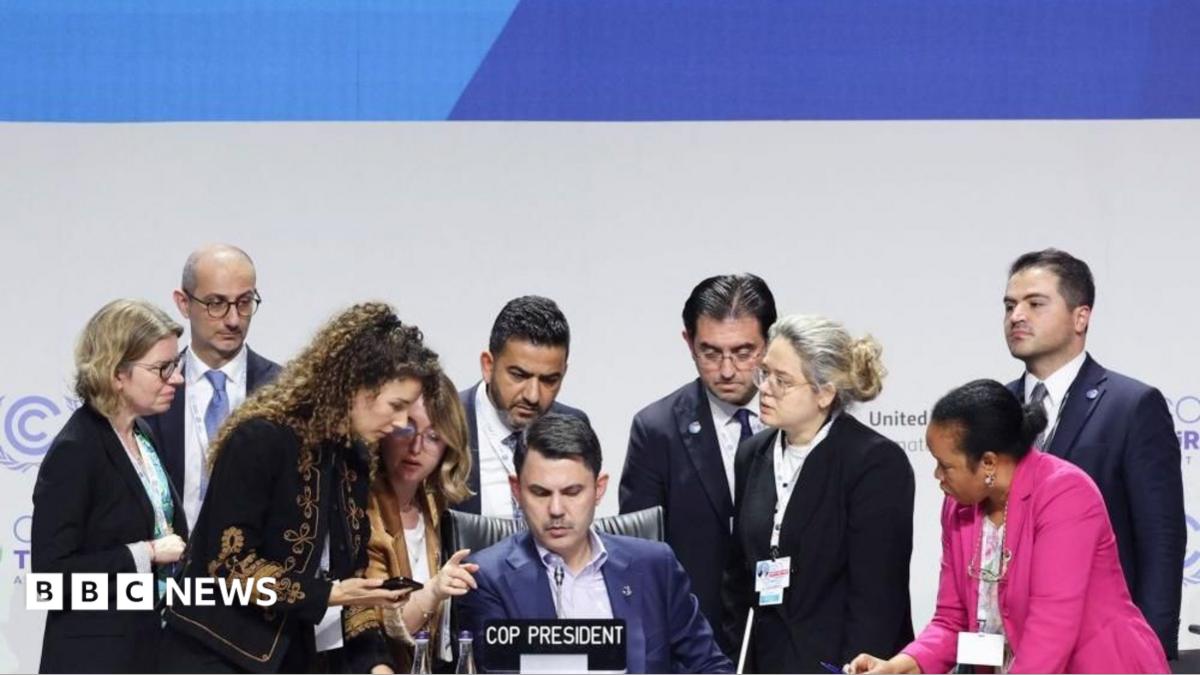
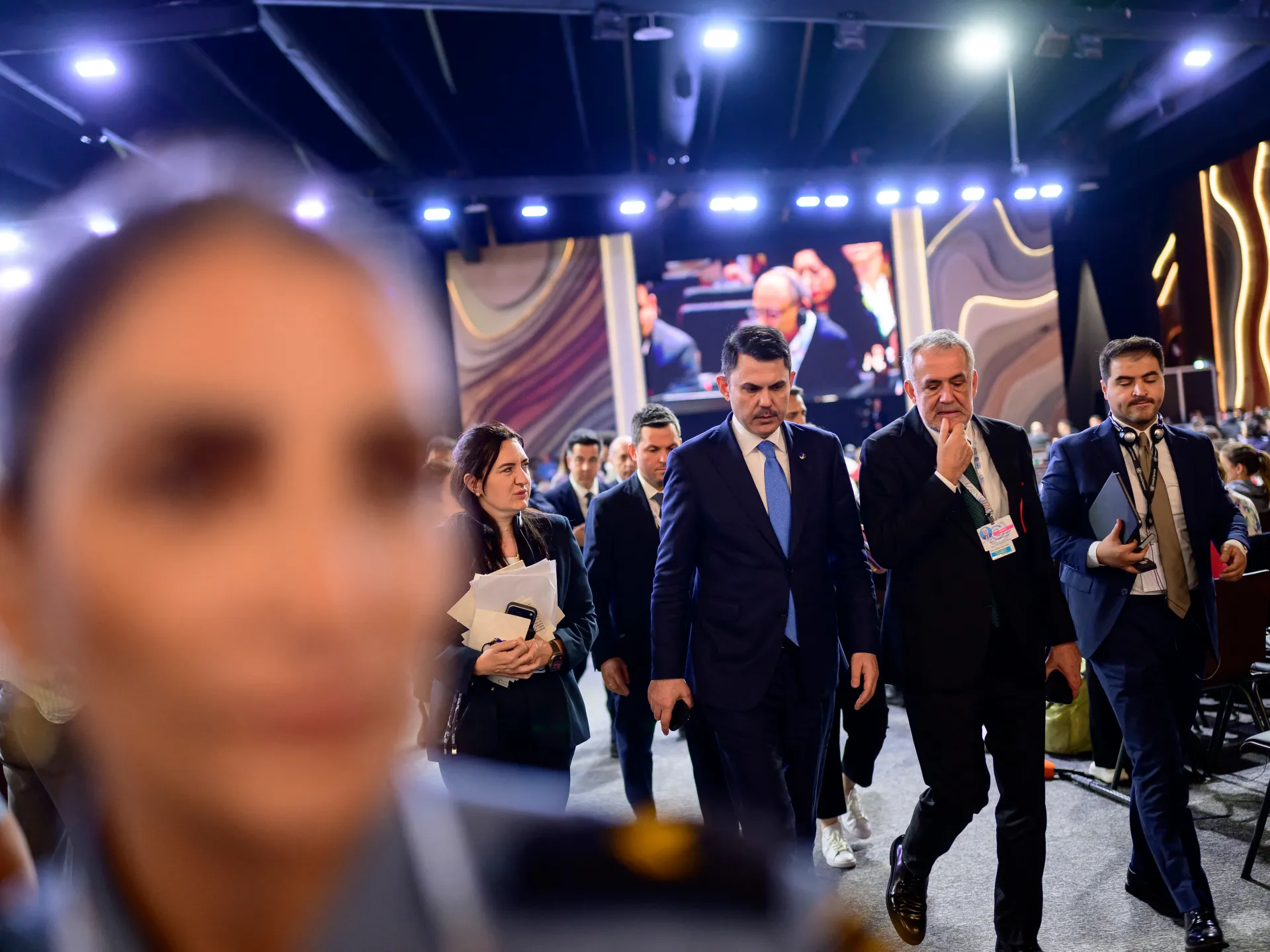
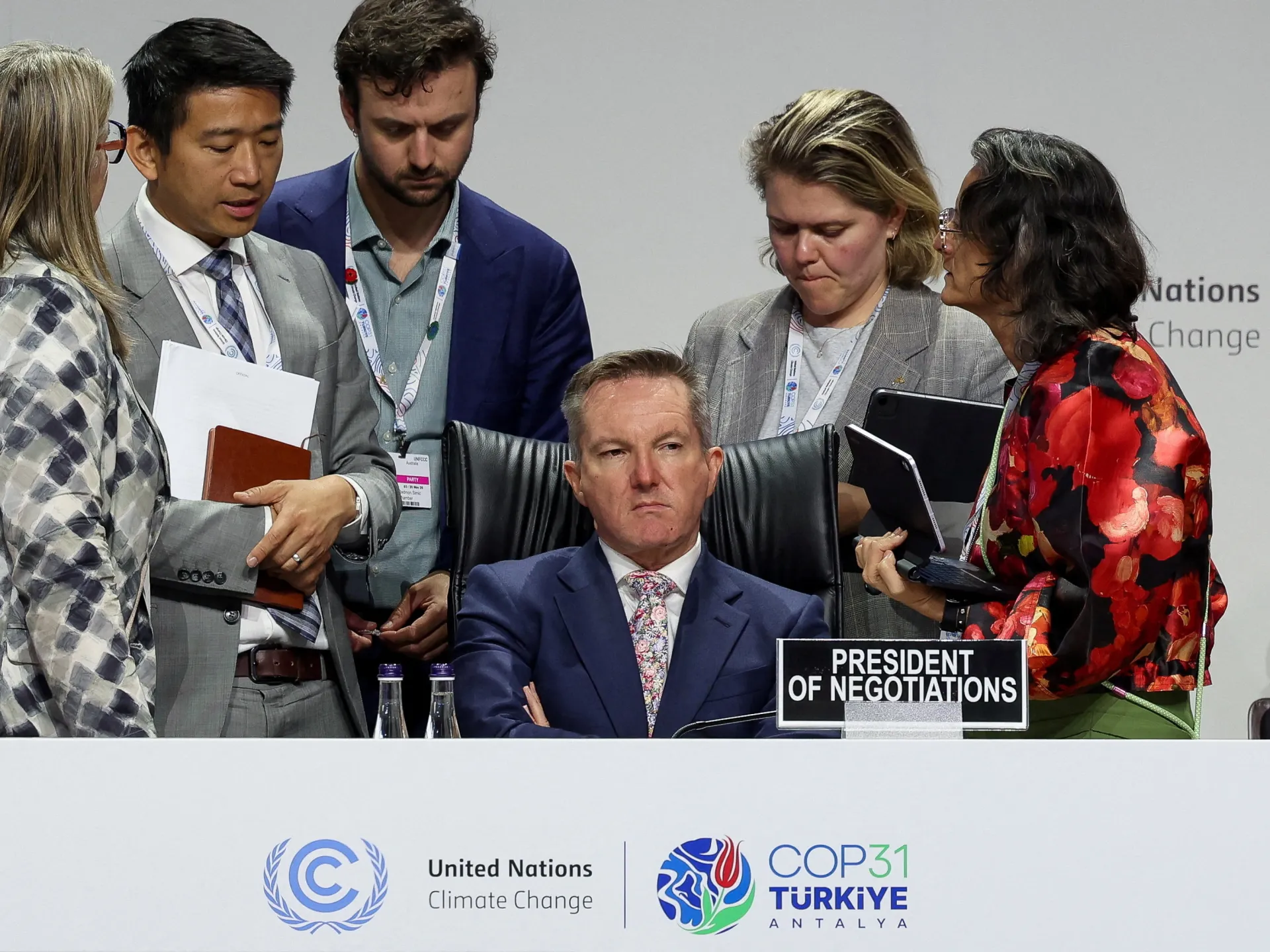
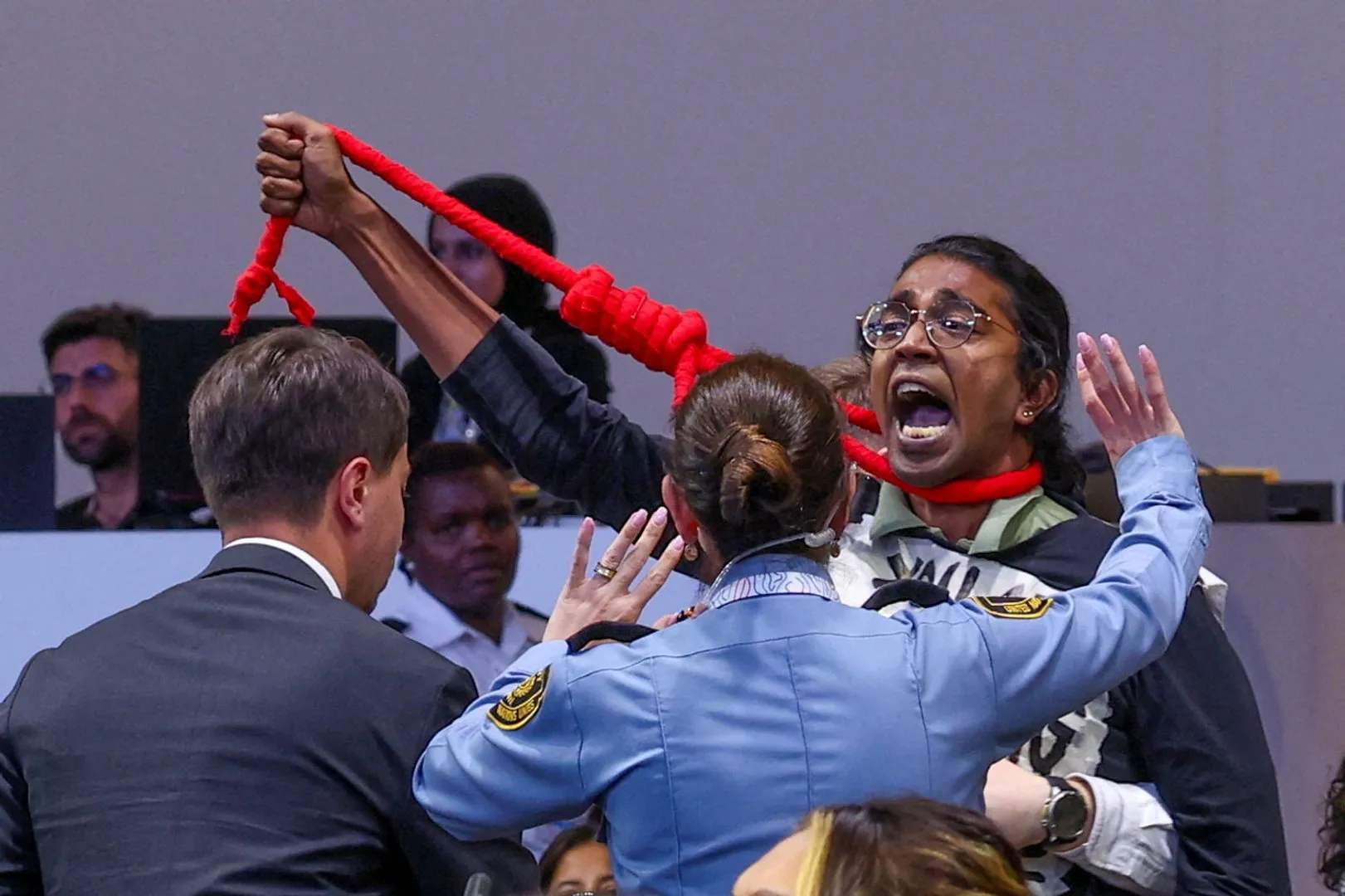
The longest UN climate summit in history collapsed without a final deal in Turkiye, the first such failure in 17 years. With countries divided over fossil fuels and climate finance, Al Jazeera’s Mikail Malik spoke to campaigners and negotiators about who was responsible.
Professor of Critical Development Studies at the Faculty of Environmental and Urban Change, York University, Toronto.
Published On 23 Nov 202623 Nov 2026
Share
COP31 ended without an overarching agreement on Sunday in Antalya, Turkiye, after nearly 200 countries failed to agree on a final climate pact. The proposed text could not even name the principal cause of global warming: fossil fuels. The European Union, several Pacific island states and other governments rejected it, while oil-producing countries resisted stronger language. After three decades of annual summits, this was the first such breakdown since 2009.
It is tempting to call this an extraordinary diplomatic failure. But the collapse reveals something more enduring. Climate negotiations have become remarkably effective at keeping governments at the table while avoiding the economic changes that meaningful climate action requires. The system is not designed literally to produce no agreements; it is designed to accommodate interests powerful enough to prevent decisive ones.
Consider what happened in Antalya. The EU objected that the final draft did not even mention fossil fuels. Yet the omission was not a clerical oversight. Earlier language on moving away from oil, gas and coal had been weakened as negotiations proceeded. The summit could not agree on how to implement the agreement reached at COP28 in Dubai in 2023 to transition away from fossil fuels in energy systems. What should have been the starting point for action became the point at which diplomacy broke down.
The contradiction is built into the negotiating process. Under the Paris Agreement, governments determine their own emissions commitments, with no enforcement mechanism to compel a country to stop expanding fossil-fuel production. COP decisions also depend on consensus, giving determined holdouts considerable leverage. The result is an international forum in which the most reluctant participants can limit what everyone else is allowed to say, let alone do.
That does not mean all countries are equally responsible. Nor does it mean that every COP has achieved nothing. The Paris framework helped establish common goals, and climate summits have encouraged investment and cooperation. Antalya itself adopted limited decisions on other matters, including one on a just transition. But these gains cannot substitute for a credible timetable to wind down fossil-fuel extraction. The distinction matters: diplomatic activity is not the same as structural change.
Indeed, fossil-fuel power operates well beyond the conference hall. Producing states defend revenues and geopolitical influence, while consuming states continue to rely on cheap energy and established infrastructure. Even governments that speak forcefully about climate ambition face incentives to protect their own industries and voters from immediate costs. The global energy transition is therefore not simply a technological problem. It is a struggle over who must relinquish assets, profits and power.
This helps explain the appeal of technological promises. The failed Antalya draft promoted carbon-removal technologies to deal with warming beyond 1.5C, while disagreements also centred on carbon capture and storage. Such approaches may have limited roles in reducing or counterbalancing emissions from difficult-to-abate sectors. But when presented as substitutes for reducing extraction, they allow governments and corporations to promise that future machines will repair the damage of continued emissions. The political benefit is immediate; the promised atmospheric benefit remains uncertain.
The same structural inequality shapes climate finance. Countries that contributed least to historical warming face mounting costs from droughts, floods, displacement and adaptation. Yet the proposed $120bn adaptation target disappeared from the revised text and disputes over financial commitments helped sink the talks. Wealthy governments can celebrate climate ambition while leaving poorer countries to borrow, divert public spending or simply absorb losses.
This is precisely why climate finance cannot be treated as discretionary charity. It concerns responsibility for harms produced through an unequal world economy. Grants, predictable funding and meaningful decision-making power for affected countries are not extras to be negotiated after emissions targets. They are conditions of a transition that poorer countries can undertake without sacrificing education, healthcare and basic development.
There is also a danger in allowing the EU to emerge from Antalya as the uncomplicated defender of climate justice. Its refusal to accept a pact silent on fossil fuels was justified. But wealthy countries cannot demand ambitious language abroad while resisting the financial obligations and domestic changes that would give it substance. Conversely, some developing countries depend on fossil-fuel income or need affordable energy. A just phaseout must distinguish their circumstances from those of rich, historically high-emitting economies.
What would a different climate politics look like? It would begin with enforceable plans for ending new fossil-fuel expansion and phasing down production, with richer countries moving first and fastest. It would fund adaptation and loss and damage through reliable, primarily grant-based transfers rather than debt-creating loans. And it would give countries most vulnerable to climate change greater influence over the decisions that determine their futures.
None of this requires abandoning multilateralism. It requires refusing to confuse its survival with success. When consensus rules repeatedly protect the interests most responsible for the crisis, governments must also pursue complementary agreements, domestic regulation and coalitions willing to move faster. Otherwise, the promise of universal participation becomes a mechanism for universal delay.
The collapse of COP31 is a warning, not because climate diplomacy has suddenly stopped working, but because its limits have become impossible to disguise. The world does not lack knowledge of what causes warming. It lacks a political system willing to confront those who benefit from causing it. Until that changes, each summit will be judged by the agreements it produces, while the atmosphere registers the emissions it fails to prevent.
The views expressed in this article are the author’s own and do not necessarily reflect Al Jazeera’s editorial stance.
Countries have failed to reach a major new deal to tackle climate change after deep divisions over fossil fuels and money emerged at the UN COP31 talks in Turkey.
Negotiations were due to finish on Friday but ran late into Sunday in search of common ground, becoming the longest UN climate conference in history.
But the final deal proved unacceptable to the EU, Pacific island nations and others because it failed to directly mention fossil fuels, the main cause of global warming.
Meanwhile, many poorer countries objected to the absence of any clear financial commitments from richer nations to help them adapt to the impacts of rising temperatures.
The last time a COP’s main political agreement collapsed like this was in 2009 in Copenhagen.
UN Secretary General Antonio Guterres, in his last COP before he steps down, said he was “deeply disappointed”.
He took aim at what he called “powerful fossil fuel interests” who he said were taking “a page from Big Tobacco’s playbook: distorting the science, delaying policy, blocking action, and piling up huge profits while people everywhere pay the price”.
Australian Prime Minister Anthony Albanese, whose country co-hosted the talks, attributed the failure to “difficult geopolitical times”.
“That is the reality,” he said on Monday.
After two weeks of negotiations, exhausted delegates were presented with a new, draft deal in the early hours of Sunday to try to break the deadlock.
But the words “fossil fuels” did not appear anywhere in the text. The only indirect reference to coal, oil and gas was a nod to a deal agreed at COP28 in 2023, when countries agreed to “transition away” from fossil fuels in energy systems.
The EU’s representative, Irish Minister Darragh O’Brien, made it clear that the EU “strongly” objected, saying that the “decisions go nowhere near the level of ambition needed to tackle climate change”.
“It is unconscionable that we would have a climate pact that makes no mention of fossil fuels,” he said.
Other countries, such as Panama and the Marshall Islands, also criticised the deal for doing nowhere near enough to tackle the pace of climate change.
A first draft of the deal on Monday mentioned “fossil fuel” or “fossil fuels” six times, but that was unacceptable to oil-producing nations.
Saudi Arabia’s delegate Mohammad Ayoub said that Arab countries “continued to engage in good faith” but argued that they only accounted for a small proportion of historical greenhouse gas emissions.
Russia warned not to “turn to slogans” over coal, oil and gas, claiming that if countries moved away from fossil fuels too quickly it would lead to “fuel poverty”.
United Nations climate talks have failed to secure a deal on how to deal with climate change, prompting UN Secretary-General Antonio Guterres to express “a very profound frustration”.
Multiple countries and negotiating blocs said on Sunday that the final draft, presented by COP31 presidents Turkiye and Australia, was too weak to fight global warming.
Recommended Stories
list of 4 itemsend of list
If the text had been approved, it would have acknowledged for the first time that global warming is on course to exceed the 1.5 degrees Celsius (2.7 degrees Fahrenheit) threshold that countries had sought to preserve from the 2015 Paris Agreement.
The talks had extended into overtime after key oil- and gas-producing countries opposed mentions of “fossil fuels” in the final text. The revised text also dropped a $120bn target for funds to help poorer countries adapt to climate change.
The last time the annual UN climate talks failed to end in an agreement was in Copenhagen in 2009.
Here’s how countries and key parties reacted to the deal’s failure:
UN chief Guterres
“I am deeply disappointed that COP31 has ended without consensus on an overarching outcome. I share the very profound frustration of all those who expected governments to rise to the moment the climate crisis demands,” Guterres said.
The UN chief criticised powerful fossil fuel interests for obstructing climate action, accusing them of distorting scientific evidence, delaying policies and prioritising profits.
EU delegation
The European Union said it will not endorse a deal that “does not even mention fossil fuels, which is the key driver of climate change, and we will not accept negotiating backward in time, and we will not accept a COP that greenwashes fossil fuel”.
A spokesman added that the draft deal “does not begin to address the climate emergency that we face”.
Denmark’s climate minister
Samira Nawa said the EU was willing to accept clauses on adaptation finance but argued that the text did not go far enough.
“This is about the mitigation. It’s about the fossil fuels not being mentioned. It’s the language on science not being strong enough.”
United Kingdom lead climate negotiator
Kate Hughes said the draft text “moves us backwards on the science” and does not acknowledge the urgency or scale of the climate crisis.
“It should have been instead presenting bold, collective ambition on climate action.”
Least Developed Countries group
The Least Developed Countries group said: “We struggled to find meaningful outcomes that respond to the priorities of the most vulnerable countries like us. … We cannot afford to see backsliding.”
The group is composed of 44 countries that are the most vulnerable to climate change and have contributed relatively little in carbon emissions.
They represent more than 1 billion people and include Pacific island nations, such as Tuvalu and Kiribati, as well as other countries most at risk to the effects of climate change, such as Bangladesh, Nepal and the Democratic Republic of the Congo.
Marshall Islands delegation
“We have been let down on all sides,” the Marshall Islands said. “We were presented with the worst possible response to overshoot, a response to enhance oil and gas. We will not be forced to accept false solutions. We will not compromise our future to benefit fossil fuel interests. We will not accept an outcome that undermines our security and threatens our future.”
Vanuatu delegation
The delegation for the Pacific island nation said: “This text falls short of what international law requires, what science demands and what our vulnerable communities urgently need.”
It called it “unacceptable” that the text was “silent” on fossil fuels.
Kenya delegation
Kenya’s delegation complained that the deal did not specifically mention Africa and did not take into account “Africa’s special needs and circumstances”.
“Those who took the lead in emissions cuts take the lead in support.”
Iraq delegation
The Iraq delegation expressed its “deep concern with some pathways that were taken to divert from [the] Paris Agreement”.
Russia delegation
Sergei Kononuchenko, a Russian delegate, argued that if oil and gas supplies shrink, it would lead to a “switch to dirtier types of fuel and energy poverty, … and the first to suffer would be the poorest”.
“For that reason, we cannot agree to any formulation on fossil fuel.”
Saudi Arabia delegation
The Saudi delegation said it believed “climate change requires all solutions on the table” and it made no sense for “concrete solutions” to be “taken off the table”.
COP31 president
Murat Kurum, Turkiye’s minister of environment, urbanisation and climate change, said: “We did everything we could. You should not hurt people in the world who really expect something out of this by just being hung up on one word or phrase. … There is no benefit for anyone in a system where you go into negotiations with no result.”
“There will be no new text from now on. We will not be carrying out work on a new text in an environment where there is no consensus. We will implement existing decisions.”
COP31 president of negotiations
Chris Bowen, Australia’s minister of climate change and energy, called the collapse of the talks “very disappointing”.
“A lot of good things happened this COP, a lot of events which told the clean energy story, a lot of commitments made – like the more than 90 countries that signed the electrification pledge, for example. And all that is good work and a great thing but not enough when it comes to climate action,” he said.
“An obvious issue is the transition away from fossil fuels, where some parties insisted that must be mentioned. Other parties insisted that if it was mentioned, they would veto.”
COP31 has run into overtime amid a contentious clash over fossil fuels. Numerous countries have criticised the latest draft of the COP31 agreement, which dropped reference to fossil fuels and weakened language on other key issues after pressure from large fossil fuel producing nations.
EU warns COP31 risks turning into a ‘fossil summit’ as critical climate commitments are omitted from the draft deal.
Published On 20 Nov 202620 Nov 2026
The COP31 climate summit has gone into overtime as nearly 200 countries remain deadlocked over a draft deal that no longer mentions fossil fuels.
The two-week talks in Antalya, Turkiye, were due to end on Friday, when a late closing session approved some technical matters, but not the wider political deal.
Recommended Stories
list of 3 itemsend of list
“We are close to the finish line, but we are not there yet,” COP31 President and Turkiye’s Environment Minister Murat Kurum told delegates.
Environmental groups tracking the two-week conference said the meeting lacked ambition to address the worsening climate crisis and was on track to be the “worst COP ever”.
A third draft is expected on Saturday, the AFP news agency reported.
The fossil fuel fight
An opening draft from cohost and lead negotiator Australia on Monday called for a faster phase-out of fossil fuels. A slimmer version on Thursday removed every mention of them after Saudi Arabia and other major oil and gas producers objected.
Oil producers have also resisted similar language at past talks, including at COP28 in 2023. The revised text also dropped a $120bn target for money to help poorer countries adapt to climate change.
The European Union said the draft “risks turning this climate COP into a fossil summit”. Panama, which signed a letter with a dozen other countries demanding “a clear transition away from fossil fuels”, threatened to walk away from the talks.
“It is not acceptable to have a COP or a cover document that does not even mention fossil fuels, and we simply will not put up with it,” Panama’s environment minister, Juan Carlos Navarro, told a news conference.
Other contested points
The draft proposes raising the share of the world’s final energy consumption that comes from electricity to 35 percent by 2035. It does not say the power must come from renewables, and some countries want the target to say “clean”.
Some countries also reject a push to expand carbon capture, a technology that traps emissions from power plants and factories. They say it is costly and unproven, and could let polluters keep burning oil and gas.
“We want to see the references to false solutions removed,” said Vanuatu’s climate minister, Ralph Regenvanu.
Developing countries are angry that rich nations are falling short on climate finance. “We didn’t come here to beg,” said Ghana’s environment minister, Zanetor Agyeman-Rawlings.
Tough backdrop
A UN report last month found the world is set to pass the 1.5-degree-Celsius (2.7F) warming limit set under the 2015 Paris Agreement.
The United States, the largest historical emitter, is absent for a second year after President Donald Trump ended climate cooperation.
The US-Israel war on Iran and higher living costs have also drawn attention away from the talks.
Environmental groups say the summit lacks ambition.
“This has been the worst COP ever,” said Mohamed Adow, director of the think tank Power Shift Africa.
Climate activist urges world leaders to put people and planet before profit as she arrives at UN climate talks.
Published On 11 Nov 202611 Nov 2026
Swedish climate activist Greta Thunberg has condemned the United Nations climate talks as hypocritical and urged world leaders to put people and planet ahead of profits and power.
Thunberg made the comments on Tuesday as she arrived at the COP31 conference in the Turkish resort city of Antalya.
Recommended Stories
list of 3 itemsend of list
“It’s a hypocrisy every year that the host countries are given an opportunity to whitewash themselves and we know that these negotiations are filled with lobbyists, paid by the very destructive industries which are benefiting from our extremely violent status quo,” Thunberg said.
“Our political and economic systems that have become incompatible with human nature.”
The talks follow a year of deadly climate-related disasters, including heatwaves and floods, and another energy shock caused by the US-Israel war on Iran.
COP31 co-hosts Turkiye and Australia are promoting renewable energy and rooftop solar installations, but both still rely heavily on fossil fuels, especially coal, to generate electricity. Previous hosts, including Brazil, the United Arab Emirates and Azerbaijan, are major oil producers.
Climate change is “threatening everything”, Thunberg said, warning that “everything and everyone we love is at stake”.
“We should act to protect and benefit people rather than constantly sacrificing the global majority and the very planet we are all living on, for a fortunate few to keep making unimaginable profits and maintaining geopolitical power,” she said.
Thunberg rose to prominence in 2018 as a 15-year-old, when she began a solitary “School Strike for Climate” outside the Swedish parliament.
The Antalya summit is the first she has attended since the 2021 talks in Glasgow, Scotland, where she dismissed world leaders’ promises as “blah, blah, blah”.
Her arrival in Antalya has created excitement among many of the youth climate activists at COP31 who are demanding more climate finance.
“I hope that Greta’s presence here reminds us of why we started this work in the first place: to push for meaningful change, hold decision-makers accountable, and work towards a better future for all of humanity,” Amber Turner, a 26-year-old fellow with the Alliance of Small Island States, told The Associated Press news agency.
Qiyun Woo, a youth environmentalist from Singapore, said Thunberg’s “powerful” presence “adds to calls from a generation that inherits the consequences of these negotiations”.
COP31 runs in Antalya until November 20.
Next year’s edition, COP32, is scheduled to take place in Ethiopia’s capital, Addis Ababa, in November 2027.
COP31 has opened in Turkiye amid war-driven energy disruptions and a renewed reliance on fossil fuels. While delegates discuss electrification and climate action, activists outside the summit are demanding an end to greenwashing and a shift away from industrial agriculture.
Explore the $1.3 trillion funding gap facing emerging markets as COP31 puts climate finance under the lens.
This article appears in the November issue of Global Finance Magazine.
The New Collective Quantified Goal for climate finance, agreed upon at COP29 two years ago, envisioned raising at least $300 billion annually by 2035, framed by a broader objective to mobilize $1.3 trillion per year for emerging markets and developing economies, or EMDEs.
Yet, as COP31 convenes in Antalya, Turkey, this month, portfolio managers across institutional trading desks and sovereign debt offices see a stark mismatch between political rhetoric and capital-markets reality.
Independent High-Level Expert Group on Climate Finance estimates that EMDEs (excluding China) will need $3.2 trillion annually by 2035 to meet their climate and development goals. Domestic revenues, tax reforms, local capital markets, and fossil-fuel subsidy phase-outs can cover only $1.9 trillion. That leaves an external requirement of $1.3 trillion annually: a sevenfold increase over current cross-border flows.
Multilateral roadmaps project that private capital will meet half of this external need — approximately $650 billion — with multilateral development banks providing $300 billion to $400 billion, bilateral public sources $80 billion to $100 billion, and international levies supplying the rest. But official tracking often conflates non-concessional commercial loans and guarantee values with true grant-equivalent support, obscuring severe risk-return constraints.
An industry insider, speaking on condition of anonymity, noted that private capital is expected to focus overwhelmingly on mitigation assets in high-emitting, middle-income sovereigns: jurisdictions with commercial activity but limited scale. Conversely, the $300 billion public core of the NCQG is intended to prioritize adaptation infrastructure and grants for low-income countries.
Autopsy of the 1:5 Ratio
Joan Larrea, Convergence
Blended finance strategically combines public or philanthropic capital with private commercial investment to fund sustainable development projects. It uses public funds to reduce risk, making emerging markets more attractive to private investors. While development finance orthodoxy has long touted a 1:5 public-to-private capital leverage ratio, joint MDB and OECD reporting shows that actual private co-mobilization in lower-income nations averages only $0.20 to $0.50 per public dollar.
However, “any headline number on blended finance obscures a large number of variables, so any generalization is going to be weak,” said Joan Larrea, CEO at Convergence, a global network supporting blended finance. Private involvement is gaining momentum, however: “Within the blended finance deals tracked, the ratio of private investment dollars mobilized relative to catalytic and concessional funding continues to grow.”
Private-sector dollars in blended finance transactions increased by 27% in 2025, reaching $11.2 billion, up from $8.8 billion in 2024, according to Convergence’s State of Blended Finance 2026 report. Commercial banks drove much of the growth, with their contribution rising from $4.3 billion to $7 billion. However, Larrea concedes that blended finance still lacks scale.
Regulations Deepen Gap
Under Basel III/IV rules, commercial banks face heavy capital charges for unrated emerging-market infrastructure debt. Similarly, Solvency II rules penalize institutional investors that allocate funds to unrated project debt without investment-grade wrapping. While MDB credit enhancements can suppress key risk parameters and reduce debt yields, underlying currency-hedging costs remain a serious obstacle.
Larrea pointed to structural shifts underway within multilateral channels.
“There remain regulatory and risk barriers to a lot of investors’ exploration of emerging markets,” she said, “but those who are doing so are using blended finance increasingly effectively. We do see room in transactions supported by MDBs and development finance institutions for the development banks to move down from senior positions to mezzanine or junior positions. That observation applies whether the transactions are blended—meaning whether donor money is also present—or fall into more traditional MDB/DFI business lines.”
The Silent Deal Killer
While global clean energy investment exceeds $2 trillion annually, according to International Energy Agency data, capital remains concentrated in advanced economies, China, and established project pipelines in India. Redirecting capital flows to high-capacity developing nations—such as South Africa, Indonesia, Mexico, Brazil, and Nigeria—requires mitigating severe foreign exchange and credit risks.
Joe Delvaux, Amundi
FX volatility frequently undermines project bankability. Clean energy projects generate revenue in non-convertible or volatile local currencies, whereas debt service and capital equipment are denominated in hard currencies like U.S. dollars or euros.
Local currency hedging in emerging markets can add 800 to 1,200 basis points per year to financing costs and restrict commercial tenors to three to five years. A standard 15-year solar asset cannot absorb hedging expenses on that level without driving costs beyond the means of local consumers or depressing returns below viable investment thresholds.
While broader emerging markets maintain functioning swap markets, said Joe Delvaux, senior-fixed income emerging markets portfolio manager at Amundi, liquidity in frontier markets is exceptionally thin and heavily dependent on central banks or primary export industries. In these economies, non-deliverable forward tenors typically stretch only six to 12 months, exposing investors to severe rollover risk.
When fully hedged returns fail to clear minimum investment hurdles, institutional capital simply walks away, Delvaux said: “If the investment does not pass certain key hurdle rates or possess such a decent net positive return post-hedging, why would an investor want to carry the risk if there is no major return being generated?”
Superimposed on currency risk is a compounding climate-sovereign feedback loop. Credit rating agencies are accelerating climate vulnerability downgrades and negative-outlook revisions across Global South sovereigns. As extreme weather events impair fiscal revenues and raise reconstruction costs, sovereign balance sheets weaken further. Lower sovereign ratings widen bond spreads, raising borrowing costs for local utilities and corporate borrowers to prohibitive levels of 12% to 18% or more.
Whether a project accelerates debt risks or enhances creditworthiness hinges on execution and viability, because delayed or failed projects can cause power deficits and blackouts that paralyze industry and strain national balance sheets. Conversely, well-managed projects can deliver vital energy, boost economic output, and strengthen sovereign credit profiles.
“It comes down to country by country, project by project,” Delvaux said.
Bridging the gap between core public finance and the NCQG’s $1.3 trillion goal requires structural reform, rather than reliance on financial leverage assumptions. Public-donor funding must target grant-based adaptation in low-income countries and absorb first-loss tranches that commercial capital cannot accept.
Concurrently, country-led platforms such as just energy transition partnerships—deals between developed economies and coal-dependent countries that aim to promote both development and the clean-energy transition—can aggregate projects into investable pipelines. Unlocking institutional capital at scale ultimately depends on expanding MDB balance sheets, establishing global FX guarantee facilities, and reforming international capital regulations to treat climate resilience as a productive capital investment.
Gilly Wright is a conributing writer based in the U.K.