Supreme Court at a crossroads over gun rights and assault weapons
WASHINGTON — In December 2012, a young gunman armed with an AR-15 rifle fired 154 shots in less than five minutes inside Sandy Hook Elementary School in Newtown, Conn.
He killed 20 first-graders and six educators and then killed himself.
On Wednesday, the Supreme Court will consider this massacre of schoolchildren because of how the state of Connecticut responded.
Lawmakers adopted a ban on the sale and possession of military-style “assault weapons” like the AR-15 and “large capacity magazines,” which means “more than 10 rounds of ammunition.”
The high court now faces a crossroads over gun rights, assault weapons and the right to “keep and bear arms” set out in the 2nd Amendment of 1791.
The justices voted earlier this year to hear and decide a gun rights challenge to the laws in Connecticut and Cook County, Ill., that prohibit semiautomatic rifles such as the AR-15.
California and nine other blue states have similar laws, all of which are vulnerable to being struck down by the court’s conservative majority.
Does the Constitution protect these rapid-fire rifles because tens of millions of Americans have purchased one in recent years?
Or may states prohibit the unusually dangerous rifles that allowed a single shooter to carry out mass murders of innocent victims at schools as well as at concerts, churches, synagogues, theaters, nightclubs and retail stores?

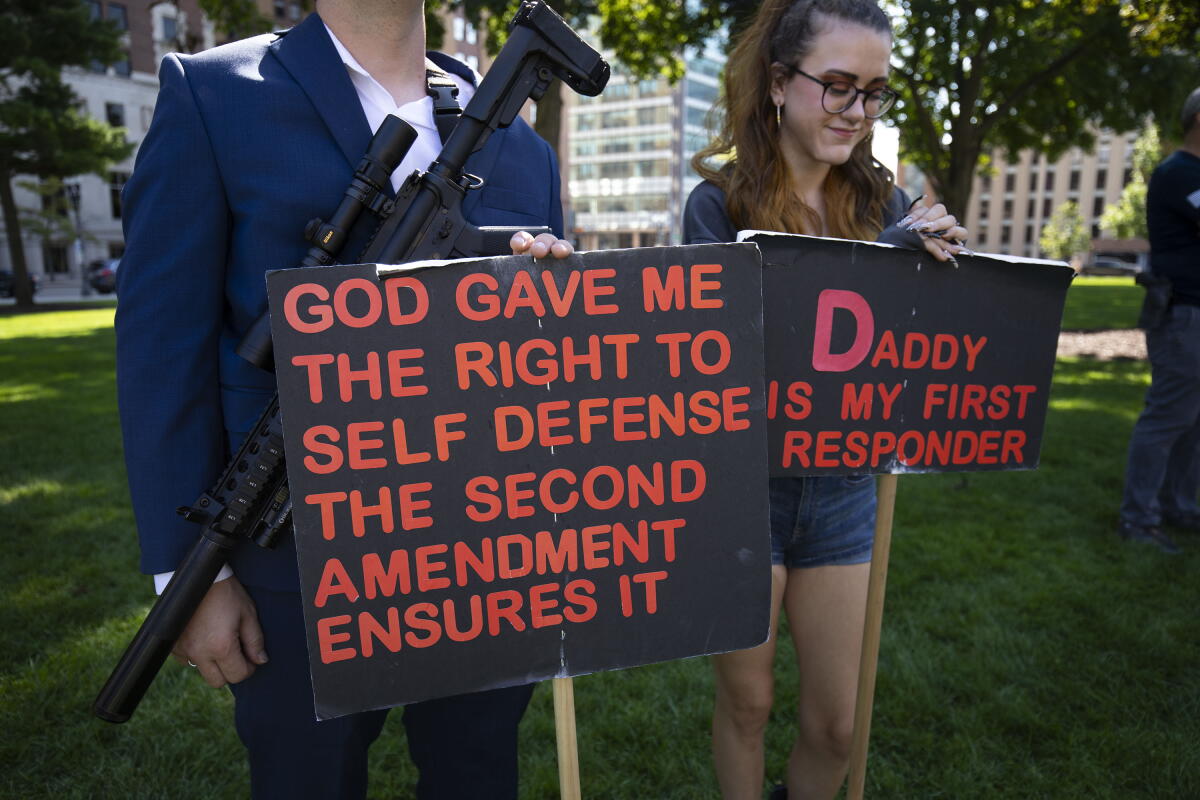
Gun rights advocates join a rally outside the Michigan State Capitol building in September 2024 in Lansing, Mich.
(Bill Pugliano / Getty Images)
These high-powered rifles are also especially lethal for police and security guards because their bullets can tear through car doors and body armor.
Experts who have analyzed the data point out that handguns, not rifles, are overwhelmingly responsible for the high rate of gun homicides in this country, including in crimes of domestic violence that may have multiple victims.
But rapid-fire rifles have been responsible for the most deadly public mass shootings.
“This case is life or death. In the last 10 years, every single one of the 10 highest-casualty mass shootings involved both an assault weapon and a large-capacity magazine,” said Janet Carter, managing director of 2nd Amendment litigation for Everytown Law.
“Part of the reason they are the weapon of choice for mass shooters is the speed at which they can fire,” she said.
In Dayton, Ohio, a shooter with an assault weapon fired 41 rounds in 32 seconds before he was shot and killed by police, she said. In those few seconds, he had killed nine people and wounded 17 others.
Mass shootings draw extraordinary attention, and a Supreme Court decision striking down state bans on assault weapons may well fuel more public anger at the court’s tilt to the right, said UCLA law professor Adam Winkler.

People gather at a makeshift memorial at Silver Rail Elementary School on Oct. 17, 2026, after a shooting the day before left three students and a teacher dead.
(Mathieu Lewis-Rolland / Getty Images)
In the 20th century, the court without dissent upheld laws against the private possession of machine guns or short-barreled shotguns on the grounds these were military weapons or especially dangerous in the hands of criminals.
In 2008, the high court for the first time upheld a 2nd Amendment claim and, by a 5-4 vote, struck down a Washington, D.C., ban on having a handgun at home. Justice Antonin Scalia said Americans had a right to be armed for self-defense.
In 2022, the court took a next step and ruled that law-abiding people had a right to obtain a permit to carry a gun when they left home.
But none of the previous gun regulations before the court “were as high-profile as these assault weapons bans,” Winkler said. “These bans have been at the top of the gun safety movement’s agenda for years, and they enjoy widespread public support. Striking them down could prompt a backlash against the court and likely exacerbate its already historically low approval rates.”
Gun laws versus gun rights have long divided conservatives and liberals.
Last year, Justice Brett M. Kavanaugh joined three of his conservative colleagues in casting doubt on the laws restricting semiautomatic rifles.
“Americans possess an estimated 20 to 30 million AR-15s,” he wrote in a then-pending Maryland case. They are legal in the vast majority of states, he said, so Maryland’s ban is “something of an outlier.”
This was not a new view for Kavanaugh. As an appeals court judge on the D.C. Circuit Court, he noted that semiautomatic handguns that were legal were “more dangerous” and responsible for far more killings than illegal AR-15 rifles.
Moreover, Scalia’s opinion said the 2nd Amendment protected firearms “in common use,” he wrote.


1. Protestors upset that gun control measures haven’t made it to the House floor for a vote chant outside the House chambers at the Minnesota State Capitol in St. Paul, Minn., on Thursday, May 14, 2026. The Minnesota Senate passed a bill banning assault-style weapons and high-capacity magazines in response to the August mass shooting at Annunciation Catholic Church and School in Minneapolis. Republicans in the tied (67-67) House blocked the measures from advancing and criticized Democrats for being unwilling to discuss funding for school security without action on guns. (Renee Jones Schneider/The Minnesota Star Tribune via Getty Images) 2. Gun rights advocates hold signs amongst the gun reform and gun safety supporters at the State House as lawmakers return for the start of the second regular session of the 131st Legislature on Wednesday, January 3, 2024. (Brianna Soukup/Portland Press Herald via Getty Images)
Gun rights advocates “have a strong argument that AR–15s are in ‘common use’ by law-abiding citizens and therefore are protected by the 2nd Amendment,” Kavanaugh said last year.
Justice Clarence Thomas agreed and said the court should “not wait to decide whether the government can ban the most popular rifle in America.” Justices Samuel A. Alito and Neil M. Gorsuch said they too wanted to take up the 2nd Amendment claim.
This suggests that Chief Justice John G. Roberts and Justice Amy Coney Barrett hold the deciding votes. However, there were also hints the justices may be closely divided not just on AR-15s but on the bans on large-capacity magazines.
For about seven months earlier this year, the court deliberated in private on whether to hear gun rights appeals from Connecticut, Illinois and California.
Two of the appeals — from Connecticut and Cook County — asked the justices to rule on whether gun owners have a “right to possess AR-15s” and similar “semiautomatic rifles.”
The California case asked the court to rule on whether the state’s ban on “the possession of exceedingly common ammunition feeding devices violates the 2nd Amendment.”
In 2016, California voters and the Legislature strengthened the ban on the possession of large-capacity magazines that allow semiautomatic rifles to shoot 20, 30 or even up to 100 rounds before reloading.
The U.S. 9th Circuit Court of Appeals upheld this provision early last year and said the state law “made it illegal in California to possess the kinds of military-style ammunition magazines that enable mass killings like those at Sandy Hook Elementary School; a movie theater in Aurora, Colorado; Columbine High School; and an office building at 101 California Street in San Francisco, California.”
California Atty. Gen. Rob Bonta had urged the Supreme Court to deny the gun rights appeal, citing the danger of these ammunition-feeding devices.
“Large-capacity magazines were used in nearly 80 percent of the mass shootings resulting in 10 or more fatalities since 1968 — and 100 percent of the mass shootings resulting in 20 or more fatalities,” he wrote.

Gun enthusiasts attend the annual Machine Gun Shoot on June 3, 2023, in Monroe, Pa.
(Spencer Platt / Getty Images)
At the end of June, before leaving for their summer recess, the justices announced they would hear the combined cases from Connecticut and Cook County to decide the 2nd Amendment challenge to bans on semiautomatic rifles. However, they took no action on the California case involving large-capacity magazines.
It was a disappointment for gun rights advocates in California.
“It will be very difficult for the court to decide whether the government can ban semiautomatic firearms without considering how ammunition magazines affect the function of those rifles,” said veteran gun rights attorney C.D. Michel, who is president of the California Rifle and Pistol Assn. If the court does not address the magazine bans in the upcoming case, he said, it will have to rule on the issue in a follow-up appeal.
The court will hear arguments in the AR-15 case called Khaya vs. Cook County.
The Trump administration joined the case on the side of gun rights advocates.
Semiautomatic rifles are “unquestionably in common use among law-abiding citizens,” wrote Solicitor Gen. D. John Sauer. “The overwhelming majority of AR-15 owners possess those rifles for lawful purposes … such as self-defense in the home, hunting, and target shooting.”
He said that “perceived dangerousness alone” is not a sufficient reason for restricting the sale of these guns.

Samuel Klug, left, and John Neff place candles at a makeshift memorial at the scene of a mass shooting in Dayton, Ohio, in August 2019.
(Jahi Chikwendiu / Washington Post / Getty Images)
Washington attorney Elizabeth B. Prelogar, the Biden administration’s solicitor general, is leading the defense of Connecticut’s law.
She argued that from medieval England to 21st century America, governments have restricted “unusually dangerous” weapons. As an aside, she noted that courts and legal treatises sometimes used the phrase “dangerous or unusual” or “dangerous and unusual” to describe weapons that may be banned.
“Tragically, real-world experience confirms the AR-15’s singular dangerousness: from Sandy Hook to Las Vegas to Parkland to Uvalde,” she wrote. It “permits even an unskilled gunman to rapidly fire high-velocity bullets that leave catastrophic wounds.”
“The Constitution does not prevent Connecticut from banning the very weapons that have wrought incalculable harm and unimaginable loss on the people of that state,” she concluded.