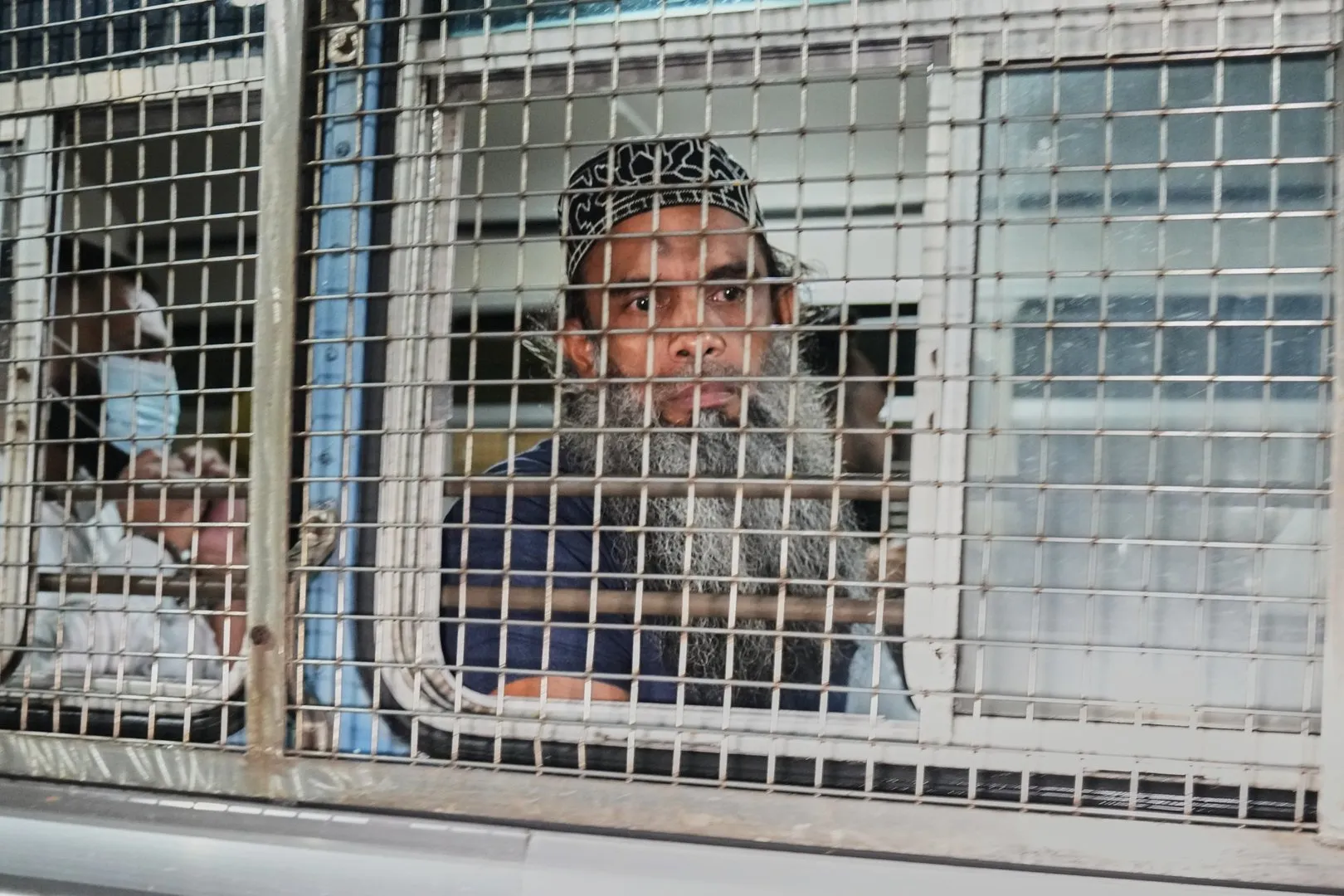
convicts

Jury convicts Salman Rushdie attacker on terrorism charges

July 30 (UPI) — A federal jury has convicted the New Jersey man who attempted to murder writer Salman Rushdie on additional terrorism-related charges, including attempting to provide material support to the Iran-backed militia Hezbollah.

Hadi Matar of Fairview, N.J., was sentenced to 25 years in prison in a state court in May 2025 for trying to kill Rushdie on Aug. 12, 2022.

Matar rushed the stage and stabbed the India-born writer at New York’s Chautauqua Institution in Mayville, N.Y., before being subdued by audience members and taken into police custody. Rushdie lost vision in his right eye and suffered nerve damage as a result of the attack.

A federal jury in the Western District of New York on Wednesday convicted Matar on charges of attempting to provide material support to a designated foreign terrorist organization, engaging in an act of terrorism transcending national boundaries and providing material support to terrorists. Matar faces a maximum penalty of life in prison on the most serious charge when sentenced on Nov. 3.

“Hadi Matar, who was born and raised in the United States, chose to align his values with the terroristic values of the leaders of Iran, which often promote violence, and in this case, the call for murder,” U.S. Attorney for the Western District of New York Michael DiGiacomo said in a statement.

“The defendant spent months planning and preparing to carry out what he hoped would be the execution of Salman Rushdie and possibly follow in the footsteps of martyrs he admired. Instead, his attempted act of terror failed, and Salman Rushdie survived, thanks to courageous members of the public and law enforcement, who saved Rushdie and captured Matar.”

The trial began July 22, and Rushdie, 79, testified.

DiGiacomo said Rushdie answered every question asked of him by the defense and prosecutors.

“It was very powerful,” DiGiacomo said.

“And at the end, at some point, Mr. Rushdie removed his glasses so the jury could see the extent of the injury to his eye that he no longer has vision it.”

Prosecutors said Matar was attempting to carry out the orders of Iran’s late spiritual leader Ayatollah Ruhollah Khomeini, who in 1989 called for Rushdie’s murder after the publication of his award-winning novel The Satanic Verses on the grounds that it was blasphemous to Islam.

The fatwa was reaffirmed in 2017 by Khomeini’s successor, Ali Khamenei, and endorsed by Hezbollah Secretary-General Hassan Nasrallah. Nasrallah was killed Sept. 27, 2024, in Israeli airstrikes on Beirut, while Khamenei was killed Feb. 28 in joint U.S.-Israeli airstrikes on Iran.

Federal prosecutors said during the trial that Matar had spent more than a year researching the fatwa before deciding to try to kill Rushdie and discussed it with people in Iran, Australia and Canada.

According to the Justice Department, Matar had surrounded himself with Hezbollah symbols ahead of the attack and had traveled to the institution that day with a false driver’s license bearing the name Hassan Mughniyeh, with Hassan being Nasrallah’s first name and Mughniyeh being the surname of Hezbollah’s former external security organization head, Imad Mughniyeh.

DiGiacomo told reporters following the conviction that ahead of the attack, Matar traveled by bus from New Jersey to Buffalo, then traveled toward the Chautauqua Institution.

On the morning of the attack, Matar visited a website run by Hezbollah and took screenshots of Hezbollah operatives who had died that month.

“The evidence presented in the trial showed that this attack was not spontaneous. It was deliberate. It was research. It was planned. It was motivated by violent extremist ideology,” Alan Davis, special agent in charge of the FBI’s Buffalo field office, said during the press conference.

“For more than a year, the defendant researched a decades-old fatwa, communicated with individuals overseas about carrying it out and embraced the propaganda and symbols of Hezbollah before traveling to western New York to commit this violent act.”

Source link

Argentine court convicts ex-Navy officer in submarine disaster

A woman visits the a makeshift tribute made with flags and notes to the 44 crew members of the missing submarine ARA San Juan at the Argentina Navy base at Mar del Plata in November 2017. File Photo by Mauricio Arduin/EPA

July 9 (UPI) — An Argentine court convicted former Navy Capt. Claudio Villamide and sentenced him to three years of suspended prison time for his role in the 2017 sinking of the submarine ARA San Juan, the country’s deadliest peacetime naval disaster.

The sinking killed all 44 crew members. The submarine was located in late 2018 at a depth of roughly 3,000 feet in the South Atlantic. It has not been recovered.

According to Argentine media reports, the court in Río Gallegos found Villamide guilty Wednesday of aggravated negligence and failing to fulfill the duties of a public official. In addition to the suspended sentence, he was barred from holding public office for six years.

Prosecutors argued that Villamide, who commanded the Argentine Navy’s Submarine Force at the time of the disaster, authorized the patrol mission despite knowing the vessel had serious maintenance deficiencies. The submarine had pending post-repair tests and was subject to a technical diving restriction that was ignored, prosecutors said.

Villamide maintained his innocence throughout the trial, arguing the submarine met operational requirements, and that investigators had not conclusively determined the physical cause of the disaster.

Because the sentence was suspended, Villamide will not serve time in prison.

In a unanimous decision, the court acquitted three other former naval officers charged in the case: former Rear Adm. Luis Enrique López Mazzeo, former Capt. Héctor Aníbal Alonso and former Capt. Hugo Miguel Correa.

Relatives of the victims expressed outrage over the ruling and what they described as the leniency of the only conviction.

According to Argentine newspaper Página/12, many family members believe the verdict fell short of delivering justice because it did not hold the Navy’s top commanders or senior government officials from the time accountable.

Lawyers representing the victims’ families said they will appeal the ruling before Argentina’s Federal Court of Cassation beginning Aug. 21, seeking to overturn the acquittals and increase Villamide’s sentence. At the same time, they described the decision as an unprecedented institutional milestone, according to La Nación.

For the first time, an Argentine court ruled that the loss of a military vessel during peacetime was not solely the result of weather conditions, but also of serious human failures and omissions.

Villamide’s defense also rejected the verdict.

His attorneys called the conviction “unusual and unjust,” arguing the trial established there was no direct causal link between the orders issued by naval command and the submarine’s final collapse in the South Atlantic, according to La Opinión Austral.

The defense said it also plans to appeal in an effort to obtain a full acquittal.

The ARA San Juan reported flooding and an electrical fire caused by seawater entering its battery compartment on Nov. 15, 2017. After contact with the submarine was lost, its wreckage, crushed by an implosion, was found about a year later nearly 3,000 feet below the surface of the South Atlantic.

Source link

Brazilian court convicts Eduardo Bolsonaro of courting US interference | Jair Bolsonaro News

A panel on the Brazilian Supreme Court has voted to convict Eduardo Bolsonaro of lobbying the United States to interfere in the trial of his father, former right-wing President Jair Bolsonaro.

On Tuesday, three of the four justices on the panel voted in favour of conviction, with one remaining justice yet to vote.

Recommended Stories

list of 3 itemsend of list

They determined that Eduardo Bolsonaro’s actions amounted to coercion against Brazil’s justice system and sentenced him to four years and two months in prison.

“It wasn’t merely an expression of opinion or a political stance, but rather conduct that clearly threatened Brazilian authorities and Brazilian citizens themselves,” Justice Cristiano Zanin said, calling Eduardo Bolsonaro’s actions “illegitimate and criminal”.

The conviction is the latest legal setback for the Bolsonaro family, which remains a dominant force on Brazil’s political right.

Jair Bolsonaro is serving a 27-year prison sentence for his efforts to remain in power after losing the country’s 2022 election.

Prosecutors described his actions as an attempted coup. Bolsonaro and his family have portrayed the trial as a political witch-hunt.

The ex-president’s third son and a member of Brazil’s Chamber of Deputies, Eduardo Bolsonaro has been active in his father’s defence.

In March 2025, he pledged that he would move to the US full time to “focus 100 percent” of his energy on “a single cause”: freeing his father.

Prosecutors accused him of mounting an illegal campaign to court US President Donald Trump and use foreign influence to pressure Brazilian officials to drop the case against Jair Bolsonaro.


Trump, an ally of Bolsonaro, had likewise tried to remain in office despite his loss in the 2020 election and has accused Brazilian officials of persecuting right-wing voices like Bolsonaro.

In July 2025, Trump issued a letter announcing 50 percent tariffs on certain Brazilian products, citing Jair Bolsonaro’s trial, specifically, as a reason.

“This Trial should not be taking place,” Trump wrote at the time. “It is a Witch Hunt that should end IMMEDIATELY.”

Trump also issued an executive order sanctioning one of the Brazilian Supreme Court justices involved in the Bolsonaro case, Alexandre de Moraes, on the basis that he worked to “target political opponents” and “suppress dissent”.

He called de Moraes a “threat” to the US, and his administration later expanded the sanctions to include the justice’s family members, as well as other Brazilian judicial officials.

Brazil’s current president, Luiz Inacio Lula da Silva, has denounced those actions as an attempt to interfere in Brazil’s domestic affairs.

As relations with Lula grew more cordial, the Trump administration relaxed its tariffs against Brazil. In December, it also repealed the sanctions against de Moraes and his family.

Lula, meanwhile, visited the White House in May and praised what he described as a productive meeting with his US counterpart.

But it remains unclear what role Trump may seek to play in Brazil’s upcoming presidential elections.

The left-wing Lula is campaigning for a fourth term, and he is likely to face his stiffest competition from Jair Bolsonaro’s eldest son, Senator Flavio Bolsonaro.

A CNT/MDA poll released on Tuesday projected that Lula would receive 49.3 percent of the vote in a run-off election against the senator’s 40.2 percent.

Flavio Bolsonaro has faced his own legal trouble in recent months, with police opening a probe in April into whether he defamed Lula. His connections to a disgraced banker have also raised media scrutiny.

Jair Bolsonaro, meanwhile, faced questions this week about the presence of a firearm in his home in Brasilia, where he is serving three months of his sentence on medical grounds.

Justice de Moraes likewise asked the elder Bolsonaro’s legal team to explain the presence of the weapon, which police discovered during a routine inspection on Monday.

A security guard for Bolsonaro initially said the 9mm Glock pistol was his own, but it was later revealed to be the ex-president’s.

De Moraes gave Bolsonaro’s legal team 24 hours to explain why “the convicted man kept a firearm at home”.

Source link