Trump cites national security as Supreme Court weighs challenge to ballroom
WASHINGTON — The Supreme Court is weighing President Trump’s claim that his new White House ballroom is urgently needed to protect him, his staff and guests from attacks by drones, terrorists and snipers.
On Friday, with a lower-court order about to go into effect halting construction on the controversial project, Chief Justice John G. Roberts decided that the court needed more time. He issued a temporary order pausing the case and allowing construction to continue while the justices decide on a pending legal challenge.
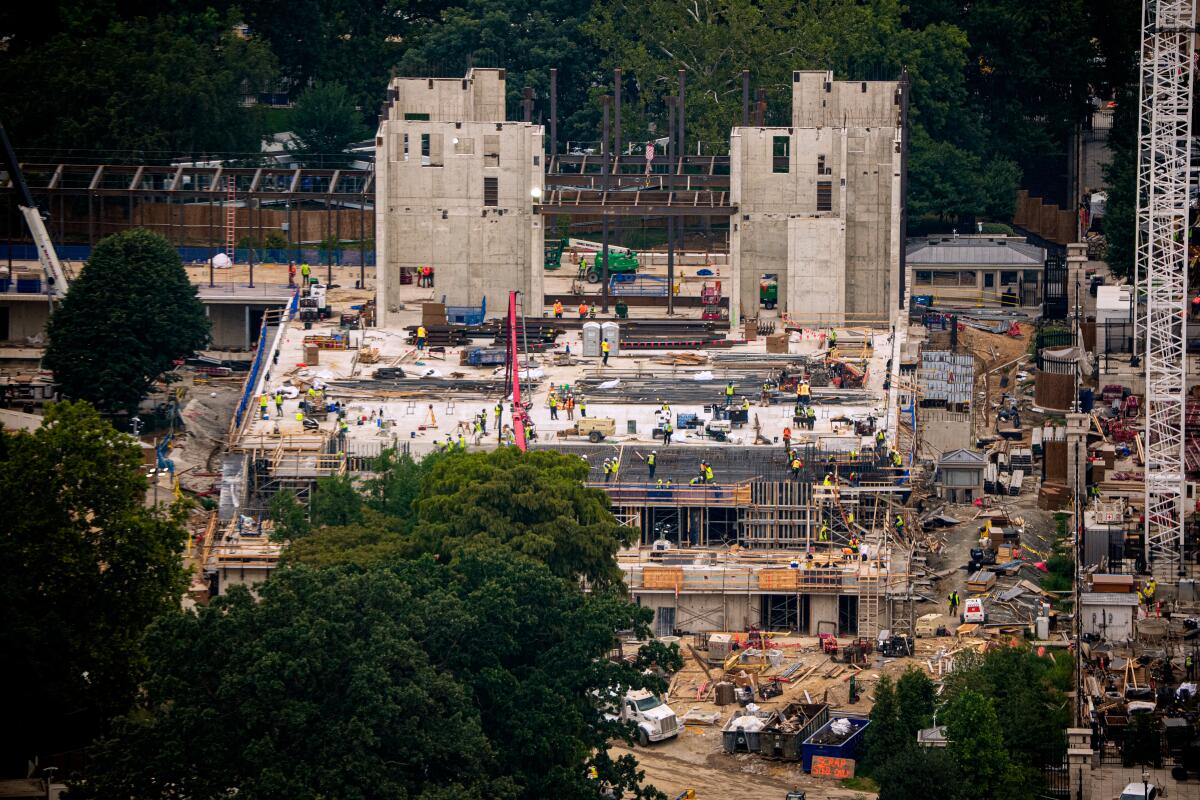
Last week, Trump’s lawyers described the East Wing ballroom as an “integrated military complex” that is “vitally required by national security.” They argued that a judge’s order blocking further construction threatened the safety of the president and must be overturned. They also said the project is nearly two-thirds completed.
At issue is whether the president acting on his own may build a huge new ballroom complex that is expected to dwarf the historic Executive Mansion.
It is a confrontation over the boundaries of executive power at a moment when Trump has repeatedly tested the ability of courts, Congress and independent institutions to constrain his agenda.
Trump bulldozed the historic East Wing before the courts had resolved whether the administration had the authority to proceed, leaving opponents to argue the project could become effectively irreversible before judicial review was complete.
The National Trust for Historic Preservation sued in December and argued that the president had overstepped his authority.
U.S. District Judge Richard Leon agreed and ordered a stop to the above-ground construction — that is, on the ballroom. He said the work on the underground bunker may proceed.
The U.S. court of appeals affirmed his order by a 2-1 vote on Aug. 7 but put the decision on hold until Friday. Roberts’ order did not explain the reason for the delay, or how soon the court might rule.
In a fast-track appeal to the Supreme Court, Trump administration lawyers sought to refocus the case as one about national security and the president’s safety.
“Given the current unprecedented levels of danger … every day the President does not have access to the vital security features of the military complex presents unacceptable risk,” Solicitor Gen. D. John Sauer said Wednesday in his final brief to the court.

Construction continues on the White House East Wing ballroom on Aug. 20.
(Andrew Harnik / Getty Images)
The Constitution and federal law say new buildings may not be erected on public property in the District of Columbia “without the express authority of Congress.”
But acting on his own, Trump ordered the East Wing of the White House torn down in October and work began on a new and much larger building to replace it.
He said the new ballroom could provide safe and secure seating for 1,000 dinner guests. He did not ask Congress to weigh in or approve the massive project.
In defense, Trump administration lawyers pointed to an annual appropriation from Congress that funds “the care, maintenance, repair, alteration, refurnishing” and other such improvements at the White House.
They also said private donations would pay most of the $400-million cost of the new ballroom. One estimate placed the cost of the ballroom and the bunker at $600 million, with taxpayers covering half, the Washington Post reported.
The president, his family and White House employees would have secure underground space, Sauer said, while a “totally secure ballroom space” would provide a new level of protection for guests and foreign dignitaries.
Otherwise, they would be seated outside in tents on the lawn, Trump said, which was neither appealing nor safe.

President Trump speaks to the media as the construction of a new helipad on the South Lawn of the White House continues on Aug. 19.
(Alex Wong / Getty Images)
His solicitor general also argued it was too late to stop the project.
“A 250-person crew is working 20 hours a day, seven days a week to keep the project ahead of schedule and under budget,” he wrote on Aug. 13. “Today, the project is 65% complete in its entirety, and moving quickly toward total completion.”
Trump’s signature construction project has fueled accusations from his political opponents that he is abusing his power to build a lavish space for entertaining guests as ordinary Americans struggle with affordability.
In April, Republicans in Congress sought to put federal money behind the project, despite Trump’s earlier insistence that private donors would pay for the ballroom.
The effort never became law, faced with bipartisan opposition to a bill that would tie them to the unpopular project, leaving the administration to proceed with a privately financed effort whose legal authority was already being challenged in court.
The Society for the Rule of Law and a group of former White House lawyers warned the court against accepting Trump’s broad claims of power.
“Under the executive’s view, the President could bulldoze the entire White House and replace it with a new building of his own design, including a skyscraper. No other President has asserted such transformative power,” they wrote in a friend-of-the-court brief.
“The invocation of national security is not a magic incantation that suspends the rule of law,” they added.
The biggest hurdle facing the challengers may be the issue of standing.
The court’s conservatives are often skeptical of lawsuits if it is not clear the plaintiffs have or will suffer a distinct injury that goes beyond their opposition to a government policy.
In this case, the National Trust said its historians and preservationists will be disturbed to walk by the White House grounds if there is a massive new structure that is not in keeping with the historic Executive Mansion.

Construction continues on the East Wing ballroom at the White House on Aug. 10, 2026, in Washington, D.C.
(Andrew Harnik / Getty Images)
“The subjective displeasure of an offended observer does not amount to a concrete injury,” Sauer said.
The D.C. Circuit judges were also split on the threshold issue of standing.
Judges Patricia Millett, an Obama appointee, and Bradley Garcia, a Biden appointee, ruled the suit may proceed because the plaintiffs suffered injuries to their “aesthetic, cultural and historical interests.”
Judge Neomi Rao, a Trump appointee, dissented and said the preservationists walking by the White House would not suffer the kind of concrete injury that gives them standing.