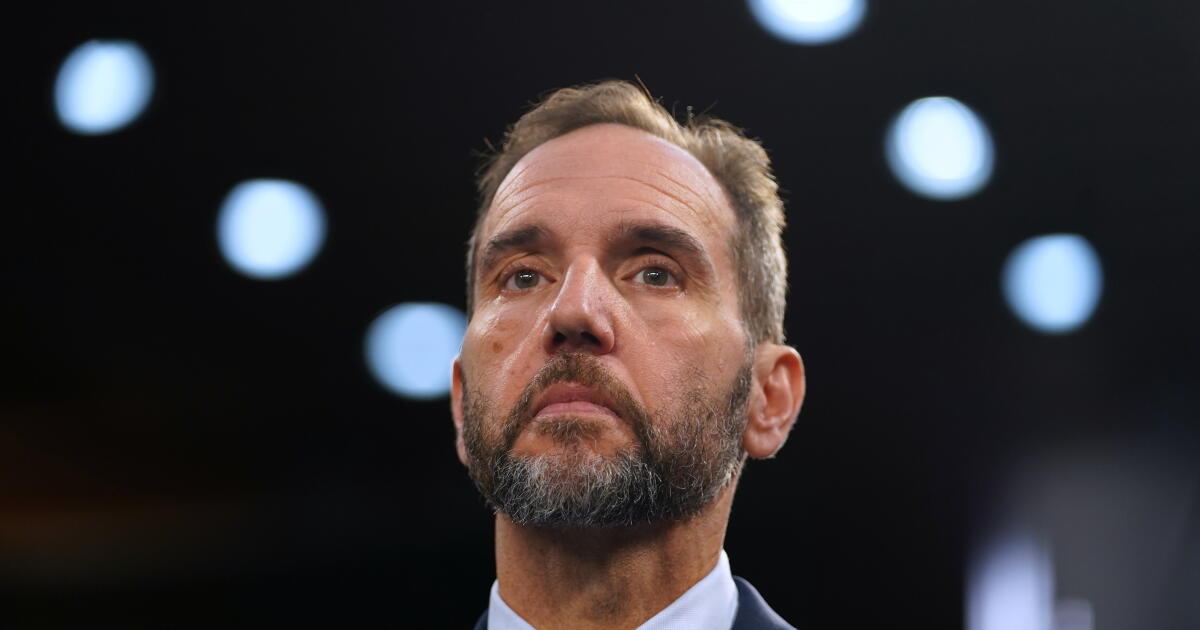
WASHINGTON — Former Justice Department special counsel Jack Smith, who brought two federal indictments against President Trump, told lawmakers on Tuesday that he “will not be silenced by continued threats of prosecution” from the Trump administration and that he believes the rule of law is being threatened like never before.
Smith also told the Senate Judiciary Committee that he stands behind the criminal cases he brought against Trump, a Republican, and that he and his team acted without regard to politics.
“I made those decisions without regard to President Trump’s political association, activities, beliefs or candidacy in the 2024 presidential election,” Smith said. “Our investigation developed proof beyond a reasonable doubt that President Trump engaged in serious crimes against our nation. If asked whether to prosecute a former president today based on the same facts, I would do so regardless of whether that president was a Republican or a Democrat.”
Republicans sought to cast the prosecution as a political fishing expedition, accusing Smith of bending ordinary procedures in an overzealous pursuit of the president.
“The Smith election case ultimately wasn’t just about Trump,” said Republican Sen. Chuck Grassley of Iowa, the chairman of the committee. “It was about partisan agents and prosecutors mapping out the Republican apparatus.”
Sen. Dick Durbin of Illinois, the top Democrat on the committee, accused Republicans of spreading “baseless conspiracy theories” about Smith’s investigations as part of an effort to “whitewash” the history of Trump’s 2020 election loss and the Jan. 6, 2021, attack by a mob of Trump’s supporters on the U.S. Capitol.
“President Trump demonstrated a wanton disdain for the laws of the United States, the will of the people and our national security,” Durbin said. “The aspersions cast on Mr. Smith, nonstop, are petty, personal and political. They are nothing but a smoke screen to distract from the president’s own clear, unlawful conduct.”
The hearing is expected to focus on subpoenas for phone records
Even as Smith defends his investigations, he is expected to be pressed anew by Republican senators about his team’s access to the phone records of GOP lawmakers as prosecutors investigated Trump’s efforts to overturn his loss to Democrat Joe Biden.
In previous testimony, Smith has stood behind subpoenas that prosecutors issued for the phone records of Republican members of Congress who were in touch with Trump when violent supporters of the president rioted inside the U.S. Capitol on Jan. 6, 2021. He has said that such subpoenas are a “common practice” in investigations and were necessary in this instance to understand the “scope of the conspiracy” between Trump and his Republican allies.
Nonetheless, the revelation that Smith’s team secretly obtained the phone records during his investigation has animated some Republican lawmakers, who point to it as proof of overreach by the Biden administration Justice Department and a hard-charging prosecutor.
In July, the Republican chairman of the House Judiciary Committee, Rep. Jim Jordan of Ohio, referred Smith to the Justice Department for potential prosecution on allegations that he lied at a previous hearing about his collection of the records — something Smith’s attorneys have vigorously disputed.
“I stand by my testimony before the House of Representatives,” Smith said. “I will not be silenced by the continued threats of prosecution from the president or others.”
Grassley, the Senate committee chairman, first disclosed last year that Smith’s prosecutors had obtained what’s known as “toll records” — data that reveals the date, length and time of phone calls between two parties but not the content of the communications.
Smith has repeatedly justified the move as necessary to document any contact that Trump or surrogates may have had with lawmakers on Jan. 6, 2021, as the president beseeched his supporters to halt the certification of the election results.
“My office didn’t spy on anyone,” Smith said during a hearing in January.
Smith is the subject of a criminal referral from Republicans
Smith was appointed in 2022 by then-Atty. Gen. Merrick Garland to take over investigations into Trump’s efforts to reverse his election loss and Trump’s retention of classified documents at his Mar-a-Lago estate in Palm Beach, Florida. Both investigations resulted in felony indictments, but Smith abandoned the cases after Trump won back the White House in 2024, citing longstanding Justice Department opinions that say sitting presidents cannot be federally indicted.
Smith has remained a top target of retribution for Trump and his administration, which last year announced that it would revoke the security clearances of the lawyers representing the former special counsel. The Office of Special Counsel, an independent watchdog agency responsible for enforcing a law against partisan political activity by federal employees, also announced last year an investigation into Smith.
Jordan’s referral to the Justice Department centers on a December 2025 exchange in which Smith was asked about subpoenas that prosecutors had issued for the toll records.
Smith said the records he requested did not include the content of the communications. But Jordan maintains that answer was misleading in light of records released by Grassley showing that Smith had obtained the contents of 44 lawmakers’ text messages in a separate subpoena to the National Archives and Records Administration that sought the communications of various Trump advisers and aides.
In response, Smith’s lawyers called his answers “unimpeachably truthful” and noted that he was responding to questions explicitly about toll records, which did not include the contents of any text messages.
Tucker and Richer write for the Associated Press.