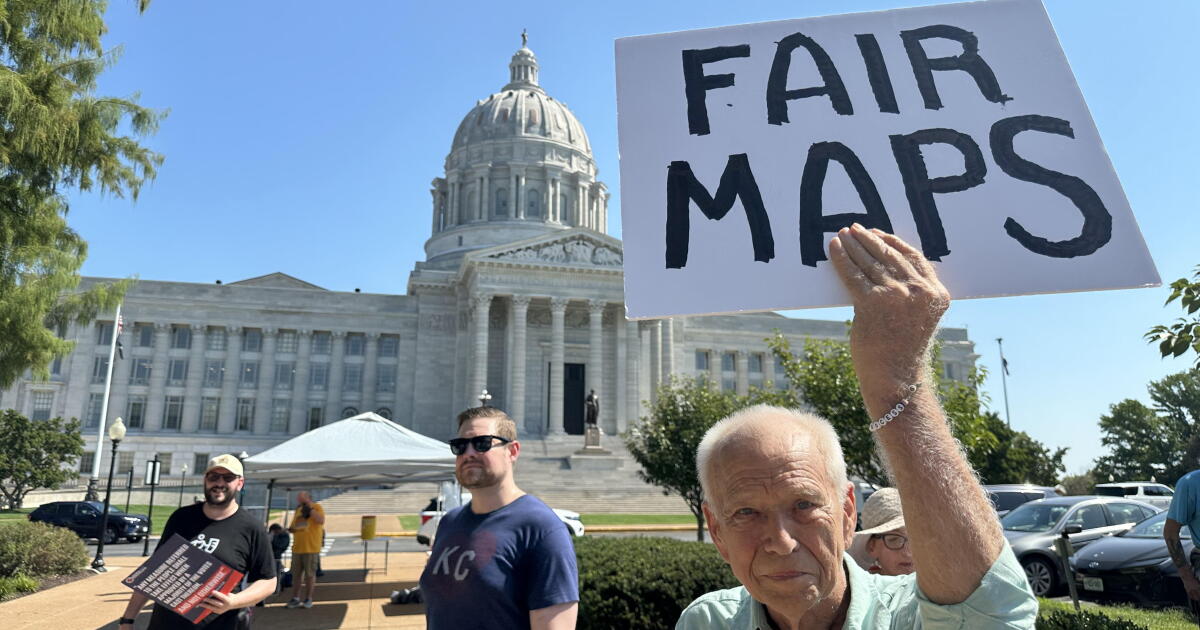
congressional redistricting

Supreme Court rebuffs Missouri’s push to use new U.S. House map backed by Trump in November

Lindsay Whitehurst and David A. Lieb

The Supreme Court on Tuesday rebuffed an appeal from Missouri officials who wanted to use new congressional districts backed by President Trump in the November election, a defeat for Republicans who had hoped the new map could help them hold onto their slim House majority.

The justices let stand a decision by Missouri’s top court, which said the new districts were automatically suspended by a citizen petition demanding a statewide vote.

The ruling marks a rare setback for Republicans in a nationwide redistricting battle that Trump urged Republicans to launch last year.

Missouri’s new districts were used in the August primaries. But the Missouri Supreme Court ruled in September that the state must revert to districts adopted after the last census.

Republican state Atty. Gen. Catherine Hanaway, who appealed, had argued it would violate federal rights to switch districts for voters between the primary and general elections. She also said it would cause confusion.

Missouri currently is represented in the U.S. House by six Republicans and two Democrats who were elected under districts that Republican state officials approved in 2022.

But at Trump’s urging, Missouri Gov. Mike Kehoe called the Legislature into a special session last year to redraw congressional boundaries to their advantage ahead of the midterms.

The revised map targeted the 5th Congressional District, held by longtime Democratic Rep. Emanuel Cleaver of Kansas City. It reassigned portions of Kansas City to two neighboring districts represented by Republicans and stretched the remainder of Cleaver’s district far eastward into rural Republican areas.

Cleaver was unopposed in the Democratic primary. State Sen. Rick Brattin won the Republican primary in the reshaped district.

On the same day as the primary, Republican Secretary of State Denny Hoskins rejected a petition with thousands of signatures seeking to force a November referendum on the map. Hoskins asserted that Missouri’s Constitution doesn’t allow a referendum on congressional redistricting. A lower court agreed, but the state Supreme Court reversed Hoskins’ decision.

The state’s top court said the new districts were retroactively frozen in December, when the petition signatures were submitted, and thus never became law. Hoskins on Tuesday assigned the redistricting referendum as Proposition A on the November ballot, in compliance with the state court order.

The Missouri Constitution does not specifically say that a referendum can be used for congressional redistricting. But the state Supreme Court said a constitutional provision allowing a referendum on “any act” of the Legislature encompasses congressional redistricting legislation.

Missouri was the second Republican-led state, after Texas, to respond to Trump’s call last year to redraw congressional districts. Several other states followed. All told, Republicans had hoped to win as many as 16 additional seats from new House maps enacted in eight states — Texas, Missouri, North Carolina, Ohio, Florida, Tennessee, Louisiana and Alabama. Democrats, whose counterattack faced several setbacks, think they could win up to six additional seats from new districts in California and Utah.

It remains to be seen whether the redistricting works as intended for Republicans. The president’s party historically has lost congressional seats in the midterms, and Trump’s poor approval ratings could provide an extra hurdle for Republican candidates.

Whitehurst and Lieb write for the Associated Press.
Source link

Missouri court blocks Trump-backed congressional map, orders vote

The Missouri Supreme Court has unanimously blocked new congressional districts backed by President Trump from being used in the November election and ordered a statewide vote on whether to uphold or reject the new map.

The decision Thursday marks a rare setback for Republicans in a national redistricting battle. Republicans had hoped Missouri’s new gerrymandered congressional boundaries could help them win an additional seat and hold on to their slim House majority in the midterms.

Missouri Atty. Gen. Catherine Hanaway, a Republican, said she would appeal to the U.S. Supreme Court, asserting that the decision “has thrust our state into a full‑fledged constitutional crisis.”

Missouri’s new districts were used in the August primaries. But the state Supreme Court said they cannot be used in the November general election — or ever again, unless voters first uphold the new districts passed by the Republican-led Legislature.

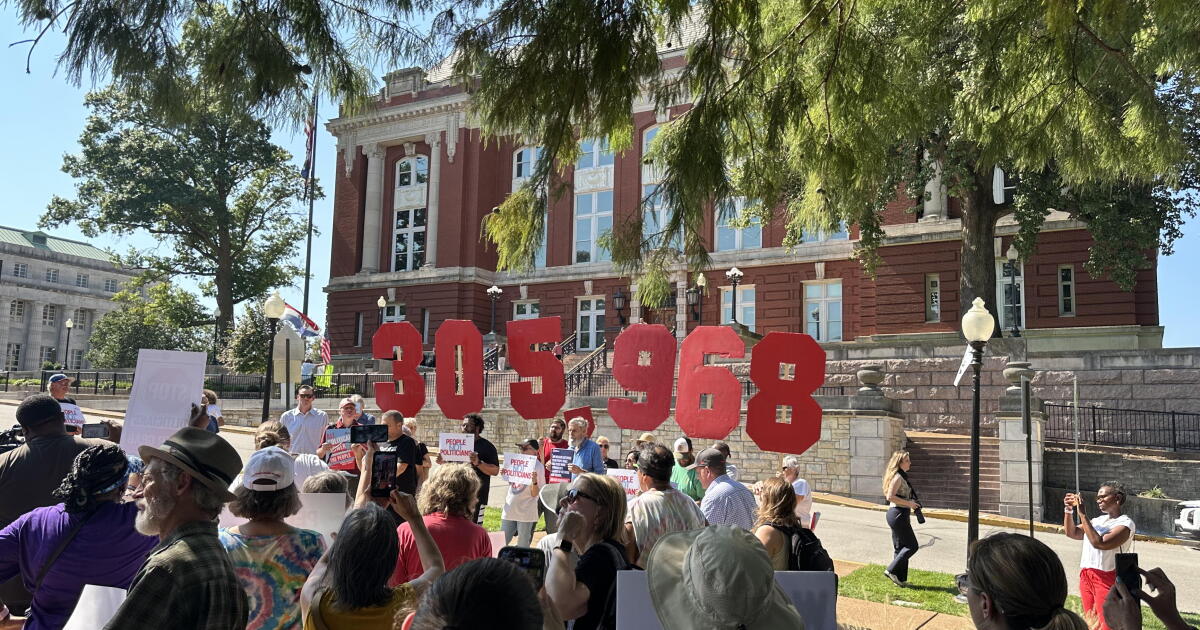
The court ruled that the new districts were effectively placed on hold last December, when opponents submitted more than 300,000 petition signatures seeking to put the map to a vote of the people. Republican Secretary of State Denny Hoskins waited until primary election day in August to reject the petition. He asserted that the referendum process cannot be used for congressional redistricting. A lower court agreed, but the Supreme Court overturned Hoskins’ decision.

“The referendum petition was legal, sufficient, and timely, and the secretary incorrectly concluded otherwise,” the court said in its ruling. The legislation containing the new districts “did not go into effect and will not go into effect unless and until approved by the voters.” As a result, the congressional map adopted after the 2020 census “remains in full force and effect for the November 2026 general election.”

Hanaway, whose office represented Hoskins, called the ruling an unprecedented violation of federal law. So did Republican Gov. Mike Kehoe, who proposed the new congressional map to lawmakers to favor the GOP.

“Never before in American history has a court overturned a congressional map after a primary and before a general election,” Hanaway said in a statement.

Court ruling hinged on referendum rights

The Missouri Constitution does not specifically say a referendum petition can be used for a congressional redistricting law passed by the Legislature. But the Supreme Court ruled that a constitutional provision allowing a referendum on “any act” of the Legislature encompasses congressional redistricting.

It rejected assertions from Hanaway’s office that federal law prohibits referendum petitions on congressional redistricting.

“This is what democracy looks like,” said Richard von Glahn, executive director of People Not Politicians Missouri, which sponsored the referendum petition. “The people of Missouri demanded a voice, and the court just confirmed what we’ve been saying all along. People, not politicians, will have the final say.”

Hoskins, acknowledging the loss, vowed to continue “the war to preserve our constitutional republic.”

The ruling, which capped a year of political maneuvering and legal wrangling, was one of two to go against Republican officials Thursday. The Supreme Court also ruled that Hoskins had wrongly rejected a petition for a ballot proposal making it difficult for politicians to change measures enacted by voters through ballot initiatives. The court also ordered that measure to be placed on the November ballot.

Missouri redistricting targeted longtime Kansas City lawmaker

Missouri currently has six Republicans and two Democrats in the U.S. House.

After Trump urged Republicans to redraw congressional districts to their advantage, Kehoe called lawmakers into a special session last year to reconfigure the 5th Congressional District, held by Democrat Emanuel Cleaver.

Cleaver, who was unopposed in the August primary, has carried the Kansas City-based district with at least 60% of the vote in each of the last two elections.

Republican state Sen. Rick Brattin won an August primary in the gerrymandered 5th District, which had been stretched eastward to include rural Republican areas. About 59% of the district’s voters were new under the revised map, according to an Associated Press estimate.

Cleaver had not posted campaign signs in many of the new rural areas, explaining that he was waiting for the Missouri Supreme Court’s decision. But he had vowed to continue his reelection campaign regardless of the outcome.

“Despite the cynical and deeply shameful attempt to silence many of our neighbors, the people fought back and won,” Cleaver said in a social media post Thursday.

Brattin, a Marine veteran and founding member of the conservative Missouri Freedom Caucus in the state Legislature, said the decision disenfranchises thousands of primary voters who now will be shifted to different districts with candidates they didn’t get to choose.

The court “handed Democrats a decision they desperately needed in their effort to help national Democrats retake the U.S. House of Representatives,” Brattin said in a statement.

Redistricting battle spread to over a quarter of states

Congressional districts typically are redrawn at the start of each decade, based on new census data. But Trump’s quest for a midterm election advantage triggered an unusual mid-decade redistricting battle that spread to more than a dozen states, including California — and triggered a dozen lawsuits in Missouri alone.

The Missouri Supreme Court ruling was one of only a few nationally to go against Republicans’ redistricting efforts.

Prior to its latest ruling, Missouri’s top court already had rejected claims that the special session was illegal, mid-decade redistricting isn’t allowed and the new districts aren’t compact enough.

After the Supreme Court heard arguments Wednesday, a few hundred people chanted, “Let us vote!” while rallying outside the courthouse. Grant Christensen, of Jefferson City, said he had signed the referendum petition to put the map to a vote.

“Gerrymandering is the same as voter suppression,” Christensen said. “Cutting up districts in order to steer them to vote one way or the other is not fair.”

Lieb writes for the Associated Press.

Source link