Palestinian officials condemn move by Colombia’s new government that marked a major shift after former President Petro had severed ties with Israel.
Published On 14 Oct 202614 Oct 2026
Colombia has opened its embassy to Israel in Jerusalem, joining a small group of countries in taking the controversial step of backing Israel’s claim to sovereignty in the contested city.
Palestinian officials swiftly denounced the inauguration on Wednesday that came as Israel is facing mounting international pressure over the genocidal war on Gaza, where three years of attacks have killed more than 74,000 people.
Recommended Stories
list of 3 itemsend of list
The move by the administration of new Colombian President Abelardo de la Espriella is a major shift from his left-wing predecessor Gustavo Petro, who in 2024 severed ties with Israel over the war on Gaza.
De la Espriella, who was sworn in in August, has also restored a free trade agreement between Israel and Colombia that Petro terminated.
Colombian Minister of Foreign Affairs Omar Bula Escobar said on Wednesday that relations between the two countries “should never have been broken” and that Bogota was taking “taking a concrete step towards restoring diplomatic relations”.
“Israel is a strategic partner. It always has been, and from now on, it will be an even stronger one,” he said during a ceremony that marked the embassy’s opening.
The opening made Colombia the 10th country to establish its embassy in Israel in Jerusalem – most countries keep their formal diplomatic missions in Tel Aviv.
Israeli Foreign Minister Gideon Saar welcomed the move during the ceremony. “This is an important date for the State of Israel. It’s also an important date for the city of Jerusalem,” he said while signing the Colombian embassy’s guest book.
Colombian Ambassador Tania Gilinski said Israel had always been a “strategic partner” and that moving forward it “will be so with even greater determination and strength”.
‘Violation of international law’
The Palestinian Authority condemned Colombia’s embassy move, calling it “a violation of international legitimacy resolutions” that undermines “the international consensus on the legal status of the holy city”.
Jordan’s Ministry of Foreign Affairs also criticised the move as a “violation of international law and relevant international resolutions”.
United States President Donald Trump moved the US embassy to Israel from Tel Aviv to Jerusalem during his first term in 2018, angering Palestinians and sparking international condemnation. Previous US presidents, as well as nearly every other country, refrained from opening embassies in Jerusalem, arguing that the city’s final status should first be resolved in negotiations between Israelis and Palestinians.
The status of Jerusalem remains one of the core unresolved issues of the Israeli-Palestinian conflict, with Israel claiming the undivided city as its capital while Palestinians view occupied East Jerusalem as the capital of a future Palestinian state.
Israel occupied East Jerusalem and annexed it in 1967, in a move not recognised by the vast majority of the international community.
Since Trump relocated the US embassy to Jerusalem, only a handful of small, US-aligned countries have followed suit, namely Fiji, Guatemala, Honduras, Papua New Guinea, Paraguay and Nauru. Kosovo and Somaliland, which are not member-states of the United Nations, have also opened what they consider their embassies in Jerusalem.
Colombia has opened an embassy in West Jerusalem under new far-right President Abelardo de la Espriella, who is reversing his predecessor’s break with Israel by also restoring a free trade agreement.
The woman’s young daughter was rescued from a large fire inside the apartment caused by the attack.
Published On 14 Oct 202614 Oct 2026
An Israeli air strike on an apartment block in Gaza has killed a woman and wounded two other people, hospital officials said.
Reem Asaad Awad, 33, was killed in the attack early on Wednesday in the Al-Rimal neighbourhood of Gaza City, the Turkish state news agency Anadolu reported, quoting a source at Al Shifa hospital.
Recommended Stories
list of 3 itemsend of list
The source said the strike caused extensive destruction to the targeted apartment and nearby buildings.
The daughter of the woman who was killed was rescued from a large fire that broke out after the attack.
Israel says it is investigating the strike and claims it targeted a member of Hamas, without providing evidence.
Reporting from Gaza City, Al Jazeera’s Ibrahim al-Khalili said the strike happened at 4am (01:00 GMT).
Israel has killed 1,501 Palestinians in Gaza since it agreed a “ceasefire” with the Palestinian group Hamas last October. The truce was part of a wider United States-backed proposal to end Israel’s genocidal war against Palestinians in Gaza.
Talks aimed at advancing to the second phase of the US plan, which includes the withdrawal of Israeli forces and the disarmament of Hamas, have stalled.
The agreement states that 600 trucks of humanitarian aid are to be allowed into Gaza each day, but Israeli authorities have continued to impose severe restrictions on supplies entering the enclave, and reconstruction of the war-shattered territory has not begun.
German authorities briefly closed an airport and scrambled fighter jets to escort a passenger plane on Tuesday following an emergency alert indicating a hijacking was taking place on board. However, the alert had been accidentally triggered by a radio “malfunction”.
Corendon Airlines said its Boeing 737-800, which was en route from the Greek holiday island of Corfu to Nuremberg, Germany, sent out an emergency code while it was flying over Croatia “due to a brief malfunction in the radio communication system”.
In a statement, the airline said that “no emergency situation occurred”, and the 178 passengers, flight crew and aircraft had not been in danger at any point. The plane landed safely in Nuremberg.
What happened?
German police said Corendon Airlines flight XR456 “inadvertently” sent out an emergency “squawk” alert with the code 7500 while flying over Croatia on Tuesday.
A squawk is a four-digit code a pilot sends via the jet’s transponder to air traffic control. The code 7500 tells air traffic controllers that a hijacking is in progress.
However, air traffic controllers were unable to make contact with the pilots or crew, causing the alarm to be raised further. It is unclear why this happened.
“The aircraft could no longer be reached by radio to clarify the situation”, prompting warnings to be activated in several European countries, police said.
A Rafale fighter jet was scrambled from Croatia to intercept the Boeing passenger jet, while the German military also dispatched warplanes.
Police cordoned off the Albrecht Dürer airport in Nuremberg as a precaution until they knew the reason the pilot had sent the hijack alert.
Police spokesman Michael Petzold explained that authorities had “received a code directly from the cockpit that suggested a hijacking”.
“Since we were then unable to reach the cockpit, and the tower was also unable to contact the cockpit, we had to assume the worst – that it might indeed be a hijacking,” Petzold said.
The incident disrupted flights, with six flights delayed and two inbound flights diverted to other airports as a precaution, a Nuremberg airport spokesperson said.
Why are aviation authorities so concerned?
The hijack scare has come amid heightened concerns about aviation security after the copilot on board a Flydubai jet bound for Israel from Dubai attacked the captain with an emergency crash axe, forcing the flight to make an emergency landing in Saudi Arabia on September 30.
On Friday, the United Arab Emirates’ prosecutor general said the copilot was on a “suicide” mission to crash the plane at Ben Gurion airport in Tel Aviv and called the incident a “terrorist attack”.
Also, before the false hijack alert in the early hours of Tuesday, flights had been briefly disrupted at Nuremberg airport after pilots reported suspected drone sightings.
Authorities across Europe have already stepped up surveillance of the skies in recent weeks after a series of mostly mysterious drone incidents and concerns about Russian hybrid warfare.
Western nations, including Germany, have accused Moscow of launching a campaign of sabotage, espionage and disruption to undermine European support for Ukraine and destabilise the continent.
Several German airports have had to suspend operations for brief periods in recent months due to drone activity, with suspicion often falling on Russia.
Last month, the German government blamed Russia for an attempted attack at Leipzig/Halle airport in August using a drone laden with explosives. Berlin closed the Russian consulate among other measures.
Russian President Vladimir Putin dismissed the allegations, saying Berlin “fabricated” the evidence. However, in light of the concerns, NATO’s top general told the Warsaw Security Forum earlier this week that the alliance has a new war plan for countering a Russian attack on its members, embedding lessons learned from the Ukrainian front lines.
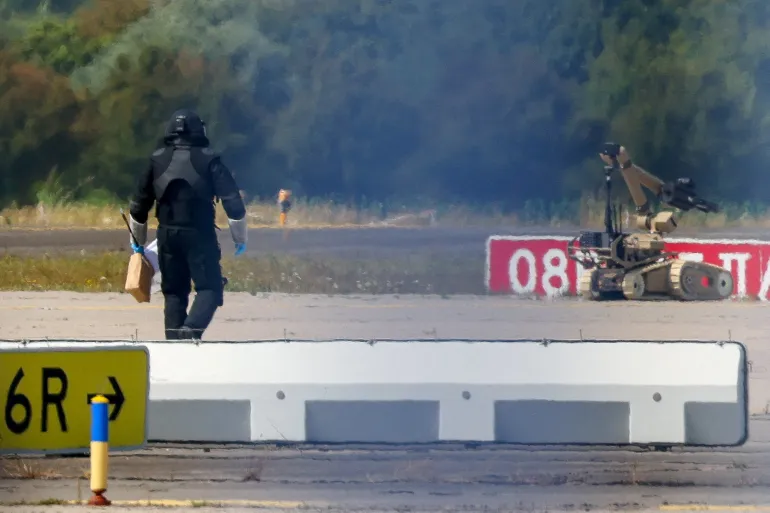
A police officer walks next to an explosive-disarming robot at Leipzig/Halle airport in Schkeuditz, Germany, on August 5, 2026, as explosives experts examine a drone found near a runway [Axel Schmidt/Reuters]
How common are radio glitches and false hijack alerts?
Radio glitches are common, but incidents rarely escalate to major security events because pilots use back-up radios to communicate with air traffic controllers when they lose communication signals.
In 2019, a pilot flying an Air Europa jet from Amsterdam to Madrid accidentally transmitted hijack alert 7500. For half an hour, aviation authorities thought the alarm was a genuine emergency and followed safety protocols, which disrupted flights and led to the evacuation of part of Schipol airport in the Netherlands.
In 2011, a flight from Chicago to Germany was diverted to Toronto when a pilot spilled coffee and accidentally set off a hijack alarm. The spill caused distress signals to go out, including the 7500 transponder code.
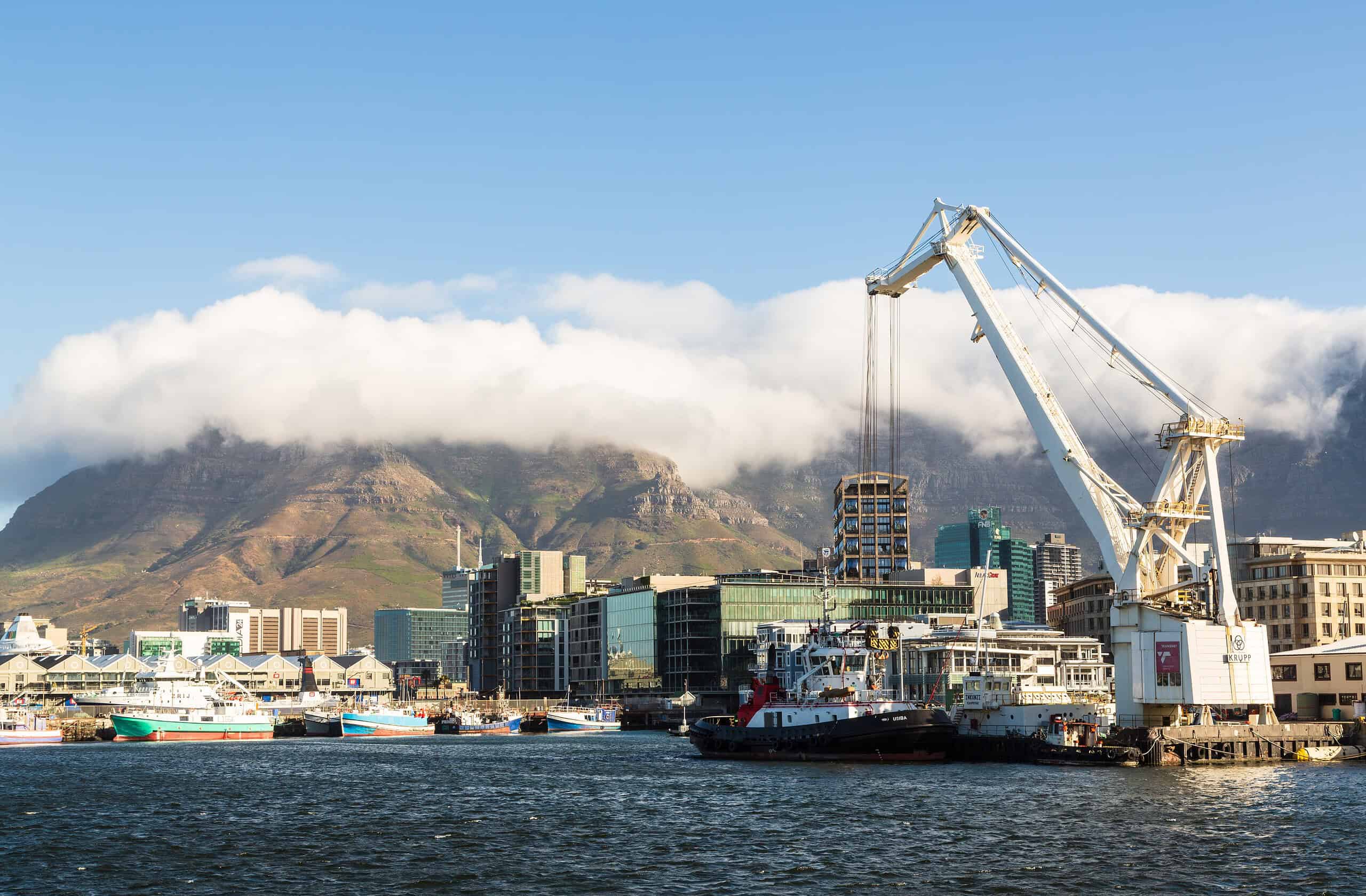
As ships bypass the Red Sea, increased traffic around the Cape of Good Hope could benefit African economies.
The ongoing conflict with Iran in the Strait of Hormuz and attacks by the Houthis, a Yemen-based militant group, in the Bab el-Mandeb Strait have forced many shipping companies to explore alternative routes around Africa. While the financial and operational costs are significant, the shift presents new economic opportunities for African countries, particularly those positioned to serve the growing volume of maritime traffic.
The main detour causes international shippers to bypass the Red Sea and the Suez Canal corridor, traveling around the southern tip of Africa past the Cape of Good Hope. This longer route can add up to two weeks to a trip from Europe to Asia, increasing energy and shipping costs.
The Cape of Good Hope was already one of the world’s busiest sea routes before recent developments, driven by the conflict with Iran that began in February 2026. According to the U.S. Energy Information Administration (EIA) World Oil Transit Chokepoint Report, released in March 2026, approximately 9 million barrels per day of crude oil and petroleum products pass around the Cape of Good Hope, accounting for 11% of global seaborne oil trade.
Despite the additional shipping time and cost, many major container operators still chose to divert mid-voyage from the original Suez Canal route because of ongoing threats and blockades, as the Houthi forces continue to advance along the Red Sea coast and target regional maritime traffic.
New Shipping Opportunities for Africa
The increase in traffic around Africa, and more specifically around the Cape of Good Hope, provides various African countries with new economic and diplomatic opportunities. The main economic benefits stem from the expenses and services associated with the new shipping routes.
First, the Institute for Strategic Studies Africa 2026 Report highlights that most vessels do not call at South African ports. These ports can offer international shippers key high-value services, including ship repair and maintenance, crew changes, resupply, and medical support. While major South African and Namibian ports, such as Durban and Walvis Bay, can provide a full range of services and logistics connectivity for this new traffic pattern, other countries, such as Kenya and Mauritius, can also connect this traffic to the Indian Ocean shipping needs.
Second, global pressure to replace shipping fuel with more sustainable, environmentally friendly alternatives is creating strong renewable energy markets and green hydrogen potential in African nations, along with an opportunity to capitalize on this shift. A recent report by the European Council on Foreign Relations shows that countries such as Morocco and Kenya can serve as major marine refueling hubs. As trade and investment in renewable energy have become a diplomatic currency in Africa, the ability to influence shippers’ emissions can strengthen diplomatic relations among relevant nations.
Finally, as almost 70% of the previous Red Sea freight has been rerouted around South Africa, according to the Center for Security and International Studies, African nations like Djibouti are becoming key players in the new maritime security space. These nations can offer foreign nations improved physical and technological maritime security and use it to advance negotiated diplomatic and commercial goals.
Saudi Arabia says it intercepted missiles targeting Riyadh and Dhahran, with falling debris injuring at least four people, and damaging homes in the capital. Meanwhile, Yemen’s Saudi-backed government says its offensive to retake Houthi-held territory is advancing.
Yemen has reported 8,034 suspected cases and 27 deaths this year, with a quarter of cases from the last four weeks.
Published On 13 Oct 202613 Oct 2026
Suspected cholera cases in Yemen have tripled in the past three weeks, the World Health Organization (WHO) has warned, as civilians have fled renewed fighting and sought safety in unsanitary camps.
Ramped up combat, which has pushed more than 200,000 people to flee their homes, the WHO added in a report on Tuesday, driving suspected cases from 217 in the week of September 6-12 to 647 in the week of September 27 to October 3.
Recommended Stories
list of 3 itemsend of list
“Families fleeing conflict are now facing another threat from diseases that can be prevented and treated,” said Annette Heinzelmann, the UN agency’s emergency director for the region.
“Without urgent funding and unimpeded access to safe water, vaccination and essential health services, outbreaks could spread rapidly among already vulnerable communities.”
This year, the global health watchdog said, Yemen had reported 8,034 suspected cases and 27 deaths, with a quarter of the suspected cases occurring in the last four weeks.
Five governorates hosting large numbers of displaced people in the southwest – Abyan, Lahij, al-Dhalea, Taiz and Aden – account for 92 percent of reported cases, they reported. The disease has also reached remote displacement camps in Hadramout in the country’s east that are particularly difficult for medical teams to access.
Displaced Yemenis wait to receive medical treatment provided by Doctors Without Borders (MSF) at the al-Kod al-Othmani displacement camp in Aden, Yemen, Thursday, October 8, 2026 [Abdulnasser Alseddik/AP]
Emergency response underfunded
Cholera has ebbed and flowed for years as the conflict in Yemen has continued. In 2024, the WHO warned that the country was facing the “highest burden” of a global cholera outbreak. In 2017, a wave of the disease infected hundreds of thousands and killed at least 2,000.
Yemen was already suffering one of the “world’s worst humanitarian crisis” and has seen an escalation of circumstances since fighting reignited between the Houthis – an armed group known as Ansar Allah (Arabic for Supporters of God), and the internationally recognised Yemeni government.
Cholera is an acute intestinal infection that spreads through food and water contaminated with the bacterium Vibrio cholerae, often from faeces. It causes severe diarrhoea, vomiting and muscle cramps.
Contracting the illness can be deadly when not treated with oral rehydration or antibiotics for more severe cases.
The Geneva-based WHO said it had only secured $3.78m of the $31m needed for its 90-day emergency response in Yemen.
The funding is intended to help expand disease surveillance in displacement sites, deploy rapid response teams, strengthen cholera treatment and improve infection prevention in health facilities and cholera treatment sites.
Explosions in Sanaa reported shortly after Saudi-led coalition’s evacuation order as Houthis promise ‘harsh’ response.
Published On 13 Oct 202613 Oct 2026
Yemen’s Houthis have warned all employees and civilians near Saudi Arabia’s oil facilities to evacuate, calling the sites “a legitimate target”.
The group’s spokesman, Yahya Saree, issued an evacuation alert on Tuesday following the Saudi-led coalition’s statement urging civilians to evacuate Yemeni Oil Company’s al-Sabah central station in the Houthi-controlled capital Sanaa before a planned military operation.
Recommended Stories
list of 4 itemsend of list
Shortly after the Saudi-led coalition’s evacuation order, Al Jazeera’s team on the ground reported hearing explosions in Sanaa. Media outlets affiliated with the Houthis said air strikes by the Saudi-backed forces struck an oil facility in the al-Sabaha area of the capital.
Following the reported explosions, Saree said Houthi fighters were confronting Saudi-backed forces in Sanaa.
Saree responded to the coalition’s evacuation order, warning that any strikes on Sanaa would be met with a “harsh and painful” response in the Saudi Arabian capital Riyadh.
In a statement on X, Saree said the Houthis would target the sites that were ordered to be evacuated if the Saudi-led coalition proceeded with an attack on Sanaa.
Civilians were told to evacuate the Aramco Company headquarters in Dammam, King Khalid International Airport and a refinery affiliated with Aramco in Riyadh.
An attack on King Khalid International Airport on Saturday left at least 13 people dead and more than 300 injured, rocking the world’s top crude oil exporter. Another person was killed, and 11 were wounded on Sunday after a projectile struck the airport in Riyadh.
Many international airlines have since suspended flights to Saudi Arabia and neighbouring countries following the deadly weekend attacks by the Houthis, including Air France-KLM, Air India, Etihad, Lufthansa, Delta, Gulf Air and Qatar Airways.
The kingdom, which backs Yemen’s internationally recognised government, was still weathering new attacks on Tuesday, with the coalition saying its forces intercepted three drones north of Riyadh.
Saree also reiterated the Houthis’ warning to airports in Saudi Arabia following recent attacks on multiple airports and oil facilities across the country since last week in a spillover from the wider regional conflict between the US and Iran.
Saudi Arabia has in recent weeks launched strikes against the Houthis and is backing a Yemeni government counteroffensive known as the “Dawn of Yemen” after the group seized strategic territory along the Red Sea coast last month.
Ramallah, occupied West Bank – Every day, Fuad Abu Salam sips his morning coffee outside his rented home in the Thinnabeh suburb, gazing at every detail of the sprawling Tulkarem refugee camp in front of him. This West Bank camp he can see in the distance once housed a two-storey building comprising four apartments, each measuring 300 square metres (3,229sq feet), in which he and his extended family lived.
After he was displaced from the camp, he, his wife, his four children, and his mother were confined to a small, rented apartment no bigger than 100sq metres (1,076sq feet) in Thinnabeh. His home in Tulkarem was partially destroyed when he left the camp.
Recommended Stories
list of 3 itemsend of list
Everything changed for Fuad and his family on January 21, 2025, when Israel launched a military assault in the occupied West Bank dubbed “Iron Wall”, initially targeting the Jenin refugee camp. A week later, the operation expanded to include the Tulkarem and Nur Shams camps in the city of Tulkarem.
Israeli forces forcibly displaced the entire populations of the three camps during January and February 2025 and continue to prevent their return, the United Nations has said.
Mass displacement
Data from UNRWA cited in a report titled, Destruction of Palestinian Refugee Camps in the Northern West Bank, stated that 33,362 Palestinians remain forcibly displaced from the three camps. By October 2025, 52 percent of structures in the Jenin camp, 48 percent in the Nur Shams camp, and 36 percent in the Tulkarem camp had been destroyed or damaged.
The Israeli operation has affected hundreds of homes, roads, and infrastructure, including water and electricity networks, while humanitarian aid to the camps has been cut off.
Israeli forces killed 102 Palestinians, including 21 children, during the period covered, according to the report. This represents 46 percent of the total number of Palestinians killed by Israeli forces in the West Bank during this period.
On Sunday, the Israeli Supreme Court ordered the government to provide a timeline for the return of displaced people to the three camps, setting November 23 as a deadline for a response.
Israel’s far-right Finance Minister Bezalel Smotrich rejected the ruling, warning that the return of residents could allow for the reconstruction of what he termed “terror infrastructure”. He called on the government not to implement the decision.
Meanwhile, Israeli Defence Minister Israel Katz opposed the court’s intervention, asserting that the army’s continued presence in the camps was a security decision and stating his intention to maintain a military presence there.
Fuad, 42, a greenhouse installer, found himself forced to flee with all the camp’s other residents and more than 40 family members. But he and his neighbours carried with them the hope of returning home.
They moved between the homes of relatives, enduring harsh living conditions, until he finally settled in the Thinnabeh suburb of Tulkarem.
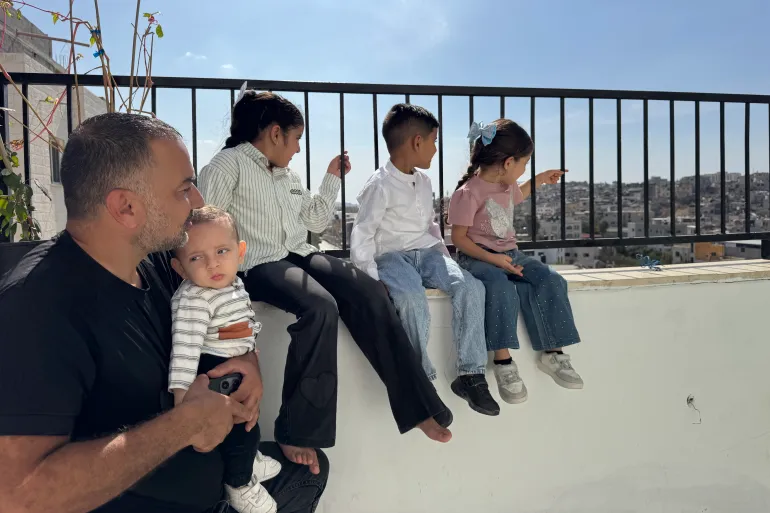
Fuad Abu Salam sits with his children in his rented apartment overlooking the Tulkarem camp, gazing at their destroyed home [Raghad Salameh/Al Jazeera]
The neighbourhood, which overlooks the camp, has “restored his spirit” because he can see his home even if it’s from afar. Although he is unable to reach the building, he can gaze at it and imagine a time when he can return.
“If a decision were issued right now allowing us to return, I would go back immediately without a moment’s hesitation,” he said.
But his home is no longer what it used to be. It was partially demolished and set on fire by Israeli soldiers, rendering more than 80 percent of the apartment block uninhabitable. Fuad plans to use the rubble to rebuild his home.
“I will never waver in my resolve to return, even if it means pitching a tent over the ruins and living there,” he declared.
Mohamad Ararawi, 18, from the Jenin refugee camp, also saw his home razed to the ground with a wide road replacing it.
He told Al Jazeera that his family of 40, who had lived in a five-story building in the al-Damaj neighbourhood, all fled the camp when the Israeli military operation began, seeking shelter in homes belonging to other relatives.
“My mother, father, five sisters, and I took refuge in my brother’s unfinished apartment. We endured harsh conditions, suffering through biting cold and scorching heat, before gradually completing the construction until it became somewhat habitable,” he added.
Returning is all that matters to them, and they refuse to live anywhere but the camp, even if it lacks basic amenities.
A near-impossible return
Returning the displaced back to their homes is not merely an issue of clearing roads for residents. Returning would mean living in a camp in which infrastructure has been damaged and hundreds of homes destroyed, all amid a lack of necessities.
Nihad Shawish, a member of the Nur Shams Camp Popular Services Committee, told Al Jazeera that the scale of destruction makes the residents’ return fraught with immense difficulties, despite their will to go back to their homes.
Approximately 400 homes, most of them three to four stories high, were destroyed, he said, while about 100 homes were burned down during the Israeli army’s presence in the camp.
Even the ones that survived are not necessarily habitable; they sustained severe damage affecting doors, windows, and interior facilities. The collapse of some buildings has also damaged neighbouring homes.
Approximately 10,900 camp residents remain displaced, including families staying in private homes and others at a school in the Thinnabeh suburb.
A photo of Tulkarem camp taken from Fuad Abu Salam’s apartment which overlooks the camp; from there, he looks out at his destroyed home every day [Raghad Salameh/Al Jazeera]
Faisal Salameh, an official with the Tulkarem Camp Popular Committee, told Al Jazeera that more than 2,000 housing units were completely destroyed, while approximately 90 per cent of the camp’s homes sustained partial damage, rendering them uninhabitable.
“Israel has turned the camp into an environment that drives residents away, given the widespread destruction and the ban on reconstruction in certain areas that have been converted into roads,” he noted.
Despite these conditions, Salameh said that displaced residents are eager to return to the camp as soon as a decision by the Israeli government permits them to.
The camp was home to approximately 15,000 people. The majority of the displaced currently live in rented homes or with relatives, while others have sought shelter in schools, mosques, or makeshift tin shacks.
Israeli rejection
While the Israeli Supreme Court’s ruling opens the door to discussing the return of displaced persons to camps in the northern West Bank, its rejection by Israeli government ministers raises questions about whether it will be implemented. Until then, the lives of the displaced families remain in limbo.
Mohamad Halaseh, an expert on Israeli affairs, told Al Jazeera that the Israeli right-wing isn’t just trying to alter the structure of the judicial system, but also seeking to undermine its legitimacy and exert pressure on judges.
He explained that the effect of political stances is evident in the disregard for Supreme Court rulings. He cites the issue of Palestinian prisoner visitations, a case in which the state failed to comply with the court’s decisions, as one example of this.
“The continued disregard for court rulings undermines the judiciary’s ability to compel the government to act when judicial decisions conflict with the stance of the political leadership,” he said.
Several precedents make the implementation of court rulings on the camps unlikely, he said. This is particularly distressing for residents who also face strong Israeli political opposition to the return of Palestinians to the three camps.
“Declared political stances set a limit on the extent to which executive institutions comply with judicial rulings,” he said.
Sheikh Tamim bin Hamad Al Thani says Qatar has demonstrated its strength and cohesion.
Published On 13 Oct 202613 Oct 2026
Qatar’s Emir Sheikh Tamim bin Hamad Al Thani has told the Shura Council that the region has faced “exceptional events”, following months of instability amid the United States-Israeli war on Iran.
Speaking in the Qatari capital, Doha, on Tuesday morning, Sheikh Tamim said the events had demonstrated the strength and cohesion of the country’s state institutions.
“Our country and the region have faced exceptional events that have once again proven the cohesion of state institutions,” the Emir said.
Qatar has found itself caught up in the war, which began on February 28 and has triggered a global energy crisis. The Gulf state has been directly attacked by Iran on several occasions, including in March, when Tehran struck Qatar’s Ras Laffan gas facility, the world’s largest liquefied natural gas (LNG) production site.
Sheikh Tamim said Qatar had been able to absorb the consequences of the regional instability due to policies implemented before the war, stressing that Doha’s preference was to resolve conflicts through peaceful means and dialogue. However, the Emir maintained that the Gulf Cooperation Council’s (GCC) security was non-negotiable.
“The security of the Gulf Cooperation Council states and the preservation of their sovereignty is a matter that cannot be compromised on,” he said.
The war on Iran has disrupted global supply routes, particularly the Strait of Hormuz, which Tehran has effectively blocked since the start of the conflict.
Sheikh Tamim said efforts to safeguard maritime routes must be increased.
“Efforts must be doubled to secure navigation in the Gulf and the Strait of Hormuz and to protect energy facilities and civilian infrastructure.”
An Israeli settler was filmed abusing and reportedly poisoning livestock in the village of Al-Mughayyir, northeast of Ramallah in the occupied West Bank. The animals reportedly belonged to Israelis and were poisoned in an attempt to frame Palestinians for killing them.
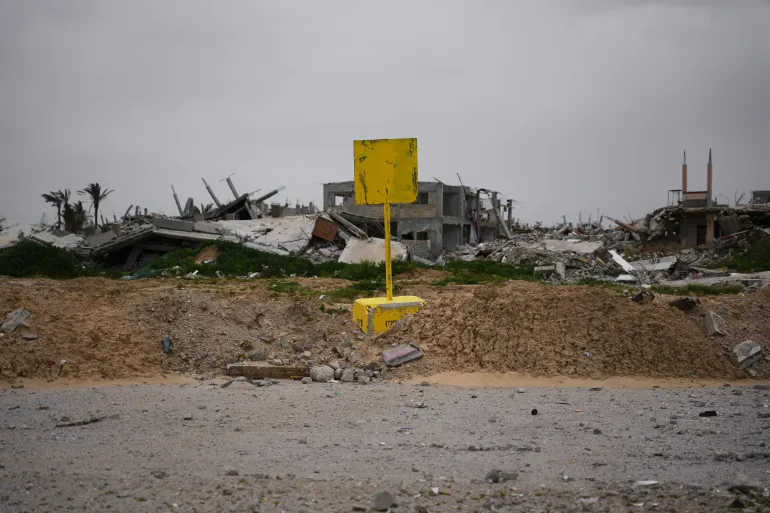
Israel has expanded its military occupation in the Gaza Strip in violation of a United States-brokered ‘ceasefire’, forcing Palestinians into an ever-smaller share of the besieged territory, devastated by Israel’s ongoing genocidal war.
Nearly two-thirds of Gaza is now under Israeli military control or subject to access restrictions.
The original ‘Yellow Line’, established under US President Donald Trump’s 20-point plan to end the war, marked the area to which Israeli forces initially withdrew. They were expected to make further withdrawals gradually, but instead, they have seized more territory.
On Sunday, Israeli forces moved yellow concrete blocks dozens of metres west in Shujayea, a neighbourhood in southeastern Gaza City, forcing Palestinian families to flee and bringing more of the neighbourhood under Israeli military control.
A yellow block demarcating the ‘Yellow Line’, which has separated the Gaza Strip’s Israeli-held and Palestinian zones since a ‘ceasefire’ began a year ago, is seen in Khan Younis in the southern Gaza Strip on January 22, 2026 [Abdel Kareem Hana/AP Photo]
“It’s not simply about where the ‘Yellow Line’ is today but where it can move next,” Al Jazeera’s Ibrahim al-Khalili said, reporting from Gaza City. “For families who have been repeatedly displaced in the past three years, the situation remains dire, and they have to make the impossible decision of where they can go.”
More than 90 percent of Gaza’s 2.1 million population has been forcibly displaced by Israel’s war, launched on October 7, 2023, after Hamas-led attacks on southern Israel.
Using maps, Al Jazeera shows how much of Gaza Israel has grabbed since the ‘ceasefire’.
Gaza before the war
Before the war, Palestinians were spread across the Gaza Strip, a 365sq km (141sq-mile) territory roughly 41km (25 miles) long and from 6km to 12km (4 to 7 miles) wide.
That made it one of the most densely populated places on Earth with about 6,000 people per square kilometre, similar to Nairobi or London. Each person had, on average, about 160sq metres (1,722sq ft) of land.
Even then, not all of Gaza’s land was accessible. Israel enforced a buffer zone along the fence with Israel, and Palestinians who approached it risked being shot. In 2010, the United Nations Office for the Coordination of Humanitarian Affairs (OCHA) estimated that the restricted area covered 17 percent of Gaza’s land and 35 percent of its farmland.
Gaza has been under an Israeli land, air and sea blockade since 2007.
Gaza at the ‘ceasefire’
Under the first phase of the “ceasefire”, Israeli forces were to withdraw to the “Yellow Line” within 24 hours, after which a 72-hour period began for the handover of Israeli captives held in Gaza. Trump first published a map of the line on his Truth Social platform.
The line left Israel in control of 53 percent of the Strip, mostly farmland and border areas in the east, and confined Palestinians to the remaining 47 percent, about 172sq km (66sq miles).
By October 2025, two years of war had killed more than 67,000 Palestinians, and tens of thousands more had left the territory, reducing Gaza’s population to about 2.1 million.
Pushed into less than half of Gaza’s territory under the “ceasefire”, its density doubled to about 12,000 people per square kilometre, comparable to New York City. Each person was left with about 82sq metres (883sq ft).
(Al Jazeera)
Gaza today
Since the “ceasefire”, Israeli forces have repeatedly moved the yellow concrete blocks marking the “Yellow Line” farther west, sometimes overnight, expanding the areas under their control. Satellite imagery has also documented continued demolitions in areas held by Israeli forces.
The research group Forensic Architecture estimated that Israel controlled 58 percent of Gaza by December. In March, the Israeli military sent aid agencies maps of a new “orange line”, a restricted zone beyond the “Yellow Line” where humanitarian movements must be coordinated with the army.
According to OCHA, restrictions now cover 65 percent of Gaza. Israel itself said it controls about 70 percent of the territory, a UN official told the Security Council in June.
(Al Jazeera)
That leaves 2.1 million people in about 35 percent of the Strip, roughly 128sq km (49sq miles). The population density has nearly tripled since before the war to about 16,000 people per square kilometre, close to central Tokyo.
Each person now has about 61sq metres (657sq ft) of land for everything: shelter, roads, schools, hospitals and farmland.
Unlike Tokyo, Gaza has little space left to house its people. The UN Satellite Centre, UNOSAT, found 82 percent of structures in the Strip are damaged or destroyed. The UN Food and Agriculture Organization says only 3 percent of Gaza’s cropland is both undamaged and accessible.
(Al Jazeera)
OCHA says the remaining 35 percent of Gaza is “already overcrowded” and access restrictions are a key obstacle as aid groups try to relocate families before the rainy season. More than 950,000 people live in displacement sites at risk of flooding, according to the UN, most of them in tents and makeshift shelters, as seen in the satellite image below.
Approaching the ‘Yellow Line” can be deadly. Israel treats areas beyond it as a free-fire zone, and Palestinians who come near it have been shot. Nearly 1,500 people have been killed across Gaza since the ceasefire was announced.
Ethiopian government forces entered Adigrat in northern Tigray after rebel fighters withdrew, heightening tensions with neighbouring Eritrea. The two neighbours cut off diplomatic ties last week. Al Jazeera’s Hamza Mohamed reports.
Sunday’s strike on King Khalid International airport kills a Pakistani national.
Published On 12 Oct 202612 Oct 2026
A projectile has struck Saudi Arabia’s King Khalid International airport, killing one person and injuring 11, according to the country’s civil aviation authority.
The General Authority of Civil Aviation (GACA) identified the deceased in Sunday’s attack as a Pakistani resident and said the injured were transferred to several hospitals for medical care.
Recommended Stories
list of 3 itemsend of list
The strike on terminals 3 and 4, which serve domestic flights, occurred a day after a Houthi missile hit the airport, killing 12 people and wounding more than 300, according to the Saudi-led coalition fighting Iran-backed Houthi rebels in Yemen.
India’s embassy in Saudi Arabia said one of its citizens died on Sunday of injuries sustained in Saturday’s attack, which would bring the toll to 13.
Following Sunday’s attack, GACA said damage assessments and safety inspections of the airport were under way.
A witness on board a taxiing aircraft at the airport told the Reuters news agency that a projectile struck the tarmac next to several parked planes at about 8:30pm (17:30 GMT) on Sunday, causing a fire.
The witness said the aircraft returned to the gate, where the passengers disembarked and were told to leave.
The Riyadh airport has been struck four times in the past five days. Houthi attacks on King Khalid airport on Thursday killed at least three Saudi citizens, including a pilot, according to GACA.
The airport has been closed since Saturday’s attack, which was the deadliest in the country since the US-Israel war on Iran began in late February.
The Houthis claimed responsibility for the strikes before Sunday’s.
The airport attacks have escalated the war in Yemen and threaten to draw in the US military. US President Donald Trump says he is weighing whether to join the fight against the Houthis.
The escalation puts further pressure on global oil supplies and prices, as well as on commercial shipping through the Bab al-Mandeb strait off the Yemeni coast, a crucial alternative waterway to the Strait of Hormuz.
Trump had said he intends to speak with Saudi Crown Prince Mohammed bin Salman, who is seeking help against the Houthis, but there were no signs on Sunday that the US president had followed up on his claim.
There are fears that US intervention could prompt the Houthis to halt shipping through Bab al-Mandeb, further restricting the flow of oil out of the Gulf.
The rebels seized key areas along the strait last month. The Saudi-led coalition, backing forces loyal to Yemen’s internationally recognised government, has been trying to seize them back.
Despite a ceasefire agreement reached between Israel and Lebanon in June, Israeli attacks continue.
Published On 11 Oct 202611 Oct 2026
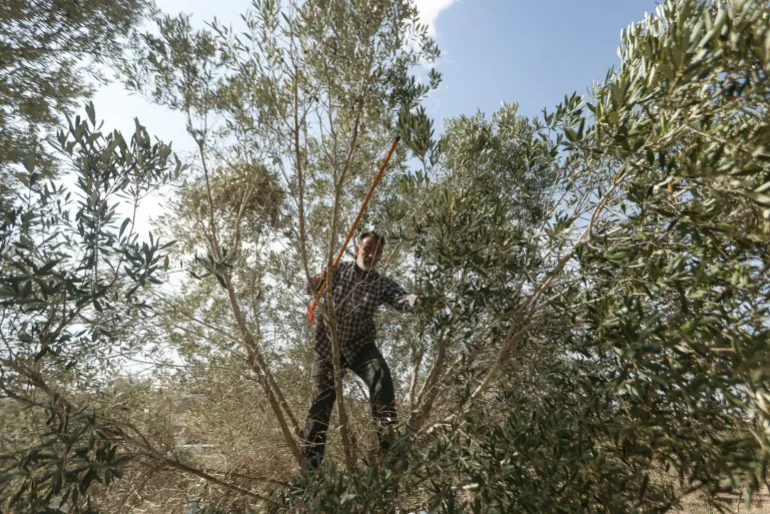
Two men have been killed in southern Lebanon’s Bint Jbeil district while taking part in an annual olive harvest, according to Lebanese state media and local authorities, as attacks by Israel continue.
One of the men died Sunday in the village of Froun from a munition left behind by recent fighting and the other in Yater as a result of Israeli shelling that “targeted the outskirts of the town while he was inspecting his land and olive harvest”, according to the official National News Agency (NNA).
Recommended Stories
list of 3 itemsend of list
The Lebanese army blamed Israeli tank fire and called the ongoing attacks “a flagrant breach of existing agreements”.
Afterwards, the Yater municipality urged residents “to avoid the outskirts of the town and refrain from crossing the earthen barrier separating some unsafe neighbourhoods” for fear of Israeli attacks.
In Froun, the NNA reported that “a foreign object” left over from previous Israeli operations exploded and killed the man, who was an engineer, as he and others tended their trees.
The engineer had come down from Beirut, where he lives, for the harvest, Froun mayor Hassan Bazzi told AFP.
The incident prompted local residents to call off the harvest and wait for “the Lebanese army to complete the decontamination of the village”, Bazzi said.
Displaced people
Since an agreement between Lebanon and Israel was struck in June, violence in the south has lessened, but not stopped.
Lebanon was pulled into conflict on March 2, when Hezbollah struck Israel in support of Tehran during the US-Israel war on Iran. Subsequently, Israel launched a bombing campaign and a ground invasion that authorities say have killed more than 4,300.
In August, Lebanon’s Prime Minister Nawaf Salam accused Israel of intentionally targeting homes and civilian infrastructure across the country. The International Organization for Migration (IOM) recorded nearly 350,000 internally displaced people in late August, a sign of the worsening displacement crisis.
One of the volunteers from Lebanon’s northernmost province of Akkar and the city of Sidon takes part in an olive-picking initiative in the southern Lebanese village of Jebchit near Nabatieh on October 11, 2026 [AFP]
Volunteers from the nearby town of Jebchit and locals came to help their southern neighbours with the harvest in an act of solidarity.
“From north to south, one people and one land,” said organiser Ahmad Chahhal.
CCTV footage released by Al Arabiya shows the moment of a Houthi strike on Riyadh’s international airport on Saturday. The attack killed at least 12 people and injured more than 300. A warning this video contains distressing images.
Zack Polanski calls for internal rule reforms to give party leaders greater control over policy after Zionism vote.
Published On 11 Oct 202611 Oct 2026
Zack Polanski, the leader of the United Kingdom’s Green Party, has proposed a potential overhaul of his party’s democratic mechanisms, calling for the leader to have larger control over strategic direction.
The appeal came in an article published in The Guardian on Sunday after party members passed a motion declaring that Zionism is racism at their annual conference on October 4 in a divisive vote.
Recommended Stories
list of 4 itemsend of list
Polanski also failed to grab a parliamentary seat in the wake of the row with Israel in a by-election.
The Labour Party won the election for the parliamentary seat vacated by former leader Keir Starmer in Holborn and St Pancras on Friday, fending off a strong challenge from the left-wing Green Party in a boost for British Prime Minister Andy Burnham.
“Our party democracy must now evolve to meet that – creating wider engagement for members, giving leaders more responsibility to set the party’s strategic direction, and making our processes as robust and accessible as possible,” he wrote.
“Above all, that unity must be deployed in the service of changing this country for the better,” the Green Party leader added.
Criticism over vote on motion
Polanski also replied to the criticisms of him for not participating in the vote on the motion on Zionism.
“I have been asked why I was not present for the vote. The answer is that my priority was fighting a hugely consequential by-election for our party,” he said, adding that he put all his “energy into the race in Holborn and St Pancras”.
He admitted that some members feel “let down” by his decision not to make an appearance there.
The Green Party’s motion, which called for “Palestinian liberation, the right of return, Boycott, Divestment and Sanctions (BDS), and a full arms embargo against Israel” was criticised by Jewish groups, other parties and most Green Party MPs.
After conceding defeat in the fiercely contested by-election, Polanski answered his critics, saying he would stay on as leader.
He was barred from entering Israel after his party backed a motion to define Zionism as racism.
Ethiopia and Eritrea have exchanged accusations of aggression at the United Nations, raising fears of a new conflict in the Horn of Africa region as fighting intensifies in Ethiopia’s northern Tigray region.
The diplomatic spat comes as Ethiopian troops and allied armed groups advanced across Tigray, where forces from Asmara have allegedly crossed the border to support rebels fighting the government forces.
The two neighbours, which fought a deadly border war between 1998 and 2000, were allies during Ethiopia’s devastating 2020-2022 Tigray war.
However, they have since been at loggerheads over the 2022 peace agreement that ended a two-year civil war between the government in Addis Ababa and Tigray rebels, and over Ethiopia’s demands for access to the Red Sea.
So, what did Eritrea and Ethiopia accuse each other of, and are they inching towards war?
What did Eritrea and Ethiopia say at the UN?
Eritrean troops had advanced as far as 60km (37 miles) into Tigray, Ethiopia told the UN Security Council on Friday, accusing its neighbour of violating its sovereignty.
In a letter, Ethiopian Foreign Minister Gedion Timothewos described the alleged incursion as “a blatant act of aggression that engages Ethiopia’s inherent right to self-defence”.
He invoked Article 51 of the UN Charter, which recognises a country’s right to self-defence, but did not specify what measures Ethiopia was taking.
Eritrea, which won independence from Ethiopia in 1993, rejected the accusations of incursions into Ethiopia, calling them a pretext for an Addis Ababa offensive.
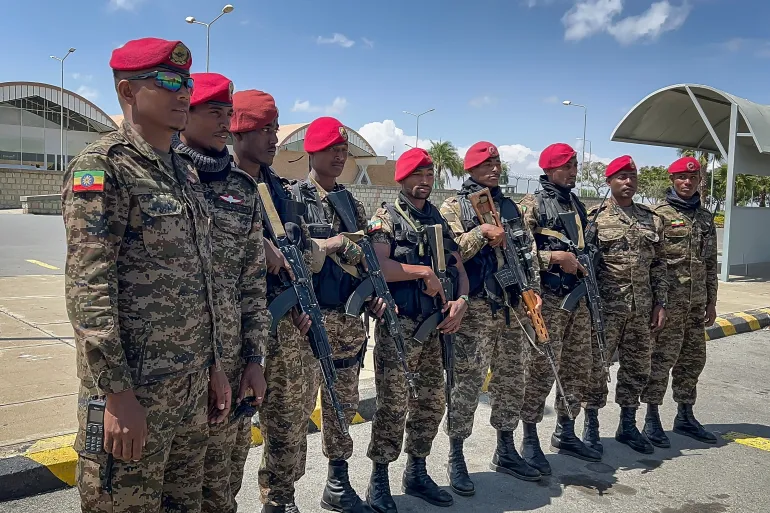
Members of the Ethiopian National Defense Force (ENDF) gather in front of Mekelle Alula Aba Nega International Airport after federal forces retook control of the facility in Mekelle, Ethiopia, October 6, 2026 [AFP]
Eritrean Foreign Minister Osman Saleh, in his own letter to the UN Security Council on Saturday, urged the body to condemn Ethiopia’s “deplorable declaration of war” and take “deterrent measures”.
He warned that an Ethiopian offensive would cause “huge devastation to the peoples of both countries and destabilise the whole region”.
The accusations come amid a broader dispute over access to the Red Sea.
Landlocked Ethiopia has repeatedly argued that securing direct sea access is essential, while Eritrea fears Addis Ababa intends to seize its port of Assab.
Ethiopian Prime Minister Abiy Ahmed reiterated on Monday that Ethiopia must have access to the Red Sea.
Hossamaldeen Ibrahim, an analyst at Bloomsbury Intelligence and Security Institute (BISI), said the narratives of both countries contain “verifiable elements”.
“The danger lies in the fact that each side now treats the other’s narrative as existential,” he told Al Jazeera.
Eritrea and Ethiopia fought a deadly border war from 1998 to 2000. Relations improved after Abiy came to power in 2018, but have soured again in recent years.
Professor Matthias Rompel from the Institute of Sociology at the Justus-Liebig-University Giessen in Germany, said that both sides have legitimate security concerns, but their accusations need to be distinguished from independently verified facts.
“Ethiopia’s allegations of Eritrean military incursions into Tigray… and …the scale of Eritrean involvement, and particularly allegations that Asmara is orchestrating the rebellion against Addis Ababa, remain difficult to substantiate independently,” he told Al Jazeera.
He added that the latest developments suggest that the confrontation is no longer merely about Tigray. “Ethiopia’s quest for Red Sea access, Eritrea’s concerns about sovereignty, and Egypt’s strategic rivalry with Ethiopia over the Nile are interconnected,” he said.
“The conflict, therefore, has the potential to destabilise the wider Horn of Africa, with repercussions for Sudan, Somalia and Red Sea security.”
What is the latest fighting about, and how is Eritrea allegedly involved?
Fighting escalated on September 23 when a rebel alliance, including the Tigray People’s Liberation Front (TPLF), launched attacks against Ethiopian government forces across Tigray, Amhara and Afar regions.
The rebels captured Tigray’s capital, Mekelle, and its airport before announcing their withdrawal on October 3. Government-allied forces subsequently entered the city.
In the latest on the battlefront, government and allied forces took Idaga Hamus early Friday and Abiy-Adi, in the Tembien area, on Thursday afternoon, according to Ermiyas Ababu, a commander of the government-allied Tigray Peace Force.
Residents, according to Reuters news agency, also reported the takeover of Idaga Hamus. Gebremedhin Kihishen, a business owner in Tembien, said government-allied forces controlled Abiy-Adi.
It was unclear from those accounts who held the towns immediately before the reported government advance or whether Eritrean troops were involved in the fighting.
Ermiyas previously reported Eritrean personnel entering Adigrat on Tuesday and Idaga Hamus on Wednesday, citing reports from his personnel. Al Jazeera was unable to independently verify the claims.
The Armed Conflict Location and Event Data Project (ACLED), a United States-based conflict monitor, reported that Eritrean troops crossed into Ethiopia near Zalambessa and came under Ethiopian drone attack while advancing towards Idaga Hamus. Eritrea has yet to comment on the development.
Addis Ababa accuses Asmara of financing, arming and directing armed groups, as well as deploying troops inside Tigray. Eritrea denies the allegations, which have not been independently verified.
The renewed fighting threatens to unravel the 2022 peace agreement.
That conflict began in November 2020 after months of tensions between Prime Minister Abiy Ahmed’s government and the TPLF, which had dominated Ethiopian politics for nearly three decades before Abiy took office in 2018.
Eritrea fought alongside Ethiopian federal forces against the TPLF, its longtime adversary. The war killed hundreds of thousands of people and was marked by allegations of massacres, sexual violence and widespread hunger.
The November 2022 Pretoria agreement ended major hostilities, but Eritrea was not a party to the deal. Relations between Addis Ababa and Asmara subsequently deteriorated.
Has Ethiopia sent troops north towards Eritrea?
Multiple media reports say Ethiopian government troops and allied militias entered Adigrat, a strategic city roughly 30km (19 miles) from the Eritrean border, on Saturday.
Three residents confirmed their presence to Reuters, while verified footage showed government-allied militia members walking through the city.
Associated Press news agency footage also showed Ethiopian military vehicles entering Adigrat as some residents welcomed the troops.
Government-allied forces have reported capturing Idaga Hamus and Abiy-Adi, while explosions and alleged drone strikes have been reported near Adigrat.
Are Ethiopia and Eritrea inching towards war?
Analysts warn that Ethiopia and Eritrea may already have moved beyond threats and into a dangerous phase of possible military confrontation.
BISI’s Ibrahim said the two countries have moved beyond “inching” towards war, noting that “The situation has entered a high-risk phase of limited but direct military confrontation with a real possibility of rapid escalation into interstate war.”
He warned that the severing of diplomatic ties removed the “last formal mechanism for crisis management”, while Ethiopian military advances towards the Eritrean border increased the risk of “miscalculation”.
Tom Gardner, a correspondent for The Economist, said the current tensions should be understood in the context of decades of hostility between the neighbours.
Their brief alliance during the 2020-2022 Tigray war was an exception and was driven by a shared hostility towards the TPLF, Gardner told Al Jazeera.
“The Ethiopian government’s strategic goal number one is access to the Red Sea, but also removing Eritrea’s government from the picture,” he noted.
“It’s very much looking like the most dangerous moment for the region since that 1998 to 2000 war.”
Rompel from Justus-Liebig-University Giessen said that the current situation is evolving. “The danger of a wider interstate conflict is real, and the situation has already moved beyond a purely diplomatic confrontation,” he said.
“The central danger is not necessarily that either government has decided to launch a full-scale war, but that military miscalculations, mutual distrust and domestic political pressures could trigger a further escalation neither side can easily control.
“A wider conflict is not inevitable, but the space for diplomatic de-escalation is rapidly narrowing,” he said.
US military jet strikes stern of commercial cargo ship in the Gulf of Oman ‘without harming the crew’, CENTCOM says.
Published On 11 Oct 202611 Oct 2026
United States forces have disabled a commercial cargo vessel in the Gulf of Oman after its crew “ignored repeated warnings and attempted to run the ongoing naval blockade against Iran”, according to US Central Command (CENTCOM).
A US military fighter jet struck the stern of the Panama-flagged M/V Ocean Molica, also known as the Arika Sun, with a precision munition on Saturday, “fully disabling the ship’s propulsion without harming the crew”, CENTCOM said in a statement. The vessel was attempting to transit regional waters after “having previously departed an Iranian port”.
Recommended Stories
list of 3 itemsend of list
CENTCOM said its forces resumed their blockade against all ships “entering or departing Iranian ports on July 14”, disabling four commercial vessels and turning around 135 ships during “three months of strict enforcement”.
US forces also destroyed 10 tankers linked to the Islamic Revolutionary Guard Corps’ (IRGC’s) “multibillion-dollar shadow network” over the same period, CENTCOM said.
Meanwhile, Iran’s IRGC said it struck a vessel in the Strait of Hormuz for attempting to take an “illegal route”, as Tehran seeks to enforce its own blockade on the vital waterway.
In a statement carried by official Iranian media, the IRGC claimed Iranian forces “have taken control of the administration of the strait”.
“In carrying out this mission, a few hours ago, a giant LPG carrier named NV Sunshine, owned by NatWit, which was attempting to transit via the illegal route south of the Strait of Hormuz, was struck,” the statement said.
Vessels in the Strait of Hormuz near the beach of Bandar Abbas, Iran, October 6, 2026 [Amirhosein Khorgooi/ISNA via WANA/Reuters]
The United Kingdom Maritime Trade Operations (UKMTO) agency said on Sunday that an outbound tanker in the strait was struck on the port side by an unknown projectile, causing a fire on board. The UK agency said crew members were reported safe, while the damage and environmental impact remained unknown at the time of the report.
Tehran has attempted to enforce control over the Strait of Hormuz during the US-Israel war on Iran, insisting that ships obtain permission to cross via its preferred routes. However, vessels have increasingly risked taking an alternative route hugging the strait’s southern coast.
The UKMTO said on Thursday that a vessel sailing 94km (58 miles) north of Madinat ash Shamal, off the north coast of Qatar, was struck by multiple projectiles, resulting in a number of casualties.
The agency did not specify the origin of the ship or the number of people killed or injured, adding that authorities were investigating the incident amid a recent rise in attacks on vessels near the Strait of Hormuz.
Ships in the Gulf attempting to cross the strait, which is the sole maritime route in or out of the oil-rich region, have faced repeated attacks since the US and Israel began the war in late February.
The Strait of Hormuz remains vital to the global economy, with about a fifth of the world’s oil and liquefied natural gas passing through the passage before the war began.
President Donald Trump says the US ‘may’ join Saudi strikes against Yemen’s Houthis following the latest attack on Riyadh airport. Trump made the comments before Saudi authorities confirmed 12 people were killed and more than 300 were injured in that attack.
Physicians accuse Israeli Medical Association of remaining silent as Palestinian healthcare is systematically destroyed.
Hundreds of doctors have gathered outside the World Medical Association (WMA) summit in the Netherlands, calling for the suspension of the Israeli Medical Association (IMA) from the grouping of physicians.
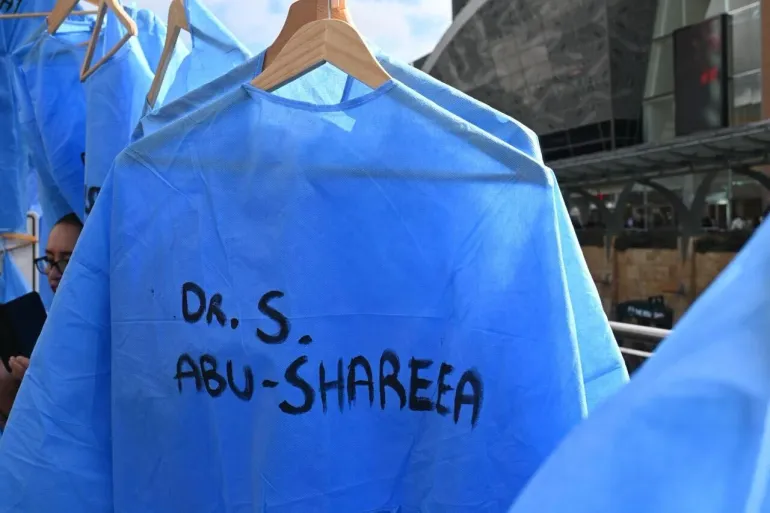
On Saturday, 81 healthcare workers removed their scrubs and hung them in a line facing the WMA assembly in Rotterdam, each bearing the name of a Palestinian healthcare worker currently held in illegal Israeli detention.
Recommended Stories
list of 3 itemsend of list
It was part of a protest against the continued membership of the Israeli association in the WMA, “despite them breaching almost every ethical principle in the WMA’s Code of Medical Ethics”, the IMA Out! coalition that organised the demonstration said in a statement.
“These scrubs should not be empty. Our colleagues belong with their patients, not in Israeli prisons. Today, we literally placed their names at the WMA’s doorstep,” said Mejrem Ahmetaj, a general practitioner and member of IMA Out!.
Since October 2023, Israel’s genocidal war on Gaza has killed more than 1,700 Palestinian healthcare workers and destroyed nearly all the hospitals and healthcare facilities in the enclave.
The campaign accused the Israeli medical association of remaining silent as Palestinian healthcare has been systematically destroyed.
“The IMA is not a bystander. It defends these attacks and blocks international condemnation while Palestinian healthcare is being destroyed. That is not medical neutrality. That is complicity,” added Ahmetaj.
Empty scrubs containing names of detained Palestinian healthcare workers hang outside the WMA summit [Courtesy of IMA OUT! campaign]
At a meeting of international doctors, medical leaders and human rights activists during the WMA summit on Thursday, the destruction of Palestinian healthcare and the responsibility of the international medical community were discussed, the campaign said.
“Our Palestinian colleagues are being killed and imprisoned, where they are starved and tortured. Their hospitals have been destroyed and patients driven out or murdered. The IMA has said and done nothing about these war crimes against health workers, patients and hospitals,” said a statement by Jonathan Fluxman on behalf of IMA OUT!.
“Thirty years of WMA dialogue with the IMA has done nothing but give the IMA a sense of impunity … It is time for national medical associations and the WMA to speak out and take action. Break your ties with the IMA and suspend the IMA from the WMA now,” he added.
The IMA OUT! campaign said it delivered a petition calling for the IMA’s suspension, signed by more than 6,500 health workers from around the world.
They also demanded accountability for the complicity of Israeli doctors in the starvation, torture and medical neglect of Palestinian prisoners.
Among those held by Israel is Dr Hussam Abu Safia, head of Gaza’s Kamal Adwan Hospital, whose unlawful detention has prompted an international outcry.
He was briefly held at the notorious Sde Teiman detention camp and has been subject to torture and medical neglect. Doctors protesting in Rotterdam held up placards demanding his release.
Abu Safia’s son Elyas, addressing a meeting organised by the campaign, said, “My father and all Palestinian detainees must be treated in accordance with medical ethics, and doctors must abide by the Hippocratic oath they have taken. Care cannot be given based on whose life is deemed worthy.”
President Lai emphasises peace and freedom, vows not to tolerate aggression in Taiwan Strait.
Published On 10 Oct 202610 Oct 2026
Taiwan’s President Lai Ching-te has said the island “cherishes peace” and will “not give up our freedom” in a National Day speech outside the Presidential Office in Taipei.
Lai made the remarks on Saturday before thousands of people, including foreign diplomats.
Recommended Stories
list of 3 itemsend of list
“We are open to exchanges, but will not accept subordination,” he said. “Our aim by increasing investment in national defence is not to provoke; rather, it is to deter war.”
Taiwanese fighter jets and two Chinook helicopters carrying giant Taiwan flags flew over the capital ahead of the speech.
The holiday marks the 115th anniversary of a 1911 uprising that toppled China’s last imperial dynasty and led to the founding of the Republic of China.
Pressure from China
Taiwan’s 23 million people live under the constant threat of an attack by China, which insists the island is part of its territory, has never renounced the use of force to take it, and calls Lai a “separatist”.
Beijing has rebuffed his offers of talks.
Lai said China continued to “apply pressure through military and grey-zone activities in an attempt to alter the status quo across the Taiwan Strait”.
Grey-zone tactics are actions that stop short of open war. “Peace cannot rely solely on wishes, and tolerance cannot become a pretext for aggressors to encroach ever further,” he added.
Lai’s government has set aside a record 1.1 trillion New Taiwan dollars ($34.5bn) for defence in 2027, more than 3 percent of gross domestic product.
China held war games around the island shortly after Lai’s first National Day speech in 2024, but not last year. Its last drills near Taiwan were in late December, after news of an $11bn arms deal with Washington, the largest ever US weapons package for the island.
Lai said he welcomed talks between the United States and China, but insisted “there must be respect for the right of the people of Taiwan to exist”.
He urged democracies in the Indo-Pacific to join forces to preserve peace and stability in the region.
The US switched official diplomatic relations from Taipei to Beijing nearly 50 years ago but remains Taiwan’s most important security backer.
Officials in Washington and Taipei have repeatedly said US policy on Taiwan has not changed under President Donald Trump.
In May, after meeting Chinese President Xi Jinping in Beijing, Trump suggested arms sales to Taiwan could be a bargaining chip with China, which set off alarm across the world.
Taiwan is now waiting for Trump to sign off on $14bn worth of weapons, including the US-made Patriot air defence system.
The dispute dates back to China’s civil war, when the nationalist forces of Chiang Kai-shek retreated to Taiwan in 1949 after defeat by Mao Zedong’s communists.
The Republic of China remains the island’s formal name.












![Members of the Ethiopian National Defense Force (ENDF) gather in front of Mekelle Alula Aba Nega International Airport after federal forces retook control of the facility in Mekelle, Ethiopia, October 6, 2026 [AFP]](https://i0.wp.com/occasionaldigest.com/wp-content/uploads/2026/10/AFP__20261006__D2CC4C4__v1__HighRes__EthiopiaTigrayConflictUnrest-1791393629.jpg?w=640&ssl=1)


![Empty scrubs containing names of detained Palestinian healthcare workers hang outside the WMA summit [Courtesy of IMA OUT! campaign]](https://i0.wp.com/occasionaldigest.com/wp-content/uploads/2026/10/3c28041b-ba64-4a61-a62b-bb02868f9e39-1-1791663288.jpg?w=640&ssl=1)