conflict

The Mali crisis could have a dangerous spillover effect | Conflict

It has been almost nine months since rebel groups imposed a fuel blockade on Mali’s capital Bamako. In late April, the conflict escalated further. The Al-Qaeda-affiliated Jama’at Nusrat al-Islam wal-Muslimin (JNIM), along with members of Tuareg separatist movements, launched a coordinated attack on the Malian army and its Russian allies, the African Corps (formerly Wagner), which killed the Malian Defence Minister Sadio Camara.

The rebels seized control of military camps, recaptured the largest northern city of Kidal, and tightened the blockade on Bamako. This latest offensive is part of a long series of rebellions in what the Tuareg call Azawad, an area comprising the regions of Timbuktu, Taoudenit, Kidal, and Gao, which is predominantly populated by Tuareg communities.

The present crisis is compounded by the weakening of the Malian state following the 2021 coup and foreign intervention. In the absence of any serious effort to address it, instability could spill over across the whole Sahel region.

Ever since the country announced independence from France in 1960, Mali’s north has seen repeated upheaval as local Tuareg communities have demanded self-determination. Fourteen years ago, Tuareg groups allied with groups affiliated with al-Qaeda launched yet another rebellion. They managed to seize several cities in northern Mali, and had it not been for a French military intervention in 2013, they could have marched on Bamako.

Two French operations resulted in the weakening of the Tuareg movements and groups affiliated with al-Qaeda. This helped persuade them to participate in negotiations with the government, which ultimately ended with the signing of the Algiers Accords in 2015.

One of the most prominent clauses of this agreement was decentralisation in the Azawad region, which gave local leaders more power. Through this agreement, the Malian government secured the country’s territorial integrity in return for promises like the enhancement of development in the Azawad region, the integration of separatist fighters into the army, and the appointment of their leaders to political positions.

These accords helped maintain relative stability in Mali and the Sahel region by containing the sources of tension and secessionist calls. However, peace did not last long. Several challenges emerged, the most important of which was the failure of the government to honour its commitments to implement development projects in the north.

The situation got worse after the 2021 military coup led by General Assimi Goita. France, Algeria, and members of the Economic Community of West African States (ECOWAS) refused to recognise the new authorities in Bamako. As a result, in 2022, the military government expelled French troops, and in 2024, abolished the Algiers Agreement. Thereafter, instead of diplomacy and dialogue, it adopted a militarised approach to controlling the restive north.

These steps strained Mali’s relations with Mauritania, Algeria, and France, with Bamako accusing them of providing logistical support to the rebels and interfering in its internal affairs. Consequently, the Malian state was weakened militarily and economically, as military coordination and trade with neighbours declined.

JNIM and the separatist movements exploited the situation. They sought to choke the capital by attacking key transport arteries where most imports and exports are routed. They disrupted supplies of gasoline and diesel coming from Senegal and the Ivory Coast, and began attacking Moroccan trucks carrying food supplies via Mauritania.

Like in 2012, the alliance between the Tuareg movements and al-Qaeda affiliates has proven successful. It has routed the Malian military, capturing more territory and operating freely close to Bamako.

This time, foreign forces have not been able to help the Malian army, as its Russian allies were forced to withdraw following the attack in late April. Meanwhile, Turkiye has seen its involvement in Mali grow amid growing instability. In early May, following the attacks on the Malian military, Ankara signed several defence agreements with the Malian military government.

The danger here is that the Malian crisis may not be contained only within the political crisis between the government and the separatist movements. It could also invite more foreign intervention as regional and global rivalries transfer onto Malian territory.

There is also the issue of the alliance between Azawadi movements and al-Qaeda affiliates, which could prove to be a ticking time bomb. There are clear contradictions within this relationship, as the two sides have no common ground except the agreement to overthrow the military regime in Bamako. This is why a future war in the north between the Azawadi movements and the Islamist groups is quite likely.

The Malian crisis inevitably has regional repercussions. The ongoing humanitarian crisis could trigger a major migration wave towards Europe and North America. Continuing instability in the north could open more space for the growth of extremist movements, which can expand their attacks across the region. Consequently, the Malian crisis can become a direct security threat to neighbouring countries, the region, and the world.

As the situation stands now, no warring side is able to achieve a decisive military victory. Therefore, a resolution of the conflict can only be achieved through dialogue and negotiation. Bamako needs to seriously consider the grievances of Tuareg communities in the north and their demands.

It is in the collective interest of neighbouring countries and regional powers to bring the parties to the negotiating table and seek peaceful solutions to this crisis. Under the threat of a regional spillover, there is no time to waste.

The views expressed in this article are the author’s own and do not necessarily reflect Al Jazeera’s editorial stance.

Source link

Mexico says it will host Iranian team during 2026 FIFA World Cup | World Cup 2026 News

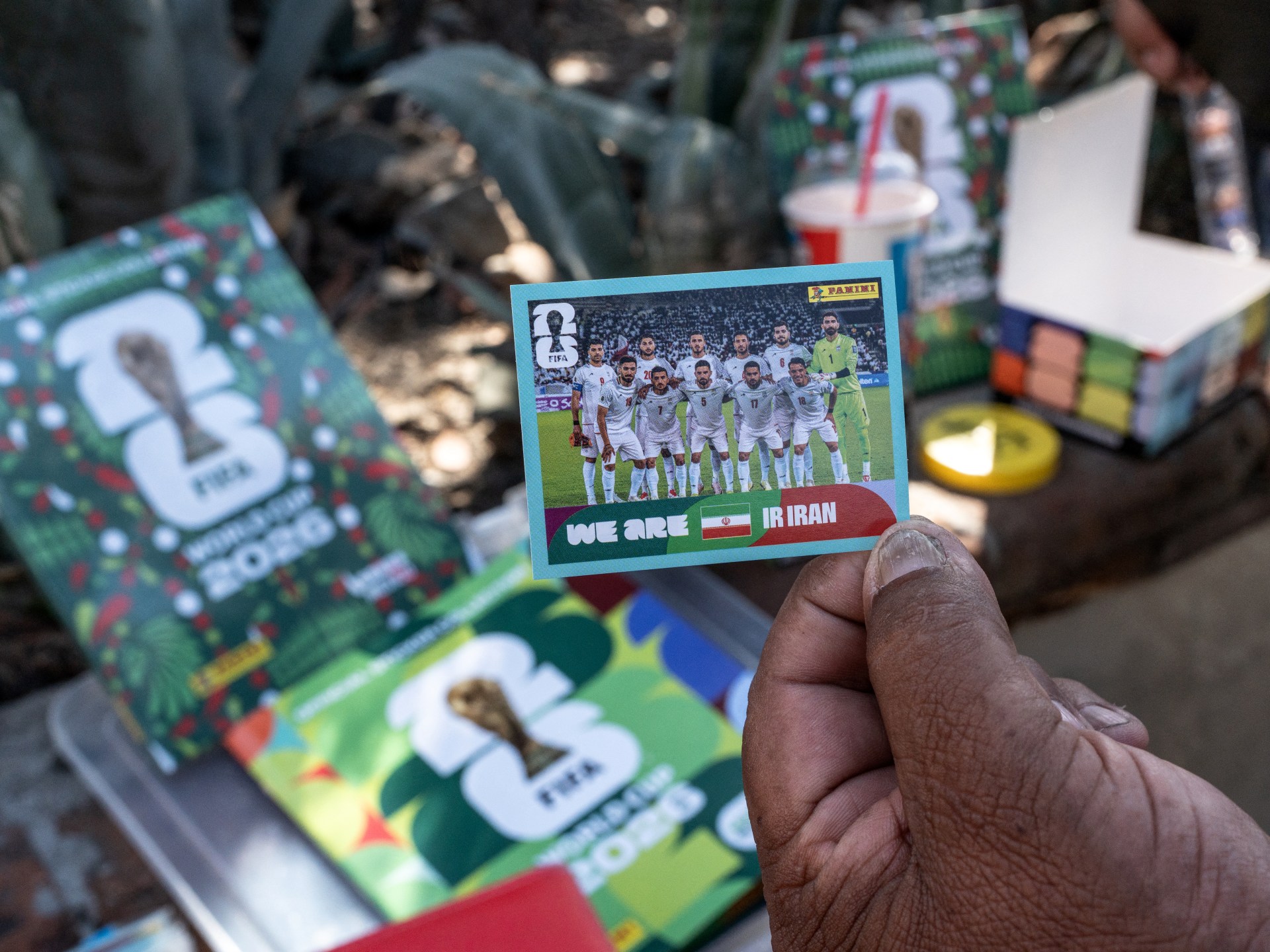
Mexican President Claudia Sheinbaum has announced that her country will host the Iranian national football team during the upcoming FIFA World Cup, due to tensions with the United States.

On Monday, Sheinbaum said that FIFA, the global football governing body, had approached Mexico about hosting Iran, after the US said it did not wish to do so.

Recommended Stories

list of 3 itemsend of list

“We have no reason to deny them the possibility of staying in Mexico,” Sheinbaum said during her daily media conference.

Previously, Iran had been scheduled to play all three of its group matches in the US.

But the administration of US President Donald Trump has previously said it is not “appropriate” for Iranian team members to be in the country, “for their own life and safety”.

It has yet to grant the Iranian team the necessary visas to travel to the US, despite Trump’s assertion that players and staff would be “welcome”.

Since February 28, the US and Israel have been at war with Iran, and peace negotiations are tense but ongoing.

The head of Iran’s football federation, Mehdi Taj, confirmed on Sunday that the team planned to move its training base from Tucson, Arizona, to the Mexican border city of Tijuana.

Taj explained that team leaders got approval for the move after meeting with FIFA officials in Istanbul, as well as holding an online conference with FIFA’s Secretary General, Mattias Grafstrom.

Switching the team’s base to Mexico, Taj said, would help avoid visa complications, with the team able to travel directly to Mexico aboard Iran Air flights.

But the US-Israeli war against Iran has cast a pall over the World Cup, making the Iranian team’s participation uncertain.

Roughly 3,468 people have been killed in Iran since February’s war began, and more than 26,500 have been injured. Further fatalities have been reported across the region.

The war has also thrown the global economy into turmoil, driving up the costs of fuel and agricultural fertiliser, among other goods.

Iran’s football team has long been a top squad in its region: It currently ranks near the top of the Asian Football Confederation. Its participation in the 2026 tournament marks its fourth straight World Cup qualification.

Trump, however, has sent mixed messages about Iran’s presence at the World Cup, suggesting at times that Iran should sit out the tournament. At other moments, he has expressed ambivalence.

In March, for instance, Politico asked Trump about Iran’s presence at the World Cup. Trump reportedly responded, “I really don’t care”, before calling Iran a “badly defeated country”.

The US, Mexico and Canada are co-hosting the games, with 78 matches in the US alone, including the final. Kick off is on June 11.

Iran is set to play its first two Group G matches in Los Angeles against New Zealand on June 15 and Belgium on June 21, before facing off against Egypt in Seattle on June 26.

The Trump administration’s hardline approach to immigration has raised additional concerns about whether the US will be a welcoming host for fans from around the world.

Already, Trump has moved to suspend visa processing for applicants from nearly 75 countries, including Iran, Brazil, Colombia, Ivory Coast and Senegal, which have teams at the World Cup.

Residents from some of those countries, however, are not required to receive visas to enter the US for short-term visits.

On Monday, Sheinbaum explained that she had been approached by the Iranian team and FIFA officials for help hosting players and staff.

“The United States doesn’t want the Iranian team to spend the night,” Sheinbaum said. “So they asked us, ‘Can we stay the night in Mexico?’ We said sure, no problem.’”

Source link

Train bomb in Pakistan’s Baloch region: Why violence is on the rise | Armed Groups News

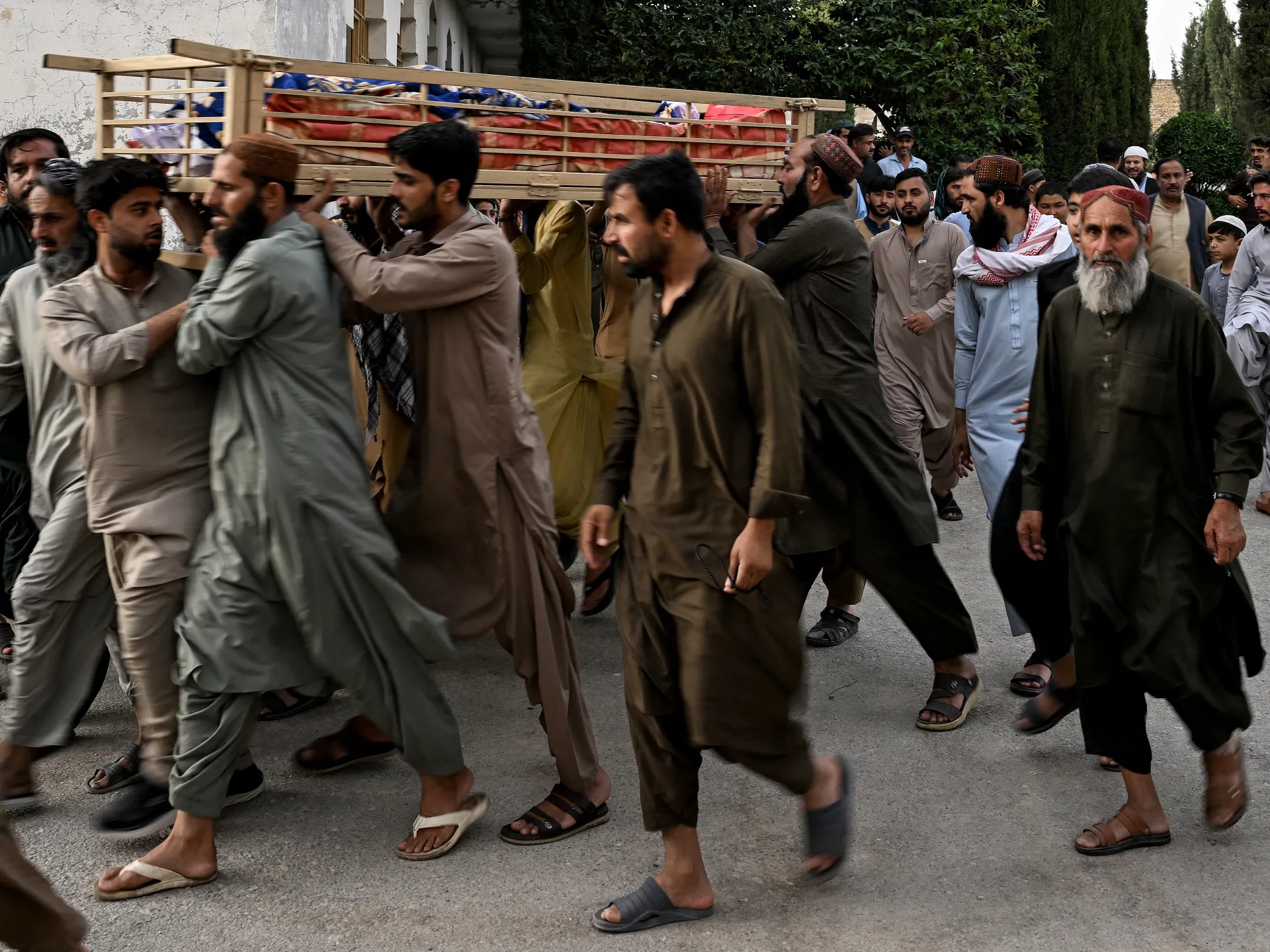
At least 24 people were killed and more than 50 injured when a suicide car bomb detonated on a train carrying soldiers in Quetta, capital of the southwestern Pakistani province of Balochistan, on Sunday.

The attack came amid Pakistan’s Prime Minister Shehbaz Sharif’s four-day visit to China, and the day before his meeting in Beijing with China’s President Xi Jinping, marking 75 years of diplomatic ties between the two nations.

Pakistan is among an exclusive group of countries China regards as an “all-weather strategic partner”, with ties featuring close economic, trade and security cooperation.

Responsibility for the train attack was claimed by the Balochistan Liberation Army (BLA), an armed Baloch separatist group which, apart from calling for an independent state, also strongly objects to large-scale Chinese investment in the region.

While the BLA has long carried out attacks that have killed civilians and members of the security forces in Balochistan and beyond, there has been a recent uptick in such incidents.

We examine what is behind this increase in attacks:

What happened in Sunday’s attack?

Reporting from the scene, Al Jazeera’s Kamal Hyder said several houses and buildings adjacent to the railway line were severely damaged in the blast, which caused train carriages to overturn and catch fire.

According to local media reports, a state of emergency was declared at public hospitals in Quetta, with doctors and other medical staff ordered to remain on duty.

Footage shared online showed charred vehicles and train carriages lying on their sides, with thick plumes of black smoke rising into the sky.

Pakistan has experienced several attacks by separatist groups in recent months. The attacks have increased in ferocity and have also targeted Chinese workers amid protests over Beijing-backed infrastructural projects in Balochistan.

As part of the China-Pakistan Economic Corridor project – one of the main arms of China’s “Belt and Road Initiative” designed to improve trading routes – China’s Xinjiang region has been connected to Pakistan’s deep-sea Gwadar port on the Arabian Sea in Balochistan.

Pakistani Prime Minister Sharif condemned Sunday’s train attack in Quetta in a post on X.

“Such cowardly acts of terrorism cannot weaken the resolve of the people of Pakistan. We remain steadfast in our determination to eliminate terrorism in all its forms and manifestations,” he said.

He added that while initial reports indicated a suicide bombing, this has not been officially confirmed. If it is, Yunas Samad, an emeritus professor of South Asian Studies at the University of Bradford in the UK, told Al Jazeera, “this would reflect tactics that insurgent organisations in the region have increasingly adopted over recent years”.

“There are also persistent claims regarding the circulation of sophisticated weaponry originating from stockpiles left behind after the US withdrawal from Afghanistan,” he said.

Are we seeing a new phase of armed separatist attacks in Balochistan?

According to research gathered by the independent, Islamabad-based think tank Pakistan Institute for Peace Studies, Balochistan recorded at least 254 attacks in 2025 – roughly 26 percent more than in 2024.

A December 2025 report published by independent conflict monitor Armed Conflict Location and Event Data (ACLED) found that separatists had also intensified attacks and pressure on security forces. The report said the number of attacks using improvised explosive devices (IEDs) and grenades, mainly targeting convoys and police stations, grew by more than 65 percent in the first 11 months of 2025, compared to the same time period in 2024.

The Global Terrorism Index (GTI) report this year found that there has been more Baloch armed group activity in Pakistan in 2025 as well. The GTI is an annual report published by the Australia-based independent think tank Institute for Economics and Peace (IEP).

Its 2026 report states that the BLA was responsible for Pakistan’s largest terror attack of 2025 – when the Jaffar Express, a train travelling from Quetta to Peshawar, was hijacked in March.

The BLA claimed responsibility and reported that six military personnel had been killed. Hundreds of people were taken hostage from the train, which was carrying 400 passengers.

“What can reasonably be said is that, following the earlier coordinated attack on the Jaffar Express, the Pakistani authorities appear to have intensified security measures around transport infrastructure, military personnel and key lines of communication,” Samad, of Bradford University, told Al Jazeera.

“The fact that this latest incident nevertheless occurred may suggest that militant groups retain a significant operational capability despite those efforts,” he noted.

The group stunned Pakistan’s security establishment in 2022 when it ‌stormed army and navy bases. In August 2024, militants carried out coordinated ⁠attacks across Balochistan, including highway assaults in which passengers were pulled from buses and shot after identity checks.

“While statistics in such conflicts are always contested and should be treated cautiously, they do indicate that the intensity of the conflict has not significantly diminished,” Samad said.

“Whether this constitutes an entirely ‘new phase’ is perhaps too strong a conclusion at present. However, it does appear to indicate a degree of resurgence in militant capability and confidence among sections of the Baloch insurgency.”

Who are the BLA and major Baloch armed groups?

The BLA, which has a suicide squad called the Majeed Brigade, says it is fighting for the independence of Balochistan, a province located in Pakistan’s southwest and bordering Afghanistan to the north and ⁠Iran to the west.

It is the largest of several ethnic separatist groups that have been fighting the federal government for decades. Balochistan’s mountainous border region serves as a safe haven and training ground for both Baloch separatist fighters and Islamist armed groups.

The BLA often targets infrastructure and security forces in Balochistan, but has also struck in other areas – most notably the southern port city of Karachi.

The BLA has deployed women suicide bombers, including in an attack on Chinese nationals in Karachi, and was designated a “foreign terrorist organisation” by the United States in August 2025 in a move welcomed by the Pakistani government. Analysts say BLA is particularly known for its ability to recruit young, often well-educated fighters.

The group, separately, was at the centre of tit-for-tat strikes in 2024 between Iran and Pakistan over what each said were armed group bases on each other’s territory, which brought the neighbours to the brink of war.

What is the Baloch cause?

Home to about 15 million of Pakistan’s roughly 240 million people, according to the 2023 census, Balochistan is the country’s poorest region despite its wealth of natural resources, including coal, gold, copper and gas.

These resources generate significant revenue for the federal government – unfairly, according to the BLA, which wants Balochistan’s natural wealth to belong to its people and rejects federal control over resource extraction and security.

The province is Pakistan’s largest by area, but smallest by population. It has a long Arabian Sea coastline, not far from the Gulf’s Strait of Hormuz oil shipping lane.

Balochistan is also home to one of Pakistan’s major deep-sea ports at Gwadar, a crucial trade corridor for China’s $65bn investment in the China-Pakistan Economic Corridor (CPEC), a wing of President Xi Jinping’s Belt and Road initiative.

The province is home to key mining projects, including Reko Diq, which is operated by Canadian mining giant Barrick Gold and is believed to be one of the world’s largest gold and copper mines.

China also operates a gold and copper mine in Balochistan.

The province – which was annexed by Pakistan in 1948, six months after partition from India in August 1947 – has a long history of marginalisation. It has since experienced at least five separatist uprisings.

Separatist sentiment was particularly high in the 2000s, around the time the BLA emerged. Analysts of Baloch resistance movements say it was led by Balach Marri, the son of veteran Baloch nationalist leader Nawab Khair Bakhsh Marri.

After the government of military ruler Pervez Musharraf killed prominent Baloch nationalist leader Nawab Akbar Bugti in 2006, the separatist movement escalated.

Rebel fighters have targeted Pakistan’s army and Chinese interests, in particular the strategic port of Gwadar on the Arabian Sea, accusing Beijing of helping Islamabad to exploit the province. Fighters have killed Chinese citizens working in the region and attacked Beijing’s consulate and language centre in Karachi.

More recently, the BLA has also attacked civilians and migrant labourers from other provinces, a shift that officials say marks an escalation in tactics.

Pakistan accuses India and Afghanistan of backing Baloch armed fighters, an allegation both countries deny.

“Baloch separatist groups themselves have, at times, sought to internationalise their cause and last year publicly appealed for diplomatic recognition by India,” Samad said.

“However, establishing clear evidence of direct state support is considerably more difficult, and much of the discussion in this area remains politically contested.”

Hundreds of Baloch activists, many of them women, have protested in Islamabad and Balochistan over alleged abuses by security forces – accusations the government denies.

Over time, the BLA has set itself apart as a group explicitly committed to Balochistan’s full independence from Pakistan. Unlike more moderate Baloch nationalist parties, which press politically for greater provincial autonomy, the BLA has consistently rejected compromise.

Why is this significant now?

Regional stability and international investment

The attack comes as Prime Minister Sharif meets with China’s President Xi in Beijing to discuss economic and security cooperation – something the BLA is strongly opposed to.

The movement could pose a challenge to Pakistan’s attempts to retain Chinese and American investment, experts say, if it reveals a deeper instability.

The Baloch separatist movement is one of the major unresolved questions over Pakistan’s statehood. It is a constant reminder of the challenges of the Pakistani state to stay united, they say.

“More broadly, the persistence of insurgency has had implications for Pakistan’s wider political system,” Samad explained. “Security concerns in Balochistan have increasingly shaped governance and political discourse, strengthening the role of the military and security establishment in national affairs and undermining the democratisation process.”

“Internationally, the issue matters because Pakistan remains a nuclear-armed state of enormous strategic importance,” Samad told Al Jazeera.

“While speculation about state fragmentation is highly premature, any significant escalation in internal instability in a country with nuclear capabilities inevitably attracts international concern. For that reason alone, developments in Balochistan are likely to remain closely watched both regionally and globally.”

Rare-earth metals

Another major issue is that geological assessments suggest Balochistan contains 12 of the 17 rare-earth minerals on the periodic table. Rare earths are critical minerals used to manufacture a vast array of modern items, including batteries, clocks, wiring, military hardware, smartphones and semiconductors, among other technological products.

Since the start of his second term, US President Donald Trump has repeatedly pushed plans to diversify Washington’s stockpile of critical minerals in order to reduce reliance on China, which currently dominates the supply and processing of the world’s rare-earth minerals.

When Pakistan’s Prime Minister Sharif met with Trump at the White House in September 2025, he offered the US access to critical minerals and rare earths.

Then, in December 2025, the US announced a $1.25bn investment in critical minerals mining at Reko Diq to drive “economic growth in Balochistan”.
Source link

Iran recounts historic battles in response to Trump’s talk of agreement | US-Israel war on Iran News

Tehran, Iran – Iran and the United States have evoked historical and geographical references to the MENA region as the world awaits the announcement of a possible deal to end the conflict between the two countries.

Iranian officials have revived key moments in the nation’s history to drive forward a message of a David-versus-Goliath battle between the two sides, with the underdog ultimately victorious.

This comes as US President Donald Trump announced that a deal with Iran had been “largely negotiated”, with Tehran also indicating there could be an agreement soon. Both sides have been keen to portray any deal to end their 66-day conflict as a victory.

Historic messaging

Iran’s Foreign Ministry spokesman Esmaeil Baghaei drew parallels to the march of the Romans against the Persians in the third century, with the invading party ultimately being forced to “come to terms” with the latter.

Baghaei also posted an image of Roman Emperor Valerian after he was captured by Persia’s King Shapur I in the year 260. It is an illustration repeatedly drawn on by Iranian authorities in recent months to evoke nationalist sentiments and promote the idea that the country is again bravely standing up to another invading force.

Sunday also happened to mark the anniversary of a more recent conflict, when Iran – under a new revolutionary government still in place today – fought an eight-year war with its neighbour, Iraq, from 1980 to 1988.

Every year, the Islamic Republic celebrates the 1982 recapture of Khorramshahr, a city with an Arabic-speaking majority in the western Iranian province of Khuzestan.

Khorramshahr marked a turning point for the Iranian side in a protracted war that killed hundreds of thousands from both sides, with that battle being one of the bloodiest.

It has been used in government discourse and messaging during the latest war with the US and Israel to symbolise the country’s long history of resistance and determination to maintain the sovereignty of its lands.

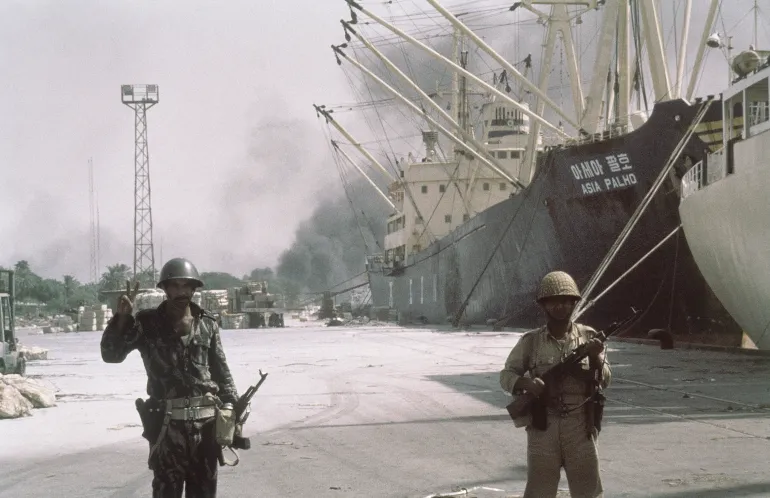
Iraqi forward troops stand guard over shipping at the dockside in occupied Khorramshahr, Iran on Oct. 7, 1980. (AP Photo)
Iraqi troops stand guard over shipping at the dockside in occupied Khorramshahr, Iran, October 7, 1980 [AP Photo]

Ahmad Vahidi, the commander-in-chief of Iran’s Islamic Revolutionary Guard Corps (IRGC), used the battle to signal that Tehran would continue to fight the US and Israel in the region.

“The liberation of Khorramshahr is a lasting model for victory in future Khorramshahr, and the liberation of Quds sharif [Jerusalem], and the destruction of the evil Zionist regime by the axis of resistance and the fighters of the Islamic world,” he said, in reference to Israel.

Masoud Pezeshkian, Iran’s relatively moderate president, linked the event to the current standoff.

“Iran’s Khorramshahr today is the Persian Gulf and the Strait of Hormuz,” he wrote on X. “Resistance, sacrifice and fighting off aggression are rooted in the culture of this land.”

Preparing for peace

Mohammad Mokhber, an adviser to Iran’s slain Supreme Leader Ayatollah Ali Khamenei, said both former Iraqi leader Saddam Hussein and US President Donald Trump failed to fully recognise Iran’s power when starting a war.

“The first was buried in the trenches of Khorramshahr, while the second has been afflicted with a political crisis in a quagmire created by the Zionist regime,” he wrote on X.

Kazem Gharibabadi, a member of Iran’s negotiating team and its deputy foreign minister for international affairs, linked the issue of Khorramshahr with the United Nations Charter and the country’s current concerns.

“Any nation that falls victim to aggression and occupation has an intrinsic right for legitimate defence to safeguard its territory, independence and integrity,” he said.

Gharibabadi added that Tehran is currently following the same logic of “peace-seeking paired with power, diplomacy paired with integrity and decisive defence”.

First Vice President Mohammad Reza Aref said the recapture of the city in 1982 showed that the new government could defeat aggression on its own terms.

Tehran now aims to “overcome our savage enemy” through holding its ground, he wrote on X.

The latest barrage of messaging from leaders in Tehran came after Trump appeared to suggest that he wanted to take control of Iran.

On his Truth Social account on Saturday, the US president posted a photo of the US flag covering the map of Iran, with the question: “United States of the Middle East?”

In response, the X accounts of multiple Iranian embassies abroad posted a US map covered with the flag of the Islamic Republic, with the question: “United States of Iran?”

The Trump administration has emphasised that it wants a long-term suspension of uranium enrichment in Iran and the extraction of high-enriched nuclear material from the country.

It also wants the Strait of Hormuz – through which one-fifth of the world’s oil shipments normally pass, but which Iran has blockaded – reopened fully without any tolls from Iran, officials have said.

Israeli officials have remained largely silent about a US deal with Tehran, but have reportedly been pushing to resume the war.

Source link

Israeli attack on Gaza kills three family members, including infant | Israel-Palestine conflict News

Mohammad Abu Mallouh, ​Alaa Zaqlan and their child, Osama, killed in the attack on the Nuseirat refugee camp, medics say.

An Israeli air raid on a home in Gaza has killed three members of a family, including a six-month-old child, medical workers said, as Israel continues to violate the “ceasefire” brokered by the United States last year.

Al-Aqsa Martyrs Hospital in Deir el-Balah in central Gaza said it received the bodies of a couple and their young child in the early hours of Sunday morning.

Recommended Stories

list of 3 itemsend of list

Medics identified those killed in the attack on an apartment in the Nuseirat refugee camp as Mohammad Abu Mallouh, his wife Alaa Zaqlan, and their child Osama, the Reuters news agency reported.

Medical workers said about 10 people were wounded in the attack.

There was no immediate comment from the Israeli military.

Since the “ceasefire” came into effect in October, Israel has continued with its near-daily attacks across the besieged Palestinian territory, which Gaza health authorities say have killed nearly 900 people.

Reporting from Gaza City, Al Jazeera’s Hani Mahmoud said Israeli bombing began on Sunday as Palestinians were fleeing following forced displacement orders. He said many people ran while carrying personal belongings, including mattresses.

Separately, Israeli forces continued demolishing homes and civilian infrastructure in eastern Gaza on Sunday behind Israel’s so-called “Yellow Line”, referring to Israeli-designated military zones and buffer areas inside the enclave, he said.

Israeli jets also carried out air raids on Deir el-Balah in central Gaza on Sunday, causing extensive damage near a hospital, Mahmoud said.

Earlier this month, the Gaza Government Media Office said it had documented at least 2,400 Israeli violations in the first six months of the ceasefire, including more than 1,100 air raids and at least 921 shootings targeting civilians.

More than 72,000 Palestinians have been killed since Israel launched its genocidal war on Gaza in October 2023. Israeli officials acknowledged the data was broadly accurate in January, after casting doubt on their credibility for two years.

On Saturday, five police officers and a 13-year-old boy were killed in an Israeli attack.

Talks between Israel and Hamas aimed at reaching a permanent end to the war have stalled, with both sides accusing each other of violating the ceasefire. Israel says Hamas’s refusal to disarm is a key obstacle, while the Palestinian group says negotiations have been paused due to continued violations and restrictions on aid entering Gaza.

Earlier this week, Human Rights Watch said the territory’s humanitarian infrastructure remained in peril, more than six months after the start of the ceasefire.

Source link

Overnight Israeli strikes on Gaza leave behind heavy destruction | Israel-Palestine conflict

NewsFeed

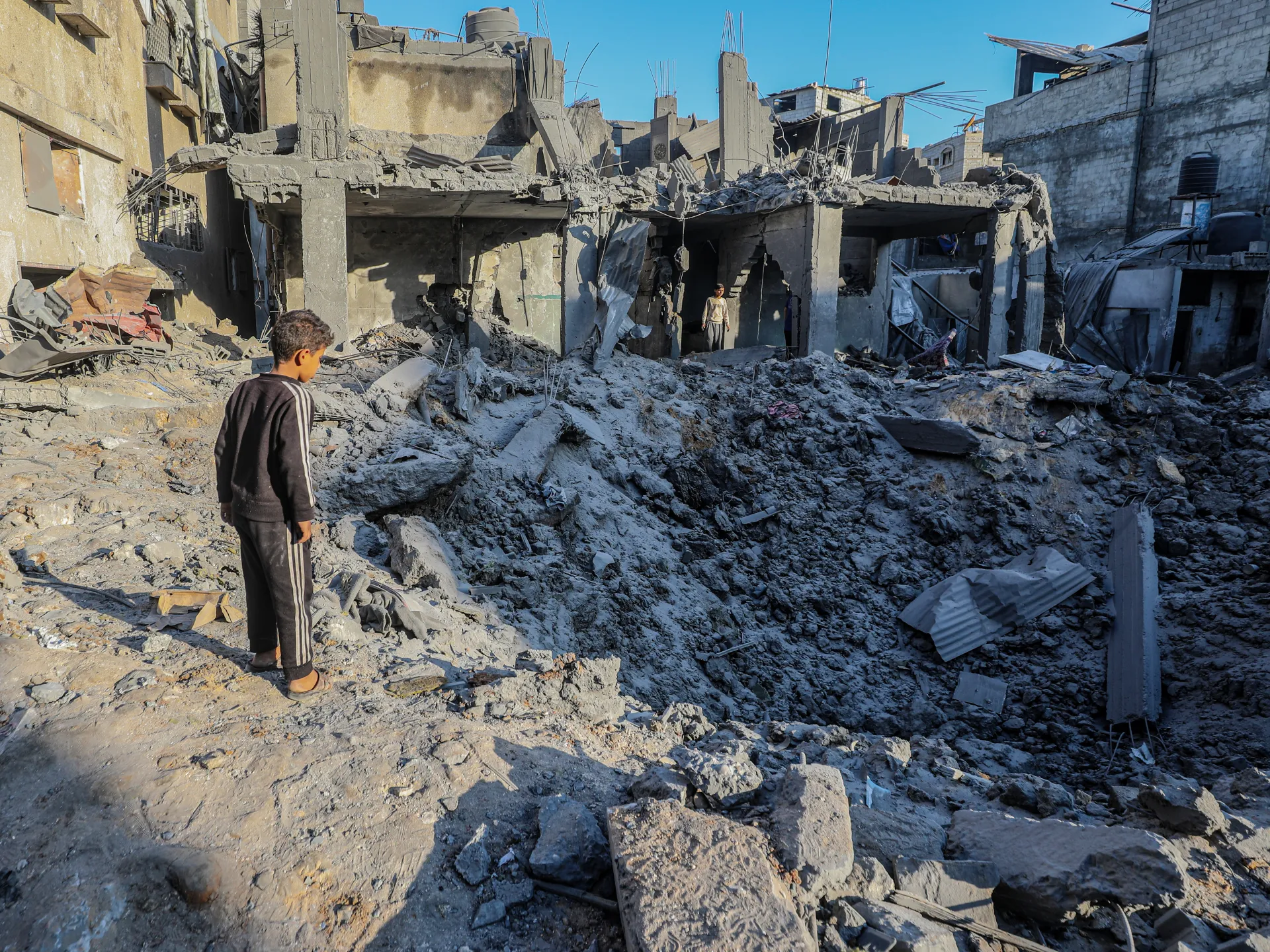
Overnight Israeli strikes devastated the Nuseirat and Bureij refugee camps in central Gaza despite an ongoing ceasefire, injuring dozens. The strikes targeted residential areas, leaving behind piles of rubble. Israel has now destroyed or damaged around 90% of Gaza’s civilian infrastructure.

Source link

US deepens European uncertainty with deployment of 5,000 troops to Poland | NATO News

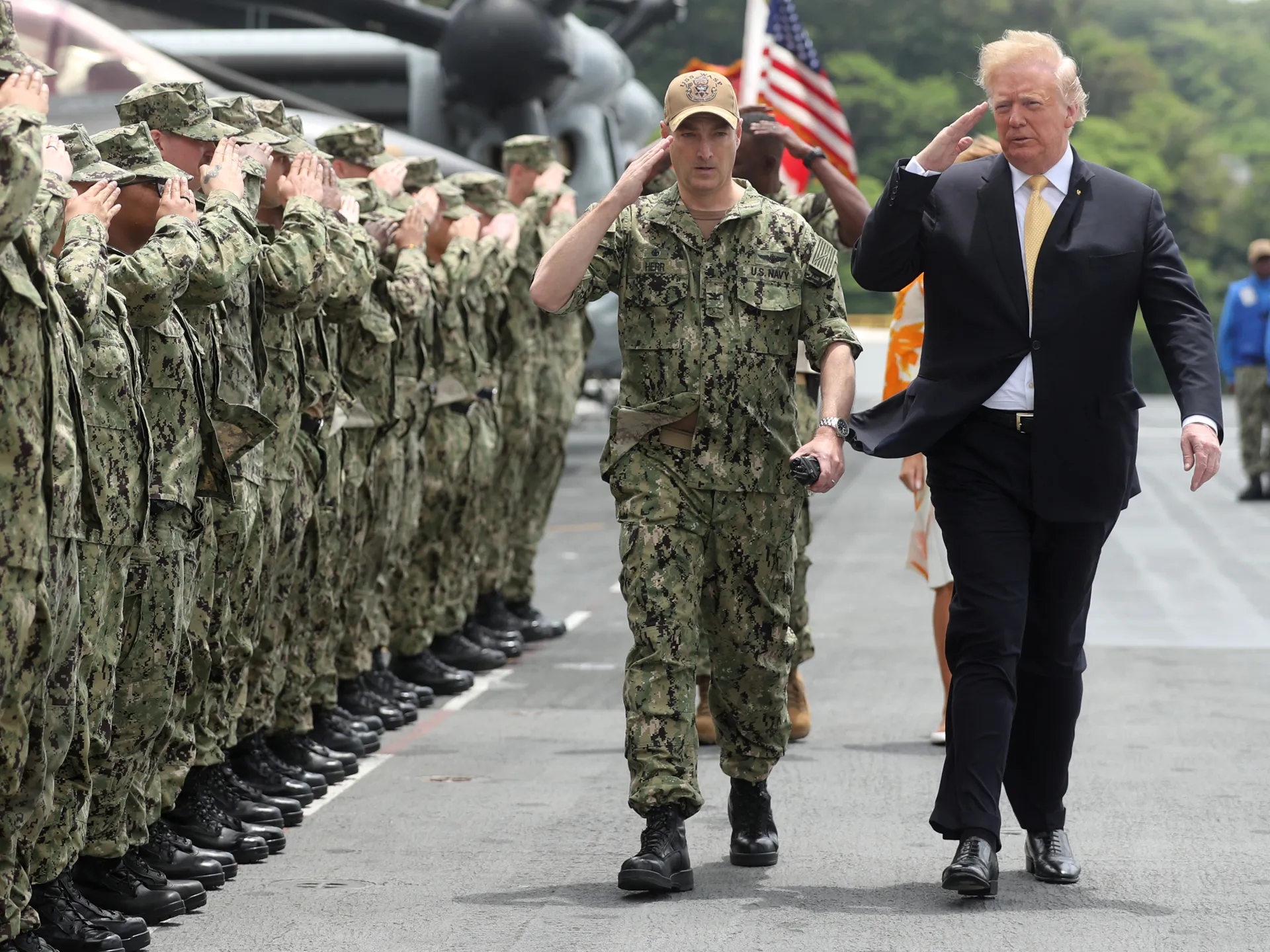
United States President Donald Trump has announced plans to deploy an additional 5,000 troops to Poland.

Trump announced the surprise deployment on social media late on Thursday, citing his friendship with right-wing Polish President Karol Nawrocki.

Recommended Stories

list of 3 itemsend of list

The move came days after a planned deployment to Poland was apparently scrapped and will deepen uncertainty surrounding the Trump administration’s approach to NATO allies and its long-term commitment to maintaining a military presence in Europe. It leaves European partners increasingly unclear about which areas they should prioritise as they formulate defence strategies.

“Based on the successful Election of the now President ⁠of Poland, Karol Nawrocki, who I was proud to Endorse, and our relationship with him, I am pleased to announce that the United States will be sending an additional 5,000 Troops to Poland,” Trump wrote.

Nawrocki welcomed the announcement on social media.

“Good alliances are those based on cooperation, mutual respect, and a commitment to our shared ‌security,” he wrote on Thursday evening.

Polish Foreign Minister Radek Sikorski also welcomed the news on Friday, saying it ensures that “the presence of American troops in Poland will be maintained more or less at previous levels”.

About-face

The announced deployment is a sudden about-face from US declarations of plans to reduce military support to Europe under Trump’s “America First” doctrine.

The US president has for years been lambasting European NATO partners for failing to spend enough on defence. His opprobrium has risen in recent weeks as European states have criticised the US-Israeli war on Iran and refused to join the conflict.

The Pentagon abruptly announced a week ago that it was scrapping the planned deployment of 4,000 troops to Poland.

Earlier this month, Trump announced he was withdrawing 5,000 troops from Germany following a spat with Chancellor Friedrich Merz, who said Washington had been “humiliated” by Iranian negotiators.

The US president later said that he would be “cutting a lot further than 5,000”.

Polish officials have noted that Warsaw pays significant sums towards the cost of US troop deployments. The suggestion of a pullback has caused concern over security in Poland and elsewhere in Europe, as Russia’s war on neighbouring Ukraine continues, with the Trump administration largely ceasing efforts to mediate a ceasefire.

European states report that they are getting to grips with the need to replace US defence capabilities, albeit slowly. However, sources suggest that the erratic policies emerging from the White House are creating confusion over which elements should be prioritised.

“It is confusing indeed, and not always easy to navigate,” Swedish Foreign Minister Maria Malmer Stenergard told reporters ahead of hosting a meeting of NATO foreign ministers on Friday, which will be attended by US Secretary of State Marco Rubio.

US defence officials are also confused, according to the AP news agency.

“We just spent the better part of two weeks reacting to the first announcement. We don’t know what this means either,” said one official.


‘America First’

The US president has lashed out at fellow NATO members in recent months for failing to support the US-Israeli war on Iran, suggesting Washington could withdraw from the military alliance as a result.

State Department spokesperson Tommy Pigott said Rubio would discuss the need for NATO allies to increase defence spending and shoulder greater responsibility at Friday’s meeting of NATO foreign ministers.

NATO Secretary-General Mark Rutte, who has worked hard in recent months to attempt to soothe the US president’s displeasure with his alliance peers, welcomed Trump’s deployment to Poland and cautioned that Europe must become less reliant on the US.

Rubio said before meeting his NATO counterparts in Sweden: “Like any alliance, it ⁠has to be good ⁠for everyone who’s involved. There has to be a clear ⁠understanding of what the expectations are.” ⁠

He also suggested, however, that the meeting is likely to prove less than comfortable.

“The president’s views, frankly disappointment, at some of our NATO allies and their response to our operations in the Middle East – they’re well documented – that will have to be addressed,” he insisted, before adding “that won’t be solved or addressed today”.

While Rubio meets with NATO counterparts, senior Pentagon officials will brief partners at the alliance’s headquarters in Brussels about Washington’s commitment to European defence.

On Tuesday, the Pentagon announced it plans to reduce the number of combat brigades based in Europe from four to three.

Many of Washington’s allies in Europe remain frustrated with Trump’s handling of the war with Iran, which has damaged their economies and prompted some European leaders to question the reliability of the US.

European NATO countries also remain concerned about Trump’s threats to annex Greenland, which is an autonomous territory of the Kingdom of Denmark, a NATO ally.

It remains unclear whether the deployment to Poland announced on Thursday includes the same soldiers as those the Pentagon said would no longer be deployed to the Central European country, or if they will include redeployments from Germany.

Source link

US raises threat of military action against Cuba | Conflict News

Secretary of State Marco Rubio says Cuba poses a national security threat to the US.

United States President Donald Trump and Secretary of State Marco Rubio have issued new threats of military action against Cuba.

Rubio told reporters late on Thursday that Cuba has been a national security threat for years because of its ties to US adversaries Russia and China, while Trump said he is likely to be the president to finally take action.

Recommended Stories

list of 4 itemsend of list

The Trump administration, with Cuban-American Rubio at the forefront, has been raising the pressure on the communist-led island in an apparent bid to institute “regime change,” including a fuel blockade that has put the Cuban economy on the edge of collapse.

The push has accelerated in recent days, with the US indicting Cuba’s former President Raul Castro and gathering military forces in the Caribbean.

Rejecting suggestions of “nation building,” Rubio told reporters the issue is one of “national security”. He added that while a negotiated agreement is the US “preference”, the path of diplomacy with Cuba is “not high”.

“Their economic system doesn’t work. It’s broken, and you can’t fix it with the current political system that’s in place,” Rubio said.

Over the years, Cuba has gotten used to “buying time and waiting us out,” Rubio said. “They’re not going to be able to wait us out or buy time. We’re very serious, we’re very focused.”

Separately, President Donald Trump told reporters that US presidents have considered intervening in Cuba for decades, but that it looks like he will be “the one that does it”, adding that he would be “happy” to do so.

In response, Cuban Foreign Minister Bruno Rodriguez lambasted Rubio for falsely labelling Cuba a threat.

“The US secretary of state lies once again to instigate a military aggression that would provoke the shedding of Cuban and American blood,” Rodriguez said.

Raised tension

Since returning to office, Trump has slapped Cuba with numerous sanctions, implemented a fuel blockade and overseen a military build-up in the region.

The renewed threats on Thursday came amid rising tensions between the countries.

The US indicted Cuba’s former President Raul Castro on Wednesday, in connection with the 1996 downing of a plane.

On Thursday, Adys Lastres Morera – sister of a high-ranking executive of the Grupo de Administracion Empresarial SA (GAESA) conglomerate, which is controlled by Cuba’s military and controls large swaths of the economy – was arrested.

More sanctions were imposed on the Cuban government in the past week. The US military announced that several navy ships, including an aircraft carrier, had arrived in the Caribbean on Wednesday to take part in maritime exercises with partners in Latin America.

Rubio has noted that Cuba had earlier tentatively accepted an offer of $100m in aid in return for reforms. But he said it was unclear if the US would accept Cuba’s terms, as Washington insists on circumventing the military-backed conglomerate GAESA.

Analysts caution that Trump and Rubio are eyeing a similar course of action in Cuba to the regime change manufactured in Venezuela. Left-wing President Nicolas Maduro and his wife were kidnapped in a military operation in January. They were taken to the US, where Maduro was charged with “narcoterrorism”.

Rubio insists that Cuba poses a serious national security threat to the US because of its security and intelligence ties with China and Russia.

Both countries have criticised the US pressure on the island.

China said on Friday it “firmly supports” Cuba and urged the US to de-escalate tensions and “stop threatening force”.

Kremlin spokesperson Dmitry Peskov said: “We believe that under no circumstances should such methods – which border on violence – be used against either former or current heads of state.”

Source link

Iran war day 84: US-Iran talks advance amid mediation push | US-Israel war on Iran News

US and Iran continue mediated talks, exchanging draft proposals aimed at reaching a formal agreement.

Iran and the United States are continuing mediated talks aimed at ending the conflict, with Iranian media reporting that both sides are exchanging messages and draft proposals to establish a formal framework for an agreement.

Al Jazeera’s correspondent Almigdad Alruhaid reported from Tehran that Pakistani officials were engaged in “intense mediation activity” between the two countries.

The diplomatic push comes as US Secretary of State Marco Rubio said there were “some good signs” for a possible breakthrough. However, US President Donald Trump also warned Washington could take “very drastic” action if Iran refuses to give up its uranium stockpiles.

Here is what we know:

In Iran

  • ‘War crime’ on medical research centre: Iran has accused the US and Israel of committing a “war crime” by bombing the Pasteur Institute of Iran early in the war, after The Lancet journal warned that the attack severely damaged a key pillar of the country’s public health system.

  • Thousands rescued from rubble: The Iranian Red Crescent said its aid workers rescued more than 7,200 people trapped beneath rubble during US and Israeli attacks, sharing footage of survivors being pulled from destroyed buildings for the first time.

War diplomacy

  • Nuclear ‘red lines’ must shift: Doug Bandow, a senior fellow at the Cato Institute, said the US and Iran will need to move beyond conflicting “red lines” on Tehran’s nuclear programme for negotiations to make progress. Speaking to Al Jazeera, Bandow said both sides must be willing to compromise and continue serious talks if they want to avoid further escalation and move away from war.
  • Rubio sees ‘good signs’ in talks: US Secretary of State Marco Rubio said negotiations with Iran have shown “some progress”, while cautioning that it remains unclear whether a deal can be reached in the coming days. Rubio said President Donald Trump still prefers a diplomatic agreement, but warned Washington has “other options” if talks fail.
  • Pakistani mediation efforts intensify in Tehran: Al Jazeera’s Alruhaid said senior Pakistani officials are engaged in “intense mediation activity” in Tehran as efforts accelerate to prevent further escalation. While one senior Iranian official said negotiators were close to a deal and working on draft texts, another source cautioned it was still too early to say whether a final agreement was within reach.

In the US

  • US forces at ‘peak readiness’:  CENTCOM said the USS Abraham Lincoln strike group remains at “peak readiness” in the Arabian Sea, sharing images of warplanes taking off as Washington maintains pressure on Iran amid ongoing mediation efforts.

  • US reportedly suffers major Reaper drone losses: Iran has destroyed more than two dozen MQ-9 Reaper drones operated by US forces since the conflict began, according to Bloomberg News. The reported losses are estimated at $1bn, nearly 20 percent of the Pentagon’s pre-war inventory.
  • US pauses Taiwan arms sales: Acting Navy Secretary Hung Cao told a Senate hearing that Washington has paused a $14bn arms sale to Taiwan to ensure the US has enough munitions for its military campaign against Iran, a move Republican Senator Mitch McConnell called “distressing”.

In Lebanon and Palestine

  • Israeli strike kills two in southern Lebanon: The Israeli military said it carried out an air raid that killed two people near the Lebanon-Israel border, after detecting what it described as “suspicious movement” in southern Lebanon.
  • US sanctions allies of Hezbollah: The US has imposed sanctions on nine people accused of helping Hezbollah undermine Lebanon’s sovereignty and obstruct efforts to disarm the group, including Lebanese politicians, security officials and Iran’s ambassador-designate to Beirut.
  • Palestinian envoy condemns aid blockade: Palestine’s UN envoy Riyad Mansour said Israel is continuing to collectively punish more than two million Palestinians through its blockade on aid and ongoing attacks, warning the world must not become “accustomed to seeing Palestinians killed”.

  • US urges humane treatment of flotilla detainees: According to Al Jazeera’s Ali Harb, the US State Department said activists detained by Israeli forces after attempting to break the Gaza blockade “must be treated humanely and consistent with international law”, while also reiterating Washington’s opposition to the flotilla movement.

Source link